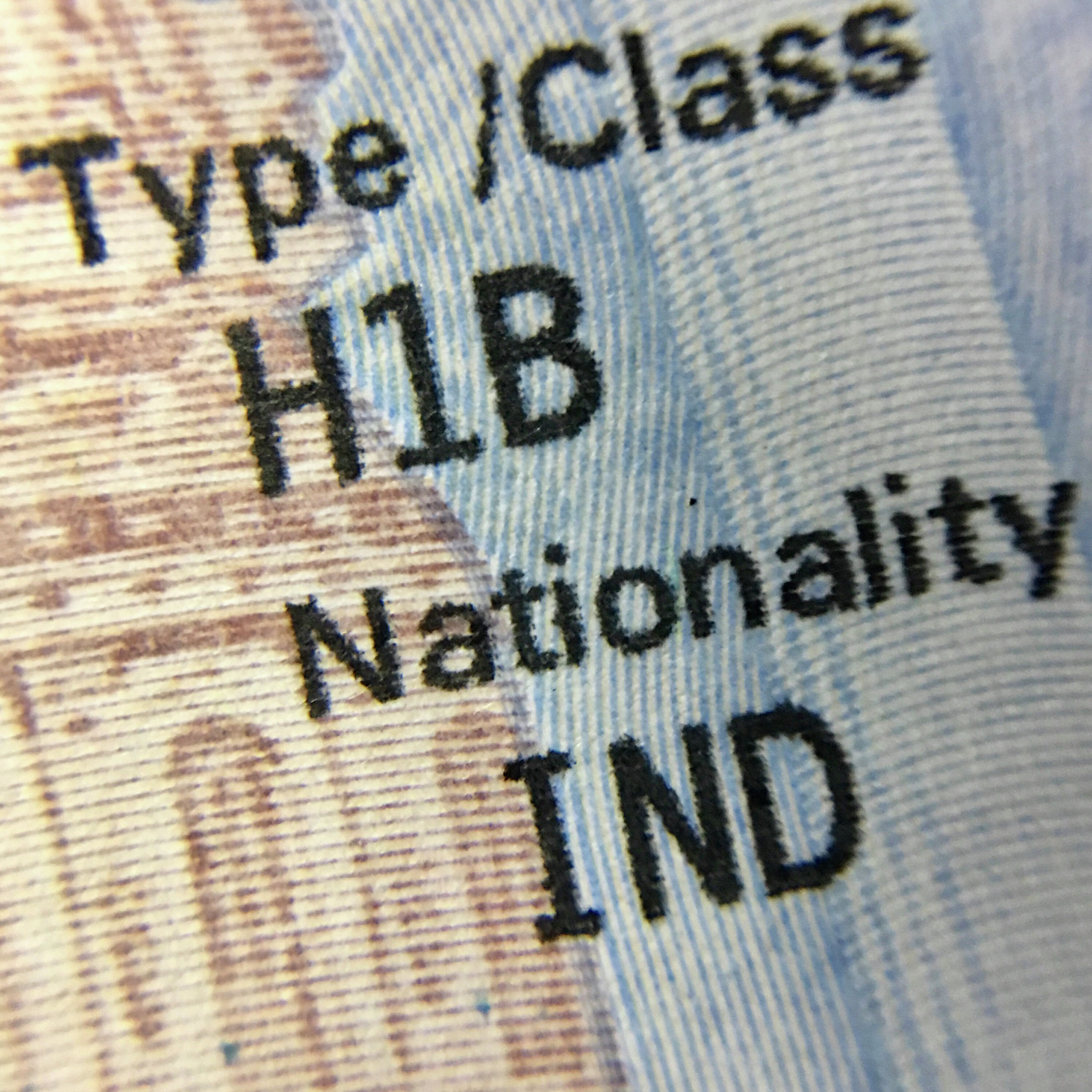
Trump’s H-1B Visa Fee Dashes Indian Workers’ American Dreams
Episode Transcript
Bloomberg Audio Studios, podcasts, radio news.
Speaker 2Ayush is an IT consultant in his early thirties from India.
He lives in the US with his wife, and he told Bloomberg Sun called Fatial that they like it there.
Speaker 3He and his wife have been in the US for very many years.
They work for NIGHTI Company, and they love working for that company.
The environment in that company is great.
Speaker 2Last month, Ayusch was in India visiting family, but the day before he was due to return to the US, he woke up to a bunch of missed calls and frantic text messages from.
Speaker 3Friends, friends saying where are you come back?
Immediately?
Did you see the news?
Speaker 2Ayusch and his wife are recipients of one of the most coveted visas in the world, the H one B that allows highly skilled foreign nationals to live and work in the United States, and on that morning, the news was about a major overhaul of that program.
The President is said to add a new one hundred thousand dollars fee for H ONEB visas in the latest one hundred thousand dollars, more than ten times what the visa had cost in the past.
The news sent hundreds of thousands of H one B visa holders worldwide into a spiral.
It wasn't clear who the new fee applied to or whether the current visa holders like Ayush would be charged upon re entering the US.
Speaker 3If you know anyone who's on it one be in India right now, tell them to border the flat as soon as possible.
Speaker 1I'm so mad and frustrated right now.
If you're currently in US with the H one B visa working as a pointer, do not leave this country.
Speaker 2President Donald Trump's announcement of the new fees was especially unsettling for the Indian community.
That's because Indians make up roughly seventy percent of H one B holders.
Ayush didn't want to speak to us on tape out of fear that it would jeopardize his career, but he's agreed to let Bloomberg sunkap Fartiel tell his story instead.
Speaker 3He told me that he was in the line for immigration just a few minutes before the deadline kicked in on September twenty first.
Thankfully, he is admitted in.
Speaker 2For decades, the H ONEB program was a way to address labor shortages in the US.
The vast majority of H ONEB holders work in the tech sector for the likes of Meta Inphasis and Google's parent company Alphabet.
Speaker 3A lot of very famous people in the US have come to the US, and H one B Zylon Musk being one of them, the current Google CEO, Alphabet CEO Sunda Pichai.
Speaker 2In the past and H one B visa would set companies back several thousand dollars for the application fee and subsequent costs.
But as of September twenty first, any new applications for the work visa will carry a one hundred thousand dollars fee.
Here's US Secretary of Commerce Howard Ludnik.
So the whole.
Speaker 3Idea is no more.
Speaker 2All these big tech companies or other big companies train foreign workers.
Speaker 3They have to pay the government one hundred thousand dollars, then they have to.
Speaker 1Pay the employee.
Speaker 3So it's it's just non economic.
Speaker 2Suncope says.
This was the last straw for our Yush and his family.
He's now decided to leave the US and is looking for jobs in Europe.
Speaker 3US is now not a place they want to be in.
This is not the fear that they want to live with that will be kicked out or we won't be admitted in He says that I'm not really sure.
You know, Trump is unpredictable.
What if he wakes up tomorrow morning with a cup of coffee, changes the rules and says, okay, this rule applies to even existing H onebb's a holders.
I just do not want to live with that stress.
It's okay.
I will earn less money somewhere else, but at least I'll be happy.
Speaker 2This is the Big Take Asia from Bloomberg News.
I'm wanha.
Every week we take you inside some of the world's biggest and most powerful economies and the markets, tycoons, and businesses that drive this ever shifting region.
Today, on the show the one hundred thousand dollars Visa, what Trump's new visa fee means for Indian talent and could the US's loss be India's game.
The H one B visa program was introduced in nineteen ninety to address specific labor shortages.
It allows companies in the US to hire college educated foreign workers for specialized jobs for up to six years.
Since H one B is a dual intent visa, an employer can sponsor the same worker for a green card, which grants them permanent residency even while the worker is still on the H one B Bloomberg sankalp Fartial says today more than sixty percent of H one B visas are used by the tech industry.
Speaker 3The US companies like Google and Microsoft and Amazon are among the biggest users of H oneb's, but also Indian outsourcers or IT services companies like Tata Consultancy Services or Emphasis are big users.
The way it works is that companies see a requirement for specialized let's say, in this case, engineering talent, and they don't seem to find them in the US, so employers make the applications.
There's a lottery system every year, and once the lottery is taken out, whoever gets their name in gets to go to the US.
Speaker 2About eighty five thousand new HEV visas are issued every year.
Sixty five thousand of them bring in general talent from abroad.
The remaining twenty thousand are reserved for non US citizens who received advanced degrees from American universities.
Since twenty eleven, roughly seventy percent of the visas approved each year have gone to Indian born citizens.
Sankop says, for a lot of educated middle class Indians going to the US has been the ultimate dream, the American dream.
Speaker 3You know, like everybody else from my generation.
I sat for an engineering exam.
Thankfully I did not get thro.
I would have made a terrible engineer.
But common saying in India that if you throw a rock up in the air, it'd probably hit an engineer.
We have so many engineers and engining colleges here, and engineering was and continues to be seen as a pathway to a better life, as a pathway to go to the US, as a means to get a green card or maybe settle in the US, essentially a better lifestyle and a good career.
Speaker 2It also meant they learned far more than they would staying in India.
Speaker 3If you look at the conversion rate of dollar to the rupee, Indians would send money home and they would make their savings and rupees, so effectively they're paid much more.
Someone with a master's degree and who's been in the US on an H one B for about four years could make anywhere between one hundred and fifty thousand dollars to two hundred thousand dollars a year.
The kind of money that someone with that experience and the would make would be in millions of rupees, but not as much as somebody like that would make in the US.
Speaker 2But the program has come under criticism in recent years.
Speaker 3Conservatives have criticized this program for taking away US jobs for cheap labor, including from India, undercutting US jobs.
Speaker 2In its statement announcing changes to the H one B visa program, the White House said American workers were being replaced with lower paid foreign labor and called it a national security threat.
The Trump administration also claimed some entry LEVELHEB visa holders make about a third less than full time traditional workers.
That wasn't verified by Bloomberg, but a Bloomberg investigation published earlier this year did find that US banks and telecom companies used the visa program to hire lower paid workers.
They were able to do this indirectly through staffing and outsourcing companies that have previously been able to capture about half of the new visas allocated each year.
By introducing a high barrier to hiring foreign workers, the hope is that companies would train and hire Americans instead, but Sandhope says it's not year whether that will happen.
Speaker 3Not everybody is undercutting jobs.
There may be few who are undercutting American skilled workers, but the whole idea revolves around the fact that America has a dearth of STEM talent science, tech, engineering, and math, and Indians or Chinese seem to be more skilled on those aspects.
This is a very conservative approach to say that these people are taking away American jobs, because when these people go to American companies, they're also creating more jobs.
They're paying Social Security, they're paying taxes, so that's fueling the economy as well.
The way to look at this is that this is essentially putting breaks on a moving car that was doing well for the US.
And if you don't bring H one B workers to the US to work for companies, that means you're essentially raising the costs for American corporations as well, because these people go there specifically to work on the demand of American corporations.
For Indian outsources, they send these people to client sites.
They're important and maintaining client relationships, work for clients and sensitive projects.
Speaker 2What potentially could be the ripple effects for Indian IT firms like Infosys and tatas some of the biggest who do use H one bs and as well as the next tier of companies right the software services firms.
Speaker 3Software services companies in India are already struggling with muted growth.
They also have a new challenge, journey AI.
So this is another kick on the backside, if I can call it that, in terms of how they will whether the storm.
They are considering sending fewer people.
At the same time, employers could be willing to pay that one hundred thousand dollar fee.
They really want skilled talent from India to go to the US.
But those are the ones that are really, really smart, and those are the ones that employers are willing to pay for.
So there'll be a certain reduction in the number of people that go to the US.
Will h one be alone uppend the entire Indian IT industry, No, I don't believe it will.
Speaker 2As the US raises barriers for foreign workers.
Is the American dream out of reach for Indians?
And can India or other countries capitalize on this opportunity to lure talent for tens of thousands of Indian workers.
The dream of building a career in the United States may be slipping away, but sanjap Partial says new opportunities are opening up elsewhere.
Could the policy also unintentionally in some ways benefit India by retaining more skilled workers here domestically instead of them going overseas.
Speaker 3It's a theory, It's a good theory, but not likely.
It all depends on whether India seizes the moment to bring out policies that could help retain talent, because one of the biggest reasons Indian talent went outside was more money.
But all so stable policy, good working environment, the chance to work in a global company.
If India is able to give its talent good product and services jobs, create a global work environment, maintain that healthy work life balance.
Yes, we could retain some talent, but one could argue that good talent will always find its way to find the best job.
Speaker 2I want to talk a little bit about the on the ground effect, you know, impact as well.
I mean, the H one B program has been a part of this market success for a lot of Indians being able to work in the US.
What does this mean for you know, those people and their kind of hopes and dreams.
Speaker 3I've been speaking to some of the people who've gone to the US on each one BS, even some students.
There is a sense of extreme nervousness.
I think the constant flip flop on policy, which wasn't the case in the US earlier, is something that terrifies people and makes them extremely nervous.
And so I think the whole idea that US is a stable place to work for foreigners or immigrants, that ideas just shattered.
Speaker 2Some countries are already moving to capitalize on the chaos.
After Trump announced the changes to the H and B program, the UK said Britain will make it easier for companies to bring in top talent.
Speaker 3Canada, UK, Australia and Eastern Europe are emerging as new tech and outsourcing hubs, and even though salaries there could be lower than in the Silicon Valley or the US in general, these new hubs will be able to draw Indian talent because of good working conditions and competitive pay packages.
Speaker 2Meanwhile, Germany's ambassador to India released a video message encouraging skilled Indian professionals to consider Germany as their next destination.
Speaker 1Highly skilled Indians are welcoming Germany.
Our migration policy works a bit like a German car.
It's reliable, it is modern, it is predictable, it will go in a straight line.
Speaker 2And while this may look like a golden opportunity to attract foreign talent, Sankop says one country could end up missing out India itself.
The country is grappling with rising use unemployment and an underemployment crisis.
Speaker 3We have reported instance of college workers sitting on the bench.
They've been hired by companies, but they're not actively involved in projects or day to day work even though they are hired on paper.
Speaker 2And why is that.
Speaker 3If I talk specifically about IT companies, the business of IT companies depends on work given by clients.
So if because the war in Europe, or because of the war in the Middle East or sanctions on Russia, if companies are pausing spence, then that directly translates to lesser work for Indian outsources, which means that the people they've hired from colleges have to sit back till the time they're called for work by the Indian companies.
You could call it disguised unemployment.
They're hired on pay, but they're not getting any salaries or they're not getting any work as yet.
And also AI is a disruptor.
AI will disrupt more and more work, which means that all of the college graduates in engineering may not immediately get jobs.
Speaker 2Another factor that could discourage skilled Indian professionals from staying in India the work culture.
Speaker 3Our majority of businesses in India are family run.
These are not professionally run businesses, which essentially boils down to a very toxic workplace situation or a non professional setup.
And you don't have the semblance of a work life balance.
So the idea of working in a global cooperation comes with its compensation benefits as well as good work life balance, a global culture, and I think that's what's lacking in Indian companies.
Speaker 2Still, Sandcops says the ripple effects of H and B visa changes might help India retain some of its talent, at least for now.
India has the third largest startup ecosys in the world, trailing only the US and China.
Speaker 3If American companies continue to push hard on these global capability centers, you could make the case that a lot of Indian talent would otherwise go to the US on H one bes could end up working in India with American corporations in their innovation in their R and D centers.
Right now, everything is pretty volatile.
The situation is still emerging, but in the long run, I think things should settle and it shouldn't be that bad.
Speaker 2There have been a series of blows to India from US policy.
First there were moves to restrict student visas.
Then India got hit with fifty percent tariffs, which is among the highest of countries, and now of course h one B's.
For many years, India was seen as a partner for the US in Asia.
Do Indians now feel like the relationship is taking this dramatic downward.
Speaker 3Term, Yes, of course.
I mean it's quite visible to Indians that America, which had seen India as a friend over the decades, the sort of camaraderie that existed between President Trump and Prime Minister Modi is definitely fading because we've seen these punitive measures in India.
And when I talk to sources in the tech industry, when I talk to political people, there's always a sense that the US has not been kind to India and has been extremely harsh and has not valued the strategic relationship that it wanted, that the two countries wanted.
I think the government certainly is recalibrating its US policy, but Indians in general continue to see US as a destination.
Indian skill talent continues to view US companies as a destination for their careers.
So to the general public, US and its leure is still there.
Speaker 2Could this turn into a moment for India, for India to rise, to really find a way to change its culture to make it more appealing for the most educated, the most talented to stay here in India and not go overseas for opportunity.
Speaker 3I would certainly hope so, But I could have said that at any point in the last twenty years.
It really depends on whether India's able to create the kind of global environment that it's skilled professionals need, Whether India is able to create that kind of physical as well as digital infrastructure that global professionals need.
Whether India is able to give global companies the ease of doing business that they find in China or in Vietnam.
It really depends on how the government wants to seize this opportunity.
Can we do better and turn India into a global workplace bigger than it already is, Yes we can.
Is there room for improvement, yes, But you know, all of the world's biggest corporations are already here, and I think we are very much near to grabbing this moment and making it ours.
Speaker 2This is The Big Take Asia from Bloomberg News.
I'm wanha.
To get more from The Big Take and unlimited access to all of Bloomberg dot Com, subscribe today at Bloomberg dot com slash podcast Offer.
If you liked the episode, make sure to subscribe and review The Big Take Asia wherever you listen to podcasts.
It really helps people find the show.
Thanks for listening, See you next time.