The Case of the Missing…Me?!
Episode Transcript
Announcer: This is a Getty podcast.
HostHost: Need something locked up?
Well today’s guest can help play a key role—because she’s literally a key!
Welcome to If Objects Could Talk, a podcast where art and artifacts get to leave the museum vault and tell their side of the story.
Thanks for joining us as we bring objects into the light!
Have you ever gotten locked out of your house or been late to an event because your parents just could not find their keys?
Or maybe you’ve tried to keep your diary private...only to walk in on one of your siblings trying to pick the lock?
If you’ve ever used a lock and key, you’ve relied on the same tools people have used for millennia!
Even today, in a world that is increasingly digital, we often still use small, metal keys to keep our most valuable possessions safe.
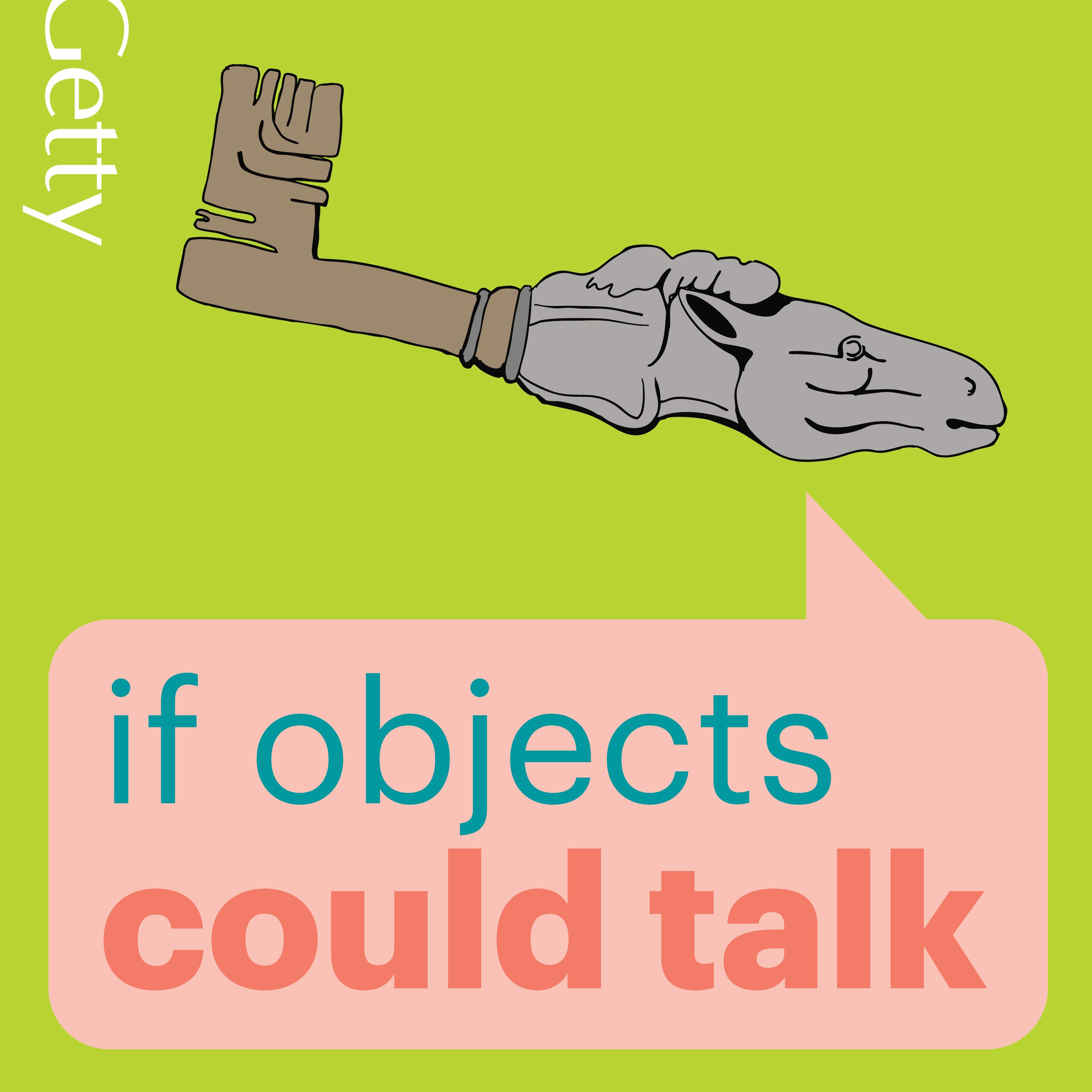
Today’s guest is an elegant Roman key with a handle shaped like a horse’s head.
And she knows the key to any good story is a little bit of mystery!
Horsehead KeyHorsehead Key: Time has a way of swallowing up objects.
Broken, lost, melted down.
Not all of us survive our pasts...
It was a dark and stormy day about one thousand, eight hundred years ago when I was made and then nearly lost to history.
But before you can understand my tale, you must first know the facts of the case.
Fact oneFact one: Fact one: I’m a key.
I’m about
Horsehead KeyHorsehead Key: the length of a toothbrush, with an iron shaft and a handle made of bronze.
The first thing you’ll notice is my face.
It’s on my handle and it's shaped like a horse’s head.
My mane is swept back as if I were charging forward into battle and my ears are pinned to the side of my head, which says “back off!” or “watch out!” in horse-body-language.
I was made by a smith using the lost wax casting method.
That femme fatale Bastet told me she's already been interrogated and spilled the beans about lost wax casting, so I won’t linger over the details.
But my bronze horse-headed handle is only half of me.
There’s also my key, which was forged from iron.
Can you find a key right now?
It could be a house key or a car key, doesn’t matter.
Got one?
I knew you had it in you, kid.
Alright.
Now run one of your fingers on the edge of the key.
Does it feel like your finger is running up and down little mountains and valleys?
That part of the key, the part where some edges stick out and some edges cut in, is called the “bit.” My bit has eight slots; It almost looks like a piece of abstract art.
Now, if you’ve got the chance, try something for me.
Try putting that key of yours into the wrong lock.
Huh.
Yup.
May not even fit.
Or maybe it just barely fits, but you can’t turn it.
Inside that lock, there are flat parts called levers and wards.
A key’s bit is made to fit inside of a lock, where those mountains can push the levers while the valleys avoid the wards.
Get the right bit into the right fit?
The levers will lift, which will turn the bolt in the lock, opening it.
And jiminy cricket.
You’re home free!
Keys can do all kinds of things.
Keep people out.
Keep belongings secure.
Used to be, if you wanted something like that done, you’d have to hire some muscle to protect your pieces.
But locks changed all that.
Now you didn’t need a person to protect your fine jewels, your secret stashes of gold, or those cool, little, fruit shaped erasers you don’t want your baby sister to swallow.
You just needed a lock, box, and key.
My type of lock, the lever lock, was invented in the Near East about four thousand years ago.
The Romans took that technology and made more complex versions.
And they didn’t just make keys that were useful.
They made keys that were beautiful.
The Romans liked to decorate their keys and they especially liked to decorate with animals.
Lions, panthers, bears, and of course, horses, were frequently featured.
Some keys were even decorated with pets.
One of my good friends at the Getty is a key with a dog-shaped handle.
He’s a very good boy with fuzzy hair engraved into his metal form, looking up into the eyes of his owner.
Cute, huh?
Gives you a lot to think about.
What kind of animal would you use to decorate your key?
A dangerous one?
A friendly one?
Maybe even an imaginary one?
And what would that choice say about you?
Give it some thought and get back to me.
Like I said, there are a lot of animals to choose from.
But the horse—there’s something about a horse that captures the human imagination like no other.
From Paleolithic cave paintings in France to terracotta figures in China, humans love making art of horses.
Why?
Just think about how important horses would be in a world without cars or other modern transportation.
Horses made managing livestock easier.
They meant it was possible to carry heavier loads across longer distances.
And they were indispensable in battle.
In the Greco-Roman world, chariot racing was a popular sport, where drivers would steer racing horses as they pulled carts around a grand arena.
It became a signal of special events.
Horses, in turn, became symbols of celebration, wealth, and power.
And where there’s power, there’s someone desperate to seize it.
Which brings us to our case.
It was a dark and stormy day.
So stormy, in fact, that Abieta and her little brother Septimius could not go outside to play.
They were the children of a blacksmith, and grew up living and playing in a smithy.
See, in Roman times, workshops were sometimes separate buildings, but they could also be connected to the home.
Abieta and Septimius’ father had gone for the one with the shorter commute.
Maybe he was regretting that as the children ran through his workshop on this rainy day.
Trying to keep the kids in line, their father showed them the project he’d been working on: a key and lock box for a wealthy patron.
You guessed itYou guessed it: that was me.
Abieta marveled at my ingenuity of the bit on the key and the wards on the lock.
Septimius just liked my horse-head.
When the wealthy patron arrived, their father rushed off to give a warm welcome, with Abieta on his heels, curious about the patron who had requested the horse-headed handle.
The wealthy patron was a horse breeder.
He wanted a way to lock up the important papers that detailed purchases and sales.
But he also wanted to show off his line of work at the same time.
He looked shrewdly around the workshop as he came in, inspecting the different projects workers were pounding and hammering away at.
But when Abieta’s father went to show him the lock box and key, I was gone!
That’s right...this was the case of the missing me!
Abieta saw the panic in her father’s eyes and thought fast.
She explained to the wealthy patron that there was no use at all in having a lock box if the lock could simply be picked!
Now the patron had a chance to see for himself how secure the lock was.
He could use any of the tools in the workshop to try and pick the lock.
And when he gave up, they would show him the key that could unlock the box!
Abieta’s father looked relieved at her ingenuity, but there was still one problem—they didn’t have a clue where I was.
Or at least...her father didn’t have a clue.
Abieta had the making of a great gumshoe.
She’d seen Septimius’ wandering eye and knew that boy could make trouble out of nothing.
She had to find him, so that she could find me.
She lined up the facts.
First, Septimius would want to be hidden, so that he could play with his stolen toy.
Second, it was nearly lunchtime, and he’d likely be hungry.
And third, her little brother had no fear of rain or mud.
The kitchen garden!
That was where he would be.
Located right outside the kitchen, many Roman homes had a private garden filled with herbs and edible plants that were perfect for snacking.
Doesn’t take a detective to understand why it’s sometimes called the “herb garden.” Abieta rushed out into the rain.
And there we were, frolicking through the basil, thyme, and costmary.
I mean, I was kidnapped and held against my will, drenched in the cold and bitter rain.
But Septimius, well, Septimius was frolicking.
Abieta snatched me from her brother and raced back to the workshop.
And not a moment too soon.
The wealthy patron had tired of the lock picking game and was satisfied with the security of the box.
He was relieved and impressed when Abieta revealed my majestic equine form to him.
And then she slid me into the lock.
Bingo!
We were back in business.
Abieta’s father made the sale and Septimius was put in time-out for his crimes.
So here’s one last fact you need to know about keys: we only work when you can find us.
HostHost: I hope you enjoyed learning about horses and keys.
Now, this is usually where I’d tell you who’ll be in the studio next week—but this was the last episode of our first season!
If you enjoyed the series, share it with your friends and leave us a comment or review on your favorite podcast app!
If you have questions or ideas for future episodes, write to us or send us a voice memo at podteam at getty dot edu.
To see photographs of the horse key and learn more about this episode and all our episodes, visit our website at Getty dot edu slash podcasts This episode was written by Claire Hupy and produced by Zoe Goldman.
Katie Jostock voiced the horse.
Theme music, mixing, and sound design by Alexandra Kalinowski.
Christopher Sprinkle is executive producer.
Special thanks to curators Ken Lapatin, Judith Barr, and Hana Sugioka.
Catch you next time!