A Teen’s Detention Diary and the Man Who Helped Share It With the World
Episode Transcript
Dear let you know USA listener.
Speaker 2Before we start, you should know that if you want to listen to this episode ad free, just join Plus and you can join for as little as seven dollars a month.
Joining also gets you behind the scenes access and yes, some cheese may so click the link in the episode description and after you do that, then click play.
Speaker 1Let's go to the show.
Speaker 2Seven years ago, Di Esperanza was a fourteen year old boy from Honduras.
He was being held at the Tornillo Facility in Texas, which was one of the immigrant detention camps where the first Trump administration began to hold children and teens.
Speaker 3There's the Principio Tousferente.
Speaker 2D believed that when he entered the United States, making the trip up from Honduras, that everything in this country would be different.
Speaker 1But it wasn't so.
Speaker 2While this little boy was detained at Tornillo, writing helped him make sense of all of these fears, and it helped him to hold on to hope.
He filled the pages of a black and white composition notebook with poems, drawings, and diary entries.
One of those entries starts with still in la Perrera, Still in the dog cage.
Speaker 1He continues with.
Speaker 2This angry man yelling questions that I don't even understand.
It felt like I was in a dream or in a nightmare.
After five long months in detention, Dee was released, but he left his notebook behind as a kind of gift of hope for the other boys that he was detained with, friends who had become a kind of family for him.
At that very same time he out of the ivan.
Morales had a job as a direct care worker at Tornillo.
Speaker 4When I found out that the kids were in cages in the summer of twenty eighteen, that was my call to action.
I knew it in my heart.
I needed to find a way to get involved.
Speaker 2Months later, the camp was shut down.
The workers were told to throw everything inside of that camp away.
There were letters, drawings, children's dreams on paper, but all of it was now trash.
Still head out of the ivan felt like he couldn't do that, so he found de Esperanza's notebook and decided to save it.
Speaker 4It starts off with reading his poem solmost Migrant This hearing his story, hearing his journey, and then seeing it come to life in this composition notebook.
Speaker 5I was in tears years.
Speaker 2Later, the two were connected, the little boy held in the cage and the man who was working there and then head out of the I.
Ivan decided to do something pretty extraordinary.
He decided to help d bring this journal to the world from Fudro Media.
It's Latino USA.
I'm Maria Josa.
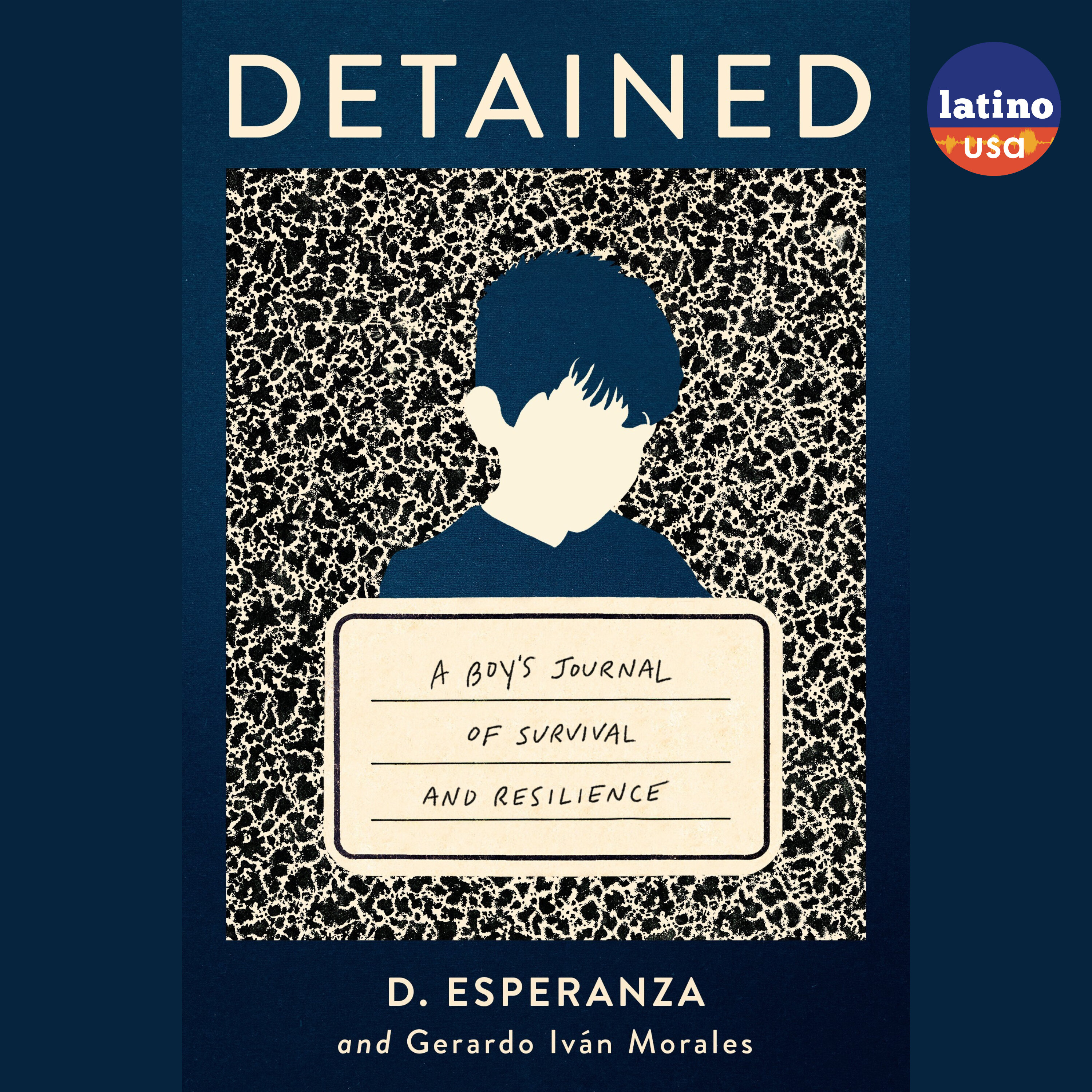
Today I sit down to have a conversation with d Esperanza and hed Ivan Morales, co authors of a new book called Detained.
It's about the resilience of a boy from Honduras that ended up in a detention camp for children in the United States.
There was something unusual about this interview.
We connected on a video call, but Di Esperanza's camera was off, so I actually don't know what he looks like.
I don't know where he lives, and he asked us for this protection, which is also why we're not using.
Speaker 1His real name, No stro culto.
Speaker 2He tells me that he doesn't like hiding his identity, and then Ivan explains it wasn't an easy decision for them.
Speaker 4I am an immigrant from Mexico and I am very passionate about advocating for human rights and fighting against injustices.
Speaker 2You had to make the decision to keep the anonymous and you too are at risk because you're a DOCA recipient, and yet you have a book published through Simon and Schuster.
Speaker 1It feels completely dystopian.
How are you understanding this.
Speaker 4It's been seven years since I had the honor of meeting d Esperanza.
Speaker 5It's been a journey to get this story published.
Speaker 4And originally the cover of the book was going to have d Esperanza's picture of when he was younger.
Speaker 5His name was going to be on the cover.
Speaker 4This is his story, and my mission was, how do we get this story in the largest possible platform so that more people can uncover the truth.
And so for us to hear the first account from a child, that is important because we have thousands and thousands of unaccompanied miners that come to the United States every single year and no one knows their story.
And then, of course things happened in November and we had a meeting with our agent and there was discussion of changing us to pseudonyms for protection.
But I am hopeful that this isn't going to be the case forever.
So we do want to one day have the ability to have the opportunity in a safe place to share his identity, and with the way the world works, we have to come together and work towards a better future.
And I think in that future the world will know who ds Bdansa is by his full name, and we'll see him.
Speaker 2To this little boy.
D Living Honduras was a way to escape fear.
Speaker 3Salidai oh ke de las persona can whenas Benzamento.
Speaker 2Staying, he tells me, would have left him and his cousin in the hands of the wrong people.
Speaker 3Asumio ket solo.
Speaker 2It's a fear, he says, that makes you feel alone.
Speaker 3King correer e pres guardarte ia quin.
Speaker 1You have no one to run to to protect you.
Speaker 3Asumi contio or conkind.
Speaker 1It's a fear that never goes away.
You wake up with it.
You got to sleep with it.
Speaker 3Clerro Amiira Umilo constante.
Speaker 1It was a constant fear.
Speaker 3They cave up Asaroi, they gave up as.
Speaker 2He gon Que, and so every night Dee would wonder what was going to happen, and the next day what would he end up having to deal with.
In May of twenty eighteen, five months of traveling, you make it across the border, you make it through the base Dah the beast.
You are put into detention alone without your cousins.
You had this fear in Honduras, now you're in detention in the United States.
What was the difference in that kind of fear?
Speaker 3When to start at Tenido no Savia Airport, Que no Saria quanto tempet Ray.
Speaker 2In the detention camp for children.
He didn't know why or for how long he would be held there.
Speaker 3Sprimos estamano or staying or as D.
Speaker 2Didn't know whether his cousins were there too, or if they had already been.
Speaker 1Deported mates masterman.
Speaker 2He says it was one of the hardest and most traumatic blows of his life.
So Evan, unlike d D, is actually forced to be in this place now closed, and you, as an immigrant from Mexico, you decide, you know what, I think, I'm going to go work at Tornillo.
I think I'm going to go work at the detention camp for children.
Why did you make that decision?
Speaker 4I was living in San Antonio, and I honestly think that it was God who really put it in my heart because the way that everything worked out was the agency that was in charge with a contract with the government was from San Antonio and so I did research and I was like, how do I get involved?
And I became a direct care worker and I was there deployed to El Paso to work twelve hours a day, seven days a week, with no days off until after twenty one days.
The way that the structure would be is they'd have three adults taking care of twenty children in a tent.
All three of us spoke Spanish, so that was the key to connect with the children.
And so for me, we had an opportunity to create an environment so that the children could be just children.
They could just have fun, play games, and just really show them that we were there for them, to listen to them, to advocate for them.
And it was just giving them more information about the process of seeking asylum, about how long they were going to be detained, about how the whole world was looking in and supporting them.
Speaker 2But despite these efforts from a few case workers, the situation, he said, was terrible.
Speaker 1D I, I just want to quote from your book.
Speaker 2Still in la perira, which means still in the dog cage.
There's another word, right, and it's called la jelera.
You thought that you were just freezing because the guards didn't realize how cold it was, and so you you try to tell the guards, You're like, hey, knocking on the door, Hey, it's they don't pay attention to you.
And and it seems at that point that you realize that it really is on.
Speaker 1Purposementor perquet.
Speaker 2Tender Samento D says he didn't understand then and he still doesn't understand today why the detention camp officials put them through all of that suffering.
Speaker 3Or kainos pecano a bebes D.
Speaker 2Was fourteen, but there were younger children freezing in those selves.
There were babies, he says, I saw the malice behind.
Speaker 3This ibebes ailoress Madres we then gear Carmares Erik And for some.
Speaker 2Of the babies there, even if they had had their mothers with them, not even their warmth could calm the cold.
Speaker 3It's Hellirake de los Uezos Fertes.
Speaker 1D says it was so freezing that it hurt your bones.
Speaker 2You also write about the fact that you now formed this family in your bunk Alpha thirteen, and that you decide to leave your journal there as a form of inspiration for the others who are being held.
So I'm just wondering if you can talk about both things happening at the same time, these horrific circumstances.
Speaker 1But on the other hand, you're also wow.
Speaker 2I mean, it's amazing that you would call the people that you've met there a new kind of family.
D says that while they were being held in that place, the children showed each other empathy that was missing from everyone else.
Speaker 3Alga mask familiat, don't de no deja mosque.
Speaker 2Oh, we were children building a family, a bond so strong that we didn't let anyone go hungry or feel sadmente.
We were constantly supporting each other's says D.
But one day, in the middle of the night, he's notified that he's being released to his parents.
He wanted to say goodbye to the family that he had built inside that detention camp, but they didn't let.
Speaker 3Him montaimi ami memorias.
Speaker 2He remembers it like a tattoo in his memory when he saw the children of Alpha thirteen unit for the very last time, all of them sleeping.
Speaker 3And tir elfrio il calor q quespandiamosos.
Speaker 1Wow, that's pretty incredible.
Speaker 2The cold on the outside, but the warmth that you created amongst yourselves, that is incredibly powerful.
Speaker 1Thank you for sharing that d coming up on Latino USA.
Speaker 2How the finding of a diary in the garbage forged a powerful story of friendship and survival.
Speaker 4No one knows what really happens in these child detention centers.
No one really understands.
Speaker 1Stay with us.
Speaker 2Yes, we're back and I'm having a conversation with d Esperanza and head out of though, Ivan Morales.
They are co authors of the book Detained, a Boy's Journal of Survival and Resilience.
We're gonna jump back into our conversation now.
Something in particular happens, Ivan, where after D is gone, he's already been taken out of Tornillo, taken to Nashville where he's with his family, you end up coming across his journal, which is a composition notebook, like the kind that you buy, you know, for your first day of school, the black and white, the one that you don't rip the pages out of.
So what happens in that moment when you're like, oh my god, this is D's journal.
Speaker 5The child detention center closed in twenty nineteen.
Speaker 4As soon as it's closed, I was there till the very end, and everything was trashed, everything was thrown away, So we're talking about children's artwork, drawings, whatever was left behind in these tents was just trashed.
And so there were some things that I had just kept with me from my personal experience because it was a very transformative experience for me.
So we fast forward to the summer of twenty twenty with everything going on with George Floyd and with the protests and people coming together, and it was that summer where the Supreme Court was making decisions on Daka too.
I became very outspoken about immigration and human rights, and I just continued that the advocacy and that experience just kept coming back into my head of like those six months, like no one knows what really happens in these child detention centers.
Speaker 5No one really understands.
Speaker 3And so.
Speaker 4I had the opportunity to reconnect with d Esperanza when he was an adult.
He found me on social media and I told him, I still think about that poem.
I still think about the story that you wrote inside of your composition notebook.
Speaker 5It was very powerful, and at.
Speaker 4That moment when we reconnected, I shared with him, I said, would you be open to the idea of seeing if we can publish this, seeing if this story can be shared with the world.
Speaker 5And from the very beginning he was on board.
He was really excited.
Speaker 4He really wanted to advocate for the thousands of children that are still being detained to this day and unfortunately silenced, and so we went on this together.
Speaker 2D I'm just wondering when you when you saw that notebook, when you actually held it in your hands after, what was that like, SYNTHI I felt very emotional de sais for.
Speaker 3Como An cos.
Speaker 2It was like opening a treasure chest that had been hidden away for many years.
For connectors, it was like reconnecting with the child that he used to be.
Speaker 1Ivan.
Speaker 2I'm just wondering, because you you did spend all of those months in Tornillo.
You were face to face with children in what's called layelera, basically the ice box where they hold children in freezing conditions, in La Perera, which is a dog cage.
If you saw the lack of food, the lack of medical attention.
So when you say he may have a special story, but it's not unique, is this the image that you have of just the hundreds of kids who you saw.
Speaker 1Circling in and out of this detention camp.
Speaker 4One of the hardest things being a part of that detention center was just seeing so many children that were ignored.
And I think that it comes down to that they are in the care and custody of the United States, and while they're in the care and custody of the United States, their human dignity must be upheld at all costs.
It's a system where the people that are left to be the direct care workers are not qualified people.
They're not qualified people to take care of children, let alone children that come from trauma that come from five months of coming to the United States, like d.
S.
Beranza and having to face cartels, days of hunger, jumping on top of trains, only to be in this situation of imprisonment, and they only add more trauma to these children's life.
I mean the simple fact that they couldn't even call them by their name.
They were wearing name tags with their names.
DS Betanza's name and his picture was right on his name tag, but he became bed number twelve because it was easier to say bed number twelve than his actual name.
Speaker 2Stay with us not there, Yes, hey, dear listener, We're back and I'm having a conversation with d Esperanza and head out though Ivan Morales.
They are co authors of the book Detained, A Boy's Journal of Survival and Resilience.
We're gonna jump back into our conversation now.
I'm wondering, Evan, how you're processing knowing that there are hundreds upon hundreds of little kids, babies, toddlers, teenagers who are still being held by the US government.
Speaker 4I think the way that I sit with that is I continue advocating for change.
I continue advocating for a world where we don't have children in detention centers, so we cannot keep children at the Perera, at the Jelera, like.
We need to look back and we need to at least figure out because when it comes to the topic of immigration, it's such a big conversation and there are so many views on immigration, but we can all come together.
And I think that that's my mission here with this story, is for us to come together and say that we can, at least as a human being, acknowledge that children need to be protected.
We have thousands of children that are still being detained, and no one is doing anything to change that.
And that's why this story in DS Bedanz's experience and his words are so important right now because more people that understand and read the story, they can come together to vote for policy and vote for change.
And so as we have children being detained right now, we also have this story, this first account of a child who was detained, that is published and that is being celebrated, and so it's really just about radically coming together in solidarity, and that's what kind of keeps me together, and that's what keeps me going.
Speaker 1Thank you for that, Evan.
Speaker 2Finally, DM, just wondering what would you say to your thirteen year old self as he's getting ready to leave Ondudahs.
Speaker 3What would you say to him?
Kiledidias, Ldria, ke Forte, quer Camino, Serramonti Ficin.
Speaker 2I would tell myself as a little boy, to be strong because the journey will be very difficult.
Speaker 3Personals, Okay, consider that's a familiar and I.
Speaker 2Would say try to never be apart from the people that you consider your family.
Speaker 3Seem pere soufe isu Freke.
Speaker 2Also to keep faith and hold your head up high and never be afraid to speak up to that end, dear listener, we want to leave you with a fragment of these poems.
We are immigrants which was written in that notebook that Erardo Ivan found here is d and Herado reading it in both English and in Spanish.
Speaker 3Somos fortes euonidos inustro.
Plan is jegar alos estados unidos.
Speaker 4We are strong and united, and our plan is to reach the United States.
Speaker 3Sony Americano, tolosivimos pamos and master.
Speaker 4Lestino American dream.
We all crave it, but very few of us reach our destination.
Speaker 3Moriendo nger camino and pianos inenus tolos pivimos.
Speaker 4Lomismo dying along the way, elderly and children.
We all live the same.
We are worth the same life.
Speaker 3Malemos lomismo, suvida organismo comosu frimos and ger camino kee conambre, as he said, jemos conambre.
Speaker 4One organ We suffer deeply on the way with hunger, so we remain hungry.
Speaker 1I almost los migrantes p.
Speaker 4Y we get on top of trains.
We are poor people, but immigrants, all those who come here.
Nothing stops us.
Speaker 2Thank you so much, D for your words and for your work, and for having your voice and owning your voice.
And thank you Ivan for helping to tell T's story.
Speaker 5Thank you so much for the time.
We are honored to be here.
Speaker 2That was d Esperanza and Heardo Ivan Morales.
They are co authors of Detained, a Boy's Journal of Survival and Resilience.
Recent court filings show that now under the second Trump administration, children are being detained in unsafe and unsanitary conditions.
A recent report from Human Rights Watch revealed that twenty twenty five is the year with the highest number of detained people in the history of US immigration detention.
This episode was produced by Adriana Rodriguez.
It was edited by Andrea Lopez Cruzado and Benile Ramirez.
It was mixed by Julie Cruso and Gabrielle Abiez.
Fact checking for this episode by Roxana Aguire.
Fernando Echavari is our managing editor.
The Latino USA team also includes Jessica Ellis, Rebecca Ibarra, Renaldo Leanoz Junior, Stephanie Lebau Luis, Luna Niman Marquez, Brieta Martinelli, Monica Moreles, Garcia, JJ Grubin, and Nancy Trujillo.
Penny Leramrez and I are executive producers and I'm your host.
Mariao Josa Latino Usa is part of Iheart's make Ultura podcast network.
Executive producers that I Heart are Leo Gomez and Arlene Santana.
Join us again on our next episode.
In the meantime, I'll see you on all of our social media And don't forget, dear listener, It's.
Speaker 1A simple ask.
Speaker 2Join Futuro Plus because you'll get to listen to everything add free, and you'll get bonus episodes and special virtual events.
And by joining, you'll support the kind of reporting that makes episodes like this one possible.
Speaker 1So muches gracias, thank you.
Astella proxima notes.
Speaker 6Chao Latino Usa is made possible in part by the Tao Foundation.
Speaker 1The Annie E.
Speaker 6Casey Foundation creates a brighter future for the nation's children by strengthening families, building greater economic opportunity, and transforming communities, and the John D.
And Catherine T.
MacArthur Foundation