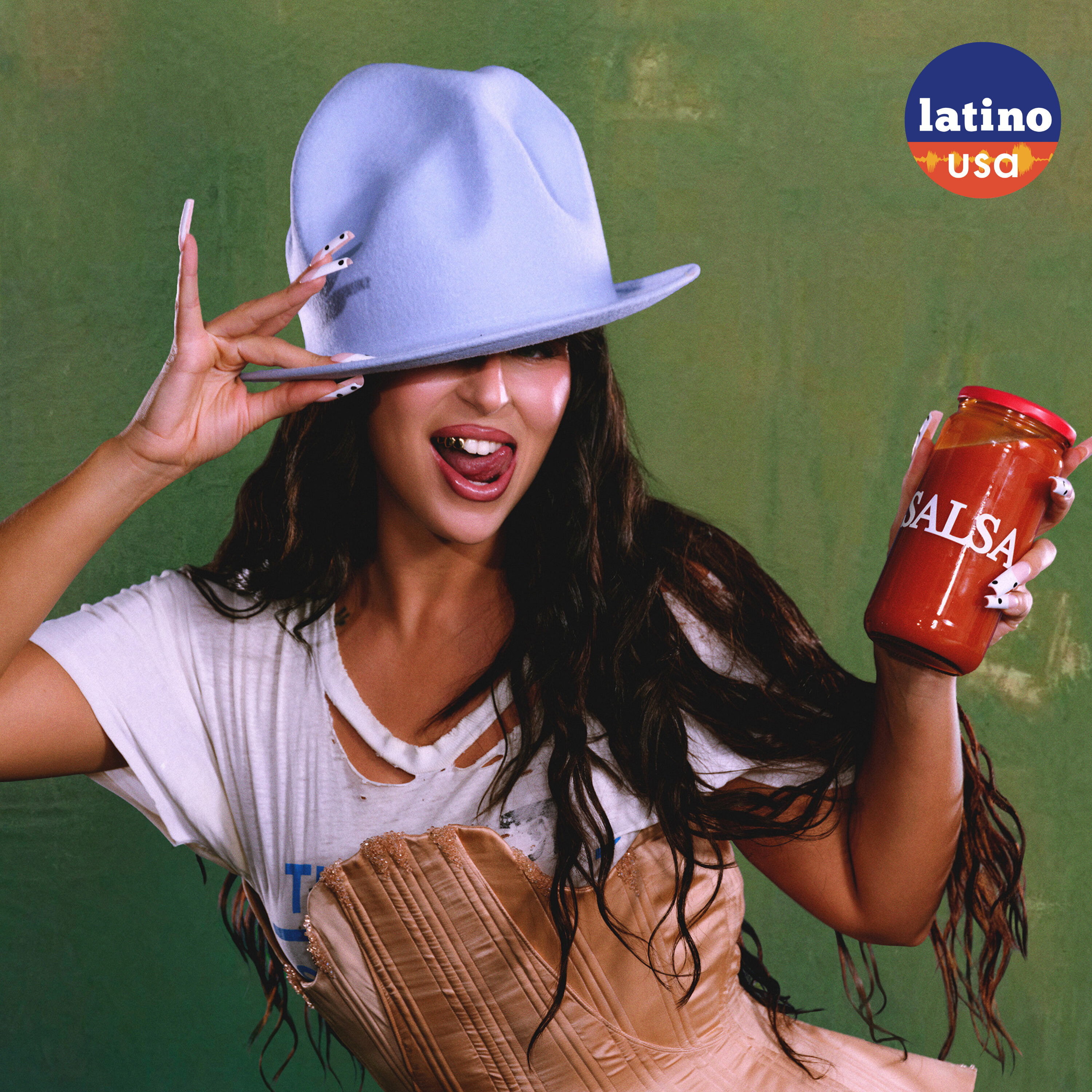
Nathy Peluso: Rapper, Salsera, and The Art of Misbehaving
Episode Transcript
Dear Latino USA listener.
Speaker 2Before we start, you should know that if you want to listen to this episode, add free.
Just join plus and you can join for as little as seven dollars a month.
Joining also gets you behind the scenes access and yes, some cheese may so click the link in the episode description and after you do that, then click play.
Let's go to the show.
Hey, dear Latino USA listener, Heads up, this story has a few curse words coming out.
Okay, I have a couple of rapid fire questions for you, but it won't that be us.
Speaker 3Yeah, okay, Pereo, Olsasa, MIFEI mm him Merces okay, Chimbote, churros, Timote, Gillmes Austria.
Speaker 1I'm not inso weird.
Speaker 2That's what we were like.
Speaker 1We don't have we further met or maybe Martini or Tequila or te Guila.
Speaker 2Nati Paluso is an Argentinian born singer, rapper, and poet, and she's looking to chart new territory on who gets to choose how women Behave you see?
Nati moved to Spain with her family as a young girl, where she landed in a community of immigrants just like her, and this ended up shaping her views of music and of the world.
Nati started her career by writing poems for tourists in the streets of Madrid, and that poetry gave way to rap sangolos.
In twenty twenty one, her breakthrough album Calambre won Best Alternative Music Album at the Latin Grammys.
Speaker 1Gafriola Zula.
Speaker 2Nati has collaborated with some pretty heavy hitters like Carol g and Bisa.
Speaker 1Mira Mitrukteino.
Speaker 2Most recently, she worked with Tokisha and with the one and only Floria Stefan not His latest release, Malta, is a six track EP of salsa music.
It's an ode to perto rico and to the salcettos of the pastora from media, It's Latino USA.
I'm Maria Josa Today Nati Beluso and her words to live by.
We're going to talk about the importance of taking risks and how Nati navigates a world that can still be unfriendly to women.
The key, she says, is to do things with love and respect.
Nati Peluso, Welcome to Latino USA.
Speaker 1Thank you so much.
Speaker 2How are you doing.
Speaker 1It's It's a morning in New York city.
I'm having real fun.
Honestly, what's going on?
What do you Because I'm leaving my best moment.
I think I'm really grateful to be here promoting this project in this big city with all these opportunities, Like I don't take this for granted, and I'm really like every day appreciating these opportunities.
Speaker 2I love the fact that you're like, I'm surrounded by all of this love as I'm dropping this project because the name of the project is my port Excite, which means badly behaved women.
But you're like, but I'm surrounded by so much love.
Speaker 1Ah, Yes, that's how we do it.
That's how mohere somos no, Like, we really like have layers.
And I think my porta I'm talking about bad behavior, but in a respectful way, is the way you go through your experience being yourself, not paying attention of what you should do or they want you to do.
Podcast my porta, my porta being a woman, it means being bad behavior because if you do what you want to do, everyone is gonna be disappointed because it's always you should be From my experience, it's always like what I really want or what I really need to do?
Is always not the right thing to do for the industry, for the crowds.
Speaker 2Seven, we gotta go back to the beginnings.
Yeah, okay, when Osires is not a hobbed for mereengeir or reggaeton or alsa.
You moved to Spain.
Speaker 3I was in alt Okay, so you moved to Alikante in Spain also not a hotbed of salsa, reggaeton, mereng But we.
Speaker 1Moved in a moment of a world that everybody was moving to Europe because crisis.
And I think I learned that in a neighborhood it was Dorribeja deep deep Alikhan like all this culture were traveling together, Ukrainian, Equadorian, Peruvian, Colombian, also Puerto Rican.
All this culture were like together.
In the school, I don't even remember having a Spanish friend in Spain whoa so I was sharing with many cultures.
They were in the same situation as me, where little children immigrants.
So I learned so much about cultures.
Speaker 2So if the crisis in Argentina hadn't happened, and a world wide crisis hadn't happened, and you hadn't had to move to Spain and be raised with a bunch of immigrant kids from Latin America and the rest of the world.
Maybe Nati would not be the performer that you are today.
Speaker 3Yeah.
Speaker 1Probably.
I was just born with a gift, as all of us.
We just have to pay attention of what gift we have and work for it to make it the biggest as possible.
So I think it doesn't matter where Jew magriere.
The thing is, I was ready to communicate.
I didn't want to be famous.
I didn't want to be I was not expecting nothing.
I was studying for being a theater teacher.
So I can't like pass you what I feel because I have something really strong in myself.
I want to give it to you so we can share together and communicate together art.
So you were not because you know to be an artist, you know this, you have to have ingrand Ego right, and you have to really fight for yourself.
So I love the fact that you're like No, I was a teacher.
I was never thinking of being on stage and all of a sudden, Yeah, it was not in my mind like you imagine like a stadium.
Are you being famous?
Also, I was writing poetry in the streets.
Oh my god, I love this story.
Is so sweet to me.
Speaker 2The fact that Nati Pluso was at one point making money by sitting on the streets of Madrid and offering to write poems for tourists or people in the middle of the day, and nobody said, Nati does Loka, Please don't don't go in the middle of the street and start writing poetry.
Speaker 1And no, no, no, All my friends, my family, they were so supportive.
They were like, proud of it.
We are giving people words, concepts, we are creating something.
We are giving people love, we're sharing stories.
Because they were coming asking for proper things, like my father is sick, I won't give him beautiful words to him like a present, or maybe I'm in love, I'm feeling this, and they give you a word and you write a poem from the world.
So it was like really constructive and really like I learned how to write first.
So then I start rapping because of that, because I was in love with rap, and because I was writing songs about melodic songs.
When I start writing poetry, you start like paying attention, like the rhythm.
So I was building up something like the terminosda.
Speaker 4Gonbelero, peta gasolina paruero pro.
Speaker 1Is the I'm so proud that I went through the streets and write poems.
Because of that, I'm now here, and because my dad and my mom decided to move, and because you know, everything is for a reason, so you have to be open.
I'm conscious about everything you feel you have to do.
Just all of that.
Speaker 2I mean, we're in New York City, the home of rapping hip hop, the boogie down Bronx.
Okay, Latinos Puerto Ricans central to that.
But you know, the criticism around rap and hip hop is that it's not really friendly to women.
Oh yes, definitely, but you're like, but the world is not.
Thank you for reminding us the world is not friendly to women in twenty twenty five.
Speaker 1We waiting for that.
We are.
Speaker 2But then what drew you to a medium that was not necessarily feminist welcoming?
And you're like, boy said mask ConA.
Speaker 1Yes, for sure.
If you don't want me, I'm gonna be there for you to notice.
Honestly, it was the attitude, first of all, because I have like a really strong attitude.
So it was calling me I discovery rap because of Biggie A couple of tell your friend the way he was drubbing, like butter really strong but soft, and I started listening to Bots and Klan.
Obviously doctor dread of my game.
I never thought it was not for me because I was a woman.
Speaker 2It was not a thought in your song business woman, business in a business I did not come to make your bed, Mahina.
And you're saying this.
Your lyrics are clearly yeah that one.
You're just like and so why On the one hand, you're like, there's no limits, I can do whatever.
But on the other hand, in certain lyrics, you're like, I'm gonna tell it to you straight.
I didn't come here to make your bed, bro.
When we come back, find out what not the Beluso came here to do as a business woman in a business world.
Speaker 1I started to really be aware and understanding the power we have as a woman in artists, as a woman with a message.
Speaker 2Stay with us, yes, hey, we're back.
And right before the break not the Beluso was telling us about finding her voice in rap music and how she came up with her lyrics for her song Businesswoman.
Let's jump back to our conversation.
Speaker 1I was in a moment discovering feminism and the power that I was handling.
I just went to Argentina to play in my songs, and it was full of women giving me such a power.
So I realized this discourse.
I started to really be aware and understanding the power we have as a woman in artists, as a woman with a message.
So it was really natural.
Business woman was like I dropped my thoughts in a paper like straight.
I was in a plane like stream of consciousness almost.
I was just talking my shit.
And this is why it's so magical.
It is magical.
So oh, that's crazy.
I think salsa has many in common with hip hop attitude, bars, punchlines, characters.
They're fronting.
Speaker 2You know.
Speaker 1CLSA is about fronting most of the time.
Some other times it's more like the r and becomespt like more romantic.
Now you have like these two side one ID is like the joyful celebrating party Celia Cruz, life is beautiful.
Then you have the romantic like more Frankie Ruiz, I can't live without you.
I need your sex, I need your but in Rapps I need your pussy is almost the same.
You know, they're talking with different words, but and then you have the virus like Juanita Imania.
They're fronting, they're talking about the hood, about the dangerous things, about the violence.
So I think maybe it was natural for me to understand the salsa environment and the salsa concept because I was so into rap and.
Speaker 2You're outside of it, so you don't see the boundary between rap and salsa.
Speaker 1Yes, that's why it was really natural and organic.
Also, I realized when I am I was young, my mother was playing Almac Stephan who was not salsa, like really tropical something.
That album is really exquiste Benzer.
I know these arrangements like in my memories, the flutes, the percussion, everything, I know, the harmonies.
I really studied the album, so it means like I was really called by the tropical song.
And then after that, when I started like being common independiente, I went to a vinyl shop and I bought Reoyls just because of cover.
Okay, they were amazing.
The Superman one, I know, I felt love with him first salsetto in my life, before Ector, before Frankie, before Ruben, before everyone.
So I discovered the salsa through percussion.
But melomana, how you say this in English?
Melomana significant is Melomana is like you are an adict?
Speaker 2Yeah, but.
Speaker 1Yes, I need to like find new music every day, and I like Lopetes.
I'm really like a freak, a nerd, you know.
I was shocked with Bosanova, with Machine Machine sang its, also jazz John Coltrane.
I was buying a lot of vinyls and discovering all the music.
It was natural, not.
Speaker 5An ingosent impot just passes.
Speaker 1And I was in Chile to ring.
I was missing someone, but in an uncomfortable way.
You know when you're suffering.
So I thought about love.
Like in a SASA song, you have to be really really take care of the words you're saying.
It's really like a poem when you talk about romantic SASA.
It was foury in and I started.
I started writing it like I sometimes I have this fire inside of me.
I need to write.
If I don't write, I can't sleep, I can't live.
Like I need to write something.
So I wrote just like just control.
I put like in a YouTube, a bpm loop with conga.
This is how I usually write SASA songs.
I pushes percussion and I start singing writing.
I have the harmony.
Then I go to the studio and reharm rearrange, but the melody and the lyrics.
I write it by my own in my home, so I wrote in sansa da.
Speaker 5Not an ecosport, just pass.
Speaker 1And then we moved to Puerto Rico.
We stayed one month arranging and making all the compositions around these songs I made.
It was an amazing, amazing experience.
It was my dream to go Puerto Rico and learn about the roots of the salsa.
And also I remember we went that place listening to salsa a whole night.
It was like an old man djaying and I was looking for the songs he was playing, because I told you, I'm like a little nerd.
I was paying attention about the arrangement of the horns because I did the arrangement with my friends.
We was like, get this busy BC horns BC bsy arrangements.
They were like putting the horns like a boye, like in front of you.
So we went the next day after what we're learning this club in Puerto Rico, we wrote the horns this song and Ko and Flores jeru gue.
Speaker 2We'll be right back with more from Nati Peluso.
Speaker 4Yes, basso, yeah, school felicita.
Speaker 1Hey we're back.
Speaker 2Let's wrap up my conversation with the One and Only Nati Peluso.
So Gloria Stephan has come up a couple of times in the interview.
Speaker 1Ah, yeah, for sure, Queen the Queen.
Speaker 2Yes, I also know that you have this incredible surprise moment with Gloria Stefan at the Latin Grammys.
Nati, would you like to perform with Gladia?
Speaker 1I'm so excited.
Honestly, it means a lot, like a moment in my life that I'm realizing how far I went with this because Gloria was like my idol all these years.
Now she invited me to remember, said really joyful and we're performing this.
Honestly, I'm not gonna forget in my life.
Speaker 2You're a very spiritual person too, so to be next to an icon.
Speaker 1Yeah, strong woman, strong woman who kind of paved the way.
Yeah.
Speaker 2I mean I love the fact that you're like, nothing is planned and I kind of live it and I'm taking it all in.
But this moment you with Rodia Stefan, Yeah, it's huge.
Speaker 1It's a blessing, and honestly it surprised me because I didn't chase it.
It's amazing how it happened naturally because I'm a hard worker and I always like doing everything we love.
So people notice that the icons if they notice that you're in a good path, Beach, you know what I mean, you have too.
I feel really blessed that she noticed that, and she's giving me the opportunity to share with her, because I think I'm gonna learn from this experience.
Speaker 2You actually collaborate with a lot of pretty incredible artists.
But the person who could not be more different than Grdian Stefan Turkishash, I mean.
Speaker 1Could not on the opposite end.
Yeah, that's crazy.
But she's very controversial because she's really like aware of everything she's doing.
I think it's really interesting to mix these worlds, you know, it's really interesting.
She's doing a great job around the world.
She's communicating something, you know, in her style.
Speaker 2Why do you think she's so controversial?
And it kind of comes off on you in the sense that both of you are not afraid of your sexuality and your sensuality and it's central, but it can also be wrong sexual Why do you think that this is so controversial for so many people?
Speaker 1Now?
We are not that far away from the past, you know, and you can tell with these reactions.
Also, I think it's necessary that we're really different people, so we should like learn from that, not judge, just learn because different and it's shocking you.
It doesn't mean it's bad.
Maybe you don't understand, or maybe you have to be uncomfortable to learn something, or just to know what you don't like.
But it's necessary to be there because you have to learn what you like, what you choose, what you don't choose, what you prefer, educate yourself and don't be afraid.
The thing is, you don't let the fear stop you.
You deal with it, you learn with it, and when you fight it you become better, stronger.
Speaker 2But we have to go there, often going to the things that are most scary actually, which leads me to what do you say to the little Nati who is an immigrant girl today who is maybe growing up scared someplace in the United States, right, Or an immigrant girl who is from Ecuador who is now growing up in Mexico City, or a little Argentinian girl who's left your country Argentina.
Speaker 1Yeah, what do you say to these little girls?
I would say what it helped me in the past was really not listening to many advices because they're not pure sometimes like not trust everybody like sometimes you just have to pay attention to your entition.
It's really important to give ori intuition the power it deserves.
ISAs do the intuition.
So if you train this, you get used to It can sound like I'm a hippie alone.
No, don't get confused.
This is a special power we have.
I would say, work hard, don't rest.
You have to work, you have to suffer, you have to break your back.
Always study, always get better.
Be kind in the process.
Compassion is really necessary.
Sometimes don't stop.
You're gonna stop later, but now you have to work.
Work, work, and never think you are the best.
You can sing better, you can dance better.
You can be a better woman, be a better daughter, be a better everything.
Maybe it's not happening right now, but still pushing it.
I think it's better to.
Speaker 2Better to have tried than to have just wanted to meet it trying.
Speaker 1What if?
Speaker 2What?
Speaker 1No?
No?
What if?
What are you going to go?
Go for it?
Go for it?
Speaker 4Confiarience horness because a particle are.
Speaker 1Thank you so much for speaking with me.
It was a pleasure.
It's a bye pleasure.
Speaker 4Noodo solo Colnadalamlo p.
Speaker 2That was artist Nati Peluso.
Her new EP, Malportada is out now.
Speaker 5Johno Navent, Territoriaja Na Robertia To Novia E Candlosa Reverdente, Johnny four Hello, Dantezipermeso.
Speaker 2This episode was produced by Gimi Montalgo.
It was edited by Revecca Barra and our managing editor Fernanda Echavari.
Speaker 1It was mixed by Julia Caruso.
Speaker 2NI Latino USA team also includes from Sana Guire, Jessica Ellis Rinaldo, Lean Junior, Stephanie Lebau, Luis Luna Joli, mar Marquez, Julieta Martinelli, Monica Moreles Garcia, jj Krubin, Adriana Rodriguez and Nancy Trujigo.
Bennilee Amirez and I are executive producers.
I'm Your Host Marie jo Josa.
Latino USA is part of Iheart's Michael Tura podcast Network.
Executive producers at iHeart are Leo Gomez and Arlene Santana.
Join us again on our next episode.
In the meantime, I'll see you on all of our social media and don't forget to join fuduro Plus to get to listen to episodes like this one without any ads.
Plus you get cool bonus content, so join Fuduro plus to it now.
Speaker 6Esta Approxima dot Bayes Latino USA is made possible in part by the John D.
Speaker 1And Catherine T.
Speaker 6MacArthur Foundation, Skyline Foundation, and the Ford Foundation, working with visionaries on the front lines of social change worldwide.