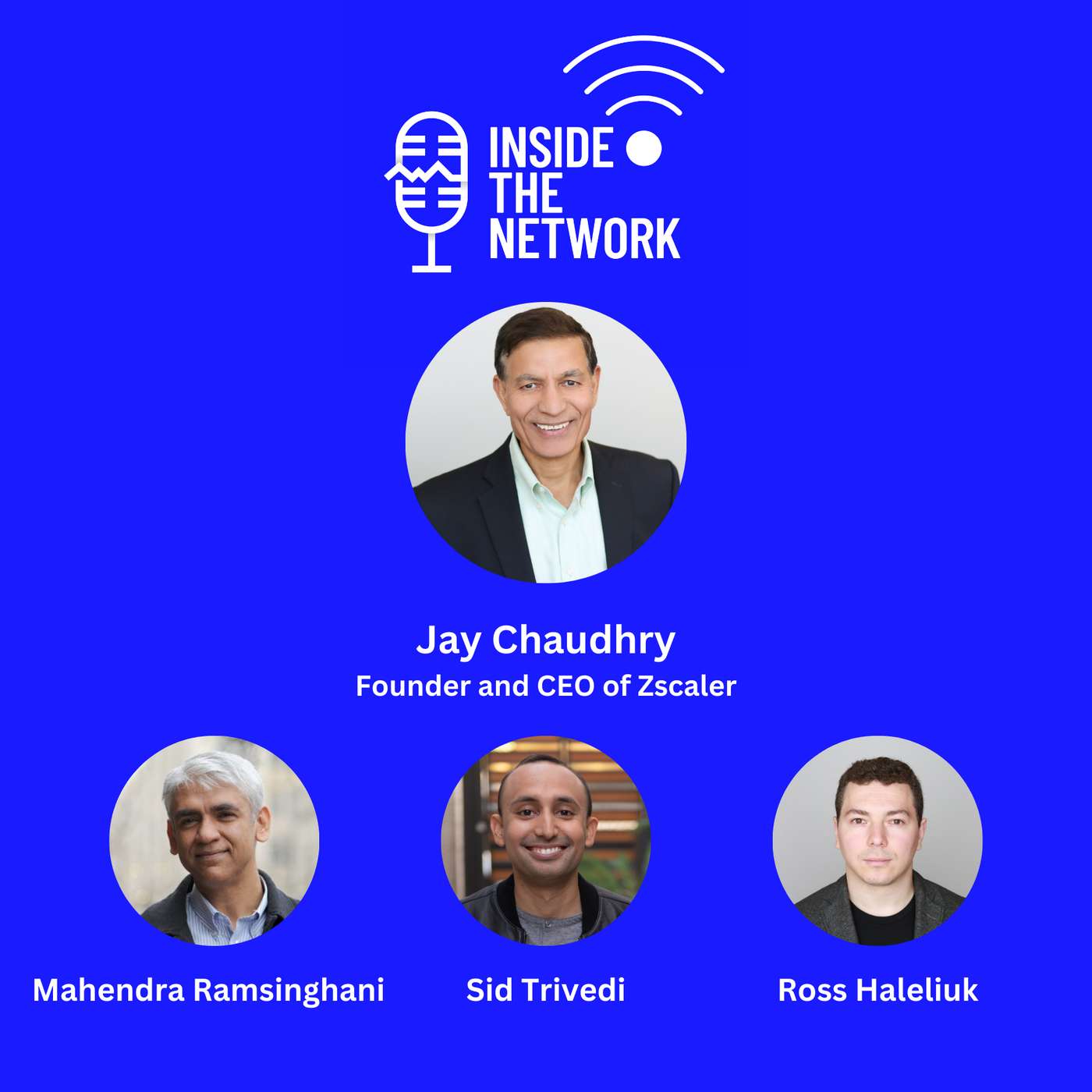
Jay Chaudhry: Betting on yourself and building a $40B+ Zero Trust giant in Zscaler
Episode Transcript
Welcome to Inside the Network.
I'm Sid Trivedi.
Ross HaleliukI am Ross Haleliuk.
Mahendra RamsinghaniAnd I am Mahendra Ramsinghani.
We have spent decades building, investing, and researching cybersecurity companies.
Sid TrivediOn this podcast, we invite you to join us inside the network where we bring the best founders, operators, and investors building the future of cyber.
Ross HaleliukWe will talk about the hard parts of the founder journey, launching companies, getting to product market fit, raising capital, and scaling to an exit.
Mahendra RamsinghaniAnd, yes, we will also be talking about epic failures.
Sid TrivediBut, Mahendra, we're here to make the founder journey easier.
Mahendra RamsinghaniThat is correct, Sid.
But we cannot make it too much easier because startups are hard, and of course, you already knew that.
Ross HaleliukAlright, you two.
And now, let's get started with this week's episode.
Mahendra RamsinghaniGrowing up on a small farm in a remote Indian village, no electricity, no running water, the nearest school is a two and a half mile walk.
From there to building a $40,000,000,000 publicly traded cybersecurity company is an extraordinary journey of our guest today, Jay Chaudhuri.
Jay and his wife, Jyoti, who is an MBA graduate from the prestigious IIM, Indian Institute of Management.
It's the equivalent of the Harvard Business School.
Both of them decided to quit their stable jobs, pool their life savings, and went all in on their first startup.
This was the late nineties, just as the World Wide Web was at an inflection point.
That bold bet paid off in two years as their company was acquired by VeriSign.
Since then, this dynamic duo has founded and exited four successful startups, riding the waves of multiple technology revolutions from the dawn of the web to web applications to mobile and the cloud.
After four exists, most might have retired to a vineyard or a golf course, but they doubled down again.
This time, they staked $50,000,000 of their own capital to start Zscaler.
Today, this trailblazing zero trust security platform generates over $3,000,000,000 in annual revenues, commanding a market cap of over $40,000,000,000.
As Zscaler approaches its twentieth anniversary, Jay is not slowing down.
He's already charging ahead into the AI revolution, envisioning how it shapes cybersecurity threats, defenses, and redefines our entire technology world.
In the world of rap, there is only one j z.
In the world of cybersecurity, there is only one j z.
Welcome to Inside the Network.
Sid TrivediJay, welcome to Inside the Network.
Jay ChaudhryThank you, Sid.
Sid TrivediWell, you know, we wanna talk about a bunch of different topics, but let's start with your early childhood, growing up in rural India and moving to The US in the nineteen eighties.
You've spoken about growing up in Pano, which is a village in Himachal Pradesh without electricity, without running water until your teenage years.
I believe you walked two and a half miles to school, and you've also mentioned that you studied under a tree.
We've had a lot of immigrant founders on this show, but that does not sound like an easy childhood.
How did those early experiences inspire your entrepreneurial journey?
Jay ChaudhryAction is a fun childhood.
That's all we knew.
We played.
We had fun together.
It was a wonderful life.
So I really never thought it was a tough, tough life.
So it tells me it's all relative.
It's all state of mind.
But one thing I did learn at that time was that hard work is good.
I saw my parents working hard.
I work with them in the fields.
You know, I had tilled using oxen in my early days, so I don't think very many founders have the unique distinction of tilling their farm with oxen.
But I like to say, if you've seen life where you have to work hard, then hard work is no longer hard work.
It's part of life.
Too many people in advanced countries are too pampered.
They think hard work is bad.
To some degree, a sense of entitlement sits in Silicon Valley.
And, ideally, I think people who come from having seen simple life, hard work life, they do very well in life.
And that's how I became what I became.
My parents taught me hard work, honesty, and integrity, and they have been part of my life.
And the biggest thing I've done or I try to do is impart the same thing to my children.
Mahendra RamsinghaniThank you, Jay.
I think that perspective of hard work and honesty and integrity is clearly a set of values that your parents inculcated in you.
Share with us a couple of stories growing up in in that farming backdrop.
You know?
One of the things that I I recall about farmers is that, you know, you're subject to weather conditions.
You know?
You're also you know, you cannot yell at the crops if they're not going fast enough.
Right?
So share with us some of those lessons that you bring to your modern day cybersecurity life.
Jay ChaudhryYeah.
What you said is really true, especially at the time in India and in my district where there's no irrigation system.
In many areas, irrigation system takes care of things.
When there's no irrigation system, you depend upon rain and whatever the nature does.
So one of the things I learned from my mother, she would say, do your best and leave the rest to higher powers.
You know, I get asked many times, how do you deal with pressures of the job?
I think back and say, work hard.
I do my best.
Then I don't worry about the rest.
This is probably one of the very important lessons I brought along with me for my childhood.
But thinking of some early childhood days, I recall when I went to my primary school.
First thing in the morning, they will ask for three or four students to go to a village well and fetch water and get their water in a little water tank so the students could drink it for the rest of the day.
And by noon, that water was pretty hot sitting in this little tank, though it didn't feel too bad in those days.
But later on, after I went back from The US, I felt, man, that must have been very tough.
So the first kind of giving back project I did for India, for a number of schools in my district in Himacho, was to deploy a bunch of water coolers.
Because now they had running water, but the running water won't be running all day long, and they'll fill it up in tanks, and they'll it'd still be hot.
So water coolers.
So it's a little bit of perspective of how you look at things.
But I'm a big fan of happiness as state of mind.
Everything is state of mind.
Your mind is so powerful.
If you make up your mind and you push, you build conviction, you drive, and you don't look at it as a way of sacrificing things.
Sometimes people think, gee, I'm sacrificing so much to do my startup.
If people think startup is a sacrifice, they shouldn't be doing a startup.
If you have a conviction, you enjoy something.
And you can look at life in two ways.
There's a challenge and here's a problem.
If you take it as a challenge, human beings like challenges.
I like challenges.
So if we take the next level of challenge, you drive, things happen, and it's no longer work.
It's no longer sacrificing.
Ross HaleliukThat is a good a very, very good perspective.
And and it also leads into the next question.
So, Jay, moving from rural India to The United States in nineteen eighties for graduate school at the University of Cincinnati was a very bold step.
All four of us on this podcast are immigrants.
We have moved to The United States in search for greater opportunities, and many of our listeners have essentially done the same.
What was the most unexpected cultural or personal challenge you faced during that transition as you made the move?
And how did it shape your perspective on risk taking?
Jay ChaudhryYeah.
You know, for me, the bigger shock was to move from my village to IIT, then moving from IIT to The US.
Frankly, massive move.
Because at IIT in India, we all talked about going to The US for masters.
So we kinda knew what to expect.
Now having said that, once you come here, obviously, things are quite different.
The food, dealing, all that kind of stuff.
I do not think that actually kind of changed me or surprised me a whole lot.
I've been generally focused on learning most of my life.
I have a one priority was studies, a two was health, and everything else didn't really matter.
Those two things were very important for me.
But I tell you, impressions of America was amazing.
When I came, I took a bus from JFK to Cincinnati, Ohio.
The bus they they changed the the bus in Columbus, Ohio.
And when I reached Cincinnati, I realized that one of the two bags I had, one was in my hand, second was with my clothes, the second bag got lost.
They did not move it.
So when I came to my UC Cincinnati, a teacher said, oh, you lost your bag.
Don't worry.
I'm gonna call Greyhound bus.
I'm gonna find out when your bag comes.
I'm gonna take you to the Greyhound station, pick up your bag, bring it back.
I have seen so much of, really, hospitality in in The US, especially in the Midwest.
That was very moving.
In terms of learning, going to school, it wasn't that hard.
In India, you're always good at mathematics and sciences because they actually taught that stuff extremely well.
So that was never a problem.
Yes, computers, science, programming was a little bit new.
I picked up pretty quickly.
The key thing probably from my point of view in learning was I finished my master's.
I had a summer job after my first year as an intern in one of the small startups in Cincinnati.
And they told me, finish your degree and come and work for us and we'll sponsor you for a green card.
Right?
What else did you want?
At that time, you want a green card.
And I did.
The the big change came into my career.
When from that software development job, I moved to IBM.
And that was a change to the business world, to sales world.
Because I realized that I could do better customer engagement and that happened because of literally by an accident.
Because one day when our sales engineer called in sick, the only sales engineer in the company, they wanted me to do a demo.
I did the demo and demo went very well.
The first demo in my life, the first customer interaction in my life, okay, that changed.
And that's when I said, I have more fun doing this than writing code.
That's probably one of the big things in my career that happened.
If I had been doing software development, I'm not sure if I would have started a company.
Working for IBM and sales and marketing gave me some of the experience and whatnot.
So I think the the point I'll make is what has helped me is taking chances at trying new stuff.
I would have said I've been a trained engineer.
Why should I go there?
I would have to stay there.
But really, falling a little bit off your guts and kind of pushing beyond the comfort zone has naturally been kind of something I had done all along.
I do not know where it came from, but I I've always had chances, had tried the new thing, and and set the new goals and the next level and the next level.
Right?
What you attain today is good, but it's not good for tomorrow.
And America is a wonderful country to try all these things without worry about how society will look at me.
Sid TrivediWell, you know, you talked about trying new things, and we certainly wanna talk about you starting multiple companies.
I think many people know you for Zscaler and will certainly get to Zscaler.
But you started four companies before Zscaler.
So let's start with company number one, Secure IT.
Almost three decades ago, you and your wife, Jyoti, took a huge risk.
You quit your jobs and you invested your life savings into starting your first company, Secure IT.
And for context for our listeners, Secure IT was the first pure play Internet security services company.
Take us back to that pivotal moment that convinced you to bet everything on starting this company.
Jay ChaudhryYeah.
And especially when there's no DNA of entrepreneurship in my family of small scale farmers, right?
It's like thinking about opportunities and trying them.
I think sometimes people get too logical.
Sometimes people start doing too much analysis paralysis.
I believe that the deeper you analyze the stuff, the more pros and cons you're going run into.
And you're going say, well, let's not do this.
For secure IT, it is fairly simple.
In '95, '96 timeframe, when Netscape has gone public, right, Marc Andreessen was kind of a big role model at that time.
And I believe that Internet will take off.
If it did, every company will be connected to every other company.
And you have to worry about cybersecurity.
And so I saw that an area that companies will have to worry about.
Then I got inspiration from Marc Andreessen and said, if this young guy who recently graduated from UIUC Irvana Champaign, if you could do a startup, why shouldn't I do a startup?
Here's a crazy question I asked my wife and she and I debated for a little bit.
And that's what really led to saying, let's give it a shot.
And I said, I have a technical background.
I have sales and marketing background.
Why not?
And then we stumbled across couldn't raise funding.
The choice was give up or take a chance by putting in life saving.
There were only two choices there.
And there, the notion was, will I be repenting and saying, I wish I had done a start up?
That's a notion that took us to let's give it a shot.
It was a tough decision.
I won't say it was simple.
But we did not sit on it for weeks and weeks.
We literally spent probably a week, week and a half or so.
And eventually we kind of said, what's the worst thing that can happen in life with this thing?
Company fails, we lose our savings.
And the next thing was, can we find a job?
And we means because Chyoti and I both were quitting.
And the answer was, we have tons of confidence that we can find a job.
What made it simpler was our lifestyle was simple.
I mean, I wasn't buying the fanciest car and the fanciest house out there.
We have a simple car at that time.
I had a 1984 Honda Prelude.
This is '97 time frame.
And in Atlanta, we had a simple house with $800 per month mortgage payment.
Said, what can go wrong?
Let's give it a shot.
And that's really what happened.
But the key was not really taking a risk.
Key was we focused on a new focus area and fast mover advantage was important.
I looked around.
There's no company out there that is doing security services.
No one knew how to deploy firewalls and the like.
It's totally new phenomenon.
So I said, if I do it, I'm a fast mover.
And I want to do further focus on it and do firewalls and firewalls only.
No networking, no switching, no routers, and the like.
So we became good at it.
In fact, one thing deeper I went and said, there used to be half a dozen firewall companies out there.
And we said, Am I going to learn about all of them and give a choice to customers like some of the other VARs and services companies used to do.
I went the opposite way.
And I would say we are only going to work with checkpoint software.
Period.
And when my customer will say, what other options do I have?
I would say, we have looked at all of them.
Here's the best technology.
We are the best at deploying it.
That's what you should choose.
The competition would say, here are six options.
You tell me what you like and I'll give you what you want.
That's a big difference.
Once you get focused, we got so good at the area we focused on.
We were far better than a lot of these other competitors who were kind of genetic VARs doing some network, some this, some this.
So if you get focused, at that time, I would say, startups are, say, a foot wide and 20 foot deep.
Don't get too wide.
Go deep.
Become the best.
I recall one day we were dealing with this large Atlanta company.
It's a power company.
We're trying to deploy firewalls.
We're giving them some security services.
And this person, this leader, security leader said, what you're asking for for rate is more than what IBM charges.
And I said, look, we are the heart surgeons of security.
If you care about your heart, you talk to us.
If you don't, you should talk to journalists.
And we backed it up because we knew our stuff cold.
If you focus, you know it better than people who go and do 20 different things.
That's why I like to say, if you want to do a startup, don't just go in a new area.
You need to have some core competency, some background to build upon.
In .com days, so many entrepreneurs will say, I'm going to build a website in this retail area.
You say, what experience do you have in this market?
None.
You need some experience or you bring a partner to join you who comes with certain experiences.
And if the two skills are complementary, it becomes easier.
If I had no sales and marketing background, I needed a partner to start with me.
Fortunately, I have been to the both sides, so I was able to go and figure out the idea and drive it, which actually helped in many ways.
If you can do that, it's a positive.
Ross HaleliukThat is such a fantastic story, Jay.
I would love to ask so many follow-up questions, but for now, we'll stick to a few that we had we had in mind.
So, Jay, very few founders build companies with their spouses.
We had Ron Gula on the show who was talking about his experience of working with his wife Cindy to build Tenable.
How was it for you?
How was it to cofound a company with with your wife?
And and how did it influence your leadership and your approach to balancing the company life and the family life?
Jay ChaudhryIt was actually wonderful and unfortunate because there could be so many tensions and things in the system.
Fortunately, it worked out extremely well.
Now why?
A few things.
My wife is MBA in finance for IIM Calcutta.
That's like Harvard Business School in India.
And she got a master's in information systems at University of Cincinnati.
But she has very complementary skill set.
In finance and numbers, she is 10 x better than I am.
So I don't even attempt to figure out the finance.
Like, I have no idea what a finance is even figuring out how to draw money from an ATM.
It's great because you can delegate.
I don't have to think about things and you find a partner who can take care of that kind of stuff.
That is one part.
You know, the other part is why it was good was.
And I kid around, but I I mean it.
If you want a happy family life, get your spouse involved in a startup.
Okay?
Because she's out there with you.
She's actually understanding what it takes, And you're working all day long.
You're going back home in the evening.
Both of you are tired together rather than the wife ready to say, come on.
Let's go for dinner now.
So I think this is this worked out very well for us.
Now, fortunately, we had our parents to take care of our kids and help the kids that was very helpful.
Otherwise, it would have created one more area to worry about.
You know, the other thing that worked very well with us was I am a risk taker, as I said.
My wife is very conservative.
So we've to balance each other.
If I get excited, I'm ready to jump off a cliff and she can pull me back and say, hold on, slow down, this is not needed.
The other aspect I'll see is if both spouses are overly ambitious and competitive, then probably they could have tension between the two, which won't be good.
Fortunately, I'm the ambitious and driven kind.
My wife is pretty contented, if I may say spiritual type.
She in fact, I don't I say I don't have attachment for money.
She has zero attachment for money.
She doesn't want to be the kinda outspoken person.
In fact, she'd rather shy.
She would rather not be in the media or any interviews.
It just worked extremely well.
I think it's overall a good thing.
Now, it's also true that she didn't want to be part of the large company management team.
So she would work for the first two or three years, then we'll bring in professional management together and go from there.
At Zscaler, she spent about four years.
In other companies, somewhere from two, three years.
It was a wonderful thing.
And, by the way, our kids learn to see how we're working hard.
So the best way to teach kids about hard work is be an old model.
When they show you see your parents working hard, they work hard.
Mahendra RamsinghaniAnd then they work like yin and yang.
Like you said, the two sides work so well together.
Indeed, it is a it's a blessing of a kind where you can build that that both that relationship as well as the productiveness of building many companies.
Now going back to the fact that neither of you are attached to money, but still, if you have your first exit, Secure IT was acquired by VeriSign just two years later after you started it.
And since then, you have had multiple exits.
Zscaler stock is up, like, 70% this year, and you're already just in month seven or eight now.
So talk to us about the lessons you've learned in building multiple companies, and also talk to us about the art of exits.
Jay ChaudhryRight.
First of all, if you don't have attachment money, you make the right decision.
When secure IT success was happening pretty rapidly, I was getting a bunch of calls from potential acquirers.
And at that time, sitting in Atlanta, I had no idea about any of this, literally.
I mean, none.
I had no VC friends.
I had no investment bankers I had ever dealt with.
So, in fact, I recall in one conversation, this one CEO tried to put a lot of pressure that if you don't sell, I'm gonna wipe out your company because when you get into this space, you'll be gone.
If I were worried about money, I would have taken this thing and run with it.
Okay.
I did not.
I said no.
I walked away from it.
So if if you are overly worried about money as a founder or entrepreneur, you're you're gonna do make some shortcuts.
You're taking chances.
Might as take some more chances out there.
But that's really linked to how much business conviction do you have.
In my style of business, I am out there in front of customers.
I'm fairly tech savvy.
I understand technology products.
So a pretty good understanding of what the strengths and weaknesses of my businesses are.
So that allows you to make the right call at the right time.
I think there's an opportunity you need to think through.
There are many times you'll say you didn't sell the company, right?
You were hanging on it for too long.
And sometimes you sell too early.
That's not good either.
None of us have a crystal ball to see what the future looks like.
But, you know, there are angles out there At there are some times, for example, when I had this company called Core Harbor, it was e procurement company using Ariba software as an ASP.
ASP is application service provider.
That means this is single tenant architecture.
We took Ariba, we put it in a data center, a database server and application server.
We ran, we managed it for our customers.
Those early days, this was ninety nine, two thousand timeframe.
And .com was pretty hot.
The Alibaba was very hot.
And then we could see things cooling down.
And there was the right opportunity.
I got a call from this other division that company had acquired to say, we want to acquire your business.
And it was a timely thing.
I I could have said, no.
I want to make it bigger, but I could see the market cooling down on some of this area.
I made the call.
I let it go and move on.
I think not having attachment to your companies is very important as well.
The way I looked at it is entrepreneurs make a difference in the world.
They're kind of changing the world.
That's the sense that drives entrepreneurship, at least for me.
So rather than being attached to this company, you're looking at how do you make the big difference in the world.
And if you're able to think through that and if you could say, this area is not likely to grow much bigger, then you move on.
You do an exit and move on.
Take you to give you another example.
Air Defense was a fascinating company.
I mean, it had nothing to do with Air Force.
It was defending your ear waves.
This is wireless security because Wi Fi's were beginning to come up.
So we came up with this very novel idea, first mover.
No one had done anything like this.
I'm gonna monitor the air waves and find out if some bad guys are trying to connect to your WiFi and the like.
But then I realized that it is it's a good start up.
It's a narrow product line that's never going to become hundreds of millions of dollars worth of business.
This business need to be integrated with the WiFi companies.
So when the right time came, we accepted an offer.
You know, if we if there are entrepreneurs listening to it, you need to make sure you have conviction in your business.
When air defense acquisition was happening, I recall without naming these companies, they would say, gee, we figured out if we are ready to do the deal.
Then they came back and they say, No, no, no.
We want to reduce it by x million dollars.
What do you mean?
I mean, we thought we had a they changed and I walked away from it.
And they came back after four weeks.
Then they said, okay, we agree.
We'll do the deal.
A lot of this happens in this, I guess, world.
So you if you are comfortable, you're strong in your business, you can withstand.
If you don't have strength, obviously, then you'll be more desperate.
But I've seen the same thing happen in the VC world too.
So entrepreneurs need to have some conviction to drive the stuff rather than cave cave in.
Ross HaleliukJay, let's talk about the biggest the biggest of your place.
Let's talk about building Zscaler.
So in 02/2007, you went all in again and invested 50,000,000 of your own money into Zscaler to tackle the emerging challenge of cloud security, a market that at the time wasn't yet mature.
Maybe we cease would have gladly written you a check due to respect to my cohost, which both are VCs.
Why are you allergic to to investors?
Why did you choose to shape the company this way and and how did it impact the company culture?
Jay ChaudhryLook, I love VCs and investors.
They can give a lot of wisdom.
But this is what I was driven.
When I want to take a big risk, I feel more comfortable with my own money than someone else's money.
I would be thinking about, if I mess it up, what happens?
So truly, the number one factor was ability to drive things the way I want to drive by taking bigger risks.
That is number one.
Number two was since the idea was fairly bold, I felt like investors are going to say, Che, this is crazy.
Don't do this.
Do this.
Don't do this.
I did not want anyone interfering in my conviction.
I want to be able to go and try things.
Those were the biggest drivers.
Sid TrivediTalk about the early days of Zscaler.
So you started this company in 02/2007.
Did you struggle with market uncertainty?
I mean, was obviously market uncertainty that was the macro economy.
I mean, we were Yeah.
By the 08/00/2009, things were looking pretty dangerous, and I'm sure you you felt worried.
But then there's also certainly the uncertainty of building a company in the early days.
And, you know, you had people like Kailash who was your, you know, chief architect.
You had Manoj Apte who was an early employee and was helping you on sales.
You had Michael Sutton who joined relatively early.
But there were these, you know, there was this team camaraderie of a few folks you had kind of bought on board.
Give us a sense of what it was like in those early days.
Jay ChaudhryRight.
So part of the reason to do it at that time was the market was slow.
They said, we aren't going to sell for the next couple of years.
We aren't raising money.
Let's just double down and build products.
So timing felt good, actually.
Okay.
Time is bad if you want to raise money.
If you don't, the timing is good.
That's how we looked at it.
I think I was fortunate.
I had some very, very good leaders who became very good friends, lifelong friends, who started early on.
And Kalash would come up with some brilliant ideas.
If someone said, I want to make it 20% better, he said, no, no, no.
We need to make it 20x better.
That level of thinking was wonderful.
That's how we drove.
And sure, we were fairly frugal in doing things.
Unlike, I raised $100,000,000.
Let me move to this fancy, whatever, class five building.
We've got basic stuff.
All we needed was simple cubes and Internet connectivity and a bunch of laptops.
So the goal was let's build an architecture of the future, multi tenant, and no shortcuts to be done.
I mean, we did some big things.
We wrote our own TCP IP stack.
Very few companies have done it.
It was done to build a multi tenancy at the TCP packet level.
We wrote our own distributor architecture.
Some amazing stuff that got done.
So we had a great time building it.
And since I couldn't write code, I did a little bit of product management and I did hiring.
And I would go and take my PowerPoint deck and run it by some customers I knew.
Would you buy this?
Would you do this?
And you know what I learned from that?
Was you shouldn't talk to customers when you're building something disruptive.
You should only talk to customers if you're only incrementally improving the technology.
Because when it's a disruptive idea, most of the customer will say, not sure.
Why would I move my security will be the last thing I'll move to the cloud if I do so.
But there's always a positive thing to learn from every interaction.
You know, when I talk to a customer, I may disagree with this customer's four things he said because it's old thinking.
But there are two things that I may pick up and embrace two ideas that become part of the things I need to drive.
Technology, while it is very innovative, disruptive, actually happened pretty well the way Kalash and team talked about.
I used to worry a little bit.
I would say, man, these teams are talking about big, big performance issues.
Then I said, even if they deliver 50% of the throughput, I'll still be miles ahead.
And it was very good.
The challenge I faced at Zscaler was on the go to market side.
That's where I went through a few iterations and learning.
On technology, we worked as planned.
On the go to market, the first thing I tried to do was I would try to go and talk to these managers who are security managers managing firewalls and proxies or network managers and the like.
And they won't be excited.
And I would kind of say, what an exciting idea.
And then one day, one of them said, if I bought Zscaler, what will I do?
And then the light bulb goes on and says, I'm talking to wrong people.
Because at Zscaler, we want to build not a blue coat type proxy.
We are building the entire Outrun DMC.
When you go out to the Internet or SaaS, you shouldn't need to buy anything.
We are your proxy.
Are your antivirus.
We are your advanced threats.
We are your sandboxing.
We are your DLP and everything.
So then I start to go to CSOs and show them.
And CSOs, early on, most of them will say, Crazy idea.
But a few would say, Good idea.
But they're not ready.
And I would only need one out of 10 or 12 people to say yes.
And if I looked at the numbers and percentages to gauge the market opportunity, I would say 90% of the customers said no.
Stop it.
And I looked and say, This one very smart, large enterprise is so excited about it.
And I can only serve so many customers at a young stage of my life.
Just that's one out of 10 was wonderful.
Think of the perspective.
You could say 90% market doesn't want it, then let's stop it.
And you could say, no, no, no.
These smart customers want it.
The one who don't want it are a little bit too old school.
Over time, they'll come along.
That's how these things work.
And then we had to adapt early on.
I would hire salespeople who came from selling security appliances, the kind of appliances I sold at Cipher Trust and Air Defense.
We sold boxes.
The right way to sell security used to be security appliances.
Then I realized that the salespeople are hiring, coming from selling boxes, the wrong kind of people.
So I I went through some changes.
Then we would go to VARs who are selling boxes.
We found that VARs don't like to sell cloud security.
They wanted boxes, deployment, all that kind of stuff.
So, these were some of the iterations we went through.
So, the lesson is get out there, learn, try, figure out what's working.
So one of my mantras is too many entrepreneurs and CEOs build a product, they take great pride in it, and if the product fails, they blame sales.
Right?
I like to say, if you are the founder and CEO, if you can't go and sell the product, nobody else will be able to sell it.
So go and figure out, get out there.
You also get a good understanding in the market and you get good at it.
And that's how we led it.
Mahendra RamsinghaniIt's remarkable, Jay.
As a as a technical founder who's now so adept at selling and spending so much time with customers, Talk to us about how your leadership style has also evolved over the years.
You know, when you look at Secure IT, your first company, then you look at Cypher Trust, Air Defense, each of these companies probably had different size and scale.
Zscaler is clearly the largest.
So share with us how your management style, leadership style has also evolved.
Jay ChaudhryIt's work in progress.
It's changing and evolving.
Look.
When you come from a start up start up background, you know, do everything.
You know everything.
Till I hired the first CFO, we were very close.
Now Jyoti was involved doing all the stuff, wouldn't she?
But as we hired the great CFO, I pulled out of spending time.
I would spend only 5% time in finance and let CFO do the job.
I think the key is having great leaders who actually are hands on, who take interest, then pulling out becomes easier.
Most of the time, entrepreneurs and founders get into micromanagement.
I get blamed for being into micromanagement because I dig, I ask questions, I go deep.
I can't go deep in all areas.
I don't.
But in in in certain areas, from time to time, I'm gonna ask lots of questions to understanding the conviction of the person.
I'm understanding how well they understand or they're sitting at 30,000 foot level making decisions.
But to me, everything is changing.
We need to change and adapt.
I I ask myself often, how differently am I running this company today than I did a year ago, a month ago, or six months ago?
So the one lesson I learned to scale is hire the best of the best people.
Then delegation becomes easy.
Business scales.
But the harder part is when you have a c player in a leadership role, it's easy to move them out.
If it's a player, it's wonderful.
The problem is when you have b player.
They're good enough but not good enough.
How do you move them out and how often?
That's always a challenge.
I kind of believe that most time when people move someone out in leadership, they're six to twelve months too late.
So I question myself from time to time.
Are you sitting on it?
Would you be six to twelve months late in making this change?
Or are you kind of facing the situation and taking care of it?
I think those are the tough decisions that need to be made.
You need to question yourself.
You need to challenge yourself and say, are you doing the right thing?
Should you be doing the right thing?
And the other thing I think that happens is, this is probably my learning that other entrepreneurs can learn.
You are running a 50 person engineering team.
You bring someone as a seasoned leader who can scale, who is running a 5,000 person engineering team.
It's rare that that person will succeed.
The delta between there and here is too big.
They just won't be able to adapt because when they're running 5,000 person engineering team, they got VPs and directors and managers, so many layers underneath.
They they just can't get close to it.
So making those decisions becomes pretty important.
And we get some right, we get some wrong.
The one we get wrong, we try to adapt and change.
But introspection is important.
Probably one of the biggest thing I learned in my life is to be self confident and self critical at the same time.
Confidence and conviction are important to drive forward.
But if that stuff goes to your head, you really become arrogant.
You kind of be lost.
So having a bit of self criticism, which means to be able to look and say, what am I doing wrong?
What could I do better?
It's very important.
In my reviews with the meeting, I like to say we're going to spend first ten minutes to pat on the back for wonderful job you did.
And the remaining fifty minutes will be poking holes and figuring out where things went wrong, why, what can be done to make them better.
I think that level of scrutiny and thinking has been very helpful to build and scale Zscaler.
Sid TrivediNow we're, you know, seven years post the IPO of Zscaler, the company is approaching 3,000,000,000 in ARR and you serve over 40% of the Fortune 500.
That's definitely a testament to your role in leading the last major IT transformation, the transformation to the cloud.
Today, we're entering another era defining stage with AI.
As someone who was early to the cloud, back in 02/2007, you made this bet well in advance of most most others.
How do you view the potential of AI?
And how do you see it reshaping the future of cyber?
Jay ChaudhryAny other changes don't come close to it.
Literally, it's almost like the industrial revolution.
It's far bigger than what Internet has done for us.
Right?
So it's not a matter of AI company.
It's a matter of AI as part of every company, everything you do.
You know, in 9697, we used to say, I'm building an Internet company.
Okay?
Everything is Internet.
So we have many aspects of all of our technologies getting enabled with AI.
And and you some of them are already out today.
A number of new products are evolving and coming.
AI can do some amazing stuff, some very dangerous stuff.
For example, you can ask AI chatbot and say, tell me all the firewalls and VPNs for company x that have certain vulnerabilities and give me in a nice tabular format.
In thirty seconds, it's there.
Now, they may build some guards around it so you can't ask this question about a specific company.
You can frame that question a little differently.
You get the same information.
So it's becoming very dangerous.
What are we doing with AI?
One of the things we're doing is all the cyber related threats and data loss.
So a lot of anomalous kind of things that happen when this thing happen.
Figuring out some anomalies, anomalous stuff.
Chen AI does a very, very good job.
We are leveraging it big time.
We got a very exciting project called Breach Predictor.
Imagine if I could predict a breach before it happens.
That's a wonderful thing.
We have over half a trillion transaction logs and we got multi trillion events and telemetry.
And AI is able to actually pass through some of that.
We can we're able to train against that.
It can figure things out.
For example, we trained our AI model with 10,000 attack kill chains.
Now it can predict a new kill chain on its own.
Isn't that powerful?
The power is amazing for cyber protection and data protection.
And the new thing, we all know about agentic AI is coming very rapidly.
It may be immature today, but it's a matter of time.
It'll mature pretty quickly.
Today's Zscaler focus is zero trust communication, which means don't trust anyone fully at all.
Give them this little trust so a user can only access application a or b, only nothing else.
You don't put them on the corporate network the way these firewall companies do.
That's why we're disrupting these firewall technologies and bringing true Zero Trust.
But think of Zero Trust agent communication.
How many agents?
Whose agents should be talking to your agent?
What model should we be able to reach?
So our focus is to be the exchange, the switchboard for agentic communication.
And we are investing very heavily in that area.
Ross HaleliukJay, for years, the major players in cybersecurity largely stuck to their core domains.
Right?
Zscaler in in cloud and cloud native network, CrowdStrike in endpoint, Okta in identity.
And with Zscaler's recent acquisitions of Avalor and especially Red Canary, it looks like you're stepping into the SOC space.
Is this the Zscaler's Palo Alto moment where you expand beyond the core and start evolving into a full spectrum security platform that covers everything?
Or is this something else?
Jay ChaudhryLook, I won't speculate about others, but we don't believe in going on a buying spree and think that we bulk up revenue by doing that.
Right?
How many vendors have done in the past twenty years?
The numbers get muddied up because you did four or five acquisitions, whose number, what, where.
But the music stops at some stage.
Then a lot of these acquisitions get sold at a fifth or tenth of the price.
We are very methodical about what we need to do.
People, you may think that we have been sticking at the zero trust, but we started with zero trust communication for users.
That was number one.
Then we expanded to zero trust of branches.
No branch can talk to each other.
That's a big opportunity.
Then we moved and advanced to zero trust of workloads.
Workloads are somewhat like users.
They talk to internet.
They talk to each other.
Our Zero Trust Exchange works beautifully and it eliminates the need for those North South virtual firewalls and East West virtual firewalls.
And now we are doing Zero Trusted devices so only certain devices can talk to certain devices without putting any software on them.
This area has become massive.
I mean, our total market opportunity in this space alone is somewhere a little shy of $100,000,000,000 kind of stuff.
So but this is not the original market.
Original market was user to Internet access.
No.
Zero trust everywhere is what we are talking about.
That's why customers are buying Zscaler.
As they embrace this cloud this world, the firewalls disappear or the entire network security segment disappears.
Sometimes people say Zscaler is a network security company.
They don't get it.
We believe that you shouldn't be securing the network.
There's nothing to secure in a network.
The packets are flowing.
They're flowing.
But they're encrypted.
We need to secure data.
Data sits with application, with servers, with endpoints by making sure right party talks to right party is what we're doing.
Now, we had one North Star for all these fifteen years.
Be the switchboard, be the exchange for everything.
And that story is not done.
Agenetic AI is the next big phase of it.
But with trillions of events and signals, our customers are saying, why are you giving it to another party?
They charge me for those logs and all.
You should be really giving me more value, more information out of it.
So Avalara gave us a jump start to build data fabric.
And Red Canary has very advanced agentic AI technology to do security operation in a faster fashion.
So, yes.
Now we are not only having zero trust communication.
Now we can do all the operational part for security and IT and give a closed loop feedback.
Today, if you discover something in Splunk or any of the systems, it takes days or weeks to feed it back.
I want to feed it back in seconds or minutes, and that's what my customers are looking for.
Mahendra RamsinghaniIn fact, that leads us to our last question, Jay.
You know, you talk about integration of systems.
You talk about a vision of building data fabrics and secure agents.
Take a look into the crystal ball.
What do you see five, ten years from today?
And also, how do you see your own legacy shaping up in this next phase of your career?
Jay ChaudhryYeah.
If I start with related areas, today we all know applications are everywhere.
My data center, my application, all that is already happening.
My AI model, large language model, small language model, they'll sit wherever they need to sit.
That's already happening.
The big thing we are doing at the next level is kind of changing the network.
Today, network is private.
It's like having private roads connecting your headquarters to five cities.
When national highways are built, you shouldn't be building private roads.
Companies still have private networks.
They shouldn't Internet is the cyber highway.
But for security reasons, they kind of keep it that way.
With Zscaler, you can use Internet as your cyber highway.
It's a matter of time.
Think of it.
Tens and tens, hundreds of billions of dollars are spent on private network for enterprises.
If we help those companies save all of that money, half of that money, it's going to make a big difference.
So that's one area we are driving towards.
The second is security today is being done as network security, securing the network.
As I said, there's nothing to secure in a network.
I see the world in not in too distant future when firewalls become like mainframes.
They will still be there somewhere sitting in some corner, but zero trust has to happen.
And AI is bringing the biggest thing out there.
And I think securing your AI model, securing communication is offering it's it's disrupting many, many of the players who have done things in the past.
But AI doesn't change zero trust communication.
You still need to make sure right party talks to right party and we play an important role.
With AI, we'll have more intelligence to figure out is the right party talking to the right party, what all is going on.
All this offers tremendous opportunity for entrepreneurs as well as businesses.
I think it's a matter of grabbing onto it and jumping on.
Last word I'll leave for entrepreneurs is if you're trying to do a startup to get rich quick, you'll be disappointed.
We look at one example of one company and say, wow, that's what happened to WhatsApp or that's what happened to but there are thousands of companies that can then do anything out there.
So just build conviction, have fun, and things will happen.
Mahendra RamsinghaniVery well said, Jay.
Here you are approaching almost your twentieth year of anniversary in 2027, not too far away from it.
And clearly, it's not been a get rich quick journey for you, but a very inspiring one coming from a very small village in Himachal Pradesh to a company that is of global scale.
So we thank you for your time.
Thank you for your inspiration, and wish you the very best.
Jay ChaudhryThank you for having me over.
Mahendra RamsinghaniIt took us almost one year to lock in a time with J.
Chaudhary.
This would not have been possible without the help of Raj Judge.
Raj, as some of you know, has recently joined Zscaler as EVP of corporate strategy and is on the board of this company.
Thank you, Raj, for helping to make this episode happen, and more importantly, helping bring out this inspiring story.
Sid TrivediThank you for joining us inside the network.
Ross HaleliukIf you like this episode, please leave us a review and share it with others.
Mahendra RamsinghaniIf you really, really liked it and you have some feedback for us, wrap it on a bottle of Yamazaki and send it to me first.
Sid TrivediNo.
Don't do that.
Mahendra gets too many gifts already.
Please reach out by email or LinkedIn.