What to Expect When You’re Expecting the Epstein Files
Episode Transcript
I want to say in the record here that the subject line of the calendar invite for this recording session is feya callen Epstein slash Santa.
It makes me wonder like, wouldn't that just be the ultimate kick in the face of twenty twenty five that Santa Claus is on the Epstein list.
Speaker 2Well, for the record, we're not talking about Santa right this second.
That's a different episode.
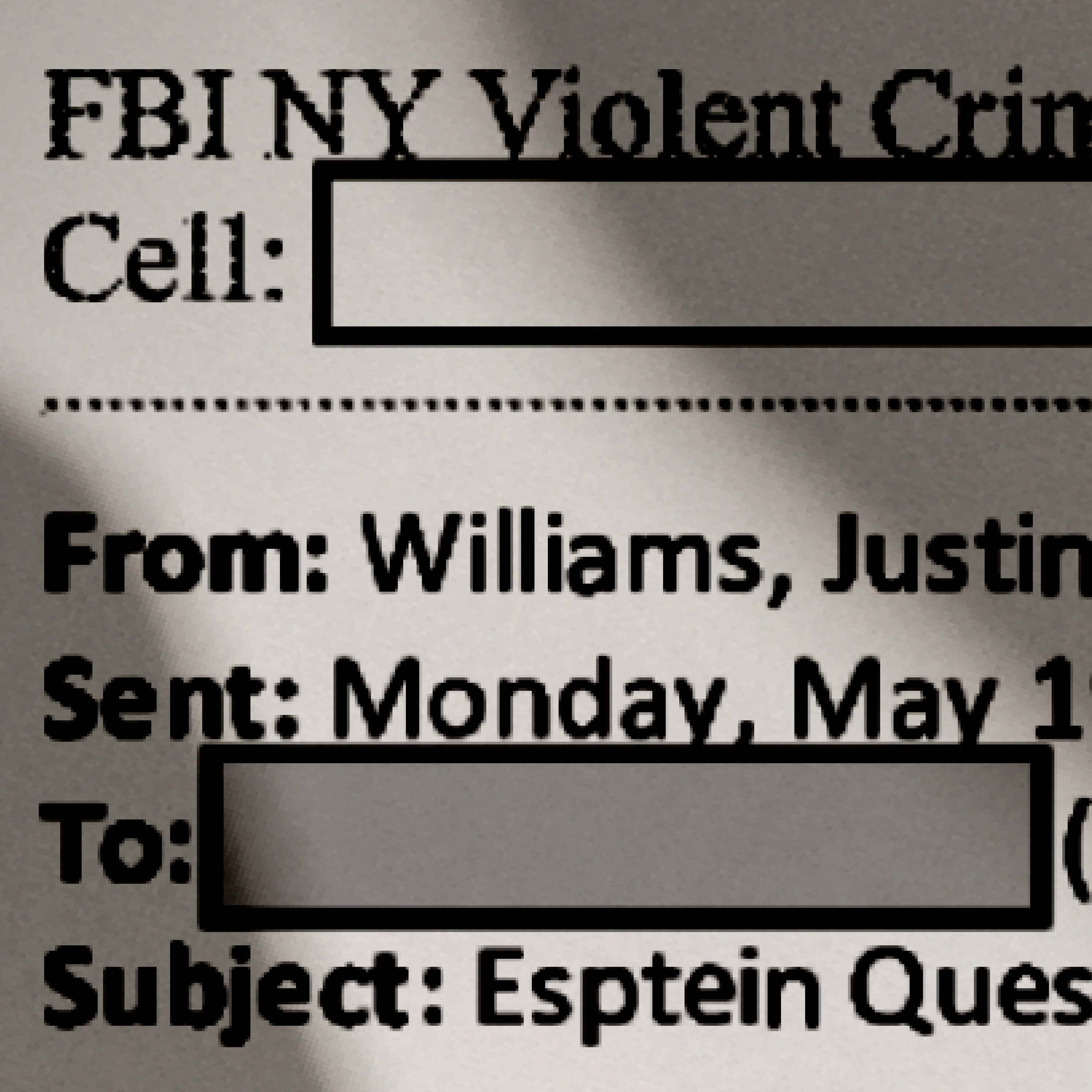
I want to talk about how the FBI turned over dozens of emails to me that revealed details about how hundreds of the Bureau's special agents and personnel from the Freedom of Information Act Office reviewed and processed the Epstein files earlier this year.
Plus the best chance forgetting the Epstein files released.
Let's go.
I'm investigative journalist Jason Leopold.
I spend most of my days getting documents from the government.
Speaker 1I'm attorney Matt Tapik, and I fight them in court to open their files when they don't want to.
Speaker 2From Bloomberg and no smiling, this is Disclosure, a podcast about buying loose government secrets, the Freedom of Information Act, and the the unexpected places that takes us.
Now, before we get into the documents, I recently pried loose and the rest of it.
Let's just recap what happened in Epstein Land these last few weeks, so, Matt.
Congress has now passed a bill which is called the Epstein Files Transparency Act, that compels the Department of Justice to release their files on Jeffrey Epstein within thirty days, and President Trump has already signed that into law.
Speaker 1Yeah, I thought that the speculation about would Trump sign it or out.
What's kind of funny is like he has the power himself to order get doj to release this.
He doesn't need Congress in order to do that.
It seems like it's taking an act of Congress to make them do it.
But it always felt a little weird to me, like he's signing a bill that's saying do what you ought to be doing.
Speaker 2Yeah, he could have released this at any time by just calling for the Justice Department to release it, which is exactly what he has done on other high profile political matters earlier this year.
Speaker 1Donald Trump has just said that he is going to release the files around the death of President JFK tomorrow.
Speaker 2The Trump administration has gone public with more than two hundred and thirty thousand pages of records related to doctor Martin Luther King Junior's assassination.
But what's interesting about this the Cepstein Transparency Act is what it allows the Justice Department to do, and it allows them to withhold certain information, particularly information within these files that could interfere with an ongoing law enforcement investigation, which in foyle Land Matt we like to refer to as the B seven A, well.
Speaker 1B seven A, but the investigations that would be the predicate for that or what like.
The President had requested that Attorney General Pambindi opened some investigations into Bill Clinton and some other Democrats or democratsretically inclined people, people that I believe the truth Social Post or whatever it was he posted it in like specifically referred to Democrats.
So just openly saying I want you to investigate some Democrats about this, and.
Speaker 2Not surprisingly they they're going to do that, it seemed.
But that directive by Trump came one week prior to the passage of this bill, and what we don't know is what does an investigation like that look like?
What are they going to investigate?
So Trump delivering this directive via truth Social to Pambondi, so that means that you know, whatever Epstein files they may have that relate to these folks could arguably be withheld.
Speaker 1Yeah, I mean I think that if they pull that, like I mean, there's a lot of angry people already about all this.
If they now are pull the rug out again and say, oh, you know, hardly release anything because of these ongoing investigations, I don't know what's going to happen.
I think there's going to be a lot of people that are going to be very upset about that.
Speaker 2So, Matt, this kind of gets at a fundamental question when we talk about the release of the Epstein files.
When we say Epstein files, what are we actually talking about.
This is a guy who is investigated by federal authorities starting around the mid two thousands.
He signed a controversial plea deal and did some light prison time, and then he was arrested again in twenty nineteen and accused of sex trafficking miners.
And the idea is that those investigations threw up a lot of paperwork, presumably about interviews with victims, evidence, names of associates and co conspirators.
So now with the Epstein Files Transparency Act, there's going to be a lot of discussion of what gets released and what may get withheld.
So the point of this, Matt, is that over the past year, I've been doing some document requests and following some other FOYA actions related to Epstein, and it all helps us get a handle on what's in the Epstein files and how the government has been handling them.
And as you know, Matt, this has been building since Trump took office again in January.
A lot of Trump's supporters want this information out in the public, and Trump seemed to say during the campaign that he'd do that, but by the summer that was looking less likely.
So in July, the Justice Department and FBI released a joint statement that said, it is the determination of the Department of Justice and the Federal Bureau of Investigation that no further disclosure would be appropriate or warranted.
Q.
The outrage, Yeah.
Speaker 1Right, I mean, there are a lot of people for whom this is the most important issue in American politics right now.
Well, and you're just telling them, yeah, we changed our mind, there's nothing to see here, move on.
Speaker 2Yeah, And this is the biggest political story of the year.
So earlier this year I found a wide ranging Foyer request for everything related to the processing of the Epstein files.
I was really interested in how the records were processed, and I was even more interested did within the context of how everything went down with the rollout of the Epstein files earlier this year.
What I was hoping was to get a look at what was going on behind closed doors with the Epstein records going back to the beginning of the new administration.
And remember, Matt just a few weeks after Trump was inaugurated back in February, his brand new Attorney General, Pam Bondi, calls a group of right wing influencers to the White House for an event because she has something to give them.
They walked out of the White House holding binders and hands them binders.
Look at what we got today, Let's say Epstein Files Phase one.
See that right there, that's the Epstein files.
Bondy has this kind of grand rollout, and so shortly thereafter, I mean, I want to say more like I'm almost immediately thereafter, the MAGA crowd goes nuts.
We frankly assumed this had at least some smoking guns.
And now it's a backlash.
That's not what's in this binder at all.
It's a backlash against Bondi.
It's a backlash against the FBI.
Speaker 1It is the biggest disappointment I think that you'll.
Speaker 2Find, because it turns out that these documents that were in the binder had been previously released in court cases and previously released by the FBI.
So it ignited a firestorm.
Speaker 1This is kind of their own folks, right, they invite all these people that are kind of from the MAGA world, and they do they think they're so stupid that they're not going to realize that these documents have already be outed and out there.
I mean, of course folks are going to pick over every document.
And like, I was this just incompetence or was it?
Did they were they trying to pull a fast one?
Or well I don't think they actually pulled a fast one.
Speaker 2I don't.
I just don't think they actually even looked at any of the files they were going to release.
And so what happened after that is Bondi, who had been really embarrassed by this, fires off a letter a letter to FBI Director Cash Paatel the AG demanding the release of the bureau's full and complete Epstein files.
Speaker 1So she's throwing Cash Patel kind of under the bus here, like, hey, what are you guys doing.
Speaker 2This stuff has already been released exactly, and she kind of blamed him for this.
She says, I repeatedly questioned whether this was the full set of documents responsive to my request, and as she later explains on Fox.
Speaker 3News, you're looking at these documents, going, these aren't all the Epstein files.
Speaker 2Bondi's letter to Patel goes on to say that she knows there are more Epstein documents.
She writes she has a source in the FBI field office in New York who told her so, and.
Speaker 3So a source said, ohoh, all this evidence is sitting in the Southern District of New York's shock.
Speaker 2So she then tells Cash Ptel that he has until February twenty eighth to have the FBI deliver the full and complete Epstein files to her office.
Speaker 3And we got hopefully all of them Friday at eight am, thousands of pages of documents.
Speaker 2And she goes on to say that she wants a full investigation as to why her order to the FBI originally wasn't followed.
Speaker 3Cash is going to get me and himself really a detailed report as to why all these documents and evidence had been withheld, and you know, we're going to go through it, go through it as fast as we can.
Speaker 2So, Matt, as you know, I actually asked for that detailed report, but they withheld it under a FOYA exemption.
But as I reported earlier this year for Bloomberg, after all this happens, cash Ptel directs FBI agents from the New York Field Office, the Washington d C.
Field Office, and personnel from the Records Information Dissemination Section or RIZ.
Those are the folks that process FOYER requests.
And they were all holed up in a facility in Virginia which is called the Central Records Complex.
So what do I mean by processing.
Well, when reviewing doc documents for a ventral release, FOYA officers have to determine what can be released and what needs to be withheld using nine exemptions under the FOYA.
For example, they would withhold information based on someone's personal privacy or an ongoing investigation.
And they begin processing these EPSTEIN files right they're they're they're pulling all nighters, they're you know, working twenty hour shifts just to process the Epstein files.
So I was really interested in what was taking place.
Behind the scenes, you know, how these requests were processed, how much money they spent on FBI personnel.
Speaker 1So this is like a this is like a meta request, right like you're you're trying to get it's a foya about a foya.
Yes, So most agencies, as they're processing requests, they have some kind of a database that they keep track of all the steps received, request forwarded to analyst, analyst rans search forty two thousand, search results narrowed with search terms sent, extension, letter to request, or like all those little details from a lot of agencies get tracked in some kind of a centralized database, and we usually refer to those as processing.
Speaker 2Those And that's informative because you sort of learn how these requests are processed and maybe even you know, learn about a record keeping system.
So I find that to be good information to get insight into how the agency is handling a foyer request.
Speaker 1It kind of reminds me of like the updates or texts I get from United Airlines about what's going on with my checked bag.
Like it'll say like it's like through the screening, you've been loaded onto the plane.
It's like it's on the cart, you know.
Yeah, but about way more detail than that.
Speaker 2So I filed multiple Foyer requests over the summer, and then Bloomberg sued to compel the really piece of these records, and recently the FBI released about sixty pages of emails and other documents I asked for related to the processing in the Epstein files.
So what do you get.
We have a bunch of emails and they're kind of heavily redacted, but there is still a lot of info in here, and there's some real interesting takeaways here.
Speaker 1So let's go through the timeline here.
So where does the story of the emails begin.
Speaker 2It begins in March, early March twenty twenty five this year.
There's an email here from the assistant director of the Information Management Division stated March tenth, and it says that we are prepared to receive boxes tomorrow as New York agents are traveling to the Washington Field office in the morning and will arrive to Winchester, that's the location of the Central Records Complex, where they will start photographing and we will start scanning and processing the physical files.
Why do you think that they were photographing the files?
Speaker 1Well, that's interesting because like regular paper documents, you would think they would just scan them, you wouldn't need to photograph them.
It suggests that potentially there's some things that aren't like documents, Like there could be physical evidence, right, there could be a.
Speaker 2Right, it could be anything.
It could be a beer bottle, it could be a hair brush, you know whatever.
Speaker 1Yeah, they might be taking photos of those physical items that you can't scan, but we're just kind of guessing at that at least for now.
Speaker 2Yeah.
The email goes on to say, once I see the volume, I'll have a better estimate of processing times.
Although I suggest we do a rolling delivery to further demonstrate the FBI's commitment to delivery and transparency.
Yeah.
Interesting, I mean, I think that's just funny because the FBI wants to demonstrate to the DOJ that its commitment to transparency.
It also says, by the way, in this email, and again this very early is March tenth, so it says that you know, in a meeting with the Criminal Division in New York and Washington Field offices, there were questions on the types of reactions the FBI should apply to these files, and then there's like just a really long redaction box.
Speaker 1So do we know anything from these emails about like what kinds of records the FBI was reviewing.
Speaker 2Oh yeah, yeah, I mean we do.
And it's kind of fascinating.
So on one page, they're discussing FBI search warrant execution photos, FBI interview videos, Julaine Maxwell's prison security footage, time lapsed video footage from an office, and in parentheses it says no persons identified and no crimes observed, street surveillance footage, aerial footage from FBI search warrant execution, police interview videos.
Speaker 1And you're just salivating.
See you're like, oh man, oh yeah, I gotta get this stuff.
Speaker 2And marketing videos, marketing videos, marketing videos.
I mean, this is what's this is what's identifying?
Do we not know?
I don't know marketing videos, Yeah, it's it's that like, is that.
Speaker 1Mister Epstein's like, come visit my island kind of marketing videos?
Speaker 2I don't know.
I mean, I'm trying to figure out what marketing videos.
Yeah.
Oh.
Actually, the other thing that's here is they're discussing the prison video of Epstein before he was found dead and after he was found dead, and they discussed this video and eight terabytes of data related to Epstein, so that is some thing that they were looking at as well.
Speaker 1So do these documents tell us anything about sort of the interactions between FBI and DJ, because, like you know, this is a little bit of a tense This is after the binders that really weren't anything new, right, So like you got a little bit of an awkward relationship between the FBI and the DJ.
Are they communicating with each other at all?
Here?
Speaker 2Great question?
I mean, in these records, it does not appear that they're communicating.
And in fact, there's one email that asked the question of did you happen to send the results of the below review to DJ at any point?
And the response is we definitely did not provide anything to DJ, just to HQ headquarters.
So it doesn't appear.
And this just may be the fact that it's early at least in these documents that the FBI released, that there's no communication with DJ.
But I also want to know that the FBI did withhold one hundred and sixty pages in its entirety.
Speaker 1Okay, so not a ton about the DOJ FBI relationship.
So do we learn anything about like did they do this in phases?
Like, how did they structure the processing?
Yeah, I see reference to like phase one in phase two.
Speaker 2Yeah, and so another document here.
You know, again this is all in March, and I think what's noteworthy is the bulk of the work was taking place in March.
You know, almost one thousand FBI agents in personnel working during the month of March.
Just plowing through these records.
You know, there's an email on Sunday, March twenty third, twenty twenty five, six forty three pm, so you can already see that they're working on the weekends.
Right stand by, we have identified more files requiring phase one review.
Please continue to refresh as files will be populated momentarily.
Speaker 1So do we know anything about what those phases mean?
Speaker 2Now?
Unfortunately the documents don't describe what those phases refer to what it actually means.
Speaker 1And it looks like so then upon completion of Phase two, the FBI is going to provide what they call see through redaction files for DOJ review, which to me reads like FBI is doing the work of identifying what to redect, but they're giving it to DOJ so DJ can see what the plan.
Speaker 2Is is that how you read that?
That's how exactly how I read that?
Speaker 1So Jason, in March, they're doing all this processing, So what's the next kind of big thing that happens.
Speaker 2Well, the next big thing, at least according to these emails, is April fifteenth, the tax day.
An email goes out to FBI personnel that says cash Patel quote asked for status of all remaining Epstein related reviews.
Makes sense, Yeah, it makes sense.
But there's no response to that email.
But Ptel is weighing in, right, The director of the FBI wants an update.
Where are we at, you know, with the Epstein files?
So when do they finish the review?
So it appears around May second is when they kind of wrap things up.
An FBI employee from the New York Field office sends an email and attached a document titled Epstein Overview Final that summarize their work.
Well do we what does?
What does it say?
Unfortunately, you know, the FBI withheld the attachment.
No, so they withheld those attachments citing a number of different FOYA exemptions such as attorney client privilege, the deliberative process, and others.
Speaker 1So they're taunting you.
They're taunting you by telling you what's there, but that you can't have it?
Speaker 2Can I tell you that?
As I'm reading these files and the subject lines refer to a PowerPoint or a document, I'm like clicking.
I'm clicking to see if there's any chance that like it will magically open up.
Did not.
It did not, Bummer, But importantly to me, like this is the biggest standout on these records.
So I asked how much money they spent on overtime, for example, for agents who are tasked with processing these records.
So go to page fourteen of the release.
Speaker 1Okay, so I'm looking at it.
It's a chart and then the division name column says Business Strategy and Analytics Section, Counterintelligence Division, counter Terrorism Division, Criminal Investigative Division, Cyberdivision, Directorate of Intelligence EAD, Information and Technology Branch, Finance and Facilities Division, Human Resources Division, and then everything else is withheld for secret investigative techniques that if released would harm some future investigations.
Speaker 2So these are all the divisions that were involved in the review of the STEAM files.
And how do we know that because the government released an index of what I requested and the FBI document types is how they refer to it.
And this is a resource planning office.
That's an office within the FBI report that documents the premium pay hours and premium pay is overtime, nighttime, differential hours, but more or less, you could think of it as overtime, and it's the number of hours they recorded on this project, right, That's how they refer to it.
The Epstein files.
They refer to as as a special redaction project.
And it's during the period of March seventeen through March twenty second, so five or six days, right.
Speaker 1So they're withholding from you the total amount of pay across each of those, but they are giving you the grand total of employees worked premium pay hours total in premium expenses.
So they just did not want to give you the breakdown.
I guess on the theory that somehow you could interfere with an investigation if they knew the specifics of how they staffed.
Speaker 2This up, but you at least know the totals.
Yeah, and those totals are kind of stunning.
There were nine hundred and thirty four employees that were involved in the processing and review of the Epstein files, fourteen thousand and two hundred and seventy eight premium pay hours worked for a total of eight hundred and fifty one thousand, three hundred and forty four dollars that the FBI spent on premium pay during the March seventeenth and March twenty second review of these files.
I mean, that's a lot of money.
That seems like a ton of money to me for the FBI to spend all this.
I mean it wasn't a national emergency.
Well, it depends who you ask, Yeah, true.
Speaker 1I mean I think there's a sizeable number of people, and I think they probably are skewing towards Trump supporters, for whom like this is like right, So I'm looking at these numbers.
I'm seeing eight hundred and fifty thousand, and that's just the overtime.
So you know, it's possible that the overtime might only be like maybe half of the total cost, So you could easily be looking at like a couple million dollars total.
The people are just working, which means they're not in the field investigating crimes.
They're not in the office processing Jason's other Foyer requests.
Like it's sort of they drop everything.
This is what they're doing, and all this work gets done and then Pam Bondi says there's nothing to see here, so nothing more is going to get released, right, So it sounds like by May second they've pretty much wrapped up.
And then in May DOJ tells Trump that his name appears in the documents.
Speaker 2Yeah, that's the timing of it.
And shortly thereafter, you know, we have this unsigned memo saying that they collected three hundred gigabytes of data, which is video, photographs, actual documents, and none of that, not a single document from that trove can be released.
Speaker 1All right, Well, the clock is ticking on the thirty day Epstein Transparency Act deadline.
So I guess that work wasn't a waste because it's gonna probably come in pretty handy, pretty quickly.
It's a good thing that they already did all this back in the summer.
Hopefully we're gonna start seeing some more stuff.
Speaker 2I want to segue into what may be in the Epstein files.
So earlier this year, I wrote about the under the Radar Freedom of Information Act lawsuit that was filed back in I think it was twenty seventeen.
It's nearly nine year old lawsuit that an attorney named Dan Novak filed on behalf of a reporter for what was Radar magazine at the time this foil lawsuit that he filed.
They were trying to get at that time all of the FBI's Epstein files.
And in this lawsuit that had been going on now for nearly nine years, the FBI released about twelve hundred pages of documents.
And these are the twelve hundred pages more or less that have been screenshotted and shared on social media.
And is this the same stuff that was in the famous binders?
Yeah, exactly where people who've been following this are like, what is this trash?
We've already seen this, right, that's exactly right.
So here's what happened.
I dig into this case and the FBI and the Justice Department essentially withheld the vast majority of records, at least ten thousand plus pages, because of an ongoing investigation.
I should go back and say they denied the request before they moved to a lawsuit.
They said to the reporter that you need to have a privacy waiver.
You need to get Epstein to sign a privacy waiver before returning over right, And he's.
Speaker 1Still alive then in twenty seven, Yeah.
Speaker 2He's still alive.
So they're going down the road of privacy waiver and a privacy excemption.
They sue, right, and so you know how it is.
I mean, we both know how it is.
This is dragging out for a while, but this is really long.
This is really it's really long.
The next thing, you know, what happens is fast forwarding here.
But Epstein gets arrested and so now everything is being withheld under B seven eight and ongoing law enforced.
Right, So they're not getting anything.
They're still arguing, going back and forth.
So these folks just continuously hit roadblocks and roadblocks and roadblocks and they're just unable to pry anything loose.
But they're fighting.
They're continuing to fight, right.
I respect that.
Speaker 1It's nice to hear you not be med at other PEO people making Foyer requests and filing lawsuits.
Speaker 2Yeah, I mean, I like when other people file Foy requests and lawsuits, as long as it's not for the same records.
I want fair.
So I go into the docket of this Foyle lawsuit that Radar filed trying to make these Epstein documents public, and on the docket is what's called a Vaughn index.
This specific document is very important as far as the Epstein files are concerned.
But before we get into that, Matt, can you explain what a Vaughn index is and the old Foyle lawsuit that gave rise to it.
Speaker 1Yes, Jason, it comes from a case called Vaughn versus Rosen, and I think kind of like the nineteen seventies, and what used to happen is agencies would withhold a bunch of stuff and then they would just dump all the documents on the court in the lawsuit and be like, here you go, court, you tell us it's called in camera review, like where the court in chambers, not in public reviews these documents.
So agencies were just kind of like dumping all this stuff, and eventually the courts you're like, yeah, we're not cool with that.
You've got to make an index of what all these documents are, just describe them, at least in some level of generality, and identify the specific exemptions that you're claiming for each one of those.
So that has become known as a Vaughn index.
So it's what it sounds like.
It's a listing of all the documents.
And sometimes the Vaughn index can have a whole lot of interesting information even if you can't get the documents right.
Speaker 2And we've received many Vaughan indices in our l lawsuits.
Yeah, routinely.
Yeah, and they're extremely to me, it's extremely valuable just to even have a general overview of what the documents are that they're worth holding.
Speaker 1So I was talking to who and when they're talking, like, even if you don't know what they're saying, it can be really interesting like oh, this person was involved or huh, that timing is really interesting as to when things were happening.
And you can usually get those kinds of details.
Speaker 2Yeah, and I feel like their news were then you could write a story out of it.
You have written stories out of it.
Oh yeah, I thought this one was really important.
And it doesn't seem like anyone you know, even knew it was out there.
It had some pretty i'm good detail of what the documents are that the FBI had as it relates to Jeffrey Epstein, And obviously it's a sliver, but what would be in the Epstein files that are now supposed to be released.
And the index says that the FBI processed but withheld information it obtained from confidential sources, letters addressed to then US Attorney for the Southern District to Florida, alex Acosta.
He was the one that ultimately authorized that non prosecution agreement with Jeffrey Epstein.
Subpoenas to MySpace, remember my space?
Oh yeah, that's specifically in this Vaughn index.
The handwritten notes of FBI agents, photographs, grand jury subpoenas is all listed out in the index.
Yeah, and bank records communications with foreign government agencies.
I thought that was really really interesting.
Of course, there are three O two's tell everyone of FBI three O two.
Speaker 1Is FBI three H two is a summary of an FBI interview with someone.
Speaker 2So in this Vaughn index, so I counted, right, because it describes the three H twos here.
And mind you, this index relates to the investigation that the Justice Department and FBI took on between two thousand and six, and you know when fsc and pleaded guilty in two thousand and eight.
So I counted, and it reveals that the FBI conducted at lease according to this Vond index, fifty five interviews with witnesses, victims, potential investigative targets, and importantly, bank records so you know, I'm hoping we get a chance to see those.
But here's what I like really zeroed in on is that it shows that some of the documents that were processed and withheld from Radar Magazine are from twenty eleven and include dozens of photographs and agents, interview summaries of third parties, and documents provided to the FBI by confidential sources.
Speaker 1That's twenty eleven, twenty eleven, you get charged in twenty nineteen.
Speaker 2No, so we're only talking about the first investigation right two thousand and six through two thousand and eight.
But it looks like the FBI never really closed it is that it remained active because there's documents from twenty eleven.
So I just wanted to get your take on this, because we've dealt with the FBI a lot.
Do you think that people may have just been coming in and just collecting evidence and submitting it to the investigative file or could this be kind of evidence that the FBI still had an active investigation in twenty eleven, three years after Epstein had pled guilty and at that point was already out of jail.
Speaker 1I mean, that's pretty hard to tell.
I mean wouldn't surprise me if victims and others continued to come to the FBI for good reason dissatisfied with the minimal punishment that he had gotten to that point.
In whether the FBI did anything with that, we really don't know unless the Vaughan Index shows like more activity at the time.
But if all you have is like a listing of a bunch of three h twos of witness interviews, that it's hard to really say if they were actively investigating or just sort of passively receiving information.
Speaker 2Right.
Yeah, And based on my reporting, the FBI doesn't typically close investigations.
They're sort of keeping it open.
That's just my experience, right.
Speaker 1For in these circumstances, that would make perfect sense.
Speaker 2Yeah, and I didn't see anything in the Vaughn Index that indicated there was like a case closing memorandum, an actual document there.
So I dug into this over the summer.
This was during that time where everyone was just kind of clamoring these Epstein files because this was immediately after the Justice Department FBI said we're not going to release anything.
So now Radar Magazine is eight years into its lawsuit to get the Epstein records.
At this point, they know the FBI has reviewed the records, and the FBI and the DOJ say they're not going to release more records.
So the Radar lawsuit has some new urgency.
It looks like they have a pretty clear path to say you have to release the records.
But then Julaine Maxwell appeals her case Dlayne Maxwell.
We now see that her attorney renewing his requests for the Supreme Court to overturn her conviction.
So there's Radar Magazine again with like ah Man.
This is still an ongoing law enforcement proceeding, so they still can't get anything.
And now that the Supreme Court has rejected Maxwell's petition, Dan Novak and Radar Magazine has now appealed to the Second Circuit and so there's an oral argument set for January twenty eighth.
So I still think, Matt, I just want to see what you think this Foyer case is the best actually the best chance of getting anything from the Epstein Files versus Congress's Epstein Files Transparency Act.
Yeah.
I think for a couple reasons.
Speaker 1I mean, first, I think that the Vaughn Index is going to be a check on whatever gets released, like if you see that there's things on the Vaughn Index that don't get released, then there's some splaining to do.
Right, but the lawsuit also has teeth.
The Epstein Act has no teeth.
If DOJ decides to violate it, there's no private cause of action.
You and I can't file a lawsuit over that.
You need to have a Foyer case.
And so so that case could end up being the legal vehicle by which the Epstein Act release actually gets challenged.
I mean, there's so many twists and turns to this, and like people get charged, and people die, and it impacts what can be with helld or not, and it's up and down on appeal and all this stuff going on.
And so that's got to be frustrating to go after that long.
But now it's it's it almost turns out it does turn out that, like it's great, rightly there is a live, active Foya case right now that can be the vehicle by which if the DOJ is trying to get away with withholding things.
Speaker 2That's how they can be held accountable for that.
Speaker 1In how we can courts can guarantee in the public can guarantee that they're actually releasing everything that they're supposed to release because the track record ain't that great so far.
Speaker 2That's kind of how I felt as well.
It's like, this is really the best course of action for the public to kind of see what's going on.
It will be interesting if the government argues that, well, Donald Trump is now called for an investigation into Democrats, so we're going to keep withholding is because of an ongoing investigation.
Speaker 1Yeah, and that's you know, I mean, it depends on how bold they are on trying to make those with holding.
And I think they're given the memo from July.
I was representing you right now in a case on this, and they said, oh, well, there's these investigations, I think you can make dogument that's a sham.
They already said that there isn't any predicate to investigate anybody else.
Speaker 2That's right, and doj and FBI, I said in their joint statement from July quote, there was also no credible evidence found that Epstein blackmailed prominent individuals as part of his actions.
We did not uncover evidence that could predicate an investigation against uncharged third party.
Speaker 1So the fact that they're now claiming they're going to do investigation it's not a real investigation, so it doesn't count for foya purposes.
That's how I would argue that, I don't know some you know, I think there's a fair.
Speaker 2Chance of succeeding on that, but no guarantees.
I mean, the timing couldn't be better for Radar magazine, right, they file this back in twenty seventeen, so they're coming up on nine years.
That's a really long time.
But man, the fact that they're still fighting at this very moment, where the Epstein files have become the biggest political story of the year, that's wild.
So, as I mentioned, there's a hearing in the Second Circuit, an oral argument that's scheduled for January twenty eighth.
And let me just let me, let me just explain.
Speaker 1So that's the Court of Appeals that covers the trial courts that are in New York and some other adjacent states.
The country is divided into a series of different regional courts of appeals, so it's above the trial court and it's before the Supreme Court.
Speaker 2An oral argument.
Speaker 1Explain it, man, oral argument is the parties have filed their briefs and then they come in and they answer the judges questions and they make their arguments and those are open to the public.
I got a feeling that it's going to be a packed court room with overflow rooms.
Speaker 2Yeah, and it's interesting because it's coming, you know, it's happening right after kind of the deadline for when the Justice Department is supposed to turn over everything in the Epstein files.
So I just want to ask you this question, Matt.
So let's say the Justice Department does turn over everything in the Epstein files to Congress, as they are required to do under the law.
Would those same records be responsive to this FOIL lawsuit.
Speaker 1Well, the scope of that request was, like all records from the FBI's investigation, right, all documents relating to the FBI's investigation and prosecution of Jeffrey Epstein.
Now they made their request in twenty seventeen.
Yeah, there could be a dispute about whether documents after that date get included or not.
I mean, it certainly would be cut off.
At whatever point the FBI searched then that would typically be the cutoff.
Sometimes it's the date of the request.
Sometimes it's whenever they do the search.
So there could be some later stuff, like you know, because he When did he When did he die?
Twenty nineteen, twenty nineteen.
Yeah, so there's a couple of years there, two thousand nine, a.
Speaker 2Little bit of there, maybe a little bit of indulgent.
Well, I guess we'll see what happens whether or not the Justice Department releases the Epstein files to Congress, And I guess we'll see what happens in late January in the Radar Foil lawsuit for the FBI files.
An upstick from Bloomberg and No Smiling.
This is Disclosure.
The show is hosted by Matt Topic and me Jason Leopold.
It's produced by Heather Schroing and Sean Cannon for No Smiling.
Our editor for Bloomberg is Jeff Grocott.
Our executive producers for Bloomberg are Sage Bauman and me Jason Leopold, and our executive producers for No Smiling are Sean Cannon, Heather Schrowing, and Matt Topic.
The Disclosure theme song is by Nick, with additional music by Nick An Epidemic Sound.
Sound design and mixing is by Sean Cannon.
For more transparency news and important document thumps, you can subscribe to my WEEKLYFOYA Files newsletter at bloomberg dot com slash Foya files that's Foia files.
To get every episode early on Apple podcasts, become a Bloomberg dot com subscriber today.
Check out our special intro offer right now now at bloomberg dot com Slash podcast offer, or click the link in the show notes.
You'll also unlock deep reporting data and analysis from reporters around the world.
We'll see you again next Tuesday.
Okay, opening the link.
Do do Do Do Do Do Do Do