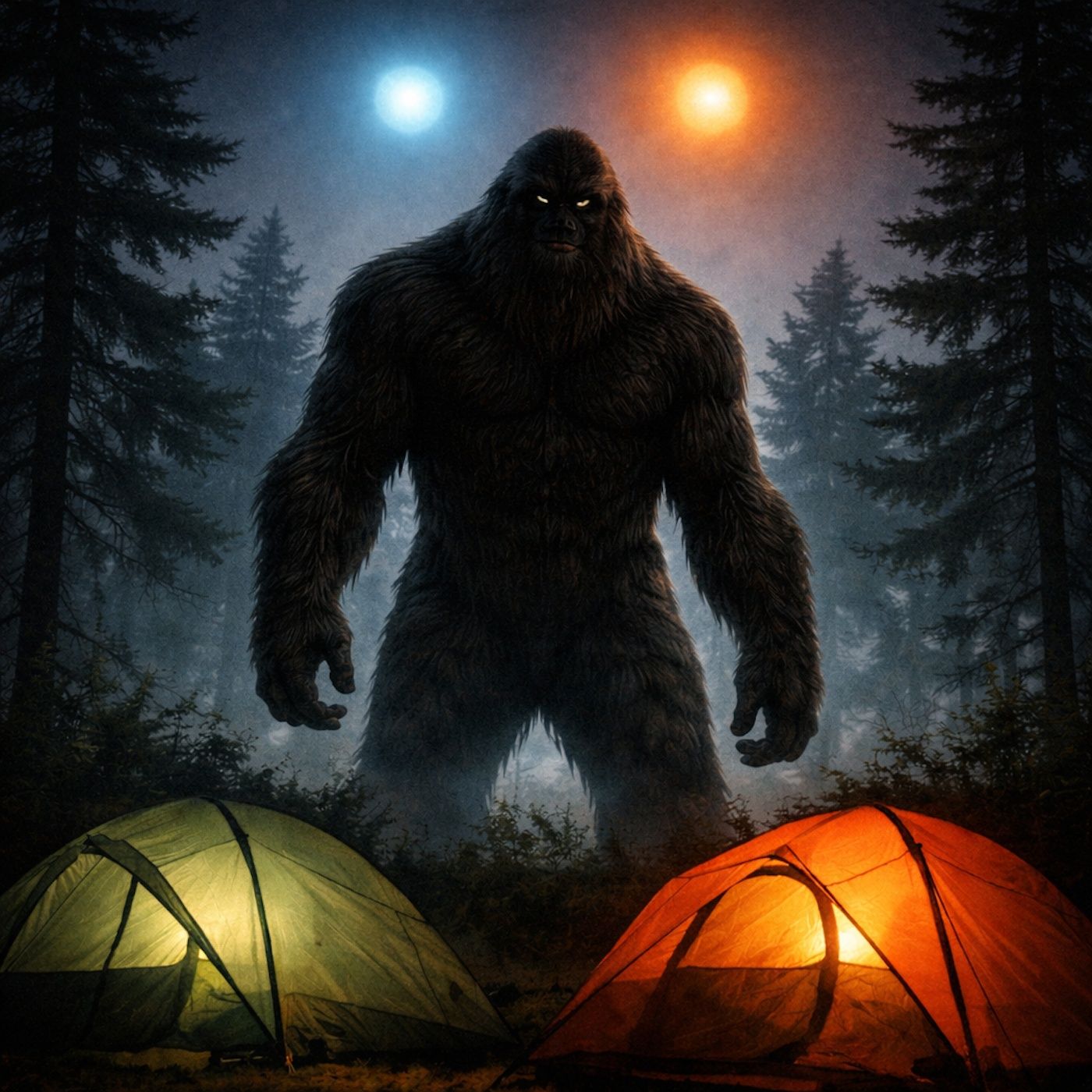
BWBS Ep:176 Bigfoot Killed An Alligator!
Episode Transcript
S S.
Speaker 1S S S.
There's something about the woods at night that changes a person.
I've spent nearly forty years chasing these stories, forty years of sitting across kitchen tables from men and women who've seen something that doesn't fit into the world.
Speaker 2We think we know.
Speaker 1And in all that time, I've learned one thing for certain, the wilderness keeps secrets.
I want you to do something as long as you aren't driving, of course, and you can do it safely wherever you are.
Right now, I want you to close your eyes for just a second.
Think about the last time you were truly alone in nature.
Not a state park with trail markers every fifty feet, not a campground with RVs humming in the background, I mean really alone, miles from the nearest road, miles from the nearest person.
Can you feel it, that subtle shift in the air when you realize just how small you are, how vulnerable.
Good hold on to that feeling, because tonight I'm going to introduce you to six people who know that feeling better than most.
Six people whose lives were changed forever by encounters they never expected, never wanted, and we'll never forget.
These stories come from different decades, different states, different walks of life, but they all share something in common.
Every single one of these witnesses walked into the wilderness believing they understood it, and every single one walked out knowing they were wrong.
Some of what you're about to hear will sound unbelievable.
Speaker 2I get that.
Believe me.
Speaker 1I've been on both sides of this conversation.
But I've looked into the eyes of these people.
I've heard the way their voices crack when they describe what they saw.
I've watched grown men break down and weep remembering a night that happened decades ago.
These aren't stories made up for entertainment.
These are confessions, testimonies from people who never planned to talk about what happened to them, people who've spent years trying to convince themselves it was a dream, a hallucination, a trick of the light.
But deep down they know, and after tonight, so will you.
I want to be clear about something before we begin.
I'm not here to convince you that Sasquatch exists.
That's not my job, and frankly, it's not my goal.
What I'm here to do is share these accounts exactly as they were told to me.
No embellishment, no dramatization, no editorial spin, just the raw, unfiltered experiences of people who saw something they couldn't explain.
Whether you believe them or not is entirely up to you.
But I'd ask you to do one thing as you listen.
Put yourself in their shoes.
Imagine it was you out there in those woods, alone in the darkness, facing something that shouldn't exist.
How would you react, what would you do?
And more importantly, would you ever tell anyone?
So settle in turn down the lights if you want.
Our first story tkes us to the redwood forests of northern California.
The year is nineteen sixty three, and a young logger named Harold Vance is about to learn that some trees hide more than shadows.
Harold Vance was twenty four years old in the summer of sixty three, and he thought he knew these woods.
He'd been working timber since he was seventeen, following his father into the redwoods the same way his grandfather had followed his father.
Before that, three generations of Vance men had made their living among these ancient trees, and Harold figured he'd spend his whole life doing the same.
He was wrong about a lot of things that summer.
The camp was set up about fifteen miles east of Arcada, deep in a section of old growth forest that the company had just opened for harvesting.
There were nine men in the crew, all of them experienced, all of them practical, level headed types who didn't have much patience for ghost stories or superstition.
That changed on the night of July fourteenth.
Harold told me this story in two thousand and four, sitting on the porch of a nursing home in Eureka.
He was sixty five years old then, and his hand shook when he lit his cigarette.
Not from age, he told me, they'd been shaking for forty one years.
We'd been out there about three weeks, Harold said, And I want you to understand something.
There wasn't anything unusual about those first weeks.
Nothing strange happening, no weird feelings.
The forest was just the forest, same as it had always been.
He took a long drag and watched the smoke curl away.
That's what made what happen so hard to accept.
It wasn't like we were already spooked.
We weren't looking for trouble.
We were just doing our jobs.
The trouble started with the smell.
Harold described it as something between rotting meat and wet dog, but worse than either of those things alone.
It would drift through the camp at odd hours, sometimes in the middle of the night, sometimes just before dawn.
The men would wake up gagging, covering their faces with their blankets, but by the time they got up to investigate, the smell.
Speaker 2Would be gone.
Speaker 1Frank Morrison, our crew boss, he figured there was a dead elk somewhere nearby, Harold said, told a couple of the guys to take a walk around the perimeter and find the carcass so we could burn it.
They spent half a day looking, didn't find anything.
The smell came and went for about a week.
Then came the sounds.
Harold's bunk was near the east edge of camp, closest to the tree line.
The first night he heard it, he was lying awake around two in the morning, thinking about a girl he'd met in town the weekend before, the kind of thoughts that keep a young man staring at the ceiling when he should be sleeping.
Then something screamed, I've heard mountain lions.
Harold told me, I've heard bears, I've heard just about every animal that lives in these woods, and I'm telling you right now this wasn't any of them.
His hands shook harder.
It started low, almost like a moan, Then it built up and up until it was this high pitched shriek that made my whole body go cold, felt like someone was dragging a knife down my spine.
The scream lasted maybe five seconds, then silence.
Harold lay there in the dark, not moving, barely breathing.
He could hear the other men stirring in their bunks, but nobody spoke, nobody got up to check.
They just lay there, waiting, listening.
The scream came again about an hour later, same direction, same awful sound.
This time it was answered by another scream from somewhere to the north.
There were two of them, Harold said, at least two, and they were communicating.
I don't care what anybody says.
That wasn't random animal noise.
They were calling to each other.
The next morning, the men gathered around the cook fire and did what men always do when they're scared but don't want to admit it.
They made jokes, nervous laughter, theories about bobcats and owls and sounds carrying weird through the Frank Morrison listened to all of it with a tight jaw and didn't say much.
But Harold noticed something that nobody talked about.
Half the crew had dark circles under their eyes.
Coffee consumption doubled that morning, and when it came time to head out to the cutting area, nobody wanted to walk on the east side of the group.
That night, Morrison posted a watch two menu at a time, armed with rifles, walking the perimeter in shifts.
Harold pulled the three to five shift with a man named Pete de Luca, a quiet Italian guy from Sacramento who'd been logging almost as long as Harold's father.
Pete didn't talk much, Harold remembered, but that night, while we were walking the edge of camp, he grabbed my arm and stopped me, just stopped me dead in my tracks.
Pete pointed into the trees.
At first, I didn't see anything, Harold said, just darkness, just trees.
Then my eyes adjusted and I saw it.
About fifty yards from the edge of camp, standing between two massive redwood trunks, there was a shape something tall, something that didn't move.
It was watching us, Harold said, I could feel it watching us, the way you can feel someone staring at the back of your head.
Every hair on my body stood straight up.
Harold described the figure as massive, not just tall, but wide shoulders that seemed impossibly broad.
Even at that distance.
It stood upright, perfectly still, just inside the tree line, where the moonlight couldn't quite reach.
We stood there for what felt like ours, Harold said.
Neither of us moved, neither of us raised our rifles.
I don't know why I'd shot at bears before without thinking twice, but something about this thing, something about the way it stood there, I couldn't make myself move.
Pete was the same way.
His rifle hung at his side, his grip loose, his eyes fixed on the shape in the trees.
Later he told Harold that he'd felt paralyzed, not from fear exactly, but from something else, something deeper, a primal instinct that told him raising his weapon would be the worst mistake of his life.
Then the figure shifted.
It turned its head, Harold said, just slightly, just enough that I caught a glimpse of its profile against the lighter trees behind it, and that's when I knew his cigarette had burned down to the filter.
But he didn't seem to notice.
That's when I knew it wasn't a bear, it wasn't a man.
It was something else.
The figure stepped backward, deeper into the forest and vanished without a sound, no footsteps, no breaking branches.
One moment it was there, and the next moment, the space between those trees was empty.
Harold and Pete didn't speak for the rest of their shift.
When they got back to camp, Pete went straight to his bunk and lay down facing the wall.
Harold sat by the dead cook fire until sunrise, watching the tree line, waiting for the shape to return.
It didn't, but the next night everything changed.
The crew had finished their work early, a big section of Douglas fir had come down cleaner than expected, and Morrison decided to let the men knock off around four in the afternoon.
Some of them went fishing at a creek about a mile north.
Some of them played cards in the main tent.
Harold decided to take a walk.
I don't know why, he told me.
Something just pulled me toward those trees the same direction where Pete and I had seen that thing the night before.
I know how stupid that sounds, but I felt like I needed to go, look like I needed to understand what I'd seen.
He walked for about twenty minutes, following a faint game trail that wound through the undergrowth.
The afternoon light filtered through the canopy in long, golden shafts, and the forest was quiet.
Too quiet, Harold realized later.
No birds, no squirrels, nothing moving except him.
The deeper he went, the more the silence pressed in around him.
It wasn't natural.
Forests are never silent.
There's always something rustling, something calling, something moving through the underbrush.
But that afternoon the woods around Harold were as quiet as a church.
At midnight, he found the spot where the figure had stood.
The ground between those two red woods was soft, covered in decades of fallen needles, and pressed into that soft earth were footprints.
They were huge, Harold said, easily twice the size of my boots and deep.
Whatever made those prints was heavy.
I'm talking five six hundred pounds at least, maybe more.
Harold counted seven prints before they disappeared into harder ground.
The stride between them was longer than he could match with his own legs at full stretch.
He knelt down and placed his hand inside one of the prints, feeling the compression of the soil, the depth of the heel, the distinct impressions of individual toes, five toes, just like a human foot, scaled up to something monstrous.
He stood there, staring at those prints, and something inside him went cold.
I realized I wasn't alone, he said.
I don't know how I knew, I just did.
Something was watching me, something close.
The hair on the back of his neck stood up.
That primitive alarm system buried deep in the human brain, the one that kept our ancestors alive on the savannah millions of years ago, was screaming at him to run, but Harold couldn't run.
His legs had stopped taking orders.
Harold turned around slowly.
It was standing about thirty feet behind him.
I'd walked right past it, Harold said.
It had been there the whole time, just standing in the shadows, watching me examine those footprints, and I'd walked right past it.
In the daylight, Harold could see what the darkness had hidden the night before.
The creature was covered in thick hair, dark brown with reddish highlights where the sun touched it.
Its arms hung past its knees, ending in hands that looked disturbingly human despite their size.
Its chest was barrel shaped, built like nothing Harold had ever seen on a living thing.
The proportions were all wrong.
The torso was too long, the legs slightly shorter than you'd expect on something so tall.
The neck was almost nonexistent, the head seeming to sit directly on those massive shoulders, and the shoulders themselves were impossibly wide, like a wall of muscle and bone that could stop a charging bull.
But the face, the face was what Harold couldn't forget.
It wasn't an ape's face, he said.
It wasn't a man's face.
It was something in between, something that shouldn't exist.
The brow was heavy, with ridges above the eyes like shelves of bone.
The nose was flat and wide.
The mouth was just a dark line, no lips that I could see, But the eyes.
Harold stopped and lit another cigarette with trembling hands.
Speaker 2Stay tuned for.
Speaker 1More Backwoods bigfoot stories.
We'll be back after these messages.
The eyes were intelligent, he said, not animal intelligent, not like looking into a dog's eyes or a horse's eyes.
This was different.
This thing was thinking, It was making decisions.
It was studying me the same way I was studying it.
The creature's eyes were dark, almost black, sat deep beneath that heavy brow, But there was something behind them, a depth and awareness, a presence that Harold had never encountered in any animal.
Those eyes held him in place, pinned him like a butterfly on a collector's board.
They stood there, man and creature, separated by thirty feet of ancient forest.
Harold said he couldn't have moved if he wanted to.
His legs felt like they'd been filled with concrete.
His heart was pounding so hard he could hear it in his ears.
Sweat ran down his back despite the cool forest air.
Then the creature made a sound.
It wasn't a scream, Harold said, not like what we'd heard at night.
This was different, lower, almost like a growl, but with something else underneath it, something that sounded almost like words, like it was trying to communicate.
The sound started in the creature's chest, a low rumble that Harold felt as much as heard.
Then it rose through its throat and emerged as a series of guttural vocalizations, not random noise.
There was a pattern to it, a rhythm that suggested meaning, even if Harold couldn't understand what that meaning was.
Harold didn't respond, couldn't respond.
He just stood there, frozen while the creature watched him with those dark, intelligent eyes.
After what felt like an eternity, the creature turned and walked away, not running, not hurrying, just walking, calm and deliberate, deeper into the forest until the undergrowth swallowed it completely.
Speaker 2And even then.
Speaker 1Harold could track its progress by the subtle movement of branches, the slight disturbance of ferns.
It wasn't trying to hide.
It had simply decided to leave.
Harold didn't remember walking back to camp.
The next thing he knew, he was sitting by the cook fire, shaking so hard his teeth were chattering, and Frank Morrison was asking him what the hell had happened?
I told them, Harold said, I told them everything, every detail, and you know what happened.
He laughed, but there was no humor in it.
They didn't believe me.
Nine men, and not one of them believed me.
They thought I'd been drinking, thought I'd had some kind of episode.
Some of them even laughed.
Morrison was the worst.
He accused Harold of trying to spook the crew, of making up stories to get out of work.
A couple of the younger guys suggested maybe Harold had seen a bear, that fear had made it look bigger than it was.
Only Pete de Lucas stayed quiet.
He'd seen the shape in the trees.
He knew what was out there, but Pete didn't say anything.
He just stared at the fire and kept his mouth shut.
Harold quit the crew the next morning, walked fifteen miles back to the nearest road and hitchhiked to Arcata.
He never worked in the timber industry again.
I tried to forget about it, he told me.
I tried for forty years, but some things don't let you forget.
He looked out at the parking lot of the nursing home, but his eyes were seeing something else, something far away and long ago.
It's still out there, he said, in those redwoods.
I know it is, And sometimes late at night, when the world is quiet, I can still feel it watching me.
Harold died three years after our interview.
Lung cancer finally caught up with all those cigarettes.
But before he passed, his daughter told me something that still haunts me to this day.
In his final weeks, Harold started talking in his sleep, mumbling words that nobody could understand.
But one phrase came through clear, over and over again.
It knew my name.
Our next story takes us north and forward in time to the rain soaked forests of Washington State in the summer of nineteen seventy seven, where a family vacation is about to become a nightmare that three children will carry for the rest of their lives.
Linda was thirty two years old when she and her husband, Robert, packed their three kids into a station wagon and drove from their home and Tacoma to a campground on the Olympic Peninsula.
It was supposed to be a celebration.
Robert had just been promoted to regional manager at the insurance company where he'd worked for eight years.
The kids were out of school for the summer, and Linda had found a brochure for a beautiful campground nestled in the old growth forest, complete with hiking trails in a crystal clear lake.
We'd never been camping before as a family, Linda told me when I interviewed her in two thousand and nine.
Speaker 2We were city people.
Speaker 1Both Robert and I grew up apartments, but we wanted our kids to experience nature, to understand that there was a world outside of concrete and traffic lights.
She paused and shook her head.
Be careful what you wish for.
The drive took about four hours.
Robert at the wheel, Linda navigating with a map spread across her lap, and the three kids crammed into the back seat.
Tommy was eleven, Sarah was nine, and little Michael was just five, still young enough that he needed a booster seat.
The kids were so excited, Linda remembered they'd never seen trees that big.
Tommy kept pressing his face against the window, trying to count the ones that were wider than our car.
Sarah made up a game where she'd try to find animals hiding in the forest.
Dear, she said, maybe even a bear.
Michael just kept asking when we were going to get there.
When they pulled into the campground, Michael started crying because he thought the trees were going to fall on us.
Linda had to hold him for ten minutes, assuring him that the trees had been standing for hundreds of years and weren't about to fall now.
Eventually he calmed down, but he kept looking up at the canopy with wide, worried eyes.
The campground was small, maybe twenty sites, scattered through the forest, connected by gravel paths that wound between the massive trunks.
Only a few other families were there that week, and the ranger who checked them in mentioned that business had been slow all summer.
He said something odd when he gave us our side assignment, Linda said.
He told us to make sure we stored our food properly and to keep the kids close after dark.
Not because of bears, he said.
Bears aren't the problem out here.
Linda shivered.
I asked him what he meant, and he just shook his head and handed us our permit.
Linda wanted to push him for more information, but Robert was already unloading the car and the kids were running around the campsite like they'd been let out of prison.
She let it go, filed the ranger's warning in the back of her mind, and got to work setting up the tents.
The first two days were perfect.
Robert and Tommy went fishing at the lake and caught three trout that they cooked over the campfire.
That night, Sarah collected pine cones and pressed flowers in a notebook she'd brought from home.
Michael followed his older siblings everywhere, asking questions about everything he saw.
We were so happy, Linda said, for those two days, we were the family I'd always dreamed we could be, no television, no telephone, just us and the forest and each other.
But even during those perfect days, Linda noticed small things that didn't quite add up.
The forest was quieter than she'd expected.
Sometimes, while the kids were playing, the birds would suddenly stop singing.
The silence would last for maybe thirty seconds, then everything would go back to normal.
Robert said it was nothing, probably a hawk flying overhead, but Linda wasn't so sure.
On the third night, Linda woke up around midnight to the sound of footsteps.
Robert was asleep next to me in the tent.
She said, I could hear the kids breathing in the smaller tent right beside ours, but outside, something was walking around our campsite.
The footsteps were heavy, deliberate.
Whatever was making them was taking its time, circling the tents in a slow measured pace.
Linda lay there in the darkness, listening, her heart climbing into her throat.
The steps would pause, occasionally, stop for ten or fifteen seconds, then resume, like whatever was out there was examining things, checking their campsite, the way a building inspector might check a construction site.
Then she heard something else breathing.
She said, something was breathing right outside our tent.
Not the normal sounds and animal makes This was different.
This was deliberate, like whatever was out there wanted us to know it was there.
The breathing was deep and slow.
Each inhale seemed to last forever, followed by an exhale that Linda could almost feel against the tent fabric.
The rhythm was patient, unhurried, like whatever was making that sound had all the time in the world.
Linda reached over and shook Robert awake.
By the time his eyes opened, the breathing had stopped, the footsteps had stopped, the forest was silent.
He thought I'd had a nightmare, Linda said.
He told me to go back to sleep, that we'd look around in the morning.
I wanted to believe him.
I wanted so badly to believe that I'd imagine the whole thing.
Speaker 2She hadn't.
Speaker 1In the morning, they found the footprints.
The ground around their campsite was soft from recent rain, and pressed into that mud were tracks unlike anything Robert or Linda had ever seen.
They were shaped like human footprints, but enormous, eighteen inches long, maybe longer and deep.
Whatever had made them was incredibly heavy.
The print circled both tents in a complete loop.
They paused at the corners, at the tent flaps, at the spot where they'd stored their food in a hanging bag.
Whoever, whatever had made those prints had been thorough.
Robert went pale.
Linda remembered he tried to tell me it was a prank, some kids from another campsite, playing a joke, but we both knew that wasn't true.
You could see in his eyes that he knew.
Linda walked the perimeter of their camp site.
Following the tracks.
They led away from the tents toward the tree line, getting further apart as they went, like whatever had made them was taking longer.
Speaker 2Strides as it left.
Speaker 1Then, about fifty feet from camp, they simply stopped.
One final print, pressed deep into the mud, and nothing beyond it.
It was like it vanished, Linda said, or like it wanted us to think it had.
They broke camp that morning.
Robert wanted to leave immediately, get the kids in the car, and drive straight home, but Linda made a decision she would regret for the rest of her life.
I thought we were overreacting, she said.
I thought we were letting fear ruin our vacation.
The kids were so disappointed when we started packing up, so I convinced Robert to stay one more night.
The look in Robert's eyes told her he disagreed, but he loved her and he trusted her judgment, and so he unpacked the car and pretended everything was fine.
For the kid's sake, he said, they didn't need to know their parents were terrified.
The day passed slowly, nobody wanted to wander far from the campsite.
Tommy asked about the footprints, and Robert told him they were from a very large bear.
Sarah wanted to know why bears had feet shaped like people.
Michael didn't ask anything.
He just sat on a log near the fire pit, clutching his stuffed elephant, watching the trees.
Michael had always been a sensitive kid, Linda said, he picked up on things that the older kids missed, and all day he kept looking toward the forest, not at anything specific, just looking like he knew something was there.
Around noon, Michael tugged on Linda's sleeve and said something that sent a chill through her.
Mommy, the trees have eyes.
Sunset came around eight thirty.
Robert built a fire, more to keep their spirits up than for warmth.
Linda made hot dogs and s'mores, trying to recapture some of the joy they'd felt on those first two days, but the mood had changed.
Even Tommy, who'd been fearless all his life, kept glancing over his shoulder.
Sarah asked if they could sleep in the car.
Robert said no, that there was nothing to be afraid of, that they were going to have a great night, But his voice was too bright, too cheerful, the way adults sound when they're trying to convince themselves as much as their children.
They went to bed around ten.
Linda couldn't sleep.
She lay in the tent next to Robert, listening to every sound the forest made, the wind in the branches, the distant call of an owl, the creak of trees swaying in the darkness.
Robert's breathing eventually deepened into sleep.
Linda lay away, staring at the tent ceiling, counting the seconds between sounds.
Then Michael started screaming.
Linda was out of her sleeping bag before she fully understood.
Speaker 2What was happening.
Speaker 1She tore open the tent flap and threw herself toward the kid's tent, with Robert right behind her.
Inside, Tommy was sitting up, eyes wide, holding Sarah, who was crying.
Michael was standing at the mesh window of the tent, screaming over and over, pointing at something outside.
Speaker 2Monster.
Speaker 1Michael kept screaming, monster, outside, Monster.
Linda grabbed him and pulled him away from the window.
His little body was rigid with fear, his finger still pointing, his eyes fixed on something beyond the mesh.
There was something standing at the edge of our campsite, Linda said, maybe twenty feet away, right at the tree.
Speaker 2Line, and it was huge.
Speaker 1Robert shined his flashlight toward the shape, and for one horrible second they saw it clearly, a massive figure covered in dark matted hair, shoulders twice the width of a man's arms, that hung almost to its knees, and eyes that reflected the flashlight's.
Speaker 2Beam with a reddish glow.
Speaker 1The creature's face was partially illuminated in that moment.
Linda saw a flat nose, a heavy brow, a mouth that seemed to stretch too wide.
But what she remembered most were the eyes, deep set, glistening, full of something that might have been curiosity or hunger or both.
It didn't run, Linda said, that's what I remember most.
When the light hit it, it didn't run.
It just stood there, looking at us like it was deciding something.
Robert pushed Linda and the kids behind him and reached for the hatchet he'd left by the fire pit, But before he could take a step, the creature made a sound.
It wasn't a growl, Linda said, it wasn't a scream.
It was something in between, something that vibrated in my chest.
I felt it more than heard it, and the message was clear.
We were in its territory.
We were the intruders.
Stay tuned for more Backwoods Bigfoot stories.
We'll be back after these messages.
The sound seemed to come from everywhere at once.
It resonated through Linda's body, made her teeth ache and her stomach clench.
The children went silent, frozen by some ancient instinct that knew this sound meant danger.
The creature turned and walked into the forest, not running, not fleeing, just walking away, calm and unhurried, like it had made its point and had nothing more to prove.
Speaker 2Linda watched it.
Speaker 1Go, watched the darkness swallow it, watched until there was nothing left to see.
They didn't sleep that night.
The whole family piled into the station wagon and sat there until sunrise, doors locked, windows up, watching the tree line for any sign of movement.
Robert kept the engine running the entire time, ready to drive away at the first hint of trouble.
The kids huddled in the back seat, wrapped in sleeping bags, their eyes wide and unblinking.
Tommy held Sarah's hand, Sarah held Michael's elephant.
Michael stared at the window, whispering something too quiet for Linda to hear.
At first light, they threw everything into the car.
Didn't bother folding the tents, didn't bother packing properly.
They just grabbed what they could and fled.
We drove for two hours before anyone spoke Linda said.
Then Michael, from his booster seat in the back, said something I'll never forget.
He said, Mommy, the big man was sad.
Linda paused, and I could see the memory was still raw, even after more than thirty years.
I asked him what he meant, and he said, the big man in the trees, he wasn't trying to scare us.
He was sad because we were in his home.
Linda never went camping again, neither did Robert.
They sold the station wagon a month later because none of them could stand to look at it.
Tommy grew up to become a Parker despite his mother's protests.
He told her he needed to understand what he'd seen that night.
Did he ever understand, I asked.
Linda shook her head.
I don't think any of us ever will.
She paused and looked at her hands.
But Michael, Michael never forgot that night.
He still talks about it sometimes, still says he feels bad for the creature, that it was lonely out there in those woods, watching us from the trees, wanting something it could never have.
Linda wiped her eyes.
Maybe that's the saddest part of all.
Our next encounter takes us to the hills of eastern Kentucky.
The year is nineteen eighty four, and a veteran hunter named Dale Rawlings is about to come face to face with something that no amount of experience could have prepared him for.
Dale had been hunting these hills since before he could drive.
His daddy had taken him out for the first time when he was seven years old, a little thirty thirty rifle that kicked like a mule, and a promise that if he was patient enough, quiet enough, still enough, the deer would come to him.
Forty years later, Dale was still hunting.
He knew every hollow, every ridge, every game trail within twenty miles of his property.
He'd taken more deer than he could count.
He tracked black bears through terrain that would break most men's ankles.
He'd spent more nights in the wilderness than most people spend in their own beds.
He thought he knew these woods the way he knew his own face in the mirror.
Then came the November of eighty four.
I was tracking a twelve point buck, Dale told me when I met him in twenty twelve, biggest deer I'd ever seen.
Sign of been following him for three days, sleeping out on the mountain, eating jerky and creek water.
I was deep in it, deeper than I'd ever gone before.
The forest in that part of Kentucky is dense, the kind of dents that swallows sound and light and makes you feel like you've stepped back in time a thousand years.
The trees crowded together, their branches tangled overhead, creating a permanent twilight even at noon.
By the third day, I was in country i'd never hunted, Dale said, old growth timber, mostly trees so big you could hollow one out and live inside it.
My Daddy used to tell me there were places in these hills that hadn't seen a human footstep in one hundred years.
I was starting to believe him.
Dale had been following a clear trail of sign fresh rubs on the trees, droppings that were still warm, tracks pressed deep into the leaf litter.
The buck was close, maybe a few hundred yards ahead, and Dale was moving with the patience of a man who had spent his whole life learning to be silent.
I'd lost the buck's trail around midday.
Dale said his tracks just disappeared.
Into a rocky stretch where the creek cuts through the mountain.
So I decided to climb up to a ridge I knew about see if I could spot him from above.
The climb was steep, the kind of steep where you have to use your hands grabbing roots and rocks to pull yourself up.
Ale was breathing hard by the time he reached the halfway point, his rifle slung across his back, his legs burning from the exertion.
That's when he noticed the silence.
You know how, the forest is always making noise, he said, Birds calling, squirrels, chattering, branches creaking.
Even if you can't see anything moving, you can hear it.
But all of a sudden, everything went quiet, and I mean quiet, like someone had flipped a switch and turned off the whole mountain.
Dale stopped climbing.
He stood there on the steep slope, rifle in his hands, scanning the trees above and below him.
Nothing moved, nothing made a sound.
The silence wasn't just an absence of noise, It was a presence in itself.
It pressed against Dale's ears, made his heart pound louder, made his breath seem like a shout in the stillness.
Then he caught the smell.
It hit me like a wall.
Dale said, this thick, musky stink that burned my nose and made my eyes water.
I've dressed more deer and elk and bear than I can count, and I've never smelled anything like it.
It was like something had been dead for a week.
Then got up and started walking around.
The smell seemed to come from everywhere at once, above him, below him, surrounding him in a cloud of stench that made his stomach clench.
Dale covered his nose with his sleeve, but it didn't help.
The odor was so thick it seemed to seep through the fabric.
Dale's first instinct was to leave whatever was making that smell.
He wanted no part of it.
But before he could take a step, he heard something moving in the brush above him.
Heavy footsteps, Dale said, not running, just walking, coming down the ridge toward me.
I raised my rifle and waited.
The footsteps were deliberate, Each one landed with a weight that Dale could feel through the ground.
Whatever was making them was big, and it wasn't trying to be quiet.
What emerged from the brush was not a deer.
It was massive.
Dale said, eight feet tall, maybe taller.
Hard to judge when you're looking uphill, but I remember thinking that it was whiter than any man i'd ever seen.
Shoulders like a linebacker, but bigger arms that looked like they could tear a car door off its hinges.
The creature stopped about forty feet above Dale, partially hidden by a fallen tree.
Through the gaps in the dead branches, Dale could see dark reddish brown hair covering every inch of its body.
He could see the thick barrel of its chest, rising and falling with each breath.
He could see its face.
The face was the worst part, Dale said, because it wasn't an animal's face.
It was almost human, heavy brow, wide nose, thin lips, but the proportions were all wrong, like someone had taken a man's face and stretched it.
And the skin beneath that hair it was gray, almost black in places, like old leather that's been left.
Speaker 2Out in the rain.
Speaker 1The creature's hands hung at its sides, enormous and thick fingered.
Dale could see dirt under the nails, could see the callouses on the palms, working hands, he thought, hands that had been using tools, gripping things, doing work.
Dale had his rifle up.
He had the creature dead in his sights at forty feet with a scope he couldn't miss if he tried.
His finger was on the trigger, but he didn't pull it.
I've asked myself a thousand times why I didn't shoot, Dale said.
I've hunted my whole life.
I've never hesitated to take a shot, But something about this thing, the way it was looking at me, I couldn't do it.
The creature stood there studying Dale with dark eyes that seemed to absorb the light rather than reflect it.
Its gaze was steady, patient, almost curious, like it was trying to figure out what Dale was.
I realized it was doing the same thing I was, Dale said, sizing me up, deciding if I was a threat.
And I got the sense, I can't explain it, but I got the sense that if it decided I was a threat, that rifle wasn't going to save me.
Then it did something that Dale would never forget.
It sat down, just eased itself down onto the ground, like an old man settling into his favorite chair, Dale said.
And it kept watching me, not threatening, not aggressive, just watching like it was waiting to see what I would do.
Dale slowly lowered his rifle.
The second I did that, everything changed, he said.
The creature's whole posture relaxed, like it had been tense before, and I hadn't even noticed.
It made a sound, not a growl, not a grunt, almost like a sigh.
And then it did something that made my blood freeze.
It pointed down the ridge, Dale said, behind me.
It raised one of those massive arms and pointed down the ridge the direction I'd come from, the direction of my camp, the direction of home.
Dale understood the message he was being told to leave.
The gesture was clear, not threatening, not aggressive, just a simple statement of fact.
You don't belong here.
Go back to where you came from.
This is not your place.
I started backing down the ridge, he said, slow and careful, never taking my eyes off that thing.
It watched me the whole way, and when I got to the bottom, when I looked back up, it was gone, like it had never been there at all.
Dale hiked out of those mountains that night, walked twelve miles in the dark through terrain he'd never crossed without daylight before.
He didn't stop until he reached his truck, parked at a fire.
Speaker 2Road near the county line.
Speaker 1I sat in that truck until sunrise, Dale said, just sat there, shaking, trying to understand what I'd seen.
I'd spent forty years in these woods, forty years thinking I knew everything there was to know, and in five minutes that thing proved me wrong.
Dale never told anyone about the encounter until I interviewed him nearly thirty years of silence.
When I asked him why, his answer was simple, Who would believe me?
He said, I'm a hunter.
I'm supposed to be the expert on what lives in these woods.
If I came home and told people I'd seen bigfoot, they would have thought I'd lost my mind.
He paused and stared at the floor.
Sometimes I wonder if I did.
But Dale never stopped hunting.
He still goes out every November, still walks those same hills, still follows the sign wherever it leads, and sometimes late at night he feels something watching him from the darkness.
I nod at it, he said, When I feel it there, I nod like I'm saying hello, letting it know.
I remember our agreement.
He smiled, but the smile didn't reach his eyes.
It hasn't bothered me, since I figure we have an understanding.
Our journey now takes us south to the swamps and marsh of central Florida in the sticky summer of nineteen ninety two, where a commercial fisherman is about to discover that the Everglades hold more than alligators.
Marcus had been fishing these waters since he was old enough to hold a rod.
His grandfather had taught him to fish before he could walk, where the fish gathered in the early morning, where the catfish hid when the afternoon heat got brutal, where the water was shallow enough to wade, and where the bottom dropped away into darkness that seemed to have no end.
In ninety two, Marcus was thirty eight years old and making a decent living as a commercial fisherman.
Nothing fancy long days on the water, longer nights mending nets and cleaning gear, but the lake provided the same way it had provided for his family for three generations.
I knew something was different that summer, Marcus told me during our interview in twenty fifteen.
The fish were acting strange, moving to parts of the lake where I'd never seen them before.
The gators were the same they'd abandoned their usual spots.
Even the birds were off, like something had shifted in the balance of things, and every creature out there felt it.
Marcus had been working these waters long enough to know that animals don't change their behavior without a reason.
When the fish move, something's pushed them.
When the gaters leave, something scared them.
And when the birds go silent, well that's when you start paying attention.
The first sign of trouble came in early July.
Marcus was running his lines near the northeast shore, an area thick with cypress trees and Spanish moss.
The morning fog was still clinging to the water, reducing visibility to maybe thirty feet.
He was alone in his flat bottomed boat, pulling in a net that should have been full of catfish.
The net came up empty, not just low empty, and something had torn three holes in the mesh, big holes bigger than any gator could make.
I'd seen gators damage before, Marcus said, this wasn't it.
These tears were clean, like something with hands had ripped through the net instead of biding it.
Marcus examined the tears closely.
The edges were smooth, not ragged the way they would be if teeth had done the damage and the pattern was wrong.
Three holes, evenly spaced, like fingers had punched through the mesh.
Marcus pulled up his other lines.
All of them were damaged, some were completely severed.
Some had been tied into knots that would have been impossible for any animal to make.
That's when I knew, Marcus said, something out there was messing with me, something smart.
He headed back toward the shore, planning to repair his nets and try again the next day.
But as he guided the boat through the fog, something made him cut the engine.
A sound.
It came from the tree line, Marcus said, back in the cypress, maybe fifty yards from the water, A kind of whoop, Not like any bird I'd ever heard, not like any animal.
Stay tuned for more Backwoods big Foot stories.
We'll be back after these messages.
Three notes going up in pitch, then a long silence, then three more.
Marcus sat in his boat, drifting slowly in the current, listening.
The sound came again, Then it was answered by a second call from somewhere further inland.
The two sounds went back and forth for almost five minutes, getting closer each time.
They were moving toward the water, Marcus said, toward me, and I got the sense they were coordinating, communicating, like hunters working together to drive prey.
Then something emerged from the trees.
At first I thought it was a man, Marcus said, the way it was standing, two legs, two arms, walking upright.
But it was too big, way too big, and the shape was all wrong.
The shoulders were too wide, the arms were too long, and it was covered in something dark hair, I realized, thick, matted hair that hung off its body, like Spanish moss.
The creature walked to the water's edge, maybe forty feet from Marcus's boat.
It was carrying something, holding it against its chest the way a mother holds a child.
It was a gater, Marcus said, a five foot alligator.
And this thing was carrying it like it weighed nothing, like it was holding a stuffed animal.
The gater wasn't moving, its legs hung limp, its tail dragged on the ground.
Marcus had seen plenty of dead gaiters in his time, and this one had the same quality of absolute stillness.
The creature crouched at the water's edge and set the alligator down.
The gater didn't move, didn't try to escape.
It just lay there like it had already given up.
I think it was already dead, Marcus said.
I think that thing had killed it with its bare hands and was bringing it to the water too.
I don't know, feed, drink.
I have no idea what it was doing.
Marcus sat frozen in his boat watching the creature hadn't noticed him yet, or if it had, it didn't care.
It was focused on the water, dipping its hands into the lake and bringing them up to its face, drinking, washing.
Marcus couldn't tell through the fog.
He had plenty of time to study the creature.
It was tall, maybe seven feet when standing, with shoulders that seemed impossibly wide.
The hair that covered its body was dark and matted, sticking together in clumps, like it had been wet recently.
Its arms were massive, corded with muscle longer than any human's arms should be.
But what Marcus noticed most was how it moved.
Every motion was deliberate, controlled, efficient.
There was no wasted energy, no unnecessary movement.
It handled that dead gaiter with an ease that suggested incredible strength, held carefully in check.
Then the wind shifted the second mice hit it.
Everything changed Marcus said.
Its whole body went rigid, like a switch had been flipped.
It turned toward me, and even through all that fog, I could see its eyes yellow, not reflecting the light like a gaiter's eyes, actually yellow, like they had their own glow.
The creature stood up.
It rose to its full height, and I swear to God it was seven feet tall, Marcus said, maybe taller.
And it just stood there, staring at me across the water.
Those yellow eyes burning through the fog.
Those eyes fixed on Marcus and didn't waver.
There was intelligence behind them, a calculating awareness that made Marcus feel like he was being assessed, measured, weighed.
Marcus reached for the engine cord.
His hand was shaking so badly he missed it twice before he finally grabbed hold.
The second I pulled that cord, the creature screamed, Marcus said, not a growl, not a roar, a scream, high pitched and angry, like I'd done something to offend it.
And it started moving toward the water.
The scream echoed across the lake, bouncing off the trees, filling the morning air with a sound that Marcus would never forget.
It was loud enough to hurt, high enough to make his teeth ache, and it carried a fury that turned his blood to ice.
Marcus got the engine running and opened the throttle.
Speaker 2As far as it would go.
Speaker 1The boat lurched forward, sprang water behind it.
He didn't look back until he was halfway across the lake.
When he finally did look back, the creature was gone.
The fog had swallowed the shore and there was nothing but gray mist and the distant silhouettes of cypress trees.
I didn't go back to that part of the lake for two months, Marcus said, And when I finally did, everything was normal again.
The fish were back in their usual spots.
The gaiters were sunning themselves on the banks.
It was like nothing had ever happened.
But Marcus knew better.
Every now and then, usually in the early morning, when the fog rolls in, I hear those calls, he said, that three note whoop coming from the cypress, and I know it's still out there, whatever it is, watching waiting.
He shook his head.
People think the Everglades are empty, he said.
They think it's just gaiters and snakes and mosquitoes.
But there's something else.
In those swamps, something that was here long before we were, and something that'll still be here long after we're gone.
Marcus paused and looked out the window at the Florida sunshine down here.
We call it the swamp ape, he said, But names don't matter.
What matters is that it's real and it doesn't take kindly to visitors.
Our fifth story brings us to the heartland, to the rolling farmland of southern Ohio in the autumn of two thousand and five, where a third generation farmer is about to learn that the fields his family has worked for decades are not as empty as they seem.
Earl Hainey's family had worked this land since eighteen ninety six.
His great grand father had cleared the first fields by hand, pulling stumps with mule teams and breaking his back against Ohio clay that didn't want to be tamed.
His grandfather had survived the depression by growing tobacco when nothing else would sell.
His father had modernized the operation, bringing in tractors and combines and all the machinery that made farming possible in the twentieth century, and Earle Earl was just trying to hold on by two thousand and five.
Family farms were going under left and right, Earle told me when we met in twenty eighteen.
The big corporate operations were buying up everything.
I was one of the last holdouts in the county, still running the farm the way my daddy had, still trying to make a living off the land.
The farm was about three hundred acres, mostly corn and soybeans, with a patch of woodland on the eastern edge that had never been cleared.
Earl's grandfather had always said that woodland was sacred, that you didn't touch those trees unless you wanted trouble.
I never knew what he meant by that, Earl said.
Speaker 2I figured it was just.
Speaker 1Old time or superstition, some folklore his daddy had told him that got passed down through the generations.
In October of two thousand and five, Earl started to understand.
It began with the livestock.
I kept about thirty head of cattle in the pasture behind the house.
Earl said, good stock, healthy animals.
Then one morning I came out to feed them, and they were all pressed against the fence on the far side of the pasture, every single one of them as far from the woodland as they could get.
They wouldn't come for feed, wouldn't come for water, just stood there staring at those trees.
Earle called the vet, thinking maybe there was a disease going around, maybe something was making them act crazy.
The vet checked every animal and found nothing wrong.
Probably just spooked by a coyote, he said.
But Earl knew his cattle.
These were calm animals, used to the sounds and smells of the farm.
They didn't spook easy.
Earl walked out into the pasture to see what was wrong.
The cattle scattered when he approached, something they'd never done before.
These were animals that knew him, animals that would walk right up to him looking for treats.
Now they acted like he was a stranger.
That's when I noticed the smell, Earle said, coming from the direction of the woodland, This thick, rotten smell, like something had died out there.
But worse than that, there was something else underneath it, something almost like skunk, but not quite.
The smell was strongest near the fence line, right where the pasture met the woods.
Earle walked along the fence, trying to locate the source, but the odor seemed to come from everywhere at once.
It hung in the air like a fog, coating the back of his throat, making his eyes water.
Earle considered walking into the woodland to investigate, but something stopped him, a feeling he couldn't explain a sense that he shouldn't go any further.
He went back to the house instead.
Earl woke up around three in the morning to the sound of his dogs going crazy.
I kept two German shepherds, Earle said, Duke and Ranger, best guard dogs I ever had.
They'd bark at strangers, sure, but they'd never sounded like this.
They were howling, screaming, like something was hurting them.
Earl grabbed his shotgun and ran outside in his underwear.
The dogs were on the porch, pressed against the front door, trying to get inside.
Their eyes were wild with fear.
Foam was dripping from their mouths.
I'd never seen them like that, Earle said.
These were dogs that would face down a black bear without flinching, but whatever was out there had them terrified.
Earle tried to calm the dogs, but they wouldn't stop howling.
Duke was actually trying to dig through the front door, his claws scraping against the wood, leaving grooves that Earle would find in the morning.
Ranger had wedged himself into the corner of the porch as far from the yard as he could get.
Earle stepped off the porch and scanned the darkness us.
The moon was full that night, bright enough to see across the yard to the barn.
Everything looked normal.
The cattle were quiet in the pasture, oddly quiet.
Earle realized, not a single move, not a single sound.
The corn stood tall in the fields, waiting for harvest.
Then he saw a movement at the edge of the woodland.
Something was standing just inside the tree line.
Earle said, big, bigger than any man.
I could see its outline against the lighter trees behind it, and it was watching the house.
Earle raised his shotgun.
His hands were steady.
He'd been hunting his whole life, and even now, with fear crawling up his spine, his instincts took over.
I shouted at it, Earle said, told it to get off my property, that this was private land, and I'd shoot anything that didn't belong.
The shape moved, It stepped out of the trees, and the moonlight hit it, and I saw what it was.
Earl described a creature covered in thick grayish brown hair that seemed to absorb the moonlight.
Its face was partially shadowed, but he could make out heavy features, a sloped forehead, a prominent brow, a wide jaw.
The arms hung at its sides, enormous hands with fingers that seemed too long.
The creature stood maybe fifty yards from the house, completely still, its gaze fixed on Earl.
There was no aggression in its posture, no sign that it intended to attack.
But there was no fear either.
It stood there like it belonged, like Earle was the intruder, not it.
It just stood there, Earle said, looking at me, and I swear I could feel it thinking, calculating, deciding.
Speaker 2Whether I was a threat.
Speaker 1Earl kept his shotgun raised, his finger was on the trigger.
At that range, maybe fifty yards, he could hit it easy, but something held him back.
It wasn't fear, Earle said, not exactly.
It was more like respect.
I guess this thing had been living in those woods my whole life, my father's whole life, my grandfather's.
It had been here before any Hainy set foot on this land.
And I was pointing a gun at it, like I had some kind of right.
Earle lowered his shotgun.
The creature watched him for another long moment.
Then it raised one of those massive arms and placed its hand against its chest.
The gesture was deliberate, meaningful, like it was acknowledging something.
Earle felt something shift in that moment, something passed between them that he couldn't explain, an understanding, an agreement, a truce.
Then it turned and walked back into the woodland.
No hurry, no fear, just calm, measured steps that carried it into the darkness.
Earl stood in his yard until sunrise.
The dogs never left the porch.
The cattle never made a sound.
I told my wife the next morning morning.
Earle said she didn't believe me at first.
Then she reminded me of something my grandfather used to say, The woods have a guardian.
Leave it be and it'll leave you bee.
Earle never cleared that woodland, never even went into it again, and for the next thirteen years, until he finally sold the farm and retired, he never had another encounter.
But I felt it sometimes, he said, when I was out in the fields late at night or up early before dawn.
I'd feel something watching me from those trees, and I'd give a little nod, just to let it know.
I remembered our agreement, he smiled, but there was something sad behind it.
I hope whoever bought that land respects those woods the way we did, he said, because if they don't, well, they'll learn the same way every generation has to learn.
Our final story takes us west to the High Mountain wilderness of Colorado in the summer of twenty sixteen, where a group of experienced high is about to have an encounter that defies explanation, and where the mysteries of the forest are joined by something even stranger in the night sky.
They called themselves the fourteen Er Club, five friends who'd met in college and discovered a shared love of mountain climbing.
Every summer for fifteen years, they'd tackle a different Colorado peak, pushing themselves against the granite and thin air of the Rockies.
By twenty sixteen, they'd summitted over thirty of Colorado's famous fourteen thousand foot mountains.
Jessica Morrow was the unofficial leader of the group, a software engineer from Denver with a competitive streak and an encyclopedic knowledge of alpine terrain.
She'd planned this trip herself, a challenging four day trek through the San Juan Mountains, culminating in an attempt on an unnamed peak that locals called the Devil's Thumb.
We'd done harder climbs, Jessica told me during our interview in twenty nineteen.
We were experienced, prepared.
We had the right gear, the right training, the right attitude, and none of it mattered.
Stay tuned for more Backwoods Bigfoot stories.
We'll be back after these messages.
The group set out on a Thursday morning, Jessica, her husband Mark, their friends Dana and Chris, and Chris's younger sister Amy, who was joining them for the first time.
The weather forecast was perfect, clear skies, mild temperatures, light winds, ideal conditions for high altitude hiking.
The first two days were beautiful, Jessica said.
We made good time, set up camp at about eleven thousand feet, watched the sunset from a ridge that felt like the top of the world.
Amy was having the time of her life.
Speaker 2We all were.
Speaker 1The hiking was challenging but manageable.
The group moved well together.
Each person falling into their natural role.
Jessica navigated, Mark carried the heaviest pack.
Dana told jokes that kept everyone's spirits up.
Speaker 2Chris watched out for his.
Speaker 1Making sure she didn't push too hard on her first major climb.
By the third day, we felt invincible, Jessica said, like we'd conquered the mountain and we were just waiting for it to realize.
On the third night, everything changed.
They'd set up camp in a small clearing surrounded by gnarled alpine trees.
The air was thin and cold, the kind of cold that seeps into your bones no matter how many.
Speaker 2Layers you wear.
Speaker 1But the sky was clear, and the stars were brighter than any of them had ever seen.
We stayed up late that night, Jessica said, talking, laughing, passing around a flask of whiskey.
It was one of those perfect moments that you know you'll remember forever.
Around midnight, Dana noticed something strange.
She pointed up at the sky and asked if anyone else saw that light.
Jessica said, At first we thought she was joking, just another star, right, But then we all looked and it wasn't a star.
The light was hovering about three hundred feet above the tree line, completely stationary.
It was pale blue, almost white, and it pulsed with a slow, rhythmic glow, like a heart beat.
We watched it for maybe five minutes, Jessica said.
Nobody said anything.
We just stood there next crane back, staring at this thing that shouldn't exist.
The light didn't move, It just hung there, pulsing as if it was waiting for something.
The glow illuminated the tree tops below it, casting strange shadows that shifted with each pulse.
Then a second light appeared.
This one was orange, hovering at the same altitude, maybe a quarter mile away from the first.
It pulsed with the same rhythm, the same slow heartbeat.
Mark tried to rationalize it drones, he said, some kind of research equipment.
But these lights weren't making any sound, no engines, no rotors, nothing, just that silent, pulsing glow.
Chris suggested they were satellites or maybe experimental military aircraft.
But the lights weren't moving across the sky the way satellites do.
They were hovering, perfectly stationary, as if they were pinned to the darkness.
The lights began to move.
They started circling each other, slowly at first, then faster, like they were dancing, and the faster they moved, the brighter they got, until the whole sky above us was lit up like daylight.
The group stood there, frozen, watching the impossible display.
The lights moved in patterns that seemed deliberate, coordinated, intelligent.
They swooped and dove and rose, leaving trails of color against the stars.
Then as suddenly as they'd appeared, the light shot straight.
Speaker 2Up and vanished.
Speaker 1One moment they were there, the next moment the sky was dark again, filled with nothing but stars.
We stood there for another ten minutes, waiting for them.
Speaker 2To come back.
Speaker 1Jessica said they didn't.
Nobody slept well that night.
The group huddled in their tents, whispering theories and reassurances, trying to convince themselves that what they'd seen had a rational explanation.
But sleep eventually came, the way it always does when.
Speaker 2You're exhausted enough.
Speaker 1Jessica woke up around four in the morning.
I don't know what woke me, she said, a sound maybe, or just a feeling, but I opened my eyes and I knew immediately that something was wrong.
She could hear movement outside the tent, heavy footsteps circling the camp site, the same way the lights had circled each other hours before.
Slow deliberate patient Jessica reached over and shook Mark awake before he could speak.
She put her hand over his mouth and pointed toward the side of the tent.
Something was casting a shadow on the nylon, something huge.
The shadow was taller than our tent, Jessica said, and the tent was six feet tall at its peak.
Whatever was out there was massive.
The footsteps stopped for a long moment.
Nothing happened.
Then Jessica heard something breathing.
It was right outside our tent, She said.
I could hear it inhaling and exhaling, these deep, slow breaths that seemed to go on forever.
And I could smell it, this thick, musky odor that seeped through the tent fabric like it was nothing.
The smell was overwhelming.
It filled the tent, made Jessica's eyes water, made her gag silently into her hand.
Mark's face had gone pale in the darkness, his eyes wide, his body completely still.
Jessica and Mark lay there, frozen, barely breathing.
The shadow moved slowly around the tent, pausing at each corner, like it was examining the structure, curious, methodical.
Then it touched the tent.
I felt it, Jessica said, through the fabric, A hand pressing against the nylon, right next to my head, and it was huge.
The fingers spread across half the tent wall.
Jessica could see the impression of those fingers through the fabric, five digits, each one thicker than her arm, pressing gently but firmly against the nylon.
The hand stayed there for what felt like an eternity.
Jessica closed her eyes.
She didn't know what else to do.
She just lay there, feeling that massive hand pressed against the fabric inches from her face, waiting for whatever was going to happen next.
Then the hand withdrew.
The footsteps resumed, moving away from the tent, getting quieter and quieter until they faded into silence.
Jessica didn't move until sunrise.
When the group finally emerged from their tents, they found footprints around the campsite.
Footprints eighteen inches long, sunk deep into the ground by something that must have weighed five hundred.
Speaker 2Pounds or more.
Speaker 1The print circled each tent, pausing at the same spots where Jessica had felt that presence the night before.
We didn't finish the climb, Jessica said.
We packed up and hiked out that morning, the fastest any of us had ever moved in the mountains.
We didn't stop until we reached the trailhead.
But the strangest part was yet to come.
That night, back at our hotel in Silverton, Amy came to our room.
Jessica said she was pale, shaking.
She showed us a picture she'd taken on her phone.
The picture was dark, taken sometime in the middle of the night.
In the foreground, barely visible was the edge of a tent, and in the background, standing at the tree line was a shape.
You could barely make it out, Jessica said, just this dark silhouette against the lighter trees, but you could see the outline, the massive shoulders, the arms hanging past the knees, the head tilted slightly, like it was looking directly at the camera.
And above the silhouette, hovering in the sky were two lights, one pale blue, one orange.
Amy didn't remember taking picture.
Jessica said, she doesn't even remember waking up that night, but there it was on her phone, time stamped at three forty seven in the morning.
The group stared at that photo for hours.
They zoomed in, enhanced it, studied every pixel.
The silhouette was unmistakable, the lights were unmistakable, and there was something else, something none of them had noticed at first.
The creature was looking up at the lights.
It was watching them, Jessica said, the same way we had been watching them earlier.
And I got this feeling, this crazy feeling that maybe the lights were watching it too, that maybe they were connected somehow.
The group never talked about that trip publicly.
They tried to return to normal, to pretend that what happened in those mountains was just a strange dream they'd all shared.
But something had changed.
I still go hiking, Jessica told me, but not at night, Never at night, and whenever I see a light in the sky that I can't explain, think about those mountains, about that shadow outside our tent, about whatever it was that walked our campsite while we tried to sleep.
She paused and looked out the window of the coffee shop where we were meeting people.
Ask me if I think the lights and the creature were connected, she said, And honestly, I don't know.
Maybe they were both just things that live in places we're not supposed to go, things that watch us when we're not watching back.
Speaker 2She shook her head.
Speaker 1All I know is that there's more in those mountains than we understand, more than we may ever understand.
And sometimes when we push into places that don't belong to us, we meet things that remind us just how small.
Speaker 2We really are.
Speaker 1Six stories, six encounters, Six ordinary people whose lives were changed forever by something they couldn't explain.
I don't know what these people saw.
I don't know if it was Sasquatch, Bigfoot, the swamp ape, or something else entirely, something that doesn't have a name yet that's been watching us from the shadows since before we had language.
Speaker 2To describe it.
What I do know is this, these people are.
Speaker 1Telling the truth.
I've sat across from hundreds of witnesses over the years.
I've heard stories from every corner of this country, from every walk of life, from people who had nothing to gain and everything to lose by sharing their experiences, and the one thing that connects all of them is the look in their eyes when they talk about what they saw.
It's not the look of someone spinning a yarn.
It's not the look of someone seeking attention.
It's the look of someone who's been carrying a secret for years, decades, a secret that changed everything.
The wilderness is older than we are.
It was here before our ancestors first walked upright, and it'll be here long after our cities have crumbled to dust.
And in that wilderness, in the places we haven't paved over or cut down or turned into parking lots, there are things that we haven't discovered yet, things that live in the spaces between the trees, in the darkness that our flashlights can't quite reach.
Maybe that scares you, It probably should, But there's also something beautiful about it, something humbling, the knowledge that despite all our technology, all our science, all our certainty, there are still mysteries out there, still questions without answers, still shadows that move when we're not watching.
So the next time you're out in the woods, pay attention.
Listen to the silence between the bird calls, watch the tree line when the sun starts to set, And if you ever catch a glimpse of something that doesn't quite fit something that makes the hair on the back of your neck stand straight up.
Speaker 2Remember these stories.
Speaker 1Remember that you're not the first person to see what you're seeing, and you probably won't be the last.
The wilderness keeps secrets, and some of them walk on two legs.
Speaker 2Didn'