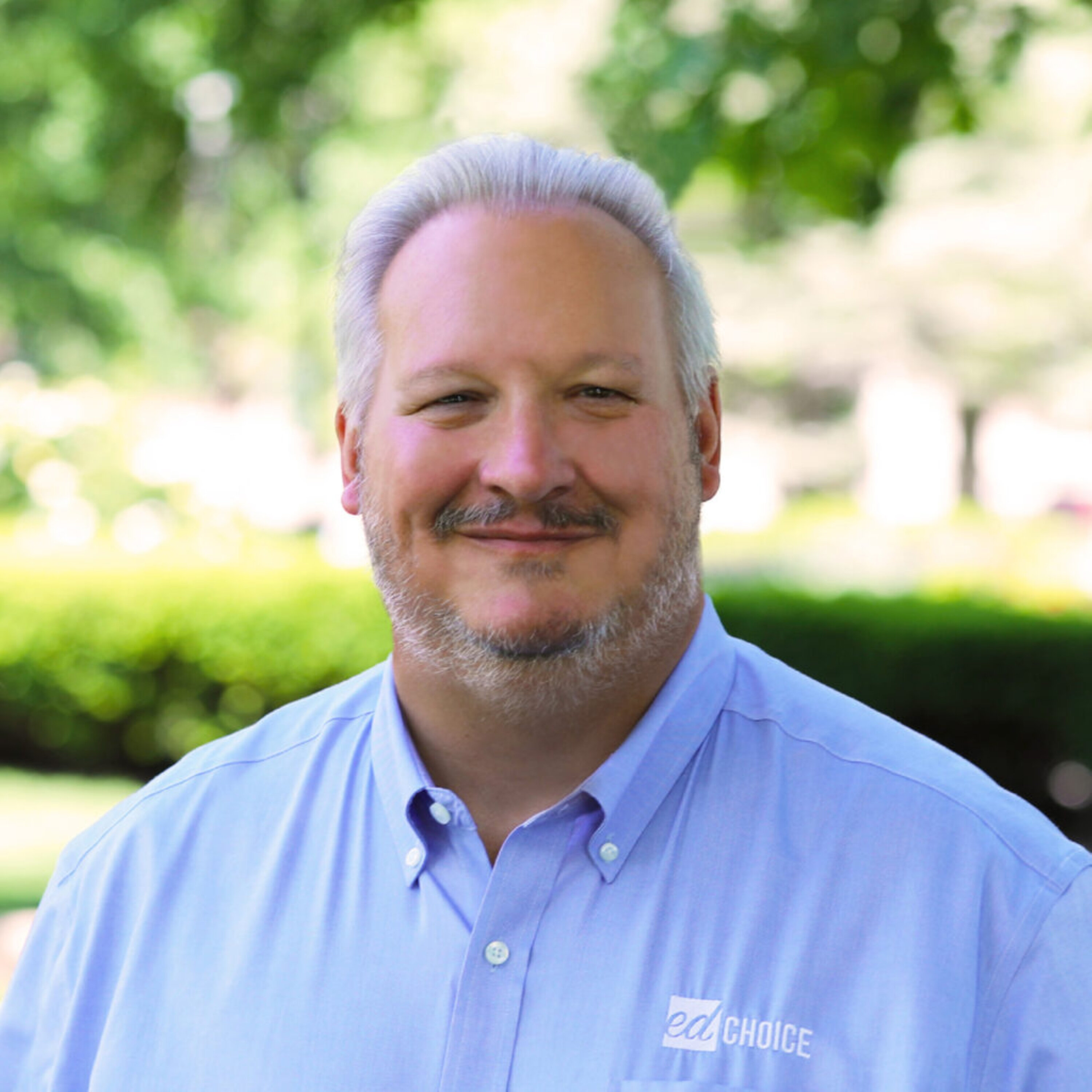
Episode 906: Schooling in America 2025
Episode Transcript
On this episode of News World, what do Americans really think about K through twelve education?
Each year, ED Choices Schooling and America Survey provides one of the most comprehensive answers to that question.
They released the twenty twenty five edition, their thirteenth annual nationally representative look at parents and the public's views on everything from school satisfaction and funding to educational choice policies and the row of government.
Over the course of the survey's thirteen year history, they've asked a set of recurring questions focusing on the direction of K through twelve education, parents schooling preferences, parents satisfaction with their children's schooling experiences, and public feelings towards educational choice policies.
Here to discuss their twenty twenty five survey, I am really pleased to welcome my guests, Robert Enlow.
He is the President and CEO of ED Choice.
Before the formation of ed Choice in twenty sixteen, Robert was an integral part of the Milton and Rose Friedman Foundation for Educational Choice from its launch in nineteen ninety six.
Under his leadership, d Choice has become one of the nation's most respected and successful advocates for educational choice working in dozens of states to advance parental freedom and education.
Robert, Welcome and thank you for joining me again on Newtsworld.
Speaker 2Nice mind pleasure, mister speaker, thanks for having me.
Speaker 1You know I have to ask you your new Schooling in America report shows that more than two thirds of Americans believe K through twelve education is on the wrong track.
Why do you think public confidence in education is so low.
Speaker 2It's our thirteenth year of doing this survey.
I wish I could say it was lucky number thirteen for our government run schools, but it's not.
It's the second highest dissatisfaction that we've ever seen.
And I think the answer for that is simple.
Parents are telling us that these schools are not safe.
My kids are getting bullied, my kids are mentally anxious, and they're not doing a good job of educating my kids.
And on top of that, they're spending a ton of money that they don't know how it's being used.
So parents are frustrated with what's going on in K twelve education around the country.
Speaker 1Why hasn't there been a faster moved to a really serious reform.
Speaker 2So the fast move to serious reform has been through school choice.
Finally, So starting after COVID, we had zero states that had universal choice.
Now we have nineteen states that have universal choice.
We had less than I think about four hundred thousand kids were in school choice by twenty nineteen.
Now there's one point three million.
So there is a massive growth in the private school choice sector.
And the theory, of course of Milton Friedman is if you allow massive te you're going to create more competition and the public school is going to have to improve.
I think we're to that tipping point in mister speaker, where we're to the point where there's enough choice in states like Arizona, Indiana, Ohio, Florida, where the public schools are either going to have to reform or adapt or die as they used to say.
Speaker 1Well Man, yet your own survey says that only thirty one percent of Americans believe K through twelve education is headed in the right direction, and that that is an eleven point declined since twenty twenty one.
Speaker 2Again, that's why people are going to choice at all sorts.
So that's why you're seeing continued absenteeism, You're seeing continued migration to charter schools and private schools and choice programs.
This dissatisfaction is why you're seeing homeschooling dramatically on the rise since COVID.
So this dissatisfaction is leading to people making new choices.
Speaker 1You know, and one of those actually was a real surprise to me.
A majority of Republican school parents say education isn't the right track, but only a minority of Democrats and independence degree.
Why is there this part of difference.
Speaker 2My guess is the partisan difference in the right track is because many Republicans are choosing more of their education, whether it's a traditional public school, by moving to a home district or not.
You know, we see changes in the survey when presidents come.
So the first Trump presidency you saw a greater level of dissatisfaction at the beginning with schooling, and the end of it you saw greater support.
And so I think Republicans are just ahead of this trend when it comes to the idea of being more satisfied with their options and their choices.
Speaker 1Well, and you make the point in your report that private school parents are much more positive.
About forty nine percent of private school parents feel very satisfied with their child school compared to thirty two percent of public school parents.
I mean, that's a big difference.
It's almost a fifty percent differential.
Speaker 2It's a huge difference.
And that's also true like if you look at charter schools and home schooling, so all the school types parents that are choosing are happier and more satisfied, and it's the traditional public school where people are feeling like they have to be assigned.
Later in the study, there's a question about why are parents choosing these schools, and it's very interesting to see the difference.
So parents who are choosing private schools are doing so for academics, for safety, and for moral values.
Parents who are choosing charter schools are doing so for academics, safety, and close to home.
Parents who are choosing public schools are doing so for three reasons.
It's close to their home, socializing their kids, and it's their assigned school.
What's very interesting is that mere fact of choice between charter and private schools is driving the conversation to quality, to safety, and to moral values.
And the more families that can choose from public schools, the better our society is going to be.
Speaker 1Frankly, I'm amazed at the number of people who are concerned about safety in school, not just physical safety, but also bullying and a whole sense of this is not a good environment.
Do you find that across the country.
Speaker 2We do find that across the country, and we of course do another survey that's a monthly survey that is done in partnership with Morning Consul, and it has been a consistent trend over five years that parents are tired of their kids getting bullied in school.
This sort of bullying is a huge issue for parents, their child's mental health and anxiety.
There's a lot of worry from families about their children having too much anxiety at a school, particularly to public school where there's not a lot of safety.
The parents are also at higher rates saying that we were worried about shooting.
These issues where public schools are not responding effectively to a child's bullying and a child's anxiety is really having an impact on parents, and they're saying that my kid's not safe, and they're looking at safety in a broader thing from just sort of physical safety, it's also emotional and mental safety.
Speaker 1A very large number of Americans, well over a majority, underestimate how much money we're already spending on public schools in their states.
Baltimore City Schools, which are the third most expensive in the country, are among the worst schools in the entire country.
So it's not a coral right now between how much we spend and what kind of education we're getting.
Speaker 2The idea that money has anything to do with quality of education is not the case, and the more money you see is often in the worst performing schools.
Parents, however, in the public, really just don't have a knowledge of how much we spend on kte of education.
They've been lied to for so long about how much we spend, they underestimate it to the tune of like somewhere between seven and ten thousand dollars.
It's crazy how much they underestimate how much you spend on public education.
Now, when you tell them how much you spend, right, their idea of it being too low goes way down by about a third, right, So it's interesting when you actually inform them how much the average spending is, the number of parents that are saying that we don't spend enough goes down by a third.
I think that's why information is so important, and parents just don't have a clue about how much we spend, they really don't.
Speaker 1Utah is the least expensive state in the country purstudent, but his outcomes are radically better then Baltimore or New York or Chicago, all of which spend I think maybe at least three times as much as Utah.
Speaker 2There could be many reasons so that.
One of those reasons would be it's one of the highest homeschooling states in the country, so they have a number of families who are homeschooling and getting better results.
It could also be that it is a state that has some of the lowest minority demographics.
And there's all sorts of different reasons for why it could be ed Ford.
But Utah definitely has proven that you don't need to spend a lot of money in order to get a quality education.
And if you look at a state like Indiana or Florida or Arizona, where there's choice programs that are really broad, you are seeing the families are doing better on NAPE and the NAPE scores that came out, the private schools did better, and the private schools in Arizona, Florida, and Indiana did better than the public schools.
Speaker 1What's fascinating is one We do know that private schools that have discipline and that have parental involvement do dramatically better than public schools that are run by unions and bureaucracies that are not paying attention.
I saw one study recently that Mississippi now scores higher than Minnesota in mathematics, which has to be an enormous shock to Minnesota's.
Speaker 2Well, you know, it is shocking by going back to those basics of reading, writing at arithmetic in Minnesota like foning.
They call it the science of reading, but you know, we know it back in the day is phonics.
In many ways, their scores went through the roof.
You know, so just some basic reforms that require traditional public schools to go back to the way they taught couldn't have impact.
We all know that choices having impact.
The data is really clear on this.
In states where there's school choice, public schools do better than the states without school choice.
Speaker 1There's a recent Open the Books report their title the Public School Crisis.
Higher payrolls associated with worse student performance, and they argue it Open the Books that as payrolls increased in public schools, student performance decreased.
That is the opposite of a healthy system.
Speaker 2Well, part of that could be that is totally true, and Milton Freeman, I think would call that the machinery of a monopoly at work.
The study that we've done shows that between nineteen fifty and twenty fifteen, and we've continued this study going forward, the number of kids and rolled in schools went up one hundred percent, the number of teachers went up two hundred and fifty percent or so, and the number of non teachers went up seven hundred and nine percent.
So think of what happened.
School districts brought in seven times the number of non teaching staff for the enrollment, and there's just no way you can actually increase the quality of education because those are all administrators, those are all bureaucrats adding to the system.
They're now more non teachers in NK twelve education than our teachers.
And so it's no wonder why places like Baltimore that have high pay rolls mostly probably for administrators or having a challenge in teaching kids.
Speaker 1And this particular report from Opening the Books, they point out that they're over eighty eight hundred public school employees earning more than two hundred thousand dollars a year.
How about almost none of those are.
Speaker 2Teachers, probably not by probably a little counterintuitive on this, we talk about superintendents of large school districts making over two hundred and fifty or three hundred thousand dollars.
You know, I look at my home city of Indianapolis.
It's district is about seven hundred and fifty million or so a year.
I don't know of many companies that would pay their CEO two hundred and fifty thousand on a seven hundred and fifty million dollar budget.
Maybe if we started treating these districts more like actual businesses, holding the superintendent's to true account, we might get different level of talent and be willing to pay it more.
Right So, I think one of the challenges that the incentives in the system is not set up to make sure we're getting the best possible talent in there, particularly the administrator side of my.
Speaker 1From a Florida perspective, Miami Dade and Hillsboro get top exam scores while spending less on payroll and employing very few high sourid staff.
Los Angeles Unified, which is an enormous system, spent more for pupil and had many high paid staff, but ranked lower.
What do you think is the contrast between the Los Angeles approach and the Miami Hillsboro approach.
Speaker 2This is a very simple anstitute.
Miami Dade has one of the most robust choice environments in the country.
The actual school district will charter schools in its own district.
It actually has robust charter schools.
It has a tremendous number of kids on private schools, on the choice program.
It has a number of kids going to a scholarship program or the taxpayer scholarship.
It is a robust environment of choice in Miami Dade.
And you know what it doesn't have in LA.
A robust environment of choice.
Speaker 1Well, in fact, I assume that Los Angeles unified bureaucrats and unions would fight at the barricades to preserve their monopoly.
Speaker 2Yes they are, and they don't even want any kind of charter schools, which you know many people think charter schools or public schools, and they don't even want any kind of reform that would allow charter schools in places like LA.
It's tragic that so many kids in the largest school districts are being held captive by folks who don't want a little competition.
Speaker 1What do you think has been the key to the really post COVID explosion of interest and the number of people migrating towards school choice and the number of state legislatures and governors who have been supporting school choice.
What do you think is happening that led to this transition.
Speaker 2So I think there was a lot of work going into sort of building to this point before twenty twenty, and a lot of good effort building and educating and getting a lot of advocates understanding what was going on.
In twenty twenty, a movement that is based on parents became led by parents, And what ended up happening is I think this common cultural experience that we used to have of K twelve education, my mom sent me to a public school.
I walked to public school, You walked to public stoo was changed and subverted and the common experience was what's going over a kid's shoulder when they're watching them on the internet right watching a teacher doing a classroom during COVID, That common experience made parents really angry and they saw that there's something different that was needed, and all of a sudden, parents were saying, we don't care what it is we want something different, and legislators finally had a voice to say, this isn't a fight about public or private schools.
This is a fight about how I can help my parents in my district.
And that shift of the conversation is the reason why legislators are now flocking to the idea of the essays all across the country because it's no longer a charter versus public, a charter versus private, or private versus public, and say I'm going to do whatever I can to give parents a choice and option.
If they choose public schools, great, If they don't, find we're just going to give them more choices.
Speaker 1So in that context is based on your work, the more people understand about the choices.
For example, vouchers support jumps like fifteen points once you expl what they are and how they work.
Speaker 2Yeah, our surveys over the last thirteen you have been very clear by this.
If you ask a parent or anyone just a cold question, do you support school vouchers, it's now over fifty percent.
But if you say a a school voucher is a voucher for a family to attend a non public or private school of your choice, that number just jumps.
The support just jumps.
That is true across the board for essays and for tax credit scholarships.
What's interesting on the ESA number what we call a cold thing, Right, do you support essays?
You know who the highest number supporters are for the cold teachers.
Teachers love the idea of essays.
That's part of the reason why micro schools are growing effectively.
Right.
Teachers are frustrated, they're tired, and they want to try something new, and they look at education savidan accounts as a way to do so.
It's very interesting.
Speaker 1Part of that also is when you explain refundable tax credits for education expenses, it becomes very popular.
Speaker 2Yeah, people like getting their own money back.
It's shocking, right, they'd rather spend it the sells rather than the government.
Look, all of these things whatever, it's a refundable tax credit, it's a charter school, it's a voucher, it's an education savings account.
Whenever you provide a tiny bit of an explanation, that support from all demographics jumps across the board.
It's interesting when you look at the support, for example, of education savings counts, which demographics supported the most.
Right, So there's a ton of support for education savings counts from Hispanic families.
They love the concept of the essays in school vouchers.
African American families love the concept of school vouchers.
It's interesting how you can look at different types and different and different demographics have different support.
Speaker 1But in every case you're seeing a support for a fundamental change from the monopoly of the last one hundred.
Speaker 2Years one hundred percent.
And legislators have basically said, and I think Democrats are going to have to come around.
Look, the tax credit bill that was passed as part of the one Big Beautiful bill in the Congress last year is going to have to put some pre sure on Democrat governors.
Are they going to allow their state to participate in a tax credit program that will allow public schools to get scholarships, private schools to get scholarships, in charter schools to get scholarships.
It's going to put pressure on them to say, hey, we want to give parents choices.
Even in these blue states.
Speaker 1There are some people, for example, children who are physically or mentally challenged, where you have to think about that that costs more, and you almost have to think about can we design models where If that's the circumstance, then the voucher's bigger or the opportunities bigger than just people who are coming in who are totally prepared.
What's your thinking on them?
Speaker 2So most states, in their public school funding from you already give weights to different types of kids.
So if you have a special needs kid in Indiana, you're getting higher amounts of money.
The reality of all we want is we just want families to be able to get the money that would have been set aside for them to go to whatever school.
So the Arizona Choice Program started as a special needs scholarship program.
It started for families a special needs group.
In my state of Indiana, there isn't program just for special needs kids.
What you're finding is the families who have children with special unique abilities want more options and would like the dollars to follow the kids.
Traditional public schools in Florida and in Arizona have high amounts of money.
Like in Texas, the bill that passed, you could get up to thirty thousand dollars for your kid to get an education savans acount if they qualify under the special needs category.
So the goal here is whatever dollars are set aside for your child is what you should be able to get.
Speaker 1It's not like moving away from the current bureaucratic school system is necessarily going to leave behind the most challenged students.
Speaker 2No fact that the vast majority of the students in Florida and Arizona at the beginning were special needs students.
This makes a lot of sense because as a parent of a specially needs student myself, there was no way that the district was going to get their hands on my kid.
Just to be blunt, my son needed something different.
Thankfully, I had the ability to pay for private schools, but there are so many parents like me that don't, and when choice comes in, that's exactly what happens.
They start taking advantage of that.
Like what's happening in Arizona right now, mister speaker.
They're these cool little micro schools where families are going to houses that are specifically set up ADA compliant and they're teaching them horse equine therapy, They're teaching them how to farm, They're teaching maths skills and reading skills through these kind of physical activities, and it's amazing.
Speaker 1Describe this concept of a micro school.
I understand the words, but I want to understand the concept.
Speaker 2A micro school sometimes is hard to define in the sense that it's typically a smaller setting in a non sort of building of vironment that is offered between one and four days a week.
It's not a full time school.
It's typically smaller with a number of kids.
It's typically also very unique in its delivery.
So there's one micro school called Surf Skates sandwhich I love to talk about.
They teach kids how to surf and skate, and while doing some they teach them geometry and algebra because you have vectors and all of that stuff when you do that right, So they teach them about ways and motions and sound and so schools like that are being created to be really unique delivery models for kids who learn in different ways.
Speaker 1Do they then tend to get paired up with other schools through the three or four days.
Speaker 2No, they go two or three days, and that satisfies it, right, And it's a pay as you go situation.
So my friend in Arizona sends her kids to a public school that runs a micro school.
So she is enrolled in a public micro school that the kids go to one day a week and the rest they learn at home.
So it's this customization, mister speaker that's really starting to happen around the country.
Speaker 1That's sort of amazing.
Speaker 2Yeah, and teachers loving it.
In Arizona and Florida and places like West Virginia and now New Hampshire, they're the ones leading away on this kind of customization.
This makes sense, right, So when you create a market, the first thing that happens is market segmentation and specialization.
Right, You're allowing yourself to build new ideas for families who need it.
And that's exactly what's happening in these states.
It's really intriguing and really unique.
Speaker 1Tell me just for a second.
It seems to me that while people are very worried about education, and while conservatives would focus their own happiness on the Department of Education, there's still a majority of Americans who oppose closing the department and only about a third supporter.
How do you evaluate the Department of Education's role in all this?
Speaker 2So what we found in our survey is that parents are saying in public, are saying, look, we don't want it to be closed, but we do understand it should be limited.
Right, So when you ask them what roles it should have fund kids, make sure special needs kids are taken care of, make sure low income kids have the funding they need, and then leave the rest aside.
The support for idea of going into classroom with mandates, with testing, with curriculum goes way down.
So the public, I think, understands that you need the government to have some role, but that role needs to be limited in terms related to funding and making sure the kids have the right needs for the right kids or right kids with right needs.
Speaker 1I was at public events in nineteen eighty three when the regular administration launched a Nation at Risk, a study which said that if a foreign government did to our children what we are doing to our children, we would consider it an act of war.
And I watched us flounder and not be able to come to grips with it.
And then in the late nineteen eighties, I was with Governor Tommy Thompson when a former Jesse jack Since state chair who had been a social worker, Polly Williams there was a state legislator one time was the longest serving state legislator in Wisconsin history, was a state legislator and she wanted school choice.
Now in her case, she actually wanted it specifically in Milwaukee, where she felt it was the poor children who were being robbed.
Tommy picked this up and I tried to help them.
At the time, I was like voices in the wilderness.
You could hardly imagine either the indifference.
The business community was not prepared to think this boldly, and it seemed like a strange idea.
It has gradually taken off, and in that sense, it seems to me we may be at the edge of a period of real renaissance and real invention, and ten or fifteen years from now we may be in a remarkably diverse and intriguing and experimental learning system onlike anything we currently have.
Speaker 2I couldn't agree more.
I think what was one's voices in the wilderness is now a chorus of people saying, try something different.
What was once voice is saying let's just fix our traditional system.
It's now a wide orchestra saying we need to do something different.
And my biggest fear is that in twenty to twenty five years from now will have gone through all of this and schooling will be delivered the same way.
It will look and feel the same way.
And if that's the case, then we haven't succeeded.
But my guess is based on what I'm saying now, the dynamism, the real movement towards private schools, towards new types of schools, public schools going four days a week because they don't need to go five days a week, the idea of having to go five days a week to learn, if you can learn in four days, This stuff is happening, and I think it's going to make a big difference.
Speaker 1Let's assume that moving forward we're going to solve this, we're going to still have forty or fifty million adults who have been cheated, many of whom are functionally illiterate, can't do math.
How do we take the lessons we're currently learning and develop an adult learning capacity?
But nobody is permanently trapped if they're willing to learn and willing to show some initiative.
Speaker 2Really appreciate you saying forty to fifty million adults.
The staff That really gets me every year is every single year since I moved back to this country in nineteen ninety six, between one and one point three million kids have dropped out of school.
That's just too many, right, It's just done in our economy and our society and handle it.
What I'm hoping is you'll see the micro school movement and the small school movement and the private school movement start to say, hey, and here's why it's cool.
We can take the money in the ESA programs and put it into college.
So why can't a child who gets an ESA program, let's say, and gets into a college and get scholarship, but they have money left in their account.
Why can't that go to a parent who needs to get more education.
There's ways to do this to create and stimulate new learning, their dropout prevention schools and charter schools.
That could also be done in the private sector.
So I think there's a lot going on and we need to move into that audience.
There's no doubt we.
Speaker 1Could be on the edge of having new learning about learning correct.
I think that's right, and that could in fact liberate us in lots of different ways to solve our problems and make us once again the most dynamic and the most competitive country in the world.
Speaker 2Yes, when you think about the idea of moving from seat time to competency as your metric, right from five days a week to whatever works for a kid, for my son, for example, we went to one of the best charter schools in the state.
He could have tested out of English in this freshman year.
Why did he need to take English for four years?
Well, because the States told him he had right What if he didn't have to, What if he could learn actually something different in those four years.
So there's got to be a customization.
I think that's what's happening right, It's really dynamic.
Speaker 1This is very exciting.
I want to thank you for joining me.
Your new ed Choice Report twenty twenty five Schooling in America, examining trends in public opinion on K twelve education, parent experiences and school choice is available now at EdChoice dot org.
And the work you're doing is probably the most significant nationwide effort to continually monitor what's happening and to help people move in the right direction.
So I think, Robert, that your dedicated commitment has made a real difference in America.
Speaker 2Thank you, mister speaker.
Ed you were there at the beginning.
It's early in DC, so thank you very much for everything you've done.
Speaker 1Thank you to my guest, Robert Enlow.
You can get a link to the head Choice Report twenty twenty five schooling in America on our show page at newtsworld dot com.
Newtworld is produced by Englishy sixty and iHeartMedia.
Our executive producer is Guarnsey Sloan.
Our researcher is Rachel Peterson.
The artwork for the show was created by Steve Penley special thanks to the team of the University sixty.
If you've been enjoying Newtsworld, I hope you'll get Apple Podcasts and both rate us with five stars and give us a review so others can learn what it's all about.
Right now, listeners of Newtsworld, sign up for my three free weekly columns at Gingrishtree sixty dot com slash newsletter.
I'm Newt Gingrich.
This is Neutsworld.