Is Thanksgiving a Feast of Lies?! Separating Myth from Truth
Episode Transcript
So it'd be like if my drunk neighbor is shooting off his guns on a Sunday afternoon and I go over to his house to see what's going on, and he like gets out of six pack and says, come on, let's let's have a couple of beers.
Speaker 2It would be like you showing up with a gang and him feeling like he doesn't have any choice but to open the door for you.
Speaker 3Good, good context.
Speaker 1You've reached American History Hotline.
You asked the questions, We get the answers, leave a message, Hey, there are American History Hotliners.
Bob Crawford here, thrilled to be joining you again for another episode of American History Hotline, the show where you asked the questions.
But today I want to start things off a little bit differently.
I want to ask you a question for an upcoming show.
We're going to do an episode about the New York Times list of one one hundred best films of the twenty first century.
What do you think about the list?
Is it accurate?
Any snubs?
And what do you think should have been voted number one best film of the twenty first century?
Give us all your hot takes.
We'd love it if you could record a video or a voice memo and email it to American History Hotline at gmail dot com.
For all questions, it's American History Hotline at gmail dot com.
Okay, now we're going to make a hard turn to today's topic, which is Thanksgiving.
Here to help me answer this question today is David J.
Speaker 3Silverman.
Speaker 1He's a historian and author of the book This Land Is Their Land, The Wampanog Indians, Plymouth Colony, and the Troubled History of Thanksgiving.
He's got a new book coming out in February titled The Chosen and the Damned Native Americans and the Making of Race in the United States.
David, thank you for joining us today.
Speaker 3It's great to be here.
Speaker 2Thanks for having me.
Speaker 1Okay, here's the question we were hoping you could help us answer.
Speaker 4Hi, this is Jillian.
Speaker 5My question is around the origins of Thanksgiving.
So Native Americans, pilgrims sitting together eating dinner at a table, this narrative.
I'm wondering how much of it is true and why it is just continued to be told as kind of like the only.
Speaker 4Story that we hear about Thanksgiving and even early America.
Yeah, just like why this story has pervaded in history for so long, and why it's still the only story surrounding early Native American history that we hear in schools.
Speaker 1Now, David, before we jump into answering this question, can you give us just one fact we can bring to our Thanksgiving table this year that's going to surprise our family members.
Speaker 2Sure, in direct answer to your listener's question, there was probably no.
Speaker 1Table, So you're saying it was more of a buffet.
Speaker 2More of a buffet, it's lap eating.
Speaker 1Okay, So let's start with the common narrative of Thanksgiving.
What is the story that most of us are taught about Thanksgiving in school?
Speaker 2Well, the question you mentioned is part of it.
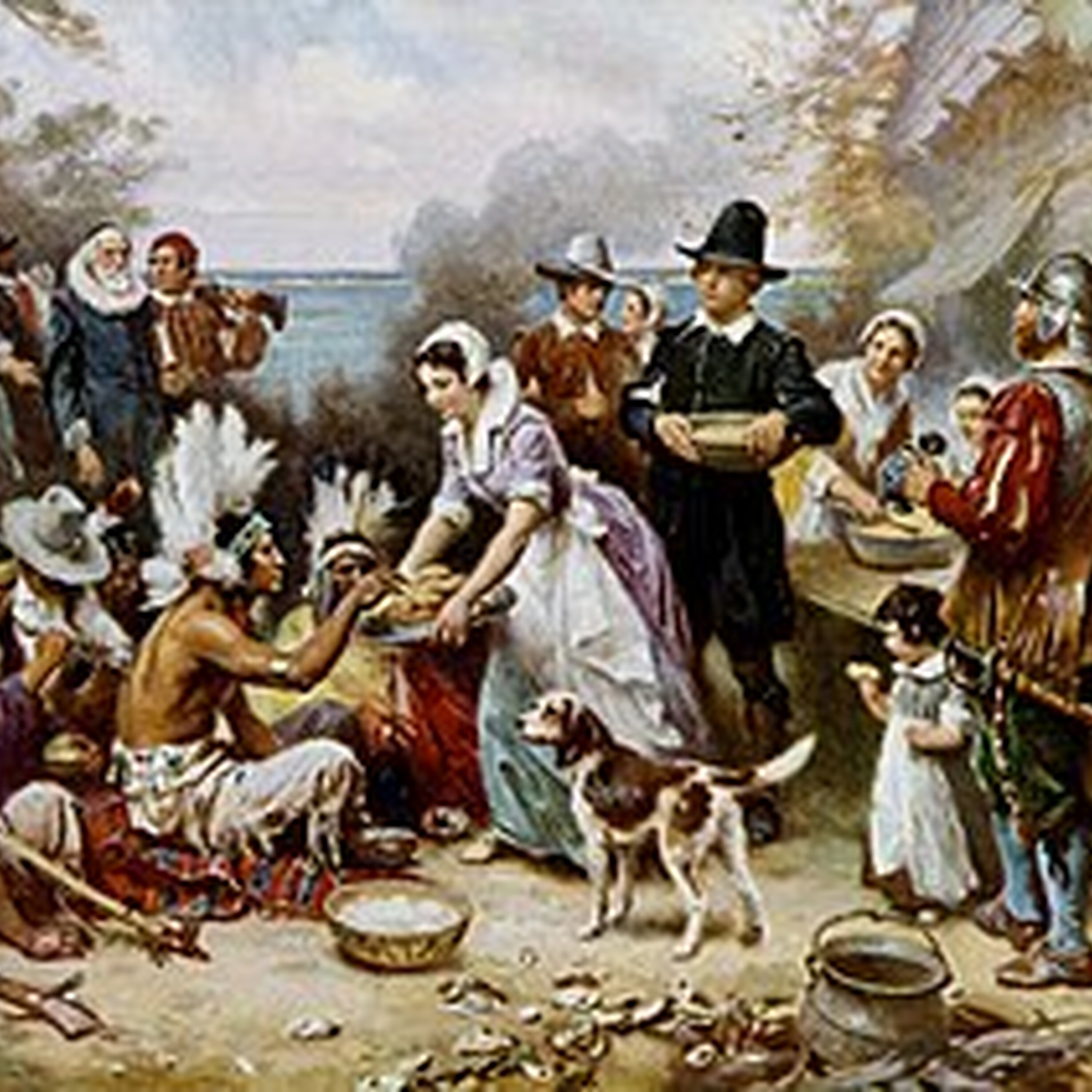
To be sure, we have this patriotic story that the Pilgrims, folks who cross the Atlantic in search of religious freedom, land off Cape Cod and make contact with Native people who almost always are unidentified in the stories.
They're just Indians, right, They're supposed to be symbols for Native America and large After some wariness between the two parties, they make contact with one another, they become friends, and then ultimately the story goes the English invite.
This is a problem with the story invite the native people to a harvest feast.
They break bread together, celebrate together for a few days, and then after the dishes are cleared, the natives wave goodbye and fade into the mist, symbolically ceding their country to the English, so that the English can found the United States, and the United States can begin its march to greatness.
That's the story.
It's a story about bloodless colonialism.
It's a story about colonialism carrying forth the best of America, religious freedom, family, peace, and ultimately democracy.
It's a story designed to make us feel proud of America and its colonial beginnings.
So what really happened, Well, not not much of that.
It is certainly true that the English of Plymouth Colony and the native people of what's now southeastern Massachusetts, the Wampanogue people, created an alliance together.
That's true.
It is true that the two parties did feast together, though the Wampanos weren't so much invited as they just showed up on an announcedent.
The English really had no choice of the matter but to concede to them.
Speaker 5Slings.
Speaker 3Well, so I think that's good.
Speaker 1Let's let's kind of like dig in on that, Okay, Sure, So they just showed up, like talk about this feast.
The doorbell rings and who's we have a caller at this hour during our feast, Like, who's at the door.
Speaker 2Right, So let's sketch out the power dynamics on the ground when this feast occurs.
When the Mayflower lands off Cape Cod, there's about a one hundred English passengers.
By the time this feast occurs, there's less than half that number.
Half these folks have died over the previous year.
Those who have survived have done so because the wampa Ogg's permitted it.
There was a debate within Wampenagg society over the course of the year sixteen twenty one as to whether to wipe out this this settlement.
The wampa Ogg's had a one hundred year, one hundred year history with Europeans before the arrival of the Mayflower, and by and large that had not been a pleasant history.
It had been a history of European explorers in slaving people, in ferrying their captives across the ocean, you know, for sale into bondage.
It had been a story about shoreline clashes, you know, when one side read the worst into the other's mostly unintelligible actions.
But the wamp and Ogs when the Mayflower arrived, are in a very very difficult spot for two reasons.
One is they had suffered a terrible epidemic between sixteen sixteen and sixteen nineteen, almost certainly introduced to them accidentally, but introduced to them by Europeans.
And this disease we don't know the name of it.
I suspect it was smallpox, but we can't be sure.
It wiped out a sizeable number of the wompon odgg people.
And when I say sizable, I'm not talking about COVID numbers.
I'm talking about more than half of the population.
Speaker 3Which is insane because COVID numbers are big, right.
Speaker 2But you know, our societal death rate from COVID was less than one percent, and you saw, you know, we all experienced what that did to our society in this case, and we knew what it was, right, We had a name for it, and we had means to combat it.
Not everyone took advantage of those means, but we had means to combat it, and you know, so on and so forth.
In this case, you know, the Wampa ogs have been attacked by a disease with no name.
They don't know how to explain its cause, you know, it could be witchcraft, it could be their God's punishing them for something they did or didn't do.
They simply don't know.
What they know is that their kin are dying all around them.
And you know, and we don't have exact numbers as to how many people died.
We have a very kind of general numbers.
But here's what I can tell you.
The English say that when they arrive in this part of the world, they encounter village sites that are covered with skeleton.
Speaker 3Yeah.
Speaker 2In other words, the people died where they were, and the living were so terrified of what was happening they fled the scene, which means a lot because native people were diligent about caring for the remains of their dead.
Okay, so the Wampaagus have been depopulated, So that's the first problem.
The second problem is their narrogancet enemies to the west have not been depopulated, and the Narragansetts take advantage of the Wompennagu's weakness to reduce them to the status of tributaries.
So when the English arrive, the Wampadogs have a choice to make.
Do they based on this previous one hundred years of hostility, wipe out these strangers and eliminate the potential danger that they pose to Wampadag people.
Or and this is the choice that their leader, Usumquin or massasoyt Act finally makes.
Do they try to ally with these folks and take advantage of their firearms, their swords, their knives, their hatchets, and all the other goods that they have that are of appeal to Native people.
That's the choice they make.
That is the context that leads to the First Thanksgiving.
It is not a matter of the Natives just happen to be friendly.
They are in a desperate position and they're making a strategic decision for their own preservation.
Speaker 1So, from the reading I've done recently Native Nations Kathleen Duval and a few other books, one of the biggest revelations for myself personally having a blind spot with Native American history is that many Native American tribes thought to themselves when the Europeans were coming, how can this work for us?
Speaker 3Like?
How can we use them?
Speaker 5Like?
Speaker 1Are there ways that we can use them for our aims?
And so it sounds like what you're telling me is is that the Wampanogh saw this possibility of an alliance to actually, you know, protect them from another, from from their their enemies from another.
Speaker 2Yeah, that's exactly right.
You know, we have a tendency, or at least you know, the public has a tendency in some circles to characterize the European arrival in North America as an invasion.
And that's understandable.
You know, in in Central and South America and the Caribbean, the Spanish conquest was just that it was.
It was a military invasion, right.
And what's more, eventually in North America, once Europeans have a beachhead on the continent, they do start conquering Native territory, but with very few exceptions, the first colonies or owned there at the sufferance of Native people.
Native people could have wiped out almost all of these places if they had wished to do so.
Generally speaking, they did not wish to do so.
Not at first.
They would learn that these people posed an existential threat to them.
They can't see that at the beginning.
One of the things we have to understand when we're accounting for Native people's actions is that they don't see themselves as a single group of people.
They don't see themselves as Indians or Native Americans or indigenous people or any other general category of that sort.
They are divided into hundreds of different polities, and these polities usually are no larger than twenty or thirty thousand people, and they're constantly at odds with one another.
So they're constantly seeking advantage against other tribes.
When the Europeans arrived, well that's your advantage, right.
You can get their military wares, you can get other trade goods that will help you attract more followers to your group, and you can try to enlist their soldiers in your cause.
And that is precisely what one native group does after another after another.
Speaker 1So the Wampanogue and the Plymouth settlers sign a peace treaty.
So how long does this what is this treaty all about?
Speaker 3And how long does it last?
Speaker 2Well, it depends who you ask.
And you know, one of the things that we as an American society have not done very well over the course of centuries is ask what the wamp and Ogu's thought this peace treaty was all about.
Now, I can remember firsthand being assigned this peace treaty as one of the earliest primary source documents assigned to me in school.
And you know, we went through each each provision of the treaty or once did we did the teacher think to ask us as students, how might the natives have interpreted these these clauses.
So I'll give you an example of what we're talking about.
So there's a provision in this peace treaty.
Right, you have some of this stuff, you can you could take it face value.
We won't attack each other, Okay.
I think it's safe to assume the wamp and Ogu's agreed to that if we're attacked by another party, we'll come to one another's aid.
Okay, that sounds exactly right.
We'll have trade with one another.
Okay.
But here's where it gets tricky.
Now, the wampan Ogus are subjects of King James.
Well, the Wampannoggs don't have a word for subject.
They don't have a word for it.
It's not it's not a concept to them.
They have no idea who King James is, Who's who's this guy on the other side of the ocean.
And there's simply no, no possible that even if they said, oh yeah, yeah, sure, we subject ourselves to King James that they understood what that meant.
Speaker 1Is there any way for us to know the story from the Wampanague side?
Is there is there other primary source documentation from the womp of Inagus.
Speaker 2Here's what we can do.
We can judge what the treaty said versus the way the wampanoaguese behaved after the treaty, and the Wampaagus after the treaty were signed did not behave like they were subjects to the King of England.
What's more, you know, the treaty says that if the Wampaoagus committed any crimes against the English, they will turn over the accused to English justice, which is preposterous.
The English are guests in Wampanogu country.
The Wampanoags are not guests in England.
The notion that they would turn over any members of their community to a foreign people's mot of justice is simple, simply nonsense.
And how do we know that?
Well, for the next fifty years, whenever the English demand the Wampa Dogs to turn over accused wrongdours, they always say no.
And when the English finally pushed the issue, the two sides go to war.
Native people simply.
You know, native people are sovereign in their own land.
They're not going to sign over their sovereignty to a group of fifty people.
Speaker 1So getting back to the first Thanksgivings, as we the popularly told patriotic tale.
Now with all this in mind, now we have all this context, talk about this this feast.
Speaker 2Sure, so you know, the English should been on the brink of starvation since their arrival.
They arrive late in the year, it's too late to plant, so they have to survive on whatever supplies they brought, whatever they can scrub up in the cold of of a New England winter, and whatever they can trade for or receive as gifts from native people.
And they managed to make it to the planting season.
And then they plant a bucket of seed corn that they had stolen from a Wampadog village.
They dug up this buried seed corn and took it with them.
Eventually they pay the Wampa dogs for it.
But you know, initially it looks like what it was theft.
They grow crop.
You know, the crop is harvested, and then you know, that fall, for the first time since they arrived, the English say we're gonna rest for a couple of days.
It's been a really it's been a very hard nine or ten months.
Speaker 3And this is before the treaty.
Speaker 2But no, this is after the treaty as signed.
So you know they have this Treaty of Mutual Defense and Trade.
Okay, so the English start letting their hair down.
There's probably a fair amount of drinking.
They engage in target practice as part of their amusements.
So in other words, they're firing guns.
The wamp and Ogs hearing these guns firing.
Presume I think we can assume that the colony is under attack, and so Usamiquin or Massasoyat, the sachem or chief of the Wamponogg people arrives at the colony with ninety armed men.
That's almost twice the size of the colony.
In almost any other colonial context, a group of ninety native warriors showing up at a colony would have produced a bloodbath.
You know, someone would have gotten trigger happy and everything would have gone wrong.
That's not what happens here.
Enough trust had been cultivated between the two sides that instead of firing on one another, the wampa Ogg's stay and they contribute some venison to the meal, and the two parties feast together.
That's this first Thanksgiving.
Speaker 1So it's like the Wampanox show up.
They're like, what's all this ruckus?
And the settlers are like, it's a party, come on, right, and they can see these music video.
Speaker 2Right, and so let they crashed the party, and so, you know, let's be clear, it's not like they received a written invitation to this event, which is you know, kind of how the story is normally normally told here.
Speaker 1So it'd be like if my drunk neighbor is shooting off his guns on a Sunday afternoon and I go over to his house and see what's going on, and he like gets out of six pack and says, come on, let's let's let's have a couple of beers.
Speaker 2It would be like you showing up with a gang and him feeling like he doesn't have any choice but to open the door for you.
Speaker 3Good, good context.
Speaker 1This is American History Hotline.
I'm your host, Bob Crawford.
Today, my guest is David J.
Speaker 3Silverman.
Speaker 1He's a historian and author of the book This Land Is Their Land, The Wampanog Indians, Plymouth Colony and the Troubled History of Thanksgiving He's got a new book coming out in February titled The Chosen and the Damned Native Americans and the Making of Race in the United States.
We're talking about the origins of Thanksgiving.
Remember to send us your burning questions about American history, and also help us out with an upcoming episode by telling us your favorite films of the twenty first century.
Record yourself using the voice Memo app on your phone and email it to American Historyhotline at gmail dot com.
That's American History Hotline at gmail dot com.
Speaker 3Now back to the show.
Speaker 1David, Thanksgiving didn't become a national holiday until hundreds of years later during the Civil War.
I was this the time to create this holiday because of the Civil War?
Speaker 2You know, Abraham Lincoln was lobbied by this woman named Sarah Josepha Hale, who, Yeah, she's kind of like the opera of the nineteenth century.
She starts this this magazine for women that becomes enormously popular, and you know, among the ideas that she traffics in is that the country needs a holiday to help bridge the divisions that led to and were perpetrating the Civil War.
Thanksgiving is that idea.
Now, Thanksgiving had been a Yankee holiday.
So the only way you were going to get Thanksgiving declared as a national holiday was for the South to have seceded when that announcement is made, and you know, so Lincoln, in the spirit that this idea was proposed, takes it up and declares the holiday.
Up until this point, New Englanders had celebrated days of Thanksgiving really since the seventeenth century, and it had been an English tradition too.
So let's be clear, this is not a tradition that begins in New England.
It stretches back into the midst of time on the other side of the ocean.
Let's be clear too, almost every Native American group has days of Thanksgiving.
People all over the world have days of Thanksgiving, so targeting which one was first is really hard.
But whereas in the colonial period, days of Thanksgiving were haphazard, they would be announced by the government depending on the circumstances of the time.
So if there was a victory in war, the end of a drought, what have you, the government would say, Okay, we're going to hold the following days a day of Thanksgiving.
Over time, the day became standardized, and eventually people began selling librating these days of Thanksgiving when you closed your account books for the year, you know, usually late fall, and you know that was a time to celebrate, so that becomes part of the routine.
But let's be clear, during that period, during the seventeenth century, the eighteenth century, all the way into the nineteenth century, up till nearly the time that Lincoln makes this declaration, nobody, nobody associated the Thanksgiving holiday with Pilgrims and Indians.
Speaker 3So how did this happen?
Speaker 1How is that connection made.
Speaker 2It's a couple of different ways.
One has to do with Plymouth Town's attempt to boost tourism.
You know, Plymouth Colony was a nothing place.
You know, it's an underpopulated, economically marginal colony where really only it's only important for two reasons.
One is it's the first English colony in the Northeast that survives, and the second is, in sixteen seventy five seventy six, it's the place where the Great War between English colonists in New England and native people starts.
And this is the war that ends up devastating the wamp and Dogs and giving the English effectively control of the region.
Otherwise, Plymouth gets annexed by Massachusetts in sixteen ninety one, and that's it.
It now is just part of the mainstream of Massachusetts history.
Well after the American Revolution, Plymouth town is falling on hard times, and so a group of men calling themselves like the Old Colony Club, decide to start promoting the Pilgrims who had been You know, they're an eccentric group of religious fanatics who no one really paid attention to.
They start promoting these guys as colonial founding fathers and Plymouth's rock this you know, we could have whole show on Plymouth Rock and the abuse it's taken over the years, but they make up the story that the Pilgrims landed on this rock, and they try to get people to come to town and spend their money so that that idea starts to start to circulate.
But the real key to associating the holiday with Pilgrims and Indians is the publication of one of the two primary sources of the original feast between the English and the wamp and Ogs.
The source is now called Mortz Relation.
It's a co authored piece by Edward Winslow, who was a key figure in early Plymouth Colony and William Bradford, who was the governor of the colony for a long time.
In this account, there's one paragraph about this feast.
Likewise, in Bradford's account to Plymouth Plantation called of Limit Plantation, is a couple of lines about the face.
Really not a big deal.
But the guy who edited this primary source, he's a minister named Alexander Young.
He adds a footnote to this section, and he says in the footnote, this was the first Thanksgiving the harvest festival of New England, to my knowledge or to the knowledge of anyone else who had studied the issue, no one had ever proposed this idea before.
Speaker 3So what year was that?
Speaker 2Eighteen forty one?
Speaker 3Eighteen forty one, So you know, we're.
Speaker 2Now two hundred and twenty years after that supposed first Thanksgiving.
Now, look, I'm a historian.
I work with footnotes.
No one other than fellow historians read footnotes.
But somehow this footnote took hold enough people read it, especially people in power, orators, politicians and the like, that the idea started to get trafficked around, so that by the time that Lincoln makes his pronouncement that Thanksgiving will be a national holiday, the notion that Thanksgiving began with Pilgrims and Indians had begun to capture the public imagination.
From that point forward, the tie between the holiday and the mythical Pilgrim an Indian story gets propagated by schools.
Public schools would regularly hold and I can remember being in one of these things Thanksgiving pageants in which they have the kids dress up like Pilgrims and Indians and reenact what people imagine that feace would be.
By the way I was a tree in the play tells you something about my acting abilities as a child.
But you know, these pageants became standard fair, especially in the North, until very recent times.
Speaker 1In Plymouth today there's a plaque that commemorates a national day of mourning every Thanksgiving.
Speaker 3Tell us what that's all about.
Speaker 2Right, So, once the holiday of Thanksgiving gets tied to the Pilgrim an Indian story, it becomes the major story that white Americans tell themselves about the role of Native people in the country's past.
Yeah, and it's a bedtime story.
It's a fairy tale of colonists and native people making friends, and Native people conceding to their own disposition, right, which is patent nonsense.
You know, Colonial America is a blood bath.
Quite frankly, you can narrate the history of colonial America as one colonial Indian war after another after another after another, you know, because colonists want Native land without Native people on it, full stop, and Native people aren't going to concede to any such a geta, So it's a war.
So Native people in the country have to listen to this idea year after year after year.
And let's be clear, these Thanksgiving pageants that I mentioned, these are performed in Native American boarding schools, right, This story is propagated two Native kids in Native American boarding schools, never mind to Native kids who are in majority white schools all around the country.
I have heard first and testimony from multiple Wampanogs people about what it's like to be a school age child in a classroom where a teacher is promoting this nonsense, and almost invariably they say, it's followed up by some kids saying well where are the Indians, and the teacher saying, oh, well, they're all gone, even as there's a Wampannog kid sitting right there who the teacher can't conceive of as Indian because the kid doesn't fulfill the stereotypes of Native people that Hollywood has been trafficking in for the laste hundred years.
Speaker 1So it's fairly obvious why there's only one version of this story of Thanksgiving.
Speaker 2Right.
So fast forward to the year nineteen seventy.
We're in the middle of the Civil Rights movement.
We're in the early days of the Red Power movement, in which Native activists around the country begin protesting for their own rights and dignity.
And there's a Wampanog activist named Frank James who says, you know, I've had it with this.
I simply have.
He's a student of history.
He had been asked to speak at a statewide Massachusetts commemoration of the founding of Plymouth Colony, and when he submitted his speech for review, the white organizers wouldn't accept it.
They said it was too provocative.
So he said, the hell with this.
I'm gonna have my own event.
I'm going to deliver the speech, and he called the event the National Day of Mourning, and he held it in Plymouth Town on a hill overlooking Plymouth Rock and a replica of the Mayflower right near a statue of Massasoiot or Usamiquin.
And you know what did he say in the speech.
It's not all that provocative.
We have what he's fundamentally what he says is, look, I know, for you wife, folks, this is a day of celebration right at the beginning of what you consider to be your civilization.
But you need to understand that this is the beginning of the end for my people.
The story that you tell as a triumph is for us a tragedy, and we are your countrymen and women, and our experience counts too.
Furthermore, he says, recognize we're still here.
We we haven't gone anywhere, and we still have sovereign rights that we're trying to defend.
Since that time, this event has grown into an annual tradition, and Native people from all over the country and indeed all over the world show up at this National Day of Mourning rally in Plymouth Town.
For some Native people and Wampinog's especially, they now, instead of holding a day Thanksgiving, hold a day morning.
Some people do both, and some people have no use for the day of morning and hold just a traditional thanks saving.
There's a range of ways Native people honor this this event, but it has become such a big deal that Pliboth Town now has that plaque that you that you mentioned.
Speaker 1We celebrate Thanksgiving, we try to as a day of coming together, and it seems in recent years that it's no longer settlers and Native Americans.
It's now one part of the family who harbors certain political view views versus the other part of the family who harbors, you know, opposite political views.
Is there a way we can we can, uh, in your opinion, you know, capture this day and this idea of coming together to to create peace amongst you know, honor the Native Americans who who were here first, who suffered horrible abases at the hands of Europeans, and also learn to love our family men members who we really disagree with.
Speaker 2Sure, you know, I'm not the guy to proffer up solutions for the very deep and substantive political divisions in our society.
But let me observe this basic point about those divisions.
On the right, there's a belief that the purpose of a history education is to cultivate patriotism.
Right, So, in other words, history is supposed to be in the service of political aims.
I'm a professional historian.
I don't care whether you come from the history that I write that I teach feeling patriotic, antiatriot, unpatriotic, or indifferent.
That is neither here nor there for me.
My only goal is to capture a complex history in all of its complexity.
That's it, full stop.
And I think on the left side of the political spectrum, you have a wide population, mostly who have been college educated and thus also take that approach to the study of history.
And it becomes very hard to have a conversation about history and truth and its role in our society when you're coming at it from such polar opposite views.
So back to the issue of Thanksgiving.
So what do we do with it?
Look, I am all in favor of getting together with family and friends and offering thanks for what's good in our lives.
I think we should do it more often than just once a year.
And let me be clear, contrary to some of the detractors of this book that I've written, I am not calling for replacing Thanksgiving with a day of mourning, or canceling Thanksgiving, or declaring war on Thanksgiving or any such things.
But here is what I am saying.
If we're going to invoke Pilgrims and Indians in relation and Thanksgiving holiday.
Let's get story straight.
We're all grown ups.
We can deal with the truth, right, But I don't think we have to do that.
We know who wants to talk about genocide and then serve up a meal?
Speaker 4Right?
Speaker 2How about we go back to the original Thanksgiving, which didn't invoke Pilgrims and Indians at all, and just focus on family and friends and what we're grateful for in our lives.
The myth of the First Thanksgiving is just that it's a myth.
It is not true.
What's more, it's an untruth that is deeply insulting to our indigenous countrymen and women.
And they've suffered a lot for the creation of this country.
They shouldn't have to revisit it every single year.
Speaker 1Well said, Well said, Well, David, I really appreciate you taking the time to answer Jillian's question and being on American History Hotline.
Speaker 3I've been talking with David J.
Silverman.
Speaker 1He's a historian and author of the book This Land Is Their Land, The Wampanog Indians, Plymouth Colony, and the Troubled History of Thanksgiving.
He's got a new book coming out in February titled The Chosen and the Damned Native Americans, and the making of race in the United States.
David, I wish you and yours a wonderful, peaceful thanksgiving.
Speaker 2Same to you and yours.
Speaker 1You've been listening to American History Hotline, a production of iHeart Podcasts and Scratch Track Productions.
The show is executive producer is James Morrison.
Our executive producers from iHeart are Jordan Runtall and Jason English.
Speaker 3Original music composed by me Bob Crawford.
Please keep in touch.
Speaker 1Our email is Americanhistoryhotline at gmail dot com.
If you like the show, please tell your friends and leave us a review in Apple Podcasts.
I'm your host, Bob Crawford.
Feel free to hit me up on social media to ask a history question or to let me know what you think of the show.
You can find me at Bob Crawford Base.
Thanks so much for listening.
Speaker 3See you next week.