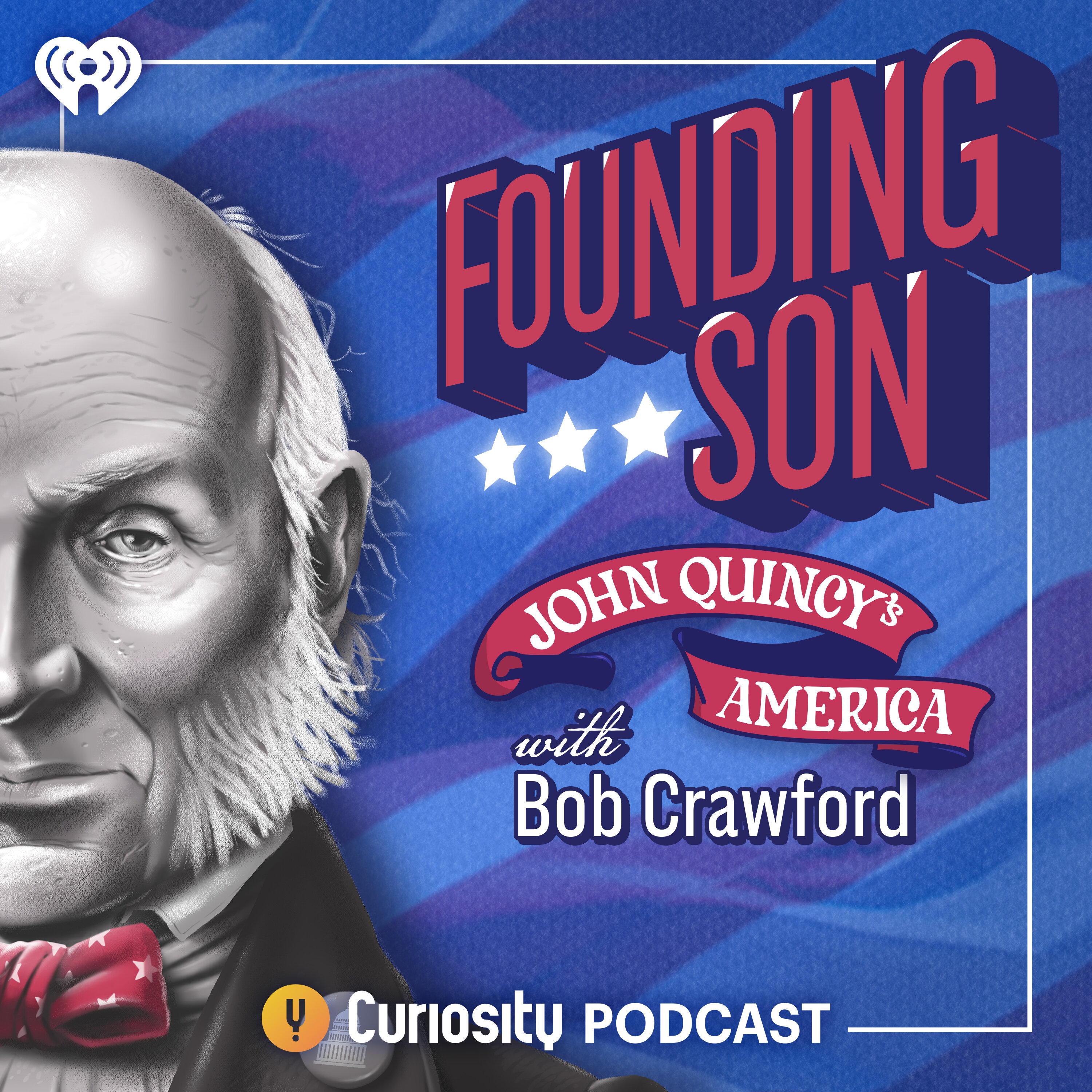
Founding Son: Episode 3 - Our Federal Union: It Must Be Preserved
Episode Transcript
Hey, listeners, Bob here just a warning that this episode contains a brief description of racial violence.
If you've got kids listening, or you would rather not listen to that, you can jump ahead five minutes in the episode.
I'm Bob Crawford.
This is Founding Sun John Quincy's America.
The sky turned an odd, bluish green that day in late August eighteen thirty one, people up and down the Atlantic coast stared at the heavens, wondering what it all meant.
One Virginia preacher had been expecting this sign from God.
Speaker 2He began having sort of visions, apocalyptic visions which commanded him to sort of bring about transformational apocalyptic change.
Speaker 1Matthew Karp is a professor of history at Princeton University an author of This Vast Southern Empire, Slaveholders at the Helm of American Foreign Policy.
He says the preacher had been seeing visions for years, recording them in his diary, things like.
Speaker 3While laboring in the field, I discovered drops of blood on the corn, representing the figures I'd seen before in the heavens.
Speaker 1The eerie, blue green sky was the final sign that the time had come, time for the preacher to set his plan in motion, and when the last strands of the fantastical colors faded from the night sky, he got to work.
He gathered six other men and crept through the swamps of Southampton County, Virginia, stealing horses, knives, hatchets, and axes.
Within two days, a group of more than seventy had joined the preacher's movement.
They went house to house, slaughtering every white enslaver they came across, freeing the enslaved people as they went.
Nat Turner's rebellion had begun.
By the end of the rebellion, Nat Turner and the other enslaved African Americans who joined him had killed some sixty white people, including women and children.
The backlash was immediate and severe.
A mob of three thousand white people tracked down the rebels just outside of the town of Jerusalem.
Speaker 4The one thing I want to say about Nat Turner is not only did they kill him, they mutilated his body, mutilated it.
Speaker 1Mary Elliott is Curator of American Slavery at the Smithsonian National Museum of African American History and Culture.
Speaker 4Just like this idea that if he has one hand attached to one arm attached to his body.
Somehow it's going to rise up and you know, kill more white people and end slavery in the nation.
And we have to tear that body up so that it doesn't come back and fight another day.
Speaker 1In the hysteria that followed Nat Turner's rebellion, paranoia seized the South.
White Southerners murdered dozens of black men and women across the region, most having no connection to the rebellion.
Enslavers had long feared violent uprisings by the people they enslaved, and now their fears had come true.
Speaker 5Bear in mind that the Nat Turner uprising was one of a series of events.
Speaker 1James Traub is the author of the biography The John Quincy Adams Militant Spirit.
Speaker 5And you have to go all the way back to Hades's rebellion against the French.
This was a slave rebellion which had succeeded against the world's greatest nation and driven them out, and so people were terrified.
Then there's the Denmark Visi uprising in Charleston in eighteen twenty two.
So all of these things say to the South, our institution is under attack.
Speaker 1A few months after Nat Turner's uprising, sixty four year old John Quincy Adams was sworn into office as a member of the House of Representatives.
Adams reluctantly ran for Congress to fix roads, build schools, and protect manufacturing jobs for his New England constituents.
But he would soon see all of his goals upended by the intense response to these slaves rebellions and be forced to either come out fully against slavery or accept its evils.
Chapter three Our Federal Union, it must be preserved.
In the years leading up to Nat Turner's rebellion, the abolitionist movement was gaining momentum.
Speaker 6It was a very gradualist and moderate movement until the eighteen thirties.
Speaker 1Richard Newman is a professor of history at Rochester Institute of Technology.
He says black abolitionists like David Walker led a new charge for abolition going into the eighteen twenties and thirties.
Speaker 6David Walker is without a doubt, the most important abolitionist figure before Frederick Douglass in the coming of the Civil War era, because he rips apart the anti slavery notion that you can be a gradual abolitionist and still make an impact on the slavery ish in the United States.
Speaker 1Walker's message was simple.
The only remedy for slavery immediate abolition and full equality for African Americans.
Speaker 6The way that I discuss his importance is that he represents all of those African American musicians in the nineteen forties and fifties and sixties who influenced all of those white rock and rollers, you know, including Elvis Presley.
You can't look at the rise of rock and roll without looking at black musicians.
You can't look at the rise of all these white abolitionists, politicians, and activists in the eighteen thirties and forties without looking at the influence of David Walker.
Speaker 1The momentum of the abolitionist movement and the growing frequency of slave rebellions set off a frenzy of political action in the South.
Southern enslavers took the reins of state and local governments, writing oppressive laws to prevent the education, movement or assembly of enslaved people.
In the North, the pendulum swung even further in the opposite direction.
These draconian Southern laws pushed more Northerners from the sidelines and into the fight against slavery.
Speaker 7By the eighteen thirties, the anti slavery movement has taken a new turn.
It's become something of a mass movement.
Speaker 1That's Sean Wood Lentz, professor of history at Princeton University and author of the Rise of American Democracy, Jefferson to Lincoln.
Speaker 7One of the things that undertakes is a series of petitions to flood the Congress with petitions.
Speaker 1Anti slavery petitions poured into Congress.
I can imagine Southern lawmakers using them as fuel for the fireplace or to light a cigar.
Enter John Quincy Adams stage left.
His desk is likely covered in anti slavery petitions on his first day in office.
To be clear, he hated slavery, but he didn't consider himself an abolitionist, and he didn't believe Congress had the power.
Speaker 3To abolish slavery.
Speaker 1Still, it didn't matter to Adams what was in the petitions.
He saw it as his duty to give voice to them on the House floor, whether he agreed with them or not.
So during his first session, John Quincy cleared his throat, stood up from his desk, and read one abolitionist petition after another.
Speaker 8I presented fifteen petitions signed numerously by citizens of Pennsylvania praying for the abolition of slavery in the slave trade in the District of Columbia.
I moved that one of the petitions presented by me be read, may be in all the same ten and very short.
It was a quarterly read.
I made very few remarks, chiefly to declare that I should not support the part of the petition which pray paid for the abolition of slavery in the District of Columbia.
Speaker 1John Quincy soon found that slavery permeated every nook and cranny of the capital.
Southern lawmakers seeking every opportunity to solidify the institution into the bedrock of the Republic.
Adams was chair of the Committee on Manufacturers.
While manufacturing might not sound like an overtly political issue, it was actually at the heart of one of the day's biggest issues, something that deeply divided Northern and Southern lawmakers.
Speaker 3Tariffs.
Speaker 7It was the one place that the federal government made its money.
It didn't have an income tax to work off of the bates money off of tariffs.
Speaker 1Just like today, tariffs protect American manufacturers from being undersold by foreign goods.
But most of this manufacturing was done in northern cities, so tariffs helped create jobs for Northerners but made foreign imports more expensive for Southerners.
However, Sean wood Lenz says, the cost of goods wasn't really the issue.
Speaker 7But it was made into a big deal politically.
That was a cover.
The tariff issue was always kind of a cover for the issue of slavery.
Speaker 1President Jackson was in favor of tariffs.
He saw them as a way to bring in money and reduce the federal debt, one of his campaign promises.
John Quincy also supported tariffs.
It was the one issue that cut through the bitterness Adams felt for Jackson and vice versa.
But it created new enemies.
Speaker 7Everybody's complicated, but John C.
Calhoun is, you know, about as evil as it gets in American politics.
Speaker 1John C.
Calhoun was not only Andrew Jackson's vice president, he was also John Quincy's vice president.
Always a bridesmaid, never a bride am I right.
Calhoun and John Quincy had been colleagues in the eighteen twenties, each holding a high office in President James Munroe's administration.
Speaker 7It begins politics actually very close friends in the cabinet with John Quincy Adams.
Adams as a Secretary of State.
He's the secretary of War under Monroe, and they like each other.
They respect each other.
Speaker 1Back then, Adams and Calhoun had pretty similar politics.
Speaker 3They were both nationalists.
Speaker 7They believed in the federal government of taking an active role in developing the country at every level, economically, even culturally, although Adams is more of a culturalists.
Speaker 1But as the eighteen twenties dragged on, Calhoun started rethinking his support for federal authority.
Tariffs were wildly unpopular in his home state of South Carolina.
They were seen as more than just a tax on imports, they were a blatant power grab by the federal government and northern states.
Speaker 7Calhoun in the eighteen twenties shifts away from his nationalists position to become much more of a Southern sectionalist and then eventually becoming the great defender of slavery.
It's sort of a metaphor for what happens to the country.
One area of the country has to become much more devoted to slavery, the south, and the North becomes much more anti slavery.
Speaker 1John C.
Calhoun and Southern lawmakers champion states rights, a battle over where power should lie that was as old as the Constitution with the states or with the federal government, and tariffs became the centerpiece of that power struggle.
Speaker 5South Carolina then holds a political convention which is presided over by John Calhoun, the vice president, and they declare that they will not honor the tariff.
Speaker 1I want to pause here because this is important.
Southern politicians have this aha moment, they say, we don't have to honor under the tariff.
States have the power of nullification.
Speaker 5The word nullification was used to mean the right of a state to supersede federal law with state law, and the issue arose during Adams's presidency because a constant source of political conflict at that time was the passing of tariffs.
Because a tariff, by its nature helps some people and hurts other people.
Speaker 1In theory, nullification gave states the ability to say, no, we don't like that federal law.
Speaker 3We're not going to follow it.
It's null and void.
Speaker 5That's very important when we come to the Civil War, because the premise of nullification is that the Constitution is not a packed among voters, it's a packed among states.
Speaker 1You've probably heard the phrase institutional crisis.
That's pretty much what this was.
I mean, what power do the constitution and the federal government have if states don't listen.
It's like if my son could nullify my no screens at the dinner table, rule, who's the boss in that situation.
The idea of nullification swept like wildfire through the South.
President Jackson was not a fan.
See he was a Southerner and a big supporter of states rights.
But he was also President of the United States.
He was the head of the federal government charged with preserving the Union and protecting the Constitution.
So all this nullification nonsense, he wasn't having it, and that exposed a rift between Jackson and his vice President Calhoun.
A bitterness simmered silently between the two, and like any couple with unresolved issues, they tend to boil over at the worst possible and most public moment.
Welcome to the Jefferson Day Dinner eighteen thirty polished stemware, crystal goblets, fancy attire.
Speaker 3It's a regular who's who.
Speaker 1Of Washington's elite political players, and this year's noted guests, President Andrew Jackson and his vice President John C.
Speaker 3Calhoun.
Speaker 7The celebration was dominated by Calhoun's friends, a bunch of people who are sympathetic to the Southern rights point of view.
Speaker 1During these dinners, every man in the room would stand up and make a toast to this or to that, and then they'd give more toasts.
By some accounts, more than one hundred toasts could be given at one of these dinners.
Speaker 7They get very drunk slowly because they take all these toasts, and every time they did a toast, they'd knock something bad, usually something very stifferent.
Speaker 1President Jackson could probably feel the tension in the room.
His fervent opposition to nullification put him at odds with almost everyone there.
Hateful eyes likely weighed heavily on him, like daggers being sharpened all around.
Speaker 7And Jackson is loaded for bear.
He's gonna be asked to give a toast, and he has a toast already, and has a toast that he knows he's gonna sing at John C.
Speaker 9Calhoun.
Speaker 1Jackson raised his glass sneered over at his vice president.
Speaker 7He's just standing tall.
He's looking right at him.
There's no question what he's doing.
He's staring Calhoun down.
Speaker 3Jackson let out a hint of a grin and let it.
Speaker 10Rip our federal Union.
It must be preserved.
Speaker 1The words hit Calhoun like a slap in the face.
Speaker 7And Calhoun, is her point to have been very flustered at this.
He just can't believe what just happened.
Speaker 1Not to be outdone, Calhoun immediately pushes back his chair and rises to his feet, raises his glass high in the air, locks eyes with Jackson, and bellows for the crowd.
Speaker 9The Union next to our liberty the most dear.
May we all remember that it can only be preserved by respecting the rights of the states and distributing equally the benefit and burden of the Union.
Speaker 1If they had microphones in eighteen thirty, Calhoun would have dropped his The crowd of Calhoun cronies burst into applause.
Missouri Senator and Jackson allyed.
Thomas Hart Benton was at the dinner.
He told a friend later that the whole thing was a setup.
Speaker 6It was prepared for the express purpose of inaugurating the treasonable doctrine of nullification.
Speaker 1Following the notorious Jefferson Day Dinner, support for nullification and defiance of federal law only grew stronger.
Speaker 3In the South.
Speaker 1Just two years later, in eighteen thirty two, Calhoun put nullification to the test.
He pushed his state of South Carolina to ignore the federal tariff.
Speaker 7And Jackson will have none of it.
Jackson threatens to send the army down, and he's going to take military action and make sure that the tariff is duly collected, and the ports of South Carolina above all Charleston.
Speaker 1Now Calhoun was engaged in a duel of sorts with Jackson, but this time Jackson was armed with the US military, not a pistol.
Jackson issued a proclamation to the state of South Carolina in late eighteen thirty two.
Speaker 10You are free members of a flourishing and happy union.
There is no settled design to oppress you.
The power to annull a law of the United States assumed by one state is incompatible with the existence of the Union.
Contradiction did expressly by the letter of the Constitution, unauthorized by its spirit, inconsistent with every principle on which it was founded, and destructive of the great object for which it was formed.
Speaker 1Jackson made crystal clear to the South Carolinians the repercussions.
Speaker 3Of their actions.
Speaker 10Disunion by armed force is treason.
Speaker 1Shortly after Jackson's proclamation, John Quincy Adams took to the House floor, waving a copy of the Constitution above his head.
He said, the South has a great protected interest.
The looms and factories have no representative in Congress.
Why should not they reason as South Carolina does, why shouldn't Massachusetts nullify whatever measures it found animical?
Roan's and booze erupted from the South Carolina delegation as John Quincy used their words against them.
One congressman interrupted, shouting, Adams has thrown a firebrand into the hall.
Calhoun could feel the pressure mounting.
He had no idea how far Jackson would go in the stalemate, and had none of the seasoned veterans steely resolve.
Speaker 7Calhounion effect backs down.
He's not a radical in all of this.
He's more of a moderate, but he is certainly pushing nullification.
Speaker 1Jackson had won the duel over nullification, and Calhoun resigned the vice presidency.
Speaker 7Nullification is undone, and it's actually an important moment in American political history because it is a premonition of the Civil War.
Civil War's not gonna be fought over nullifications, gonna be fought over secession, but secession was kind of the ultimate step beyond nullification.
Speaker 1The nullification crisis had been averted, but it gave Americans a glimpse at the potential for a much larger conflict to come.
Jackson said in May of eighteen thirty three.
Speaker 10The tariff was only a pretext, and disunion Southern Confederacy the real object.
The next pretext will be the slavery question.
Speaker 1Jackson and Enslaver had held the slave powers in check, but it was just a matter of time.
Speaker 3Before things got out of control.
Speaker 1We'll have more after a break.
By the mid eighteen thirties, the abolitionist movement became organized.
Abolitionist newspapers were spreading anti slavery petitions, flooded the US Capitol at a furious pace.
At the heart of it all was a white abolitionist named Theodore Weld.
Speaker 6Theodor Dwight Weld gains a reputation as not just a great organizer, not just a great speaker, but as someone who, within a lot of institution educational religious can spur anti slavery debate in really meaningful ways.
Speaker 1Weld and other abolitionists created an anti slavery juggernaut in the eighteen thirties, traveling from town to town giving lectures and circulating ready to sign anti slavery petitions.
Speaker 6Weld is part of an incredible network of anti slavery activists who've been working on abolishments petitions.
He's got a lot of help from anti slavery women and other activists.
In fact, the majority of the people who sign these petitions are women.
In the North.
Speaker 1The pressure in Congress to do something about these petitions was ratcheting up, but John Quincy Adams was dealing with another issue.
In the fall of eighteen thirty four, Adams received a letter saying that his son, John Adamson was extremely ill.
The author urged John Quincy to come immediately.
The news was shocking, but not surprising.
Young John was John Quincy and Louisa's middle son.
Like it did for his older brother George, the Adam's name hung like an albatross around his neck.
To cope with the pressure, he self medicated with alcohol.
Louisa believed if only John and his family came to stay with her, she could save him.
Speaker 3She pleaded, I.
Speaker 11Shall be perfectly miserable until I hear that you have left the city.
As the health of yourself, your wife and Fanny make it essential, and the season leaves no time for deliberation.
Speaker 1Desperate, she recommended he sell her silver bread basket to cover travel expenses.
Speaker 12Do not hesitate to take this step, as they are my own, and if they can prove serviceable, they will yield me more pleasure and more solid wealth than they ever have since I've owned them.
Speaker 1But young John was too sick to travel, so his father came to him.
Speaker 8I went to his bedside twice, song heard him.
You had no consciousness of anything on earth.
Speaker 1Helpless John Quincy watched the life fade from his son's body.
He bent down and kissed his boil on his sweaty brow.
He had outlived another one of his children.
Speaker 13I was never like a huge John man.
And then when I wrote his theft scene, I remember so well was one of the most of the dead experiences I had writing the biography.
I remember writing it and thinking, ah, I feel kind of like hot, and then I just started sobbing.
Speaker 1This is Luisa Thomas, staff writer at the New Yorker and author of Louisa The Extraordinary Life of Missus Adams.
She says John Quincy and Luisa's life was filled with sorrow and grief, and for all their love and caring, they couldn't help but feel like they had failed their children.
Speaker 13These are human beings in some ways that you can never know, but you see them there's some sort of window at a distance, and you come to care about them, for all their faults, and also just see the ways of which the world let them down, as it lets down many people, and the ways of which they let down each other sometimes too.
Speaker 1When Luisa Adams learned of her son's death, she was incapacitated by grief.
She crumbled into a deep depression.
Her son Charles Francis wrote.
Speaker 2She lay in a state of stupor for some time, followed by violent and indefinite emotion.
Speaker 1I can imagine her at Peacefield, staring out of her window at the yellow wood tree.
It's still there today.
It's one Luisa had planted when her other son, George, had died just five years earlier.
It's yellowing leaves floating to the ground in the cool autumn air.
It was a reminder of the seasons she had spent without him.
Down in Washington.
John Quincy grieved, as he always had.
He threw himself into his work in the House of Representatives.
Speaker 3In the waning days.
Speaker 1Of eighteen thirty five, abolitionist petitions continued to flood the US Capitol.
Speaker 2In the eighteen thirties, one faction of abolitionists becomes much more radical and immediate, demands the end of slavery right now and takes direct action.
Speaker 1Abolitionists didn't just send petitions to the Capitol.
They started mailing anti slavery petitions directly to voters in the South.
Speaker 2What the South, he starts to do is intercept the mail and search the mail for any anti slavery materials, and then prevent it from being delivered.
Speaker 1Southern politicians seethe as the anti slavery literature took center stage in Congress.
Speaker 6So they say, you know, you have to prevent the discussion of abolitionist petitions when they're brought in.
You say, we cannot talk about these.
It's an actual congressional mandate.
Speaker 1Southern lawmakers tested this new tact on one of Adams's fellow representatives from Massachusetts when he began to read a petition on the House floor.
A congressman from South Carolina stopped him, saying the petitions should be rejected out of hand.
The lawmaker got flustered, caved into the southerners demands and sat down without reading the petition.
John Quincy was furious.
He later wrote in his diary.
Speaker 8This proposition, which was wholly unexpected to polk speaker.
This concerted him and he blundered in the tangles of the rules.
Speaker 1Southern politicians then took to the House floor for three days, bloviating about why Congress must reject all these anti slavery petitions, like listening to your drunken uncle drone on and on about his insane politics.
At the Thanksgiving dinner table, Adams's irritation built and built and built, and then he had had enough.
He sprung from his desk and spoke directly to the Southern delegation.
Speaker 8You introduce a resolution that the members of this House shall not speak a word in derogation of the sublime merits of slavery.
Well, sir, you begin with suppressing the right of petition.
You must next suppress the right of speech in this house.
You suppress the right of petition, You suppressed the freedom of speech, the freedom of the press, and the freedom of religion.
Speaker 5For in the.
Speaker 8Minds of many worthy honest and honorable men.
Fanatics, if you so please to call them.
This is a religious question in which they act under what they believe to be a sense of duty to their God.
Speaker 1When Theodore Weld read about John Quincy's speech on the House floor, he had a thought, what if Adams could be a voice for the anti slavery movement in Congress.
John Quincy's support for freedom of speech had put him on an ideological collision course within slavers and made him a hero in the eyes of abolitionists.
Adams wanted to stay neutral when it came to slavery, but the ground was shifting all around him.
And then war came to the Southern border and it changed everything.
On the next episode of Founding Son.
Speaker 14I shall never surrender, all retreat.
I am determined to sustain myself as long as possible and die like a soldier who never forgets what is due to his own honor and that of his country, victory or death.
Speaker 6There's a sense that if Texas is an annex then Great Britain is going to step in or some other European power, and you'll have this big anti slavery borderland in the Southwest.
Speaker 1Founding Son is a curiosity podcast brought to you by iHeart Podcasts in School of Humans.
For help with this episode, we want to thank James Traub, author of John Quincy Adams Militant Spirit, Mary Elliott, Curator of American Slavery at the Smithsonians National Museum of African American.
Speaker 3History and Culture.
Speaker 1Richard Newman, professor of history at Rochester Institute of Technology, Luisa Thomas, staff writer at the New Yorker and author of Louisa, The Extraordinary Life of missus Adams.
Sean will Lentz, author of the Rise of American Democracy, Jefferson to Lincoln.
Matthew Carp, professor of history at Princeton University and author of This Vast Southern Empire Slaveholders at the Helm of American Foreign Policy.
Our lead producer, story editor, and sound designer is James Morrison.
Our senior producer is Jessica Metzger.
Our production manager is Daisy Church.
Fact checking by Adam Bisno.
Jesse Niswanger mixed and mastered this episode.
Executive producers are Virginia Prescott, Brandon barr, El C.
Crowley, and Jason English.
Original music by me Bob Crawford.
Additional scoring by Blue Dot Sessions.
John Quincy Adams is voiced by Patrick Warburton, Andrew Jackson is voiced by Nick Offerman.
Luisa Adams is voiced by Gray Delisle.
Additional voices in this episode provided by Scott Davitt, Jay Jones, and James Morrison.
Show art designed by Darren Shock.
Special thanks to John Higgins, Julia chris Gow, the Massachusetts Historical Society, and the National Park Service.
If you enjoyed this podcast, please give it a five star rating in your podcast app.
You can also check out other Curiosity podcasts to learn about history, pop culture, true crime, and more.
This podcast was recorded under a SAG after a collective bargaining agreement.
I'm your host, Bob Crawford, Thanks for listening.
Speaker 9Mm hmmm.
Speaker 5School of Humans