·S2 E34
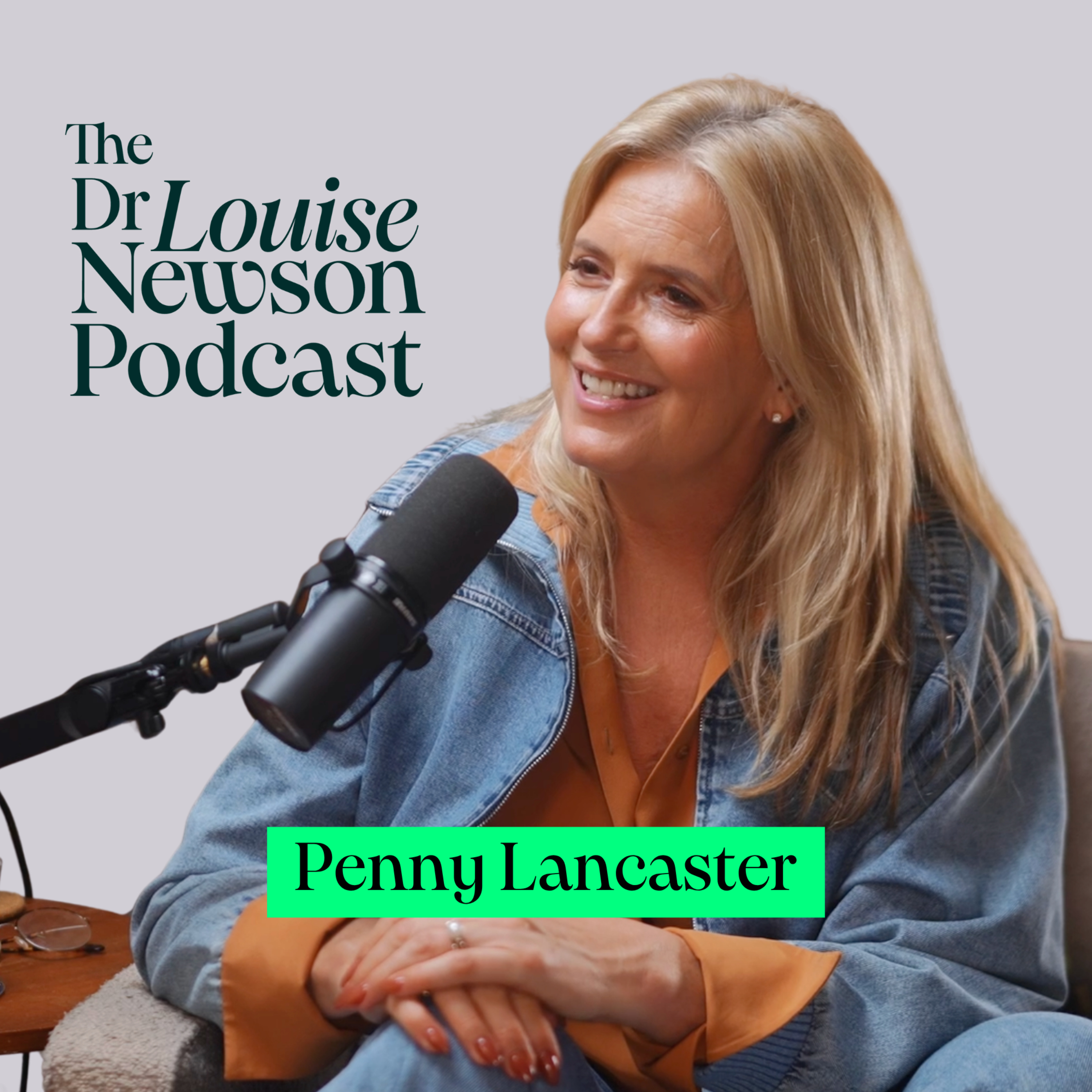
34 - Penny Lancaster: The truth about menopause care
Episode Transcript
Penny Lancaster is my guest today.
She gives a really open account of her own story, not just her own menopause story, but her life in general.
But her menopause was diagnosed by the team in Loose Women.
She had been misdiagnosed as depression and thought she actually had depression and needed antidepressants.
So it was a real honor to meet her as a patient in COVID times and help her to educate herself about hormones and also about the different symptoms, which has really helped her to educate so many other women about hormonal health.
So Penny.
Hello.
We've only met once in real life.
I know, haven't we?
But it's I feel like I've known you forever because I feel like you've also changed my life.
Oh, Penny, thank you.
I mean, that really slippery slope that I went on, you know, when I just when I was like 49, kind of crying out for help in the middle of lockdown, thinking it was the anxiety and fear around lockdown that was causing my symptoms to the point where I, I'm always the guiding light and the one that people turn to for help.
And you know, the answers.
I, I couldn't even help myself.
And I was like literally just on the floor in a, in a ball of sweat and tears and just panicking.
And then my GP, who I had at the time, male, just responded to the tears with antidepressants.
And did you know then that you weren't depressed or did you?
No, I thought I was depressed.
And I'd never felt that way before, so I didn't recognise it.
But of course I hadn't had any knowledge on what menopause was other I'd heard of the word but I didn't understand it at all.
And it wasn't until I went on one of the Loose Women shows and it was when we were back in the studio, I think it was, but there was no audience because of the lockdown.
Rules and stuff.
And I was describing what I was feeling and they were like, Penny, no, no, no, no, no, no, no, you got this all wrong.
You were not depressed.
This is your hormones.
This is the menopause.
Your body is like being depleted of the hormones and, and obviously you know, women will have side effects, Some are going to be affected more than others, but this is everything.
You're ticking enough boxes to suggest that it's the menopause and they better get some blood work done.
And then that was a whole misconception because then I realised that actually having gone through IVF and having blood work done with that, there'll be one month I'd take my blood.
It's not really a great month.
Hormones aren't where they need to be.
Let's wait, be patient.
We'll test you another week.
Boom, they were great.
So what's the point in doing a blood test to see if you're hormonal?
Because one week it's my next minute it's not.
And we all know that you have a good period and a bad period, one that's like clockwork, the other one that just goes on longer and it's heavier.
And so, you know, I was told by you and passed on the message to others that it's, it's all about let let, I mean, the list goes on and on.
But if you can at least take five of those main symptoms, then just talk to your GP, request that you go on to it.
And then maybe two or three months down the line, look at doing blood.
Work, yes, and that's really important.
And I remember, I mean, you've written about it in the book, so I'm not disclosing anything, but you know, you were in a really bad place.
But you are a massive copper, you know, I remember because you had all the children at home and we, I mean, we all did.
Schooling.
Yeah.
So there was a lot that you had to deal with, but you've always dealt with a lot, Yes.
And I remember you saying, you know how worried you were about yourself and Rod was, obviously.
Very concerned, yeah.
Concerned about you?
Because it was just, you know who, who did everyone look to for the answers and the decisions?
Was me.
And then I wasn't there.
No, not.
Really.
No, not presently saying you just wanted to escape from the house.
Yeah, I used to lie in a hammock in the the the chicken area, like and hide like, like a cocooned myself up and just wanted to shut myself off from everyone.
Like don't come to me.
I'm I'm I'm no use to you kind of feeling.
You see, it's, it's funny, but it's not funny.
And, you know, even since we last met, we've, I've been funding a PhD student in suicide prevention and I'm really focused on mental health and hormones because, you know, I've lost count the number of women I see who have really struggled.
And they've not just had antidepressants, they've had antipsychotics, they've had lithium, they've had electroconvulsive therapy.
And they think that's the path, you know, that's their lot really.
And a lot of women just become more and more invisible.
They, they can't cope because of their mental health symptoms.
And they think that's just the way it is.
And we've known that for hundreds of years.
Women have become more invisible as they've aged.
But actually it doesn't have to be that way.
And it really frustrates me and saddens me that so many people can't get hormones.
Well, it absolutely frustrates me because you you look at what you're talking about being invisible, like the workplace of women that have been working hard but working their way up the ladders.
It were, you know, on on par with their male counterparts who's going to get the promotion?
And it's a that real prime age when we've gained all that experience and knowledge, we're suddenly we feel like we're falling apart.
And like you're saying, nobody can see me and I can't remember this or, you know, I'm forgetting things.
I, I've got the brain fog or I can't sleep at night, so I can't function properly during the day and all those things.
And maybe I'm not what I thought I was.
Maybe I should just slip away and just hand in my notice and and did you see that?
Happens and you know, years ago, so about 10 years ago, I did some work for West Midlands Police.
And I know obviously police falls very close to your heart as well.
And I just did half a morning a month and they wanted me just to talk about menopause and symptoms.
And they, when I first went in, they were talking about policies and I said, Oh no, I'm not an HR consultant.
I have no idea about policies or pay or 8 any HR things but what I can do is just inform women and when I first went there was about 8 women lovely women round the table and they all just said Oh no hormones means cancer doesn't it?
And I said, no, it doesn't actually, let me just tell you about all the symptoms because they thought it was just hot flushes.
And one by one they're saying, oh gosh, I'm I was going to hand in my notice or I've come off the beat.
And now I'm working in an office job because I can't walk.
It's really painful.
My joints are stiff and I can't lift my grandchildren and put them on the swing.
And they were all thinking about their early retirement.
And I thought, gosh, and one by one when they were talking about their experience with their healthcare professional, they they're all on antidepressants.
So I said, well, maybe you should think about hormones.
And then over the months they would come back and they would talk about, Oh my goodness, I'm on hormones and I'm so much better.
And you should try it.
You should try it.
And, and at the end of the year, there were hundreds of people in the room and it was like stand up room only when the last session and everyone was so empowered.
And it was, it was just brilliant.
We even got the chief constable involved and because once you see it, you can't Unsee it exactly, but it's getting to that stage, isn't.
It well, you see so many household names promoting products, you know, health, this is health benefits, you know, this this cream or this tonic or this signals like that, you know, but you know, we're talking about this a product that we're not selling.
We're talking about a product that we it's something that we've always produced our entire lives naturally, absolutely.
And why should we be without it?
And now, thanks to the work that, you know, with the marching to Parliament, with Manhole's mandate and you know, Caroline Harris, you know, at at least we've, we've got the, the, the cost down.
Yes, Oh yeah, it's been a massive difference.
It's still like one fee for a whole.
It doesn't.
Include testosterone.
But it still does not include testosterone because someone, I would think it was probably a male, has decided that women don't need.
That which is crazy.
I've spoken to quite a few women who have been fined.
So their doctor didn't know it didn't cover testosterone because it's about hormones.
So they've presumed it was a HRT and testosterone.
And a husband came up to me recently and said, you know, my wife just got a fine and it's about, I can't remember the exact, it's either 80 or 100 lbs.
It's a lot of money for, for, for people.
And they've had to pay this fine and they said we never did it, trying to avoid the money.
We just thought it was covered.
So it's really fine.
For what?
Because they've got got their testosterone for free.
And so they then get a letter back with a fine to say no, it's not covered.
You shouldn't have put it through.
Oh, I know.
It's really sad.
So, yeah, so we've still got things that we need to change.
HR2, it's two.
It's hormone replacement.
I know therapy.
It doesn't say.
Oh, except, except it doesn't include.
It doesn't say that.
No, no, no.
But that's the small print, which that's people don't realise, but it's but it it what did what Carolyn Harris and others.
And you know, you were the mandate and everybody working together.
It's just about awareness and choice.
And you know, what I feel really sad is that HRT prescribing is less than half of what it was 20 years ago when that study came out.
You know, it used to be 30% of menopausal women were prescribed hormones in the UK.
And then the.
Negative report came out.
Yes, and then it scared people, scared people away.
But has it has.
It increased in in the last two years.
With all the work that you know everyone's been doing the last 10 years or so, it's gone from 10% to 14%.
So it's still and it's plateaued the last year.
I think we're going back in time.
The stories that we hear of doctors refusing has become a lot more.
So it's 14% in the last year, it's plateaued.
It's not kept going up.
Oh, that's that's disappointing to hear it.
Is and in in the US it was 40% of women who were menopausal before the WHI study, and now the recent figures are about 4% of women in the US.
What?
We're going to do about that.
We just want to keep talking, you know?
Like the IT went down because of that report, so we need a different type of report.
Well, The thing is now this is interesting because this was the only randomised control study and a lot of people say you have to have randomised control studies in medicine.
So that means you divide the group into two.
You don't know who's having what.
Half have the real drug and half have placebo.
And then you see the difference.
And that's what they did in that study because they knew HRT was good for women, but they started to give it women who are older to the average age and the body was 63.
But a lot of those women had had heart disease, they were overweight and that had raised blood pressure.
And they gave them the synthetic hormones that we know has risks with it.
So it was like the wrong type of HLT, the wrong study.
So now if you did a randomised control study with natural hormones, it's not actually ethical because we know there are more benefits and risks with natural hormones.
We know they reduce incidence of heart disease and osteoporosis, for example, and improved symptoms.
So, you know, if I was menopausal and not taking hormones, I wouldn't want to go into a study because I'd want my hormones.
Do you see what I mean?
And I wouldn't want to risk because if I went on placebo, I couldn't work as a doctor.
I couldn't be happy marriage.
Can they do the test on women that I'm taking it?
Yeah, so, so then, but then what they have done all?
Those women that that are afraid to that are scared to that the the women that go to the doctors that refuse to give them, can't they sign up?
Yeah, but then it's still hard because then as a doctor, you know, I'm really clear to women that there are risks of not taking hormones.
So there are risks for your future health as well.
So, but not every study has to be a randomised control study.
When they discovered that penicillin, you know, antibiotic was, was good, they didn't say, oh, we're only going to give it as a randomised control study because it was good.
So you can do observational data.
But the other thing is we know how the hormones work in our body.
Like we've known that for decades.
So we know they reduce inflammation, we know they get produced enough in our brain.
They know, we know that for many years we've known that women who have hormones have less depression and less mental health issues.
So we just need to join the dots really and and then allow women to choose.
It's a bit like saying to you, exercise is good for you, but you can choose whether you exercise or not.
You know what I mean?
And it's the same with hormones.
You can choose whether you take them.
But I think the saddest thing of all of this, Penny, is that women are just not even the choice.
You know the number of women I meet who are on antidepressants compared to hormones, you know?
Well, I mean, I get women coming up to me on the school gates or at the Pilates classes and things like that asking me, you know, so what's going on?
What's, what's the latest?
I'm thinking of taking, but I'm not sure.
I'm like, why aren't you sure?
What is it that where's the stumbling block?
And they still have that little niggly.
It might not be good for me.
There might be a side effect.
I said why?
Why should there be?
You've had these hormones in your body your entire life.
It's the same thing.
It's not a foreign object that your immune system's suddenly going to react to.
I mean, I've, I've had an undirected thyroid gland, so I've required, which is another hormone, thyroxine.
We have required that since I was 21.
So I hated the idea at that age, taking a tablet.
But like the doctor said, we won't survive.
Yeah, yeah.
And it's exactly the same.
It's just another hormone.
But the problem is when they were discovered, they were commercialized because people wanted to make money.
They always wanted to make money out of drugs.
So they changed the chemical structure.
So with your thyroxine, you take levothyroxine, which will be exactly the same as the thyroxine that I make naturally for my thyroid.
With the HRT you take estadiol, which is a natural form.
In the olden days they used to use a synthetic hormone which was either made synthetically, like in all the contraceptives, or they used to get it from pregnant horses.
Urine.
I know.
Which is awful, isn't it?
Yeah.
So that was when a lot of the studies were done.
So it contains estadiol, but it also contains all sorts.
Of oh I.
Know, but the drug company painted it so if you've got a patent for that drug, you don't tell anyone else your formulary.
So they wouldn't tell other people what was in that magic urine.
As long as it's got what you're saying it hasn't, you forget.
About the rest, yeah.
So once you realise that it's completely different, you know, because you want to replace like with like, and that's all we're doing.
But what's really interesting, I think, is that people take contraception pretty easily because obviously it works as contraceptive, but it's synthetic, so it has far more risks than taking natural hormones.
But you suddenly say to someone HRT and they're thinking, oh, I'm not sure.
As our hormones change throughout our lives, especially during perimenopause and menopause, looking after our bones, muscles and balance becomes even more important.
That's why I love Vivo Barefoot.
Their shoes are designed to let your feet move more naturally, helping you build strength and stability from the ground up.
That natural movement can support not just your physical health, but your sense of well-being too.
Vivo Barefoot are so confident you'll feel the difference that they offer 100 day trial with a full money back guarantee so you can try them completely risk free.
And as a listener of this podcast, you get 20% off your first order with the code NEWSON 20.
Just head to vivobarefoot.com and give them a try.
Your body will thank you.
I've got something really exciting to share with you.
Every Thursday I'm going to be releasing an extra episode for those of you that sign up.
It's an opportunity that I can have more guests share more information, dig deeper into the research that I can share with you.
And when you subscribe, this money is going to be used to help with research, much needed research that's away from pharmaceutical companies.
So information is down in their show notes.
So have a look and subscribe and enjoy.
Because of course, that's all you ever taught about at school.
You're never you're not taught about the menopause.
No, you're not taught about how to get pregnant.
Yeah, it's just taught about how not to get.
Pregnant, I know.
Bees and the birds you boys, girls like protect yourself from diseases, protect yourself at getting pregnant.
This is how you don't get pregnant.
This is how you don't get pregnant.
And, and the whole thing of like, you know, I've tried to explain, well, like the boys understand what menopause is now of course, because they saw Mummy go through hell with it.
And then I, you know, I needed to explain to them what was wrong.
And I'm OK now because I've got my home replacement.
I remember I was in the boys bathroom and I heard Aidan who was probably about 13, it was like a year ago and I heard him chatting some of his friends from the lads.
There was about four of them and they were going, oh, what?
What was, what was Miss doing today?
Like, God, dear, she was so snappy and miserable and this and that and I'm listening, going.
They were chatting away and it seemed like it was an unusual behavioural pattern for her.
Anyway.
So I put my head in and I said, boys, how old do you think this teacher is?
Oh, I don't know, maybe a little bit younger than you, Mum.
I went, oh, OK, so Aiden, you've heard this from me, but but maybe you could consider that she might be going through her menopause, you know, like mummy had a lot of trouble.
And, you know, you cry more easily.
You, you get, you have less patience and you get anxious and all of those things.
So Can you imagine the stress a teacher's under and she's feeling that way because of the lack of hormones?
And The thing is that they teach you boys So what happens in puberty and how girls begin their periods.
But that's just the beginning of that fertility cycle, because at the very end, the full circle, is when those periods stop.
So you get a rush of the hormones, which ignites the body and turns a girl into a woman and her periods begin.
But why don't they finish the conversation and say, look, your mums or your aunties or your grandma or someone else might be at the other end of their fertility and the opposite happens.
The hormones start disappearing.
So just I said, boys, look at the the girls of your age.
You might say, oh, of course she was a bit snappy or she wasn't very nice today, was she?
Or why was she ran off crying?
And because it's explained that it's hormones, the same with you boys, whether you get testosterone, you can get angry and all those things, but they're not explaining no the other end.
So surely there has to be a part of that whole journey.
Absolutely.
And it's interesting because I've got three daughters and you know, a lot of them recognise it in their friends mothers, yes, all their teachers.
You know, my 14 year old couple of years ago at one of her schools, she said, oh mummy, the maths teacher.
So obviously, you know, she had a, she kept opening the window and there were times when she was really, and it's a real.
Struggle embarrassed about it and the the thing that you know the kids are going to eagle what have you, but if you just be like look, this is what it is.
You know I remember Aiden he he used to go hang on mummy.
Wait a minute.
I need to open a door and you know waff the door back and forth and back and forth to try and call me down like he was you know it was just it's it's that taking the stigma and the shame away from it and just go look this is part of life cycle just same with you kids going through your puberty.
This is what adults of my age go through, so we're colour on the same page.
I get what you're going through and I'd like you to be able to understand that what I'm going through and then how many kids can go home, like you said to their parents that aren't educated on it to go dad, I think maybe you should chat to mum, maybe that you know, like to have.
The conversation having the.
Conversation men into the conversation.
So important.
And actually I was in Glasgow, I did an event at the theatre.
I got an e-mail today from one of the few men that were in the audience.
There were only three men in the audience and he was ex army and he said I'm writing to thank you for everything that you do.
But he was, he'd come with his wife and he said, you know, if I hadn't, I've been aware of your work, I wouldn't have been able to help my wife.
And now she's taking hormones and you know, a whole relationship, everything is completely different.
But actually, sometimes you need someone else to advocate for you, not just to recognise the symptoms, but to say, come on, I'll come with you to that doctor or I'll make that appointment with you.
Yes, don't take those antidepressants.
If that that's not right for you, then think about hormones, because it's the second part of the conversation that's missing so often, isn't it?
Well, I mean the idea that there have 50% are going through the menopause, but actually the other 50% the men are going through it with us, they're.
Standing.
Right by our sides scratching their heads and they're panicking.
And then of course, it and it can very easily end in marriage breaks down.
And then of course, like we're still, as you mentioned, suicidal thoughts.
But I remember my eldest son Alastair, he, he was saying Mama was, was at the side of the football pitch this Sunday morning and one of the dads came over to me and said can you thank your mum because I know what my wifes going through now.
That's nice, isn't it?
Like yeah, but it's.
Sort of a football pitch.
Yeah.
Where it's like all tough and mud and, you know, grits swearing and all that.
And they're talking about menopause.
And at my police station in the city, I had one of the one of the mail officers come up to me and say the same thing.
Thank you so much.
Talking about it now.
I understand.
And I was on one duty where we all have to look smart, be smart.
So they have to wear the same uniform.
Yes.
Primarily we have the same uniform, but we have different types of styles of jackets depending on the weather.
And it was a long duty, so we were trying to gauge the weather and decide what for uniform we're all going to be in.
And they decided on the heavy coat.
So I thought, I don't know whether to bring this up, but quietly, not in front of everyone.
I went over to the one of the sergeants and I said, look, I, I don't know.
I don't want to be treated any differently.
I, I, you know, I, I don't want you to, I just want you to understand that I'm going through a menopause.
You went, you don't need to go any further.
Do you want to wear the lighter jacket?
That's nice.
Well.
You think I can do that?
Yes, of course you can.
Oh, thank you, he said.
No, we set up a whole menopause thing and we haven't.
I was like.
Whoa, that's really nice.
Isn't it a male dominated place like that?
So it's it's getting there, it's just slowly.
And I think if we don't continue talking about it, it will just drop off like you say, and there'll be another generation.
The next women coming up that radio.
Recently.
And then they dropped me and said, oh, we've spoken enough about the menopause.
It's like really, no, you haven't.
I will only stop talking about it when everyone who wants to take hormones is on them because it's this 14% isn't because only 14% of women want them.
It's really not.
You know, everyday I'm speaking to women who really can't access hormones because they're not seeing a Doctor Who's been educated and it's really wrong.
So the more that everyone works in different ways, then it amplifies the messages doesn't.
It absolutely.
I mean, I'm thinking of that those health checks that women get with their GPS and the information that's kind of given to them at the right stage.
Same with fertility.
I have a girlfriend who, you know, it's like very career focused and very intelligent girl and but she's 35 and now she's like babies.
And once again, like she's, I only remember being told how not to get pregnant.
And now I want thinking about babies, but maybe I've left it too late.
And, you know, we'll go to doctor and like, but go with a list, you know, they want to be able to see a pattern of like, when did you have your last period?
Are there your periods regular, how many?
You know, like you've got to write a list of all these things.
The same with the menopause.
Go in with a list of of your symptoms and how often you have these symptoms.
And there is a particular time in a month you feel worse and you know, you have to go with, you know, armed with.
Material difference, that's one of the reasons that I created Balance app, you know the free app because it's got all the symptoms there.
People can then create a health report and go and say, look, these are my symptoms.
And actually for me as the doctor, everyone does it who comes to the clinic and it means you can look very quickly.
And you can.
Oh.
Yes.
And then sometimes people say, oh, I haven't got many symptoms.
I look at their list and I say, well, what about your vaginal dryness?
So what about your joint pain?
Oh, Oh yeah, I forgot about that.
And then the whole conversation starts then.
Because it's that you go, go away afterwards and you go, oh, I forgot to mention this, forgot to mention that.
Oh yeah.
Oh gosh.
Yeah, yeah, yeah, yeah.
So.
So tell me about your book.
It's amazing that you've written such a long book.
It's so brilliant.
It's so easy to read.
Yeah, I know.
We're having dyslexia and writing and like you say, reading it.
Out, yeah, which was particularly challenging.
I call it someone like me because yes, it's a story about me, but it's also a story that so many other women, men even have gone through A lot of the experiences that I've gone through, whether it's bullying, whether it's dyslexia, whether it's been a victim of crime, pregnancy, fertility, IVF, menopause, you know, all of those things.
So, yeah, it's, it's the journey from, from my childhood.
And by writing it, I've dug really deep into detail about the events that have gone through in my life, some of them traumatic, but it's amazing how I've realized that I've gained skills.
You know, just when you think you're in the worst place, you don't think there's any positive from from that you can get from that.
Actually, you turn another page and another chapter and before you know it, you you, you know the, the other experience you, you have later in adulthood, you maybe wouldn't have been out to get through had you not gone through those things as a child.
I totally agree with that and sometimes that very dark times there comes like this, but you don't know it at the time or resilience or strength.
You can't be strong if you've not been pushed over before.
And so there's I think also people.
It's so easy to look at you, you know, look at you, you're married to Rod, you've got everything you like, you've got a lovely family.
But it's not always been easy.
And I think for somebody to just share their back story takes quite a lot of courage actually.
But it helps people resonate, doesn't it?
It does.
It helps people resonate, connect with you and know that well if she's been able to make this of herself.
You know, when I was told that I wouldn't make anything of myself when I was at school, a teacher once told my father.
And so I never thought I was ever going to be good at anything.
And but then when I met Rod, he, you know, much older than me, they had a bit more life experience and he recognised side of me that I hadn't seen.
And he said, you're great at this.
You've got, you're so good at communicating and your, your, your thoughts and you're great with the kids and you've got this empathy and understanding.
And you see, always see things from other people's perspective.
And you can use that and channel that.
And, and I was like, didn't think of those as talents or skills.
But of course, in policing, it's.
Massive, yeah.
So it's, yeah, I've really sort of tapped into things and like bullying and realising, of course, this bullies in adulthood in the workplace.
And you come across those and I've learned to recognise it and I've learnt to rise above it.
And do you know, de escalate is my key thing.
And, you know, in the end of the day, karma will come round.
But if you just just keep giving kindness and love and take care of yourself, there's no need to attack, just defend yourself.
Takes a lot of a lot of bravery and courage to do that actually.
But also patience.
Patience but also a lot of kindness.
Because the more I think about bullies, I realise they're not kind and they're probably not happy.
They're not happy, but that's.
The key my fault they're not happy or your fault they're not happy and I don't think anything that what we can do as victims, we'll make them happy actually well.
If you if you show suffering, it's kind of given them.
They're winning, aren't they?
They're winning, yeah.
So as hard as it is to suffer quietly somewhere else, you know, but of course, express it to your loved ones.
And, you know, obviously as kids, it's not, it's not a conversation you can have with those bullies.
But they will recognise it in themselves and they know they're doing wrong ultimately.
And more often than not, you find them in groups.
It's only as the, the true, the centre of that group, maybe the true bully that's instigated, it will end up continuing to have that pattern because their needs haven't been met and they become that that adult bully when they're older.
But yeah, a camera does come and get you.
I think in the end I.
Think it does, but it can take a while and it sometimes it's really different.
People can.
Stuff that long as well.
Yeah, I think so, people.
Do need to be called out and I think more and more is being done in the workplace to kind of not suffer people in in a powerful position allowing people to get away with stuff these days.
I think, I think it's important and you know, there's so many different types of bullying and even, you know, I employ a lot of doctors and most of us have worked in quite difficult circumstances and being unable to speak out because these people are our bosses or they're going to give us our references or whatever.
And it's, it's no different in medicine to other professions.
But, but I think also the most important thing is having a good network of people around you, people that you can trust and make you feel good.
And you know, your family certainly do that, don't they?
Family, my friends and happy and yeah, I'm very lucky in that respect.
Very lucky.
Yeah, so, oh, I'm just so grateful that you're so open.
But before we end, I always ask for three take home tips and I am just going to ask three really simple questions.
Three things why people should buy this book.
Someone like me is is an expression of hope and gratitude and I, I've already had so much positive reaction from people and I hope it just resonates and gives guidance and makes people feel like they're not alone.
And I think it's kind of touches people in different ways, but it's been good for me and I hope it's good for others.
Yeah, well, you've already had such great feedback.
Of course it is.
And just thank you so much for all your energy and love.
Thank.
You.
Thank you very much, Louise.
Cheers.