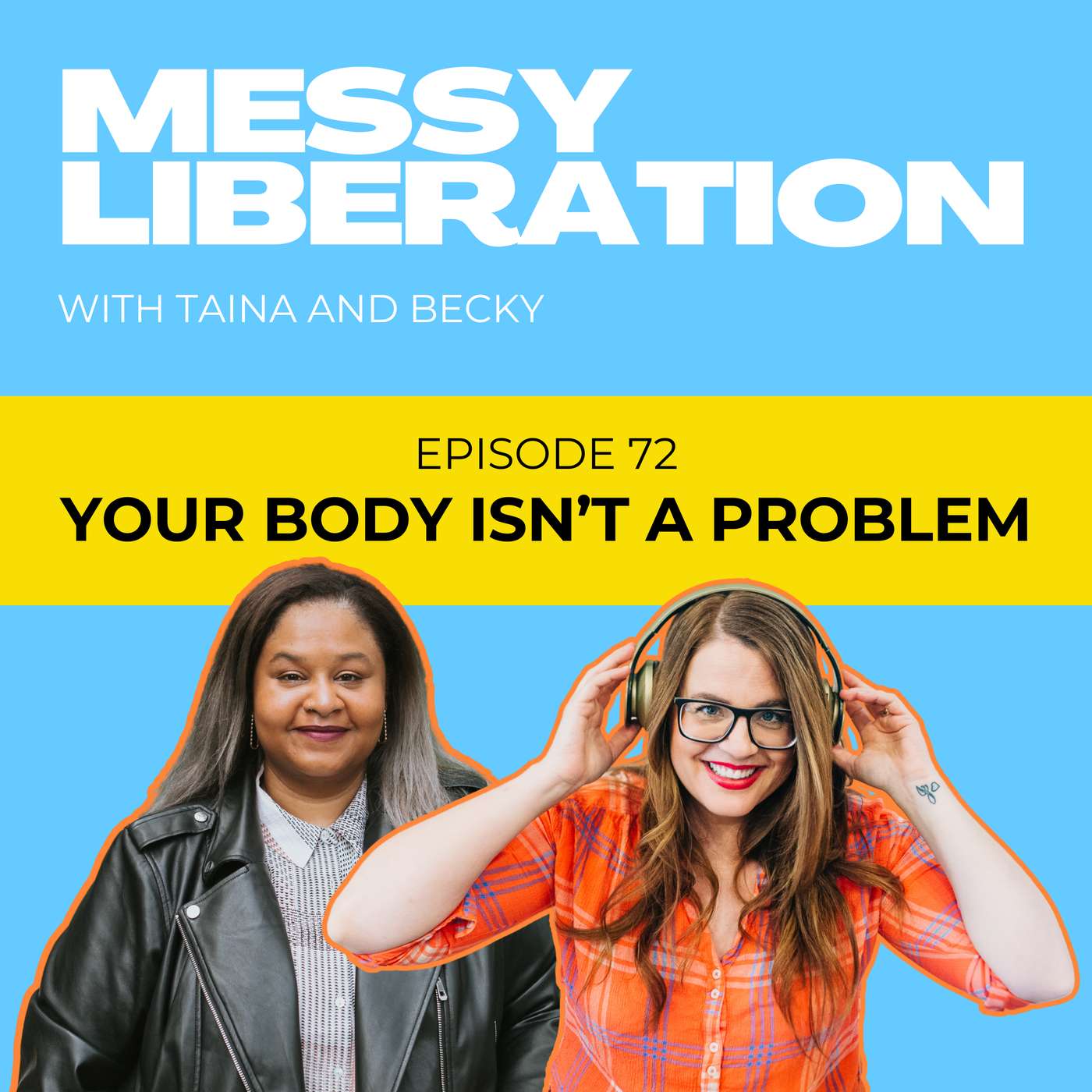
Your Body Isn’t the Problem: Divorce Diet Culture & Come Home to Your Body with Laura Thomas
Episode Transcript
Taina Brown she/hers (00:00.14)
and then we're good.
Laura Thomas (00:03.576)
Sounds good. I do have a little still a little bit of a cough, but hopefully it'll catch some of that.
Becky Mollenkamp (00:08.839)
and you'll be fine.
Taina Brown she/hers (00:09.014)
Yeah, we should be fine. Becky's had her deep, sick, sexy voice for a few weeks now.
Laura Thomas (00:10.721)
Okay.
Becky Mollenkamp (00:11.579)
Greetings!
Becky Mollenkamp (00:17.669)
I'm getting back to normal. Make sure you're centered. So when we do our shorts, Taina, I'm looking at you. You're not really centered.
Taina Brown she/hers (00:20.106)
Ha ha!
Taina Brown she/hers (00:26.924)
I'm trying, I'm trying. Is that better?
Becky Mollenkamp (00:29.415)
We're the one. That's better. Okay. All right, now we'll start. Hi. Yeah, hi. Good morning. Hi. We have a guest.
Taina Brown she/hers (00:33.109)
Good morning.
Laura Thomas (00:35.189)
Hi.
Taina Brown she/hers (00:37.343)
How are you today?
Laura Thomas (00:39.576)
Good, how are you guys doing?
Becky Mollenkamp (00:42.055)
cold and loving it. and loving it. My house is my house is 63 degrees because I haven't turned on the heat and I had the window open last night and it's cool. I had to go grab a cardigan because I was like, it's cardigan weather. I'm so happy. I love it.
Taina Brown she/hers (00:43.327)
You're cold?
Laura Thomas (00:43.52)
my gosh.
Taina Brown she/hers (00:58.923)
Sweater weather, sweater weather. Yeah, me too.
Becky Mollenkamp (01:00.345)
Yeah, I am such a basic bitch. just, love, I love me sweater weather. I love autumn. I'm here for it. So.
Taina Brown she/hers (01:08.351)
Nah. Give me all the sweaters, the cardigans, the turtlenecks, the beanies, the scarves.
Becky Mollenkamp (01:13.947)
Yeah, like what I call it is comfortable clothes season. You know, which actually is kind of perfect for today because one of the reasons, I'm gonna just come clean. I texted Taina before this episode and said, I gotta be honest, I'm not super feeling today's episode. I love Laura, but I hate all things fitness and diet and body.
Taina Brown she/hers (01:18.684)
Mmm, yes.
Laura Thomas (01:37.55)
okay.
Becky Mollenkamp (01:39.335)
And so I was like, I really don't want to, I'm just like struggling here. Will you take the lead, Taina? Yeah, here I am taking the lead because I'm just coming clean. Cause the title is like, yeah, I kind of feel the same way about this stuff, but like, honestly, it's probably why we need to have the conversation. So it's great.
Laura Thomas (01:46.243)
Well.
Taina Brown she/hers (01:52.222)
Yeah.
Laura Thomas (01:52.462)
Maybe I'll change your opinion a little bit once we're done. Maybe. Yeah.
Becky Mollenkamp (01:56.487)
We'll see that'd be great. So we have Laura Thomas joining us today and Laura, don't you tell people why we're talking about the body and you being here, tell people what you do.
Laura Thomas (02:05.078)
the body.
Yeah, so I am, my name is Laura Thomas. I'm a fitness coach, primarily based in Cleveland, Ohio, although I am allowed to work virtually. So that's really exciting in the greater US. And I've been doing this for, gosh, almost eight years now, which is, oh, I guess about eight years, yeah, which is so wild to me. And I work with women and femmes and thems, because I always love to say I work with all identities.
you know, really want to sort of explore coming back to their body. So I think what a lot of times happens is that not to get too deep right off the cuff, but what happens is as we, you know, grow up and realize that like our bodies are, you know, commodities, so to speak, and like people can have opinions on them and things like that, that we start to really distance ourselves from our bodies and their capabilities and, and what they can and can't do. And I really like to bring people back to
their body as a home and what it can do, right? And we're all beautifully designed and we're all built differently. And that's not by accident. I think that's definitely on purpose. We're not all meant to be, you know, thin and all look the same and all that kind of stuff and had the same type of body. And I like bringing people back to that, to find inner strength in what they can do, which, you know, it can be a variety of things. Some people love to strength train. Some people focus more on, you know, just
walking and a little bit more of like gentle cardio and things like that. So I never try to critique what feels good for someone. I'm always going to be at the school of, you know, a little bit of resistance training and strength training is good for you because it helps with bone mass. It helps with bone density, especially as we get older. People who are cis, cis women or cis female tend to lose.
Laura Thomas (03:53.582)
Bone mass I think is a small percentage each year after 30 or 35 So it's always great to continue to build that but that can look like a million different ways, right? It doesn't mean you have to go to a gym and bro it out and you know Do all that kind of stuff and be in a very uncomfortable Place for you and a lot of women aren't comfortable in in gyms because of that and that's completely fair right like gyms I don't think were really made with marginalized and
Taina Brown she/hers (03:56.833)
Mm. .
Laura Thomas (04:20.334)
female identities in mind. think they were kind of designed with men in mind. So, yeah, so I to bring people back to their bodies. I do that through alignment, strength and function, which is something I started doing back in 2024. So instead of throwing people right into a weight training regimen, I really try to work with their body and their spine and their inner strength and get all that figured out and the foundation established before I even dream of giving somebody a weight and saying, okay, now we're going to start doing.
loaded exercises. I really try to be more ethical in the way that I approach working with people's bodies.
Taina Brown she/hers (04:51.397)
Yeah, yeah.
Well, before you ask a question, I just want to let people know, because you mentioned, Becky, like we love Laura, but we're also, I think you and I, and I would say even Laura, I would argue even Laura, actively divorcing ourselves from diet culture, right? And all of that negativity. And so I just want to let our people know how we know Laura. We know Laura because she's a part of our culture circle community. We knew her before in a different community.
Becky Mollenkamp (04:53.061)
I'll go ahead and eat now.
Taina Brown she/hers (05:22.729)
And so you're not a stranger that we're bringing onto our show. You're someone that we've known for quite a while that we engage with regularly. And so we trust you. We trust what you have to say. And so I'm actually excited to have this conversation because even though the three of us, and I would even venture most of our listeners or viewers are people who are actively divorcing themselves from diet culture as someone who is now.
in my middle age error, right? Bone density is something that I'm thinking about because I, in the past several years, have just noticed older women in my life, like my mom and aunts and my wife's mom and people like that who have lost bone density and the way that that has affected their day-to-day life. so strength, building up strength.
is something that's kind of been top of mind for me the past few months. So anyway, go ahead, Becky. I'll throw it back to you.
Becky Mollenkamp (06:27.015)
No, I was gonna say, I think it'd be interesting too for us to maybe individually share some of our own stories. Cause I don't know how deep we've, we've talked about body stuff before we had Tiana Dodson on not too long ago talking about body liberation. So that's a good episode to reference as well. But I don't know how much we, oh yeah. And Marina that then that was a while back health at any size or every size. Um, but yeah, I don't know how much we've really shared, like maybe personally to some of our own relationships with our body and our.
Laura Thomas (06:40.191)
Mm-hmm.
Taina Brown she/hers (06:40.84)
Yeah, when we have Marina on to. With the health coach, yeah, yeah.
Becky Mollenkamp (06:55.943)
perceptions of our body and our feelings about those perceptions. So I thought that could be kind of interesting and Laura would probably be a chance to talk a little bit about how you've come to the place that you are with that. Because I will say like one of the reasons I struggle with this is exactly you're talking about talking of like divorcing ourselves from diet culture and I don't I'm sure you discover this to Laura with clients. That is like it feels it is an epic journey of
Laura Thomas (07:05.454)
Hmm?
Laura Thomas (07:22.858)
yeah.
Becky Mollenkamp (07:23.651)
releasing all of that stuff. then, like, I feel like the pendulum can swing very far in the other direction. And I know it has for me where, like, my body has changed by 100 pounds plus in my adult years, right? So I've had very, I've been on the almost too thin, I would argue, size. I'm, you know, pleasantly full now. But I've been all sorts of stages in between that. I've
gained and lost. So I've done what so many women have done that like yo-yo dieting of losing and gaining the same 20, 30,000 and incrementally often edging myself way up. However, I have had that place where I've been very thin. I've also had a place in my life where I've been very, very fit. I ran a marathon. I've run many half marathons. I was a really pretty good runner. I had gotten to place where I could actually run like a
Taina Brown she/hers (08:03.651)
.
Becky Mollenkamp (08:19.153)
a single mile in about six minutes. Most of my miles were a little, you know, slower than that. But like, I had really, really good fitness for a while in my life. And I actually thought about going down the journey of being a fitness coach, which is what led me ultimately into coaching in a different form, which for me, I think is good because I think if I had done that, I would have continued to perpetuate all kinds, because I was perpetuating harm when I was in that space. And trying to unpack from diet culture has been so challenging. What I have found, I think,
Laura Thomas (08:42.423)
Easy.
Becky Mollenkamp (08:47.705)
ultimately it really means is learning to decenter men from my life. Because to me, so much of what diet culture is about is actually about being centered inside the male gaze and having your own worth being determined by that. And I don't just mean by, again, because I think even Taina, who is maybe less interested in men than I might be, even though I also like women. But I mean like,
Taina Brown she/hers (08:53.084)
Mm-hmm.
Laura Thomas (08:58.882)
Mm-hmm.
Becky Mollenkamp (09:14.063)
the definitions of beauty as created by men. So even people who don't care about men valuing their bodies, we still like often, think even many lesbians, think many bisexual women, I think women, heterosexual women, we judge women, other women based on beauty standards that have been set by men for us, right? And then we internalize those and then we also use them.
Taina Brown she/hers (09:35.067)
you you
Becky Mollenkamp (09:42.459)
to judge other women. And so like, think even a big part, like big, to me a big part of this is decentering men in all the ways, all the ways that they've determined our worth and setting a new standard of worth, which is really fucking hard. And that's been the journey that I've been on and realizing how much in the past, like you mentioned going to the gym, going to the gym felt like being on display and not.
Laura Thomas (10:07.288)
Mm-hmm.
Becky Mollenkamp (10:08.909)
just men looking at me, them too, but also women looking at me, but everyone looking at me through this lens of this is what a woman is supposed to look like, right? And so being there thinking of myself as I'm in the gym, thinking about how am I looking as I'm exercising? Like that's not what I should be thinking about, right? I should be thinking about my form. Am I doing these things in a way that's going to be safe for my body? But instead I remember that feeling of like, do I look good while I'm running? Do I look good while I'm lifting? Right? And I just think
Taina Brown she/hers (10:25.519)
Yeah.
Becky Mollenkamp (10:38.189)
I think a lot of us can relate to that. so freeing yourself from that, it's hard to then return in a way, because you're like, I don't want to go back. There's that fear of like, if I go back to the gym, if I start to worry about, if I start to run again or lift or whatever the things are, am I gonna then, is that gonna pull me back into a lot of that old way of thinking that I've worked so hard to free myself from? So anyway, that's sort of been my journey and battle.
Taina Brown she/hers (10:54.758)
Mm-hmm.
Laura Thomas (10:58.606)
I'm
Becky Mollenkamp (11:06.373)
And I don't know, Tanya, if you wanna share, here's our floor or you wanna comment on that.
Laura Thomas (11:06.402)
Yeah.
Laura Thomas (11:10.284)
Yeah, I'll comment real quick. Yeah, actually haven't been personally, I haven't been back to a commercial gym since the pandemic. So that was what 2020. I let my gym membership lapse and then I just ended up canceling it. was working, I've always worked in private gyms when I did work in a gym setting. So I always worked in a space that was by appointment only. So I never worked in a box gym or anything like that.
It makes it a little bit more difficult to get clients because people aren't just walking by and walking and seeing what you're doing. I personally, number one, they don't pay you shit as a trainer in a box gym. But number two, I didn't want that environment for my clients. I just didn't want that, that atmosphere. And I liked the private gym space, but I even had issues with that. Like I would have issues with the noise levels. Sometimes people would be training and clanking weights around and that can be rather jarring.
if somebody is sensitive to loud noises or something like that. So that was, could be a little bit. And then sometimes too, and I actually had to bring this up to the owner of the previous space I worked in. I didn't think the music was appropriate. There was lyrics I didn't think were appropriate for white people to be blasting in a gym with black and brown kids, high school kids.
in the space. I'm like, that does not sit right with me. That just does not. I don't think that's appropriate. And I mentioned it to the owner and he was like, no, yep, taken noted. I'm going to send an email out. So that was good. At least heroes receptive to it. and he was a white guy. So, I left that space a couple of years ago and now I just rent a dance studio. Basically when I need space, I just, I just run a studio. That's a blank slate and I bring in my own stuff if I need to, or what have you. But I think that's a lot more of a calmer space.
Taina Brown she/hers (12:44.998)
Mm-hmm. .
Laura Thomas (13:03.406)
Nervous system wise, think it's just with people a little bit better. It doesn't have all the fancy equipment and everything, but most of my clients aren't working out with fancy equipment. Most of the time they're doing stuff at home. They're using bands. They have maybe some dumbbells at home. So they're not, you know, going to the gym. I've had a handful of clients that go to like a planet fitness type situation, but I would say nine times out of 10, it's people that are doing their own thing. So I didn't need all that stuff anyway. You know what I mean?
Taina Brown she/hers (13:31.36)
Yeah.
Laura Thomas (13:32.61)
But yeah, to your point, Becky, I, yeah, I personally have not gone back. I've actually toying with the idea of going back in the winter. And the only reason I'm toying with the idea of that is because last winter we had snow on the ground here in Cleveland for like two months and I couldn't walk outside. And the only reason I would go back would be like, do like some cardio and stuff like that. But I would go in the off times when people aren't, it's not jam packed. They do say, and I've heard this from, you know,
Taina Brown she/hers (13:56.256)
Mm-hmm.
Laura Thomas (14:01.056)
men that I've listened to and things like that. mean, that most of the time people aren't paying attention to you, that they're really kind of in their own world. I, you know, I'm a white, thin woman. I know people can't see me as, because this is a podcast, so I am a white, cisgender female and I'm thin bodied according to society standards. And even though my weight has actually fluctuated, like you said, Becky, mine's fluctuated about 40 pounds over the last few years. You know, I fit the mold, but
Taina Brown she/hers (14:08.061)
.
Laura Thomas (14:30.158)
Even still, I'd have a couple of guys try to come up to me and I'm really good at my RBF. My RBF is on point. So my rusty bitch face and I'm just like, no, not today. No, I'm in my zone. Leave me alone. So I'm also very protective at the gym too. I just don't want to be bothered. I'm here to do my thing and whatever and just leave me alone type situation.
Taina Brown she/hers (14:35.929)
.
Laura Thomas (14:57.272)
But I hate that people have been harassed or they have had negative situations happen to them at the gym. I have heard stories of that happening to people and it makes me mad because it shouldn't be a space like that. people should, I knew somebody who was photographed without their consent at a rec center, which is like usually a rec center. Yeah, and usually a rec center is more like family friendly. Yeah, usually it's like an older crowd, especially like during the day.
Taina Brown she/hers (15:00.996)
my gosh.
Becky Mollenkamp (15:15.717)
That happens all the time.
Taina Brown she/hers (15:20.93)
Community, yeah.
Laura Thomas (15:27.106)
Yeah, she was one of my former colleagues actually. She was filmed without consent, so she had to go to like the manager and she's like, this person's filming, like clearly filming people without their consent, and that's nothing.
Becky Mollenkamp (15:39.559)
I see this stuff on social media, typically making fun of people in larger bodies who are trying to work out, right? And I've seen that kind of content on social media and it's clear that they're not being home with their consent and that sort of stuff. But that is some of the reinforcement that I think keeps so many people from wanting to move their bodies. And again, whether it's in a gym space or on the side of the road using a public sidewalk to walk, like, or even in your own home, just knowing that that stuff is happening, it does something to your...
Laura Thomas (15:45.517)
Yeah.
Right
Laura Thomas (15:54.638)
Hmm
Laura Thomas (15:58.241)
yeah.
Taina Brown she/hers (16:00.983)
Yeah.
Laura Thomas (16:02.306)
Yep. Yep.
Becky Mollenkamp (16:08.261)
your own self-esteem and your own desire to move your body because you can hear those same voices. I can hear them in my head mocking me, right? Like I can hear that. So yeah, it's really, it's so upsetting. Tanya, how would your... go ahead.
Laura Thomas (16:12.11)
100%.
Laura Thomas (16:15.768)
Mm-hmm.
Laura Thomas (16:22.229)
discouraging.
Taina Brown she/hers (16:22.261)
Yeah, but I think that's also why like people like you, Laura and like Marina that we've had on the podcast before who Marina is less of a fitness coach and more of like a health coach. But like I think why it's important for coaches like you and Marina who have these values, right? To be out in these spaces, right? To work with people one on one because you can then
Laura Thomas (16:33.027)
Is it out?
Taina Brown she/hers (16:48.297)
work with people in spaces and environments that they're comfortable in without having to feel like they have to put themselves in a space that feels unsafe or potentially unsafe, you know, for something like that, that could be triggering. And so I mean, we all grow up, right, with this cultural understanding of what it means to have a beautiful body, like what that's supposed to look like, which
Ironically changes every few years, right? Like I remember like in early 2010s, right? It was voluptuous, right? I'm thinking of the Kim Kardashians and like Beyonce and you know, people with like really curvy bodies. And now it feels like we're back to like the waif look of the 90s. Heroin she, yeah.
Laura Thomas (17:35.64)
Mm-hmm. Yeah. Yeah.
Becky Mollenkamp (17:36.721)
quote unquote, heroin chic, that I, that was my formative years too. Like I was in high school with those damn super low rise jeans that the Jessica Simpsons and everyone was wearing and Christine Aguilera and whatever. Yeah, the whale tail. I mean, I remember all of it. And I just saw a girl posting on TikTok of her putting on those jeans, some young girl, and looking at them going like, is this, is this what they're supposed to look like? She's like, there's, how do you bend over? And I'm like,
Taina Brown she/hers (17:48.716)
where you could see the thong, yeah.
Laura Thomas (17:52.366)
No way, I'll tell you.
Becky Mollenkamp (18:06.471)
I remember all of that and how damaging, right? It was so damaging because I remember, I mean, now I look at myself in photos at that same age and was like, holy smokes, I didn't realize how normal and thin, like even thin I was. But I remember when that was the desired body size, I felt so fat because I couldn't wear those. I couldn't go to 579 to buy my clothes.
Taina Brown she/hers (18:08.128)
You just show your crack, babe. Yeah.
Laura Thomas (18:29.986)
Mm-hmm.
Taina Brown she/hers (18:33.589)
Mmm.
Becky Mollenkamp (18:35.047)
And by the way, five, seven, nine is not what we think of as a nine, just so people know. like, yeah. Right? All right? And I remember what that did to me. And I was thrilled that I felt like we were moving away from a lot of that and that girls had learned and society had learned what that was doing to us. And to see that stuff coming back, oh, fuck, it hurts my heart. It hurts my heart. I mean, I'm old enough that I don't have to try to.
Laura Thomas (18:37.23)
Right? Right?
Taina Brown she/hers (18:39.361)
Yeah, it was more like a 135. I think that was like the joke.
Taina Brown she/hers (18:58.421)
Yeah, well, I think...
Laura Thomas (18:59.17)
Totally.
Becky Mollenkamp (19:01.817)
do those styles, like I'm not expected to, don't want to, don't care. But like me and I, my heart aches for young girls again.
Taina Brown she/hers (19:03.167)
Yeah.
Taina Brown she/hers (19:07.464)
Yeah, yeah, well, I think that's evidence of the fact that like, we shouldn't be buying into those standards because they change, right? So like, how often are we expected to change the way our bodies look to mold these standards, right? And I remember when I was in my 30s, was actually my early 30s is when I started to just kind of like really deconstruct my own views on like body image and
Laura Thomas (19:24.142)
Thank you.
Taina Brown she/hers (19:37.279)
you know, understand how harmful things like diet culture could be. Reading this article for a class I was taking, and it was a feminist media studies class, and it was really just laying the groundwork or the argument for how media is used to create these problems.
Right? Media is used to sell us on this idea that we have a problem with our bodies, and then they sell us the solution. Right? So they create a problem and then they sell the solution and then we buy into the solution. But then when that isn't working anymore, then they create a different problem and then they sell us the solution to that problem. And that's why body image fluctuates so much, right? Because it's a market. It's an economical kind of system.
Laura Thomas (20:10.318)
Mm-hmm. Mm-hmm.
Laura Thomas (20:25.4)
Mm-hmm.
Taina Brown she/hers (20:33.653)
built to keep people consuming a specific type of product, right? And so, yeah, right. And so I'm curious, Laura, like, I guess this breaks down into two questions. Like, one, like, when did you start your journey to become a fitness coach, right? Like, has this always been the thing? But then also at what point in your own like journey?
Becky Mollenkamp (20:37.762)
to uphold capitalism. Yeah.
Laura Thomas (20:43.831)
Okay.
Laura Thomas (20:54.147)
Mm-hmm.
Taina Brown she/hers (21:00.538)
Were you deconstructing diet culture, all the harmful aspects of that?
Laura Thomas (21:03.086)
Yeah.
Laura Thomas (21:06.968)
Yeah, for me, I, so my background's actually in nonprofit and marketing. When I got, so my major, I majored in film and journalism, which essentially I have a communications degree from Iowa. And then I got out of school and I had interned at my local film festival. I grew up in Florida, so I had interned at my film festival, the Sarasota Film Festival, the previous summer. And I went back and was hired in for the festival season.
So that's kind of like the closest I ever got to like the Hollywood kind of atmosphere. And I thought that's what I wanted to do. I thought I wanted to move to LA, work in the film industry. Like that's really what I thought I was going to do. And I did that for a season. And then because it's Florida and it's just such a, it's the wild west of the US as we all know. And I would have to kind of take odd jobs here and there. I worked retail, I went.
to a nonprofit and worked at a ballet. I did a lot of, I mean, I learned a lot in all the jobs that I had. So I don't regret any of it. And then I went back the following year and worked at the film festival again. I had a different role. So the first year I was the president and street ticketing supervisor and the second year I was the assistant festival manager. And my boss, who's still a really good friend of mine, she just really trusted me. was.
It's wild to think like I was 21, 22 when I first started working with her and she just really trusted me and what I could do. And she was 10 years older than me and just saw potential, which was so lovely because I feel like sometimes women can not be that way. They can be very judgy and very micromanaging and I don't think they're going to make it. And she was very enthusiastic and encouraging right off the gate, which was lovely. And we're still friends. Like we still talk. She lives in Florida. I'm planning on seeing her when I go down in December.
Taina Brown she/hers (22:26.733)
.
Laura Thomas (22:53.55)
And then I worked for a home builder in 05, 06, right before the housing market crash of 06 in Florida. I was the marketing manager and I decided, so in that time and in that span of time, I had also started going to the gym more regularly. I had started going to an all women's gym actually, which was really lovely. And I liked that space because
Taina Brown she/hers (23:02.208)
.
Laura Thomas (23:22.126)
I personally, now again, I was 20 something, I was a lot more aloof and I was a lot more naive at the time, right? I personally never saw people tearing each other down. I saw different body types there. Now where I lived in Sarasota was very, I would say predominantly white. There wasn't a lot of culture there. There still isn't. I mean, it's gotten a little bit better, but it's a very segregated community if I had to be honest. It still is. Cause it's Florida. So.
Taina Brown she/hers (23:34.928)
Yeah.
Yeah, yeah, a lot of retirees.
Laura Thomas (23:51.214)
Yeah, yeah, a lot of retirees. So I started going to an all women's gym and I really liked the atmosphere and I got super lucky in the fact that I started going to fitness classes and I had instructors that were not the kind of instructors that were queuing stuff like, know, burn off those calories or, you know, burn off that turkey dinner from Thanksgiving. I had really like
they were queuing more about the body. Like, you know, how strong can you get? It was more about like strength. It was more about you as a person. It wasn't about your body size, which I very much in hindsight, appreciated. And I was actually thinking about this the other day. One of the instructors and I became friends right before I moved to Ohio. And we followed a touch for a little bit. Now we're actually back in touch now, which is great. So she was one of the people that kind of influenced me to get involved in the industry. Cause I just, liked her.
Her energy was good. She was definitely, I mean, she's the quintessential fitness instructor. She's very, like totally ripped, like very low body fat, but that's also her body. That's just how she is. Cause I've known her now for a while and I know that's just how her body genetically is. It's not like she diets hard or anything like that. I've seen her eat a burger. Like she's not like, my God, you know, she eats normally. That's just genetically how she's, you know,
society would say she's blessed. think it's a body. She's got a body. That's just how her body is. So then I came up to Cleveland and started working about a year, not quite a year here. I started working for a financial firm and I started in a marketing assistant role, worked my way up to the marketing director role.
Taina Brown she/hers (25:22.898)
Hmm.
Laura Thomas (25:38.878)
And I was working with business owners because essentially when you're working with financial advisors, they're their own business. They just work under the umbrella of a firm, but they have to pay for their own stuff, their marketing things and so on and so forth. So I was working with small business owners under an umbrella of under the guise of corporate basically. And I was doing that work and I was just like, man, I really feel like I could do more with marketing and helping people. But
Taina Brown she/hers (25:55.025)
Mm-hmm
Laura Thomas (26:07.106)
I don't want to do it here because there's a lot of red tape in the financial industry, a lot of red tape. Compliance is just like a whole different ball game thanks to people like Bernie Madoff who have just made it like super impossible for people to be creative in that industry because somebody breaks all the rules and then all of sudden like, you know, everybody has to adhere to all these very, very, very, very, very strict guidelines. And in that time, I was very entrenched in diet culture. So
I moved up here, started reading, you know, like Shape, I was reading Shape Magazine at that time. I got into Clean Eating Magazine around that time. And I still like take recipes from Clean Eating Magazine. There are some good recipes, but I don't preach any kind of clean eating. think they should rebrand honestly, because like, I just don't think that's, because they've actually broken away from a lot of that too. They're not like only use, you know, this type of cream or whatever, like they'll
Taina Brown she/hers (26:55.094)
Okay.
Laura Thomas (27:03.274)
actually use like real fucking cream now, which is nice to see in a recipe. But I was very entrenched in it at that time. And, you know, very like this is what I'll eat, brought my lunch to work, to work every day was very strict about was very regimented about my diet. I followed different diets. I tried like keto, I tried paleo, I tried all those different types of things just to see how they would land in my body.
Taina Brown she/hers (27:25.469)
Yeah.
Taina Brown she/hers (27:30.492)
Yeah.
Laura Thomas (27:31.438)
And I think it was right around, I mean, even when I started my business in 2017, I never was adamant about weight loss as my marketing messaging, as my message. I never was like, okay, if you work with me, you're going to lose 10 pounds. Like I never, as far as I remember, I mean, I don't, I don't recall, even if I look at like really old social media posts, I was never like,
Taina Brown she/hers (27:47.919)
Yeah. Yeah.
Laura Thomas (28:00.662)
work with me for three months, lose 10 pounds. Because I just never felt like that message was positive and I never felt like it was true. Because you can't guarantee somebody's outcome ever about anything. You just can't. like, I get pissed off when I like listen to business coaches and stuff, because they're like, sell people the results, sell people the result. And I'm like, I don't know what the results gonna be. Like, I can do the best that I can. And one of my big things now is like, I like to get people out of pain.
Taina Brown she/hers (28:11.548)
Yeah.
Taina Brown she/hers (28:23.494)
Yeah.
Laura Thomas (28:29.494)
and help people get out of pain. And I think I do a pretty good job of it, but sometimes it gets to a point where I need another professional to come in and work with me like a physical therapist. Like I can get somebody to a certain point and I'm like, okay, well, we're dealing with a tear or we're dealing with this, we're dealing with that. And like, I know my scope of practice and I'm like, I got to firm this out to somebody else, you know? But I think for me too, what really sealed the deal was like, you know, in that 2019, 2020 timeframe when like things started getting really ugly and
Taina Brown she/hers (28:44.891)
Yeah. Yeah.
Laura Thomas (28:59.394)
you know, I started going deeper into anti-racism and body liberation work and realizing like, shit, a lot of this is tied up in the same, this fellow colleague of mine, Jenna, calls the same shit sandwich, right? Like, it's the same thing, right? Like us preaching thinness is us preaching anti-blackness and anti-fatness and anti anything that's not, you know, white, thin society accepted bodies, right?
Taina Brown she/hers (29:18.916)
Hmm.
Laura Thomas (29:27.316)
And I read Fearing the Black Body by Sabrina Strings, which was a very heavy read. You know, I kind of was one of those you had to read and then put it down and then read and put it down. I know you guys have talked about that on the podcast as well. And really just really started, I read, yeah, so I'm getting ready Taylor's book as well. then Chrissy King's book, if you haven't heard of Chrissy King, The Body Liberation Project. She was actually the first person I really started to learn from about
Taina Brown she/hers (29:34.479)
Yeah.
Laura Thomas (29:54.582)
anti-fatness, anti-blackness in the fitness space. Like right around the time like things were kind of shutting down, I was like, ooh, who's this person? I want to learn from her. And I read her book and she and I have actually DM'd on Instagram, which I'm like, ooh, she's got like 70,000 followers. Like, how does she care about me? She'll thank me when I share her stuff. Like she's that cool. I love her. So I really started opening up that can of worms. And I was like, yeah, I don't.
Taina Brown she/hers (30:07.836)
You
Laura Thomas (30:20.802)
Thank God I had never really gone down that path, but I'm really glad now I didn't really hardcore to go down that path. And then for me personally, it started going into like, I don't want my clients to feel like there's something wrong with their body and the way it is. Like I want people to feel like they can gain strength and maybe, I don't know if they're gonna, body's gonna change or not. Maybe, maybe not. I don't know. I can't predict anything. I don't read blood work. I don't read fecal exams. I don't read, you know,
Taina Brown she/hers (30:40.366)
Hmm. Okay.
Laura Thomas (30:49.612)
Bodies are so different, bodies carry stress differently. Like I talked about earlier, genetics, huge, right? Like you can't ignore genetics, like genetics are genetics. And so I really just started unpacking all of that and being like, man, yeah, I don't, I don't, I'm really glad I didn't bark up that tree and start shoving that down, that message down people's throats. Cause I think it's super important. Like all bodies are allowed to exist and all bodies, but unfortunately we live in a society where like we don't make,
airplane seats comfortable enough for all bodies. we don't make, you know, I'm seeing it more now when I go to the doctor, like waiting rooms are becoming more inclusive. So they're starting to make chairs, which is great. I'm so happy to see that. But like, you know, I've read Aubrey Gordon's work too, like 19 myths about fat people. really maintenance face is her podcast. She's really awesome. And she talks about living in a fat body and how like, this is my body. Like it's always been like this. And like, this is how it's going to be.
Taina Brown she/hers (31:21.17)
Yeah.
Taina Brown she/hers (31:28.195)
Yeah, the chairs are bigger. Yeah.
Taina Brown she/hers (31:46.331)
Mm-hmm.
Laura Thomas (31:49.274)
And my husband, I just had him read her book, because he's had some diet culture stuff too, and it really opened his eyes. He's like, and I'm like, yeah, not all. We just think automatically when we see someone in a larger body, like, they don't take care of themselves. And it's like, that is so not true. There's just so many layers of, there are people in larger bodies that take care of themselves way better than people in straight, thin-sized bodies, way better.
Taina Brown she/hers (32:03.617)
Mm-hmm.
Taina Brown she/hers (32:17.001)
Yeah.
Laura Thomas (32:17.752)
But because they're in a straight thin-sized body, just automatically equate that to they're healthier. Even if they're, even if they're chain smoking, all these things that maybe aren't so good for them. But that's just how we are. Yeah.
Taina Brown she/hers (32:22.254)
To health, yeah.
Becky Mollenkamp (32:29.905)
Taking Finfin, I remember those days, to get into those little pants. It's like chain smoking, taking Finfin. What are you doing to your heart, right? Yeah, well, you talked about strength training, and then, Taina, you mentioned like bone density. And it's interesting because as you age, like you start to think about your body differently as well. And like just, it becomes less about how do I, although I say this, but then like my mom, and mom, know you probably listen, and I love you. She's, you know.
Laura Thomas (32:35.278)
WHA-
Taina Brown she/hers (32:38.648)
Yeah.
Laura Thomas (32:39.126)
Yeah!
Becky Mollenkamp (32:58.895)
in her, we'll say 70s, we won't say her age, but, and she still cares a lot about the aesthetics of her body. But also she cares more about, finally, it's you about like, just how do I make this body last longer? Right? Because I want to live longer. And I think as you start to get older, my hope for people is that they don't have to wait until they're older to have that change over, that you could just stop caring about the aesthetics of your body and start thinking about the mechanics of your body earlier on.
Taina Brown she/hers (33:10.238)
Mm-hmm.
Laura Thomas (33:11.0)
Mm-hmm.
Laura Thomas (33:25.507)
Right.
Becky Mollenkamp (33:26.439)
But that's sort of the place I think I am in, Taeyun, where you are too, where it's like, I'm starting to think more just about the mechanics of my body. Like, especially for me, my heart, because I suffer from anxiety, I think I have a heart attack pretty much every day. I'm pretty certain every day I'm having a heart attack. But I do consider, like, yeah, I know. I'm like, the number of searches in my phone history for signs of a heart attack, I have them memorized at this point, but I'm still constantly looking like maybe there's gonna be something that's gonna tell me, this time it really is a heart attack.
Taina Brown she/hers (33:31.866)
You sound like Mellow. My wife.
Taina Brown she/hers (33:49.114)
Yeah.
Taina Brown she/hers (33:53.903)
Yeah.
Becky Mollenkamp (33:54.555)
And so I'm sure that's how I'll die because I will dismiss it as anxiety. But anyway, I do think about things like heart health. I do think about things like, I've seen a lot more older women with, know, that kind of the hump or the hump starts to happen. And I find myself worrying more about posture and sitting upright. And like, how do I make sure my bones don't get more brittle? Because they are, but how do I slow that process without it having to just look like medical interventions, just medications, right? Like...
Laura Thomas (34:00.814)
Mm-hmm. Yeah.
Taina Brown she/hers (34:04.548)
That's stoop, yeah, yeah.
Laura Thomas (34:06.189)
Yeah.
Taina Brown she/hers (34:09.017)
Yeah.
Laura Thomas (34:16.312)
Mm-hmm.
Becky Mollenkamp (34:21.007)
Yes, I'm happy those things exist. I want to be able to have statins if I need them. I want to be able to take drugs for, know, osteoporosis if I need them. But are there things I can do to help save off some of that? But when we think about things like weightlifting, like I think there's also just even around that stuff. So forget about the diet culture and the like exercising to lose weight. But I think there's also these thoughts of like, I hear it all the time, like, well,
Laura Thomas (34:21.068)
Right.
Becky Mollenkamp (34:46.267)
I'm not a weightlifter. I don't want to do strength training because I don't want to be bulky. Or I'm not the kind of person who's ever going to lift 200 pounds. And I think there's also just a lot of misperceptions about what it looks like to take care of your body in this other way that's outside of just the way it looks of bulking it up to be in a... Anyway, how do you talk to people about things like strength training or bone density stuff, heart health?
Taina Brown she/hers (35:06.361)
Yeah, yeah. .
Laura Thomas (35:07.522)
Yeah.
Laura Thomas (35:12.588)
Yeah.
Laura Thomas (35:15.982)
So for me, I a lot of times will equate. here's the, so going back to like what I talked about earlier about like pain management. So nine times out of 10, a lot of pain in the body didn't just happen overnight. Now it's different if it was like trauma, right? If we were like in a car accident, we fell, okay, like that type of stuff, that's totally, that happens and that's trauma to the body and that can rattle things around. But a lot of injury is actually like built over time.
It's the body compensating over time. So it's muscle compensation patterns. So if you think of like a three legged, like a table, and then if like, you know, one leg is broken, then the other ones are going to have to hold the table up. And the body is like that too. So if someone has like a foot injury, for example, and they've been compensating for years, you don't see it necessarily. I can see it because I've trained my, I've been trained to see it.
Taina Brown she/hers (36:05.434)
.
Laura Thomas (36:12.118)
and trained to measure it, but there's a discrepancy happening with like the hip or whatever, something's going on. And there's a muscle that's usually compensating for that injury or ailment that's been going on for however long, years, months, whatever. So that's where I come in with the alignment work and I say, okay, like let's align the body first to a safe space where things are foundationally looking pretty good. And then we take it into resistance training.
Now people are like, resistance screening. I don't care if you buy a set of bands off Amazon and do it at home. I don't care if you've got, you some people have some dumbbells. They actually make adjustable dumbbells now, which are nice too. They don't take up as much space as if you bought like sets and sets of dumbbells, you just get adjustable ones. Cause I go to people who lived in smaller spaces, like apartments and things like that. They don't have space for that kind of stuff. That's just not feasible. What I always say is like,
Taina Brown she/hers (36:58.009)
Mm-hmm. Mm-hmm.
Laura Thomas (37:10.752)
What do you want to do? What do you enjoy doing? I love to garden. I love to, you know, walk with my kid in the summer. I love to hike. Cool. Cool. Cool. You want to keep doing that, right? So you're like older. Well, yeah, I do. I definitely do. Okay, cool. Awesome. The body needs the way we create strength is with load is with contraction. So anytime you're lifting a weight,
you're contracting the muscle to do that. Contraction builds strength. So that's where I always come in and say, okay, cool. don't have to, this doesn't have to be lifting a 200-pound barbell at the gym. It does not. Cause often are you going to do that. But every day we're lifting things, right? We're lifting kids, we're lifting groceries. We're, yeah, we're making shapes with our bodies. If we have, if we have yards in the summer, right? We're doing yard work or we're gardening or
Taina Brown she/hers (37:55.678)
Yeah. Furniture, books, computers, yeah.
Laura Thomas (38:07.97)
whatever people do in that regard. So we're always making cool different shapes with our bodies. And the point for me is to say, I want you to able to continue to make shapes with your body and not be in pain doing it and be able to do it for the long haul and quick personal story. But my father passed away last year and my father was active his entire life. And I tell you that saved him. Like up until he couldn't really move anymore, my father
was in hospice and eventually had to be like bedridden and stuff. But he was so good about physical therapy, going to the gym, doing his yoga. Now we're hypermobile. So that means that we have more laxicity in our joints. That is genetic. Sometimes I've noticed it in him and his sisters and me. So it's definitely a genetic thing in my family. So we're just more like bendy in our joints. But he was so good about his
movement. I'll call it. I just call it movement, honestly. I don't even call it sometimes weight training. I'm just like movement. And because of that, I really truly believe that he lasted way longer than he probably would have otherwise because he was so good about walking, doing things that I mean, he was 73 when he passed away. So he was a senior, right, technically, but he could still move his body pretty well.
Taina Brown she/hers (39:12.231)
Mm hmm.
Taina Brown she/hers (39:33.671)
Mm-hmm.
Laura Thomas (39:37.59)
I mean, he had some ailments and stuff like that from wear and tear over time. But I remember distinctly like the last couple of days when he could still like move his legs around and stuff. And he's on his back doing a figure four position. And I'm like, and it's so interesting to me how like the body doesn't give up at the end until it really has to. His body still wanted to move at the end. He was like really, he had what was called restless, like some type of restless syndrome people get sometimes when they're on
Taina Brown she/hers (39:45.939)
you you
Laura Thomas (40:07.224)
They're heading out, they're transitioning. And it was amazing to me. So I witnessed his body just like, no, I'm not ready yet. I'm not done here. And I think it was a testament to his commitment to continuing to move his body until he couldn't. you know, we talk about like doing things for, I always think about like, what do I want to do in 20 years? I still want to be able to like hike and travel and go places and do things. And I don't want to have to worry about, you know,
Taina Brown she/hers (40:09.687)
Yeah, yeah.
Laura Thomas (40:36.214)
my knee's hurting or my ankle's hurting. And I've had my own stuff too. I'm not perfect at all. I've definitely had some injuries and ailments that I work through. I work with other people too on my body. So I'm also doing the work just like my clients are. But yeah, yeah.
Taina Brown she/hers (40:46.235)
Yeah.
Becky Mollenkamp (40:48.977)
Coaches need coaches.
Taina Brown she/hers (40:50.919)
Yeah, yeah, I think that's a really good point because it's like what you were just saying, Sarah and Becky, what you were saying too about just like, it's really just about making sure we like feel good in our bodies to live the kind of life we want to, right? Like, I don't want to be like 60 years old and can't garden or can't travel because my body can't handle it. You know, like I want to be able to
Laura Thomas (41:07.758)
Mm-hmm.
Taina Brown she/hers (41:20.424)
still do the things that I enjoy doing now, 20 years from now, 30 years from now, for as long as I can, in order to live a life that feels fulfilled, right? And I think part of that goes back to feeling safe in my body. Like you were mentioning at the beginning of the episode, Laura, like feeling safe in my body, feeling at home in my body, when so much of what...
Laura Thomas (41:37.368)
Good luck!
Taina Brown she/hers (41:46.634)
we see on a day-to-day basis through culture, through media, through all kinds of things, is about making us feel unsafe in our bodies. You could live a life with no trauma and still feel unsafe in your body because of the society that we live in. Now, I am almost 100 % certain that there is no one on this planet who has not endured some kind of trauma.
Laura Thomas (41:54.828)
Mm-hmm.
Becky Mollenkamp (42:13.831)
Especially not a woman or anyone who I exactly.
Taina Brown she/hers (42:17.073)
or non-binary or queer person or a black and brown person, right? Like our bodies suffer a lot of trauma, right? Whether it's through the hand of someone else, whether it's through like medical trauma or disability, right? And so there are so many ways to feel unsafe in your body. There's so many ways to not feel at home in your body that it almost sounds like the first step
Laura Thomas (42:19.554)
Yeah, yeah. Yes. Right.
Mm-hmm.
Taina Brown she/hers (42:46.489)
is mental, right? Mental and emotional, right? Like being able to get to the point where mentally and emotionally you desire that before you can physically engage with any kind of activity that is going to take you there. And so I guess my question is like for people who like...
How often do you encounter that mental and emotional block when you're working with people and like what happens then?
Laura Thomas (43:21.07)
Yeah, so I would say a lot of my clients are, I would say nine times out of 10. Usually my clients are seeing me and also seeing a therapist. Not necessarily for body image, but for just mental health, regardless. I think it's interesting, not gonna, I haven't seen any names, but the last two clients I brought on in my practice were also recovering from their father's passing away. I don't think that's an accident.
I think that sometimes the, you know, not to sound wooey, but I think the universe kind of delivers who you need in your corner at certain times. So think that's just a coincidence. But yeah, I would say a lot of times my clients are working through grief. working through, I had a client working through somatic, doing somatic work from trauma. They're usually working through some type of mental health stuff that may or may not be body.
Related and then I bring that in and then I say hey, so You know, I know that on your application or we initially talked about you know, you're not super comfortable in your body and I think where I get a little irked with a lot of people in my industry, especially People in like the diet the dietitian space sometimes is that they'll have clients come to them and say well I want to lose weight and they'll say okay
but they're not asking the deeper question of why, like where did that come from? Because we didn't just come into the world and go, I want to lose weight. That was a message that was ingrained to us over time, right? So I feel like it's my duty to go deeper with people and be like, where did this messaging start? Where did it come from? Like when did you start feeling like you weren't yourself in your body?
Taina Brown she/hers (44:55.01)
Yeah.
Laura Thomas (45:14.926)
Most of us, was probably around, I would say, like, probably honestly, some people elementary school, definitely middle school, high school, right? That's when people get, you know, exposed to, and even though, like, I know the three of us are a little bit older and we didn't have social media in our youth, thank God, but we had, you know, we still had like MTV, we still had, you know, magazines, you know, like 17 magazine.
Taina Brown she/hers (45:21.929)
Yeah.
Taina Brown she/hers (45:30.985)
Yeah
Becky Mollenkamp (45:37.031)
MTV, they just announced they're going out of business. It makes me feel so old.
Laura Thomas (45:43.63)
But we had all that exposure. We just had exposure in a different way. Right now, the kids, feel like, my god, I'm like, I can't even imagine. It's awful. It's 100 times worse. yeah. Yeah.
Taina Brown she/hers (45:48.614)
It's yeah, it's like a hundred times worse.
Becky Mollenkamp (45:49.191)
TikTok and yeah. I kind of pop in really quick to suggest a book just because it relates to what you just said about the ages at which we start to get this messaging. There's this great, great book for people watching the video or I'll tell you, but it's called Why Does Patriarchy Persist by Carol Gilligan and Naomi Snyder. It's definitely sort of a theoretical, like research-based kind of book, but it talks about
Laura Thomas (45:59.894)
yeah
Yeah.
Becky Mollenkamp (46:13.733)
basically the psychology of patriarchy, like when we are inducted into it. And it talks about the stages of life. So for boys, there's this very clear demarcation that happens for them where, and I see it with my son because he's really at that sort of peak age where they're no longer allowed, quote unquote, to be soft, to be sweet, right? And they have to learn how to be hard and masculine. And that starts to happen for them right around my son's age, sort of in this like eight, nine, 10 kind of age. For girls, it tends to be a little bit later.
Laura Thomas (46:17.505)
Mmm
Laura Thomas (46:31.726)
Mmm.
Laura Thomas (46:39.576)
Mm-hmm.
Becky Mollenkamp (46:43.301)
It tends to be, there's usually like a, there's one sort of introduction period, but for girls, it's a little bit later where we around, no surprise when we go through puberty, right? So, which is actually happening younger now. So instead of it being 12, it is almost the same as boys. So it's more like this nine, 10, 11, 12, where we're no longer allowed to be tomboy's quote unquote, rough and tumble and play. Like we have to learn to be feminine.
Laura Thomas (46:54.659)
Yeah.
Becky Mollenkamp (47:11.205)
right, because we now have these bodies that are representative of femininity. All of this is like bullshit, obviously. But it's a really interesting book if you want to like, especially for parents, I think, but learning and understanding like how that indoctrination happens and when it happens. So sorry, I didn't mean to interrupt specifically. If I just I was like this book really gets into that. And you're right. I mean, for most of us, it happens early, but the the real stuff around our bodies tends to coincide with
Laura Thomas (47:11.31)
Mm-hmm.
Laura Thomas (47:21.006)
Yeah.
Laura Thomas (47:30.262)
No, you're good.
Becky Mollenkamp (47:37.765)
our body's changing. And that's when we're to get those messages because now you get boobs, now you get curves, right? Now things are starting to happen and we get these messages that those things are either good if you're developing in the way that you're quote unquote supposed to, or they're bad because now you're getting too many curves, you're getting too much breast tissue, right? You're not fitting into the mold. And that's when we often are starting to get the worst and most extreme of that messaging that our bodies don't fit the narrative.
Taina Brown she/hers (48:04.402)
Yeah, yeah. Quick question about that book. Do they break it down by culture or racial demographics?
Laura Thomas (48:04.492)
Yeah.
Becky Mollenkamp (48:11.729)
They don't do the best job of this. It's two white women. So I would say good call. And as most things are, it's very much based on white folks. It's been a while since I read it. So it's a great question. Clearly I liked it though, cause I highlighted a lot that I thought was really interesting, but I should go back and reread it now and see what I think if they do that. But my guess is it's probably pretty whitewashed as are a lot of these kinds of things, sadly. Good call out.
Laura Thomas (48:37.154)
Yeah, another one I like, it is, I think they do actually bring up some ethnicity stuff in this book a little bit, is More Than a Body by Lindsay and Lexi Kite. That was one of the first ones I read. Similar type of book, yeah. And it was about like othering your body and what age that happens and they're twins.
They were swimmers. then like you just said, Becky, right around puberty, they were like, I don't want to get in the pool anymore. Like, I don't want to. And like how they felt about their bodies. And then they did do some research, obviously, with different groups of people, white women, black girls, brown girl. Like, obviously it's different, different things in different cultures. And yeah, just about how it's just, it's all across the board. You know, it's not, it's definitely an all across the board sort of topic. doesn't just affect one person or the other.
Taina Brown she/hers (49:32.403)
Yeah, yeah. Yeah, I think, you know, just thinking about.
Laura Thomas (49:33.997)
Yeah.
Taina Brown she/hers (49:43.74)
culturally specific like expectations for how we perform femininity or masculinity and how we're expected to shape our bodies. I think there's obviously differences across different cultures and ethnicities and races and stuff. there's, I feel like it probably happens a lot younger for young girls who are not white.
there's like this kind of dual expectation sometimes to be grown, like to act grown, while also like maintaining this sense of innocence. Like I can't tell you how many times when I was a child, like younger than 10, I was told to like not sit with my legs open or like, like.
Laura Thomas (50:21.602)
Mm-hmm.
Laura Thomas (50:37.276)
yeah.
Taina Brown she/hers (50:39.105)
certain things that I would wear or how I would like position my body because it would be tempting, know, like to, well, the implication was that it would be tempting to like, you know, to older men.
Becky Mollenkamp (50:48.507)
Well, there's been a lot of studies that have shown that young Black girls are sexualized at a much earlier age than white girls, in the same way that young Black boys are treated and expected to behave as older than they are at a much younger age. So, yeah.
Laura Thomas (51:02.082)
Men, yeah.
Taina Brown she/hers (51:02.287)
Yeah, yeah, yeah, which that intersects with diet culture, right, with body image issues because diet culture exists for the sexualization of women, right? Because it's, again, it's positioning women, femme bodies to be available for the male gaze for the satisfaction.
Becky Mollenkamp (51:08.401)
Absolutely.
Laura Thomas (51:09.154)
Yup.
Becky Mollenkamp (51:23.527)
Well, there's also different expectations around what, around beauty standards in different cultures as well. And then there's also that inevitable cultural appropriation that happens, right? So like when you talk about that voluptuous look, like that was happening inside of black and brown cultures, like black cultures, Latina cultures before white women, right? And then the Kardashian kind of comes along. We could talk all kinds of stuff about the Kardashians and.
Taina Brown she/hers (51:45.284)
Yeah.
Laura Thomas (51:50.168)
Right.
Becky Mollenkamp (51:50.331)
that's the, but you know, and then there's this like appropriation that happens. And then suddenly white women are now expected to have these same kind of curves with the, bigger behinds and the thinner waist and whatever. where previously, I don't know, I'm curious. I don't know, taking it from your experience, but like, I feel like that waif heroine chic thing in the nineties felt like it was more expectations among white girls. Whereas, and I don't know, did that feel like it was also pervasive into black culture in your experience? You might've been a little young.
Taina Brown she/hers (52:19.216)
Yeah, I think I was a little too young to really notice it too much, but I think like within black or like women of color circles, like the expectation is has always been different, but that's not to say that there isn't a white gaze upon like black and brown women, right? So like there's like the male gaze, but then there's also like the white gaze. And so
Becky Mollenkamp (52:42.246)
Exactly.
Laura Thomas (52:43.63)
100 percent.
Becky Mollenkamp (52:47.783)
which probably creates this weird split dynamic of like dual expectations on how you show up and then you can't win because you can't be both. Yeah.
Taina Brown she/hers (52:50.35)
Yes.
Yeah, yeah, yeah, yeah. It's a lose-lose for sure. And so you...
Becky Mollenkamp (52:58.085)
Yeah. Well, and I sort of feel like if you are born not cis het male, white male, it's we're all in a fucking it's lose lose for all of us. Right. But I mean, I understand these added pressures, which I think we always have to bring in. But yeah, like none of our bodies are meant to none of our bodies fit the mold of what we're supposed to be like. That is such a small group.
Taina Brown she/hers (53:04.964)
You're just fucked. Yeah. Yeah. Yeah. Yeah. Yeah. Yeah.
Laura Thomas (53:05.132)
Thank you.
Taina Brown she/hers (53:16.271)
Yeah, yeah, yeah. And I would even argue if you are born cis, heterosexual, white male, you're still fucked also. Like, this shit is toxic for you, like, for all the... Right. Like, it's not healthy for anybody. It's not healthy for anybody.
Laura Thomas (53:27.414)
Yeah. Yeah. Yeah.
Becky Mollenkamp (53:29.531)
Yeah. Well, in our current bro culture, the ways that they are trying to... I know. And it's so gross because I... We look at those men and I always think like, who are you doing it for? In the same way that often women are dressing for and trying to lose weight for ultimately for women and the judgment they receive from other women, men are doing that same thing for other men because every woman I know looks at those like beefed up beefcake guys and is like, Like that's not what we want.
Laura Thomas (53:36.13)
Mm-mm.
Taina Brown she/hers (53:54.928)
Yeah.
Becky Mollenkamp (53:56.017)
but they're doing it for each other. And it's so unhealthy. mean, so many of these people who are perpetuating, you talked about keto and like the caveman culture and whatever, like they're doing really harmful things to their bodies in the name of quote unquote fitness as well. And it's like, who are we even listening to?
Laura Thomas (54:09.592)
Right.
Taina Brown she/hers (54:12.616)
Yeah, and it's even beyond doing harmful things to your body, it's doing harmful things to your emotional and mental health. Like you are self-othering, right? Like we are taught to other our bodies and it's not at that point, it's not just other people othering us. Now it's us ourselves othering us as well. So if you're buying into diet culture, if you're buying into all that harmful shit, like
Laura Thomas (54:13.315)
Yeah.
Laura Thomas (54:22.307)
Yeah.
Becky Mollenkamp (54:31.462)
Mmm.
Laura Thomas (54:32.877)
Yeah.
Taina Brown she/hers (54:36.867)
you are objectifying yourself at the same time, right? And so there's a detachment from your physical entity, your corporeal body that has to happen in order to believe those things. And I think that's why the work Laura that you do and people like Marina, like it's so important because it helps people to reconnect.
Laura Thomas (54:40.91)
Yeah.
Laura Thomas (55:04.547)
Mm-hmm.
Taina Brown she/hers (55:04.877)
right, to close that gap so that there's a connection between the mind and the body and the spirit in the body and the emotions in the body and in a way that helps us to feel more whole and not so like separate or compartmentalized.
Laura Thomas (55:20.686)
Yeah, for me, it was like I started gaining, like I turned 40 in 2022. And for me, my body just started changing. I started gaining more weight in my midsection. I've always had just my thighs. I was a dancer as a kid. I was a belly dancer as a kid. But even then, like my thighs have always just been a stronger part of my body. And for me, the message became, okay.
What if this is your body's way of protecting you? What if your body is saying enough? We've dyed it on and off for like a decade. We're done.
we're going to protect you now. And when I started thinking of it that way, when I started thinking of it, my body protecting me because like knock on wood, I'm battling a little bit of an upper respiratory thing today, but like, I don't get sick a lot and I don't, I only have had COVID once. like, maybe it's my body's way of protecting me. And when I started to like have that message, I felt like, cause our bodies are so smart and they really do truly
hold on to fat and things like that for a reason. You know, for a reason. And what I've noticed, you know, in my work too, going back what you talked about, you asked me earlier, Taina, I think a lot of it too is nervous system work, which I do a lot more of now than I ever did before, right? So I always am cognizant that I am coaching and teaching to people's nervous systems and I'm trying to meet their nervous system where it's at. And that's also combining the mind and the body.
Taina Brown she/hers (56:36.635)
Yeah.
Becky Mollenkamp (56:38.791)
Yeah.
Laura Thomas (57:03.384)
together. But yeah, when I started thinking about like, this is keeping my body safe. And what I'm starting to notice now too, is like older women who are losing weight, not on like GLP ones or anything, but they're just losing weight, like beyond, I would say at the age of 60, when they lose a significant amount of weight. The next thing I hear is an osteoporosis or osteoarthritis diagnosis.
And I'm like, it's because your body needs that body fat for the muscles and the bones to have a cushion, to have something there. Yeah. And when you lose it at that older age where your bones are already getting like a little more, I don't want to say brittle, but you're losing bone density. and then you lose a bunch of weight on top of it. Your body's like, what the hell just happened?
Taina Brown she/hers (57:37.884)
Insulation, yeah.
Becky Mollenkamp (57:54.257)
Yeah.
Laura Thomas (57:54.274)
Like what is going on here? And I've seen people lose like dramatic amounts of weight in that. When I say dramatic, I would say like 30 pounds plus. And I'm like, and they're like, I feel great. But then like two, a year later, they're like, and now I have osteoporosis and now have osteoarthritis. And I'm like, there's not any evidence yet out there. Like, but I've talked to somebody who works with like that population, like senior women, and she's like, yeah, I'm seeing it too. And I'm like, our bodies are smart. If we just trusted them,
to like hold on to a little bit, like body fat's good for you. Like we all need body fat. Like even people I know who run lean are like, I want body fat on my body because I know that it's important because if I don't have it, I do run the risk of more issues with my joints and things like that. like, you know what I mean? That's where we also have to.
Becky Mollenkamp (58:30.236)
Yeah.
Becky Mollenkamp (58:45.071)
Yeah, I love the idea of intuitive eating and like just learning to look into our bodies. But it can be hard because there's so much noise. It's hard to understand what is your body. I wanted to also just say, because you're talking about older women, I think one of the gifts of aging for me has been realizing that I have aged out of beauty, out of beauty standards. Because conventional beauty standards, everything about beauty is trying to look young, right? Everything is like, do you, because even what you're talking about with being thin, having no like...
Laura Thomas (58:48.502)
Yes.
Laura Thomas (59:01.774)
Yeah. Yeah.
Laura Thomas (59:06.817)
Mm-hmm.
Becky Mollenkamp (59:11.417)
nothing in your middle section. But when we turn 40 and start to age, our body shape changes and it no longer fits the traditional, the quote unquote beauty standard because it's based on young women. And might I even say perhaps girls, because I think there is some real sick shit, twisted shit in the male gaze well, right? So, right. See, when you age out of that, it's like, what a gift. I can't be beautiful, quote unquote beautiful, right? When I think...
Taina Brown she/hers (59:29.1)
yeah, yeah, yeah.
Laura Thomas (59:31.042)
Yeah, for sure.
Becky Mollenkamp (59:40.007)
I think the natural way that we all look is beautiful. So I'm saying I can't meet the beauty standard. Why am I even trying? Like nothing I do will ever be able to be beautiful anymore because I don't meet, I can't look 20 unless you're Kris Jenner and spend a bazillion dollars on whatever else she just had done. And even then you don't look 20, you look like you're 70 trying to look 20. So like it's just, anyway, I think that's a gift. Our time is almost up. I didn't want to have this conversation because I didn't love these topics. However, here I am.
Laura Thomas (59:47.309)
Yeah.
Taina Brown she/hers (01:00:01.526)
Yeah.
Laura Thomas (01:00:01.858)
Right, right.
Becky Mollenkamp (01:00:09.863)
I had plenty to say. So see, even when I get, when I'm like, Oh, I don't want to talk about my body. My body has things at once heard. So that, yeah. How can people find Delora? Oh, sorry.
Laura Thomas (01:00:11.672)
There you go!
Taina Brown she/hers (01:00:16.468)
Yeah. Yeah. Thank you for joining us, Laura. Yeah, tell people where they can find you. And I know you have like a, do periodically like a free like alignment workshop and I think you have coming up. So can you share a little bit about that?
Laura Thomas (01:00:17.292)
Yeah!
Laura Thomas (01:00:21.154)
Yeah, thank you.
Laura Thomas (01:00:29.602)
Yeah. Yeah. Yeah. So you can follow me on Facebook, Instagram at Laura Thomas fitness, Laura Thomas, I think it's Laura Thomas on LinkedIn. and then yes, I have one of my free workshops is coming up on November 8th and it is my free alignment workshop where we just talk about how the body moves, why we care about alignment before strength and function.
And we really focus on the four types of tightness and how only one of them actually needs lengthening or stretching. And the other three actually need contraction or strength, what I talked about earlier. And that's free. So that's going to be a Saturday morning at 10 AM Eastern coming up in November in a couple of weeks, three weeks. And that's on my website, laurathomisfitness.com. You can find it on there under services and register for that. It's totally free. And
Yeah, I can always hop on my newsletter too as well over on my website and I send out a newsletter once or twice a week.
Taina Brown she/hers (01:01:31.98)
Awesome. Yes.
Becky Mollenkamp (01:01:32.741)
All that'll be in the show notes too. And so if you're listening live, like when this comes out, that won't have happened yet. If you're listening after, I'm sure you'll have updated services as well. My door dash just got here y'all.
Laura Thomas (01:01:34.657)
Awesome.
Taina Brown she/hers (01:01:44.94)
That's our cue.
Laura Thomas (01:01:46.828)
Good timing!
Becky Mollenkamp (01:01:50.119)
Thank you so much for being here, Laura. And as I'm eating my delicious lunch, including a brownie, because listen, we also need to eat them live, I will be thinking about our combo.
Laura Thomas (01:01:52.16)
Yeah, thank you!
Laura Thomas (01:01:56.822)
Yum! Heck yeah! Awesome! Good to see you both. Have a good
Taina Brown she/hers (01:01:58.358)
Yeah.