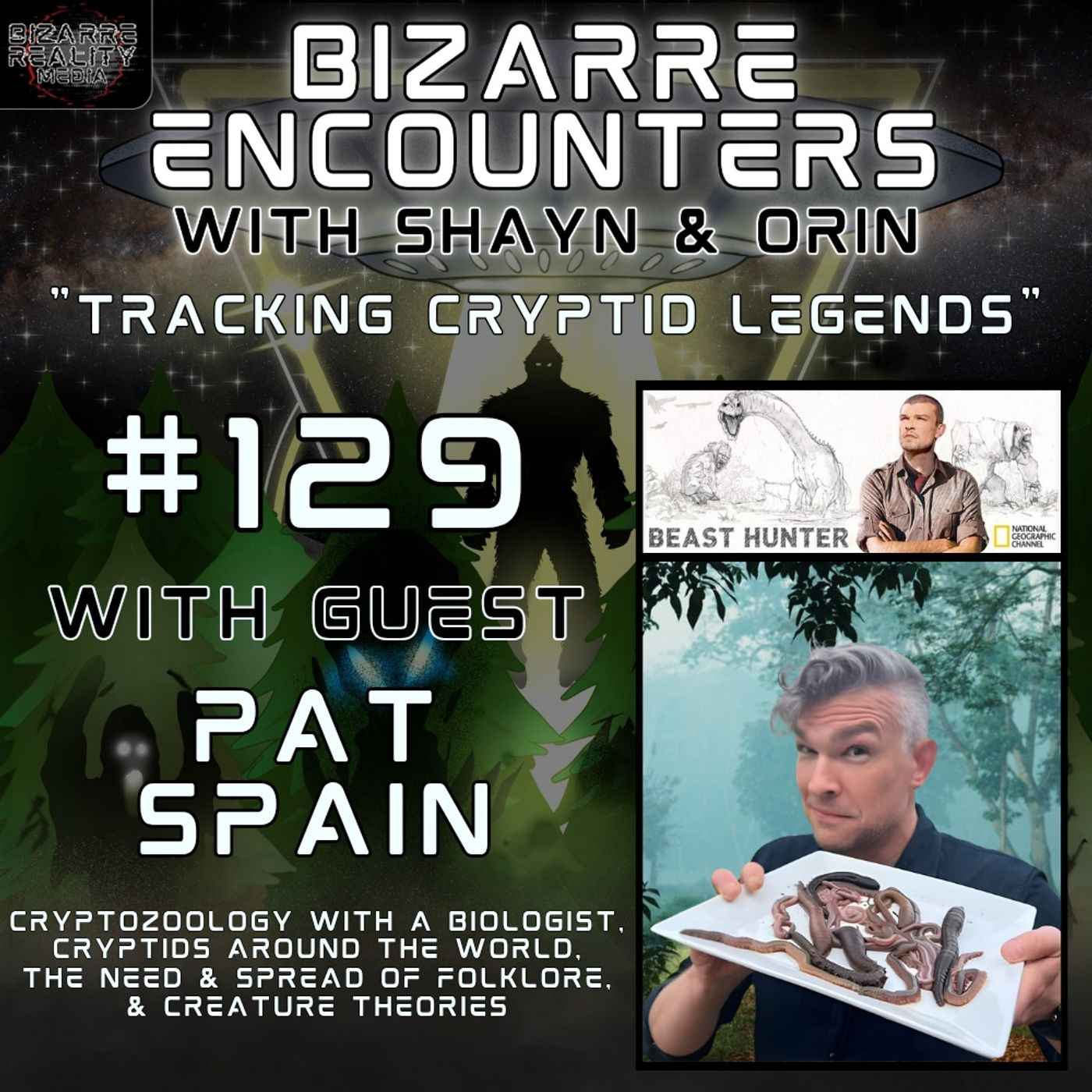
#129 "Tracking Cryptid Legends" with Pat Spain
Episode Transcript
Any of the one.
Speaker 2And then looked out and there was this big, red, blinking UFO.
I can just say this, something's going on in the woods.
Speaker 1Something's going on.
Speaker 2They're not dogs, they're not coyotes.
What could it be?
Speaker 1Right?
Speaker 3I had an encounter with a skunk cake and it completely altered the course of my life.
I got a call, got walk on building, what about?
Speaker 1What about?
Speaker 3Saying E sighting of a u f FO hovering over a farm really.
Speaker 2Woke up from a dream.
And when I went into the bedroom, she said, there's a monster on the wall.
Speaker 3They saw that the creature had run through a barb wire fence that.
Speaker 2They were able to obtain cares.
Speaker 1They sent the hairs to their lab and it came back as an online creature.
Speaker 3Creature creature?
Speaker 2What is up?
Speaker 1Bizarre Rights and welcome back to the most bizarre showing the internets.
I am the one that a handful of people refer to as Shane Squatch.
What is that fucking thing?
And alongside me I have the infamous Big bad Boo Daddy himself, Sir Orn Felix, trying to pg up the show a little bit.
Maybe we'll uh, you know, not be taken a little bit more seriously if we get don't get too too far taken away with using sound clips.
So we're gonna we're gonna mature up our soundclips a little bit around here.
Speaker 3We're probably never gonna be taken seriously, but uh yeah.
Speaker 1So we can try.
We can try.
At least we.
Speaker 3Traded the sexy, suggestive opening or more spooky one, so I'm all for it.
Speaker 1It's still moaning, just a different type of moaning.
Speaker 2Hey, that is true.
Speaker 3You've got us there.
It's hard to argue that.
So just a quick piece of news and updates.
So next week I am not going to be available to record on our normal recording date.
My baby sister is getting married.
Woo precedents over bizarre encounters.
I'm sorry, Shane, but it does.
Speaker 1Family always comes first, that's you know.
Some podcasters don't have that mentality, but me, being a dad man, family always comes first.
Speaker 4That's all right.
Speaker 3So we're gonna do something a little different and special for you guys next week, so be on the lookout for that.
Speaker 1If you guys might be interested in checking out the Halloween special that'll be happening on October thirtieth at seven to fifteen pm Eastern Standard time over there across all of the different places that you can find Bizarre Reality Media and if anybody might be interested in being part of that special still, you guys can call in leave your own bizarre experiences for us to share on the show.
And as I always say, if you guys need to be anonymous, I can definitely do that for you, but specifically you guys will have to be robot Alex Jones.
But if you guys mntioned't be interested in doing that, that number is three one three, three six four one five to five to one.
You guys can text or call that twenty four to seven.
And again if you happen to miss that, it is available down in the show description.
Speaker 4Scary robot voices only.
Speaker 1Maybe a ghost Maybe I'll do a ghost voice.
Ghostvoice might be fun.
Speaker 3And our next episode of Bizarre Inquiries, our YouTube live show, is going to be Thursday, November sixth, roughly seven to fifteen Eastern time on the Bizarre Reality Media.
Speaker 1See I did it, there you you got it?
That's on there you a.
Speaker 4Bizarre Reality Media YouTube channel.
Speaker 3So you guys be sure to submit questions or clips or articles or anything you want us to inquire about and also join us in the chat during the episode.
And if anyone is interested in being a guest on the show or getting up with us for any reason whatsoever, Shane tell them how they can do that.
Speaker 1You guys can first and foremost email us at Bizarre Encounters at outlook dot com or that number that I mentioned a little bit earlier.
You guys can again always text or call that twenty four to seven, and again if you miss that, that number is three one three, three six four one five to five to one.
Speaker 3And if you guys would like to support the show, Shane, now tell them how they can do that.
Speaker 1You guys can definitely go and check out the Bizarre Reality Media Patreon.
Two tiers available over there at free slash, early access and full access.
And if you guys want to see what it's all about, but you guys don't want to spend any money on it yet, there are seven day free trials.
You guys can see what it's all about for a week and see if you guys want to stick along and tag along.
And if you guys do, we definitely definitely appreciate the support.
Speaker 3And you guys can also check out the Bizarre Reality Media merch store with T shirts starting at the oddly specific and terrifyingly low price of just fifteen sixty eight plus shipping.
Speaker 1Wow, that's fantastic.
Who said that?
And if you guys, it definitely wasn't me.
And I know time's can be tough out there.
But if you guys would like to support the show in some other ways, what are some awesome ways that they can do that?
Speaker 3Or you can leave a review and like, share and subscribe and do all the internet things.
Speaker 1You guys can always go and follow the show on Instagram, Facebook, and TikTok.
Speaker 3You can share the show with your friends and family or people you don't like.
That would probably be more likely.
Speaker 1If you think the show will really annoy them, send it to them.
We love the bad comments because we'll talk shit on the show.
One stars only, one Stars only one or five stars only.
And you guys can also catch live shows on the Bizarre Reality Media YouTube, Twitch and Rubble channels.
You'll catch this show Increase of All Reality and Bizarre Encounters.
And we always appreciate you guys showing up.
Speaker 4All that stuff.
Speaker 3I don't understand what it is, but anyway, all this shit we've mentioned is in the link tree and the show description.
Speaker 1Please welcome to the show Biologists, cryptozoologist, and some may even know them as the beast Hunter.
Please welcome to the show.
Pat Spain, how's it going today, Man?
Speaker 2Do it all right?
How about yourself?
Speaker 1Absolute pleasure to get have you on the show, Jo Man doing pretty good.
Always excited to talk to you about cryptids and creatures and all of your research that you do on your end.
Man.
So as usual, Man, I'm always looking forward to these conversations.
Speaker 2Same here, Yeah, I always.
I love your questions and I like how you dive a little bit deeper than a lot of other interviewers, which keeps me on my toes and I think it gives everybody a little bit more than they get from other spots, So thank you for that.
Speaker 1And we got a third mind thrown in on this conversation, so who knows where we might end up going because we've got three analytical minds diving into cryptids who do a lot of our own research into it.
So I think, well, we might hopefully uncover something new and interesting here.
Man.
Speaker 4Excellent, Yeah, good to meet you, orin Yes, it's nice to meet you.
Speaker 3Pat thank you so much for joining us tonight.
Like I said a little bit before we started recording, Shane's told me a lot about you, So I'm definitely excited to pick your brain a little bit.
With that being said, would you mind kind of sharing a little bit about yourself and some of the research you do.
Speaker 2Sure?
Yeah, So I am.
I went to school for marine bio, and I've been doing biology, wildlife biology basically my whole life.
When you're the kind of guy who's in a field who just caught a rattles, you tend to get a crowd gathered around you, and you know, that's kind of the reputation that I ended up getting grown up, So I ended up giving all these impromptu talks, you know, just about the animals that I was finding and how excited I was to find them, walk around the neighborhood and teach people about, you know, whatever it was that I can get my hands.
And oh, I found a giant yellow spotted salamander.
Come on, everybody, check it out.
And then I went to school for marine bio and I taught a bunch of classes and labs and loved that and loved trying to reach reach people who maybe weren't as interested in wildlife as I was.
And then my wife actually suggested that the way that I could get a bigger audience for this stuff and to really express my passion for these animals is to do it on TV.
So that's what I did.
I went out for a show called King of the Jungle two on Animal Planet way back in two thousand and three, and I've just been kind of going ever since then.
But I have this whole other side where my great uncle was Charles Ford, and I grew up reading his books.
Yeah, without even realizing that he was without really he was a relative.
I was into his books.
And it wasn't until high school that my grandmother, who always used to say, you're just like your uncle Charlie, I had no idea what she was talking about.
She saw me reading the Book of the Damned, like rereading, and she's like, you know, that's your uncle Charlie.
So all of it started to click and started to make sense.
And I've always been into cryptozoology.
I held off calling myself a cryptozoologist for years.
I just didn't feel like I had earned it.
But after being elected or being granted Cryptozoologist of the Year, in twenty twenty three, I guess I can officially call myself one, So I'm proud to have that title.
Speaker 3Also, not just any cryptozoologist, Cryptozoologist of the Year and paranormal forty in royalty.
Speaker 4So I mean, you're a man of many hats.
That sounds like I keep busy.
Speaker 2For sure.
Speaker 1And not only that, but unlike a lot of cryptozoologists, he has like a different spun perspective on it.
I know a lot of people like to get into the wu woo, and I know that Pat definitely gets into the wu wuo, but his perspective as a biologist kind of brings a lot more like real world validity to a lot of these creatures.
And I think that one of the most interesting things about the way that you do your research pad is that you don't go out there saying like, oh, I'm gonna find this monster.
You end up trying to find the folklore, all the roots of everything.
How people actually kind of got to the idea of developing this creature.
And of course you're gonna call something out if you think it's really out there, But on the flip side of it, you're one of those people.
It isn't gonna let something continue on for years.
If you don't think that there's anything to it, you're gonna say, all right, this is the animal that I think that they were talking about.
And the reason I say that is because of all these stories, all these stories, like you just do it a lot differently, even with the even with the expection that you actually go out there, you talk to the tribes, you actually get their folklore firsthand instead of collecting it from other people.
Just a really interesting way to do research.
Speaker 2Man, Thank you very much.
I appreciate that.
And yeah, I mean I love the I love the stories, I love the myths behind it.
That's really what I think cryptozoology.
Cryptosology is just biology with folklore.
So there really isn't a distinction.
I mean, any animal that hasn't been given a scientific name yet is a cryptid.
So there's a million crypt I mean potentially that's not even an exaggeration.
There's a million cryptied insects out there, but we don't really hear that term being used for them.
But until an animal has been been given a scientific name, it is a cryptid in my mind.
So when I hear these stories, when I hear these myths, and these legends from people who live in the area where these animals are found.
I want to hear more about it, and just like Shane was saying, I want to go there and I want to hear the stories directly from them, because a lot is lost in translation and a lot is lost on the camera.
If you just watch a show, it's not the same as being there.
You know, if you're I'm talking one on one to an individual and the camera is showing like a two shot of me talking to that person, but what you don't see is their entire family behind them, who's either feeding them lines or kind of nudging each other and laughing, where I'm like, oh, this is probably not legit what they're saying right out, or absolutely horrified and reminding them of, you know, a little factoid that maybe they they had missed or they forgot to tell in the retelling of this because their family's been hearing this story for so many years, or you know, with the ring con deck.
When this one gentleman was kind of describing his encounter with it, he was glossing over some of the details, and then one of the researchers that I was with actually asked about it it's genitalia, and his wife just blushed and turned and she started hitting him and yelling at him, and he, you know, immediately lit up and he's like, no one's asked me that before, and he went into a really in depth, definite details about the animals genitals, and that just made it so much more real.
I mean, it's it's funny because of what it is, but also having that interaction and seeing that firsthand was like, oh, this guy is not making this up.
This is not you know, some kind of story like this.
He's clearly talked to his wife about this before.
But yeah, so being there and hearing from people who've actually witnessed the creatures, or who know the folklore because they grew up with it, or who just know the areas where the animals are spotted, gives you such a depth of knowledge that you really can't get anywhere else.
Speaker 3Well, I think an interesting point that you brought up is the fact that you, like you said, a cryptid is really just an undiscovered, undocumented animal.
Speaker 4And you know, we're guilty of it as well on this show.
Speaker 3But a lot of times it seems like you know the Hopkinsville Goblins and you know, the Flatwood's Monster and things like that get lumped in with cryptids, who if these stories are true, they're clearly not cryptids and some undiscovered animal.
So, you know, it's just the idea we've been talking about a lot lately is all these stories probably have this nugget of truth somewhere, and you just have to figure out the nugget of truth.
And especially with these older tales and like Native American type legends, you have to kind of ask yourself what could these accounts mean in modern day, real world terms.
And it sounds like that's kind of the work that you're doing, is going boots on the ground, talking to these people who have had these real world encounters and figuring out that nugget of truth in these kind of fantastical.
Speaker 2Stories exactly exactly.
And that's one of my favorite examples of that is the Mongolian death worm.
Speaker 4So we've covered that on the show too.
Speaker 2Yeah, it's wild, right, I Mean, you hear these stories and you're like, what, there's no way you know, this monster like this, this thing can't shoot electricity and blow itself up and spit hot acid, and you know, all of a sudden pop up out of these sands and what's a worm doing in the sands anyway?
But when you get to Mongolia and when you really start investigating the biology, you're like, oh, you know shooting blood, Well there's a horn lizard that shoots blood out of its eyes.
Oh okay, Well there's an electric eel that you know, can electric get and oh and some thing's burrowing, you know, burrowing through the sand.
It could be building up a static charge.
And then you're like, well, is it really and there So I was digging in the Gobi Desert and it's I mean in parts of it it's soil.
It's not actual sand, it's soil.
And you're like, oh, I probably could find some kind of warm here.
And then you start really talking to the individuals who are there, And the more conversations that I had with the nomads who are there, the more that I was realizing that they have such an immense respect for nature.
Just absolutely.
It's a Buddhist country and they have respect for all life, but their sort of reverence for the wild is like no other culture that I've really experienced.
And it's a really, really harsh environment.
And one of the rules of being in a harsh environment is you don't want to get hurt, right, You don't want to get hurt because any injury can turn deadly pretty quickly, and you're in a really harsh environment.
So they essentially all of the legends that I learned could boil down to don't mess with nature if you don't have to.
That's really what.
So they're not digging looking for lizards, they're not catching snakes because they have no reason to catch a snake.
So they know the animals that they interact with every day very very well.
But anything that's trying to stay hidden, they're gonna let it stay hidden.
And all the stories of the death worm, all the horror stories that you hear, I really started going through and you know, I have like a log somewhere of all the story, all the interactions that I could find, Every single one of them was someone messing with it.
It was like, oh, this person poked it.
Oh, this person stepped on it.
Oh, this person you know, through a through gasoline on it.
Oh this person tried and every one of them is someone messed with it.
It's never the Mongolian death worm came up and ate this person who was asleep or who you know, spit acid on someone who was just walking the other direction.
So it really comes down to okay, you know, there's stories about this, and the legends about this are all just allegories for just don't mess, like, don't mess with something that you don't have to, like, just live in harmony in your environment, live and let live.
And if you see something that might look like a death worm, like just don't hook.
Speaker 1We apologize, guys for the interference, but we will be right back and now back to the show.
So I know in Mongolia they do put a lot of stock behind like the existence of the Mongolian death worm, Like, what was some of your conclusions with it?
Do you put stock or validity into it?
Or you think it's a misidentified animal?
Speaker 2Like, So I do think that there are unknown creatures in Mongolia, and I think that anything burrowing is the most likely to be some kind of unknown creature.
I don't think that there is one animal that has all of the traits that they're describing.
I think it's probably an amalgamation or kind of a combination of a few different animals.
I think there is it's very very possible that there's a type of spitting cobra that that is there that we know that there are ones bordering in the in the areas that border the Gobi Desert, so it wouldn't be too hard to say that one made its way there.
There are sandfish like the lizards, that really go through the sand very very easily and kind of disappear quickly.
If you just saw the tail of one of those going away.
There's also grubs, so a really large grub.
I dug up a mole cricket, and if you ever seen a mole cricket, they're about that big.
They had these really cool kind of front paws that that they you know, that that they separate the sand with.
And they also send this vibration.
They send out a vibration that's their call, like their mating call.
So they dig a tunnel and the tunnel gives them acoustics to send out this this mating call.
So we heard one, we could feel it on the sand, and then I dug it up and the nomads that I was with freaked out.
They were their mind was blown.
They had no idea what this was.
There these huge, hulking wrestler guys were like, ah, what are you doing?
Like you messed with something, why would you mess with it?
And they shake so like I picked it up and you could feel it kind of give like a little vibration.
There was nothing I could say that wouldn't convince them that was an electric shock.
So really, what that's saying to me is that there's there's these activities of known creatures that happen that in their mind, you know, you don't mess with anything that you don't have to, And it's just conflating these stories and making it into something like the Mongolian deathworm.
That's that there are unknown animals there, But I don't think that there's an actual Mongolian death worm in the way that we think of it, right, And that's another problem with cryptozoology is that I love cryptozoology and I would love to find an animal that that kind of meets the descriptions of this.
But for the general public for cryptozoology, like take the Mongolian death worm or sea serpents, if I found a new species of squid that could explain a lot of the sightings of a sea serpent, most of the public would go, yeah, but it's not a sea serpent.
And if we find a relic polar bear in Nepal that meets with a lot of the sightings of the Yeti.
People will go, yeah, that's cool, but it's not the Yeti.
You're like, but it is, like what if it is?
So if we found a new species of spitting cobra in Mongolia, which is entirely possible, I would be super excited, be like, yep, death one, but the general public would go, now, it's still not the death.
We're still looking for it.
Speaker 3That's another thing we talk about a lot on the show is this idea of the issue of language and people trying to describe indescribable things with the best language they have, and like you said, throughout the years, these tales could get confabulated into something more fantastical than maybe they initially were when they started off more as cautionariy retails.
Speaker 4And as you were telling that story.
Speaker 3It reminded me of we covered it's probably been a year or so ago on the show the mackelay Bembek.
Speaker 1I was just about to bring that up too, and it's.
Speaker 3You know, a very similar story from my understanding, and I'm sure you're far more of an expert than me and Shane combined.
Speaker 4But you know, these people.
Speaker 3Went on all these expeditions to try to find this thing, and eventually, you know, they showed the locals and the natives pictures of I believe it was like a rhinoceros or something.
Speaker 4They're like, yeah, that's it.
So, I mean, that's all I.
Speaker 3Could think of while you were telling the story about the Mongolian death worm.
Is how similar to that account it really is?
And like we said, like how through the years in the game of telephone, these normal things can be just really blown out of proportion.
Speaker 2One hundred.
So I went to West Africa.
I was in the Congo, Cameroon and the Central African Republic and lived with three different tribes there, and two Pygmy tribes, the Baka and the baiy aka Uh tribes, and they were incredible and very welcoming, and you know, it was a really unique experience and we I did that.
So I had pictures on an iPad and showing them the different photos because you always read the stories about you know, like oh, you show someone a soro pod and they're like, oh, that's Mokelia and Benbe, And I definitely found that it was a lot of it was in the way that you ask the question, and a lot of it was in the order that you show the pictures, and a lot of it was if you're at in.
What I found in the Baka.
In the Biaka is that you were never talking one on one ever.
It was a group always.
They wanted to be there.
This is the most action that the village had seen.
I was the first Westerner that any of the kids had seen, which was super fun.
So I got to put like millipedes on my face and like run around the village and they were like, he's crazy.
You know, just all kinds of fun stuff with that.
But so this is like the most exciting thing that's happening this week for this group.
So you're with a group of people, and I would because one of our producers spoke French and he could hear like the side conversations that were going on.
And we showed a picture of a crocodile and the person's like, oh, that's a that's a monitor lizard, and someone else's like, no, no, no, it's not a monitor lizard.
Like monitor lizard, you know, they're the ones that we find over blah blah blah.
This is a caman.
They're like, nah, I don't think that's a caman you.
So there was a lot of that back and forth with literally every photo.
And then we'd show, you know, like a jaguar and they've never seen or heard of a jaguar, but they're like, it kind of looks like maybe a leopard.
And it's like, okay, well, I can understand that.
That makes sense, and then whatever.
The first big animal that they didn't recognize was that was Michelambbe, and then there'd be like a conversation about it, like I don't think that's it.
I'm pretty sure, like that one has that one looks like the neck isn't long enough, or that doesn't have spikes, and you know.
So yeah, there was a lot of tales being told over over many, many years.
But my favorite thing about Mackellya and Bembe is whether whether or not you believe that there is a dinosaur in West Africa, which I do not other than all the birds.
All birds are dinosaurs, but other than that, I don't think there's a Sosaa pod there.
But this legend needs to exist and it needs to perpetuate because in the tribes that I was with, there's a huge like machismo kind of culture where you have to be the toughest, you have to be the bravest.
People file their teeth down to points to make themselves look more fierce, and they do this facial scarification to make themselves look more fierce.
So if you say I don't want to go down to the river at night because there are crocodiles, people will be like, oh, you're weak.
You know you're disrespecting your family.
How can you?
But if you say I don't want to go down to the river at night because Mokela and Bembe was fine, everyone goes, oh, smart, yeah, good move, don't do that.
So it's like almost a social out.
This legend needs to be there in order to not do really dangerous and dumb things.
Speaker 3Well, and Shane, I'll let you get a word in because I know I've just kind of been going off to the races this episode.
Speaker 4But that's so funny.
Speaker 3We've been talking a lot lately about how a lot of these stories could have started off as cautionary tales, like The Wind to Go is what we've talked about a lot recently.
And then Shane did a great episode just last week on vampire lore, just kind of like for Halloween, and we saw a lot of connections between windigo lore and vampire lore and how a lot of that could have started off as cautionary tales as well.
And Shane, now I'll shut up and let you talk.
Speaker 1I mean, even expanding into some of the paranormals we're talking about.
I mean, you hear about all of these different cities that all have these roads that they're haunted roads.
You got to drive slow, you got to do this on them.
And we're talking about even with those those are cautionary tales because if you tell the kids in the local area on this really really sharp turn that there might be ghosts, you better not go through that area, or if you do, you better go slow.
Then you're avoiding people actually going off the side of the road because now they're looking for a ghost.
So even some of these cautionary tales, even in like modern like United States society, also play that same role because I mean it's keeping people, it's making people be a little bit more cautious and aware of what's going on around them, which honestly is never a bad thing, even if it is focal or if there is truth to it.
Speaker 2I mean one hundred percent.
There's this great story from Brazil that I love with the Boto.
Are you guys familiar with the boto the I don't think so.
The Boto is a pink river dolphin and these are real, real animals.
But the legend is that occasionally the Boto will leave the river and put on like a fancy suit and go to like dances and impregnate women and they have no ability to resist the Boto.
He's just so desirable and just this this like siren song kind of thing.
And there's actually in remote areas of Amazonia people who have the Boto listed as their father when there's like an unexpected pregnancy, and it's it's this amazing, like culturally accepted story where you know, a young woman shows up pregnant, who's unmarried, shows up pregnant, and the parents are like, oh my god, I can't believe this happened, Like what are we going to do?
And she's like, no, no, no, you don't understand.
Like I was at the dance it was the Boto, like it must be, I don't remember, And the parents are like, oh, well great, all right, Well so we're going to be really happy about this and like maybe your boyfriend will like marry you anyway, and see like this is and the guys are like, yeah, well I'll raise them as if it's my O, and like this is a totally culturally accepted thing, and I think that's really beautiful.
It's like, well, we don't really want to deal with this, so we have this story that everyone eyes into and yeah, we're gonna go with it.
Speaker 1I mean, you end up hearing those same stories even it translated into the United States with I mean talking about like going to dances with the devil.
You hear this down in like Mexico and stuff too, So it's almost like you see these same stories reoccurring.
It's just like the archetypes stay the same, but like the visual of them changes up a little bit.
Because even how many stories have we covered or and where it talks about these things coming from the water and then having relations with people on land and going back in Like what was that one we covered recently where the person had like the half the bottom of them was like a crocodile or an alligator from like Brazil or.
Speaker 4The el Ombre came on.
Speaker 1Yeah that one, Yeah, that's another prime example of the same thing.
Speaker 4Well, and we've other than that.
Speaker 3You know, we've told stories about like sasquatch type entities here in North Carolina where I live that you know, they do the same thing, like hide in the the edge of the woods and watch young women while they bathe and then you know, beat them over the head and abduct them and drag them to their caves.
Speaker 4So, I mean it.
Speaker 3Seems, you know, like Shane said, this is a motif that pops up time and time again and just a little bit of research we've done.
Speaker 2Yeah, yeah, absolutely.
Speaker 1What was that one that we covered recently where he got the female from giving her the little like gemstones and stuff.
It was a North Carolina story too, the boojum.
Yeah, that was another problem with.
Speaker 3Sasquatch type wild man creature who was, like we said, spying on women as they bathed and then abducted one of them and you know, made her his wife, and yeah, lured her with shiny rocks and gemstones, as one does.
Speaker 1Yeah, isn't that where that I think that's that's the one where the whole hooton nanny thing comes from, right, Because the girl's name was was Annie or something like that, and she'd go walking through the woods hooting for him or whatever.
So they started using the hooting nanny.
Speaker 3The folklore is that the young girl who got abducted, her name was Annie, and to communicate with this bigfoot or wild man, she would you know, hoot and holler at him in the woods, and they, you know, locally started calling her hooting Annie, and then you know, that's sort of the term hooton nanny for you know, like a party or whatever in the rural South came from.
Speaker 4So, yeah, it's funny.
You know, I've lived.
Speaker 3In North Carolina my entire life.
I never knew that aspect of the story until I was doing the research for that episode.
Speaker 4So it's funny.
Speaker 3You know, basically a cryptid story has pervaded culture and society at that point.
Speaker 2Yeah, that's pretty awesome.
No, I had never heard that either.
That's great.
Speaker 3All right, guys, we got to take another break.
We'll be right back, and now we're getting back to the bizarre.
Speaker 1Well, I guess since we're kind of talking about some Sasquatch stuff, we definitely have to dive into some of your eight Men research.
I know that you've done this in multiple different places.
So whatever one you might want to get into, but I always think it's fun to maybe talk about the one that you maybe put the most stocker validity in.
Speaker 2Yes, I think a ring Condec is one of the most fascinating to me, and I went into that investigation really thinking that this was mistaken identity for an orangutan.
I just if you've ever seen the giant male orangutans, when they get so large that they don't really go up in the trees very much anymore, they're basically on the ground.
They get these crazy long dreads like in their they just and their face plates get enormous, so they just look otherworldly.
And I really thought that that's that's what I expected to find, and that is not what I found when I got there.
When I got there, I found that the folks that were seeing are in Condec had really great biological stories to tell, and all of it made sense from from the perspective of a wildlife biologist.
People were talking about, you know, animals that don't that don't necessarily use trails, so they'd be really hard to capture images of.
They were talking about primarily nocturnal uh primates, of which Gibbons really are the only one one that are you know, that's a that's a borderline nocturnal primate.
The way that they described their anatomy was nothing like in Orangutan, The way that they described their behaviors was nothing like in Orangutan.
And the fur color on them, which they always said hair, They would never say fur.
They would always say that that it had hair, which was interesting, and they did make that distinction between them and UH and other primates.
The way that they described the coloration was not like anything for a given or or in orangutan either because it's hair, not fur.
A lot of the people that we spoke with would always say that it was black hair because the only hair that they're used to seeing is black, so fur can be all different colors.
But then I brought a Laurel color chart with little hair, and I was like, can you show me, like, which one of these is the closest?
And it was across the spectrum.
Like they would point to all different things like never black, but because of his hair, it had to be black.
So it was just like this weird kind of lost in translation thing and yeah, so and finally it really came down to this one guy who was an eyewitness, and as I'm asking him questions about it, I was somewhat leading, like letting it slip that I, you know, I really thought that he had probably seen a given.
This individual.
I thought that he had seen a given.
And at one after like you know, maybe five minutes, he kind of sat back and laughed and he was like, look at man, I know what a given is.
He's like, the only people who don't believe in a rank and deck are people who don't live here.
And I'm like, oh, all right, yeah, good, good point.
I am a you know, I'm being an ugly American right now, and yes, thank you for putting me in my place.
You're right, like, why should I question this when you know you live here and see them all the time.
Speaker 1Well, that's like a double edged sword too, because, like we're talking about a little bit earlier, sometimes you need that outside visual to actually kind of bring it into the picture.
But then in the other situations like this, it's like when people are all describing the same thing and they are aware of the animals in the area, then it's like what direction do you really go in?
I mean, if there's some of these tribes where they don't necessarily like have much communication outside of like their group, then that's one thing.
Of course, they might have some misidentification, they might have different words for things, but if they're like honestly familiar with that area, like I said, it's a double ed shorty, you don't know which direction to go in.
Is it a matter of a different perspective or is it really really something out there?
And I mean, it's like the stone apes.
I know, I always bring this one up every time we talk Pat, but the stone apes are like a prime example of that.
That's one of those things that like exists in folklore.
But even like the Vietnam vets that we're going at the time, we're like, yeah, these things are everywhere, they'll just start throwing rocks at you.
Like there's so much validity behind those stories.
Everybody in Vietnam even believes in them.
But then everybody outside is just like, Yep, nope, it's just another sasquat story.
It's just another folklore thing.
Speaker 2Yeah, but that is a great one, and that's one that I really really want to get over there to explore.
My wife is Vietnamese and she's a second generation she was born here, but both of her parents came over as refugees, and I've gotten I've tried to get her father to talk about the rock apes a couple of times, and it's really one of those things that like he'll tell me a couple things, but then he always goes, but you should not be looking for them, like you should not go.
So you should definitely go to Vietnam, do not look for them while you're there.
And I want to look for them.
Speaker 1Well, I mean with the stuff like that, it almost kind of makes you wonder if they might not necessarily be fully what you expect, but maybe some type of like undiscovered tribe, because even if they go generations generations, generations no contact, they're all breeding within with each other.
I mean, they might start starting to get that smaller gene where they all start becoming shorter, because that's the only gene that's getting passed around.
And I don't know how far this would go with people, but obviously you throw like a hog out in the wild and eventually they'll start growing hair, and they'll start growing tusks and start turning into a bore.
So I know there's a lot of people that have thrown theories with these like wild men type people.
But if you have generation and generation and generation, like who knows where that could possibly end up.
Like what we're thinking is the stone Age could be literally just like a miniature tribe of like really hairy people that exists in this area.
But they have their own language, they don't communicate with the outside world, so they look like a whole different creature, not realizing that again, they might just be like a tribe of small people.
Speaker 2Yeah, so I mean it is it the wild boar well pigs like domesticated pigs and humans two very very different scenarios, where the domesticated board does kind of revert back to the more wild type as it's being being released.
But those are traits that are in there.
But then you're right that isolated populations can develop either what we would call island dwarfism or island gigantism, and all different species do show that they believe that's what happened to Homo floresiensis the hobbits in Indonesia, they think that that was island dwarfism, but that occurred there were also tiny elephants that were there and giant komodo dragons, So you get some island dwarfism island gigantism, and I've read different theories as to why one happens versus the other.
Most likely due to nutrient availability, but the pigmy tribes in Africa, that definitely does not explain them, because it's the same nutrients that are available.
There's abundant nutrients.
They think that that may be more the trait for being small.
There was an advantage to being able to get through the bush easier, for you know, you're not getting hit with as many things, there aren't as many things in the way.
But when I saw a true most of the pigmy tribes that I was with, unfortunately there's a lot of discrimination against them by the local peoples, and a lot of them have tried to sort of marry outside the tribe and have kids outside the tribe to no longer be full pigmies.
But there are some who are, and when I saw them, it was striking.
It was really you know, there were some who still lived in the forest, still lived in nomadic lifestyle, and when they would come in, you just kind of see them on the outskirts the size of children, but people in their thirties, so that that is possible, and there are when you do have an isolated population and you are getting a smaller gene pool, there are certain traits that can be that do get perpetuated that would make someone look unusual.
So yeah, there's every possibility that this is more of a group or a tribe.
Speaker 1Just in that case too, just out of curiosity when they develop this like dwarfism.
Is it like dwarfism like how we know it where you kind of get some of the like not normal body proportions or is it almost like they have normal body proportions but they're just like a shrunken size.
Speaker 2Just a smaller size.
Yes, yeah, it's just they use the same term, the island dwarfism or island gigantism.
And there's also a benthic deep sea tends to do the same thing.
Deep sea you tend to get out of the tiny or huge as well.
But yeah, the tribe that I was with, at least they it was the Sames, but just much much smaller, and it really was striking.
It was really like at a distance, I thought this was a child, and then you get up close and see like wrinkles and the scarification and the filed teeth and he's like, WHOA.
Speaker 1Well, I mean that throws more into like the whole stone amp concept then, because if they're not, you know, oddly proportioned, then it would make it that much easier for them to be able to get around the jungle super easy and had the ability to throw their what rocks as precise as they do.
So, I mean, I mean, I feel like that's probably a pretty good idea on what these things could potentially be, on top of possibly some you know, undiscovered eight possibly.
I mean, I definitely put stock into the fact that there might be some mini variation of sasquatch, because it seems like those stories that kind of exist all around the world.
And I'm not putting stock in that every single one, but at a certain point, I think that there has to be something like this out there, or there was something like this out there, otherwise these stories wouldn't exist all around the world.
But my biggest fear is not being able to catch up with these things before they become extinct, and then they become this thing that exists forever, ends obscurity and you never really know the root of where it actually came from.
Speaker 2Yeah, Yeah, And that's I do think that we're seeing that with a rank and deck.
The people that I spoke with, they said, like my grandparents used to see them much more often.
My parents would occasionally see like a family unit, but my generation, the only ones that we've seen are older ones, like we've seen lone individuals, and they're they're all older, which leads you to think that they are, you know, dying out.
They're seeing the last of them, which is unfortunate.
But I think that there's what seventeen thousand islands in Indonesia, so there's a lot of unexplored places to still get to.
But the it's it's always interesting to me when you talk about Harry hominids and these stories to make the distinction between Homanid and a primate, because there were really like the legends kind of span this gambit and we think of them as the same thing, but there really is this huge distinction between a Homanid and a primate, and we don't have another living Homanid that we've identified where we can really get to the scientific basis of how we're going to make that distinction.
Because humans are a part of the like we are primates, right, but we call ourselves home Itids, So would we extend the same kind of respect to another Homanid species that we saw?
Like what are we basing it on?
Is it just on hair?
Like if we had if a chimp was born with a mutation where it had where it wasn't as hairy, would we Yeah?
So I always find that aspect of human evolution really fascinating because we lived in a world where there were you know, a dozen species of Homanids interacting with each other at any given time, and now we don't, or maybe we do, but we don't commonly accept that we do.
Speaker 1I mean that could be where a lot of the Sasquatch stuff comes from.
I mean, I know a lot of people kind of throw the like undiscovered tribe concept, but I mean that could go to a whole other level that you know, if there was all these different subcategories of like human like beings, you know, if one kind of state amongst itself, of course it would develop amongst itself kind of like we're talking about with the last one.
So you know, maybe the whole thing of the Sasquatch thing is more of what like the natives talk about that they're us they're people.
They're just a different tribe, a different variation, because I've heard from a couple of different like First Nations, that they kind of have this distinct set of rules that when people started developing and started using fire, they started doing all this stuff.
This group of Sasquatch decided they didn't want to do that.
They want to stay everything natural.
They didn't want to be part of that.
So if you start hearing some of these old native stories, like it adds even more of a human component to some of these things.
And I'm sure that you know, you've traveled around the world, talked to a bunch of people about this type of stuff.
I'm sure that that's probably one of those things that's universal across countries, across continents, is that you start seeing these same things that are reoccurring.
Speaker 2Yeah.
Absolutely, that's the First Nations groups that I spoke with in Vancouver told me the same thing that they said.
They were like, yeah, you know, you're thinking about Sasquatch all wrong, Like, this is not an animal.
This is just a different tribe of people, Like this is these these are humans, just not in the way that like they don't look like us, but these are people, And yeah, I thought that was a very interesting perspective on this.
And when you're talking about for rank and deck, I do think that there's likely two different animals that people are talking about and they're just using this one term.
I do think that there's likely a ground dwelling gibbon that is there, and you know, primarily ground dwelling upright walking gibbon, because it would give it an evolutionary advantage the main predator in the area as a tiger, and tigers are not in the area are not known to attack humans.
The only place where tigers really predate humans with any regularity is in India, and there's a number of different factors for that, but in Indonesia they tend to leave people alone.
And the theory is it's because we look so different than their prey, because we're walking upright, so like, we just don't look like an easy meal.
So if a gibbon was to evolve that and to walk upright as well, they would get the same type of protection.
Speaker 1That we have.
Speaker 2And then there's the hominids, where the descriptions of them are very very clearly home ind where it's really, you know, just a smaller human like likely a descendant of homoflooresiensis.
And Mike Moorewood, who was the researcher who found Homo floorsiensis.
I was able to meet with him at one point while I was over there in Java, and he said that he had evidence that Homo floor asiensis was around until at least the nineteen twenties.
And he said, it's not good enough evidence for me to publish in a scientific paper, but I'm working on it.
I'm working on gathering more and unfortunately he died less than a year later, and the research is apparently gone.
Nobody's been able to find it.
Spoken with, you know, some members of his team, and I've had a production company that I was working with reach out to members of his family, and nobody can find the research that he was talking about that gave him at least he believed that they were there until the nineteen twenties.
Speaker 3I think that was a really interesting point you just brought up, Pat about how it could be kind of two different creatures or two different things being kind of confabulated into one story, because I think Shane will attest to this.
That's something just again in our limited research for the show, that's something we've come across time and time again.
How again, this real world nugget of truth could be combined with this folklore throughout the years to come up with this kind of again outlandish story.
We've talked about kind of sea monsters and river monsters here recently on the show, and it seems like, especially in those kind of cases, it could be Yeah, it was a really big catfish.
Speaker 4Or something like that.
Speaker 3But then you get just as many where it's you know, a seasoned riverboat captain or something as like, No, that was no whale or whatever that I've ever seen.
So it could be these two things that kind of get combined throughout the years.
So I was just wondering, have you come across any kind of sea monsters or anything like that in your research, and if so, what are your opinions and thoughts on those type tales.
Speaker 2Yeah?
Absolutely so.
I've done both Lockness and Caddye.
Those are two of the expeditions that I've done.
And Lockness, I'm very sorry to say, I don't believe there is a large undiscovered creature there.
I think that there are some really cool things in the lake, but yeah, it's an extremely deep and very very cold area.
But they've recently done e DNA surveys and found you know, there's a lot of eels, there's a lot of salmon like fish, but there's really nothing.
Nothing that came back with like unidentified DNA.
And I do think that there's a lot of when you read the Locknew stories, it's exactly what you're described.
Speaker 1Hold that thought.
We'll be right back after this brief commercial break and we are back to the show.
Let's hop right in.
Speaker 2Some of the original original sightings of the Lockness Monster happened miles away from the lock On land.
Speaker 1Yeah, I was gonna say it came on land more often with the old stories.
You never just saw them in the water at the old stories.
Speaker 4Yeah, like the salamander theory, isn't it.
Speaker 2Oh yeah, yeah, I've heard that as well, But I mean a salamander that big would be a real tough sell.
Speaker 1Yeah.
The old stories, they would mention that they'd come up and eat their sheep and stuff like that and then disappear back into the water.
So like maybe there's something there at one point, but then it kind of turned into this big folklore thing as the years went on.
But again, like the characteristics are so different.
Speaker 2Yeah, there's one of the one of the original stories, it's like a deer Like they're describing a deer very very clearly, and you're like, I don't understand, how is this the lock Like this is definitely a deer that this person just had never seen a deer this big.
But and then there's there's the idea of a deer swimming the head sticking out of the water.
So I've I've gone camping extensively up in Maine, and if you're ever out on like a kayak and a moose pops up next to you out of the water, like that's a sea monster.
That moose pops in seat up if it doesn't have antlers, You're.
Speaker 4Like, what the hell is that?
Speaker 2You know, huge eight foot tall animal that you're in the you're in the water, you don't expect to see a moose.
But they eat algae, they're really good swimmers.
I can see where people have this kind of misidentification.
Or even a whole bunch of birds in a row kind of moving in the same powern So there's a lot of different things that can be misidentified with the Lockness monster.
With Caddy, I think that there, there's some of that.
So there's some of these.
You know, we we found this mysterious blob squatch that that washed up and no one's exactly sure what it is, and like usually it's a basking shark or a sperm whale or something that's decayed in a particular way that makes it look like this.
But then I do also think that there are undiscovered creatures in the deep ocean.
Even the most conservative marine biologists will say that there are undiscovered creatures left.
Darren Nash, I think famously did a mathematical analysis where he said, I think he came up with six I think there's six large creatures over ten feet long left to be discovered or something like that.
But I mean, even like I said, even conservative biologists, and the unique features of Vancouver are that you're in a heavily populated area that reaches deep water really really quickly.
So usually from the shore you can't see an area that that goes down one thousand feet, but in Vancouver you can.
And the sightings of Caddie correlate to the colder water currents that are coming in.
So I do absolutely think there's some kind of large undiscovered creature that normally lives in the deep, but people in Vancouver just happened to get glimpses of it when it's coming up.
You know, it's probably following a prey species on a migratory route.
And yeah, so I really think there is something behind that, but I tend to go with it's probably some type of squid more likely.
But I don't really have a reason for that other than I really love squids.
Speaker 1Well, I mean, there's a lot of giant squids that are still somewhat recently being discovered.
I mean, the whole idea of like the kraken existed in folklore forever until what maybe like the early two thousands when they started discovering these giant squids, and then they realized that they would attack whales, and then they started correlating the fact that from underneath when there's not a lot of movement going on back in the day, they saw a boat, they assumed it was a whales.
They'd come up and attack it, and that's where all these different kracking stories come from.
But I know that there's even a lot of different species of squids that they theorize and know exists, but they haven't even laid eyes on them yet, Like, what was the what's that really really weird looking one that has like the really longated head and has like the big long, like almost like kind of square looking tentacles that come down and they've only clashed.
Speaker 2Yeah, the long arm squid.
Speaker 1Yeah, they only caught like one picture of that thing so far, and it was a baby's They don't even know the full size of these things can even reach anyways.
I mean, just simple stuff like that correlating into like the early two thousands, I mean, what else could possibly be down there, especially species that don't have the ability to come up ever, Because I'm sure there's a lot of stuff that's so used to existing at such high pressure lower in the water that there's probably some giant stuff that has never even come anywhere near the surface before.
Speaker 2The wildest animals that we will ever find are down at the deep parts of the ocean.
I mean, you're talking about the volcanic vents where you've got a tube worm.
You know, you might have an eight foot long tube worm where the base of it exists in an area that's seven hundred degrees seven hundred degrees from the and then the top of it, So eight foot difference, the top of the animal is going to be in like thirty degrees, So the animal and it can survive like it can survive that temperature variation.
Imagine having your feet in seven hundred degrees in your head just above freezing.
It's wild to me, absolutely wild everything that we find in the deep ocean.
But yeah, there's there's a lot of squid species that are yet to be found.
Shark species as well.
I mean, I think they've only seen the frilled shark.
We've only got a couple pieces of footage of it ever, and the megamouth I want to say like a dozen, you know, less than twenty of them have been found.
So yeah, there's the sharks and deep sea sharks and squid are the two most likely in my mind, large animals for us to find.
Speaker 1Well, I'm gonna ask you, Well, I will.
Speaker 2Say that it's a sea serpent and no one else, So that's the bummer.
Speaker 1Well, I'm gonna ask this, considering that you're a biologist and you've definitely studied into this type of stuff, have you done any research into those?
A couple of people have discovered them.
It's almost like a body of water underneath water where it's like has a lot more How does that work.
Yeah, there's a lot more sul to it, so it like exists at a different spot.
But even when they try to take the subs into it, they'll like bounce off of it because it's two buoyants.
They can't actually enter these spaces, Like, have you done any research to see if there's good possibility of there maybe being undiscovered species that live in those And I mean, who knows how far down those things could go.
There could be like another second underwater ocean that has an even bigger set of animals and we'd have no ability to get to them, and they'd have no ability to get through that to us either.
Speaker 2They are really really interesting areas and there will be undiscovered creatures there, but they're likely tiny.
They're likely very small, and you know, microbes and things in there because it is such a harsh environment and it's something where it would it would be very difficult for cellular life to multicellular life to form under those conditions because of the pressure and because of the hypersalinity.
But it always a SpongeBob square Pants and they like go to the beach under the water, because that's really what it looks like.
And if you see some of the footage, there'll be a fish that's like swimming along and swimming along, and all of a sudden it'll go over one of those lakes and it's like, ah, I'm dead, just dies and sinks down because even within a few feet of it, the salinity is so high that it just kills anything that tries to get there.
So yeah, I think they will find undiscovered species in there, but they are probably microbes and other things just based on the cellular makeup on multicellular life.
But hey, we've been proven wrong.
I mean those hydrothermal events, there's animals that exist with absolutely no oxygen or they're chemosynthetic, so they are surviving purely off of like sulfuric acid basically, which I mean, if you can survive in sulfuric acid, then anything's possible.
Speaker 1See the way I'm seeing it too, I feel like there's got to be some spots where, some big pockets that things exist on there, because if we know that there's all these giant squids that exist on there, I'm assuming that there has to be a food chain that goes along with those things.
So not only is there probably gonna be bigger sharks, but there might even be other stuff that we're not even aware of yet, because I'm assuming that the way the system would work is if this thing's bigger, everything else has to be bigger in comparison.
It wouldn't make sense that there would just be one giant, monstrous animal and then everything else be microscopic.
Otherwise, what would that thing's food source be, Like, there's got to be at least something else that would counteract back and forth with those giant squids.
Otherwise, why they would they have developed to that size if they didn't have predators that were that size for example.
Speaker 2Yeah, Yeah, and that's the interesting thing.
It's called abysmal or benthic gigantism.
God, my professor would be so angry at me, but it's Yeah, it is wild when you see that there are a few different evolutionary factors that push for the larger size, not just for prey, not just for predation, but just the environment that's down there.
Larger that you are, the more spherical that you are, the more able that you're able to withstand the pressure and to Yeah, it just makes it makes it easier to survive when you're kind of a bigger size with more of that type of body shape that you typically see in the squids for the deep sea creatures, and you see that with a lot of different deep sea animals.
You see that with greenland sharks as well.
They kind of get this large, elongated body shape.
That's it's just that's the way to survive those pressures.
To be that kind of like that, that's really the evolutionary factor that's pushing them towards that larger size.
Speaker 3We're actually just talking Oh I'm sorry, but no, no, I can't believe you brought up the green We're actually just talking about that on probably three or four episodes.
Speaker 4Back, Shane, if you'd like to.
Speaker 3Elaborate a little bit on our greenland shark theories.
Speaker 1Oh yeah, I'll let you lay down the episode the ground work for and then I'll throw in the greenland shark part I.
We sort to connect it.
Speaker 3Okay, So we were covering a cryptid sea monster lake monster called the Alta Mahaha lake monster native to Georgia, and you know, we were talking about how this lake system kind of connects to the ocean, and then at that point, you know, all bets are off.
Speaker 4It could be anything.
Speaker 3And then from just going through the different folklore and the descriptions of the creature, and you know, Shane was googling while I was going through that.
Speaker 1I was looking for a lifespan of like two hundred years or so, and how it stuff that wouldn't breed very often that might actually come up to certain areas to breed every Like what was it The sightings were every like one hundred years or so for that I.
Speaker 3Can't remember off the top of my head, but yeah, kind of correlating with these cycles of when this thing was kind of reported, there were like eighty one hundred year gaps between you know, kind of the big waves of sightings, and it seemed like, you know, the deeper we got into it, and the more Shane googled as we were talking, it was like one thing after the.
Speaker 4Next, she was like, oh my god, here's another connection.
So we kind of came.
Speaker 3Out of that episode thinking, Okay, either this is a greenland shark or it truly is just some undiscovered something.
Speaker 2Yeah, some undiscovered shark, but the greenland shark, I mean it really it is one of the strangest animals out there, and nothing about it really seems logical when you first start describing it to people.
But yeah, they're they're incredible.
Speaker 1Yeah, we're reading that they were one of those ones that not a lot of people know much about them, as much research as they've done into them, Like they don't really know much about their breeding habits.
They don't know necessarily like they had the area of where they like to be in, but they're spotted going into even like warmer waters during like the colder months.
So we're even looking into some of these sightings and we're realizing that they were around like January February where the water would be a little bit colder, so it makes sense that they would start coming down there.
Like this is what I was talking about, where we end up connecting in a lot of this stuff kind of like you do.
Like we're talking about the Beast of bladan Borough and we're talking about how this thing used to like smash animal skulls and everything, and then we started connecting in with some other stuff that was happening around that time and realized that it was a normal thing for people that have pet hyenas, like Roosevelt had a pet hyena, and then all of a sudden they passed this law where people couldn't have them, so everybody just like pushed them outside before anything else happened with it.
So then we started kind of correlating that we think the Beast of Bladenburgh was literally just a hyena or a pack of hyenas, because they're known to have that crazy jaw and be able to smash skulls.
So just another one that it's like, if you kind of look at the context around it, it seems like it's a I mean, I put a lot of stock into it.
I think that honestly, the Beast of bladen Burrow was probably a hyena.
But you have to be able to correlate the two things happening at one time, because if you're just hearing one side or the other side, it doesn't make any sense.
But if you hear these stories and then you hear about hyenas getting released in the area at the time, typically not something to be in the area, but it makes sense that would be happening at that exact time that people just kicked out their hyenas, that they had his pets.
Speaker 2Absolutely, and that's Charles Fort's biggest contribution I think to the zeitgeist is he just obsessively read newspapers, got newspaper pers from around the world and got all these stories and he would put them into like by date, put them into groups because he wanted to see what was happening everywhere at this one particular time, so that he could make those kind of correlations and he could make those associations like that, and that's what he would do.
That's how he found a lot of his biggest findings were just from making those kind of correlations and those associations.
He was one of the first to really mention like climate change because he found that, you know that in given years, you know, based on the amount of pollution, there would be this weather event that was happening here.
And he was like, maybe we're doing something really bad in the environment.
I'm not sure, I'm just throwing it out there, but I mean he made he took this huge amount of data and kind of correlated it down into to make these associations, and people really weren't doing that at the time.
They were looking at everything happening as a very very localized event and it's not going to have you know, repercussions, and he was like, no, we have to look globally like we are.
Every is a connected system.
And just as you're saying, like, yeah, releasing hyenas into the wild is going to cause some really crazy stuff and people around here have never seen hyenas, so sure, Yeah, there's gonna be some stories that pop up about these giant mutant dogs.
Speaker 1Yeah they're smashing livestock's head.
I mean, where else would that make sense?
Speaker 3Yeah, well, and if I remember correctly, in the Beast of Bladenborough story, it was a very short lived kind of cluster of sightings, which would make even more sense if it was you know, a handful of these once domesticated or domesticated quote unquote pits that were released into the wild and then you know, whether they got killed off or died of natural causes.
Then the stories kind of stopped.
Sit tight, guys, we got to pay some bills and now back to the show.
But I did to comment on something else that you said, Pat.
You know, we talked about the concept a lot on the show of for a lot of these type things we talk about, answers are never going to be found.
We can't really hope to find concrete answers.
But I think as much as we can hope to find these answers, it's in the connections between these different subjects.
And you know, a drum I beat all the time on the show is more than one thing can be true at the same time.
But anyway, so that kind of just got me thinking about, like you're talking about with mister Ford and kind of drawing these real world connections to these more you know, paranormal or Fortian type circumstances.
So being that you come from a more scientific background, I was just curious here as we are kind of wrapping up and towards the back end of the show, is there any just like outlandish forty and paranormal story that you kind of unironically believe.
Speaker 2So, I mean, I I will say that I love all the stories about aliens, anything alien related.
I want to read more about, I want to learn more about.
I want to know more about this.
It's Fort.
You know, Fort did investigate this and did you know, try to uncover this.
But I do find that stuff fascinating.
That's a little bit more concrete.
I think that my favorite of all of Fort's ideas that I don't believe, But I do love his you know sense of drama.
Is the super Sargasso see where he just thinks that it was the source of like this Sargaso Sea is such a weird body of water, right, Like there's so many different stories about this and different things in frog fish are so weird, and he just he threw out that, you know, his concept that this giant Sargasso Sea is where all weirdness comes from.
It's where all strange things where everything else.
And then I love the fact that it was years later, like, you know, dozens decades later after fort died, that we find that the Sardasso seas almost certainly where eels come.
Speaker 1From, which we know nothing about, and they go and breed in the Bermuda triangle.
Speaker 2Like, but the Sardasso seed that is the source of the weirdness, that's the of the eels.
And I was like he's he was on the subthing.
Speaker 1Ahead of his time with his ideas, man, because I mean, the eels are one of those weird things that even to this date, as much research as people have done in them, we still don't know anything again about the reproductive cycle.
All we know is that they go down to the Bermuda triangle.
No matter where they are in the world, they reproduce them.
They go back like, we don't really have much of explanation.
Speaker 2Water streams, all of a sudden, elvers pop up, and you've got like, you know, thousands of pounds of glass eels, these little like shiny clear things showing up.
I mean, they really That was one of the reasons that they thought of spontaneous generation, that they thought that there are some animals that just spring out of nothing.
So they're like, well, there was nothing here, and now it's like the river is literally full of elvers, So where are these things coming from?
Speaker 1And you're like, and I mean, since you brought up aliens too, I gotta bring this one up, because this has been a chain that we've been pulling on for a long time.
You know, just like Molder says, I want to believe, we definitely believe in extraterrestrials.
We want to believe in them just because the concept's fascinating.
And honestly, I've put a lot more stock and validity into the fact that we're not the only thing that exists in the universe.
Considering that the universe is so immensely big, but on the flip side, with a lot of our research, it's actually brought us back to this human connection.
And I actually put together at one point this whole episode that was connecting in from you know, like the Nazi experimentation to when we started pushing into this whole thing with sci fi to an mk ultra started to when all these experiments and everything started.
And we've kind of correlated the fact that we think a good portion of the extraterrestrial phenomenon is actually humans that are using the facade of extraterrestrials to continue on these experiments.
And as we've like gone down the line with stuff, we've noticed all of these different people talking about like seeing mask lines, seeing these different weird things, seeing like officers, seeing like soldiers and stuff, but they leave that out of the story sometimes, like even past how many times have people talked about Pascagoula and Orrin is probably one of the first people that I've seen that actually throws in the fact that one of the people that experienced it said that the female had a mask line, and that's kind of what started this whole chain of events for us that it seems like when you going into the thing that you were kind of saying earlier that more than one thing can be true at a time.
You know, I think that there's a huge human aspect to this, but I also think that there's a huge extraterrestrial aspect to this.
And just like with a lot of this scryptid stuff, you know, there probably is some weird, bizarre things out there that cannot be explained.
But on the flip side, there's probably some very easily explainable things.
But people just don't want to hear that because it's a lot more fun to live in that world of obscurity than to be like, yeah, you know, your Mongolian death worm is more than likely some type of snake or something.
You know.
Speaker 2Yeah, yeah, with the Aliens, I got to I got to give a speech at NASA, which was amazing.
It was I was the dumbest person, which was awesome, and I got to tell a lot of crazy stories.
So that the direct at the time, with this guy Pete Ward, who was fascinated by the fact that in modern era there's still tribes.
There's still like uncontacted tribes in the world, So they brought me in just to tell some stories.
About living with different tribes all over the world.
So got like my wife and I got a full back behind the scenes tour of NASA, got to walk around, we got these cool badges like it was just an amazing day.
And then I got to spend half an hour with Pete.
So I got to hang out with the director of NASA and we kind of chatted for a while and he's like, all right, we got ten minutes left.
Is there anything you want to ask me?
Anything at all?
And I was like, I couldn't leave here without He looks at me go to aliens.
He was like, I'm going to tell you something really sad.
I was like, all right, I'm ready for it.
And he's like, if I had proof of aliens, I would never have to beg for a budget from Congress.
Again, I was like, oh, that is really sad.
He's like, I'm not saying they're not out there.
I'm not saying there's not anything.
And he's like, but if I had like indisputable evidence, He's like, I would not have the budget and I've got right now.
I'm like, all right, fair enough, But.
Speaker 3I think that's kind of a good point and hits on a lot of things we've talked about in this episode, like people want to believe kind of the fun sexy thing, like of just really big squid is not as sexy and fun as a lucknest monster, some undiscovered primates not as fun as sex and sexy as some woo woo bigfoot, And like you said.
Speaker 4I mean the whole alien thing.
Speaker 3It's more fun to think that there's something out there than you know, a lot of this could just be government experimentation or you know, something much more mundane than that.
So I think that's a really interesting point and bringing it back around.
Speaker 4To, you know, something we talked about at the very top of the show.
Speaker 3It gets back to the idea of real cryptids versus these more kind of fantastical outline just things that get lumped into real and I think it kind of does a disservice to the field of cryptozoology for a lot of people that they're oh, that's just you know, hokum and all this blowne pie in the sky crap, when there's like true cryptids all over the place and they're just all lumped in together.
Speaker 4We need a different word.
Speaker 1Feel like squonk is like always grouped in with cryptids, and like every bit of research that I've ever done into that it is simply created to get people to stop destroying the forest in Pennsylvania.
That entire book, like the snipe Like that's the even funnier part is snipes come from the same book, and everybody grew up with, Oh, you're gonna go out and catch some snipes, you know, go bang the pie, go on a snipehun But everybody knows that's a joke.
But then Squank for some people in the cribpet community is still like it's out there, like it's from the same book.
Man, Like this is clearly like.
Speaker 2Yeah, agreed, But oh.
Speaker 1Man, we'll definitely have to have you come back on again, man, because we haven't even gotten into all of your fascinating stories from travel, even beyond the cryptid stuff like you getting to do like the fire or the ant ceremony and all the different other stuff.
So we'll have to have you come back on at some point and we can talk about all of your world travels and get back into cryptids and stuff.
All right, guys, this is our last break, so hold on tight.
Speaker 4And now back to the show.
Speaker 1So starting to wrap up towards the end, Pat, if anybody wanted to come and find all of the fascinating research you do, possibly pick up a copy of your book, even possibly get a signed copy.
Where can people find in the Internet and where can people come and find your research?
Speaker 2Thank you?
So I'm at patsmain dot com and on Instagram and TikTok, so you can find me at Any of those books are at Amazon or you can get your local bookstore to order them.
I've got six books in the series, and yeah, and then I'll also be speaking at cryptid Con in November, and so come on out and check it out.
I'll have a table there and I'll be selling some books and signing things.
And if you'd like to sign copies though, just patspain dot com and I'll be happy to send them to you.
Speaker 1Perfect man.
I really appreciate you, as usual making the time to come on having a conversation with us, and I'm glad that we're able to include Orn with this one because I knew it was going to be fun having three analytical minds altogether.
Speaker 2Absolutely no, this was a lot of fun.
Speaker 3Thank you so much, well, Pat, thank you so much for joining us tonight.
It's been an absolute honor and pleasure to talk with you.
I hope maybe you'll grace us again in the future, and I can't wait to hear some more.
Speaker 4Of your stories.
Speaker 2Thank you very much.
Speaker 3All right, if anyone would like to get in touch with us or be a guest on the show, Shane tell them how they can do that.
Speaker 1First and foremost, you guys can email us at Bizarre Encounters at outlook dot com.
Or you guys get ahold of us through social media Instagram, Facebook and TikTok are the ones that we are the most active on.
Or you guys can also get ahold of us through the submission form which is available up at the top of the link tree and goes directly to our email.
And the last way you guys can get ahold of us is through the hotline.
You guys can call or text that twenty four to seven and that number is three one three three six four one five five to one.
And if you happen to miss that, all that information is available down in the show description.
Speaker 3And you guys be sure to show some love to our sponsors and friends of the show.
We got our buddies Rick and Hans with Iosquatch for all your Squatchy gear needs.
We got our buddy Dave aka the snarle Yao with Snarleyow Natural Products, and we got our buddy Joe with Cryptoteology for all your well.
Speaker 1Grobowl equipped its favorites.
I wanted to throw it on that one too.
Speaker 4It can still be how aween equipped.
Speaker 1Halloween equipped it.
And if anybody is trying to get spooky this spoosky season and you guys want to take advantage of our affiliate links, you guys can go scoop yourself some paranormal investigating equipment from Dimension Devices, and you guys can also get yourself some stickers, T shirts all that fun stuff from sticker Mule, and we got some additional discounting credits available for you guys, and more information on that is available down in the show description.
And with that, I have been the one that some refer to as Shane Squatch and.
Speaker 4I have been the big bad boot Addy or in Felix.
Speaker 1And guys, I remind you every single show, and especially the spooky season, always guys, remember to always always stay bizarre.
Bizarre.
Speaker 4Bizarre Squirt Squids is cool, cool quipped.
Speaker 1It's