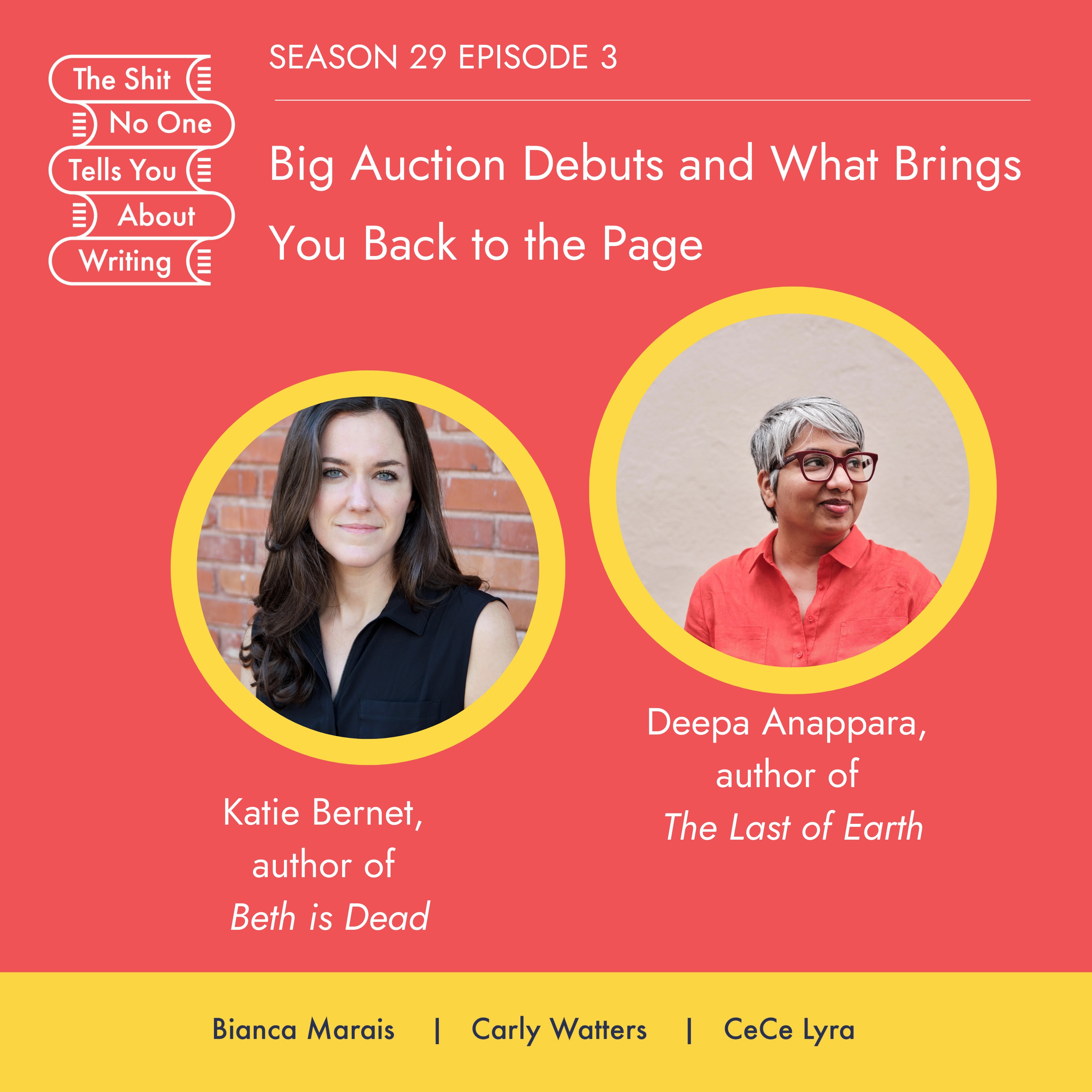
Big Auction Debuts and What Brings You Back to the Page
Episode Transcript
[SPEAKER_01]: and welcome to our show.
[SPEAKER_01]: The shit no one tells you about writing.
[SPEAKER_01]: I'm best selling author Bianca Marie, and I'm joined by CC Lira of Wendy Sherman Associates and Carly Waters of PS Literary.
[SPEAKER_03]: Hi everybody!
[SPEAKER_03]: It's Carly doing the interview today.
[SPEAKER_03]: I know that you are used to are normally lovely Bianca doing the author interviews, but I'm at somebody that I want to interview for the podcast, and so I'm having Katie Burnett here, and yeah, I just have so many things to talk to Katie about.
[SPEAKER_03]: There's a couple of reasons I wanted to have Katie on the show.
[SPEAKER_03]: Number one, Katie and I met when we were at DFWCon, the Dallas Warth [SPEAKER_03]: I had a chance to chat with Katie who was great and everybody was just talking about your book and like you have to talk to Katie and her book and it's so good and you know so much buzz around and I was like okay I got to talk to Katie about her book so there's a few things we have to talk about first of all I'm going to introduce you so I do have Katie's lovely official bio so Katie Burnett is the author of Beth is dead a junior library guild gold selection standard she's an award-winning creative director along standing member of DFW Reader's workshop [SPEAKER_03]: 25 DFW writers conference where we met as the oldest of three sisters she's a die hard fan of little women and I have the book description here but sometimes it's nice to hear from the author about what their book is about so and once everybody here's a description you'll know why I wanted to have Katie on the show so Katie welcome to the show first of all and second of all tell everybody what your lovely book is about [SPEAKER_02]: Yeah, so Beth is dead is a modern day reimagining of little women as a mystery thriller.
[SPEAKER_02]: So Beth instead of dying from scarlet fever at the end of the book, she is found murdered in chocolate one.
[SPEAKER_02]: So that's Beth is dead.
[SPEAKER_03]: It's great!
[SPEAKER_03]: I mean, I was scrolling through all of the materials, obviously, that your wonderful publicist sent over and kind of getting ready for interview, and obviously some incredible endorsements.
[SPEAKER_03]: You also have, I counted, three, starred reviews.
[SPEAKER_03]: You have a starred really percuss, a starred review from Publishers Weekly, a starred review from shelf awareness.
[SPEAKER_03]: So the buzz is really just building for this one, and I have so many, I have so many thoughts and questions for you.
[SPEAKER_03]: Yeah, I'm going to work, try to start.
[SPEAKER_03]: I'm going to start with this is your debut.
[SPEAKER_03]: Yeah.
[SPEAKER_03]: So.
[SPEAKER_03]: I want to know.
[SPEAKER_03]: How many books you wrote before you wrote this book?
[SPEAKER_02]: Great question.
[SPEAKER_02]: So that is dead with my sixth manuscript.
[SPEAKER_02]: And honestly, I had no idea that it was going to take that much time, but I'm so glad that it did.
[SPEAKER_02]: I tell people all the time.
[SPEAKER_02]: I think I learned something new with each of those five manuscripts that were unpublished and they all kind of, you know, built up my skills and led to me finally writing Bethesda.
[SPEAKER_03]: Yeah, and so when did you get your agent Sarah?
[SPEAKER_03]: Was it with this book or was it previous manuscript?
[SPEAKER_03]: So how long have you and Sarah been working together?
[SPEAKER_02]: No, it was a previous manuscript that didn't sell, but yeah, I got a sign with Sarah through queries and slash pile with a previous manuscript.
[SPEAKER_02]: And I actually had an agent for Sarah's.
[SPEAKER_02]: I had kind of a long journey, but yeah, I've really loved working with her and kind of workshopped the idea for Betha's dead with her and wrote that while I was sign with her.
[SPEAKER_02]: That was really helpful.
[SPEAKER_03]: Yeah, yeah, I had two questions to do about the editing, right?
[SPEAKER_03]: Because for those of you who are listening to this, this is coming out right when the book is coming out, so you should be able to get it, if not today, then very shortly and you should pre-order it.
[SPEAKER_03]: But I think this book is so just tight.
[SPEAKER_03]: There's not a lot of room for, I don't know, just like there's not a lot of access.
[SPEAKER_03]: And I was kind of wondering, is it because it was YA?
[SPEAKER_03]: Is it because obviously it's so plot-heavy?
[SPEAKER_03]: And then the other thing I was kind of theorizing last night as I was typing up some of my questions [SPEAKER_03]: Because little women is such a familiar book to so many of us, you didn't actually have to spend a lot of time developing the characters on the page because we have these characters so rich in our minds over the lore of the book or the movies and just our general experience with these characters.
[SPEAKER_03]: So I thought it was so smart because you got to like bounce so quickly into plot because you didn't have to like over explain the characters to us.
[SPEAKER_03]: So I was just wondering how intentional that was or that was just natural through the process.
[SPEAKER_02]: yeah it was kind of natural I think because you're totally right I had so much borrowed from little women like we all know who those characters are you're coming into it with such a rich idea already so you know you're standing on a lot when you start which is really really great and I think also because the book has four perspectives and two timelines that kind of forces need to be tight because you have to hop back and forth and there's just a lot to pack in so I think that was part of it as well.
[SPEAKER_03]: Yeah, and did you always imagine this was going to be YA?
[SPEAKER_03]: Because obviously it's true to the girls ages, I believe, you know, from the original story.
[SPEAKER_03]: I don't know, just wanting to do you ever think about did it have to be YA?
[SPEAKER_03]: I'm just curious about that.
[SPEAKER_02]: I did debate it a little bit, but I had been writing YA, so it's kind of more comfortable in that genre and had gotten used to that voice.
[SPEAKER_02]: And so that was part of what led to my decision to ultimately make it YA.
[SPEAKER_02]: But I did debate it, and I think we've talked [SPEAKER_02]: it feels a little bit crossover.
[SPEAKER_02]: Like I think people who are, you know, a little bit older, but enjoy it little women can also read it and enjoy it.
[SPEAKER_02]: So [SPEAKER_02]: Yeah, I think it could have gone either way, but I am excited that I made it way because I really love writing way.
[SPEAKER_03]: Yeah, yeah, no, I think in a sense of crossover potential.
[SPEAKER_03]: I think I'm just a prime candidate for that person, right?
[SPEAKER_03]: Like right away, I don't read time away.
[SPEAKER_03]: I don't wrap out time of way either.
[SPEAKER_03]: It's not any particular personal reason.
[SPEAKER_03]: It's just kind of the way my career developed.
[SPEAKER_03]: But I was just obviously really drawn to it because it's one of those things where there's so many retellings of so many things, right?
[SPEAKER_03]: And I'm sure you went through this of like, [SPEAKER_03]: what does quote unquote deserves to be retold?
[SPEAKER_03]: How can you retell it in a way that feels fresh?
[SPEAKER_03]: And there's so many Austin retellings.
[SPEAKER_03]: There's an agent, sometimes I see a lot of these retellings.
[SPEAKER_03]: And I'm like, how do we know that this is actually going to be the most fresh retelling?
[SPEAKER_03]: And so for you, what you were thinking of, like, how could this be the most fresh retelling?
[SPEAKER_03]: Is that where you worked with Sarah on the brainstorming and that kind of thing?
[SPEAKER_02]: Yeah, I sent her in early draft.
[SPEAKER_02]: It was probably probably like five chapters in one of the questions that she asked me really early on, super helpful.
[SPEAKER_02]: what is the reason that you're doing this?
[SPEAKER_02]: Not just, you know, it's an interesting story.
[SPEAKER_02]: I think it'll be a cool mashup, but like, what is the purpose?
[SPEAKER_02]: And that was something that was just in the back of my head the whole time I was working on it.
[SPEAKER_02]: And I think that's one of the most important questions you can ask yourself when you're working on a re-telling because a lot of people have so much love for the source material.
[SPEAKER_02]: It's like, you don't want to ruin it.
[SPEAKER_02]: You don't want to, you have to have something that you're adding, but you also have to have an appreciation for your actual story.
[SPEAKER_03]: Yeah, because I almost feel like in a way and I hope this is a compliment.
[SPEAKER_03]: I think you're contributing to the lore of the story.
[SPEAKER_03]: You're adding a new fan fiction meta layer of the book to the people that I think they're really going to relate to.
[SPEAKER_03]: And it was very interesting to me also.
[SPEAKER_03]: It's hard for me to read things as like a reader.
[SPEAKER_03]: I read things as a agent and as a publishing person and as an interviewer.
[SPEAKER_03]: And so I was really thinking about how true you were staying to each character.
[SPEAKER_03]: Not only the story, but did you find it?
[SPEAKER_03]: Like you had to box anything in.
[SPEAKER_03]: And things feel forced or what did you do maybe when you thought, Oh, I got to get this person into this box as a writer.
[SPEAKER_02]: Yeah, that's an interesting question because I don't think that I've ever felt forced because the march sisters are so different.
[SPEAKER_02]: I got to go in so many different directions with them.
[SPEAKER_02]: And you know, one thing that I thought was really interesting was just like the character surprised me.
[SPEAKER_02]: Starting out, I have never really loved that.
[SPEAKER_02]: She just hasn't been my favorite character, but she is now.
[SPEAKER_02]: After writing this book, she is absolutely my favorite.
[SPEAKER_02]: I just learned so much about [SPEAKER_02]: brave in a way that I had never imagined or thought up before.
[SPEAKER_02]: So that was something cool.
[SPEAKER_02]: It's like I actually learned new things about these characters that I'm just for so long.
[SPEAKER_03]: Yeah.
[SPEAKER_03]: Yeah, I feel like in some ways she I don't want to say she's the least memorable because that's not fair.
[SPEAKER_03]: Don't come at me all the way.
[SPEAKER_03]: You know, fans, but because we lose her in the end, you know, just like her health problem.
[SPEAKER_03]: She's not as large in our minds.
[SPEAKER_03]: I don't think and you really centered her obviously it's called Beth is dead.
[SPEAKER_03]: You know, you really centered her.
[SPEAKER_03]: in a way I think that the original story didn't get changed to or you know wasn't able to.
[SPEAKER_02]: Yeah I just think she's so interesting that she I mean in the original she knows she's going to die and she is she's facing this really terrifying thing I think anybody would be scared by that but even still she makes face for other people before herself she's really kind she's calm she's strong like man I wish we could all be like that right like I just had never thought of her in that way before.
[SPEAKER_03]: Yeah, that's such a good point that that honorableness of her was always spectacle.
[SPEAKER_03]: So how many times have you read little women first of all and then in preparation for this like how did you annotate and like did you break things down like how did you use the source material as the launch point?
[SPEAKER_02]: Yeah, so I've read it gosh, I don't even know but probably seven times at this point and not like you know [SPEAKER_02]: cover to cover.
[SPEAKER_02]: I've read it in different order and kind of picked different chapters to read and things like that over time, but I think what I did is I wanted to have a really good understanding of the story and then take a little bit of a step back.
[SPEAKER_02]: The heart of the story, the heart of the characters, the themes, and then some of those really memorable scenes I definitely repeated in my own way, but I didn't want it to be like a beat for beat retelling.
[SPEAKER_02]: So I took a step back after sort of digesting everything.
[SPEAKER_03]: Yeah, yeah, and I think it totally rings true.
[SPEAKER_03]: And I also think, again, when I read retellings or, you know, versions of retellings, where it feels like, again, you're trying to like, drawing arm like, remember when this happened, you know, and I thought, you like, I don't like breaking the fourth wall, but you don't, in my reading of this, like you don't really break the fourth wall, because you're creating a whole new universe where you get to explore it in that context.
[SPEAKER_03]: Okay, I want to go back to way for a second, because I had [SPEAKER_03]: technology, right?
[SPEAKER_03]: So obviously in little women, it's historical novel.
[SPEAKER_03]: This is a version of technology is very different than a version of technology.
[SPEAKER_03]: So how did you imagine you wanted to use technology as modern teams?
[SPEAKER_03]: Where did you feel like, you know, the retellanges or opportunities?
[SPEAKER_03]: Because I find a lot of writers these days really struggle.
[SPEAKER_03]: Whether it's adult or whether it's YA.
[SPEAKER_03]: How do you use texting or apps or things like that in a way where if we always know where everybody is or there's always a way to contact somebody how you create tension, especially as teams.
[SPEAKER_03]: So how do you think about that?
[SPEAKER_02]: Yeah, so that technology was a hurdle in some ways because of the murder mystery aspect.
[SPEAKER_02]: Like, you know, my family, when I was growing up, like, we all shared our locations.
[SPEAKER_02]: And so I had to make a really conscious decision to have the march sisters not share their locations.
[SPEAKER_02]: And there's a sort of spoiler reason for that.
[SPEAKER_02]: I mean, I guess the oldest does not want to share their location.
[SPEAKER_02]: And so they've kind of made that choice.
[SPEAKER_02]: But yeah, I think technology plays a the biggest role in Joe's character because I made the choice to have Joe be [SPEAKER_02]: She's writing personal essays and she's gaining a following online for those personal essays and so I think part of her struggle is relevance how does she stay relevant and then also just this decision of like what can I put online and what should I not put online is something that's going through her head.
[SPEAKER_03]: Yeah, that was so interesting to me when I got to that part where I was like, oh my gosh, she's an influencer in her way of working through her thoughts, the way that she would writing as the original character.
[SPEAKER_03]: She uses the social media, Instagram essays or your version of Instagram.
[SPEAKER_03]: I can't remember if you actually call it Instagram, but like that idea of using the online universe as a way to kind of journal through and work through those thoughts.
[SPEAKER_03]: Yeah, it was just interesting to me, like what would what would the modern joe be?
[SPEAKER_03]: And you were like, she would be an influencer for sure.
[SPEAKER_03]: Yeah, so.
[SPEAKER_03]: Yeah, yeah, that's okay.
[SPEAKER_03]: Okay, so talk to me a little bit about your concept of class structure because obviously in the historical version that it's the Civil War, there's all these kind of elements of that you have the girls in an affluent neighborhood, but they are not specifically affluent.
[SPEAKER_03]: Yeah, that's necessary.
[SPEAKER_03]: I mean, it's again, it's all relative.
[SPEAKER_03]: Talk to me about how you kind of thought about like their place in modern society.
[SPEAKER_02]: Yeah, so they live and conquered and they are like you said in a more affluent neighborhood, but I picture them as being kind of like the gosh, I don't know if it's the right way to say this, but like the bottom of the barrel in their neighborhood in terms of like what they have.
[SPEAKER_02]: And so, you know, their characters like Sally Gardner who have so much more in their comparing themselves to characters like Sally, [SPEAKER_02]: but at the same time, they're very comfortable.
[SPEAKER_02]: They're not struggling for money as much Meg at being the oldest sister.
[SPEAKER_02]: I think she has a little bit more visibility to the family's finances and to what her mom is dealing with and thinking about.
[SPEAKER_02]: So she worries about it a little bit more, which you know just happens to the original Meg, but yeah, so they're they're kind of just I guess a middle class family in this story.
[SPEAKER_03]: Yeah, I'm trying to figure out like how many spoilers do I give and how many questions do I ask and like an usbile the ending It's all great.
[SPEAKER_03]: Everybody go read it.
[SPEAKER_03]: You know, I definitely won't spoil the ending for you guys because it is a murder mystery and we're not going to do that Okay, so I want to come back to some of the publishing stuff.
[SPEAKER_03]: So yeah, had a very kind of busy publishing story, which is obviously great.
[SPEAKER_03]: So happy for you after writing five pages.
[SPEAKER_03]: Okay [SPEAKER_03]: This is the one that happens all that action.
[SPEAKER_03]: This is the one that sold in, I don't know how many territories you're up to, but can you talk a little bit about, like, maybe why you think this manuscript, not only was this the one that broke through domestically, but also internationally, right?
[SPEAKER_03]: Because little women is a very American story.
[SPEAKER_03]: Not to say this in travel, but I'm curious about why you think that worked here.
[SPEAKER_03]: And also, like, why do you think it works abroad?
[SPEAKER_02]: Yeah, so I've actually gotten some feedback on that from some of my international publishers who have said that they think that just the the crossover between being a thriller, but also having the more literary bent to it, there's an audience that appreciates literary classics, there's also an audience that appreciates.
[SPEAKER_02]: thrillers, that's been really, really helpful.
[SPEAKER_02]: So I think the fact that it spans audiences has been helpful.
[SPEAKER_02]: And then actually, this kind of goes back to, so my sister is a professional dancer and she owns a dance company in Dallas.
[SPEAKER_02]: And so we were having conversations before I started writing Bethesda about.
[SPEAKER_02]: her shows and people not really wanting to attend dance performances as much and we were saying I think you need to do something that's a little bit more commercial, a little bit less hetty or artistic and that conversation led me to think okay I might need to come up with a more commercial premise because all of the books that I had written previously before about this [SPEAKER_02]: We're a little bit more literary.
[SPEAKER_02]: They didn't have a really easy hook, a really easy way of describing the book.
[SPEAKER_02]: And so that was an aha moment for me when we were talking about advanced performances like, hey, actually I should take this advice myself and I should come up with a more commercial premise.
[SPEAKER_03]: Yeah, I love that you're just like speak to the ethos of our show, everybody.
[SPEAKER_03]: So you heard it straight from Katie, folks need hooks.
[SPEAKER_03]: Yes, that's how we grab on to them.
[SPEAKER_03]: Katie's lived experience.
[SPEAKER_03]: Yeah, so talk to me a little bit about your experience in Frankfurt.
[SPEAKER_03]: So talk to us about, you know, you had a party, we had a little bit of a Frankfurt book for those of you that don't know, Frankfurt book for is kind of a translation fair, but it's very rare for an author to be invited and via a guest of honor [SPEAKER_02]: It was so cool.
[SPEAKER_02]: I feel so lucky that my agent Sarah Crowe took me with her and she has been going Frankfurt for many, many years.
[SPEAKER_02]: So she just knows everyone at the fair and knows how to navigate it.
[SPEAKER_02]: It was so cool.
[SPEAKER_02]: So much bigger than I imagined.
[SPEAKER_02]: It would be.
[SPEAKER_02]: There's so many different publishers and so many different countries.
[SPEAKER_02]: And I had a day where I kind of had free time and I was able to just walk around and [SPEAKER_02]: take it all in, but then I was also taking meetings with each of my different international editors, so that was really cool just to hear, you know, hear their thoughts and like what works through their market or what challenges they have in their market, it was really educational for me, so it was a great time.
[SPEAKER_03]: Yeah, that's a master class.
[SPEAKER_03]: That's like a, I don't know, masters and create writing or publishing studies right there to meet everybody and learn about that.
[SPEAKER_03]: And as everybody publishing early next like early 2026 or when is everybody publishing?
[SPEAKER_02]: It's summer coming a little later, something the summer, some of them haven't decided yet, but yeah, a lot are publishing kind of right around the U.S.
state.
[SPEAKER_02]: So January and right after.
[SPEAKER_03]: That's great.
[SPEAKER_03]: Yeah, as you guys know, we reported ahead of time.
[SPEAKER_03]: So at KD9, I've recorded before the Christmas holidays, but this will be out in this is, I think, our January first episode.
[SPEAKER_03]: So this is our kickoff of the new year, which is great.
[SPEAKER_03]: So talk to me about some of your just like, you know, inspirations for writing obviously the source material of little women was a big source of inspiration.
[SPEAKER_03]: What are your favorite authors?
[SPEAKER_03]: Who do you read?
[SPEAKER_03]: What are your like go to auto buys?
[SPEAKER_03]: What do you like?
[SPEAKER_02]: Oh, yeah.
[SPEAKER_02]: So, [SPEAKER_02]: Why authors?
[SPEAKER_02]: I really really love Tiffany D.
Jackson.
[SPEAKER_02]: David Arnold is a favorite needle core, Jandy Nelson.
[SPEAKER_02]: So those are some authors that really inspire me.
[SPEAKER_02]: But then also just in the adult space, I really love Barbara King's Oliver.
[SPEAKER_02]: Poisonwood Bible was a huge inspiration for Bethelstead.
[SPEAKER_02]: I read that at a really young age and just loved the four POVs of the sisters and how different they all felt.
[SPEAKER_02]: And so that was something I always wanted to do is write a multi POV novel.
[SPEAKER_02]: So yeah, she's a huge inspiration.
[SPEAKER_02]: Margaret Atwood as well.
[SPEAKER_02]: Well, at the handpads tale.
[SPEAKER_02]: kind of a varied, I don't you know, I don't read in like one particular genre, but then mystery thriller I also have to mention injury parts because I was reading a book by Andrea Barts when I decided to write Bethan's dad, I was like I'm having so much fun reading this book, how I would probably have this much fun writing mystery, so that was kind of what took me over the edge.
[SPEAKER_03]: Yeah.
[SPEAKER_03]: Andy's a big fan favorite of the pod.
[SPEAKER_03]: So we love Andy.
[SPEAKER_03]: So poison my Bible was one of my favorite books for a long time.
[SPEAKER_03]: Like whenever whenever anybody asked me like what's my favorite book, I would always say poison my Bible.
[SPEAKER_03]: I love that book.
[SPEAKER_03]: And then I just kind of like I haven't reread it in a while.
[SPEAKER_03]: Like that's reminding me of like how much that was a very influential book to me as well.
[SPEAKER_03]: I'm absolutely adored towards that book.
[SPEAKER_03]: That's one of my days.
[SPEAKER_03]: Now I want to talk a little bit about your experience with the writer's workshop and you know, and obviously as I mentioned your director of the festival, can you walk us through you know, just some of the structures about like the writer's workshop and the festival and how that kind of informed you're writing in your career so far?
[SPEAKER_02]: Yeah, I would love to because it is honestly the thing I credit for you know, all everything getting published, I wouldn't be published without the DFW writer's workshop.
[SPEAKER_02]: I joined right after I graduated from college, so about 11 years ago now, dating myself.
[SPEAKER_02]: But I first decided to go to the conference, so I kind of went in cold.
[SPEAKER_02]: I was, I had written my second manuscript and my first one I had really struggled with querying, and so I was like, okay, I need to find a community, I need to get some advice.
[SPEAKER_02]: So I went to this writer's conference knowing absolutely no one and I realized that the most knowledgeable people at this conference were wearing badges that said DFW writer's workshop and so I was like, hey, what is this how do I join and so I joined basically the week after that conference and [SPEAKER_02]: The workshop meets every single Wednesday, Rainer Shine, and we have about 200 members total, but I would say maybe like 50 to 60 will show up each week and we break up into red rooms and you get a chance to actually read your work out loud and then get critique right there in the moment.
[SPEAKER_02]: So that has been so helpful over the past 10 years, just whatever project I'm working on, reading that week after week, after week, and then also hearing other people's stories and how they develop them over time has been really, really helpful.
[SPEAKER_03]: You know, I think you guys are such a great organization and we talked with this obviously meant in person But I've been to DFWCon 10 years ago, and I had a great experience and just seemed like such a well-run show Like everybody was so happy to be there.
[SPEAKER_03]: I love conferences I love coming to conferences where I can tell that the people spend a lot of time together And they also really enjoy that like annual event and it's such a celebration of the work They've done all year as Brighton as an as organized.
[SPEAKER_03]: So like I feel so charmed by that And I just like bothered that weekend and say hi for a couple days, but I'm really charmed [SPEAKER_03]: by those organizations, because I know how much work goes into those things, depending on the amount of writing you're doing, people have day jobs.
[SPEAKER_03]: There's just so much, obviously, involved with these things.
[SPEAKER_03]: Yeah, so tell us about how to DFW go as the chair, what was your official title this year?
[SPEAKER_03]: What was your title?
[SPEAKER_02]: How is the director this year?
[SPEAKER_02]: So, director, yes.
[SPEAKER_02]: It was a big job.
[SPEAKER_02]: We all rotate, so somebody different will step up and be the director each year.
[SPEAKER_02]: And it's funny when they first asked me to do the job, I actually said no, but I got kind of strong arm to do it and I'm so, so glad that everybody convinced me to do it because it was actually really wonderful experience and it gave me a lot of opportunities to just talk to different authors and speakers that I wouldn't have interacted with otherwise.
[SPEAKER_02]: So it was an amazing opportunity and the team that I worked with, everybody has their role, everybody knows what they're doing.
[SPEAKER_02]: So it's a really well-oiled machine and it was not as hard as I was imagining it was good.
[SPEAKER_03]: You only had to give like two speeches, it's fine, it's fine, it's fine, it's fine, it's fine, it's fine, it's fine, it's fine, it's fine, it's fine, it's fine, it's fine, it's fine, it's fine, it's fine, it's fine, it's fine, it's fine, it's fine, it's fine, it's fine, it's fine, it's fine, it's fine, it's fine, it's fine, it's fine, it's fine, it's fine, it's fine, it's fine, it's fine, it's fine, it's fine, it's fine, it's fine, it's fine, it's fine, it's fine, it's fine, it's fine, it's fine, it's fine, it's fine, it's fine, it's fine, it's fine, it's fine, it's fine, it's fine, it's fine, it's fine, it's fine, it's [SPEAKER_02]: Yeah, I did workshop Beth is dead.
[SPEAKER_02]: I probably didn't read every single chapter, but I would close to it.
[SPEAKER_02]: And the reception was different than other books that I had written.
[SPEAKER_02]: So that was really rewarding to to feel that and to get different critique that I got in the past one of my.
[SPEAKER_02]: mentors, A-Wee Martinez, he had read almost all of my other manuscripts, and I said that this dead to him, and I was actually trying to decide if I was going to pursue the idea.
[SPEAKER_02]: I said, hey, what do you think?
[SPEAKER_02]: Like, this is really different from what I've written in the past.
[SPEAKER_02]: I should I pursue this, and I got an email back from him that just said, this is the best thing you've ever written.
[SPEAKER_02]: And I was like, I just lit up in that moment, and I think that propelled me forward to finish it.
[SPEAKER_02]: But it was like, that was super rewarding because these are the people that [SPEAKER_02]: you know, teaching me and helping me over the past 10 years.
[SPEAKER_02]: And that was the feedback I got from them.
[SPEAKER_03]: Yeah, I love that.
[SPEAKER_03]: And, you know, we talked a little bit about like what that sense was and that change and how you decided to make that change.
[SPEAKER_03]: Were there other ways that you noticed why this was the reason for this book in particular?
[SPEAKER_03]: I guess I'm just trying to break it down for our audience.
[SPEAKER_03]: It's like, I guess what I'm trying to ask is if you were somebody listening to this, how would they know, oh, maybe a couple of minutes you haven't worked out, how do I know, what does the light bulb go on?
[SPEAKER_03]: What are some ways, I guess, that the light bulb goes on that there's been a shift.
[SPEAKER_02]: So, okay, I think every writer has different strengths and weaknesses, and I think what happened for me is that over the course of writing five manuscripts, I was able to identify what I think my biggest weakness was, which was plot.
[SPEAKER_02]: A lot of the previous manuscripts I was writing, like, oh, it's a great character study, or it's all vibes.
[SPEAKER_02]: You know, it just didn't have a really compelling [SPEAKER_02]: need to turn the page.
[SPEAKER_02]: And so I think for me in particular deciding to write a mystery forced me to understand plot and force me to understand tension and how to pull a reader forward.
[SPEAKER_02]: So I think I guess that's a long way of saying like each writer I think it's important that you write enough that you learn what your personal weaknesses and then find a way to fix that personal weakness.
[SPEAKER_02]: I think it's different for everyone and for me it just happened to be figuring out plot learning plot.
[SPEAKER_03]: Yeah, yeah, that's such a, it's a good advice for anybody, you know, a lot of athletes apply that like I'm thinking of Yeah, Tiger Woods that said I don't practice the things I'm good at, I practice the things that I'm weakest at, you know, it's like way of, you know, we can go blindly into the things we're really good at, which is great, but if you don't reflect on the things that you actually probably need to improve on and have on a speedback, maybe if they [SPEAKER_03]: what those things are, right now everybody is self-aware enough to realize, hey, that's my weakness, right?
[SPEAKER_02]: Yeah, and also I think finding friends and critique partners who have different weaknesses, one of my best friends, Dana Swift, she's really good at plot, that's her thing.
[SPEAKER_02]: And so we would, like a while I was writing Beth's dad, we were meeting weekly, and she was giving me advice on, hey, I don't think this is where this should go.
[SPEAKER_02]: I think this should go this way.
[SPEAKER_02]: So finding people who compliment you in that way is really helpful.
[SPEAKER_03]: Yeah, and so how long do the writing process take from like idea to, you know, figuring out if it's worth pursuing to finishing the manuscript?
[SPEAKER_02]: Yeah, it took about two years.
[SPEAKER_02]: During that time, I was working a full-time job in advertising and doing a lot of other things.
[SPEAKER_02]: So I think, you know, I could have gone faster, but with life, like it took two years, I'm beginning to end.
[SPEAKER_02]: So kind of a long time.
[SPEAKER_03]: Yeah, no, I love it.
[SPEAKER_03]: I'm like trying to give all of our listeners all the little things that I think they they'd want to know and they'd be curious about oh, this is what I want to ask you and I don't think this is too much of a spoiler just a little bit of character stuff, but I think what I got this is kind of what I open the interview with was this idea of [SPEAKER_03]: It's a really complex idea and yet you have the foundational kind of support of the little women's structure.
[SPEAKER_03]: But it's really like a book within a book.
[SPEAKER_03]: It's actually like Mary Meta, the concept of it, right?
[SPEAKER_03]: So we have our little women original characters, right?
[SPEAKER_03]: Then we have the dad and the story, wrote a book about the present day girls and we're reading it in book form while Jo wants to be a writer.
[SPEAKER_03]: So it's like very Meta, very sophisticated.
[SPEAKER_03]: Did you run into [SPEAKER_03]: like hurdles with figuring out how meta you wanted to be.
[SPEAKER_03]: I feel like I've asked this question a few times, but I think what I'm trying to get at is like how easy the structure came to you or really was two years of working this out.
[SPEAKER_02]: Honestly, figuring out the the dad's plot of, you know, him writing this book was the thing that really cracked the story open for me.
[SPEAKER_02]: I had written probably 10 or 11 chapters before I figured that out.
[SPEAKER_02]: I had a completely different storyline for the dad.
[SPEAKER_02]: And then I realized, no, you know what, it was actually the question that that my agent Sarah asked me if what is your reason for doing this, what's the purpose and I realized that I think my purpose for writing it was to have the girls give them an opportunity to reflect on who they are and how they're portrayed and how readers perceive them.
[SPEAKER_02]: And so deciding that he was going to write this book that the girls were going to read this book and then have a chance to react to who they are in the book like crafted open for me and it's like, okay, this is what this is what I'm trying to say, this is what I'm trying to do.
[SPEAKER_03]: Yeah, but I think that's what makes this book in my mind, what makes this book really special, why it's, I think it's gonna be successful, knock on board, why all your foreign publishers think that is like, you, you really thought of everything and it's, everything's really subtle, everything's really tight.
[SPEAKER_03]: You had to figure out reason like, how do we get this data away?
[SPEAKER_03]: But also, you used him as the launchpad for every, how everything blew up.
[SPEAKER_03]: So, I feel like in so many ways it honors the original story but comes out of from an entirely new perspective and it's just like, I don't want to say the writing is sparse in the sense of like a literary way but I feel like you didn't waste any time or any space and so many of my highest compliments.
[SPEAKER_03]: Everybody's so disgusting.
[SPEAKER_03]: Go needs to buy it.
[SPEAKER_03]: I screenchatted one line that I really liked and it was about this is from Joe's point of view and Joe, this is the moment where Joe is.
[SPEAKER_03]: Trying to figure out how to express herself about her sister's death.
[SPEAKER_03]: And basically, as we know, she is an influencer.
[SPEAKER_03]: So she's like, I don't want to write about this on the internet.
[SPEAKER_03]: I want to figure out a way to write this.
[SPEAKER_03]: And so in Joe's point perspective, it says, you're going to crack open a blank page, let the story drain out.
[SPEAKER_03]: I write about this morning, finding Beth in the snow.
[SPEAKER_03]: Her empty eyes reflecting the sky, the gash in her forehead.
[SPEAKER_03]: So deep, I worried that her memories and thoughts had escaped with the blood.
[SPEAKER_03]: And anyway, it goes on.
[SPEAKER_03]: love that, like, you know, you're not overly gory with it, but like that line about, you know, pouring that her memories and thoughts had escaped with the blood, I'm like, oh my gosh, so beautiful, Katie.
[SPEAKER_03]: Thank you.
[SPEAKER_03]: That's such a great story.
[SPEAKER_03]: Thank you.
[SPEAKER_03]: I love it so much.
[SPEAKER_03]: So tell me, you know, you don't have to go into detail, but have you started working on something new?
[SPEAKER_03]: How, how did you manage the selling the book, publicizing, you know, you're going through this whole thing while trying to work on something new, usually is what happens.
[SPEAKER_03]: So how was that?
[SPEAKER_03]: Excuse me.
[SPEAKER_03]: It's going for you.
[SPEAKER_02]: It was a wild year.
[SPEAKER_02]: I'll say that.
[SPEAKER_02]: But you know, I actually just submitted my first draft of what will be book two about month ago.
[SPEAKER_02]: So that was a really exciting moment.
[SPEAKER_02]: And I am doing another retelling of a literary classic as a mystery thriller and modernized mystery thriller.
[SPEAKER_02]: So I'm going to keep a secret which one it is, but yeah, I'm I'm really excited about it.
[SPEAKER_03]: Okay, okay, I wasn't sure I'm like if you're gonna go to different directions again Don't need to spill the beans before it's ready.
[SPEAKER_03]: Yeah, no, we'll be we'll be really excited So tell us a little bit more about you know what advice you might have for writers You know like you've been through this, you know with your manuscripts, you've had two agents If you sold this big book, you know, if you think about our podcast listeners What are some kind of bits and advice that you might want to share with them?
[SPEAKER_02]: Yeah, I think like biggest piece of advice is something I've kind of talked about already which is just finding a community [SPEAKER_02]: because that is the thing that made the biggest difference for me, which is finding people who could give me honest feedback, and who could also answer questions every step of the way, like, how do you query, how do you work with an editor, if you find somebody who's done that before, it's just gonna be so much easier, and you're not gonna be as nervous and stressed about it, because you're gonna have a roadmap.
[SPEAKER_02]: So that's been the biggest thing.
[SPEAKER_02]: And then I think also, one thing that has really helped me is like loosening my own grip on who I want to be as a writer, [SPEAKER_02]: and learning how to pivot and just say, you don't have to do the same thing every time.
[SPEAKER_02]: I don't have to write the story that I think other people want me to write.
[SPEAKER_02]: It's just whatever I'm on a write.
[SPEAKER_02]: And yeah, so I think being a little bit looser about with your work.
[SPEAKER_02]: Not holding it so tightly.
[SPEAKER_03]: Yeah, I think that's great advice because I think there's so much conflicting about like, find your brand and like, this is your brand.
[SPEAKER_03]: But what I always tell my authors is, [SPEAKER_03]: like your brain comes from the content and the brain is also allowed to pivot and shift like you do because the cure human being and the brand is often in the themes and the linking pieces between your stories it's not actually like this you know packaged identity that people think it is so there's there's always a lot to work through with people figuring out [SPEAKER_03]: who they are as a kind of commodity of sorts.
[SPEAKER_03]: I love that advice, Katie.
[SPEAKER_03]: So let's run through your tour schedule.
[SPEAKER_03]: I don't know if you have a handyman, but I want everybody to know where you're gonna be.
[SPEAKER_03]: Do you have a handyman?
[SPEAKER_03]: Can you run through where you're gonna be this month?
[SPEAKER_02]: Oh, my tour schedule is pinned on my Instagram for anyone who wants to check it out later.
[SPEAKER_02]: But super excited.
[SPEAKER_02]: I'm gonna be going to act in Massachusetts, which is right outside of Concord, which is where obviously Louisa may outcut grew up and wrote little women.
[SPEAKER_02]: So that's gonna be January 6th on launch day.
[SPEAKER_02]: And then the next day I'm going to pronounce this book in Nashville, Tennessee, and then I'm coming back to Dallas, Texas, to do a conversation at Interribing Books, and then I'll be doing a signing in Plano, Texas at Bibliobar, and then I'll be in Houston at Murder by the Book, and then in Waco at Fable Book Shop.
[SPEAKER_02]: So I am super excited.
[SPEAKER_03]: Amazing.
[SPEAKER_03]: Well, if anybody's in those locations, I highly recommend you go see Katie in person, hear her, you know, story in the book, and then it should be a great community there as well, supporting you guys.
[SPEAKER_03]: If you are in the Dallas Fort Worth area or otherwise, I highly recommend to check out the DFW Reddish Workshop, and obviously the Incredible Conference, which I was at and totally endorsed, because I thought it was lovely.
[SPEAKER_03]: Yeah, it was a Katie anything that you want to talk about that I didn't ask, Granny, and anything else that's been coming up with [SPEAKER_02]: Yeah.
[SPEAKER_02]: That's kind of it.
[SPEAKER_02]: I'm just really excited to, you know, start actually getting the book into readers hands and seeing what people think.
[SPEAKER_03]: Yeah.
[SPEAKER_03]: It's a long time coming as you know.
[SPEAKER_03]: So yeah, no, it's great.
[SPEAKER_03]: I totally recommend everybody.
[SPEAKER_03]: Beth is dead.
[SPEAKER_03]: Go grab it.
[SPEAKER_03]: Whether you're a teen, whether you're an adult.
[SPEAKER_03]: I think I agree.
[SPEAKER_03]: And I think it has that magical crossover of the potential.
[SPEAKER_03]: So I think everybody's going to love it.
[SPEAKER_03]: So I'm hoping the best for you, Katie.
[SPEAKER_03]: And I hope you have this cross again.
[SPEAKER_01]: Yes.
[SPEAKER_01]: And congratulations.
[SPEAKER_01]: Thanks.
[SPEAKER_01]: This is so fun.
[SPEAKER_01]: Hi everyone, it's all the interview day today and today's guests debut novel, Jen Petrol on the Purple Line, was named one of the best books of the year by the New York Times, The Washington Post, Time, the Guardian, and NPR.
[SPEAKER_01]: At one, the Edgar Award for Best Novel was longlisted for the Women's Prize for Fiction, shortlisted for the JCB Prize for Indian Literature, and included in Times 100 Best Mystery and Thriller Books of All Time.
[SPEAKER_01]: It's been translated into over 20 languages.
[SPEAKER_01]: She is the co-editor of letters to a writer of color, a collection of personal essays on fiction, race, and culture.
[SPEAKER_01]: It's my pleasure to welcome Deepa and Apara.
[SPEAKER_01]: Deepa, welcome to the show.
[SPEAKER_04]: Thank you so much for having me.
[SPEAKER_04]: I'm so happy to be here.
[SPEAKER_01]: that is one heck of a resume deeper.
[SPEAKER_01]: What?
[SPEAKER_01]: For those of you who are not watching on YouTube, I am holding up the book cover, the last of Earth, absolutely beautiful, beautiful cover, stunning.
[SPEAKER_01]: And I'm going to read you the flat copy and from there we are going to dive right in as per usual.
[SPEAKER_01]: So, 1869, Tibet is close to Europeans and infuriating obstruction for the rapidly expanding British Empire.
[SPEAKER_01]: In response, Britain begins training Indians permitted to cross borders that white men may not to undertake illicit dangerous surveying expeditions into Tibet.
[SPEAKER_01]: Valhram is one such surveyer spy, an Indian school teacher who for several years has worked for the British [SPEAKER_01]: But Gian went missing on his last expedition and his rumoured to be imprisoned with Interbette.
[SPEAKER_01]: Desperate to rescue his friend, Balram agrees to guide an English captain on a full-hardy mission.
[SPEAKER_01]: Of the years of paying others to do the exploring, the captain disguised as a monk once to personally chart a river that runs through southern Tibet.
[SPEAKER_01]: Their paths were crossed faithfully with that of another Westerner in disguise, 50-year-old Catherine.
[SPEAKER_01]: The night of fellowship in the All-Mail Royal Geographical Society in London, she intends to be the first European woman to reach Lasser.
[SPEAKER_01]: As Barram and Catherine make their way into Tibet, they will face storms and bandits, snow lippards and soldiers, fevers and frostbites.
[SPEAKER_01]: What more, they will have to battle their own doubts, ambitions, grief and paths in order to survive the treacherous landscape.
[SPEAKER_01]: Nadeepa, when I was reading the book and then researching you as well, you said in another interview that you wanted to be a writer from when you were six and I think that resonates with so many of our listeners and we really love hearing everyone's journey from that initial desire to their publication.
[SPEAKER_01]: Can you take us through that including getting an agent and then publishing [SPEAKER_05]: As you said, I really wanted to write from the time I was a child and the way in which I tried to do that because I didn't come from a privileged background, I don't come from a privileged background.
[SPEAKER_05]: And so writing didn't really see the way for me to make a living.
[SPEAKER_05]: So I tried.
[SPEAKER_05]: I wanted to do something that would allow me to write by burning a salary and the way for me was to be a print journalist.
[SPEAKER_05]: So I was a journalist in India for several years.
[SPEAKER_05]: All the time I was thinking about fiction, I wrote some short stories, but I honestly didn't have the time to work on a novel because the job was full time and it took up a lot of my emotional mental bandwidth.
[SPEAKER_05]: It was only when I moved to the UK that I started thinking about writing fiction, was seriously as part of the fact that I studied in an evening creative writing course and I started working on a novel.
[SPEAKER_05]: I wrote three books that didn't really go anywhere and that essentially stayed on my laptop.
[SPEAKER_05]: After that, I did a master's course in creative writing in the UK, and which was, you know, as part of that, Master's, I wrote, Jim Petro, and I finished it post the Master's.
[SPEAKER_05]: So, with the first three books that didn't go anywhere, it submitted it, one of them to a couple of agents who turned it down, and then I didn't send it to anybody else because I felt really upset by the rejections.
[SPEAKER_05]: I felt that maybe I really didn't have it in me to write and maybe this was not for me, which was something that was ingrained in me as a child from the kind of society that I grew up in.
[SPEAKER_05]: But I think it was really helpful for me to study creative writing, be around others who also wanted to be [SPEAKER_05]: writers and took writing in fiction, they seriously which had not seen, you know, in other parts of my life.
[SPEAKER_05]: And with Jim Petrol, I submitted it to novels and progress competitions in the UK.
[SPEAKER_05]: So in the UK, there are still many contests which are for emerging writers, emerging novelists.
[SPEAKER_05]: And fortunately, Jean Petrol won three of those prizes and which led to agents contacting me.
[SPEAKER_05]: So I always tell my students, I teach greater writing and I tell my students that it doesn't usually happen.
[SPEAKER_05]: So I know that that was a very privileged position that I happen to be in.
[SPEAKER_05]: In that, I submitted the novel to these various contests, it won those prizes because of the age in Scott and Touch with me and then, you know, from there, they sent it out and it was picked up for publication.
[SPEAKER_05]: So, it is a very long process, I was in my 40s when my book was published and I actually wanted to be a writer when I was a child.
[SPEAKER_05]: You know, I think I wrote my first novel, I finished my first novel, maybe in 2013, or something, or 2011, I can't even remember.
[SPEAKER_05]: But it took three failed projects before I wrote Chen and before that was published.
[SPEAKER_05]: So, you know, even from the time I started seriously writing fiction, it took me 10 years to get published.
[SPEAKER_05]: So I just want to make it clear that even though I had a quite an easy ride with getting an agent and publishers, it was it's a very long and difficult torturous process really to get there.
[SPEAKER_01]: Yeah, geez, you know what, I don't feel like that was an easy way to get an agent at all, you know, we discuss on the podcast all the time, how many different journeys, how many parts to publication there are.
[SPEAKER_01]: And I think writing three novels, clearing agents being rejected and then finally winning a ton of competitions and getting agents come to you is certainly not the easy way of doing it.
[SPEAKER_01]: But for our listeners, so important to know, because sometimes [SPEAKER_01]: you are not going to grab an agent's attention or a friend for whatever reason and there are other ways of doing it which is why I always like to ask all the these questions because it really shows again that you know so many ways to do it and I love especially deeper your [SPEAKER_01]: sort of overcoming that self-doubt, because that inner critic, when you're not getting yeses, when you are getting nose or hearing silence, it is so easy to say.
[SPEAKER_01]: I don't have what it takes, maybe I should just give up on this.
[SPEAKER_01]: And I mean, I know so many of our listeners are going through that themselves.
[SPEAKER_01]: So can you speak a bit about their process of what it was specifically that made you go, I'm not going to give up.
[SPEAKER_05]: In part I think it was that I had these stories that I wanted to tell, which I felt nobody else could do that, you know, I had to tell these stories myself.
[SPEAKER_05]: unconscious in a way of the stories that have not been part of the mainstream discurs, primarily because a lot of stories have been told about, say, my country, India, by the victors, which is the British Empire.
[SPEAKER_05]: And so there are a number of stories which are not really out in the world, because of the ways in which voices have been marginalized or neglected or deliberately suppressed.
[SPEAKER_05]: So in that sense, I felt a responsibility towards the stories that I wanted to tell and I think that was part of what kept me going.
[SPEAKER_05]: But I also want to be honest and say that it wasn't any deep process.
[SPEAKER_05]: I think I didn't write for almost a year after my first rejection.
[SPEAKER_05]: And when I started writing again, it was mostly short stories because I felt that with the short story I can finish one.
[SPEAKER_05]: maybe in six months, that's the longest it will take me to finish a short story.
[SPEAKER_05]: Whereas with the novel, because I'm a very slow writer, it takes me around three or four years.
[SPEAKER_05]: And I felt that I couldn't give that kind of time to a project that they never see the light of day.
[SPEAKER_05]: So it was, I don't want to say that I overcame it.
[SPEAKER_05]: immediately your overpayment after a period of moping.
[SPEAKER_05]: I think it took me a solid two years before I could start the next project, the next novel.
[SPEAKER_05]: And with that novel I didn't, essentially I didn't show it to anyone, I finished a first draft very quickly and then I just never went back to it.
[SPEAKER_05]: So it was, there was time between each of these projects, I would say, which I had to regroup and tell myself that this is what you want to do and I will say that I do feel quite unhappy even I'm not writing and I think that's part of what gets me back on the page which is the fact that I don't feel fully myself if I'm not.
[SPEAKER_05]: Region for a long time.
[SPEAKER_05]: So it I feel like I'm missing something.
[SPEAKER_05]: So I think that brings me back to the page more than any idea of publication or accolades because you never know how, you know, how you're perfectly received, you don't know how people will respond to it.
[SPEAKER_05]: So those things are not in your control.
[SPEAKER_05]: What's essentially in your control is [SPEAKER_05]: you know, being at your desk, turning up on the page, and writing this particular story that maybe nobody else can tell.
[SPEAKER_05]: So those are the things that I would say keep me going.
[SPEAKER_05]: I did hear the great British, Irish writer Anne and Wright say that offers students, among her students, the ones who got published were the ones who were the most persistent.
[SPEAKER_05]: So, they might not have been the most talented students, but they were the ones who kind of never gave up and who kept going back to writing no matter how many knocks that they faced.
[SPEAKER_05]: So, that's something that I do think about often as well.
[SPEAKER_01]: Yeah, that's been my experience as well.
[SPEAKER_01]: It's persistence over talent so much of the time.
[SPEAKER_01]: So for our listeners, let that inspire you, please.
[SPEAKER_01]: Okay, so deeper your two books are so different.
[SPEAKER_01]: So just the flap copy of the first book for our listeners, nine year old, giant.
[SPEAKER_01]: watches too many reality police shows, thinks he's smarter than his friend Pari, even though she gets the best grades and considers himself to be a bit of us than Phayaz, although Phayaz is the one with a job.
[SPEAKER_01]: When a cosmic goes missing, Jai decides to use the cramsolving skills he's picked up from TV to find him.
[SPEAKER_01]: He asks Pari and Phayaz to be his assistants, and together they drop lifts up people to interview and places to visit.
[SPEAKER_01]: But what begins is a game turned sinister [SPEAKER_01]: okay so I won't like even go through the rest of it.
[SPEAKER_01]: This just tells you how different these books are.
[SPEAKER_01]: So before we discuss the huge leap in genres in the type of stories, I also want to unpack something else you said about writing their book and you said, I enjoyed writing their point of view.
[SPEAKER_01]: The trick is of course not to slip into adult sensibility at any point and stay true to their perspective, which is so important.
[SPEAKER_01]: So can you break that down [SPEAKER_01]: the intentionality in terms of the last of Earth in terms of those points of use as well.
[SPEAKER_05]: The Sigean Patrol on the Purple Line and the last of their board based on true stories.
[SPEAKER_05]: I was working as a journalist in Delhi when I came across stories of children who were disappearing and no effort was meant to find them because they were often from rape or families.
[SPEAKER_05]: the police would just ignore them, politicians would ignore them.
[SPEAKER_05]: And I became interested in that story because I felt the voices of children were getting lost.
[SPEAKER_05]: You didn't really know what their experience was living through a time and their friends were disappearing.
[SPEAKER_05]: So I wanted to tell the story centering their voices and similarly with the last of earth, the history of India is told by the British Empire.
[SPEAKER_05]: So they essentially curated the archives because if there was under the British [SPEAKER_05]: So, they would curate the archives and they would make sure that the information that was there in the historical record.
[SPEAKER_05]: And in fact, they were quite meticulous about it.
[SPEAKER_05]: It didn't show them in an unflattering light.
[SPEAKER_05]: They didn't portray the voices of Indians at all.
[SPEAKER_05]: So, in that respect, both Jean Petrole and the Purple Line and the Lost of Earth, [SPEAKER_05]: At the heart of both the books is the idea that we can recover certain voices through fiction and that's certainly my tent I would say in writing Jim Petrol because the main narrator in the novel is a nine-year-old boy named Jay [SPEAKER_05]: who is very naive and innocent, but also has these ideas about himself about his talent and skill as a detective as many children do.
[SPEAKER_05]: It was really important for me to stay within that perspective.
[SPEAKER_05]: Whereas if I were to write that story as an adult, I would definitely comment on the unfairness of that society, you know, which allows certain people to be incredibly wealthy and rich.
[SPEAKER_05]: by the other half is, you know, so poor they don't even have water or basic sanitation.
[SPEAKER_05]: And I would have committed all those aspects of infrastructure, on the failures of governments and authority, none of which I could do, because it was a child's point of view.
[SPEAKER_05]: And I felt that was really essential to that story, because it's such a dark story.
[SPEAKER_05]: And [SPEAKER_05]: it needed levity and it could only come from that child's point of view and perspective of the world, which they're living very closely only in that moment.
[SPEAKER_05]: They're not thinking about what will happen 10 years later or what is going to be the consequence if I do a certain thing, because as a child, you're really caught up in that moment, you just want to have fun, you know, you think about food, you're thinking about playing with other kids.
[SPEAKER_05]: So that kind of perspective really helped me tell [SPEAKER_05]: without it, without losing the humanity of the characters, because I felt that there was a real risk that people would only see the trauma if they read the story in an adult's perspective, whereas telling it from a child's point of view helped me foreground the humanity.
[SPEAKER_05]: And similarly with the lost effort, it has two perspectives.
[SPEAKER_05]: One is that of an Indian surveyor who's pied into bed for the British Empire.
[SPEAKER_05]: And this is a gain of voice that we don't see in the historical records, which are all written by the British, and they would read these exploration accounts in the Royal Geographic Society here in London.
[SPEAKER_05]: You know, talking about how they learned about the cartography of a particular country, like Tibet, about institutes and rivers, the location of mountains, which are very important for them, because mapping was a way in which they expanded their empire.
[SPEAKER_05]: So, learning about the contours of a landscape helped them figure out how they could control that landscape.
[SPEAKER_05]: So, cartography was always a tool of colonialism, and there were Indians who helped them do that.
[SPEAKER_05]: But we do not see the perspectives of Indians as interested in that, you know, in how they understood that mission themselves was there.
[SPEAKER_05]: of fracture of the cell for what how did they understand what they were doing because essentially they would be trained to fit in so much closer to them and culture than the British.
[SPEAKER_05]: So I was interested in that question of exploring what it meant to the identity to be undertaking such missions.
[SPEAKER_05]: The other perspective is from that of, it's the voice of a woman who is 50 years old and she wants to be the first European woman to reach Lasser and again she's based on a [SPEAKER_05]: You know, it was a time in which there were very strict Victorian morals, restricting the freedoms of women, but at the same time there were these female explorers who traveled to different parts of the world and where there could be a different version of their selves that they couldn't be, you know, back in London or wherever they're from.
[SPEAKER_05]: So it's interesting in exploring these two accounts, [SPEAKER_05]: and the variation between what we see in the historical record and what might have been their experience, which I tried to fill in to, you know, my imagination.
[SPEAKER_01]: Yeah, very much.
[SPEAKER_01]: What you said early on is something that I'm experiencing with my latest novel, because I was going to write it in the third person, because it's also from a child's perspective.
[SPEAKER_01]: But I found myself so boxing.
[SPEAKER_01]: I found myself getting up onto the soapbox and being, you know, me being pissed off about these injustices and yelling about them.
[SPEAKER_01]: and that completely takes away from, you know, the kind of undaluated story that you are trying to tell.
[SPEAKER_01]: So again, we're always saying to our listeners, be very intentional with the point of view you choose.
[SPEAKER_01]: Now, deeper, you could have written ballroom or Catherine from the first person.
[SPEAKER_01]: in this novel.
[SPEAKER_01]: So again, going back to intentionality, why the third person?
[SPEAKER_01]: I do know that we get Catherine's diary entries or letters in the first person and I love how we see what she crosses up because this speaks to what you were saying earlier.
[SPEAKER_01]: There were certain things that they would, you know, not allow people to see the truth of.
[SPEAKER_01]: So there's so many things where she self-edits.
[SPEAKER_01]: But again, in terms of intentionality, why didn't you feel either of the point of use would have worked in the first person?
[SPEAKER_05]: This is something that I think about quite a lot because, you know, I edited, co-edited letters to a writer of color, which is a collection of essays on what is good writing mean if you move away from that very American MFA centric point of view and, you know, the number of American novels they do center the individual and I think the first person point of view is something that works if you really want to foreground the individual.
[SPEAKER_05]: Whereas with this book, I very much wanted to talk about the history of both of a place and a people that is not there in the historical record and for that reason, I felt that I needed the third person to have a little bit of distance.
[SPEAKER_05]: from the interior of the characters and to make sure that it didn't come across as just one person's experience.
[SPEAKER_05]: So I think my argument would be that Balram's experience is not just Balram's experience, that it's experience of many Indians or Catherine's experience is not just her experience but of many people who were mixed rays and who didn't quite know whether they were [SPEAKER_05]: they would have subsumed one part of their identity so that they could continue living a certain life.
[SPEAKER_05]: And I felt that the best way for me to bring out these aspects in the story was through first, through third person.
[SPEAKER_05]: I did have a different version of the novel in which I tried first person and I felt that it just didn't work for this particular story.
[SPEAKER_05]: So I think I threw away around 30,000 words at some point and started all over again.
[SPEAKER_01]: I love that because I'm always saying on the podcast that you need to circle the building of your work to find the best interpoint into it and to figure out what you want to say and to make a solid foundation.
[SPEAKER_01]: And for me, that's always the case.
[SPEAKER_01]: It'll be first person, third person, second person, past tense, present tense as you try and figure it out.
[SPEAKER_01]: So I love that somebody of your caliber.
[SPEAKER_01]: experiences the same thing because again it speaks to our listeners that no matter what point of your career you add, no matter how many awards you've won, you still have to circle the building to find your entry points.
[SPEAKER_01]: So that's that's true to my experience.
[SPEAKER_01]: I want to really speak deeper about the specificity that you brought to a novel like this and how it brought the novel alive, not just the historical accuracy, but there were things like [SPEAKER_01]: characters, manorisms.
[SPEAKER_01]: You had somebody digging in their ear, but they're pinky finger and then wiping wax off on their clothing.
[SPEAKER_01]: You had people chronically like smoothing their clothing.
[SPEAKER_01]: They were gestures and they were mannerisms that were so particular to people.
[SPEAKER_01]: And then of course, you know, in terms of writing a book that takes place in the 19th century, in terms of the equipment they used, there was just so much specificity.
[SPEAKER_01]: So I know a lot of that is research because you have to research it to bring it to the page.
[SPEAKER_01]: But in terms of specificity, when it comes to mannerisms to the character speak, that's not research, that's observation.
[SPEAKER_01]: And that's learning through observation.
[SPEAKER_01]: Can you speak a bit about that for us?
[SPEAKER_05]: I think you put it really well.
[SPEAKER_05]: There's almost nothing from me to add to that.
[SPEAKER_05]: I'll definitely say that as I did a lot of research, or I had the idea in 2009.
[SPEAKER_05]: So I spent nearly 10 years researching the book.
[SPEAKER_05]: And some of it was really hard to find because as I said, the experience of Indians just don't exist in their records.
[SPEAKER_05]: So you have to look at the documents that do exist and construct the Indian consciousness from what's there.
[SPEAKER_05]: but definitely that research helped me, you know, create the setting and create the kind of experience that they would have had, mimicking what would have really happened.
[SPEAKER_05]: In terms of gestures, definitely there was a lot of observation, especially when I traveled to Tibet.
[SPEAKER_05]: And I traveled to Tibet at the end of a first draft server.
[SPEAKER_05]: Every detail was not there at the beginning, but then once a child threw Tibet, [SPEAKER_05]: you know, you can notice the kind of gestures that people do have, the kind of nervousness that something like an expedition or crossing a mountain which is 18,000 feet, that creates a certain level of anxiety in people and how you respond to that.
[SPEAKER_05]: So, you know, I was speaking it myself and I was also looking at others.
[SPEAKER_05]: but also on a day-to-day basis, I think what we have to do as writers is to keenly observe the world.
[SPEAKER_05]: And if there's anything that you notice, you know, you take notes either on your phone, or if you have a notebook, you want to take notes, and especially if you see people doing something that they seem quite unusual.
[SPEAKER_05]: So for instance, this person, it was not that they were digging vacts, but that they were immediately eating something almost immediately after that, [SPEAKER_05]: You know, it might be something that makes you go, but for them, it's nothing, it's just something that they do every day.
[SPEAKER_05]: So you want to notice, if you notice something like that, I think it's good to put it down somewhere or to storage in your brain.
[SPEAKER_05]: If you have a good brain, which I no longer have, so I have to take everything down.
[SPEAKER_05]: And it's strange how, you know, where it may come up, it may not go in the project that you're working on immediately.
[SPEAKER_05]: But it might, [SPEAKER_05]: It might actually find a place to a three years later or five years later in, you know, something else that you're writing, which is completely unrelated to what you were thinking about at that time.
[SPEAKER_05]: So clues observation at all times, I think, really essential for a writer.
[SPEAKER_05]: And with my students, what I see is that they're so focused on their phones that they never look up and you know, they don't notice the world at all.
[SPEAKER_05]: So I think it is really, [SPEAKER_05]: still that you're losing as you're as humans, and maybe as writers, it's something that we can cultivate and you know, do it intentionally every day.
[SPEAKER_05]: I would say, and it is so much fun to see how people behave and respond in certain moments.
[SPEAKER_01]: Yeah, I love all of that.
[SPEAKER_01]: I'm someone who'll sit in an airport and just people watch for ages.
[SPEAKER_01]: And I will listen in conversations quite unnecessarily.
[SPEAKER_01]: I'm like, if you're going to talk so loud, then I'm allowed to listen to whatever the heck it is you saying.
[SPEAKER_01]: And that really does inform my writing in terms of the eavesdropping.
[SPEAKER_01]: So yeah, feel like writers need to be in tune with their environment, whether they're traveling around the home because I think it really helps inform the workers well.
[SPEAKER_01]: I want to also chat about writing on the line level.
[SPEAKER_01]: So, you know, [SPEAKER_01]: Tell me now struggle with all the times I love metaphor, I love similarly, but you don't want to lean so far into it that you're going into purple prose and it's over the top, but some writers write so sparingly that there's never a metaphor or a similar in anything that they write.
[SPEAKER_01]: So I mean, people can argue for hours what constitutes good writing, but with your book, the last of it, I had my sort of highlight to with me and I was highlighting certain sentences [SPEAKER_01]: So again, you know, is that something that comes to you in the first draft?
[SPEAKER_01]: Is it something that you come back to later and polish?
[SPEAKER_01]: And again, how do you straddle the line of leaning into that beautiful writing?
[SPEAKER_01]: But not so much that it becomes too distracting for the reader.
[SPEAKER_05]: And that's such a good question and something that I think about all the time.
[SPEAKER_05]: And I was reading Kiddy Goodamura's audition recently.
[SPEAKER_05]: And at the lines level, it's so clean and polished and elegant, and it seems to work for our characters and the story that she wants to tell.
[SPEAKER_05]: And I think that is really the key to it.
[SPEAKER_05]: The key to it is to think about what is the, how is the character going to respond to the secretion?
[SPEAKER_05]: When I wrote my first novel because the main narrator is a child, I had to use some leaves and metaphors or images based on what his interests would be.
[SPEAKER_05]: So if he spoke like a person with a [SPEAKER_05]: So I had to make sure that all the simles that he used was based on what he was interested in and his interests are very limited, he's interested in TV shows, he's interested in food, he's interested in animals.
[SPEAKER_05]: So I had to make sure that if he was drawing for a comparison or reaching for a comparison, it had to be something that then his world and you know with then his understanding.
[SPEAKER_05]: And I think making sure that you're following those guidelines.
[SPEAKER_05]: it really helps with crafting the sentence.
[SPEAKER_05]: So I think if you think of somebody who is experiencing the world in a very composed or detached manner, they may not use that many families or metaphors or images.
[SPEAKER_05]: Whereas with this book, the last of it, it's said in the 19th century, it's a different time, and you know, they are trekking through Tibet.
[SPEAKER_05]: So they have vast amounts of time, and they're essentially doing nothing.
[SPEAKER_05]: It's just, you know, them, they're around.
[SPEAKER_05]: each other, but mostly they have their thoughts.
[SPEAKER_05]: So I felt that in this book I had that opportunity to be more expansive in the kind of language that I used because they had that time and it was the 19th century when people were reading books for [SPEAKER_05]: pleasure and there was almost no other form of entertainment about from reading and then there was also the fact that the landscape of Tibet it is so vivid and so rich that you are constantly drawing for comparisons to understand what it is that you're seeing because it's such a huge landscape and you feel like a very small you know part of the universe you're very aware of how [SPEAKER_05]: You know, if you have any good, I recommend walking through to bed because then you feel like a small insect.
[SPEAKER_05]: So you have to try and understand what it is that you're seeing because the weather is always changing, the clouds are so close to earth.
[SPEAKER_05]: You know, you see all these different kinds of animals, which may be a figment of your imagination.
[SPEAKER_05]: The altitude is very high, the air is 10, and you can't really, you know, your thoughts are everywhere.
[SPEAKER_05]: What you're seeing might be just, you know, because you don't have enough oxygen in your brain.
[SPEAKER_05]: So I felt that to cut me all that experience of being in that land, I had to, you know, my characters would try and understand through, understand that through imagery and metaphor.
[SPEAKER_05]: But see if I were to write it, if I were to write a contemporary novel, you know, a novel set in London, for instance.
[SPEAKER_05]: I just don't think I would be, you know, my characters would not be using any of those, you know, [SPEAKER_05]: images.
[SPEAKER_05]: I think most of the images in this novel are really connected to the natural world, because that's their experience at that point.
[SPEAKER_05]: And I feel that is for me a useful defining characteristic while thinking about what kind of language should I use.
[SPEAKER_05]: With Jim Petrol, some people will say, I just hate reading child narrators because they're so limited.
[SPEAKER_05]: But they're limited in a different way.
[SPEAKER_05]: They can be quite colorful in how they understand and how they represent the world.
[SPEAKER_05]: And it is, I think, on as its writers, to be truthful in how we portray the [SPEAKER_05]: experience of characters.
[SPEAKER_05]: And I think part of, you know, it's a huge part of that is deciding what is the voice of this character going to be.
[SPEAKER_05]: And for this novel, it just felt appropriate to reach for those metaphors and images, mostly associated with the world around them, with the natural world around them.
[SPEAKER_01]: I love that so much.
[SPEAKER_01]: There was a line where the one character said, I think he said, sunlight is the poor man's coat or something along those lines and I was just like, highlighting that is amazing because it's like just ring so true and it's something they're character would think about.
[SPEAKER_01]: Deepa still have a ton of questions, but we are unfortunately out of time.
[SPEAKER_01]: For our listeners, I am holding up the last of Earth and we're linking to it on a bookshop.org affiliate page.
[SPEAKER_01]: If you buy the book from there, you support an independent bookstore and the podcast at the same time.
[SPEAKER_01]: Deepa, thank you so much for joining us.
[SPEAKER_05]: Thank you so much for having me.
[SPEAKER_05]: This is so much fun.
[SPEAKER_05]: Thank you for the great questions as well.
[SPEAKER_05]: Beank more.
[SPEAKER_01]: And that's it for today's episode.
[SPEAKER_01]: I hope you'll join us for next week's show.
[SPEAKER_01]: In the meantime, keep at it.
[SPEAKER_01]: Remember, it just takes one yes.