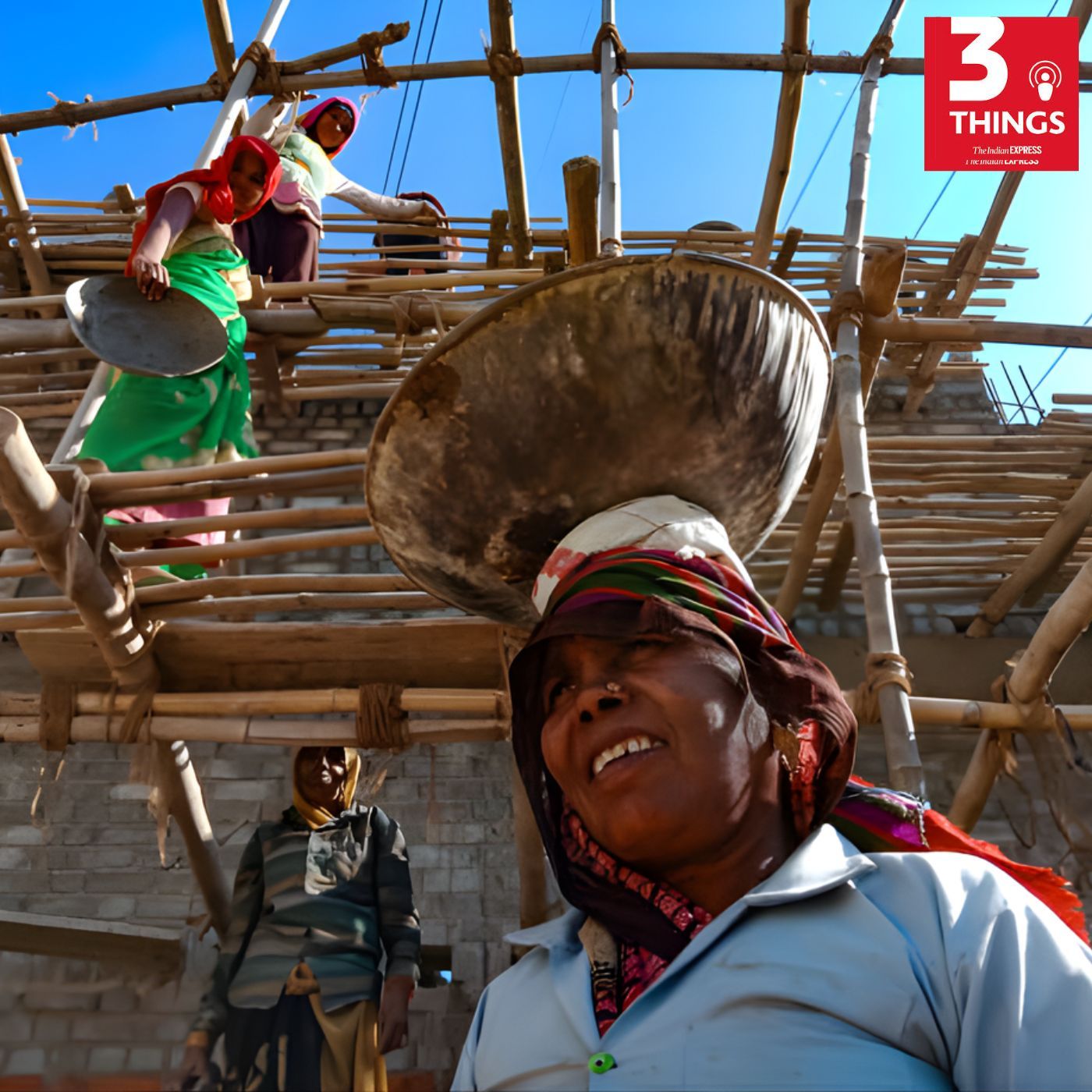
Repealing MGNREGA, curbing pollution, and Homebound shortlisted
Episode Transcript
In this episode, we talk about a new regulation by the Delhi government to curb air pollution.
We also talk about the Indian film home Bound making it to the shortlist for the Best International Feature Film category at the ninety eighth Academy Awards.
But we begin today by talking about the newly introduced Barret Guarantee for Roscar and Urgvka Mission Gramin Bill twenty twenty five, which proposes to repeal and replace the mg in Neega Act two thousand and five.
Hi I am Ahri Kananda and you are listening to three things the in an Express.
Speaker 2News show.
Speaker 1On Tuesday, in the Looksaha Union, Agriculture Minister Shivrat Saint Jahan introduced a bill titled the Bharat Guarantee for Rosgar and Our Gvka Mission Gramin Built twenty twenty five, more commonly being referred to as the vbg Ramji Bill, Mandy.
Speaker 3De Mohoda can We Via GUARANTEEF Road Guard and Ajas Gramian b B g Ramji viaj rajiod.
Speaker 1The bill proposes to repeal and replace the Mahatma Gandhi National Rural Employment Guarantee Act two thousand and five, under which the government is mandated to provide up to one hundred days of guaranteed employment in a year at a minimum wage to any rural household that seeks work.
Now, the first big change that stands out in this new bill, of course, is the name.
From having Mahatma Gandhi in its title, the new bill now includes ram in the middle, a move that opposition has been quick to criticize.
Speaker 4Let Amara.
Speaker 2Ra Ra.
Speaker 4Ram Ma.
Speaker 5Is or.
Speaker 1Now renaming schemes in Hindi and removing references to members of the Nehru Gandhi family is something we've seen several times under this government.
But beyond the title, it is important to note that the bill departs from m GENEGA in several crucial ways.
These include placing much higher financial burden on states, changing how funds are allocated, and introducing a pause in the scheme during peak agricultural seasons.
Critics of this bill point out that while MGENEGA is a rights based, demand driven scheme, the proposed laws shifts to a supply led and budget capped program that will end up hurting some of the most marginalized groups in the country.
To understand the possible implications of this new law.
Michael Leak Shashank Pargev speaks to the Indian expresses with Misha who writes on economy for the paper.
Speaker 5Would it just to set the context for this conversation, could you talk about just how important Mandrega has been for the poor in the country.
Speaker 6So, you know, ben Narrega came up as a law, it was not without any precedents.
India has had a long history where governments have at different times run food for work programs and they were typically done when there was distress in the economy in the or at least in sections of the economy.
You know, so say Rajasthan's going through a drought, then the government would run some kind of food for work programs And that's how Narrega sort of built up over time.
And the idea behind Naraga is not just as many people understand, is not just about a rural guarantee, jobs guarantee program.
That is how it is understood.
But having tracked this for a very long time, and one of my old professors, Jeanres, was the frame person who made this framework, the idea behind Naraga was there was a larger vision of how rural democracy has to work.
So the whole rights based approach was part of it, which wherein you said that, you know, the people have certain rights in this country and they need to assert those rights.
And so Narrega was going to be a vehicle for not just about getting jobs, but also for rejuvenating the panchayiti raj institutions, you know, because you would go and hold the local punchayath and this are punch responsible for getting the job, for ensuring that that job is of some good caliber which improves the economy or provides some kind of improvement in.
Speaker 4The rural economy.
Speaker 6So it was supposed to bring about a participative change in the country.
And you know, people forget that Marega came about at a time when India was just hitting the best phase of India's economic growth, which we saw the fastest growth we have ever seen between two thousand and four and two thousand and nine before the global financial crisis sort of derail everything.
The idea was also that even when we are growing fast, and especially when we are not growing fast, there are large sections of this country who do not benefit from the growth process, and there is a need for a safety net for those people, a requirement for the government to provide some ways to bring those along, those large masses along.
You cannot let a large section, an increasingly large section, just be out of the growth process because growth happens in a very iniquitous manner and that is the nature of growth.
Speaker 5So basically one understanding that there are a large number of people in the country that require that safety net, and also looking at it in a way that you know, these people do have the right to be employed even if they're unskilled.
Speaker 6Yes, and you have to understand that the idea is that it's not like we are giving people a right which is so unreasonable that they can just want a job every day.
There is a certain basic minimum set that okay, you'll get this much amount of jobs.
So one house for every household hundred days of labor.
Now there can be four people in the household, but only hundred days of labor is available.
Speaker 4That kind of a thing.
Speaker 6And in the twenty years now that Narrega has been there, you recall every crisis period in India's economy and every time the first go to measure was either providing direct food, free food through the Right to Food Act that was passed, or provide jobs and some kind of a rural jobs guarantee and through that push the money even demonetization.
You know, when we had the distress immediately after announcing demonetization, the machines were not working.
Cash had totally gone away, ATMs were not functioning.
The only way the government could actually tied over that tough period was through providing jobs and food.
Same happened with the COVID pandemic.
So you know, NARREGA has served a large purpose.
It has had a checkered history in terms of what it could have done, and that's a separate debate, but by itself, it had a role to play and it has served that purpose.
Speaker 5Okay, Now, like we mentioned, this new bill will replace MANREGA, and this is also our jobs guarantee scheme.
But it differs from MANDREGA in a number of different ways.
One is that its funding will be shared by the Center and the states.
The second is that the Center will decide the kind of budget that will be allotted to states.
And also the other thing is that now the number of guaranteed job days have gone up from one hundred to one hundred and twenty five.
Now, as someone who has reported and written about Mandrega for a number of years.
What immediately turns out to you about this bill.
Speaker 6So the most fundamental difference now is that as against a demand driven program that Narrega was, whereas which is to say that if more and more people asked for jobs, you had to provide jobs.
You had to get them to do something, and if you could not provide that, you had to provide some compensation.
Speaker 4That was the broad idea, and it was universal.
Speaker 6If I was living in a rural area and if I didn't have any job, then I could actually approach it.
Speaker 4It was universal.
Speaker 6It didn't say who could get that facility and who could everybody could get it.
Speaker 4So the idea was that only those who are distressed.
Speaker 6Enough will actually go for that kind of physical, hard libor and skilled labor.
Right.
Speaker 5So, for example, if ninety thousand people in a village in Bihar were demanding jobs under the Act, they will be offered jobs or will be paid compensation because the Act guarantees one hundred days of employment to each household.
Now in this new bill, it actually guarantees one hundred and twenty five days instead of one hundred, which on the face of it is a good thing.
But that's not actually what stands out to you about it.
Speaker 6Yeah, it does not, because I think these numbers are you know, now pointless at one level, because the nature of the promise.
The government is no longer looking at this as a demand driven program.
Now it is looking at is a supply driven program.
That the government will say this is the amount of money allocated.
I'm allocating for Utar Pradesh, this much for Chattisgar, this much for Bihar, based on whatever data they have or whatever calculation they make, and you will have to then run the program within that money.
If the state finds that there is more demand, then the state government will have to shell out more.
So at one level, this is less about people's demand.
This is now center minimizing its own expenditure and saying I will only go this far and rest is state government's problem.
It is less about a right of the people to demand a job and get that or a compensation, and it's more about the government saying, okay, this is how much I will pay for this program, and rest you the state governments will have to handle.
Speaker 4And so there's a fundamental difference.
You know, there's no point saying.
Speaker 6One twenty five days or one fifty days if you're not going to provide money for that.
And this is a problem that we've had in Narrega also where governments did not you know, central governments did not allocate enough money.
And over time, if a poor person is not getting paid, then they will stop going to that Narrega center demanding job because they don't have the qushon to just keep going every day there working and not getting paid.
If they are demanding a job and you don't have a job to give, then after fifteen days you're supposed to give compensation.
But if you do not do that, then they will stop asking for that job.
So this was a problem in Narrega also then it was not being run properly.
But now what was a flaw has been made a feature.
Speaker 5Right, So in that example we mentioned earlier, when ninety thousand people were demanding jobs, now under Manrega, hopefully there would have been a budget for that.
But now under this bill, let's say the center only approves the budget for forty thousand people, so those remaining fifty thousand people, their budget will have to come from the state government Bihar in this case.
Speaker 6Yes, and this is a very you know, as a journalist, we all look at where things will go in a specific policy.
I suspect that if it is going to be like this, then you are likely to find that with the kind of very fractious politics that we see, where we already have the central government repeatedly calling for a double engine kisser car, you know that you have the same government in the center in the state and that there will be benefits as a result of that.
It is not difficult to conceive that if the government in the center is unhappy with the state government, which is ruled by another party, and there is distress if money is not allocated, you are just turning the screws on that distress because either the state government will have to shell more if it doesn't, then there is more distress on the ground.
And you can always say that if only you had the right government, you could get more allocation.
So I mean, those kind of problems may arise in the future with this kind of system and with the kind of fractures politics that we've seen every election.
We see that that arguments, and I think a lot of people have said that, you know, because we are such a polarized country right now, a lot of people who do not agree with the Congress's view on narrega.
The argument is that, well, if our state government is so bothered, why don't they.
Speaker 4You know, pay more?
Speaker 6You know, And on the face of it, it looks very fine, but you have to understand that in terms of financial matters, in terms of taxation power, in terms of that kind of financial resources with the government, it's the center which is really powerful in this country.
Now we are very unitary in our in how the center control the finances in this country.
Speaker 4You know, this is not like the.
Speaker 6United States, where the states have very separate set of powers and they have complete sway over the resources.
Here the center has complete sway of the resources.
In fact, the GSD was the last bit, you know, where states had their own control, but now that has also been kept under GSD Council.
So there are very little resources that states really can say, okay, we have the resources to raise taxation or create revenue for us.
So this is a very salient point.
Whether a dominant entity in the Union is then asking the entities which are weaker in terms of financial resources to handle the burden for the poorest.
Speaker 4Sections of the society.
So that's the anomaly part in this.
Speaker 5Yeah, and just to mention that the fund sharing pattern between the Center and the state governments will be ninety to ten for the Northeastern states, Himalian states, and Union territories without legislature, and sixty to forty for all other states and Union territories.
But you know that the other major departure that this bill makes from NARREGA is that this employment guarantee scheme will be paused during the peak agricultural season.
Talk about some of the implications that come to your mind regarding this.
Speaker 6So this, I thought was a particularly stinging part of the new bill because you know, it seems like in an aquous suggestion, but understand what is happening the macroeconomic implication of this.
When you pause NARREGA for sixty days, then over those sixty days, the floor for wages for agricultural labor will just fall.
Because while one of the reasons why NARREGA was so effective in ensuring that the poor do not get distressed and they don't have to resort to distress migration or running away to some other job, is that it would provide a basic minimum wage rate.
If suppose a person can get one hundred and fifty rupees for argument's sake, doing something on a narrega work site during the agriculture season.
Landed farmer or landlord cannot employ that narrega worker for anything less.
Speaker 4Than one fifty rupees.
Speaker 6But by pausing this program, you are basically taking away the security that the poorest had, the landless laborers had.
And now that rich farmer can actually employ that landless laborer for any amount like could be thirty five rupees, could be fifty rupees, could bee hundred rupees.
Anything less than one fifty will go because that person, that landless laborer, has no other avenue apart from saying that okay.
That person then goes to the city, you know, migrates and finds something else that because you know, in fifty rupees, he will not be able to survive.
Speaker 4So this is a stinging bit.
Speaker 5And can you talk about what implication this would have on a macro level, How exactly will it change things?
Speaker 4So it will have widespread macroeconomic implications.
Speaker 6One in agriculture costs will come down, so agriculture prices hopefully will come down.
You and I will see perhaps lower food inflation.
Right if those landless laborers rush to the cities.
They might be willing to work for, you know, the city owners, the manufacturing guys, the rich businessmen.
They will also know that there is no one to fifty rupiece they can go back to, so they can also employ them at seventy five maybe instead of thirty five the landed gentry was doing in the villages.
And that would mean that labor would be available at a cheaper price during that period.
Speaker 4And again it will have a positive impact on inflation.
Inflation would be lower.
Speaker 6All of us would get the benefits out of lower inflation, but it would all come at the cost of the welfare of the weakest sections of India who do not have any skill set, who have no wherewithal to deal with the adversity and smack at the time when they needed the floor for their wages, that support has been taken away or will be taken away when this becomes an act.
Speaker 5And how would you say this bill aligns with how this government under PMOD has viewed Mandreega in the past, and how does it align with their overall economic vision.
Speaker 6So I think this is a very important thing to understand that mister Mody never actually believed in the vision of Naraga or the thought process behind it.
And he has said this as soon as he became the Prime Minister, that I will keep the scheme running as a monument of Congress's failed economic policies.
And to be sure, Narrega's idea was that if the economy is doing well, then the demand in Narrega would fall right and if the economy is not doing well, then only the Naraga demand will go up.
So it is true that if Narrega continues and there's demand for work, that basically is an argument proof that the economy is not doing that well.
Otherwise why are these people asking for a job at a bare minimum wages.
So at one level, what mister Mody is doing, his promise of minimum government, maximum governance, roll back of the state, all of this actually fits in.
And it's a very honest thing that he has done, and that should be you know, recognized that it has actually taken eleven years, but you know, at long last he has actually repeat or wants to repeal, what he doesn't actually believe in.
Speaker 4And today a lot of people might deny that, you know, this repeal is.
Speaker 6A bad idea, but the government is absolutely justified it wins elections on a certain agenda.
And this was one of the very clear things that this is a politics of dole.
This policy is not of any use.
It's holding back India's growth.
We have cheap labor, surplus, cheap labor, why don't we use that.
You know a lot of industrialists have over time openly and quietly demanded that NARAGA is holding back you know, it increases costs for them.
It's holding back everything, it's holding back entrepreneurship.
There is not enough, in a manner of speaking, enough distress for labor to sort of go ahead with the industrial development that we wanted.
So with labor laws changing, with Narrega being repealed, it then we move ahead finally to that other vision of a policy, vision of what mister Mody wanted or what BJP wanted.
So we have you know, for a while there has been this confusion and at one level rather duplicit us that you run a policy which was done by previous government although you don't believe in it.
Speaker 4So it is a good thing that they have actually taken that decision.
Speaker 6As reporters, as journalists, it's always curious to see where this next phace will take us.
But per se, there is nothing illegal or incorrect in a democratic government taking that decision.
Speaker 4It has a different vision, so it should implement that.
Speaker 1And next we shift our focus to Delhi government's attempts to curb air pollution.
On Monday, during the last leg of his India tour, global football superstar Lionel Messi was in Delhi at the arun Jaitley Stadium, where thousands of fans had gathered to catch a glimpse of the Argentine legend during the event, When Deli Chief Minister Rikha Gupta arrived on the stage to join Messi, the crowd began chanting AQI repeatedly.
Now the chance continued for as long as Gupka was at the stadium, and she was even boored on her way out.
This came on a day when Delhi's air quality index remained in the severe category for the third consecutive day, and the crowd's reaction reflected a growing public frustration over air pollution and the demand for stronger governm action to address the problem.
Now, in an effort to tackle the problem, the Delhi government has taken a decision to bar nonbs six private vehicles registered outside the capital from entering the city.
Considering that vehicular emissions are one of the biggest and most stubborn contributors to air pollution in the region, the BS six or Barrett State's six emission standard has been mandatory for all new vehicle sales and registrations since first April twenty twenty, meaning vehicles registered before this date would be affected by the band, but vehicles like CNG, LNG and electric will be exempted.
To learn more about this new regulation and how it is going to impact the city's air quality, we are joined by The Indian Express's Sophia Matthew.
Sofia, can you begin by telling us about the current state of pollution in Delhi?
Speaker 4How bad is it?
Speaker 2Hiker?
Speaker 7So, the pollution levels are very bad to an extent that the Center has imposed the highest set of anti pollution measures, which is the Stage four of the Greater Response Action Plan in the city in Deli and CR And this is because the air quality since December thirteen, that is at least for the last five days has been extremely bad and the air quality levels have ranged as has like crossing four twenty seven and reaching four sixty one.
So this is like a severe plus category for the Capital.
And you know, these are levels which are extremely hazardous for people even without any ailments or any medical history.
And the CPCB, the Central Pollution Control Board, has identified these levels to be very hazardous for human health.
And even we have found that AQI stations have maxed out at five hundred at these levels.
So these are extremely hazardous levels and this is the highest we have seen so far this season.
Speaker 1And tell us about the new regulation regarding the non bsix vehicles and what is the reason behind banning them particularly.
Speaker 7So non BS six vehicles are highly polluting and this is because we have several studies in the Capital that have shown the vehiclear pollution to be the top contributor in terms of PM two point five.
And also we know that vehicles so when it comes to you know, all these barret stage engine standards, so vehicles which are NONBS six are essentially old vehicles.
Speaker 2In all over India.
Speaker 7Across India, BS six was introduced in twenty seventeen and which is cleaner compared to all the previous BS four, BS three or all the prebsix vehicles.
And this is because it it emits very low pollutants compared to the previous PREBSIX standards, and especially when it comes to talking about the pollutants, we know that vehicle emissions cause nitrogen oxide, sulfur, dioxides, and voss which are volatile organic compounds, all of these to be released in the atmosphere.
Now what happens is these highly toxic pollutants react in the atmosphere at a secondary level and these lead to the formation of secondary pollutants, which is a very important part of the smog and everything that we observe in the winter pollution season.
So these are some of the highly toxic pollutants that is caused due to vehicles alone.
Speaker 1And Sophia, you write that vehicular emissions are one of the biggest contributing factors to pollution.
Speaker 5So why is that so?
Speaker 2Delhi has a very high level of you know, ownership.
Speaker 7Essentially, that means the number of registered vehicles private vehicles per person is very high compared to other cities combined like Maharashtra's Mumbai and bangalover all of these combined, it still stands to be the highest.
And also we know that the number of polluting vehicles which is BS three or older vehicles is very high.
At least thirty seven percentage of the entire vehicles in NCR belongs to BS three or below standards.
Then we know that these vehicles, especially these PREBS three vehicles, are highly contributing to the pollution levels.
And this is because these emit you know, thirty one times at least more particular matter and at least a dozen times more nitrogen oxides.
Even carbon monoxide is at least five times more.
So these vehicles are very, very polluting compared to the latest emission standards, which is comparatively cleaner the base six months.
And secondly, there's a lot of enforcement that's still required for all of these old vehicles or end of life vehicles to be you know, actually phased out.
Then thirdly, the public infrastructure public transportation is not aducate to actually give an incentive to people to you know, give away or scrap their old private vehicle.
Speaker 1Right and Sophia, given the current severe situation, what are some of the solutions that were suggested by the experts that we spoke to and what do they make.
Speaker 5Of this man?
Speaker 7So, one of the experts, Sunilda here, who is a lead environmental analyst and founder of a think tank called enviro Catalyst.
He had said that there is a need to look into this scrappage policy as well.
So ideally when we introduce these engine measures like not allowing PREBS six or non B six compliant vehicles to enter Delhi and all of that, so he said, along with this scrappage policy needs to be strengthened.
If there's no proper utilization of this scrappage policy and there's no proper strengthening of the public transportation system, both of them happening parently, then he said, these restrictions are then not useful at all.
Secondly, a senior associate professor at Delhi Technological University, Raji Meshra, he's done several studies on vehiclear pollution.
In a recent study which he led, he found that milege is also an important concern.
So our existing policies actually are focused on the age of the vehicle.
So it's not just the age you were saying.
There could be vehicles which are like, for example, buses that are recently bought which are V six, But these buses have traveled extensively, perhaps they are running round for twelve hours a day.
Speaker 2Or something like that, like the use or the mile age.
Speaker 7Of the vehicle is very high, then the where and tear and the emissions of the vehicle would also be very high.
And there was also one unique suggestion that was given by Bharti of Chinten Environmental Group.
She was saying that there has to be a complete restrictions on social gatherings or big events because these events cause a lot of traffic congestions.
Speaker 2So these need to be avoided, especially during a pollution seasons.
Speaker 7So ideally it doesn't mean that we're going into a lockdown situation, but certainly our policies and our actions should include elements of lockdown because we have reached at that level, is what you were saying.
Speaker 1Also, what are some of the other measures that are being taken by the government to cur pollution?
Speaker 2So the government has claimed that it's taking several steps.
Speaker 7The Delhi environment ministers in a press conference said on Tuesday that they're going to introduce a lot more number of electric buses and secondly they have increased the rate of waste processing at the landfill sites.
Thirdly, they also said there's a focus on enhancing the green cover in the city and they're trying to introduce dense forests as well with the help by undergoing plantations, undertaking plantations and all.
Then there are also the Dele government has recently identified around sixty two traffic congestion points, so these are areas where more oversight is required.
And he's also said that these pollution hotspots are being trapped and more extensively now by officers and they're trying to ensure that there's no violations of you know it construction sites and all the measures taken under GRAP are also strictly being followed.
Apart from these, the tundor has also been banned and because these cost pollution, So then they have said that they have intensified the use of anti smrgan's mechanical road sweepers and all of that for dust suppression.
Speaker 1And finally we talk about the film home Bound, directed by nider J.
Gewan an executive produced by Oscar winner Martin Scorsese, which has now been shortlisted for the Best International Feature Film category at the ninety eighth Academy Awards.
The film, with stars Shan Kutter and Vishal Jeitwa, was announced as one of the fifteen films on the shortlist yesterday, after competing with eighty six official entries from around the world.
Homebound is inspired by a true incident and follows childhood friends Shoe Ben Chundan, a Muslim, and Adele at my Grint, worker from an Uttar, Pradesh village.
The film draws from Basha Field's twenty twenty New York Times article on migrant workers during the COVID nineteen lockdown.
Now making it to the shortlist is considered a major achievement, especially in the Best International Feature category.
Unlike other OSCAR categories, where only members from the specific branches vote, Academy members voting in this category are required to watch all shortlisted films before opting in.
This makes the competition both intense and wide ranging, with each film representing its country's official submission.
It is also worth noting that the shortlist is not the final stage.
From here, the Academy members will vote again to narrow the field further, and only a small number of these films will eventually make it to the final list of nominees announced later.
So far, only three Indian films have received the final nomination Mother India In nineteen fifty seven, Salam Bombay in nineteen eighty eight and Lagan in two thousand and one to the Milestone.
Producer Current Joher shared his excitement on social media, calling the film's journey deeply overwhelming.
Gavon also thanked the audience worldwide for their support.
Here's him talking about the process of making it.
Speaker 8The writing took longer than shooting or creating any of it because a I was writing myself for the first time, and also you're writing something such a big task of actually adapting a story that has been written by bashadape no less.
And I mean from what I took from that story was that, Okay, there is a germ of an idea and there's a great story there, but the whole world had to be created around it.
And I thought one of the ways that I would go about was that.
And I thought, you know, world over, we see that marginalized identities are always spoken in numbers, especially in urban and where we speak of them in numbers because it makes it easier to talk about it.
There is this slight contescend engage towards it because we feel that these many number of migrants of walk, this many number of planets have been gone through atrocity, so it takes away the accountability of it, you know.
So I feel that what if we humanize these people and we pick up two people from these statistics, deep dive into their world, go to their homes, see what they eat, see what they feel, see what they aspire for, See how their dreams get chattered, how do they build their life back on and what makes them leave their homes and travel all the way to their cities.
Speaker 1You were listening to Three Things by the Nail Express.
Today's show was edited and mixed by Siriesh Bavar and produced by Shashank Pargev and Nina Hrikanand if you like the show, then do subscribe to us wherever you get your podcasts.
You can also recommend the show to someone you think will like it, share it with a friend or someone in a family.
It's the best way for people to get to know about us.
You can also tweet us at Express Audio and write to us at podcasts at Indian Express dot com.