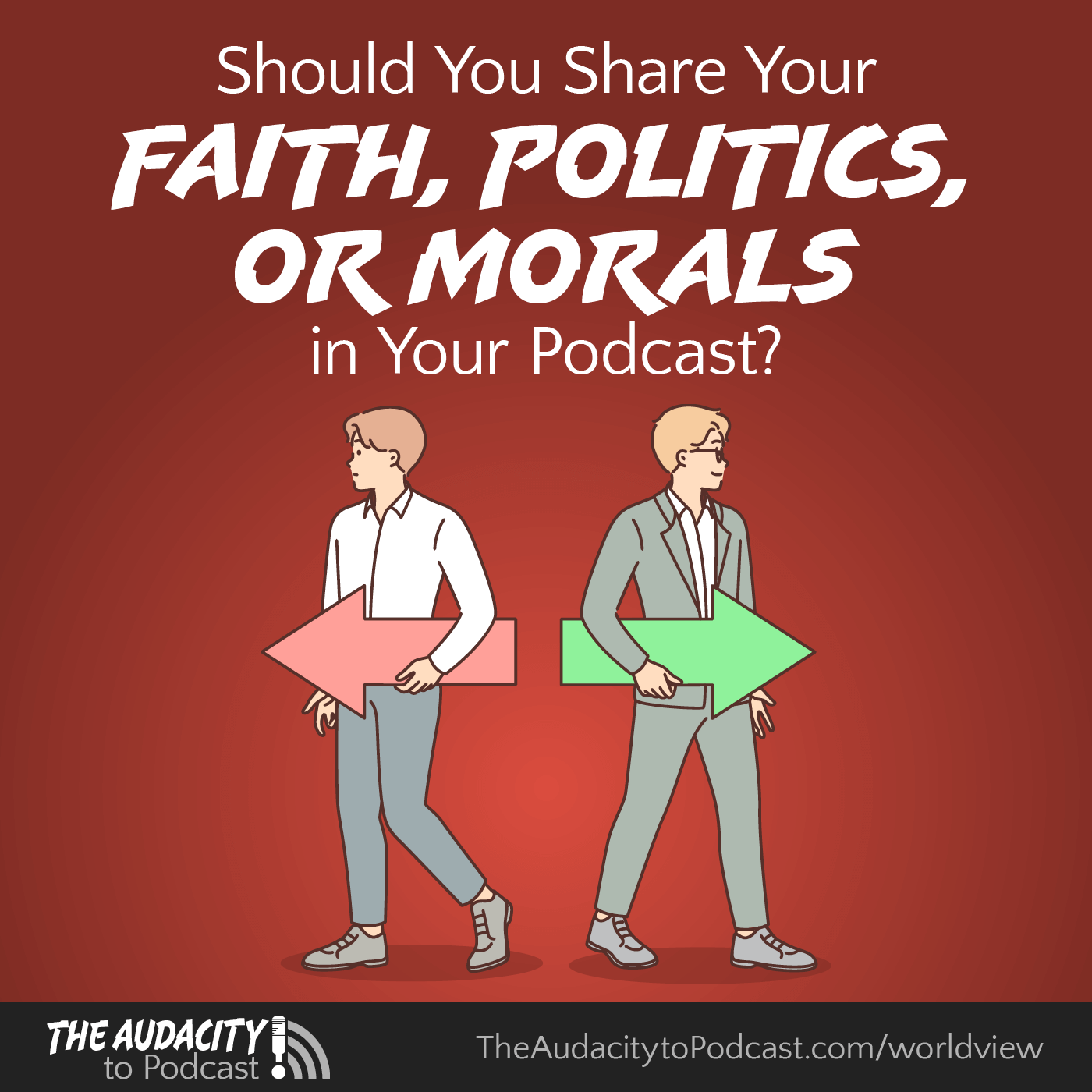
Should You Share Your Faith, Politics, or Morals in Your Podcast?
Episode Transcript
Should you share your faith, politics, or morals in your podcast?
Thank you for joining me for The Audacity to Podcast.
I'm Daniel J.
Lewis.
You may have heard that certain topics are taboo to share in your podcast, but are they really?
Or is it okay to share your controversial perspectives?
I'm not going to tell you what you should do on this issue.
Instead, I'll give you several things to consider so that you can make the decision you believe is right for your podcast and your audience.
If you'd like to follow along in the notes for this episode, they are a simple tap or swipe away.
Check out the chapters made by podchapters.com, or go to the audacitytopodcast.com/worldview.
And why that word world view?
Well, because number 1, faith, politics, and morals are parts of your world view.
A world view is simply how you view the world.
So world view, how you view the world, And that's based on your belief system.
Thus, your faith, your politics, your morals influence how you view the world, how you interpret facts, and what you prefer.
Because of this, no person is truly neutral.
Even if they might attempt to make their content neutral, they themselves are not neutral.
Number 2, everyone leaks their worldview.
What you believe and how it affects your view of the world will come out in various ways over time.
Although you might not overtly share your faith, your politics, or your morals, it's usually easy to figure it out from the content you share or don't share, the labels you use, and the things that you prioritize in your podcast.
I can think of several podcasts that claim to be neutral and apolitical, but it's quite obvious they and their hosts are on particular sides even if they're not talking directly about faith, politics, or morals.
Just look at The Audacity to Podcast, for example.
You probably know I'm a Christian and a conservative because of how much my own worldview leaks into my content.
I'm not preaching or forcing anything on you, except maybe the definition of a podcast, but I do leak my worldview just like you and other podcasters do too.
Number 3, is it relevant to your podcast?
If your worldview already leaks into your podcast, should you lean fully into it and overtly present your worldview through your content?
You probably know the answer on this 1.
It depends.
I think relevance is what matters most in this case.
If your podcast is about faith, politics, morality, and such, then you are already sharing your own positions.
You're already stepping into this.
But if your podcast isn't about such things and your audience isn't already expecting you to share those things in your podcast, then you might want to share them and address them rarely, if ever.
But again, that's up to you.
And consider The Audacity to Podcast as an example again.
I've never marketed this show as a podcast about podcasting only for Christians or conservatives.
When my faith, my politics, and my morals are more obvious in my podcast, it's coming through something that I believe is actually relevant to the podcasting topic I'm sharing.
For example, I've quoted from the Bible multiple times throughout the years of The Audacity to Podcast because those particular scripture passages said something relevant to the topics in those episodes.
I'll be doing it again later in this episode.
I know you don't come to my podcast for Christian preaching, just like I don't go to my pastor for podcasting advice.
But if your podcast is either about those things or you want to reach that specific audience or you want to approach things from a particular religious, political, or moral perspective, then fully embrace it and make it obvious that's your goal.
Like, if The Audacity to Podcast was a podcast about podcasting only for cake bakers, And everything I did was talking about how cake bakers can podcast and how do you podcast as a cake baker.
And this is what you can do in your bakery while you're recording your podcast.
If that silly approach was the actual approach of The Audacity to Podcast, then that should be in my description.
It should be obvious from my episode titles.
It could maybe be part of the title of my podcast, and it should also be in the podcast cover art and the visual branding of the podcast so that it is very clear.
This is who this podcast is for.
This is what this podcast is about.
Yes.
That means it will turn away some people, but it will turn away people who wouldn't be the audience for it.
But The Audacity to Podcast is not only for cake bakers.
It's for anyone who wants to start a podcast, even for non Christians and liberals.
Because I don't talk about specific political, moral, and religious things in the podcast as main topics.
Yes.
They do come out here and there.
They do leak, but that's not what this podcast is about.
So I'm not going to spend a whole episode talking about a scripture verse or preaching to you because that's not relevant to this podcast.
It's been relevant to other podcasts I've done in the past.
Like, the second podcast I ever hosted was called are you just watching?
Now it's continuing on with my cohost.
I passed it off her, and she's done a great job with it, e Franklin, over at areyoujustwatching.com.
That podcast is a movie review podcast.
And you might be thinking, movie review podcast?
Mind equals blown.
I've never thought of that.
I've never heard of that before.
Obviously, I jest.
But our approach was not just to review movies, not even just to review movies from a Christian perspective.
Our approach was to teach critical thinking skills for Christians by using movies and TV shows to help teach those critical thinking skills and to help practice those critical thinking skills.
So it was a very different approach to reviewing movies and media, and we made that obvious in the branding, in the marketing, in the messaging, in the titles, and more for that podcast because it was a particular perspective for a particular specific audience, and that was great for it.
And there are other podcasts, all kinds of topics taking different approaches.
And when they fully embrace it and make it obvious that that is their goal for the types of people they want to reach or the approach they want to take or the positions they want further, that is good when they make it clear so that they can set those expectations for their audience through their description.
And so their audience knows this is what I can expect from this podcast.
This is what I'm going to get from this podcast, and they do get that from the podcast.
That's good.
Do that if you want your podcast to be known for those particular things.
Number 4, you will alienate some of your audience.
I keep grouping faith, politics, and morals together because they can be the most divisive issues since these things are very black and white by their nature.
So when you share your faith, politics, or morals in your podcast overtly or even just leaking them in your podcast, it will likely alienate and possibly even upset some of your audience because truth divides.
And like I've heard teacher Mike Riddle say, when you reject the truth, you must accept any lie in its place, and so the truth is divisive.
Imagine the world was divided by people who please bear with me on this silly example, but divided by people who like cake and people who like pie.
Most of the pie people will probably be fine to hear the cake people talk about any other subject.
But once the cake people start talking about cake, the pie people might get upset and vice versa.
And sometimes you even see this where the pie people might love the cake people, and they're friends.
They've encouraged each other.
They motivate each other.
They love each other.
All of this great stuff.
They've got all of this past history and relationship.
But as soon as those cake people dare to mention cake, then everything in the past completely destroyed, ripped apart, not worth it anymore, and they're cast away.
I hope you understand.
I'm using a ridiculous example to also kind of illustrate how ridiculous that can be that sometimes it's just 1 little thing.
It might not be little to some people, but it's 1 little thing in the big scope of life that sometimes destroys relationships and opportunities simply because of a difference in perspective when all of these other ways that people can connect are still there.
But just because you dared to talk about cake, you cake person, therefore, my pie personality cannot be around you, you cake personality.
No.
It's ridiculous.
And from my research and observation, it seems it's usually 1 side that gets more angry about and intolerant of the other side.
So keep that in mind if you're on the side that gets targeted more.
I'm not saying that should stop you, only that it's something to keep in mind as everything else in this episode, stuff to keep in mind so that you can make the decision that's right for you and your podcast.
Number 5, you might be the voice your audience needs to hear.
Even though some of your audience might get upset when you share a particular worldview, it might be exactly what other people need to hear.
Many people feel underrepresented in various forms of media, and survey data reflects that reality that the media landscape does not proportionately represent the audience consuming that same media.
To use our silly cake versus pie illustration again, the population might be evenly split between cake people and pie people.
But legacy and new media might be mostly on the cake side by a large margin.
So when a pie person speaks out boldly and without apology, it gives the pie people their needed representation that they don't have very much of.
If you feel it necessary to take a controversial stand, do so boldly and make it obvious that such is what you stand for and whom you want your podcast to serve.
This was my big issue with a particular group I once supported.
They claimed to represent everyone, but when it was pointed out that they were marginalizing and underrepresenting a massive group, they didn't care and maybe still don't.
Despite their, I would say, false claims of representing everyone, they don't.
And they don't want to represent the others that are outside of their particular group.
And I would just rather they make it obvious of who they do want to represent and who they don't want to represent.
Number 6, standing for what's right will have a cost.
When you stand for what's right, people will attack you.
They will slander you, threaten you, abuse you, give your podcast negative and false reviews, and more, and maybe even worse.
That really stinks.
I know because I've been through it too, multiple times actually, and it stinks.
So you have to consider whether your podcast is the right context or now is the right time for you to take a particular stand.
And if you go through with it, be prepared for what follows.
You might even decide that because of how transparent you've been about your private life and whereabouts in the past, you might not want to risk the safety of yourself or the people you care about to say something in your podcast now because people might know where you live or maybe that's really easy to figure out or they know where you work or anything like that or they know where your kids are or scary things like that.
So you have to think about some of that safety for yourself and especially for the people you care about and the potential risks if you take a stand.
It doesn't mean you shouldn't take a stand, but do remember that taking a stand for what's right does have a cost.
I have a lot of beliefs people will call controversial, and I keep emphasizing that word controversial with air quotes on it because I'll get more into that word and some others in a moment.
But I decided years ago that there would be 2 main things I would never compromise and would speak openly about without fear of the costs because I believe those things are right.
Those are my hills I'm willing to die on, And 1 of them did truly almost kill me, but it was still worth it to take that stand.
Number 7, don't let labels control you.
When you share your faith, your politics, or your morals, the haters will likely label you.
You might be called racist, Nazi, hateful, supremacist, controversial, extremist, whatever phobic, abusive, and more.
But it really seems like people don't even know what such labels mean anymore.
It's like that line from The Princess Bride.
Speaker 1You keep using that word.
I don't think it means what you think it means.
Speaker 0Indeed, many of the words that people use don't actually mean what they think they mean or how they're using them.
Those labels could even mean completely different things to different people.
Just look at how the word podcast now means different things to different people, and listen to episode 400 to learn more about what a podcast is anymore.
I talked about that in-depth in that episode.
Even just the word controversial seems to be slapped on people only when their opinions differ from someone else's.
It's like cake people telling pie people they're being controversial when they talk about pie, but that cake people never see themselves as controversial when they talk about cake.
It's like anything I disagree with is controversial, but not anything that I hold.
No.
It's controversial if there are controversies around it, and that can mean both sides.
But that doesn't mean it's a taboo thing to talk about.
It's just something you have to be careful with, understanding that there is controversy around that idea.
So you have to keep these things in mind.
And no matter how vile the label is that someone tries to slap on you, do not let it control you.
You can simply say no and move on.
You don't have to dignify false accusations with rebuttals.
You can simply reject them and then ignore the trolls.
And number 8, remember kindness.
Before you decide to go getting militantly religious, political, or moral in your podcast, please remember kindness.
A few years ago, I felt face smacked by a passage in scripture that challenged me then and continues to challenge me today.
And despite how many times I fail, I keep exercising myself to come back to what I should do instead of what I feel like doing.
That passage is second Timothy 2 22 through 26, and this is from the ESV translations.
It says, so flee youthful passions and pursue righteousness, faith, love, and peace along with those who call on the Lord from a pure heart have nothing to do with foolish, ignorant controversies.
You know that they breed quarrels, and the Lord's servant must not be quarrelsome, but kind to everyone, able to teach, patiently enduring evil, correcting his opponents with gentleness.
God may perhaps grant them repentance leading to a knowledge of the truth, and they may come to their senses and escape from the snare of the devil after being captured by him to do his will.
That's from second Timothy 2 22 through 26.
The adjectives to avoid are challenging enough from that passage.
Things like foolish, ignorant, quarrelsome.
It doesn't say avoid controversies, but it did say avoid foolish, ignorant controversies and not to be quarrelsome.
But there is also the admonishing 2 correct opponents, not with rage, but with gentleness.
Yes.
It is kind to speak the truth, and you must remember to do it with gentleness, whether that's in your podcast or in person or online, especially if you're in an anonymous environment, still do it with gentleness.
It's like if your doctor tells you that you have a horrible disease and you must change your lifestyle because the things you're doing will kill you.
He's not being a hater or anything phobic or controversial.
Instead, he is being kind to share the truth and point to you in the right direction.
And that's what I hope you do with your own podcast.
If you believe you must share something controversial, you might not normally share, be kind and point your audience in the right direction.
Special thanks to Claire Waite Brown who sent 500 Satoshis on my previous episode about podcast chapters.
Go back and listen to it.
It's turning out to be a quite a popular episode.
And she said, I'm a big fan of chapters and chapter art.
When I interview indie podcasters on the creators from True Fans podcast, I recommend podcasting 2 features that could be good for their particular show and chapters with pics and links is 1 I very often suggest.
It's frustrating that some apps choose to not support 2 chapters, but great that PodChapters can make the chapters in all formats.
Thanks for linking to Podcasting 2 in practice in the show notes.
And that is her show, Podcasting 2 in practice.
I got to be a guest on there.
And in last week's episode, I linked to the episode I did with her where we talked about chapters in podcasting 2, both what they are and what they could be in the future.
And that was long before PodChapters was actually a thing.
And her mentioning of PodChapters there, I did not pay her to mention that.
She's not being compensated by mentioning that.
In fact, she is the 1 paying me to praise PodChapters in a message.
So I really appreciate that.
And if you want to chapter your podcast the fastest, smartest, and easiest way, then use PodChapters over at podchapters.com.
And if you found The Audacity to Podcast helpful and valuable to you as a podcaster and inspirational to you, maybe I've motivated you, maybe I've equipped you in some way or inspired you, would you consider what that's worth to you and see if you're able to give some value back?
You can do that really easily through a modern podcasting 2 app or go to the audacitytopodcast.com/giveback.
Now that I've given you some of the guts and taught you some of the tools, it's time for you to go start and grow your own podcast for passion and profit.
I'm Daniel J.
Lewis from theaudacitytopodcast.com.
Thanks for listening.