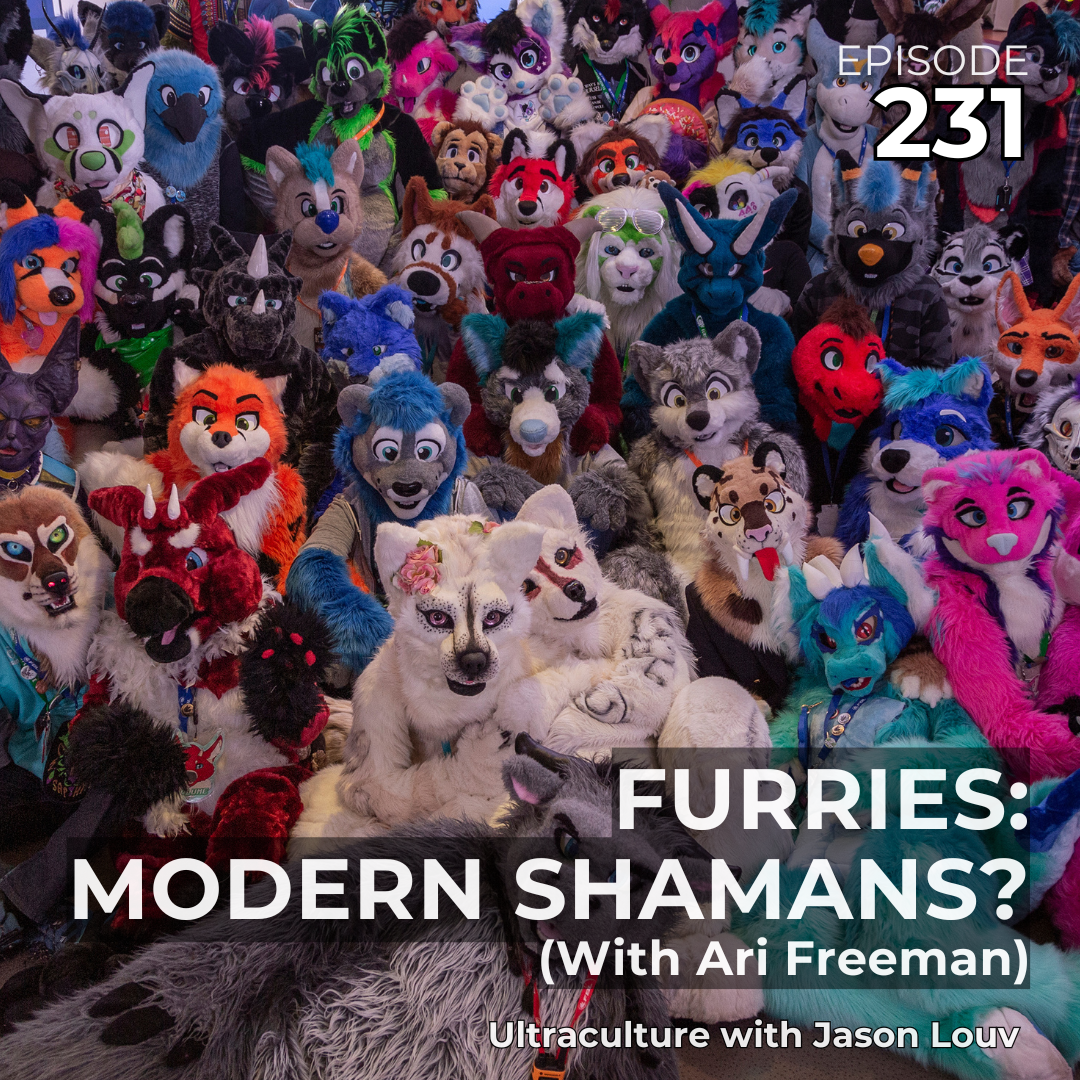
"FURRIES ARE SHAMANS!" Ari Freeman On the Horrors of Furry & Brony Sorcery
Episode Transcript
Jason: I feel the controversy just trying to butt its way in a way it doesn't normally would podcast.
Jason: What is the esoteric significance of furries?
AriAri: Our furries, the Aghori of the West.
JasonJason: Yeah, there we go.
That's a scary furry.
AriAri: Jason, you may not know that there is, since the beginning of the internet, Ari: been an entire furry religion going on.
JasonJason: So, well, here's another question.
Are furries also modern shamans?
AriAri: This is the official first,
JasonJason: The very first video podcast of the Ultraculture podcast.
Jason: I've uploaded Zoom calls in the past, but that's not the same.
Jason: So you and I are appearing side by side with like an animated city background going behind us.
AriAri: Oh, okay, cool.
JasonJason: It looks like a real new show.
You can't see it on your end.
Jason: But why don't you go ahead and introduce yourself?
You've been on the show before.
Jason: But tell us about how life has been in wizarding.
AriAri: Okay, well, thanks very much, Jason.
And thanks, Heats, for having me on again.
Ari: I've been a longtime fan of your stuff.
And I think we have a similar mission as educators.
Yeah.
Ari: And people who explore weird phenomena to bring back stories that hopefully Ari: people can use.
What have I been doing?
JasonJason: That's a good way to put it.
I like that.
That sounds so normal when you put it like that.
AriAri: Well one one of my this is going to piss off some of your students already but Ari: one of my missions jason is to de-spook the occult oh well
JasonJason: I'm fine with that.
AriAri: Yeah i know you are yeah and and i will get into that in a second with with Ari: the whole theme of this discussion Ari: what have i been doing well this year i'm releasing a whole bunch of stuff Tell us about Ari
JasonJason: Freeman and who you are.
AriAri: Ari Freeman, I am a public wizard in New Zealand.
Ari: I spent seven years as the apprentice to the official wizard of New Zealand.
I'm now independent.
Ari: He's sort of taken to Facebook with angry old man rants, but that's okay.
Ari: I am a musician, and I perform public shows and magical performances as a funk wizard.
Ari: Dressed in a Saki Dugla outfit and of headline festivals doing that.
And I'm a writer.
Ari: I have one book already out called Pragmatic Magical Thinking that is magical Ari: theory in the tradition of people like Ramsey Jukes, Ari: who's the other guy in my world who's doing magical theory.
JasonJason: Wait, does he live in New Zealand now?
I thought he was in South Africa.
AriAri: No, Ramsey Jukes lives in South Africa, but I've interacted with him a little Ari: bit online.
Oh, good.
He's a great guy.
I hope he's doing well.
Ari: Yeah, he seems to be okay.
He's, yeah.
Ari: And I've got a magical-themed album on which I played all the instruments recorded Ari: by myself, and I built quite a few of those instruments myself, including this guitar
JasonJason: And a bunch.
AriAri: Of other guitars.
So if you like, we could end this with a guitar solo.
JasonJason: Well, then you'll be the first musical guest also of the Old Culture Podcast, Jason: so you'll be making multiple records here.
AriAri: Awesome, awesome.
And then I have two more books coming out this year.
Ari: The first one, my magical themed album is called You Can See Everything If You Look From Nowhere.
JasonJason: Okay.
AriAri: Yeah, and it's coming out at the end of this month on March the 30th, my time.
Ari: I live in the future, so in a future time zone.
Ari: So it may come out on the 29th for you guys.
Okay.
Ari: Watch for that.
I have a book called Tarot for Skeptics coming out with Aeon Books this year.
Ari: It's got a full course on the Marseille, the Rider-Waite-Smith, Ari: and the Thoth decks, all taught in parallel.
JasonJason: That's amazing.
AriAri: If you read about the first 40-50 pages of this book, you'll already be reading Ari: tarot and getting results, even if you're a skeptic.
Ari: Cool.
and it answers questions like what's really going on with psychics and Ari: things like that what's really
JasonJason: Going on with.
AriAri: Psychics yeah oh you want to know yes Ari: so i'm what i call a magical pragmatist pragmatism is the philosophy started Ari: by william james who's probably your most important philosopher pragmatism is Ari: also used by science the philosophy of science.
Ari: And it's the idea that you should ground truth claims in what you can actually do in the world.
Ari: So if something produces results, something about it must be true.
JasonJason: I'd say Plato is our most important philosopher, by the way, Jason: in the Western esoteric tradition, but Henry James made a good contribution.
AriAri: William James.
JasonJason: Henry James also made a good fictional contribution.
AriAri: Henry James was his brother, but I meant William James's pot.
JasonJason: Yeah, variety is a spiritual experience.
AriAri: That's right.
JasonJason: Yeah.
AriAri: And my point was he's probably the most important American philosopher.
JasonJason: More than, that's also a controversial claim if you put him above Emerson and Thoreau.
AriAri: Hmm.
I think I would, but I am there.
JasonJason: Shots fired.
I'm not sure we go so far, but interesting.
Okay.
AriAri: Yeah, so you mentioned the Varieties of Religious Experience, Ari: which even got name-dropped by Crowley.
Ari: It was part of the AA reading list.
JasonJason: That's right.
Interesting.
AriAri: Yeah, yeah.
JasonJason: I just ordered a copy, actually, for that reason.
AriAri: Oh, it's great.
It's really good.
So the idea is, Ari: I'll try and put it simply, when you look at someone who's religious, Ari: the question shouldn't be whether you Ari: can prove you know god is real or whether they're really talking to angels because Ari: these are always grounded in subjective experiences probably a better question Ari: is can they can they with their belief system get something done that you can't Ari: without that belief system interesting
JasonJason: And what was what was his conclusion.
AriAri: Yeah he he He brought up as many examples as he possibly could on what prayer Ari: does and religious experience and Ari: transcendental experiences and the Holy Spirit and all of these things.
Ari: Now, what I'm doing is defending magic on the same principles.
Ari: Chaos magic already allows you to adopt a belief system for a duration of an experiment.
Ari: But I argue that sane people believe different things on different days and Ari: different things on different parts of days, Ari: and that the real problem that causes people real cognitive dissonance is when Ari: they try and have one belief system, and you can't get through life with only one belief system, Ari: or if they try and reconcile belief systems that won't work together, Ari: but only because they can't compartmentalize them.
Ari: So someone who is a really good scientist but goes to a Catholic church and Ari: prays to the Holy Spirit on Sunday can probably do that because it's contained Ari: within the Sunday service and it doesn't invade his life during the week.
Excellent.
JasonJason: And so, for instance, somebody could also be a furry on the weekends and compartmentalize Jason: that from the rest of their identities.
It could be anyone.
AriAri: And we'll definitely get into that, yeah.
JasonJason: Well, let's just go straight to it.
Now that I'm in like the Piers Morgan type Jason: format, I feel the controversy just trying to butt its way in in a way it doesn't Jason: doesn't normally would podcast.
Jason: So let's just this was your this was your idea of something to discuss.
Jason: But I'm all like I'm going to expand it.
Jason: So shocking, controversial topic for today.
What is the esoteric significance of furries?
AriAri: Oh, can I go harder?
JasonJason: Oh, yes.
AriAri: Are furries the Aghori of the West?
JasonJason: Oh, absolutely.
Well, we're definitely going to do that.
But I would say that Jason: is a subset of the pure esoteric meaning of furries.
Jason: Because I have other ideas, but let's start with that one.
Jason: So are furries the Aghori of the West?
AriAri: Okay, give me a moment.
JasonJason: Can you explain Aghoris too?
AriAri: Give me a moment to explain this.
Firstly, I have a concept which I've heard Ari: you talk about, but I've been given a term and a shout out to Aurora for coming Ari: up with this term after I explained the problem to her.
Ari: It's called inversion without liberation.
Ari: Inversion without liberation is when you try and rebel against a system you Ari: found oppressive, say your parents' religion, but what you do is invert their Ari: values so that everything that was bad is now good and vice versa.
Ari: And many people dedicate their lives, you know, like Anton LaVey on the Church Ari: of Satan, or even Crowley himself fell into this trap for a lot of sections of his life.
Ari: But you're still playing the same game by the same rules set by the oppressor.
JasonJason: Yes, yes.
AriAri: Cool.
Okay, so that's the first point.
That's the first term, Ari: inversion without liberation.
JasonJason: So an example of that would The one that I usually give is, if you are a Christian Jason: and you become a Satanist, well, you're still working out of the same book there.
Jason: Are you free from Christianity?
No, you've just inverted it, Jason: as you said.
So I like that phrase, inversion without liberation.
Jason: Stop before you skip ahead.
Today's sponsor is me, because I don't have sponsors, Jason: because sponsors won't touch my content with a 10-foot pole.
Are you feeling stuck?
Jason: Why not try Magic and the Occult at Magic.me, my school for magic, Jason: meditation, and mysticism.
Jason: As seen on the Duncan Trussell Family Hour, Midnight Gospel, Jason: Days Digital, Gaia Online, Netflix, Team Human, Vice, and not yet updated on Jason: the site, Tetragrammaton with Rick Rubin.
Just check out all the stuff that you can learn.
Jason: The Magic of Tarot with world-renowned tarot master Lon Milo Duquette.
Jason: Introduction to Magic with me.
Jason: Meditation, Chaos Magic, Astrology, Meditation, Unleashing Your True Will, Jason: and lots, lots, lots more.
Jason: And of course, we're about to start a brand new course, The Adapt Initiative Jason: 2, which starts on the 16th.
Jason: You still have time to join.
It's going to be incredible.
The Adapt Initiative Jason: 1 changed people's lives all over the world.
Jason: Revolutionizing not just their ability to master the occult, Jason: but to master their finances, to master life, to revolutionize their career, Jason: their relationships, everything.
Jason: It's going to be phenomenal.
Jason: Check out what students are saying.
They are over the moon, pun intended, Jason: with how excited they are about this course.
Jason: And check it out.
You're going to be learning all kinds of cool stuff from ceremonial Jason: magic to Kabbalah to astral projection.
Jason: We're talking about the big leagues of personal transformation and consciousness Jason: evolution here.
You're going to have an incredible time.
Jason: Meet us in class.
It's adept.magic.me.
You still have a few more days to sign Jason: up, but that's it.
All right, back to the show.
AriAri: From the Western eye looking in, the Aghori, Firstly, a short summary, Ari: and you know more about this than me, so you can correct me, Ari: but they are Shavis, and they believe that...
Shavites, yeah.
Ari: Shavites, yeah.
They believe that...
JasonJason: They don't shave.
They don't shave.
Neither do I.
They do worship Shavis.
AriAri: So, the Godhead is perfect and good in Agori belief, and therefore, Ari: because creation is created by the Godhead, all creation is good, and therefore, Ari: it's up to the ascetic to overcome their negative emotions about things they Ari: find bad, disgusting, immoral.
Ari: So, for instance, part of the Agori path, if I am correct, is eating and drinking Ari: from human skulls, painting oneself with cremation ashes, Ari: and generally embracing death and hanging around funerals and death fires, Ari: getting close and personal with excretement and other gross things, Ari: walking around completely naked in public, potentially.
JasonJason: Not unique to them, but yeah.
AriAri: Cool.
To rebellious Westerners, there's an issue here that maybe misses the point.
Ari: These people look awfully goth and very cool and rebellious.
JasonJason: Yes.
AriAri: Yeah, yeah.
So this is possibly the point of Agori is that they're rebelling Ari: against tenants of their own society.
Ari: But because we have our cultural clothing or cultural filters, Ari: we see them as something cool when they're trying to be the exact opposite.
Ari: So what is the most uncool thing to Western occultists?
I argue it might be furries.
JasonJason: I think you're right.
Somebody pointed out to me, it's actually very, very hard.
Jason: I do my best, you know, it's like, it's very, very hard to practice anathema Jason: in the chaos magic sense.
Jason: I found some good hot buttons, for instance, cop consciousness.
AriAri: Right.
JasonJason: Western occultists can't, like, I'm really good at that.
Like, Jason: they just cannot handle it at all.
It was really funny.
Jason: Anything that sounds like it's an opinion their dad might have is always a winner.
Jason: So I'm fast and furious with the sounds like dad yelling at Fox News opinions Jason: because I know how much it winds people up.
But yeah, furries.
Jason: Somebody pointed out to me once, what can you do in America that is actually Jason: socially unacceptable in America?
Jason: Because I don't know about New Zealand, but America, parts of it at least, Jason: are pretty anything goes.
It's very hard to shock people.
AriAri: Yeah.
Ari: We have a very love and love attitude.
JasonJason: Gotcha.
But America also has this, you know, really deep seated.
Jason: I don't know what to call it, you know, capitalist impulse.
Jason: So I think it's like the worst things to be in America are poor, Jason: overweight and mentally ill.
Jason: And all three all three will make you socially unacceptable i'm not saying that's Jason: a good thing of course i'm just saying that you know when you really get down Jason: to what what is unacceptable to americans but furries yeah if you just want Jason: to go all the way all at once all the.
AriAri: Way okay so i am not myself a furry but i have hung out with them and just to prove that i have Ari: I've captured some of these costumes and I've used fairy characters in my
JasonJason: Musical performances I just saw the fur, I didn't see the face.
AriAri: This is a rabbit's head
JasonJason: Oh god, here, move it in front of your face there we go, a little closer towards Jason: the mic oh yeah, there we go, Jason: Do that again.
This is going in the first 30 seconds of the video now.
Jason: I can see its nose, but not its eyes.
It's quite disturbing.
AriAri: I wrote some songs that have animal metaphors for psychological types of human being.
Ari: And the rabbit is someone who always toes the lions.
He's very scared of confrontation.
Ari: And so we'll have a song i wrote called rabbit on the Ari: moon and and the rabbit would Ari: come out in the crowd while while we were playing the song cool then i have Ari: another song with that same band that band was called lupus luna which means Ari: wolfman and the other one was a wolf character these were all made for me these Ari: were made for me by my god friend who's a musical furry so
JasonJason: He is this was made by a furry.
AriAri: Yeah yeah wow
JasonJason: Yeah here move it towards the center so it's like looking into the mic there Jason: we go because i can know it's cut off halfway yeah there we go that's that's Jason: a scary furry aren't furries are supposed to be cuddly aren't they that looks Jason: like a horror movie character.
AriAri: Fair my my furry friends are somewhat more more out there and and creative with Ari: with it they're dark dark fairies i guess they're not dressing up as cartoon Ari: characters okay anyway so i have I've been in costume as a wizard out in public Ari: with these furry werewolf characters and things around me.
Ari: And so we've done a lot of, I don't know what you call that, Ari: public culture jamming, whatever.
Ari: Yeah.
And I've had them appear at my musical performances.
So I've spent some time.
Ari: I am as squeamish as anyone else about fur piles.
JasonJason: Wait, what is a fur pile?
What is a fur pile?
I'm not sure I want to assume what that is.
AriAri: Do you want me to be blunt about it?
It's sort of, how much would you like to Ari: dress up as a teddy bear and jack off a man?
JasonJason: Not very much, I have to say, not very much.
But that's called a fur pile.
AriAri: I think most of, to be fair, most of it's just people who like to cuddle, and I pretty much don't.
JasonJason: Right, right, right, I understand.
I understand.
So, well, here's another question.
Jason: Are furries also modern shamans?
Because classic shamanic practice, Jason: of course, has you find your totem animal and practice shapeshifting, Jason: at least hallucinogenically.
AriAri: That's right.
Jason, you may not know that there is, since the beginning of Ari: the internet, been an entire furry religion going on wait what's i'm actually
JasonJason: If if i don't know about this i'm actually embarrassed professionally it's.
AriAri: Called it's called other kin and
JasonJason: Oh yeah of course i know other kin.
AriAri: Yeah and it takes the idea of basically the idea of transgender but it applies Ari: it to trans speciesism oh yeah
JasonJason: This has been huge on tumblr forever the other.
AriAri: Yeah yeah so these people believe they have the Ari: souls of an animal or everything an animal Ari: or a fox or a mythical creature so they Ari: dudes who have the souls of a dragon or elves but Ari: i did go out once on another forum to because Ari: i'm somewhat of a social anthropologist and and Ari: ask why are you always kind of like cool things like why are you always dragons Ari: and why are there no like fly furries maggot furries and one of them said oh Ari: no i do know an earwig furry an earwig otherkin sorry where
JasonJason: Do you have to get to in your life that.
AriAri: You think
JasonJason: You're a reincarnated earwig.
AriAri: I'm not sure.
JasonJason: Yeah, I'm not sure either.
But here's the thing about that.
I take them seriously Jason: because, you know, here's one of the things.
Jason: The population of the planet has, what, doubled since the 1960s at least.
Jason: So if you believe in Hindu, excuse me, if you believe in reincarnation, Jason: as a lot of religions do, Hinduism, Buddhism, even Judaism believes in reincarnation.
Jason: If you believe in reincarnation, you got to ask, well, where are all those extra souls coming from?
Jason: Unless souls are subdividing, presumably it's animals who are graduating into Jason: the human kingdom, which would explain the proliferation of fursuiting.
AriAri: Absolutely.
Well, I have asked that question to spiritualists.
Ari: I'm basically like a social anthropologist, so I basically go out and figure Ari: out what other people believe.
I've always been fascinated by what other people believe.
Ari: The answer to that one, Jason, is spiritualists who believe in reincarnation, Ari: the New Age reincarnation people.
Ari: Don't think that we have consecutive lives exactly.
Ari: Basically, there's no time on the other side.
So therefore, you can just split Ari: up your soul into many different ways.
Ari: So they even say that you might be three or four people right now.
JasonJason: Oh, so we have a quantity over quantity issue then.
People are spreading themselves too thin.
Jason: Everyone's walking around with like a 16th of a human soul.
That would explain a few things too.
AriAri: Well, no one goes through time once they're dead, according to spiritualists.
Ari: So all of your lives are happening all at once, even the ones in the Renaissance Ari: and even the ones when you were an earwink.
Ari: I see.
JasonJason: I don't know.
I used to feel this way because it sounds cool, Jason: but as time goes on, I've adopted actually much more of a linear perspective Jason: on things, just through firsthand experience.
But who knows?
Jason: Who knows, really?
But it's like one way or another, even if we're not simultaneously Jason: incarnating, that raw soul stuff has got to come from somewhere.
Jason: I mean, are people reincarnating backwards in time from the future, Jason: which would suggest that the furries win?
Jason: It's kind of like Terminator 2 with Terminator's taking over humanity, Jason: except it's, you know, the F-1000 furry running towards people at full speed.
AriAri: I'm not sure if the furries win, but the furries don't give a fuck about being cool.
Ari: And that is a way out of Inversion Without Liberation.
JasonJason: So do you feel that, do they, have they told you that they feel, Jason: are they deeply free or are they just confused?
AriAri: They seem pretty free when they're running around like teddy bears on the street.
JasonJason: Are they spiritually free?
Have they liberated?
Is, okay, is becoming a furry Jason: the true way out of the Matrix, the Black Iron Prism?
Jason: Yeah.
The scheming of the demiurge.
AriAri: I don't have the answer, but I argue it is one way out of inversion without Ari: liberation.
And if you're going to be a Western agori, don't be a black metal goth.
Ari: Go to something that actually grosses you out and learn to be okay with it.
JasonJason: I support this.
I'm not sure.
AriAri: I want to
JasonJason: Become a furry, but I am an initiated agori, but over there.
Jason: So it's just extra goth points for me, you know.
Jason: But yeah, could I become a furry?
This.
AriAri: Is the type of thing
JasonJason: I would have done in college.
But now I'm going to be on YouTube talking about Jason: it.
This would be a hilarious YouTube project.
Jason: It just started, I don't know, this compilation of furry wizardry video.
AriAri: Okay, let's take it further, because you suggested and teased out the idea.
Ari: Are fairies good magicians?
JasonJason: Well, I was saying.
AriAri: Are they free?
JasonJason: Excuse me, are they free in the spiritual sense, in the human sense?
Jason: Have they achieved some type of enlightenment?
AriAri: I think we've sort of covered that.
They were at least escaped the inversion of that liberation.
JasonJason: You said they seem free when they're running around, but I'm wondering if you Jason: had any firsthand testimonies from them saying that their life is improved.
Jason: And they've become what they always wanted to be or whatever.
AriAri: Some of them are pretty interesting in magic at least so yeah i don't know okay
JasonJason: They seem to.
AriAri: Have a lot of fun okay much way more than the average person but
JasonJason: Are you talking about the fur piles there.
AriAri: I try not to look at the fur because
JasonJason: That could that could be the thing that's the the cherry on top.
AriAri: Uh polyamory is a big thing and the and the fairy community
JasonJason: Yeah polyamory is a big thing everywhere now i don't.
AriAri: Understand it
JasonJason: At all and it's like i tweet i put on twitter last week Jason: or something like nobody wants to be in your polycule sorry i Jason: didn't hope you're not offending anyone out there it's just like like i i you Jason: know it's kind of like the groucho marks thing of i wouldn't want to be a club Jason: of any any i wouldn't want to belong to any club that would have me as a member Jason: and that goes like times a hundred for yeah maybe i'm just maybe i'm just old now but yeah.
AriAri: Well my bottom line is i don't think human beings should be ever considered Ari: to be a smorgasbord it's a bit gross well
JasonJason: You know it's succinct and to the point.
AriAri: Though okay
JasonJason: So furry magic though is this like a whole new branch of this is.
AriAri: A thing
JasonJason: Okay so tell us more.
AriAri: Yeah so i'll give you an example if Ari: you want if people want to know more about this they can buy Ari: my first book pragmatic magical thinking which is Ari: available on aeon books and amazon etc the most Ari: interesting most in-depth and most Ari: Detailed example of how to Ari: generate a tulpa which is a Ari: theosophic term for a spirit that you a magician creates comes from the brony Ari: community who are fans of my little pony fun what is it my little pony friendship Ari: is magic friendship is friendship are you
JasonJason: Afraid that i just had that like right ready to go like top of top of memory.
AriAri: So they and and in the depths of this sort of forum and this was I found an Ari: academic paper on this Jason Ari: there is by a PhD student which is all documented in my book Ari: There is a detailed description of how one generates a tulpa exactly along the Ari: lines of a familiar spirit.
Ari: Cool.
So basically, through a meta...
JasonJason: This was the whole tulpamancy thing that was happening all over the internet Jason: and 4chan and all that?
Okay, okay.
AriAri: Yeah, it was centered, apparently, around the bronies.
Ari: So they would spend months and months and months meditating and doing imagery Ari: and things until they could have a conversation with a sub-personality.
Ari: And then they'd go further and imagine using active imagination techniques to Ari: imagine that their new friend was sitting beside them or behind them.
Ari: So they're basically generating an imaginary friend.
Ari: But they talk about how this can take a year to create this familiar spirit Ari: and how convinced the magician can become that they have split into another personality.
Ari: Cool.
And, you know, we have psychological phenomena that are similar, Ari: like dissociative identity disorder, but there's this, like, Ari: dissociative identity disorder on purpose.
Ari: But there's this more detail than I have found outside of a Renaissance grimoire, Ari: and it came from the Bronies.
JasonJason: Have you compared it to, like, the Tibetan tulpa stuff?
AriAri: Yeah, at least what I haven't done is read the Tibetan source material, Ari: but I've read a lot of the theosophical stuff.
Ari: Now, I can tell you this, the term tulpa was created by theosophists from a Ari: Tibetan word that is something more like tulkus.
JasonJason: Okay.
AriAri: So the idea of a tulpa is already a Western sort of fudged term of the original Tibetan technique.
Ari: And I think it originally was something like if you become a meditation master Ari: in the Tibetan system you can like project astrally project yourself in a way Ari: that other people can see you over time and space to turn up and deliver messages Ari: and things but in theosophy it became Ari: they mashed it together with the concept of the familiar spirit oh
JasonJason: That's really interesting so that means that concept is basically a theosophical creation.
AriAri: Tulpa appears to be a theosophical creation of a Tibetan idea, Ari: which was something more like tulkus.
JasonJason: Which is wild because it's become you know, whether you call that you could Jason: also call that making servitors right, or evocation.
Jason: That technique is everywhere.
It's one I actually don't recommend people do Jason: because you're splitting parts of yourself off, which I find that in practice is not worth it.
Jason: But that said, it's wild that just by essentially mashing up, Jason: whether intentionally or not, the idea of the familiar and this tokus, Jason: that they created an occult technique.
Jason: I mean, that kind of shows, says a lot.
AriAri: There are outside of the brony example, there are people on the internet, Ari: on YouTube, who are demonstrating that they can at least perform as if they Ari: are two different personalities.
Ari: Like and there's a dude Ari: who went on you thinking aloud who's I said a dude I don't know a transgender Ari: person on you thinking aloud who's got a complete female persona and a complete Ari: male one and can even do a duet singing on the guitar and it's very weird wow
JasonJason: That's very that's very shamanic as well yeah that's incredible yeah this is go ahead oh.
AriAri: Sorry i'm just gonna say the some of this the strangest and most present examples Ari: of magic will come from the cringy places of the internet i tell
JasonJason: You yeah so that's kind of what i was just gonna gonna riff Jason: on where i was thinking as you were saying that it's Jason: it's funny how we have this there's like this academic magic Jason: world where people are reading crowley and writing papers and Jason: all of that and writing books and it's the occult Jason: publishing and and then there's and almost Jason: all of that is studying the past right it's studying folk Jason: magic or things that emerged in a grassroots Jason: or perhaps a more grassroots way in the past but at Jason: the same time magic is a emergent phenomenon Jason: that is occurring everywhere all the time and so at the same Jason: time it's also just happening it seems organically in some in basically the Jason: least socially acceptable places places on the internet there was also the whole Jason: there were there were also the 4chan nazis and keck and all of that absolutely Jason: all these fringe groups discovered magic and uh i.
AriAri: Suspect these people have actually read chaos books
JasonJason: Okay at least chaos magic right okay but they're not that's they're not like Jason: academically studied it seems like because i know i know that when the kek thing Jason: happened it was because people had found one book on magic on scribed about Jason: how to make memes and the whole thing was based off of one book that was distributed as a pdf so.
AriAri: This gets really weird and this is beyond anything i can make truth claims about Ari: but the 4chan community got very excited when they found out because like they're into dugan Ari: and Alexander Dugan is into chaos magic and the idea of the spectacle and the idea
JasonJason: Of a can of worms right there, that's a big can of worms it's a yes and it's, Jason: his own weird twisted version of it.
AriAri: Oh, yeah, don't get me wrong.
So, and by the way, this is just here, Ari: guys, if you want to try it out.
I'm not endorsing any of this stuff.
JasonJason: Yeah, yeah, yeah.
I'm just saying that because basically Dugan appropriated Jason: the chaos star, and he seems to have incorporated some chaos magic ideas, Jason: but it's really Duganism.
Jason: You know, it's like it's and it's like I feel like his his ideology, Jason: the fourth political theory ideology probably only really makes sense if you're Jason: Russian, I think, because it's all about geography and a multipolar world and Jason: allying with China and a transcending political ideology and all this stuff.
Jason: That's very much about the Russian and it's also very much about the Russian Jason: attitude esoterically towards America because he straight up says that there Jason: are good angels which run Eurasia and bad angels that run the West and that they're an open war.
Jason: Anyways, so interesting side tangent.
AriAri: Again, it's a rebellion.
You know, it's a yeah, it just kind of makes sense.
Ari: I think he's looking at the West and trying to figure at how to rebel, Ari: but still using the formulation of the West.
Ari: I've seen one interview with him, and he was very, very shifty on what his personal Ari: involvement with Putin actually is.
JasonJason: I've heard people saying that it's actually not that much, and that the Western Jason: media has kind of exaggerated it because he's such a colorful character, Jason: and he actually doesn't really have that much pull with Putin.
Jason: That may be a Western perception.
so he may be kiddy about that because he doesn't actually have any but.
AriAri: That said he was he was that's what came across yeah oh
JasonJason: Okay okay okay yeah that said you know he's enough of a player and a target Jason: that i'm sure you saw his daughter was assassinated yeah at the beginning of Jason: the ukraine war you know with a car bomb that i think was i'm not sure i think Jason: it was actually meant for her not him but that was pretty pretty targeted.
AriAri: Yeah let's start
JasonJason: I mean you know you wouldn't I wish that on anyone, even somebody like that.
AriAri: So further on the Aversion Without Liberation idea, if this is an idea you think Ari: is useful to your listeners.
Yes, I think so.
Ari: I have a joke as to why the Hindus appear to be immune to the Christian missionaries.
JasonJason: Okay.
AriAri: So a Christian missionary walks into a Hindu temple and he says, Ari: This is Jesus Christ.
He is God incarnate, and you should worship him as the one true God.
Ari: And the Hindu goes, yes, of course, we'll put him right next to Ganesh here.
Ari: We love gods here.
We've got so many gods.
We'll put Jesus right here.
Ari: And the Christian goes, oh, no, I'm sorry, you're misunderstanding me.
Ari: He's the one and only God.
You're only allowed to worship this one God.
Ari: Jesus is this human incarnate form.
Ari: And the Hindu goes, yes, of course, all gods come from Brahman, Ari: the one unified source.
and Jesus is one of his millions of avatars, Ari: so we'll put him right next to Ganesh.
Ari: And the Christian goes, no, no, you're only allowed to worship Jesus.
Ari: And the Hindu goes, yes, yes, all worship of gods is ultimately pointing towards Ari: the one Godhead, Brahman.
Ari: And basically, they can incorporate Jesus, which is the escape route from a Ari: visual elaboration, and have created a rule system where they can never be annexed.
JasonJason: Yes, it absolutely makes sense.
And I think that that was done intentionally.
Jason: And it's like, you know, it's been said, I think this is true.
Jason: Also, there are more religions in India than in the rest of the world combined.
Jason: And, you know, the idea of Hinduism itself even is a Western construction where, Jason: I mean, you know, Hindustan is the actual name of India.
Jason: So it's this idea of Hindustan ideology.
Jason: But that's a blanket that covers hundreds, if not thousands, Jason: of religious groups that we don't really have a sense of as much in the West, Jason: in the same way that we don't have a sense that there are over 50 ethnic groups Jason: in China, right?
It's just like, we don't get that.
AriAri: Including some non-Asian ones.
JasonJason: Yeah, right, right.
And….
AriAri: Which is wild, yeah.
JasonJason: But I lost my train of thought.
AriAri: Hindustan.
JasonJason: Hinduism, right.
So the Indian way has always been to embrace other religions.
And it's theological.
Jason: It's actually theologically coherent, right?
In a way that Christianity isn't.
Jason: It makes sense and is satisfying mathematically the way that you just described it.
Jason: Everything's pointing to the one.
That's how they see it.
Jason: It's like, that actually makes sense.
Why would one individual born in the Middle East be special?
Jason: Of course, there's a counter-argument to that that I'm sure, Jason: you know, the counter-argument is, well, those are all pagan gods, Jason: and there only ever was one incarnation, and then that would be the Catholic argument.
AriAri: Okay, so here's my challenge to that, though.
I argue there is actually no difference Ari: between polytheism and monotheism.
JasonJason: Okay, let's hear it.
AriAri: Yeah.
basically the problem Ari: is in the english language and possibly you know i speak german as well so it's Ari: a problem in german so it's possibly through european languages we have this Ari: problem with the word god and basically we use the god for too many things and Ari: we it's a loose term so i argue that the Ari: the place that the spiritual type of entity that used to be, Ari: for instance, say Jupiter or Mars or Thor, Ari: is now taken, for instance, in Catholic theology by angels and saints.
Ari: That is, you pray to an angel and saint for the same reason, Ari: same types of reasons, you'd pray to, say, Thor.
Ari: You want nicer weather, so you pray to a saint.
So as a spiritual archetype, Ari: construct, or concept, or literal being, a saint or an angel is actually a god.
Ari: It's just when we're talking about paganism, we call them gods.
Ari: And when we're talking about Catholicism, we have these other categories.
Ari: So given that Catholics are polytheists.
Ari: Now, I have met Catholics who admit to that.
JasonJason: Well, that's what I was going to say.
So, you know, I think you're correct.
Jason: Clearly and you know this is a big part this is a big point of contention during Jason: the the protestant reformation where protestants would protestants you know Jason: consider catholics to be pagan because they're saying what is what are all these Jason: these saints this is i this is, Jason: completely missing the point this is paganism this is idol worship this is downplaying Jason: the role of the intercessor and what is with mary and it seems like it they Jason: and so they openly call Catholics, pagans, or polytheists.
Jason: So I'm not arguing for either one of these positions.
Well, I am saying that Jason: I'm not arguing whether it's good or bad, but I do think that Catholicism is Jason: clearly pagan and polytheist, as is orthodoxy.
Yeah.
AriAri: So hopefully, that's my argument for the way Christianity is polytheistic.
Ari: However, the reverse is also true.
Ari: All of the Eurasian mythologies, and I mean this, I mean Chinese mythology, Japanese mythology, Ari: all of the European ones, Norse mythology, Greek mythology, but also all the Ari: cultures that evolved from Asian mythologies, the Native American Indians, Ari: The Polynesians and Austronesians, And I come from New Zealand and have Maori Ari: family members, so the Maori mythology is important to me.
Ari: And I've had experiences with those gods too.
Ari: So all of those say that there is a universal godhead that is undifferentiated Ari: through an act of creativity.
Ari: It produces the world, and it starts with a splitting act, which is the logos, Ari: which causes difference.
and only with difference can you have our perceptual world.
Ari: So I can only know your view because I know you're not me.
Ari: But that's an illusion.
Now, that appears to be a mythological story saying Ari: everything comes from a universal godhead that we have been telling perhaps for 40,000 years.
Ari: So basically, more than half of the world's mythologies have that in there.
Ari: And you find it over and over and over again.
And if you guys want the academia Ari: on this, the book, which is astounding, is called The Origins of the World's Ari: Mythologies by Michael Witzel, who was the Harvard professor of Sanskrit.
Ari: And it's just an incredible academic bomb Ari: With screds of evidence for a way mythology is a 40,000 year old story and it Ari: rather it's the answer to and rather undoes the idea of Jungian archetype Ari: archetype theory generating mythology.
He says no, they're just really old stories.
JasonJason: So his argument is that well I'm unclear on his argument.
Jason: It's something like they're only stories, they're not neurologically based or.
AriAri: What he's got evidence for because if all those cultures have the same story Ari: the question is what was when was the last time that Ari: these people were all one culture and it was 40 000 years ago that's the last
JasonJason: Time so he says that there it was all one it was one united culture.
AriAri: He makes the case that we've been telling Ari: we're still telling stories that are 40 000 years Ari: old wow and he's got there's nearly Ari: 200 pages of references in this book this guy knows his enemies you know it's Ari: even if you disagree with it it's one of the most beautifully written academic Ari: cases and he waited till the absolute end of his career before he put this out Ari: which was around 2012 he's still around it's that controversial Ari: it's just one of those things that i believe will become the golden bower of Ari: our new age but no academic wants to touch it because they can't argue against it
JasonJason: What is the current do you know what the current consensus is otherwise?
Jason: Are people working off the idea that they're still working off a Jungian idea?
AriAri: So the Jungian idea is the reason that we tell and Joseph Campbell took this Ari: line and had a lot of evidence for it, Ari: but it's the idea that we tell the same kinds of mythologies over and over again Ari: and our religions look quite similar because humans have inbuilt and culturally inbuilt archetypes.
Ari: So everyone has supposedly everyone has a mother and a father and therefore Ari: there's always father and mother archetypes there are problems with this there Ari: are cultures that don't have any fathers and like people are already going what Ari: the hell are you talking about Ari there are cultures that only have uncles Ari: where the where the children belong to the mother Ari: nobody keeps track of who the daddy is and Ari: that children remain in the sister's house where the women have all the property Ari: and that the children are raised by the mother's brothers so that the fathers Ari: never raise their own kids and no one cares about who fathers are.
Ari: So something as fundamental as fatherhood is not anthropologically universal.
JasonJason: And do those same cultures that are fatherless tell father mythology?
Jason: Like are they still telling the same mythology as everyone else or is it.
AriAri: Significantly well i would suspect not okay Ari: yeah so so Ari: vitzel just asked the question well could these stories just be really old and Ari: it could be could be the mainstream of influence actually be that we're still Ari: telling really old stories that go back to before the current races that we Ari: have on earth were on it, you know, when we had common ancestry.
Ari: And he comes up with a solid case for 40,000 years.
Now, I'll give you a couple of examples.
Ari: So i live in you know i live in the southern part southern hemisphere so australia Ari: is close by and we're pretty damn sure that the australian aborigines have been Ari: there for 65 000 years now that's like the short end of the story that's
JasonJason: Got to be the oldest culture on earth at this point though right is there any Jason: is there any culture with continuity going back that far.
AriAri: There's no culture that is as isolated while having continuity as them.
JasonJason: Wild.
AriAri: So obviously African culture is older, but it's so intermixed.
Okay.
Ari: By the way, 65,000 years is the short end of the story.
Ari: The wider hypothesis puts it 80,000 years.
It's incredible.
Ari: And that's changed really fast because in the 80s, people thought they'd been Ari: there for maybe 40 40 000 years um so things are changing fast i'll give you another quick fact in Ari: 2000 either 2013 something like Ari: that they found some bones in morocco that are homo sapiens and they're 300 Ari: 000 years old or older and so that doubled the human story because before then Ari: And when we were kids in primary school, because we're roughly the same age, Ari: they told us that homo sapiens had been around for 150,000 years.
Ari: So there's incredible changes in anthropology and human history going on now.
JasonJason: That's something that's always really fascinated me, that the past is always changing also.
Jason: It still blows my mind, for instance, that we didn't really...
Jason: First of all, we didn't know hardly anything about ancient Egypt until the end of the 19th century.
Jason: And we didn't even know that Sumeria existed until around that period also.
Jason: So we may have known about Egypt earlier, but things were being just excavated Jason: at that time, and hence the massive public fascination.
AriAri: Uh but now we've always said the items from egypt but the thing you're reaching Ari: for is that hieroglyphs were deciphered in the 1820s gotcha
JasonJason: Okay thank you so these huge Jason: advances overturn everything that we Jason: knew previously and they're continuing to happen all the time like the ones Jason: that you just described i see these things go by and then it like goes by in Jason: google news feed and it strikes my interest for half a second but although we Jason: have so much information now it's very hard to correlate it or remember and.
AriAri: So when you
JasonJason: Look back at the things that have just happened in the last 10 years of that Jason: magnitude it's probably endless.
AriAri: So just this week we've had a major news Ari: story in new zealand from the chatham islands which is Ari: a new zealand territory they have found an Ari: ocean going waka buried in a beach a Ari: waka is a maori name for a for a Ari: vessel so it includes boats and ships Ari: and canoes and and the ones Ari: that we've got have all been like large trees Ari: that were dug out like so a lot of the canoes Ari: were like carved from a single tree but this one has Ari: at least 450 pieces and then Ari: you know that they're about to start trying to put it put it Ari: together and which means i suspect it's really Ari: huge and i've been the polynesians and austronesians were the best navigators Ari: on earth they got to south america they got the they got the kumara which is Ari: not only a peruvian vegetable but it's also peruvian word and it's sweet potato but in In Māori, Ari: a kumara is what we call a sweet potato.
And...
Ari: The word for that vegetable in Peru is kumara.
Ari: They also have genetic evidence.
So it's just, it's true.
JasonJason: That's wild.
And they got there.
Do you know when they got there?
Jason: It was before the Europeans?
AriAri: Way before the Europeans, but we're not sure.
It's probably about 1000 AD or something.
Ari: But we don't have written records.
So it's genetic evidence, Ari: horticultural evidence.
Ari: But there's Peruvian indigenous bloodlines and the people from Rapa Nui who Ari: are very very closely related to Maori Rapa Nui is Easter Island I
JasonJason: Guess this is all getting revealed by modern genetic testing.
AriAri: And we're
JasonJason: Still just beginning to understand that.
AriAri: They navigated they navigated by the way without the concept of longitude.
Ari: So the Westerners required special clocks that work on rocky waves, Ari: special clockwork, like high-level clockwork, developed in, I think, Ari: the end of the 15th century.
Ari: The Maori and Polynesians did it without any clockwork at all.
Ari: They didn't have clockwork.
Ari: So they did it through, I argue they did it through magical thinking.
Ari: Like they had a...
And part of what magical thinking is, is using the right Ari: side of your brain to solve problems instead of the left.
Ari: So it's going to come in terms of spirits because the right side of the brain Ari: attributes personhood to objects and pets and microphones and things.
Ari: And it's going to come in terms of relationships and it's going to come in terms of story.
Ari: But what the right side of your brain doesn't do is talk.
Ari: So if you're a culture with philosophy that's always written down, Ari: you're a left brain culture.
Ari: So when we look at these cultures that solved incredible problems, Ari: and this is what my first book, Pragmatic Magical Thinking, it's about, Ari: We look at them and go, well, they don't really explain themselves, Ari: and they don't have philosophy, and they don't have books.
Ari: But if you look at their technology, and by the way, technology is separate from science.
Ari: Some of the technology and some of the things these people could do were sometimes Ari: better than the Europeans of the same time.
JasonJason: I'm super interested in Maori magic and cosmology and gods, and I'd love to Jason: know more about that.
because I know hardly anything about it, if anything.
AriAri: Well, it maps so closely to all of these mythologies that say at the top there is a universal godhead.
Ari: So in the beginning, there is a state called the nothing, which is called tekore.
Ari: This is the same story as you find in the Greek system where it is called the Ari: night or it's called chaos.
Ari: It's brahman do you know what i mean so this is what michael witzel and the Ari: origin of the world's mythology's thesis that these stories are really old because Ari: there's this common mythology now the way he the way he builds it is like okay Ari: so if these are old stories rather than archetypical Ari: framework of our brains and bodies and things that produce the same stories Ari: over the time then there should be exceptions right there should be cultures Ari: that don't have this and then we know that it's a and there are cultures yeah that's
JasonJason: That's kind of what i was fishing for a little bit earlier yeah.
AriAri: Okay so there's the southern Ari: africans the australian aborigines Ari: the andaman islanders which are where those Ari: sentinelies those those people who don't like Ari: people turning up on their island come from and the Ari: yeah those cultures are have Ari: a completely different structure to their mythology so for instance none of Ari: those cultures talk about the beginning of the world they just don't care they Ari: talk about the beginning of human beings but the world the world the world's Ari: either always been here or at a certain point it was just a timeless Ari: mishmash out of which everything comes and you go back to that timeless place Ari: when you dream and things like that which is the aboriginal dream time so so Ari: there are just like there's cultures that don't have fathers, Ari: there's cultures that don't have the creation myth.
JasonJason: So it's just a non-starter, but it's assumed that humans started at.
AriAri: Some point into an
JasonJason: Eternal world.
AriAri: Yeah, that's right.
It's almost a world without time.
Ari: The world has always sort of existed.
It's like the imaginal Henri Cobain.
Ari: It's like there's a state that's just always there that you can visit magically
JasonJason: Yeah, I mean, time is so clearly a complete modern construction, Jason: and we hear from cultures, Jason: certainly pre-electricity cultures, pre-electrical lighting cultures all over Jason: the world, that life is much more timeless and is lived almost.
AriAri: As a timeless dream.
well children go through time differently than adults and Ari: some of my magical experiments Ari: for a long time i ended up going through time really differently than all my Ari: friends and it was really disconcerting how so it's like all of my because i'm 43 like all of
JasonJason: My friends were going.
AriAri: Yeah with so much all of my friends were were saying oh man time goes by so Ari: fast and i was like time crawls it's like every day i i came to the conclusion Ari: by comparing stories with my friends that i was going through time like four Ari: times slower than the people around me that's
JasonJason: A good thing.
AriAri: I guess so yeah
JasonJason: Well then you'll die for you'll die four times.
AriAri: Less quick yeah that's right yeah that's that yeah so i guess i think you can Ari: use magic to or magical experience to to Ari: change your your the way you experience time yeah
JasonJason: I thought since my teens actually that magic in a lot of ways comes down to Jason: a matter of time manipulation.
AriAri: And of
JasonJason: Binding time which is.
AriAri: You know
JasonJason: The thing that distinguishes human beings from the rest of the animal kingdom Jason: or the mammal kingdom outside of opposable thumbs is our ability to bind time Jason: and to work in the dimension of time for instance by writing things down or Jason: making a promise to oneself that is resolved in the future.
AriAri: Or that
JasonJason: Something is memorialized like a statue that is completely unique to us it seems Jason: it seems as far as we know and i think that a lot of magic comes down to working Jason: with that ability in various ways.
AriAri: Yeah absolutely and another thing you find in the western magic tradition is Ari: one of the ways you know these people were tapped in is that they appear to Ari: get way more done in a human lifetime than seems reasonable yes
JasonJason: What do you think what do you think that trick consists of.
AriAri: I think there's a lot of things that people claim about Western occultism and Ari: Western magic tradition that aren't true.
Ari: But I think one of the things that is true is it strips your life of the things Ari: that you don't want to do by focusing on the will.
Ari: And it doesn't get talked about enough.
Ari: It's really magic as a form of creativity.
creativity like it's really an exercise Ari: and trying to push creativity as far as it will
JasonJason: Go i think so i think so yeah yeah and Jason: it's really exciting when you put it like that too suddenly it's Jason: less scary it's not scary now it's really seems like very Jason: very exciting that's what one of the things that drew me Jason: to it that idea of kind of Jason: a master art that subsumed all other arts that Jason: would allow me to explore because i was interested in in writing Jason: but i was also an artist and i was Jason: interested in in digital computers and the Jason: web as it was coming in all and i had all these interests Jason: and i wanted to find something to do with my Jason: life where i could put all of those creative impulses into it and then then Jason: i found magic which is i think called a great work for a reason and still to Jason: this day i mean i everything i do i do basically myself and i've had to learn Jason: all I've had to learn how to be like 70 different people.
AriAri: Yeah, that's right.
JasonJason: Yeah.
And I think that's a common experience.
That's not just me.
Jason: I think that's a common type of experience.
AriAri: Well, I played about eight or nine instruments on my album that's coming out Ari: at the end of the night.
And it's a 100% one-person project from start to finish.
Ari: So one of my missions is to, by examples, show people...
Ari: To really understand a person, you can't just use your modern ideas of how things Ari: work or your own cultural things of how things work and just project onto them.
Ari: So the whole world of magic became way more exciting to me when I learned by Ari: reading about alchemy and stuff that our ancestors believed that the world of Ari: concepts was the spirit realm, Ari: or at least the spirit realm contains the world of concepts, but they overlap.
Ari: So when they say, when they talk about spirits, Ari: you've got to understand that to an alchemist or an indigenous person, Ari: and there's examples where this, people are going to come with examples where Ari: this isn't true, but often the case.
Ari: Number one, the number one is a spirit.
The number two is a spirit.
Ari: Number two is trying to get different things done in the world that's different to number one.
Ari: Songs are spirits.
They're little packets that contain willpower by the person who created them.
Ari: And you get songs stuck in your head, and that's a spell.
By the way, Ari: there's no sound causing that.
Ari: So music isn't even sound.
Ari: The alchemists believe that one of the ways that the godhead produced the world Ari: was through maths and through ratios and things that were akin to musical harmony.
Yes.
JasonJason: Pythagoras believe that also.
AriAri: There yeah absolutely in fact he's the one Ari: who came up with the idea that we should have 12 notes and Ari: music so he's the father of music theory it's Ari: incredible yeah so when you realize when the world of concepts is the spirit Ari: realm then suddenly you realize that they're talking about maths and music and Ari: they're talking about things that are way more relevant to our modern world Ari: when they're talking about spirits than we realize.
Ari: And it's just sort of starting with Descartes and the Enlightenment mission.
Ari: We sort of created a line in history where we stopped trying to understand our ancestors.
Ari: And I'm trying to help heal that gap.
JasonJason: So ironic because Descartes aspired to be a member of the invisible Rosicrucian Jason: brotherhood in his youth and wrote a letter to them as is the ancient.
AriAri: Tried and true tradition and
JasonJason: Ended up becoming descartes and torturing a bunch of animals he was a real oh Jason: really he was yeah apparently he was a real bastard to, Jason: you know it's kind of like what's that like let's yeah for so let's take apart Jason: a dog to see if there's a soul in it like that type of thing have.
AriAri: You read ian mcgillchrist the master in his emissary about brain lateralization and
JasonJason: Culture no i don't know about that.
AriAri: It's such a good book for magical theory.
Ari: So dissecting things is such a left brain activity and talking to spirits is a right brain activity.
Ari: So part of the reason our culture is Ari: makes this magic division where some things are magic and some things aren't Ari: and like some things are spooky and some things aren't is because we've forgotten Ari: how to describe the world in terms of the right side of our brain and right Ari: side of the brain sees people where a tree is a person yeah yeah
JasonJason: And that's that seems to be completely hardwired.
AriAri: So that my argument is there is real problem solving that actually helps you Ari: survive to be had with that side of your brain.
Ari: And it's very easy to point out because Emma Gilchrist builds the case that Ari: your entire perceptual system goes through the right side of your brain first.
Ari: So you can't actually perceive very much at all with only a left side.
JasonJason: Huh, okay.
AriAri: Yeah.
So the right side is dominant, which is why you titled it The Master and Ari: His Emissary.
The left side thinks it's in control, but the right side is always Ari: the one presenting the world to
JasonJason: The left side.
Does that suggest that pretty much everyone is in a state of Jason: magical thinking all the time, even people who think they're being hyper-rational?
AriAri: So our first interaction, Jason, we had a debate about where the magic is real.
JasonJason: That was fun, that was great, yeah.
AriAri: Yeah, and one of the things I said to you is, Jason, the question is not whether Ari: we can have magical thinking and rational thinking.
Ari: It's magical thinking all the way down.
You can have better magical thinking Ari: and worse magical thinking, and that's all you can have.
Ari: Even science has faith-based constructs built into it.
JasonJason: Would it be fair to put that in another way as, Jason: is it a scale of magical thinking or is it a scale of precision in understanding cause and effect?
Jason: Whereas the more you understand cause and effect at a more and more fine-tuned Jason: precise level the more that approaches science modern science whereas more primitive Jason: understandings of cause and effect might be more akin to what we look down as Jason: look down on as magical thinking.
AriAri: So again the right side of the brain which is the one more prone to magical Ari: thinking although there are left side of the brain types of magical thinking Ari: too but the right side is more prone to what Western culture would do magical Ari: thinking tends to see the larger picture so it's a gestalt situation whereas Ari: the left side of the brain likes details Ari: so the choice is this you can be talking about more stuff in terms of cause Ari: and effect in an imprecise way or you can be talking about a smaller amount Ari: of stuff in a more precise way and the more precise you want to be the less Ari: of the world you're encompassing
JasonJason: That's interesting also because as a general hypnotic principle, Jason: using vaguer and vaguer and vaguer language tends to induce trance in people, Jason: whereas using more and more and more and more precise language, Jason: basically as you were just saying, Jason: brings them out of a trance-like state of consciousness and into a different Jason: trance, the trance more of ordinary daily reality.
AriAri: No, that's really interesting, yeah.
JasonJason: Which would kind of go along with what you're saying a bit.
AriAri: Yeah so a scientist who's probably trained doesn't talk in terms of facts at Ari: all while they're being a scientist so we've got this we have some really bad Ari: ideas about what science is for people who are not trained in science Ari: science is not about facts at all science is about predictions so you have a Ari: set of data and you try and predict the way the world will go by looking at Ari: the tests and the data and the meta-analysis of that data.
Ari: So scientists, like for instance, when they had the Higgs boson experiment in Ari: the Large Hadron Collider, some journalists asked the scientist, Ari: so is the Higgs boson real?
Ari: And the scientist would go, well, you know, 99.9999 whatever it is, Ari: 0.6 chance that it's Ari: real and they go no tell us yes or no is it real it's like no i'm a scientist Ari: it's 99.99996 probability that it's real and that's that's how you talk if you're Ari: being a scientist it's not about facts and it's about making predictions do Ari: you know me and following
JasonJason: A process of.
AriAri: Following everyone who's yeah everyone who's ever been a scientist ever is filtering Ari: that science through a human perception system Ari: so you're never, it's a bit like placebo effect in drug testing, Ari: the placebo effect is not there because it's a convenient baseline to measure anything, Ari: it's super inconvenient it's all kinds of factors that come in that have nothing Ari: to do with the chemistry, Ari: if we could get rid of it, it'd be great, the placebo effect is there because Ari: you can't get rid of the placebo effect in a conscious patient Ari: And by the way, placebo effect includes the color of the walls of a hospital, Ari: what the doctor's wearing, how they're talking to you, whether they have their Ari: degree on the wall or not.
JasonJason: Right.
AriAri: The size of the name of the pill.
JasonJason: Right, right, right, right.
AriAri: Which is magic.
Ari: Yeah, absolutely.
Yeah.
Absolutely.
So the magic never fully escapes, even in science.
Ari: The perceptual system, you're never completely certain.
JasonJason: Well, you definitely see it in mass consciousness, where, Jason: for instance, with the political polarization in the world, Jason: I don't know how it is there, but certainly in the US, People have a completely Jason: talismanic relationship to language at this point, where if they hear, Jason: they're no longer interested in ideas or thinking through things.
Jason: If they hear something that in their mind sounds like a talking point that the Jason: other side would have, it's just a talismanic thing.
It's like, Jason: oh, you're part of that tribe.
Jason: It's being used as a tribal marker.
right and that's like all it is that you know what i mean.
AriAri: So lionel snell who's who writes under the name ramsey jukes and you interviewed him at one
JasonJason: Point he talks about legend.
AriAri: He talks about how a lot of a lot of people who think they're being rational Ari: are actually using banishing magical thinking so but i would put it Ari: A lot of the political stuff going on now, which is happening in most countries, Ari: including New Zealand, can be looked Ari: at by transference and projection and psychology, those three terms.
Ari: So what happens is people Ari: read read something and it proposes Ari: that someone up at this type of person should be their Ari: enemy and then they do what i call shadow boxing where they pretend to have Ari: an argument in their head as if someone's the enemy and then instead of having Ari: like we're trying to have here a human to human conversation they'll go well Ari: you're a work this or a mega that Ari: And so therefore, your position is this, and this is my attack.
JasonJason: Yeah, that's exactly what it is.
Exactly.
Yeah, that's exactly it.
AriAri: Project, project, project, project.
And so I have a wizard technique to overcome this.
JasonJason: Okay, okay.
That sounds useful.
AriAri: Which is, you have to get a little pissed off with them and go, Ari: I'm sorry, I'm here and I am a human being.
Ari: And what you've done is put a costume of an enemy in front of me and you want Ari: me to wear it and I refuse.
Ari: So if you want to know what i think you can ask me what i think and you won't Ari: know what i think until you ask me because i guarantee i will i i will surprise Ari: you with what my actual positions actually are and i have made friends with Ari: fundamentalists with the atheists who argue Ari: fundamentalists with mega
JasonJason: People so you find that opens up the conversation.
AriAri: If you do that and they start going okay and like very few people Ari: if you point out that they're dehumanizing you and you insist on being talked Ari: to like a human being they almost always turn around and have to talk to you Ari: like a human being I'll tell you an example Ari: I went along to a theosophy meeting because I like checking out what people do.
Ari: So they invited me along.
And then there were some people turned up and they're Ari: like, oh, do you want to come to a party on the weekend?
I'm like, yeah, sure.
Ari: So I went along to their party.
And when I turned up to their party, Ari: only then was I told that these were COVID conspiracy people celebrating the Ari: first anniversary of their lockdown protests.
JasonJason: Okay.
AriAri: Cool.
And so at that point, I could have just gone home.
I was like, Ari: no, I'll stay and talk to these people.
Ari: Yeah, and so these people, because conspiracy people tend to treat conspiracy as a collection.
Ari: So it's never one conspiracy.
It's always a one.
JasonJason: It's always a conspirituality.
It's a very complex homemade religion.
AriAri: So they all agreed about that COVID was a hoax or a government manipulation Ari: of the population or various things.
but everyone else had their own kind of fascinating things.
Ari: So one guy started, like I started talking to him and he's like, Ari: started rabbiting on and on and on about Jewish banking and how the Jews are Ari: controlling the world and everything.
Ari: And so I just looked at him straight in the eye and I was like, Ari: you know what?
Just consider me part of the Jewish conspiracy.
Ari: He said, what do you mean?
It's like, I have Jewish ancestors.
Ari: Just consider that When you look at me, just go, oh, I'm actually talking to one of them.
JasonJason: What did he say?
AriAri: We had a really nice human conversation for the next two hours because he stopped Ari: projecting bullshit onto me.
That's quite a trick.
JasonJason: I feel like this is a really subtle trick because depending on who you are, Jason: if you don't have quite as, some of us don't have quite as direct smooth of Jason: a control of vocal tonality.
Jason: Sometimes I feel like these could end up in violence if they were misunderstood.
AriAri: Yeah amazing eh like he could have kicked me out of the party but he ended up Ari: actually we had a really nice human conversation Ari: what do you think about this one and he stopped dehumanizing me when I told Ari: him I was part of the Jewish conspiracy laughing Ari: So it's really just projection there, Jason.
It's projection.
Ari: And if you can get people to stop projecting onto you, and you've just got to Ari: stand your ground and say, I'm not putting on that costume.
Ari: I'm not going to let you.
I'm a human being.
JasonJason: It would be very healthy worldwide for people to learn how to do that type of thing.
AriAri: It's worked for me over and over.
Yeah, Ari, you can't walk up to a whole protesting Ari: gang that's holding sticks and do this.
Ari: Yeah, I'm not saying that.
I'm saying when you have a one-on-one interaction Ari: with another human being, you can get away with this.
Ari: I've gotten away with it over and over and over for years.
Ari: I've been practicing this for, I don't know, 15 years.
JasonJason: Okay.
Oh, okay.
Okay.
So.
AriAri: When you first
JasonJason: Started doing it 15 years ago, did it always go smoothly or did you have some Jason: interesting experiences?
Jason: Yeah, it just seems to work.
Right away, it worked right out of the box.
AriAri: To put this in perspective it's not Ari: just someone sometimes i was walking for seven Ari: for over seven years i was walking around in Ari: a wizard costume in public doing street philosophy and having Ari: people walk up to me and then going on about whatever was on Ari: their mind so people were projecting you know Ari: nice nice things like harry potter or weird Ari: things like oh you're some sort of a cult witch i mean like all day every day Ari: and i i think i was having a hundred photos taken of me a week in some points Ari: i was certainly meeting hundreds of people every week hundreds of new people Ari: and i was also having my image put on all over social media
JasonJason: It's incredible it's incredible.
AriAri: Yeah uh one Ari: one pretty funny and weird wizard story Ari: is i for like Ari: a couple of weeks i i tried out a dating Ari: app and and and Ari: finally like if i if i'm at a party i Ari: i can i can generally like charm people into conversations pretty damn easily Ari: but if but yeah i wasn't getting any bites but i was like because you know i'm Ari: a big hairy dude and these dating apps are for sporty people look at me in the Ari: mountains or no look at you know they're not they're not
JasonJason: That's pretty funny.
Well, we've covered a lot.
Let's see.
We've been going for a couple hours.
Jason: I think we've gotten to the bottom.
AriAri: If people like my ideas, I have just sort of about a month ago started a sub stack.
Ari: And if you search for Ari Freeman Wizard, that's A-R-I Freeman, Ari: F-R-E-E-M-A and Wizard, maybe you can put the link up.
Ari: And a lot of the things I talked about today are there.
So, got
MusicMusic: Music