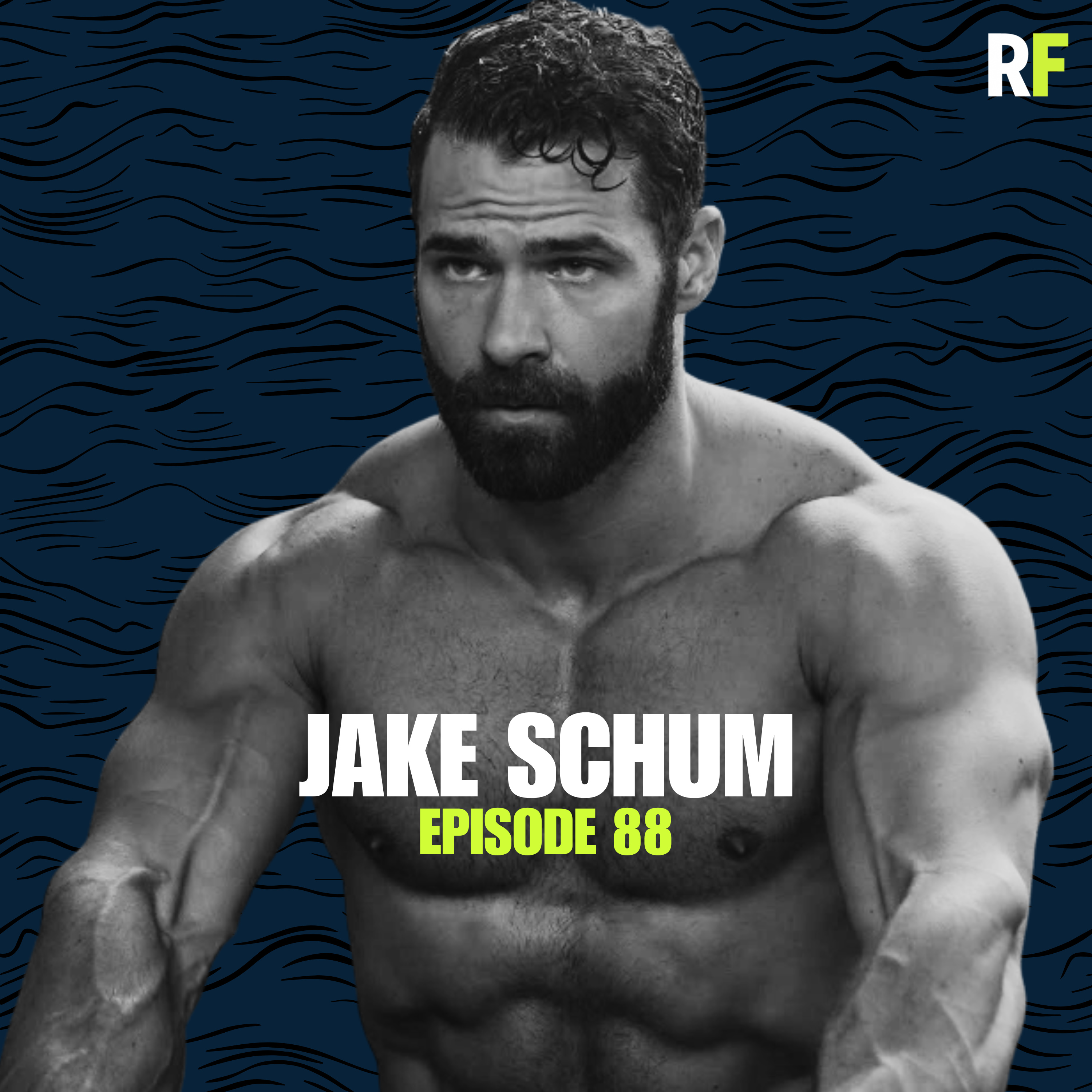
·S3 E88
Maximize Fitness with Minimal Time | Jake Schum, Ex-NFL Player & Elite Coach
Episode Transcript
If you don't have 45 minutes in the day, just look at your phone and your screen time.
I guarantee you're going to find 45 minutes right there.
So it's just priority and that's it.
You know, we'll find time.
If you got to get up 45 minutes earlier, yeah, it sucks, but get up and knock it up.
I'm not one for excuses.
You know, I've, I've been through so much and I've seen how how people can be.
And so like, it's all about prioritizing.
Well, super pumped you here.
We'll jump into it.
Everybody.
Welcome to Running Free.
I'm here with Jake Shum.
How you doing, Jake?
I'm doing great.
Thanks for having me on I'm.
I'm soaked, you said.
Yes.
I reached out to you.
One of your one of your reels hit me.
Actually, a friend forwarded it to me.
You're doing a lot of different things, a lot of cool things, and hopefully in this conversation we'll jump into it.
But let's just start a little bit with your background to get into the NFL, to be a punter, transition to a trainer.
It's like a really interesting story.
I want to hear from you.
But I I feel as though there's been a lot of like perseverance and dedication for you to get where you are.
But why don't you just give a little bit about your your background if you could?
Yeah, you know, growing up I was, I was always very active, you know, always sports all year round.
My two favorite were football and soccer.
So kind of just kind of fell into it of all right, let's combine both and ended up kicking a ball in football, you know, so for for mostly punting and I would do field goals here and there, but kind of at a certain point just realize I can go to college for it and started at Division Three, worked my way up to Division One.
And then after college, it took four years and five cuts before finally even landing on a roster spot.
So I knew I had the ability and it was kind of just one of those things.
I'm like, you know, if I just keep knocking on the door, someone's going to open it eventually.
And it was the training that really kind of pushed me to kind of like really believe in myself because I was just getting stronger year after year.
And I had to make up for it because I'm not like crazy tall guy with like most punters where they got these long legs.
So I had to make up for it with like strength and power.
And it's just, it kind of really what gave me that boost and, and gave me that strength.
So, I mean, I could compete with anybody.
And that's that's where like I really just grew a lot of confidence and I just felt like I could go against, you know, the best guy in the nation and and be able to hold my own or be even better.
And and finally landed that roster spot where it was more of like a relief if anything, since like I was trying so hard for so long and I felt like other jobs, I should have probably won it.
But wish with the NFL, you just never know what's going to happen.
And, and yeah, played a year in Tampa, year in Green Bay, unfortunately hurt my back, which took me out of Green Bay and then tried making the XFL run in 2020 and then COVID shut that down.
So it's been a whirlwind.
But fitness became such a huge part of my life and I knew how much it helped me.
That was always something I knew I wanted to do after football.
So that's if I could take what I've learned over the years, you know, and help other people.
That's that's what I wanted to really get into.
So it was really rewarding everything I've done with football but and it set me up for the next chapter and phases of my life, which has been pretty awesome.
How, how long have you been focusing on it, man, 'cause you're, you're crushing it.
You've got a big platform.
You look absolutely incredible.
So clearly you know your stuff.
Like, how long have you really been leaning into that?
So I mean, I, I say I've probably been lifting consistently for like 15 years doing, you know, that the football workouts, I probably was lifting kind of here and there before.
You know, when you're in high school, you're looking at the old bodybuilding magazines and just following chest day and, you know, crushing nose out and then football workouts in college with the team.
But doing this, the style system that you see in all my videos, I've been doing roughly since 20/12/2013.
And you know, I tried to steer away and kind of go back to, you know, I'm, I'm going to do like a push pull thing for a while or go back to maybe a bodybuilding split or a little bit.
And it only lasts like a week or two because I love the system I do now because it hits everything.
And I had to stay a certain weight and not gain too much muscle while pursuing football or playing because I didn't want to be too bulky and slow.
So I tweaked my training just in the slightest when I was done, which was a couple years ago, I think like 2020 through 20/22/23.
And that's where I wasn't afraid to maybe pack on a little more muscle, but I actually weigh less than I did when I played.
I play my playing weight was like 210 two 12 and I'm currently around 2O32O5 consistently right now.
I'm going to be super selfish for the rest of the episode and just figure out how to hell I can look like you and how my listeners can look like you.
So we're going to, we're going to jump into some tactical stuff and I'll and I'll just, we'll start like kind of high level.
We'll just start with a bigger question.
But if you're if you're busy and you're maybe time sensitive, you know what does an efficient, well-rounded training program look like?
So that's why I really like the system I've done is like it's, it's a lot of upper, lower splits.
So I feel like you get so much more done with upper and lower and you can hit multiple, you know, muscle groups multiple times a week, you know, compared to doing, I mean, you know, get people doing your chest day or push day and then they're not hitting that for who knows how long because maybe you got it, you're planning on doing it twice a week.
You get caught up with something, you missed it.
Now you're not going to hit it for like a week later or me because I'm able to and because I embrace training and I love it.
I train every single day, but that doesn't mean I'm training as hard as I can every single day or else my body would be breaking down South.
I split it up.
I have my 3 upper, my 3 upper days.
I have my 3 lower days, Sunday's optional day, which I'm in there anyway.
So, so it's like my bro day.
I call it like maybe some arms or just like a full body circuit.
Just get the body moving because for me mentally, yeah, I just feel better from it.
So I have, you know, majority of my clients do an upper lower splits because we can knock out a lot.
It's a lot of super sets and triceps and it just kind of keeps you going.
So there's minimal rest time.
And if you can't find that, I say 45 minutes and a lot of people say half hour, but I'm like, if you don't have 45 minutes in a day, just look at your phone and your screen time.
I guarantee you're going to find 45 minutes right there.
So it's just priority and that's it.
You know, we'll find time if you got to get up 45 minutes earlier, yeah, it sucks, but get up and knock it out.
So it's just, you know, I've, I've had those days, minimal sleep and I'm like, all right, I'm getting up at when I was away, or was I?
I was away over the summer and I had stuff all day long.
I got up at 3I got up at 3:45, knocked out my workout and carried on with the day.
But that's just my mindset.
I'm like, I'm going to I'm not one for excuses.
You know, I've, I've been through so much and I've seen how, how people can be and it's like it's all about prioritizing.
So that's, that's it.
We'll find.
That way and mindset.
Yeah, for sure.
And mindset take take away there from Jake's basically like you might you might not think you have the time, but audit your day.
I bet you you can pull 5 minutes here, 10 minutes there, 5 minutes there, 10 minutes of scrolling before bed.
Yeah.
And that equates to that extra 45 minutes that you need.
I'm going to double click on your 3 upper 3 lower because it sounds like that's what you do.
So can I assume that let's just say we started a week on a Monday, It's like AB upper lower where you're doing upper, lower and that would be Monday, Tuesday.
Here's the fun.
Wednesday back to Upper SO.
What I do actually, what I have a lot of my other clients do, but it's a preference thing because some people just like going back and forth.
I'm crazy enough for I start my week Monday with heavy lower and then Tuesday is a volume lower day and then it goes opposite heavy upper, volume upper.
And then I go dynamic lower, dynamic upper.
And then I hit, you know, my, my optional day.
But, and a lot of my clients like it.
I mean, it's kind of like one of those things where we like, Oh my God, two leg days in a row and then, but then you knock those out by the time Wednesday comes and you got that heavy upper.
It feels so good and then you crush those out.
But some other people too, I do that back and forth.
So it'll be like a heavy lower or heavy upper volume, lower volume upper, you know, and then dynamic, dynamic.
So, but it depends on how many days too.
If we just do upper, lower, upper, lower, you know, some people can only knock out four days a week.
So it's just adjusting and I adjust for each person week on a weekly basis.
Got it, got it.
And I'm assuming like in, in your model, are you doing a lot of your like nasty big compound lifts on that first day and then the second day a little bit back off like the real central nervous system tax and stuff doing more like machines and lighter stuff?
Or is it just so you're just blasting?
Yourself both days yeah.
You want to treat it almost like recovery.
So you know, it's like movement is key, you know, so movement is blood flow.
And that's what it, it almost like fresh, like get your legs fresh again.
So like if you knock out, yeah, all those drooling tough exercises, like we all love those heavy Bulgarian split squats.
You know, everyone's smiling doing those.
Or you know, your heavy squats, heavy deadlifts Monday.
And then when you come in Tuesday, that's my jump day as well.
So I hit my jumps and, you know, just real high volume, usually like moderate weight.
You can go really light.
A lot of band work as well.
So it's just like, for example, if you're doing like lying hamstring curls, we're busting out either for time for 30 seconds or high reps of like 2025 reps.
So it's just kind of getting enough of like getting that pump, getting that blood flow into that muscle and just kind of flushing out all the garbage in there and just getting your legs moving again, 'cause the worst thing to do heavy leg day.
And then just sit around, you know, or you go upper, you know, where you're still not not getting that extra work in those legs.
And that's what it is.
The basis of these workouts is GPP, which is general physical preparedness.
We it's, it's building your base up.
So I feel like my base is so strong, you know, that I can do a warm up and it's almost like people's workouts because I've built up that GPP so much.
And that's, that's what it's kept me healthy.
It's what's kept me really strong.
And GPP is, is those Tuesday, Thursdays for me.
It's just getting that high volume, getting those accessory exercises and getting that body moving.
It's just like extra reps of extra strength and it just adds up over the weekend over time.
So, you know, I'll be knocking out all this hamstring work, you know, hit over 1000 hamstring curls in a week and you just did it on that one leg day that you have scheduled in a week.
So, you know, it's like that's where those numbers make a difference.
You know bro splits for king for like a decade and then now you hear a lot more about the importance of hitting your muscles with more frequency.
So can I assume then based on what you shared so far that hands down it's not like hey do 1 upper body workout and then see you next week.
People should be focusing on hitting all of their muscles at least twice a week, and if they're a freak like you, 3 * a week.
Yeah, absolutely.
I'm I'm all about volume, but in a smart way.
Like you don't want to hit heavy volume all week long.
You're going to end up destroying yourself.
But you know, for me, it a lot of people will ask about my shoulders.
Like, you know, it's like either think I'm on something or whatever, but I'm like, I, I swear by the volume of like doing YS&T's and different variations of it.
And that's the other key to it too.
It's I'm not just doing, you know, barbells and dumbbells, but I'm throwing bands in there.
I'm throwing chains.
I'm doing stuff that's throwing my balance off the support.
Just those different variations, YS&T's and just light shoulder raises 3 to 4 times a week.
I'm like, that's what has helped build up so much of my muscle overtime.
Look, life can be hard and stressful sometimes, we all know that.
But when it comes to supplements, why is it that nobody talks about stress and resilience?
For me, I take the Adaptogen stack from Momentous Supplements.
It's a daily blend of ashwagandha, rhodiola, and L theanine, all clinically backed to help you stay calm, focused, and resilient.
I'm proudly partnered with Momentous Supplements because they are the industry's best.
They don't cut corners, Everything's third party tested, used by pro athletes, and high quality.
Head to livemomentous.com and use code strength for 35% off your first order.
Again, that's live momentous.com code word strength for 35% off your first order and get started today.
Right.
If someone's listening and they hear, you know, training 6 * a week and they heard our advice, find you can find the time in the day.
But let's just say hypothetically, someone's easing into this.
Their body, their essential nervous system can't take on that volume and intensity yet with the goal of like ramping up.
But if someone has less time, they just don't have the time.
And let's just say they can dedicate five days a week total to training, including cardio, which we haven't hit on yet.
What would be maybe like an entry point where they can still get some of the important principles like frequency and volume and stuff, but what would be like maybe a little bit like scaled down version starting point as far?
As training goes, yeah, I mean, 5 would be great.
You know, I, I have a lot of beginners and I try to get them at least at four days a week, you know, because then you at least get a upper lower, upper lower.
I mean, bare minimum, if we're just getting three, I'm like the results will come slowly, but at least then you can almost do like an upper, a lower and then like a full body, but it's being efficient with that time.
Hey, I only got 40 minutes.
And then so again, you got to have all your rest times in there and there's no messing around in between each.
And again, we're you're most likely not going to be able to hit your big heavy movement like squats because it's just going to take up way too much time unless you're super setting with it, which is something that I really like to do.
I'll go like squats and do like jumps with like some dumbbells, but I always like super sets and triceps.
Like that's something I swear by.
Just keeps you moving.
But again, it depends on your goals.
If you're trying to get into the bodybuilding and the building, you need that extra rest time to get the most out of that, that lift and, you know, really break down the muscle and that's why you need those more of those heavy days.
So it just depends on that person, their goals, What are they trying to get out of it?
But most of the people I work with is, hey, I want to be able to train as hard as I can, still be able to feel good and function the next day.
Well, you know, I'm playing with my kids or walking up the stairs because that's what gets people kind of like rundown is like, they train so hard right away or they're always way too sore and it just hurts to sit down, you know?
And that just kind of like takes the motivation out of it all.
Right.
So let's just say somebody has, we're going to go 4 days of strength training because again, we didn't talk about cardio.
We're going to go there and let's just say you program it Monday, Tuesday, Thursday, Friday.
I want to just double click on one upper body workout, let's call it the first one in that scenario and 1 lower body workout.
Walk me through how you would program that upper body workout.
We start usually just kind of do like a real quick warm up, whether it's just like a a quick foam roll or something that is kind of like a full body movement.
Like if you have a medicine ball slime just kind of do like chest slams in the ground, usually some like YS and TS with some dumbbells, just kind of like stealing those extra Rep reps band pull aparts set of like maybe like push ups just to kind of get things falling.
Usually only takes like 5 minutes if that, but it should just be like boom boom boom.
You're just kind of getting the body moving.
If depending on the time, if we have like good amount of time, we'll at least try to get that main lift in.
So like we'll do like a heavy bench superset.
So we'll do something like maybe like reps of like 10864 for bench press going right into failure for push ups.
And you can always change the variations of those maybe right on the ground or bench push ups or decline.
So do that three to four times and then kind of go into another heavy chest or upper body superset might do more of a pull.
If we started out with that, that push then might do like a heavy lat pull, like reverse lat pull down into a single arm dumbbell row and knock those out.
And then might go into like a couple, maybe 2 sets of triceps, which could be shoulder press.
You're hitting your banded, I come front and over.
So bringing the bands up and over back to the side.
And, and one of those are some plate raises kind of go through that low circuit because I like the plate raises because you're squeezing your chest a lot while you're doing that.
And you can just change your hand position and then right at the end might do like an arm burnout.
And sometimes I might even turn into a giant set.
So it might be tricep like rope tricep extensions right into banded tricep extensions for 30 seconds and then dumbbell curls right into banded hammer curls for 30 seconds.
And you go through that.
And I mean, by the time you do all that, you're get, you're crushing.
You know, anywhere from like 8 to 10 exercises is usually what I'll aim for.
And then that really, really utilize the time, but it's just go, go.
Hearing that heart rates probably up during that whole thing because you're doing so many super sets sounds like little rest.
Any like intentional kind of like isolated cardio, whether it's like 10 minutes of HIT at the end or like throw them on a treadmill for 30 minutes.
Or do you keep cardio kind of separate from the strength training?
If they're going to do more of like a long cardio, like, yeah, like a treadmill or elliptical or something like that, I try to keep it separate.
But I mean, if you just don't have that time, you know, to do it later in the day or whatever, then yeah, we'll do it after.
But I like to feel like the workouts are such, you know, like a faster pace and you're really pushing.
If you're pushing yourself enough, you should almost feel like you're getting those benefits from, you know, from the workout itself.
So I kind of always joke around, I'm like, So what do you do for, you know, people ask me, what do you do for cardio?
I'm like lift weights faster, you know, So I like.
But.
Yeah, but but yeah, so that's kind of where like if you can kind of get that full body, you could kind of turn into that circuit or, or I'll throw something a little more dynamic in there.
So it's more of a full body exercise, but kind of like those dumbbell thrusters, you know, with like the push up pop up curl press.
I mean, you do 10 of those at a heaviest weight, you're going to be gassed.
So and that's like the, I call it like strength cardio.
You know, I feel like you're going to get way more benefits doing that type of stuff.
I mean, unless you're planning on running, you know, like doing a race or this or that, I'm not one to just just run, run.
I've been doing it recently just and I hate it.
But I have some secret things coming in the in the future.
So I'm kind of training for.
But other than that, I'm getting my cardio from my box tunes, my, you know, jump roping, sled pushes, tire flips and that type of stuff.
So it's, it's, and that's more fun for me, you know, and that's kind of the biggest thing for people is that if you just make someone do something they hate over and over and over again, they're just, they're not going to be motivated to do it.
So you have to find those things that people are going to like and enjoy.
And that's part of, you know, building that relationship with that client and adjusting what I do weekly.
So then we figure out and fine tune what works for them.
You know, 'cause it's nothing's worse than doing something you hate every single day.
Yeah, Amen to that.
You know, Zone 2 cardio has become quite the viral talked about thing.
It's right up there with cold plunges.
What's your what's your kind of take on basic hearing on what you just said?
Anyone that's like kind of sold on the idea that Zone 2 cardio is good if not for fitness and aesthetics but for health span?
I think if it works for them, great.
And I'll say the same thing with, you know, diet and everything else.
It's like if it works for you, then do it, but it doesn't work for everybody.
And zone 2, it's like might be boring for a lot of people, so it's not going to work for them.
And I think it's just kind of like could be a fat thing like like anything else and all these different diets and, you know, different style of lifting.
And, you know, I found what works for me and it works for really well for a lot of my clients.
And they enjoy it because it's so different.
And they're they really don't know what they're going to get hit with next for the next week.
So it's just kind of keeps them on their toes.
But it's it's possibly changing.
So yeah, the Zone 2, you know, it benefits a lot of people.
And you know, it seems like there is a lot of, you know, good research on it that shows that it's really efficient and effective.
But I know that zone 2, a lot of people get really bored doing that type stuff.
So like, you know, it's like, oh, you know, in the morning, hit that facet cardio and hit that Stairmaster for an hour and a half.
I'm like, I know I don't want to do that.
And like that just sounds miserable to me.
So I feel like it's not going to be efficient for me because I know I'm not going to do that long term because it's just like everyday I'd be going to that just hating the fact that I'd have to do it.
You know, I get it for people that have to do shows and this and that, there's just a certain things you just can't really get by.
But I'm like, if you're trying to lose weight as well, I'm a firm believer you got to be in the deficit.
You know, it's like, and usually the people that aren't aren't really tracking as much as they should be.
Yeah, yeah.
And it takes so damn long.
I mean, the recommendations, most people agree.
It's like you need 90 minutes a week of intentional Zone 2 training to get the intended yeah, kind of health span longevity benefits.
And your, your wheelhouse is really about efficiency.
I mean, busy driven dads, busy driven parents moms.
So to your point, man, it sounds like what you're recommending works for those people because you're in and out.
You're getting your cardio within the strength training session.
It's itself.
But then you also have the opportunity to build muscle, which is, I mean, it, it, it makes sense to me.
Look, one in ten Americans today struggle with alcohol use disorder and I was one of them.
Did you know that there is a safe, science backed daily pill that you can take to drink less or even quit alcohol for good?
It's called Naltrexone, a doctor prescribed medication that you get online an hour Sponsor or Health is the nation's leading provider of naltrexone.
To date OR Health has helped over 35,000 people find freedom from alcohol and I'm proudly one of them.
To get started, text Strength to 710710.
Again, that's STRENGTH to 710710 and get started on your journey to finally find freedom from alcohol.
Can we hit a lower body workout because you you kind of went into nutrition and I definitely want to talk about nutrition, but same same kind of, you know, question there.
So let's just say it's Tuesday.
You did what you did on Monday.
Now it's time for lower body day.
I can't wait to hear this one.
But what's that look?
Like, yeah, so it's kind of a, you know, kind of like that same concept usually kind of hit a little less exercise with lower body just because I feel it's just a little more taxing.
You know, lower body is almost just still like a full body.
You know.
I mean, if you're doing squats, say we're just going to have a squat day.
Kind of same thing with the warm ups I have my a lot of my guys always do.
Like if you, if they're available to you, like those little loop bands around the knees, like the lateral walks back and forth, get the hips blown up.
I like to do a lot of wide stand stuff.
So dumbbells or kettlebell sumo squats, dumbbell jumps and this all part of the warm up, just rolling out a little bit and just again, it's just one after another, just kind of get things fired up a little bit.
You don't need these long 1530 minute warmups.
Like you could just get in, do similar movements and what you're going to be doing for your actual exercises to make it quick and explosive.
And then just hop right into like I said, we'll start with like a squats and whatever the numbers are for the upper body or vice versa with like the legs much I keep the same.
So again, we'll do the 10864 and I'm going to super set that with dumbbell squat jumps and it burns and you're going to do like 10 of those.
So that's a nice little super set.
You're doing that for four sets and then going to something heavy, alternating single leg stuff like a barbell safety squat by reverse lunges or dumbbell step UPS or Bulgarian split squats or like something like that where you're doing kind of a single leg movement.
I might kind of keep that theme where I do that and then I might hit the hamstrings a little more and do like a single leg RDL.
So kind of hitting that that heavy, that heavy superset again.
Or like I really like belt squats, you know, so you might hit like a belt squat with one of those leg exercises and then kind of hit more of that somewhat higher volume.
So then single leg hamstring curls, you know, banded hamstring curls, lateral hip walks, adductors, adductors like Copenhagen's, like where you're going to get some isometric work and something that a lot of people don't do and they, they realize how hard that movement actually is.
And I like doing a lot of stuff where you're holding weight in front of you because it gets your back working a lot more too.
So either dumbbell or Med ball squats or Med ball walks, you know, kind of like a strongman style thing.
So that's again the conditioning.
You're holding a heavy Med ball and you're walking back and forth, you're holding it tighter, making it a little harder to breathe.
Like that's strength conditioning right there.
So again, you're kind of getting your heavy, your Max superset, then you're kind of getting your little heavy superset and then maybe one or two of those triceps with a little more volume of like 10 to 12 reps with the hamstring curls, the lateral walks, the Copenhagen's.
And if there is time, depending on people, I always try to throw in corn there as well every single day.
So heavy AB work on heavy days, on the volume days, it would be more ice, you know, isometric work like side planks, weighted planks or just something opposite.
If I'm doing heavy crunches, weighted crunches, the next day I'm going to try to do something more like maybe rotational or side side plank to kind of hit more obliques and just like your whole erectors and and everything like that.
But I'm always trying to do core work every day.
Just you can't go heavy all the time.
You got treated like everything else, you know?
So it's like these people are just doing crunches for like high reps, but you're just working out your neck more than anything.
So right.
Right, right.
So, OK, so in that scenario, this person's training four days a week, we'll say Monday, Tuesday training, Wednesday off, Thursday, Friday training.
You're doing some core work all four days.
Yeah, all four.
OK, got it.
What is the rest period?
So let's just take that lead exercise for the lower body day.
When you're doing the 10864 and you're super setting with box jumps, let's just say that's what you chose for that day.
What's the rest?
So you do your your set of 10, set one, and then you do your box jumps.
How long are you resting before you get back under the bar?
A time crunch, I'll say anywhere from a minute, 30 to 2 minutes.
If we got some time, I'll shoot for that two to three minute time, but I don't want to waste any more time over going over 3 minutes.
So, but yeah, you'll be, you'll be gassed a little bit.
Yeah, oh for sure, man.
I just do straight sets of squats.
So now you got me.
Wanted to challenge myself.
I heard you say safety, safety bar.
Safety bar, squat.
What was that?
Safety squat bar it's called?
I just bought 1 squat.
Bar the s s bar?
Yep.
Just bought one.
Would you just if if someone has access to that equipment and they wanted to do squats, would you recommend that versus a traditional Olympic bar?
Yeah, I'll always choose another bar over your typical Olympic bar.
It's so violent on the joints and everything.
That's why I, I rarely bench or squat with like a regular stiff bar.
If you are, you know, seen like band bell and they got like the rhino bar and stuff like that.
It's got like that flex to it and you'll get like a little bounce out of it.
But especially on my dynamic, my speed days against bench where you're, you're just trying to be explosive as possible.
It's got enough give where it just takes the your shoulders and elbows just feel way better benching with that.
And then with squats, I really, I highly recommend the the safety squat bar.
It just puts it kind of distributes the weight a little differently and sits on your back differently to, you know, kind of protect your spine a little more.
But still at the end of the day, you need to know your proper breathing and bracing.
And that was my big game changer.
After I got it injured, I kind of had to take a step back and rebuild myself the right way to make sure that everything was strong evenly.
But and that's kind of where I really got into, you know, the belt squats more and like the safety squat bar and different bars.
But I'm trying to figure out like a true Max just with the regular bars.
I'll kind of do it here and there.
But yeah, you'll that's why you'll probably rarely see videos of me using a stiff bar.
So hearing from you, Jake, you're saying ain't no value in those conventional bars unless you're competing in like a an actual tournament or something?
Yeah, and it drives me crazy, but I get the benefits.
But I, I understand a lot of issues with the two, like like seeing these strength coaches with like football and stuff.
You're having these guys who aren't Olympic power lifters still doing hang cleans and, and power cleans and snatches and this and that.
I'm like the safer ways.
Just use dumbbells.
You know, it's going to be way safer for you.
And you know, same with deadlifts.
If if you're not confident in your athlete or the athlete self isn't confident doing deadlifts, conventional or sumo, I put them on a trap bar.
You know, that's like there's no shame in doing that.
But you know, if that person's not strong enough, don't put them in that bad position with like a barbell, Like I trust myself and especially with all my experience doing it, but you know, it's like I have certain kids and certain adults and I'm like, we're going to do this instead, you know, with like the dumbbells because there's just a little free motion there.
But when you're doing the Olympic style lifts for reps upon reps, you know, with a stiff bar, I feel like it's just a matter of time for something not too great.
It's going to happen.
And that's why, you know, this just, yeah, I'm, I'm not, I have a big issue with those, those big powerlifting movements.
They're like Olympic lifts, you know, that people are doing for reps when they were made for kind of more like a single Rep.
Yeah, I know.
I'm with you, man.
And for anyone that hasn't tried a trap bar, which Jake mentioned, and if you, if you're doing dead lifts, just dump, just try it with a trap bar one time.
Anatomically, it's just so much more natural to lift the weight with your hands by your side versus awkwardly trying to clear your knees with 315 lbs.
I mean, it just feels right is the way I would play, you know?
That's why I want the sumo after my back like I used to Conventional all the time before and also conventional here and there but never Max out sumo.
I'm not afraid to Max out, but it's just, it just feels better.
You're in a more upright position, you're getting your glutes and your hamstrings more engaged.
And I feel personally it's just safer.
But at the same time like that's with caution because I know how to properly brace and control my breathing and this and that.
And that's something that I just drive into all my clients head.
Like I want my voice to kind of constantly be in your ear Brace, brace, brace.
So but yeah, the trap art is great.
I use that when I was recovering as well.
So it's, it's just like, you know, it's like, again, there's no shame.
It's like you're still lifting this amount of weight, the trap bar, like that's impressive.
You know, it's just you don't need a bar where you put yourself in a bad position trying to go over your knees and then now you just hurt yourself.
Yeah, agree, man.
Agree.
All right, Jake, so you started talking about nutrition earlier on, so I'm just going to ask one question.
I bet you we can hit everything on nutrition, but I'll just ask it this way.
What?
What do you advise your clients around nutrition?
If we're if we're trying to get results gaining or losing like you have to track and I've been, I've been on both sides where I have been really good at tracking everything.
And that's usually when I'm trying to really make a cut or I've kind of eyeballed it and I thought I was eating good and I was, you can still eat good foods, but then completely be off on your calories.
So it's a pain in the butt.
But I like, I tell them like, if you want the results, you need to track everything.
And that includes like all those little oils you put in when cooking and this and that because people that don't track that stuff like, whoa, why am I not seeing results?
Well, did you count those condiments?
Did you count the, you know, the oil you're cooking with the butter you put on this?
It's like all those little things add up so much.
If you really want to make big changes, track.
But then you can get to a certain point, you can eyeball it if you're not trying to be strict.
And that's where I'm at.
Like I'm, I know the exact foods I can eat.
You know, I, I know, you know, for breakfast, I'll do like an egg or two and then like a couple egg whites and I'll have like a yogurt with it and, you know, throw in like my Sriracha sauce, which is like 0 calories.
And then I always do like a some type of bowl like chicken, like or ground Turkey rice, broccoli bowl.
And I would just change those ingredients, maybe ground beef one day, sweet potatoes, you know, brown rice, white rice.
So you need to find less core foods and just make it work for you, you know, each day.
And that's kind of like what we've, what I find out like with my clients and what they're willing to do and the time they have.
Yeah, how many calories do you eat a day, Jake?
At two O 5.
I'm roughly probably like that 2300 to 2500.
Man, I got to scale back.
I weigh 185 and I'm eating more than that and I'm I got to scale it back.
I'm going to throw out some kind of buzz phrases to you and just get your kind of like knee jerk reaction to it.
So carbohydrate timing, does it matter?
Yeah, I mean the right carbs too.
The the tricky part with diet is just everyone responds so differently to things like I can eat approaching pancakes at night and I'll wake up starving the next morning and I'll be like, I'll feel lean.
I know someone else I can do the same thing and they'll be like bloated and whatever.
So it's just it's, yeah, I believe in timing for the right person.
Got it.
OK, intermittent fasting, yay or nay?
Love it.
Love it, you do it like what I did.
What's your window?
What's your fed window as they say?
Usually I, I try to keep it
between about 12between about 12:00 and 8:00.
So I kind of just fell into that whole thing.
But I work better without food in my system and that's just how I am.
So and then it just crunched that window.
If I miss a meal, I have 5 planned for the day and I, I only get 4.
Oh well, it helps me in my deficit, you know, especially when I'm trying to cut, you know, so but then I sleep better because I'm not eating past 8:00 when I'm trying to go to bed.
Yeah, I'm with you.
So you train in the morning fasted then?
Yeah.
OK.
Pre workout, you take something?
Yep.
Yeah, so it's it's probably not technically a true fast because I drink pre workout, you know, I know the true fast was like water or tea, you know, but food wise, yeah, I won't eat anything until noon or a little later.
OK, cool.
And then you just you started to break down how you eat.
It just sounds like it's pretty well-rounded.
Like you have your fats, you have your proteins, you have your carbs.
But if you had to choose, and I'm forcing you to a, I'll call it a nutritional lifestyle and things that come to mind like a Mediterranean carnivore, but there's come up.
Would you just advise people like eat the right foods and don't get too caught up on like following like a nutritional lifestyle or do you have like one in mind that you typically kind of advise?
Yeah, it's, there's so many out there.
I feel like everyone's just trying to make their mark of just like, you know, I'm following this diet of this new fad and, and maybe it's work for some people.
But at the end of the day, just you need to track and find the foods you like to make for you.
Because again, it was just like when I was talking about working out.
If you're eating something you hate all the time or you can't, you can't maintain, you're just not going to stick with it.
So it's, it's just finding those core foods and if you can do it in a way, again, if you're a busy parent, you're not going to be able to cook every single meal of every day.
So you have to kind of cook some things in bulk, cook the things you like in bulk, you know, and then have a couple of fresh meals.
For me, my fresh meals are breakfast and dinner.
I always have like kind of like a big salad for dinner, but I changed the protein.
Salmon, steak, you know, chicken or or tuna, you know, just kind of always changing that.
But it's always a big salad for breakfast.
I again have like a cup of egg whites, maybe an egg, maybe two eggs in there.
Sometimes I'll throw a little rice in there for some extra carbs, yogurt.
So those are my fresh meals in between.
I'm so busy during the day.
Those are what I call my filler meals.
And that's where I'll have like my bowl, you know, So I have that ground Turkey, that ground beef that's all cooked in bulk.
I have potatoes and rice cooked in bulk.
So it's just like scoop, scoop, scoop, microwave, eat it, you know, and that's something you can easily pack and bring with you if you go to work or, or whatever.
And then the other meals are just kind of like small or high protein things like a packet of tuna or cottage cheese with some blueberries in it.
And then the other one's kind of like call it garbage protein ones, where does it might be a protein bar or a protein shake or something, you know, but it's still like getting something in your system and, and this and that.
So those are like my 3 filler meals and then have like my I have more fresh ones at the start and the end of the day.
But that works for me because I'm like I'm not going to cook every meal of every day.
It's just not going to happen.
Cool man, one more I know you're you're pressed for time so let's hit supplements.
You talked about a pre workout.
What is your recommended supplement stack?
What do you advise?
So I I use Ng nutra they have a couple different pre workouts.
I have different ones with different amount of caffeine for each day.
So like a real intensate.
It's got like the one that's got like the crazy like 300 milligrams of caffeine.
So I'm, I like the caffeine.
I like the little boost from pre workout.
I know some people don't.
So you can always get the stem free one.
That's good.
It's got the, you know, it's got beta in it, but creatine is a must.
I swear by creatine.
I, I think everybody should take it, not just, you know, what does physical standpoint, but defining more stuff mentally.
Protein shakes only if I'm like on the go or just I just need something quick.
I try to get all my protein mostly from food.
But if I just, you know, I'm really crunched on time or just need something, then I'll throw that in.
So pre workout and same with post workout.
I'm kind of like depends on the mood, where sometimes I just like to sip something after a workout and it's more of just enjoying that aspect of it and the taste.
But again, getting all my nutrients from food is the main thing for myself.
I mean, you can get all the supplements you want, but you can't outrun a bad diet, you know, And that's kind of like what I say.
So like to your typical pre workout, post workout creatine, protein powder here and there.
And those are what I take for supplements.
And I got like my other like other vitamins like magnesium, zinc, you know, vitamin CDK 2B complex.
And those are kind of like my main ones for just kind of on the side.
So this next question, probably last question for you, but just around like I'll call it like lifestyle habits.
It seems like recovery wise, you're not putting a lot of space in between your training, you're training 6 * a week.
But any kind of like lifestyle advice you would give to make sure that they're recovering to be able to sustain their fitness goals?
Yeah, and I'm huge fan of recovery.
That's probably where I got majority of my recovery tools is when I got hurt and I was like trying to fix myself.
So I got the recovery boots, I got my own grass thinning set, cupping set, which I feel is more kind of a fed facing, you know, But I mean, if you do it right, I felt like the most beneficial thing with cupping was 1.
So if you're on your arm, we got two cups here and then you have one in between and you rub it back and forth.
So one that you actually can move.
I think it can.
I love the grass inning because you can kind of get into a stretch and you just, you know, scrape whatever is kind of like bothering you and that really gets, it almost feels like a stretch and you're kind of getting the blood flow to that area.
So grass inning.
The compression boots, I really like the Thera gun I have, I think is by like hyper ice rolling out, like body tempering use, not using foam rollers, but steel rollers.
That's what's going to get mixing because foam rollers we kind of just call props.
You know, it's it's not going to really do much on the you'll get a little bit of, you know, release out of it.
But I mean, I would say at least try to it's going to suck, but use APVC pipe.
But if you have like the steel rollers, like that's, that's what's really going to, you know, dig into that muscle and force change.
You know, you could stretch all day you want, but your muscles are just going to go back to, you know, the the length they were at.
So you need to kind of add that extra to it contraction while you stretch.
So I like stretching, but you got to make sure you're working while you're stretching.
And that's what I would say like rather than sitting on the couch, you know, go on the floor and stretch and watch TV, you know, and that's kind of something that I'm embedded in my brain at a younger age was like, I'd be holding stretches and and, you know, to get more flexible for punning rather than sitting on the couch.
And then people wonder why they have back problems.
Your lower back is at such a poor position when you sit in the couch and, you know, so and your hip flexors short.
And so it's just, there's so many things like minor changes like that that I'd recommend.
But the cold plunge, yeah, that's new to me.
I did it the most consistent I was with it was like back in college, we do it after like a hot practice or when I was in the NFL.
You kind of do like a little hot, cold contrast, which I really liked that you know, you can almost feel the difference instantly when you go back and forth.
So this is new to me.
I've only been doing ice bath with a polar dive for a couple weeks now and I've been just trying to play around with times to see when the best time is.
And for me, I haven't really noticed a crazy physical difference, but mentally I, I love what it does because it's almost like, Oh my God, it's going to suck.
You know, you're like every time you go, yeah, it's going to suck.
But when you do it and when you're done, like you feel like so accomplished and you do get that dopamine rush and you feel that, that burst of energy.
So like doing it early morning before I train my morning clients, it just helps me.
I just feel like, you know, I'm, I'm more upbeat already then I already am, but like more energy, you know, I feel more awake and alert.
The other night I just did it closer to bedtime, which was the first time.
And I felt like I slept pretty good because I feel like my my core temperature was down because I always feel like I sleep so hot.
So I'm going to play around with that a little more.
So I'm still figuring that out.
But I love like the almost like the challenge of it.
Yeah.
Yeah.
Saunas.
I love saunas, but mostly just for like recovery, just just just active work, you know, like rolling out the grassing, the the stretching with the contraction bands, using all those.
And, and it's, you got to treat it as as just as important as working out because like, you know, it's just, it's what's going to keep you going.
You're just working out and breaking your body down and not giving a chance to recover or doing the necessary stretching.
It's just going to just tighten right back up.
So that's that's where I think punting in the NFL, not just being a player, but having to stay so flexible and strong and explosive really helped me develop this really strong system of you're kind of getting that, you know, strength and functional work where you can really train hard, but you can move as well.
And that's, that's I think the most important thing at the end of the day.
Bro, you're, you're, you're, you're blowing up.
You just got such smart training.
I can see like a really bright future for you in the fitness space.
But when you kind of look forward, man, like what?
What's next for for Jake Shum?
What are you excited about?
And then where can people find you and get engaged and maybe even get some training?
Yeah, I have everything, just kind of on my main platform is my Instagram.
So just Jake under score Shum, I have links in my bio.
So that's kind of where you'll find the application to work with me.
You know, I'm just kind of answering some questions and then just some other links with some people I'm with like my centric brand, which is like most of the clothing I wear.
You know, it's kind of got some other, you know, companies that I like work with that I've used their stuff and everything.
So everything is right pretty much on Instagram.
But I mean, other stuff, YouTube, TikTok, it's, it's usually all the same stuff right now.
But for the future, you know, it's just kind of embracing this whole elite dad mode chapter, you know, kind of moved on from football.
And I'd like to bring that back in at some point.
You know, obviously I train athletes and everything, but you know, football was a huge part of my life.
I'd like to somehow get involved some way and kind of just continuing to grow, you know, on these platforms and everything and meeting new people like yourself and doing this type of stuff and trying to get, you know, the information that's helped me in my journey.
You know, I feel like I've, I've done so much and I've kind of done the, you know, like the persistence of being told no multiple times and did an impossible thing with the NFL and making a dream happen, but then overcoming an injury and and then getting back into playing.
And you know, it's just I, I felt like I've been through so much.
So that's why I love to share this journey and and hope that new challenges are going to present itself.
So I got some stuff coming up, as you said, you know, some secret missions that that's going to be, but I think I'll be able to, there's one or two I'll be able to share soon.
But it's all about just, you know, meeting new people, networking and sharing your, your own journey and listening to theirs as well, because everybody's got a story.
And it's, it's cool how fitness and health is such a big thing that, you know, connects so many people, you know, and there's so many different ways to do it and you just find the right one for you.
And it's just fine tuning it.
And that's that's why I think the biggest thing with coaching people is it's like, you know, you can just get them in the right direction and guide them.
So then after those three 612 months that they can figure it on their own because you've, you've built that system for them.
But yeah, going to keep making these videos those and do stuff with my daughter and and get hurt, you know, to see what I'm doing and and just see what type of opportunities will, you know, come my way.
Yeah, man.
Well, I look, I'm so glad you're doing this, man.
You got so much great wisdom.
I I really truly believe you're that you kind of represent like the future of fitness, kind of breaking the mold and what everyone's been doing for a while.
So I will link to all the places in the episode description, man.
But thanks for joining Running Free Jake, man, Jake Shum, everybody.
Yeah.
Thanks for having me.
Appreciate it.
All right, everybody, that's the show.
Folks.
Thank you so much for tuning into the podcast and spending some time with us today.
We've got a favor to ask.
If you enjoyed the show, would you please consider subscribing to the show and even leaving a rating and review?
That simple act drastically helps us reach more people and our mission to help them live better, longer, healthier lives.
You can also follow us if you'd like on Instagram and YouTube for regular tips and motivation around mental health, addiction, and so much more.
Know that your support fuels our brand and is greatly appreciated.
So until next time, stay strong and live deep.