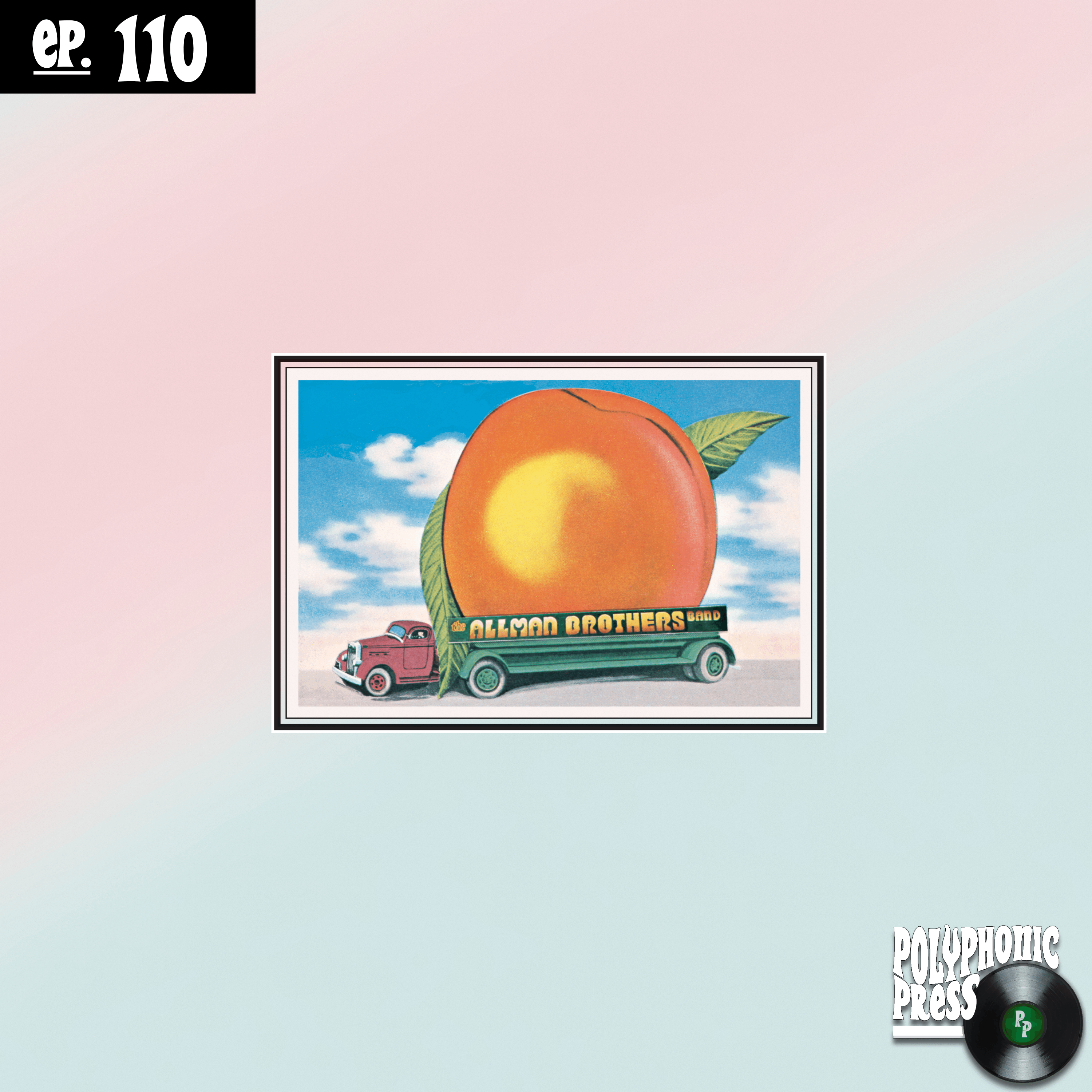
Eat a Peach by The Allman Brothers Band: Southern Rock’s Bittersweet Triumph
Episode Transcript
This is Polyphonic Press, the podcast where two music fans pick a classic album completely at random.
Okay.
Hey, welcome to Polyphonic Press.
I'm Jeremy Boyd.
And I'm John Van Dyke.
And let's not waste any time.
We've got the patented random album generator right in front of us here.
So let's hit the button and see what album we're going to be listening to this week.
And the album we're going to be listening to is...
The Allman Brothers' Eat a Peach.
Okay, that's the one with one song that goes for two sides of a record.
Yes, it is.
Mountain Jam.
All right, so here's a description of the album.
Says the Allman Brothers' Eat a Peach, 1972, is both a celebration of their fiery southern rock sound and a poignant farewell to founding guitarist Dwayne Allman, who died in a motorcycle accident during its recording.
The album is a hybrid of studio tracks, live performances, and unfinished sessions completed after Dwayne's passing.
making it both a tribute and a continuation of the band's momentum.
Musically, it captures the group at their creative peak, blending blues, rock, country, and jazz with extended improvisations.
The live centerpiece, the 33 -minute Mountain Jam, showcases the band's jam band ethos, while songs like Melissa and Ain't Wastin' Time No More reveal a more reflective personal side in the wake of tragedy.
Studio tracks such as Blue Sky, written and sung by Dickie Betts, bring a bright optimism that counterbalances the album's sense of loss.
The title, famously drawn from Dwayne's offhand comment that every time I'm in Georgia I eat a peach for peace, adds to the record's bittersweet aura.
Eat a Peach became both a commercial success and a symbolic turning point, solidifying the Allman brothers as pioneers of Southern rock while memorializing the spirit of a fallen bandmate.
All right.
Okay.
So, yes.
So this album was released on February 12th, 1972.
Um, and, uh, the genres are Southern rock, jam band, and blues rock.
And, uh, it was released on Capricorn records and produced by Tom Dowd.
And so, yeah, so it is, uh, it is a double album essentially.
So, uh, what we'll do is, uh, we will, um, we'll listen to the first disc and, uh, discuss at the halfway point.
And then, um, listen to mountain jam listen to mountain jam well mountain jam sort of it's uh split it's like on side two and side four so it's like oh that's right yes i did know that that was uh they used to um do that for the old record players where that you could drop a record right onto it oh like the automatic ones yeah the automatic ones oh okay so if you're listening with one of those it would be a continuation Well, we'll listen to it, um, the way it's, uh, the track listing, the way it's laid out, but, um, okay.
Uh, so yeah, so this, the, uh, album starts with, uh, ain't wasting time no more.
And, uh, the first disc ends with mountain jam, I guess, part one of mountain jam.
And, uh, so we'll discuss after that, uh, point and, um, and we do encourage you to listen along with us.
And we've linked the album to both Spotify and Apple Music, so you can get it on your preferred streaming service.
But without further ado...
Okay, so the CD is...
I guess the version that's on streaming services is the CD version, which has the complete Mountain Jam fully intact.
So I guess what we'll do is we'll just...
listen to uh all of mountain jam and and then that's that'll be we'll uh make that the halfway point um so yeah so correction if you're listening along just listen to the whole thing of mountain jam because we're not going to stop halfway through but anyway without further ado uh here is the first song ain't wasting time no more here we go The sunshine smells like rain.
The week before, they all seemed the same.
But with the help of God and two friends, I come to realize I still had two strong legs and even wings to fly.
Oh, I ain't wasting time no more.
As time goes by like hurricanes and faster pains.
All right, and ending part one with Mountain Jam.
Wow, that was a trip, man.
That was great.
I'd never heard the whole thing.
I've heard of Mountain Jam.
I'd never really sat down and listened to the whole thing.
Maybe I just found it intimidating because of the length, but it's just, yeah, it's a really...
It's a journey.
The musicianship is really impressive.
The fact that it's all improvised is just really cool.
Really cool that they included it on an album.
That's really kind of taking a chance.
Yeah, it just really kind of blew me away, you know?
Yeah.
No, it's a good track.
It is long, but it doesn't feel as long as it is.
I mean, it definitely feels long, but there's enough going on, and it's broken up into sections, so it's almost like different things going on, like the drum solo halfway through that's fairly decent, and it's not a boring drum solo either.
a lot of drum solos can be.
It's actually, there's a lot of jazz influence going on in his playing.
But I think the track was basically put on there for the sake of the band more than anybody because it was, you know, one of their last times on stage with Dwayne Allman.
Right, exactly.
Yeah, you're right.
The drum solo is very...
it's more musical.
Uh, I, I find like, you're right.
A lot of drum solos, this is going to sound weird, but this drum solo was a melodic almost.
Um, because it was, it was very, like, it was more musical and, and the, the, the bass solo was really cool too.
Um, and, and they did like each solo, like most of it was guitar solos, but it wasn't, guitar noodling like there was a purpose to each to all of the guitar lines and everything it's hard to do that in the best of times.
It's really hard to do that when you're improvising the whole thing.
And so, uh, so yeah, so like, and, and, you know, Greg Allman, uh, playing the organ throughout and then like Dwayne playing slide and you got Diggy Betts playing lead and the two of them sort of blending together.
And, uh, you know, it's just, It's one thing to have great songs on record.
It's another to be a great band.
And by being a great band, I mean knowing what the other musicians are thinking, and you can sort of go there together, and you're sort of all on the same page, and you don't need to say anything.
You just kind of know you're communicating nonverbal cues, and I've seen it.
in bands playing live they'll just uh give somebody a look and then you know they know okay i know what you're thinking we'll just go off and do this thing so that's that's to me what makes a great band is you can write great songs but you got to be able to play together um and uh you know i think i think they certainly are that and i think you know it's funny a couple of uh A couple of weeks ago, we did that Grateful Dead album, Working Man's Dead.
And to me, it seems like that was obviously happening in California, in San Francisco.
And it's almost like, I think the Allman Brothers started like a year, maybe two after the Grateful Dead.
And obviously, they're from the South.
And so it's sort of like...
you have the California jam band and the Southern jam band.
And, uh, and I think the Grateful Dead was a big influence on these guys.
Obviously the setup, I mean, having two drummers is not a usual setup, but, um, they're sort of taking what Grateful Dead were doing in California and sort of putting a more Southern spin on it, I guess.
Yeah, I think so.
Um, It's hard to say who's the better band, too.
I think the Allman Brothers might actually eke it out for that one, personally.
But, you know, nothing against the Dead, either.
I think the Allman Brothers are just a little bit more to my taste, I think.
Yeah, I would agree with that.
I mean, yeah, like I said, like you said, I love the Grateful Dead.
They're a great band, but...
The Allman Brothers, yeah, they're just more up my alley, more blues -based, I guess.
So, yeah, I hear what you're saying.
But, you know, also the other songs, too.
I mean, Ain't Wasting Time No More, that's a great song.
Yeah, it's a great starter.
And Libraires in A Minor, I mean, that's a great, that's another jam, although it's a studio jam.
It's more of a, that's a great, jam as well and then i've also i've always loved melissa that's a really beautiful song um so like so it's also like and then like i was saying the flip side you can also be a great band but not have great songs and this the allman brothers are both they're they're both a great band and they have great songs as well yeah i agree absolutely Yes.
Yeah.
There's, there's also, there's like having multiple songwriters in the band.
I mean, it's just, I feel like I'm gushing over the album, but it really says, I mean, it's, it's the, I can't think of anything negative to say about it.
I mean, there, I really don't have any criticism or anything about it.
Like it's, I think it's just one of those albums, this kind of music that's just, it just puts you in a good mood.
Yeah, I think the Allman Brothers are one of those bands that are just great.
I mean, I think all their albums are kind of like that.
This one seems to be sort of like their apex, though, I think.
And it's interesting.
It came out in 72 after Dwayne Allman had passed, unfortunately.
And I think their bass player was going to pass later on that year, too, in the same spot, which is crazy.
Wait, so their bass player died, like, so Dwayne Allman died in a motorcycle crash, right?
So their bass player died same way?
I think so.
Wow, okay.
I didn't know that.
I knew about Dwayne, but I didn't know bass player Barry Oakley, yeah.
Yeah, okay, this is interesting.
On November 11th, 1972, Oakley was involved in a motorcycle accident in Macon, Georgia, a mere three blocks away from where Dwayne Allman had his fatal motorcycle accident the year before.
Holy shit.
Yeah, that's what I was saying.
Yeah, it's pretty crazy.
Yeah, that's spooky.
Very spooky, yeah.
What are the odds on that?
Riding a motorcycle looks like fun, but I don't think it's anything I would ever do because it's not a matter of if you will crash, it's a matter of when.
There are ways to avoid it.
You can't be reckless on them.
But yeah, I've known a lot of people with motorcycles and, you know, a few of them have crashed.
Not everybody crashes necessarily, but yeah, it's easy.
You just get some gravel on the asphalt, and it's like ball bearings under your wheels, and it's really dangerous.
And grass, clippings, just anything like that.
You've only got two wheels to stabilize you, and a car's got four.
I mean, you can ride them safely, but you've really got to pay attention.
You've got to be very careful.
You gotta be very careful.
Yeah.
So I did manage to find a few, uh, interesting facts about this album.
Um, the, uh, it obviously it's, it's a hybrid album.
Um, eat a peach isn't a traditional studio album that combines live recordings from the film or East, like the massive mountain jam, uh, with studio tracks recorded before and after Dwayne Allman's death, uh, giving it both an energetic and reflective quality.
Which, you know, is kind of unusual.
I mean, I think Cream did Wheels of Fire, which was a hybrid studio and live.
Yeah, their last album too, Goodbye, was also sort of the same thing.
A lot of Cream's stuff towards that time was like a combination of...
They put out some live albums with, you know, the occasional bonus track on it that was studio as well.
And like we said, Dwayne's...
It was Dwayne Allman's last studio work.
The song Little Martha, a gentle acoustic duet, was the only Allman Brothers composition solely written by Dwayne Allman and was the last studio track he recorded before his fatal accident.
So, yeah, so I guess they were in the middle of recording this album when he died.
Yeah, it could be.
Yeah, seems like it, yeah.
It would be, and I guess that's why they decided to include some live tracks on it.
I mean, it works as an album.
Yeah, absolutely.
It's just a shame the circumstances.
Yeah.
I wonder what the album would have been like if Dwayne hadn't have passed.
You can't help but wonder.
Can't help but wonder.
Yeah, would it?
Like, this is obviously...
Like, that's the next fact, is this is their commercial breakthrough, which is kind of sad that he wasn't able to experience that level of success.
I mean, you know, he, well, I'll just read, the record was a huge success, reaching number four on the Billboard charts and helped cement the Allman Brothers as one of the biggest American rock acts of the early 70s.
Um, yeah, like I said, it was, it's a shame that Dwayne Ullman didn't really experience that.
I mean, he did a little bit playing with Derek and the Dominoes and had a hit with Layla, but that wasn't, that was more of a side project.
It wasn't really his band.
It was more of a, like a one -off type of thing.
Um, well, although I don't know, were there plans to do more with Derek and the Dominoes had he not died?
I don't know, actually.
I think Derek and the Dominoes is another one of those projects that's just kind of like, you know, happened and then didn't happen.
Much the same way as like Blind Faith and some other Clapton stuff.
He had a lot of bad luck with sticking with a band at that period.
But it was always brilliant.
Talking about Eric Clapton.
The stuff is, yeah.
Um, but he, I, I, well, I think the problem with that was that, um, he was always putting bands together with guys that had careers outside of the band.
Yeah.
So that, that's always tough.
Yeah.
I've seen that happen a few times.
Um, sometimes where, you know, a brilliant album comes out because everybody's a professional musician and everybody's locked in and they put out a brilliant album.
And then they're like, yeah, well, I don't know when the next time we're going to do this again is because everybody's busy and their schedules are basically filled up for the next decade or something like that.
It's unfortunate.
It is unfortunate.
Yeah, it's impossible to, like we keep saying on the show, it's impossible to keep a band together and even more difficult when everybody has other commitments.
So the album's title, as sort of said in the description, it comes from Dwayne's remark to a reporter that, quote, every time I'm in Georgia, I eat a peach for peace.
After his passing, the band chose it as a fitting name to honor his spirit.
Just a quote about enjoying the simple things in life.
Yeah, I didn't know that before today.
So that's interesting.
and uh this is kind of cool it's the the iconic cover art this surreal cover uh featuring a giant peach on a flatbed truck this was designed by the label's art team at capricorn records over time it has become one of the most recognizable and enduring album covers in rock history yes but i i always had an issue with the album cover i wish the peach part was the whole thing and not just like not just small in the center i wish it was like the whole um album cover i mean it never really bothered me but it's it's one of those things that yeah i'm not sure for for for for an album or i mean a uh a cover like that um it could have been a little bit bigger on the thing but i think they tried to make it as you know because the the picture is not square so they had to put it on a square cover and make it look somewhat you know like it fit and i think that's where they were coming from at that one so yeah matt has a tendency to sort of um fix the issue yeah yeah that is true but it could be a little bigger i guess i don't know at least from a design perspective that's what i'm sort of picturing but yeah if the picture itself was square then it would have been like a perfect album cover for sure still pretty iconic though i mean it's not dark side of the mood iconic but it's still pretty iconic it's still still iconic yeah absolutely um so yeah so those were some interesting facts about the album um but uh i guess we'll get back into the second side And it starts with another live track, One Way Out.
So here we go.
All right.
All right.
All right, and ending the album with Little Martha, a little instrumental guitar thing there.
Yeah, this is, like I said, I really can't say anything bad about the album.
It's just, it's a great hybrid of the live tracks and the studio tracks.
Yeah, I just, I can't, it's unusual.
in that but it's it's almost perfect it just it just makes sense somehow yeah um considering you know what the wrenches that life threw in them threw at them um you know during the recording of this album uh they came out and put a uh uh quite a cohesive album together um and uh sort of turned it into a tribute and it's uh the good tribute too because yeah and on the surface you wouldn't think it would be a cohesive thing because it's it you look at the tracks and it's well you know there's live tracks there's covers of blues songs here it's like what what is this but it it just somehow works um one of the things that i really liked and something that i noticed specifically in blue sky is um the way So there's a long instrumental section in the middle.
First of all, the guitar playing between Dickie Betts and Dwayne Allman was...
There's a way that they were both playing.
They're playing using the major scale, but it's not cheesy.
Um, and it's almost bluesy, but in they're playing blues licks in, in the major scale, I guess is the best way to describe it.
But, um, the way that they did it was they, yes, they took turns playing guitar, but I think it was Dickie Betts was the first solo and then Dwayne Allman joined in and they were harmonizing.
And then, and then Dwayne.
takes the solo.
It's almost like they were passing the baton.
It wasn't just an abrupt transition.
It was like a smooth, like, I'll take the solo, then we'll harmonize, and then you take the solo.
And it was a really well done, really smooth transition between the two guitar players.
Yeah, the two just really click together.
Whatever they're doing in whatever album, that's one of the key things about this era of the Allman Brothers band, the quintessential era, is just the play between the two guitar players, absolutely.
And they each...
It didn't feel like a competition between them, I think is the best.
It's not like they're both showing off.
They're playing together separately, but they're serving the song, is the best way to put it, I suppose.
So yeah, that was great.
And then Stand Back was a great song.
And then you had One Way Out, which is an Elmore James.
cover um yeah just all just all around a really really great album um so having said that what would be your three uh highlights on the album oh geez uh that's pretty tough wasting time they burn a minor let's see here um i really like stand back i thought that was like a really groovy song Really good.
I love that Fender Rhodes lick in there.
It was really cool.
The two live ones, besides Mountain Jam, of course, are both really, really good.
Trouble No More.
I think we're going to pick Trouble No More out of those two, because I really like One Way Out as well, but Trouble No More.
Then I might actually pick La Brea in A minor.
Ain't Wasting No Time No More was also really good.
I thought that was great.
Yeah, the whole album is good.
Solid, solid picks.
Yeah, it is tough to pick just three.
I think I would go, I would probably go with, well, I think Blue Sky.
That is a good song.
I think, yeah, La Brea in A minor as well.
Oh, man.
Yeah, I think One Way Out as well.
Those would be my three.
But it's tough to not just say the whole thing.
So I think I know the answer, but would you listen to this album again?
I would listen to this album again.
It's a really good album.
We have it on record somewhere, but I haven't heard it in a long time.
I know I put it on.
Oh, geez.
It's probably like 20 years ago.
I put it on.
Yeah.
Yeah.
Yeah.
I would too.
I mean, it's, it's just, um, yeah, it's, it's, it's definitely up there.
I mean, I've always loved the Allman brothers.
I never really, I don't think I ever sat down and listened to like, I've, I think I have a complete, like those, the gold double, um, compilation album, but I never really sat down and listened to a whole album of theirs.
Um, and I'm glad.
i got to sit down and listen to this this is like really um yeah this this is fantastic um so yeah so yeah i would definitely listen to this again So yeah, so I guess we'll end the episode there.
Thank you so much for listening if you made it this far.
We would love to hear from you if you agree or disagree with our assessment of the album.
You can do that by going to the website.
Go to polyphonicpress .com and you can go to the contact page.
And there you get updates about the podcast and check out all the past episodes that we've done so far.
And if you want to help out the show, you can do that.
Just click the support link in the show notes in the description of the episode and you can help with the show and get a shout out on air and pick an album for us to review and get these episodes the day before they go live.
Lots of cool stuff there.
And yeah, if you're listening and you want to follow the show, be sure to do that because it really helps.
New listeners find us.
And if you want to leave a review of the show, that even helps more.
And I think that just about does it.
I'm Jeremy Boyd.
I'm John Van Dyke.
Take it easy.