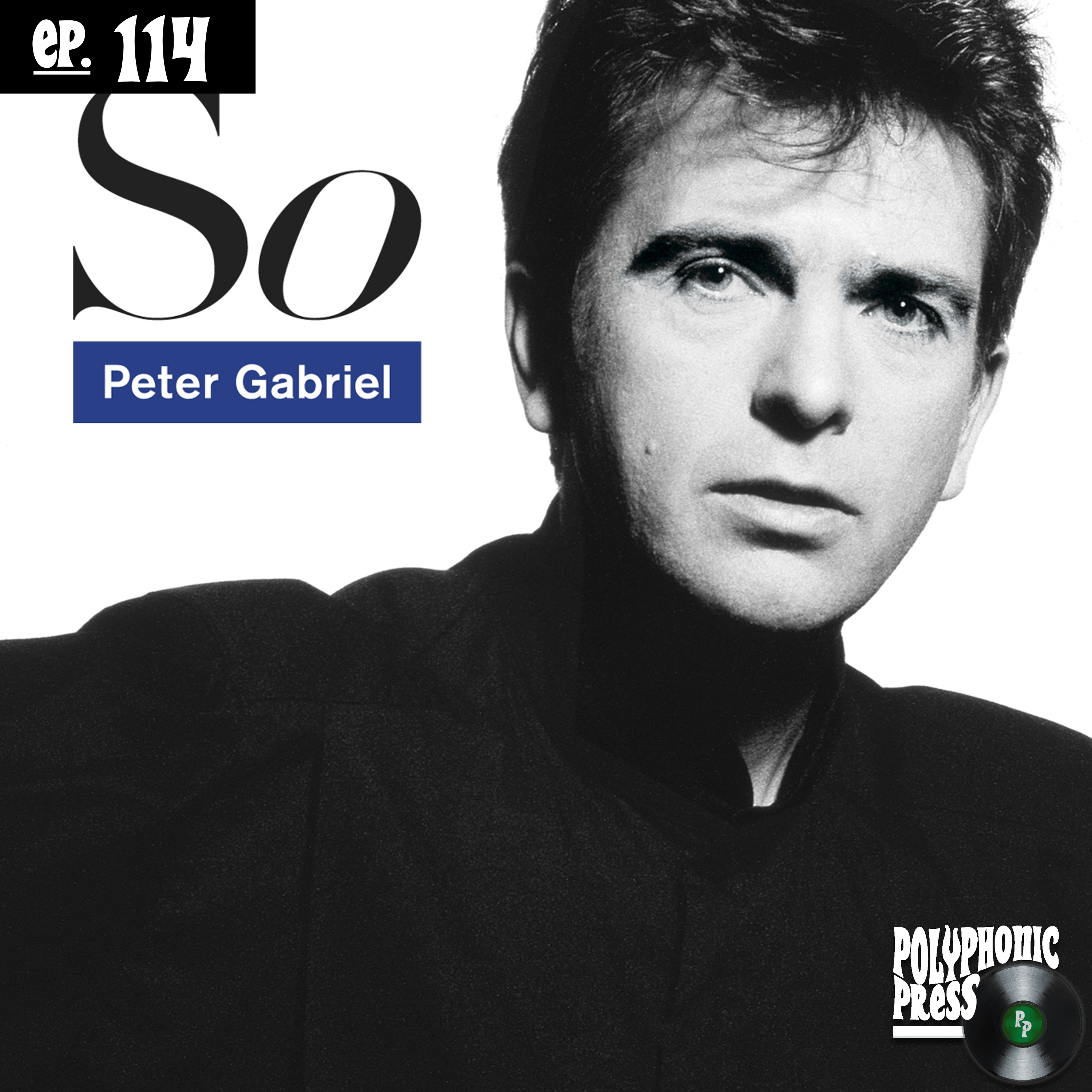
So by Peter Gabriel: How an Avant-Rock Outsider Made a Pop Classic
Episode Transcript
This is Polyphonic Press, the podcast where two music fans pick a classic album completely at random.
Hey, welcome to Polyphonic Press.
I'm Jeremy Boyd.
And I'm John Van Dyke.
And let's not waste any time.
We've got the patented random album generator right in front of us here.
So let's hit the button and see what album we're going to be listening to this week.
And the album we're going to be listening to is Peter Gabriel, So.
Oh, okay, cool.
I think this came out about 1985.
Yeah, 85 or 86, around there.
And I think it's his first album that isn't just called Peter Gabriel.
Was it?
His first?
Because I know a lot of those came out in the 70s and very early 80s.
This might be his first.
But anyway, here is a description of the album.
Peter Gabriel's So is one of the most iconic art pop albums of the 1980s, a record that blends emotional vulnerability, ambitious production, and global musical influences into something both personal and cinematic.
After years of being known as the enigmatic former Genesis frontman, dabbling in experimental textures, avant -rock, and political themes, Gabriel pivoted toward a more accessible yet deeply crafted sound with So.
The result was a creative crossroads where pop hooks met world -beat rhythms and cutting -edge studio techniques met soulful songwriting.
At its heart, so is an album about connection, romantic, spiritual, and human.
You can hear it in the yearning in your eyes, the playful and sensual sledgehammer, the haunted introspection of Red Rain, and the grief -stricken storytelling of Don't Give Up, his duet with Kate Bush.
The album pairs emotional depth with sonic brilliance, meticulously layered percussion, innovative sampling, and a wide palette of instruments from horns to synthesizers to traditional African rhythms.
So also marked Gabriel's breakthrough into the mainstream, supported by visually groundbreaking music videos, especially Sledgehammer, which became a cultural phenomenon thanks to its stop -motion innovation.
The album remains far more than its singles.
Its sequencing, flow, and emotional arc make it a cohesive, immersive listen that still feels fresh decades later.
In short, So is a rare achievement, an art rock album that became a pop classic without compromising its intelligence, experimentation, or emotional honesty.
If you're exploring the most enduring albums of the 80s, this one is essential.
Okay, so this was released the 19th of May, 1986.
The genres are art pop, art rock, progressive pop, and world beat.
And it was released on Charisma, Virgin, and Geffen Records.
And it was produced by Peter Gabriel and Daniel Lanois.
So there are nine songs on the album, and side one and side two.
So the album starts with Red Rain.
And it ends with that voice again.
So if you're listening along, which we do encourage you to do, we've linked the album to both Spotify and Apple Music.
So if you want to start the album at Red Rain and then pause at that voice again and hear the discussion at the halfway mark.
And without further ado.
All right, here we go.
Here's the first song on the album, Red Rain.
Here we go.
Ending side one with that voice again.
Yeah, this is a really good album so far.
I like that it's very 80s, but it's unique.
It doesn't sound like anything else in the 80s.
And it's very slick, the production, but it doesn't feel synthetic or anything like that.
It feels...
still feels humans making music.
It doesn't have that sort of robotic feel to it.
But the production is still very slick, and it's very well put together.
It doesn't feel very loose.
Every instrument is sort of a decision, but it still has a warm quality to it, I guess.
Yeah, yeah, I know what you mean.
Yeah, it's true.
It's definitely of the zeitgeist of the era, but it's got a more approachable sort of texture to it.
And that might have to do with a little bit with like the world music.
That's a, in quotations, world music influences in it.
Well, I can't exactly say exactly where some of these things came from, but...
That sort of flute -y note noise in Sledgehammer, or even some of the beats he's using, are sort of African in origin.
Embraces that aspect of inclusion of all sorts of different cultures.
He's always been a guy to experiment.
I mean, that was said in the intro.
But yeah, he never shied away from getting influences from everywhere, no matter what he was doing.
Yeah, that's very true.
And like that last song, That Voice Again, I was going to say the beats, like the rhythm is very African influenced, you know.
And yeah, like that flute that was used in Sledgehammer.
And you know, it seemed to be a...
bit of a trend at this point because i think uh paul simon's graceland came out around the same time yeah same same year um it's interesting how they were sort of on a similar wavelength around this time yeah i was actually sort of thinking it was like well you know in 86 wasn't exactly the greatest year for music coming out of that time but this is probably one of the best albums graceland is another one of probably the best albums and you also had like whatever Kate Bush was doing as well, and probably the Eurythmics, you know, a very interesting direction to sort of take things.
Still 80s, but...
Because by 86, you had, like, the rock world, the mainstream rock world was fully embracing hair metal at this point, and then...
New Wave was sort of dying out in popularity and sort of the British synth New Wave bands were not quite as popular as they once were.
And so at this point, and you know, obviously Peter Gabriel was not a new artist when this came out.
I mean, he had...
been with genesis for 10 years and then you know he did this is like his fifth or sixth solo album so he's not a new name at this point this this is like his commercial breakthrough but it's not he's not a new artist apparently it's his fifth album which means i think there was a little bit of a break between his self -titled albums and this one um not sure what was going on in there but i Don't think he released much throughout most of the early 80s.
Yeah, so there's a four -year gap between albums, which for an artist that's not new, that's a pretty big gap between albums.
Maybe more established artists who are later in their career, that's not a big gap.
You can go a few years.
But when you're still relatively new, four years is a pretty long time to go between albums.
Yeah, I think they considered him pretty established at this time.
Because at the same time, his tenure with Genesis, I mean, they kind of became, they did more of a pop thing after he left.
He was more in the progressive.
sort of thing that they were doing early on.
And, you know, even when he does like his solo stuff, which is a little more poppy, but it's still has that, uh, experimental progressive spirit to it and, and things like this.
I mean, um, I was watching a video about a couple of years ago, I, I got a bass and so I got really hyper -focused on learning everything about playing the bass and who played on what.
And just watching my YouTube algorithm slowly was all videos about bass.
But the one thing that I saw was about the bass player on this album.
And he's a relatively well -known session player.
toured with peter gabriel as well uh his name is tony levin and uh they were talking about how he recorded the bass on sledgehammer and if you listen to that album or listen to that song the bass tone it has this cool um i don't know if it's like it's not a phaser but it's like a flange chorusy effect on it and sort of modulates a little bit and it's tone i know it's a little bit it's like it feels like it's underwater or something like that it's really interesting yes yeah and uh they were talking about how he played that part and it's done it was done on a fretless bass with um with uh flat wound strings and but also he didn't use his fingers or a pick he had these like plastic finger extensions that he plucked the bass with these like it was it's it sounds like a pick but it's played with like finger style so it's um these like just these things that he puts attaches to his fingers they're like these plastic like long fingernails or something uh and that's how he played the bass on that uh on that song um which is really weird, but it's, it's things like that, that he's like, I know, um, uh, Daniel Lanois is producing, but Peter Gabriel helped produce as well.
And, and it's, it's like little things like that, that, you know, that song, that same part probably would have been fine to just play either with fingers or a pick, but getting that specific sound and you, that, That bass line always stood out to me, even before I knew anything about music.
I remember hearing the song on the radio and listening to that sound.
I'm like, what is going on there?
And it's just that little attention to detail is really, and that little experimentation is really what sets him apart from just a typical pop singer.
No, it's true.
Yeah, as much as Daniel Lanois, I think, was sort of like a co -producer, because I think Peter Gabriel always sort of took a front seat to his own projects quite, I don't want to say aggressively, but indefinitely.
Yeah, he's definitely, like, he's not a control freak, but I mean, it's his album, his name is on it, so he wants to, you know, make it the best that it can be.
It's generally his vision.
Yeah, exactly.
And, you know, he's going to hire people like Daniel and Daniel and was no slouch as a producer.
I mean, he's he's definitely he's very artist friendly and he's going to help the artist realize their vision really well.
He's really good at that.
Yeah.
Just sort of navigate the technology and and and, you know, studio studio trickery and stuff like that.
It helps to have someone like that.
Yes, exactly.
So I did manage to find a few pretty interesting facts about the album.
So number one, So was the turning point that made Peter Gabriel a bonafide pop star, and it has the sales to prove it.
Released on 19th of May 1986, So became Gabriel's best -selling solo album.
It hit number one in the UK, number two on the US Billboard 200, and was certified multi -platinum by the R .A.
RIAA, the record's commercial success transformed him from an art rock cult figure into a mainstream international star.
I think Phil Collins is probably more associated with Genesis than Peter Gabriel is.
If you ask an average person who doesn't really know much about music, you would say, well, who?
Who's in Genesis?
They're probably not going to say Peter Gabriel.
They'd probably say Phil Collins.
It's quite possible.
It sort of depends on who you ask, but yeah, the average person, I feel like they can kind of go either way, kind of depending on how old they are.
But yeah, I think Phil Collins has sort of filled that role for so long, he sort of becomes synonymous with it.
even to this day, although I don't think Genesis has done much.
They've released the odd thing here and there over the past, I don't know, I want to say 40 years or something like that, but Phil Collins, he's basically gone off and done his own solo work as well.
But he was initially hired into Genesis to be a drummer, and he didn't really start singing until they realized his voice sounded just like Peter Gabriel's.
or very close to it.
And when Peter Gabriel decided, you know what, I want a solo career, you know, Phil Collins sort of filled the gap rather seamlessly.
I think the average person didn't even notice.
Yeah.
I mean, it's not like Van Halen where, you know, David Lee Roth and Sammy Hagar have two very distinct voices.
It's like the Phil Collins could sing Peter Gabriel songs and it, it sounded, pretty natural.
And so the next one is Daniel Lanois' production shaped So's warm rhythmic sheen, but the sessions were unusually patient and collaborative.
Gabriel brought in Daniel Lanois, fresh from work with Yutu and Brian Eno, to co -produce.
Lanois and Gabriel deliberately moved away from colder, more experimental textures and focused on groove, atmosphere, and getting to a soulful place.
Multiple accounts of the sessions describe long exploratory jams, careful layering of percussion, and the search for emotional space rather than instant hooks.
A big reason so sounds both polished and human.
That's what I was saying before.
It's a slick production, but it feels like musicians playing.
It's got an organic soul to it.
Not that, you know, songs like hit sledgehammer don't have a hook they've definitely got a hook um that bass line is very very hooky um i think big time's got similar sort of thing going on on with it as well yeah and but they weren't like they weren't looking for a hit they weren't looking for for a hook and it's funny if you if you if you just a lot of the time if you let go and stop trying to force a hook, a lot of the time the most poppy music will come out just naturally because it's pleasant to listen to.
Yeah, and it always comes out a little bit better when you don't try to force it.
And you don't try to commercialize it, I think.
If your goal is to make the best song that you can make and not necessarily to make a hit, I think naturally you're going to make a hit because maybe the pressure is off a little bit.
It's true.
And if you don't make a hit that hits the radio, you'll probably create something that will be memorable down the road and will be played on radios or whatever medium is available at the time.
You create a classic.
And speaking of classics, the Sledgehammer video was a technical and cultural landmark, and it was exhausting to make.
The stop motion video collage clip for Sledgehammer, directed by Stephen R.
Johnson with Aardman and other animators, reportedly required roughly 100 hours of shooting with painstaking frame by frame animation and bizarre visual gags, including animated chickens.
The video won a record nine MTV Video Music Awards in 1987 and helped push Gabriel into heavy MTV rotation, a major factor in the album's mainstream breakthrough.
Yeah, it is a pretty, it's a pretty amazing video.
And even more so when you realize that, I mean, they did have computers, but pretty primitive computers compared to what they have now.
And stop motion's been around since.
they invented cameras.
And, uh, I do like, there is the part with the dancing chickens.
And I do remember, do you remember that show pop -up video?
Yes.
I remember seeing that.
And I remember very distinctly, uh, one of the bits of information that came up was about the chickens, the dancing chickens that they had.
And they're not, if you've ever seen anybody, they're not chickens like birds, they're chickens that have been slaughtered and, plucked and they're like chickens you would buy at a grocery store and under the hot lights the but the chickens which actually start to cook and but they because they're prop chickens there they're not being ready to eat they didn't really care too much about like food safety so they'd been sitting out for a while so the cooking of the chickens and them sitting out for it They really didn't smell good, and I think Peter Gabriel had to have his head right beside them, so that probably wasn't fun.
Yeah, having your face near some rotting chickens doesn't sound very good.
Pretty sure I've probably seen the video, but it's been a long time.
I don't think I saw it on pop -up video.
I saw other ones pop up on pop -up video.
But this one I don't think I remember seeing on that.
Interesting.
Well, it's on YouTube.
I mean, go take a look at it whenever you get the chance.
It's pretty amazing to think about what they did.
And yeah, you're right.
Stop Motion, it's been around for a long time.
But it's also live action with Peter Gabriel.
And he lip syncs the song.
So they're doing stop motion, but they have to know his mouth position sync up to the vocals of the song.
And it's just, I don't know how they did it.
They probably have to film him just singing the song and then go frame by frame.
At least that's how I would do it.
It's one of the best, probably the best music video technically.
There's some pretty good ones, but I think it's probably it's up there for sure.
And number four is that Don't Give Up is a political human duet.
And Kate Bush's part was a deliberate counterpart, counterpoint of comfort.
Don't Give Up grew out of Gabriel's response to images and stories of economic hardship often compared to Great Depression imagery and was shaped as a two -voice conversation, a man in despair and a consoling voice.
Kate Bush's vocal cameo, she'd collaborated with collaborated with Gabriel before, was chosen to provide the empathetic don't -give -up counterpoint.
The song became an iconic statement about unemployment, dignity, and solidarity rather than a simple pop ballad.
And I've heard lots and lots of stories about people hearing that song and having it get them through some tough times.
I'm strong.
is the so -fused world music elements into mainstream pop, famously bringing Yusou Dounour into the frame.
Sorry, I'm probably mispronouncing that.
Yusou Dounour into the frame and later embedding itself in pop culture.
The song In Your Eyes features Senegalese singer Yusud Nur, sing part of the coda in Wolof, giving the song an unmistakable global texture.
Gabriel's interest in folding African, and other non -Western sounds into rock and pop on Soul helped popularize the approach in the mid -80s.
The track later gained a second life and a wider cultural afterlife through its use in Cameron Crowe's Say Anything, the boombox scene, which reintroduced the song to a new audience.
Right.
Yeah, that is the song he used in that.
I'd forgotten that.
That reminds me of...
There's an episode of South Park where they, I can't remember which character it is, but one of them is trying to impress a girl.
And they say, well, you got to stand outside your house with a boombox and play Peter Gabriel.
But he goes to her house and plays Shock the Monkey.
Yeah.
Yeah, so those are some pretty interesting facts about the album.
But I guess we'll get into the second side, and it starts with the song Marissa Street.
So here we go.
All of the buildings, all of the cars were once just a dream in somebody's head.
She pictures the broken glass, pictures the steam.
She pictures the soul with no leak at the seams.
Take the boat.
All right, and ending the album with In Your Eyes.
Yeah, I really enjoyed this album.
I can't really think of anything negative to say about it.
yeah, is really well put together, really well crafted.
Uh, you can tell that they really sort of labored over it, but it feels very, uh, feel very natural at the same time.
Um, it's, uh, I mean, his vocals are great.
Um, he's a great singer and, uh, interesting lyrics, um, unusual lyrics, uh, unusual song structures.
Uh, it's not like typical pop music, but it, It's still approachable and accessible at the same time.
Yeah, I think it's really well done.
Yeah, it is a pretty good album.
Yeah, especially for the time period it came out in.
It was hard to put out an album that was as organic using the technologies that they had at the time.
very easily have uh gone a very synthetic route but uh peter gabriel knew how to not do that yeah and i yeah and you know i mean and daniel lanois too i mean he's it's um i think like we're saying like it's it's they're not trying to chase pop success they're just making an album and making the the best album that they can.
And, um, I mean, yeah, definitely the, the, the video for sledgehammer helped for sure.
It helped to get in front of audiences.
Yeah.
It's a good thing that the song was a jam itself too.
I mean, very much so.
I mean, it's, uh, it's catchy as hell and, and, um, and to have that video with it too.
put that much effort into a video it's got to be a a good song so yeah so i i really i really uh can't think of much to say about it i mean the i feel like this album is also sort of unique in the sounds of the that they've chosen for it like it it definitely it definitely doesn't like it has that 80s sound to it like if you were to play this and and you ask okay well when was that this release you would probably say oh yeah sometime in the 80s but even within that the sounds that they chose and the combinations it's sort of unique even within the context of like 80s pop music it's not like i don't think anything else It's not trying to copy anything, and I don't think anything else really tried to copy it.
It's really its own thing.
Yeah, the album, it definitely has a certain amount of an 80s sound to it, but at the same time, it ages well.
It's not entirely, it's pretty timeless, but it's not completely timeless, but it ages really well.
It's got this real, just again, that organic...
soul to it that just you know helps it transcend uh a decade so yeah yeah and i yeah it's yeah because it's not like is it they're not they're not chasing trends they're just um and and the best music i mean the stuff from the 70s and in the 90s as well that you can tell that that's when it was recorded but it's not tracing chasing a trend those that music's also you know stands the test of time and and uh feels timeless as well um so with that being said what would be your three highlights on the album well i gotta pick sledgehammer because it's just it's just a great song um i want to pick big time too but it's again sledgehammer and big time are like the two real bops in the album but i also like uh I like Don't Give Up and I like In Your Eyes.
I don't know.
What are my three favorites?
Yeah, it's, it's, it's, I'm going to pick Sledgehammer, In Your Eyes, and Don't Give Up.
That's what I'm going to pick.
Those are solid choices.
Yeah.
Yeah.
I, I think I have to go Sledgehammer as well because it's just so, I mean, I know that's kind of like the typical response, but it really is.
It's, it's, it's a great song.
I mean, Yeah, I would go Sledgehammer, Red Rain, and In Your Eyes.
Yeah, those would be my picks.
But, you know, there isn't a bad song on the album.
Not really, no.
So yeah, so I guess that brings us to the questions.
Would you listen to this album again?
Yeah, probably.
I might have to be in the right mood for it, but it's a pretty good album.
There's some songs on it that definitely would put me in the mood for it, I think.
Yeah, same here.
If I'm listening to the radio or something and Sledgehammer comes on, I might go, oh yeah, I want to go listen to the whole album.
So yeah, I would definitely listen to this again.
So yeah, so I guess we'll end the episode there.
Thank you so much for listening if you made it this far.
We would love to hear from you.
You can contact us by going to the website.
Go to polyphonicpress .com slash contact.
And while you're there, you can get all the previous episodes and updates and things like that.
And if you want to help us out, you can go to Patreon.
You can go to patreon .com slash polyphonicpress.
And lots of cool stuff there.
Like you can pick an album for us to review, get these episodes the day before they go live, and even get a shout out during these episodes.
And if this is your first time listening, be sure to give us a follow and leave a rating and review because it really helps new listeners find us.
And I think that just about does it.
I'm Jeremy Boyd.
And I'm Jonathan Van Dyke.
Take it easy.