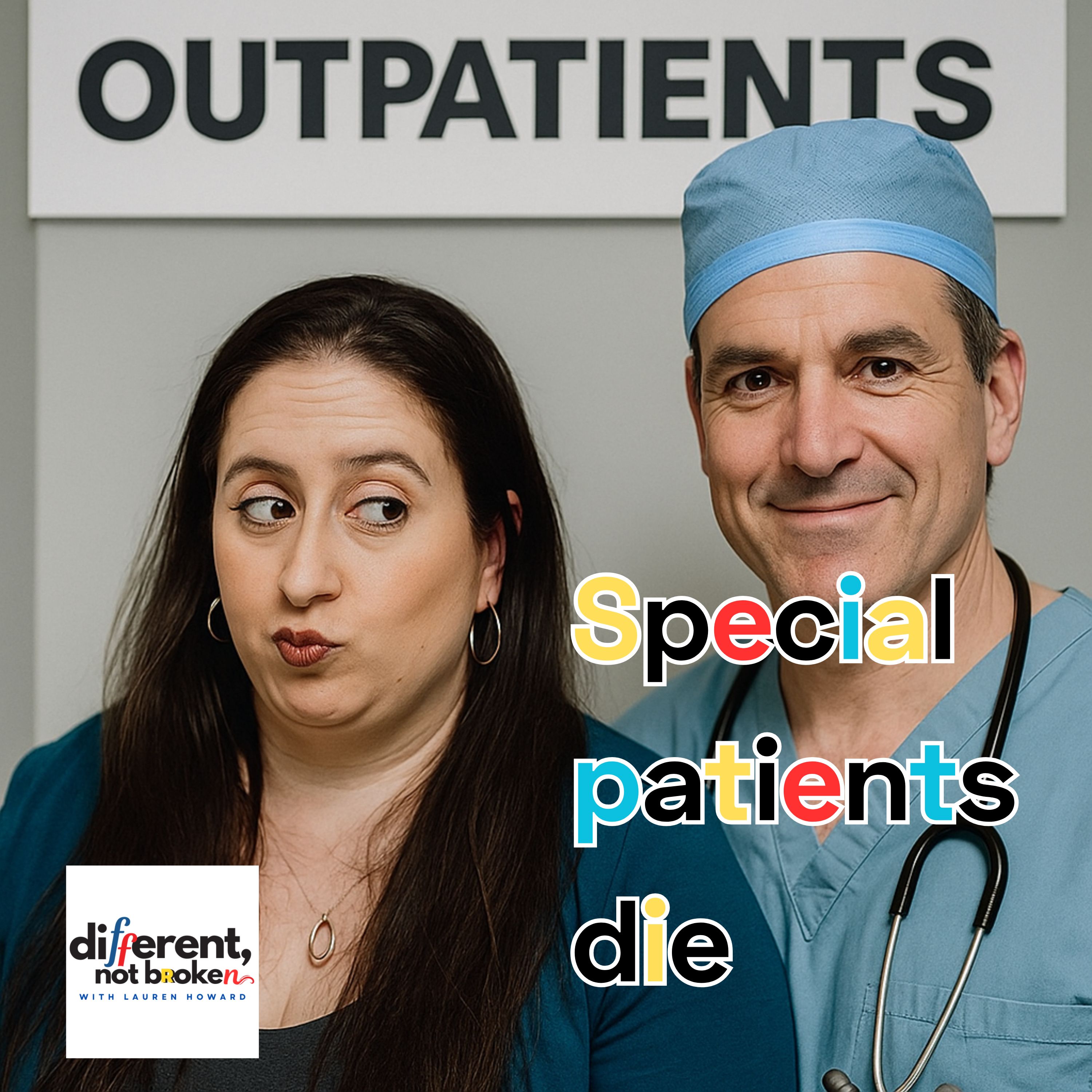
When All Else Fails: A True Story About Fighting the System and Saving My Dad
Episode Transcript
He had had chest pain on Thanksgiving and didn't tell anybody because he didn't want to miss dinner.
Your doctors are playing defensive medicine and protecting themselves and not doing the right thing for you.
That's not okay.
That's not something you want to hear from your neurosurgeon before he's planning to cut into your brain.
All right, here we go.
I'm going to pretend I'm pushing record, because that feels right.
Okay, I'm pressing record.
Boop.
Hi, everybody.
I'm Lauren Howard.
I go by L2.
Yes, you can call me L2.
Everybody does.
It's a long story.
It's actually not that long a story, but we'll save it for another time.
Welcome to Different Not Broken, which is our podcast on exactly that.
That there are a lot of people in this world walking around feeling broken, and the reality is you're just different, and that's fine.
At one point, I want to say in like, his early 70s, probably, my dad started having a lot of trouble walking.
He was a doctor, and in theory, should have had access to the best medical care around from colleagues and unaffiliated providers and just knowing the medical system the way he did.
But that is not usually the way it works for doctors.
Doctors tend to get the worst medical care, so much so that doctors will tell other doctors families to not tell people at the emergency room that your family member's a doctor.
There's a couple reasons for that.
One of them is complicated healthcare stuff.
But the other one is that when people find out that something about you could warrant special treatment, which nobody should be getting special treatment, but if they find out that your brother works in that hospital or in that ER or whatever, their inclination is to treat you differently and usually to treat you better because you have some sort of special relationship.
And that sounds great, right?
It sounds.
Oh, well, this is gonna be faster for me or I'm not gonna have to wait as long or I'll get priority service, or they're gonna pay better attention to me or care more or whatever.
Like, all of that sounds great, but the reality, what actually ends up happening is that they don't follow protocols in an attempt to give you, quote, unquote, specific special treatment.
And when you don't follow protocols, people die.
Dr.
Stevens to ER, please.
Dr.
Stevens to ER.
Thank you.
Now, are there bureaucratic reasons that protocols are in place, and do they all serve a healthcare purpose?
No.
I mean, yes, there are bureaucratic reasons.
No, they don't all serve a healthcare purpose.
Sometimes they serve Other purposes that are not helpful.
But if it's the protocol, it's the protocol and they need to follow it for you.
Even if you're quote, unquote, special.
Special patients die because you skip important steps that avoid infection, that help with, you know, making sure everything's done, that ensure that things are not getting sewed back up into you that need to be out of you.
Things like that happen all of the time.
And it gets worse when you take the protocol out.
The protocols are, for the most part, there for a reason, even though there are some that are ridiculous bloat that need to be dispelled of.
But by and large, we have protocols for a reason and special patients die.
And a really good example of this, and this sounds wild, but Joan Rivers died because she was a special patient.
Joan Rivers convinced a doctor to do what should have been an inpatient procedure as an outpatient procedure.
She was, like in her 80s, maybe even her 90s, or at least very close.
There's no such thing as a routine outpatient procedure when you're in your 80s or 90s.
Had they followed procedure and put her in the hospital for that procedure the way they should have, would they still have complications?
I don't know.
Could she still have died?
I don't know.
My understanding of that situation is the reason she died was the delay between the complication and getting her to the correct medical care that the only thing that they could do was call an ambulance, which takes time and delayed the care that she needed.
Celebrities tend to also get really bad medical care for the same reason.
Like, people will do them favors because they're famous and they have a lot of money and they want to be liked by famous people.
And as a result, they often die from really, really horrific medical care.
Somewhat different reasons.
Often it's because they get everything they want, as opposed to somebody who has no money and gets nothing that they want or gets no attention.
They get too much attention and nobody will tell them no.
But it's very similar special patients dad for like five years.
And the majority of the.
Probably six or seven years before my dad died, he really struggled with walking.
And it got progressively worse to the point where if we wanted to take him anywhere, we really had to take him in a wheelchair.
He could only walk short distances, and nobody knew why.
His legs were fine, his spine was fine.
He wasn't in pain.
He.
He just couldn't walk.
And he would also do this thing that I very distinctly remember where when he would stand up, he would take three or Four steps before he would actually start walking.
Almost like roadrunner, like ramping up.
And at the time I was like, ha ha, you look like road Runner.
Well, now I understand that that's actually in and of itself almost diagnostic for what he ended up having.
So it got progressively worse, Progressively worse.
We had trouble finding a doctor that could help him.
We took him to a bunch of doctors.
Finally, he went to a neurosurgeon who looked at him and said, that's normal pressure hydrocephalus, which means that there's a backup of cerebral spinal fluid on the brain.
Your cerebral spinal fluid is not draining correctly.
And so because of it, it impairs motor function, it can make people foggy, it can impair cognition, and also it makes it difficult to walk.
Basically, he said, you're going to have to have brain surgery, which sounded terrifying to all of us, like, are they going to have to cut into a skull?
And you.
Still a very busy practice.
He had no interest in retiring, obviously.
I heard brain surgery and, like, panicked.
He didn't care.
He was like, cut into whatever you want.
I hate living life this way.
I don't like not being able to move.
So, you know, fix it however you have to fix it.
So we started the process of.
There was like a registry we had to enroll him in.
I don't remember why he couldn't just go get the surgery.
Like, I feel like it's a surgery they do without enrolling you in a registry, but I don't remember all of the details of that.
And that is kind of unlike me because I usually know.
Know those things inside and out.
But he went in front of the registry and they got all the paperwork, they did all the evaluations in the process of this process.
It was Thanksgiving, and I don't remember there being anything specifically interesting about that Thanksgiving.
All very normal.
Now it's, you know, officially Christmas time.
Dear Lord.
Went back to work.
Got out of work early that day.
I don't remember if we just had a short day with patients or whatever, but was out with a friend of mine.
And I think my parents had doctor's appointments.
And my mom calls me and says, your dad's going to the hospital.
And I was like, why?
Like, he was just going for a regular follow up.
And she said, well, he told Dr.
Gurgis that he was having chest pain.
And Dr.
Gurges sent him directly to the emergency room because he was looking at his EKG and he didn't like the numbers.
And so we, of course, rushed over to the Emergency room.
And we were there with him.
And then I get the full story.
This was, like, three days after Thanksgiving.
He had had chest pain on Thanksgiving and didn't tell anybody because he didn't want to miss dinner.
That was the reason.
He looked me straight in the face and said, I didn't want to miss dinner.
So I didn't tell anybody that I was having severe chest pain.
He said, but then it went away, so it's fine.
And I looked at this man, whose name is followed by MD and nearly slapped the life out of him.
They do all the tests, and they said, you know, your tropronins are fine.
We don't see any indication of a heart attack, but your doctor wants us to admit you for further monitoring and to talk to a interventional cardiologist.
So they admit him.
Interventional cardiologist comes over, says he needs a stent.
Now, we found out later that the stent was not curative.
It was not treating anything.
It was just to address the chest pain, which he had only had one time ever for a very short period.
But at the time, like, it just felt like.
I think all of us were so terrified by the idea that he could have just had a heart attack or recently had a heart attack and he had had, like, a triple bypass years prior that we were like, just get the damn stent.
They put in the stent.
The stent means that he has to stay on blood thinners and anticoagulants basically forever, which was fine because he had to anyway because he had had a aortic valve replacement.
So we just didn't think anything of it.
We're like, no problem.
Whatever.
He's already on the medicine.
Well, then this goes in front of the board of deep thinkers who decide whether he can have the surgery for normal pressure hydrocephalus, which will restore his ability to walk.
And they said, well, you just had a stent put in, which means you can't come off of your anticoagulants.
We can't do brain surgery while you're on anticoagulants, so you can't have the surgery.
You're denied.
And I'm going, okay.
But the dude can't walk, and you just want him to not walk.
And they were like, it's too dangerous.
It's too risky.
My dad was upset, but he just kind of took the defeated stance.
My mother, I'm sure, was histrionic about it, because obviously, me being me, though, I went full, hey, super.
Fuck that noise.
This dude can't walk.
We have a dear friend who is an emergency room doctor.
And I was like, this is bonkers, right?
Like they're worried about him being on anticoagulants and having basically a brain bleed or a bleeding episode while doing surgery, which is a valid concern and something they should be concerned about.
But he can't walk.
And our friend said to me, yeah, well, things think about it this way, if he tries to walk and falls while on any coagulants, he's going to die anyway.
I was like, good point.
So I, my non clinically trained self went on Dr.
Internet and researched the mortality rates of people who come off anticoagulants after getting what's called a drug eluding stent, which is what he had.
And they had fairly recently done a study on it.
My luck.
Thank you.
And the study showed that the mortality rate was 7% over a year.
So 7% of people who stop taking anticoagulants die after a year of being off the anticoagulants if they have a drug eluting stent pudding.
I needed five days.
So the study, I think, had been done by the Cleveland Clinic.
It was like I felt like somebody had written a manual for me because I'm reading it going, this is literally the protocol we need.
And it took me 30 minutes of Internet searching to find it.
And all of these very, very smart people who read the New England Journal of Medicine as light reading are telling me that this can't be done.
When this literally says it can be done is right here.
So my dad's poor cardiologist.
He's a great doctor.
He was such a nice man.
I don't think he realized what he signed up for.
But I called him and I was like, can you please check your email?
And he's like, sure.
You want to tell me why?
And I was like, I found the protocol that you're going to use to wean him off of his anticoagulants onto a low molecular weight heparin, and then off of that so that he can have the surgery.
And then two days after the surgery, he can put him back on his anticoagulants.
And there's just this long pause and he finally goes, you did what?
And I was like, yeah, Cleveland Clinic did a study on it.
It shows that it's safe.
Can you review it and see if you'll sign off on this?
Because I need you to sign off on this.
And he's like, yeah, okay.
You could tell part of him was like really happy that this existed because it did mean that there was a path forward.
And the other part of him was like, God damn it.
Like, why?
Who are you, and how does this happen?
So he read it, and he called my dad, not me.
He said, this will actually work.
So I need to admit you four days early, and if they'll sign off on it, I need to admit you four days early, and then we'll do the transition.
That way you'll be hospitalized.
Should there be any indication of clot, we'll put you back on three days after the surgery.
So he said, you'll do the surgery.
He said, I'm signing off on the surgery.
Everybody else has to sign.
Sign off on the surgery.
And I swear to God, he says, I would send your daughter to handle that.
Got it.
No problem.
So we get everything in front of the board's.
Board looks at it, and the board says, all right, if the cardiologist is fine with it, we're fine with it.
Send him in.
So a couple weeks later, they booked the surgery.
They admitted him a couple days early.
I very distinctly remember showing up on the day that they were going to do the surgery.
It's a couple surgeries.
The first surgery, they put in a temporary drain that they literally just, like, insert.
Like, you can actually see it to drain off fluid that they then measure to make, you know, to see how much fluid they're taking off.
There's, you know, you're allowed to get up and walk around, but it's.
It's only in very specific situations.
You.
You have to be in certain positions.
There's risk of a really severe headache that can be fatal.
They insert the drain.
Basically, he has a nurse at bedside for, like, the better part of 48 hours, because they have to literally count how much is coming out in the process.
I don't remember if it was when they did the temporary drain or before the permanent drain.
It had to be before the temporary drain.
So they basically come in and say, we're canceling the surgery.
Like, we had been in the hospital at that point.
He had been in the hospital at that point for four days.
We had done everything they asked.
He was ready.
We were all excited because this was finally going to happen.
And they said, we're canceling the surgery.
And so we said, excuse me, what now?
And they said, his platelets are too low.
He won't clot.
And I was like, okay.
He was on an antiplatelet until four days ago.
I feel like there are solutions for this.
And they said, the interventional radiologist won't do the procedure because his platelets are too low.
And I swear to God, somewhere there is video of me walking down a hallway of a neurosurgery wing at Florida Hospital South.
That's what it was called at the time, yelling, someone get the man some damn platelets.
This is why you have a blood bank.
So I called the person who ran the registry, and I was like, I will find him platelets.
She was like, how are you going to do that?
And I was like, don't ask questions.
But either you do it or I'm going to do it, because he's having the surgery today.
So his doctor walks in, and I said, can someone get him platelets from the blood bank?
And he goes, yeah, why didn't we just get him platelets from the blood bank?
And I'm like, I should not be the one pointing these things out.
So they go, get him platelets.
Someone get the man some damn platelets.
The nurse, who is very sweet and who to this day is one of my favorite nurses he's ever had, went over to my dad because at that point, he had been NPO for, like, literally 28 hours or something.
And she was like, can I get you something to eat, since they're not going to do the surgery today?
And I was like, I swear to God, if you put anything in that man's mouth.
She just kind of, like, backs out slowly.
And I gave her a big hug and apologized to her later, but she was like, I get it.
I get it.
I do.
I just.
I had to take care of my patient.
And I was like, I will take care of your patient.
Trust me.
Anyway, so they went and gave him platelets.
45 minutes later, his platelet numbers are fine.
We go down to talk to the interventional radiologist.
Interventional radiologist says, oh, you're the troublemaker.
And I was like, nice to meet you.
You're gonna do it, right?
And so he walks us through the procedure.
After the procedure, he said it was the easiest one that he had ever done, that it just worked perfectly.
And I was like, mm.
Mostly I was like, because you are scared into precision.
Anyway, he had the drain in place for, like, 12 hours before they were like, all right, we're going to get up and walk now.
He walked down the hallway like there were no problems.
Like, he had not been bedridden for five years.
It wasn't bedridden, but it was close.
It was like watching his whole life come back.
And so they were like, okay, this is a good sign.
We're gonna do two more test drains and then we'll put in the full drain.
Great, awesome.
They put in the full drain, discharged him basically from like an outpatient unit, which was kind of wild.
They put in the permanent drain and I think they only monitored him for like an hour.
And then he was sent home like it was, it's quote unquote brain surgery.
But it was actually like really, for all intents and purposes, minimal surgery.
My dad was left handed.
Both of my parents were left handed.
Somehow they got three right handed and one fully ambidextrous kid.
Guess which one is fully ambidextrous.
No left handed children among them, however.
But his neurosurgeon comes in fairly shortly before the initial drain, the temporary drain placement, and goes, larry, are you left handed?
And he goes, yeah.
And the doctor goes, oh shit.
Like, it's just not.
Of all the things that could come up, that's not the one you want.
So it turns out that 20% of left handed people have their language functions for lack.
I don't know what the actual word is.
I don't remember it in the opposite side of the brain.
Right brained people almost always have it on the same side.
20% of left handed people have it on the opposite side.
And if you don't check first, you could accidentally leave somebody without speech if they're in the 20%.
So they had to take him before they did the surgery and do like a last minute test that tells them what side has his language functions.
Of course he was in the 20%.
Of course he fucking was.
So thank God they checked.
Just know that your neurosurgeon saying oh shit before he cuts into your head is not an experience you want to have at all.
Full stop.
They discharge him.
And I just have this very distinct memory of looking up from whatever my phone, my computer, whatever I was looking at.
And my dad, who had been all but in a wheelchair for several years, is standing in front of me, thumbs looped through his belt loops, the way he had stood his whole.
Like every time that I remember seeing him stand, this was the stance.
And I had not seen it in so long that I had forgotten that it was the way he did it.
They say, all right doc, you're ready to go.
And they try to pull up a wheelchair and this man looks at me and goes, oh, no, no, no.
He's like, I've been in one of those for several years.
No, no, I'm walking.
And so I have video.
I still to this day have the video.
Of him walking out of the hospital.
And he walked just like normal.
You would never know that Five days before, he literally was not able to get his feet under him.
It was just like, get the fluid off the brain.
And then all of a sudden, everything returned.
He had some muscle atrophy issues because he hadn't used them in so long that his stamina wasn't great.
But his ability to stand up, his ability to walk, his.
All of it.
The surgeries that they did, I think each took 20 minutes.
Like, it was that fast.
It sounded scary.
Cause it was brain surgery, but it really was just like inserting a tube above the brain that drains things off the brain.
And then the other end of the tube went into the stomach to drain off the rest of the fluid.
Anyway, so he had, like a.
He had like, a bump.
Like, they.
They shaved half of his head.
And we said, like, can't you shave his whole head?
And they were like, we're doctors, not barbers, so, no, you have to do the other side.
And I was like, okay, fine, whatever.
So he did go home and appropriately shave the rest of his head.
So he didn't have hair.
Like, he didn't have much hair to begin with, but you.
There was a difference.
You could tell.
And there was a scar there, obviously, because they had just cut into it.
And it wasn't even that bad a scar, but it was a scar.
It was noticeable.
And it probably.
Like, we probably didn't want to tell people that he had been in a bar fight.
So we just decided that maybe.
And they were like, you can go back to seeing patients in a week.
Like, there's no.
You know, he was.
They're like, if you feel fine, there's not really a recovery period here.
Just don't overdo it.
Don't do more than you would have done before.
And so, like, a week later, he was back to seeing patients.
But he wore a hat.
He got like this, like, I don't know, like, page boy hat thing.
And he wore that.
And it was.
It was kind of cute.
But he didn't take the hat off just because he didn't.
I don't know that a lot of people want to see their psychiatrist with a giant scar on his brain.
And so he would see his patients.
He could type better.
He was able to get up and hand charts back to people.
He would do dishes at home.
It was like all this little stuff that, like, everybody's, like, not pleased about doing that.
He was, like, so happy to be able to do again.
But anyway, so every time he saw patients, he wore a hat.
And for the most part, nobody said anything about it.
And sometimes people would come in and say, I like your hat.
He would say, thanks, I like it, too.
It was probably a month after he went back to work, maybe not even.
This woman comes in, and she does not stop crying the whole time.
And it's the psychiatrist's office that happens sometimes.
Every word out of her mouth is like a gulp of air as she's trying to tell us what's happening.
And I couldn't get very much out of her before she went in for her actual visit.
And so I tried to do her intake, and I was able to get most of the things I needed out of her for her intake, but she was just so, so emotional.
And it turned out that she had just left her neurosurgeon's office, and she had horrific, horrific pain in her neck that was caused by, I want to say, some sort of pinched nerve or something that had to be surgically relieved.
The only way that the pain was going to go away was surgical relief.
The problem was that she had severe cardiac issues, fairly recent cardiac intervention, and was on anticoagulants.
And she had gone to a bunch of doctors, and all of them said they wouldn't do the surgery because it was too high risk because she was on anticoagulants.
And so I walk into his office.
I put the chart down.
I had gotten her story prior.
I put the chart down, and I looked at him, and I was like, you're not gonna believe what this woman's story is.
And he says, I mean, I believe you, but do you want to tell me?
I was like, okay, fine.
So I explained that she's in severe pain all the time.
She went to, like, her last hope doctor, and the doctor said he wouldn't do the surgery because it was too high risk because she was on anticoagulants.
And I was like, I didn't tell her, but I think you should.
And he was like, oh, no, I'm going to handle this.
And so she walks in and sits down, and I will never.
He looks at her, and he says, I'm gonna do something that I don't do.
I'm gonna take off my hat.
And he takes off his hat, and you see this giant scar.
And she kind of.
She kind of reacts a little bit to it, but she's still crying, tearful.
And he says, I recently had a procedure to put a stent in to drain fluid off my brain because I was Having trouble walking.
And it really was.
It got to the point where either somebody fixed this, or I don't wanna live anymore because I can't live my life like this anymore.
And when I got to the finish line to have the procedure, they told me no.
For very similar reasons.
You ended up here because I have the research, the documentation, and the doctors who will do it.
I'm gonna go talk to my team.
I'm gonna go give them some marching orders.
Your doctors are playing defensive medicine and protecting themselves and not doing the right thing for you.
That's not okay.
And we're gonna get this straightened out.
And she said, but I came to you because I'm depressed.
I didn't come to you.
I have pain.
And he goes, what's the difference?
Would you be depressed if you didn't have pain?
Would you be depressed if you didn't just get told no by the 10th person?
And she goes, no, probably not.
And he goes, that's not a depression.
That's a reasonable reaction.
People are not helping you, and you need help.
So he walks out his new trick walking.
And he says, I need this doctor on the phone, this doctor on the phone, this doctor on the phone.
I need this imaging for her so I can send it over to them.
I need these three things done, and I need the documentation that you got from the Cleveland Clinic.
We put it all together.
We sent her to his doctors.
She came back a week later, before she had even had anything done, before she had even had anything done.
And she was like a different person.
And he said, you look like a totally different person.
Like, did they figure out.
You know, did they figure out anything?
And she goes, well, no.
I mean, I'm going to get scheduled for surgery, but I feel so much better.
And he says, so the pain's better?
And she goes, oh, no, no, the pain's still terrible.
But, like, there's a chance I'm gonna get to live my life again.
Like, that's genuinely all I care about.
It would have been really easy for him to say, well, we have to listen to my colleagues.
My colleagues say that they can't safely do the surgery.
But he had been there a month before, a month before.
Like, how does that happen?
How does this.
This person end up in his office literally a month after we did that?
And he had resigned to the fact that if this didn't get fixed, his life was over and he was miserable.
She came back a totally different person.
Not because he did anything.
He did do things.
He set the whole thing in Motion.
And he did a heroic amount just because he happened to have the access and the ability to do those heroic things.
But he didn't physically do anything.
The only thing he actually did for her, aside from coordinating some of these things that other people would not coordinate, is listen.
And by listening, gave her back the hope that she had lost by talking to this other guy the day before who had taken away her last shred of hope that this would actually get better.
She did end up having the surgery.
I wanna say he actually put her on a tricyclic antidepressant before that.
Not for the depression, but because it also has efficacy for pain.
And that was the first thing, the first pain medicine that actually helped her.
But I also don't know that it had anything to do with the medication.
I think it had everything to do with the fact that she felt like somebody actually gave a shit, which is sorely lacking in a lot of things that we do currently.
She came back, I want to say within six months, she had surgery.
Within seven or eight, she was back to living her life, happy as a clam.
She kept coming back.
And like, psychiatrists don't usually treat happy people.
It's like once people are back to baseline, they usually tell you to get bent and leave nicely.
But she didn't.
She was like.
She loved coming in just to say hi.
And we really weren't doing anything for her at that point.
But our office represented the turning point between having absolutely no hope, wandering into the office for the one person in the world that literally had the skills, the provider, the understanding, and the know how to get this done.
For her, all he had to do is take off his hat.
So when all else fails, take off your hat for this week's small talk again, remember, this is something we do every week.
My kids are in a tooth losing phase and not because anybody's knocking them out, which is both great.
And, I don't know, it does look a little bit of a disappointment, but it's fine.
And for some reason, when one of them loses a tooth, they're two years apart.
When one of them loses a tooth, the other one loses one within, like a day.
It's just been, like, constant.
And so it does look like we are letting them punch each other in the mouth because of the number of missing teeth between the two of them.
But it's just the way it's working.
My youngest lost a tooth that we knew was going to come out because she had been messing with it nonstop and talking about it nonstop for, like, Two days.
But that same night, actually, after I went to bed, my oldest lost a tooth that had been kind of bugging her for a while, but she's less fixated on things.
And so neither of us realized that she was getting ready to lose tooth.
So we had prepped the appropriate things for the initial tooth losing, and then the secondary tooth losing had to happen without me because I was already asleep, and I didn't know what happened.
My husband did.
I did not.
So my oldest comes down the next day, and she says, mom, look.
And she shows me that she lost a tooth.
And I was like, oh, that's so cool.
Did the tooth fairy come?
And she says, yeah, tooth fairy came.
I was like, awesome.
Then she came in later.
She goes, I don't know.
I think the tooth fairy must have found out about my tooth late because she only left me $1.75.
And I was like, was she supposed to leave you a different amount?
And she goes, well, usually I get $2.
She'll leave me $1.75.
And I was like, maybe that's what people are getting for tooth that day.
I don't know.
Is it a problem?
And she goes, no.
I'm glad she brought me stuff.
But, you know, it was just weird.
I don't know.
It felt like maybe she ran out or something.
And I was like, okay.
So that part comes out of her mouth, and I just happened to.
She was standing next to my desk, and I just happened to kind of turn and look at her as she said it.
She was fidgeting with something in her hands, and that part comes out of her mouth, and then there's just this, like, fleeting thought that you can see pop across her head, her brain.
She looks at me and goes, wait, is the tooth fairy even real?
It was like getting punched in the stomach, and I was not prepared.
I was not ready.
I'm usually, like.
I usually have a speech plan for all of these, like, seminal life moments, and I was not there.
I did not think we were going there from.
I got shorted a quarter.
Like, that is not what I thought was happening.
And I'm usually, like, really good on my feet.
And I just went, what?
And she goes, I don't know.
It's just kind of weird that I only got $1.75.
I don't know.
And I went, that doesn't seem like a reason for somebody to not be real.
She just kind of gave up on it very quickly and walked out.
And I was like, oh, my God, we're there.
We're there.
We have deductive reasoning skills, and we're using them.
And I was not prepared, and I don't know what to do.
Oh, God.
Christmas is only a couple of months away.
I'm Jewish.
I don't know how to handle this.
If she figures that out, my entire life is over.
She is officially too old.
I can no longer be her mother.
Oh, God.
I genuinely felt like I got punched in the stomach.
I went up to my husband and not knowing if the kids were any or shadow at all, I said, hey, did the tooth Fairy give her $1.75?
And he goes, yeah, that's what the tooth fairy had.
And I was like, okay, so if you could just let the tooth fairy know that the non round amount got some little wheels turning and we might have a situation now.
And I got to see the same thing go across my husband's face that I had just experienced.
And he was like, no, no, no, no, no, no, no, no.
We're not ready.
I will say that we have kept them.
She's older than she should be, but they're still homeschooled and they aren't around a lot of children who will crush their dreams.
And so it doesn't come up very often.
We've gotten them for longer than I think most families do.
But I was not prepared.
And I swear to God, it was like watching the innocents just, like, escape from her little brain.
And I was just like, oh, no.
I wasn't ready for the reasoning skills.
Take them back.
I don't want them.
I've dealt with the height.
I've dealt with the sassiness.
I've dealt with the edge.
I've dealt with the eye rolling.
I was.
I did not sign on for deductive reasoning skills.
We are not ready for that.
Take them back and bring me back my little squish baby.
So if you need me, I'm gonna go cry in the corner and sing Sunrise Sunset while I figure out how to, I don't know, turn back time.
Cause I'm not ready.
I'm not ready.
Thanks for being here, guys.
Have a good day.
Love you.
Mean it.
Oh, he's back.
And he just licked my entire arm from my wrist to my elbow.
He dragged his tongue across it.