Car shopping in Florida is a scam — I have receipts!
Episode Transcript
So I made a fake email address.
I feel like somebody has sucked all the joy out of my life.
I'm literally asking to pay.
I want to give you money, but I don't want you to lie about it in the process.
And I'm like, I'm just gonna get a bike, because fuck this.
This is awful.
All right, here we go.
I'm gonna pretend I'm pushing record, because that feels right.
Okay, I'm pressing record.
Boop.
Hi, everybody.
I'm Lauren Howard.
I go by L2.
Yes, you can call me L2 every.
Everybody does.
It's a long story.
It's actually not that long a story, but we'll save it for another time.
Welcome to Different Not Broken, which is our podcast on exactly that.
That there are a lot of people in this world walking around feeling broken, and the reality is you're just different, and that's fine.
I need to replace my car.
There were a handful of things that we did not consider well when we adopted house horses, and one of them was transporting the house horses, which to me, like, I just throw them in the backseat and let them wreak havoc all over each other.
I don't care.
My husband's OCD does not permit that.
We need apparently, more order and less slobber all over every corner of the car, to which I'm like, I have a car.
I'm gonna use it for whatever car things I need it for.
And he has this thing about not having dog slobber everywhere, which I understand in theory, but, like, does life really allow for that?
Like, when you're just living your life, do we have that much time to worry about dog slobber?
So we are car shopping, and I know that car shopping is a universally miserable experience, at least in the US I don't know if it's better anywhere else in the world.
I hope it is.
I hope that.
This is, like, shitty healthcare.
This is just, like, a thing that we have.
But it has been, like, every time we go through another day of it, I go home, and I feel like somebody has sucked all the joy out of my life.
I'm like, I'm just gonna get a bike, because, fuck this.
This is awful.
It's always like, basically, now you buy a car via email, which is fine.
Like, you shouldn't go to the dealership and just buy a car unless, I don't know, it just is not a thing you should do, because you will get screwed.
Even negotiating by email is just a bloody nightmare.
And I realized that it's that it's just this, like, it feels like a minefield.
It feels like you're walking into a minefield every time you have to have these conversations.
And no matter what is happening, every time you turn around, somebody's standing there waiting to screw you over.
And I do not exist well in those environments.
Like, if you come to me for a service, I'm going to tell you exactly how much the service costs.
I'm going to tell you why it can't cost less.
I'm going to tell you the ways that maybe it could cost less if these things happen.
I'm going to explain to you your insurance coverage I'm going to do.
Everything's up front.
There's nothing hidden.
I'm not going to.
There's no way that I can change.
Like, the things are the way they are, what they are.
And I know it's not always that way in healthcare, but that is just the way that I have to operate.
And I have realized in the last several weeks that being forced to operate in a existence that does not work that way is bad for my mental health.
Among other things.
Like, holy shit.
So you email and the first thing that they want is to get your phone number.
First thing they say is, well, can you give me your phone number and I'll call you.
No, because then you're gonna harass me by phone and I know you're gonna harass me by phone and you're gonna text me constantly.
So I made a fake email address.
It's not a fake email address.
It's a really address, but it's an email address that is the only, like, I don't use it for anything else.
They're not gonna get any information from it.
It's not in their systems or if it is in their systems, it's because of the last time we went car shopping.
And I actually have a couple of them now because for some reason, like a bunch of the emails weren't going through.
And so I was like, well, I can just test it out with a new email.
I even made only a fake name to see what happens.
Anyway, I'm like incognito, trying to shop for cars, so these people don't bother me.
But I do have an old email that I use very infrequently.
So I was like, well, I don't really care if they have that one.
And so I used that one for a couple of requests to get more information.
And literally as soon as I sent it without, I don't put my actual phone number on anything.
As soon as I sent it, I was getting text messages.
So it's tied to my email in somebody's system somewhere.
Some giant CRM has my phone number in it when this email is attached to it.
And so like literally the second I send the email saying I would like more information, it gets into their system.
I get a text message saying, steve from blah blah, blah blah would like to text message you about your request.
But I'm like, how did you even get my phone number?
So that's exactly why I don't give them my phone number.
Thankfully these are opt out texts, so I can like immediately just say stop.
And for the most part they have not repeated.
But like, no, I'm not giving you my phone number.
If that's the way that you behave.
As soon as you have my phone number, I'm not, certainly not giving it to you again.
They say like, can you send your phone number?
We can, we can resolve this in a quick call.
And I'm like, there's nothing to resolve.
What are you actually charging for the car then?
They don't want to give you what they're charging for the car.
If you ask for numbers on, at least because of our businesses, it makes sense to lease, though I'm not sure that that's what we're going to do.
They act like there are not places on the Internet where you can figure out what reasonable lease numbers are.
Like, where you can literally put in the VIN for the vehicle and they'll be like, this is inexpensive, this is medium, this is high.
And they're like past high.
They're like hundreds of dollars beyond high.
So they send numbers and you're like, what insane planet did you get these from?
What turnip truck did I supposedly fall off of?
So like, it is literally like, it feels like I'm sending my information out into a world of people who are just waiting to be predators.
Occasionally you'll find somebody who isn't that.
And I'm sure there are lots of really honest car salesmen out there.
I would like somebody to make a fucking list because I will just go buy my cars from there.
No, even, like, there's a dealership that we know really well where we bought a number of cars from for different members of our family not that long ago.
The guy who owns it lives screaming distance from me.
Oh, hey, did you want to buy a new Chevy?
And even like, literally I could walk out the front of my house, scream, and he might hear me.
That's how close he lives to me.
I didn't know that before we walked to the dealership, but he lives right there.
And they sent us numbers on a car a couple days ago after we bought multiple cars from them.
And it's the same fucking thing.
I get it that everybody wants to make money, but, like, if you.
The only way that you can make money is by blatantly screwing people over, just go away.
I don't.
I don't want you breathing my oxygen.
You are poisoning my oxygen.
And go have your own poison oxygen over there, which is down the street.
And not.
He doesn't listen to this, so it should be fine.
So, anyway, so we went to another dealership over the weekend.
Really, at this point, we're just trying to, like, knock things off the list because I know what I want, but the numbers that I've gotten for it are so insanely astronomical, like, beyond unreasonable when I say almost a thousand dollars more a month than is reasonable to pay for this vehicle.
So we went again, because Kyle was like, let's just make sure this is what you really want, because if it's what you want, we'll figure it out.
Like, maybe we have to go out of Florida.
Maybe we have to order it.
Maybe we have to have it shipped in.
Like, what?
He's like, we can do that, but let's make sure it's what you want.
And so we go there.
I look at the car, and I'm like, I really think this is what I want.
I really do.
And he's like, okay.
And I didn't say it in earshot of the guy, but of course the guy is like, do we want to, like, try to figure out a deal?
And I'm like, okay, well, now you're already pissing me off because, like, just, no, I don't want to wheel and deal with you.
I want you to actually give me the actual numbers.
And then again, this goes back to the same thing.
People think Kyle's the mean one because.
I don't know, maybe it's just because of his face.
I don't know.
But people think that Kyle is the mean one, and so they worry about him.
And he's not the mean one.
He's actually the very pleasant one.
I'm the mean one.
I'm never actually mean.
I'm just very direct.
If you say something that is blatantly not true, I will point out that it is blatantly not true.
And that apparently does not sit well with car salesmen.
I'm just.
I don't know.
I just feel like if you don't want to be called out on saying things that aren't true, you should not say things that aren't true.
I've talked to a lot of really, really nice, pleasant car people in the last several months that we have been looking for a car.
We've gone to a number of dealerships.
A lot of the people who are like answering the door or like grabbing you to show you cars are just like entry level people.
They have no responsibility for anything.
They're not responsible for the numbers.
They can't make deals.
They're really just there to show you the cars.
They want to make sales.
It's a shitty job if you're not good at it.
It's awful.
It's really high turnover.
It's really high pressure.
And for the most part, the people that we've dealt with have been like, absolutely delightful.
Now when you get to their managers, less delightful.
And we haven't done a whole lot of negotiating in stores because it's just like these people are going to actively try to screw us over.
So if you leave, you actually have more bargaining power than if you stay there trying to buy the car.
But the point is that we still haven't bought a car because the process is so demoralizing.
I just can't commit to any of it because the car that I want for the numbers we're getting is way too expensive.
I'm not going to spend that much money on a car.
If we go by the assumption that I have to put shoes on to drive a vehicle and you look at the amount of use my shoes get, I don't need a car that bad and I don't need to spend a bunch of money on a car because I don't even know where my shoes are right now.
And it will probably be days before I find them.
They don't get a lot of use.
I remember being like 16, 17, 18, and like really loving shoes.
And I would buy all these different shoes and always match my outfits to my shoes.
And it was like a whole.
It's a whole ass thing.
And now I'm like, you want me to do something that requires shoes?
I don't.
No, I don't think I have that in me today.
That's like a clear sign that this is not happening today because I'm not gonna put on shoes if I can walk outside barefoot.
Cool.
I do that all the time.
I am that barefoot neighbor.
But no, we are not in the 40 pairs of shoes era of our life anymore.
We're on the please don't ever make me wear shoes.
That's so much work.
I don't like it.
So anyway, if we use that as the barometer for how much I need a car, it's not a lot, but we still do need to get the second car, because when you have two children, there are times where people need to be in different places at the same time with a capable adult.
And so we do need to get the second car, but it doesn't make sense to spend money on it, or a lot of money, at least, because, like, again, I have this whole shoeless thing going for me.
So we get the numbers, and the numbers are always way too high.
And I know what the numbers should be.
So this person is clearly lying to me, and you say, your numbers are high.
We need to be here.
And they say, oh, man, I can't get to that.
And you're like, you can.
You just don't want to.
Okay, fine.
I'm gonna go somewhere else.
We have had a couple of them, like, get close.
But, like, by the time I've gone back and forth with you 75 times to get you to just tell the truth, that's all I want you to do.
I'm not asking you to give me a great deal.
I'm not asking you to break any rules.
I'm not asking you to give me anything for free.
I'm literally asking to pay.
I want to give you money for a vehicle, but I don't want you to lie about it.
In the process, everything falls apart.
It's like the anthropomorphizing of dishonesty, and it makes me so uncomfortable.
And every time we get done from a day of trying to figure these things out, doesn't matter if it's online or in person, I'm like, I'm just gonna get a bike.
Because I just.
I'll just go to the store down the road, and I'll pay them $179, and I will get a functioning bike.
And nobody.
I don't have to haggle with anybody.
I'll throw a kid on the back, or I'll just get another bike and put the kid on it.
I would literally rather teach my kid to ride a bike without training wheels than deal with more car salesmen.
And to be clear, it's not the salesmen that are the problem.
Every one of them supposedly has a manager that makes these decisions.
And all of your managers are buttheads.
It is the worst experience, and I don't know how to fix it, because I assume that if I let big industry fix it, it will get fixed to the advantage of big industry.
Like they're not going to make cars cheaper for me.
And then you have all these websites now that are supposed to fix it.
Like they're supposed to tell you what to pay for a car.
Anybody that you talk to who can actually sell you a car is like, nah, that's not true.
And you're like, no, but I think based on the data they have, it is true.
And they're like, no, don't look at that.
Don't look, look away.
Don't look at that.
No, don't be informed.
That's no good.
So if you live in a state where this is not a thing, let me know because I'm going to come move there.
Because I do think it might be worse in Florida than it is in most places.
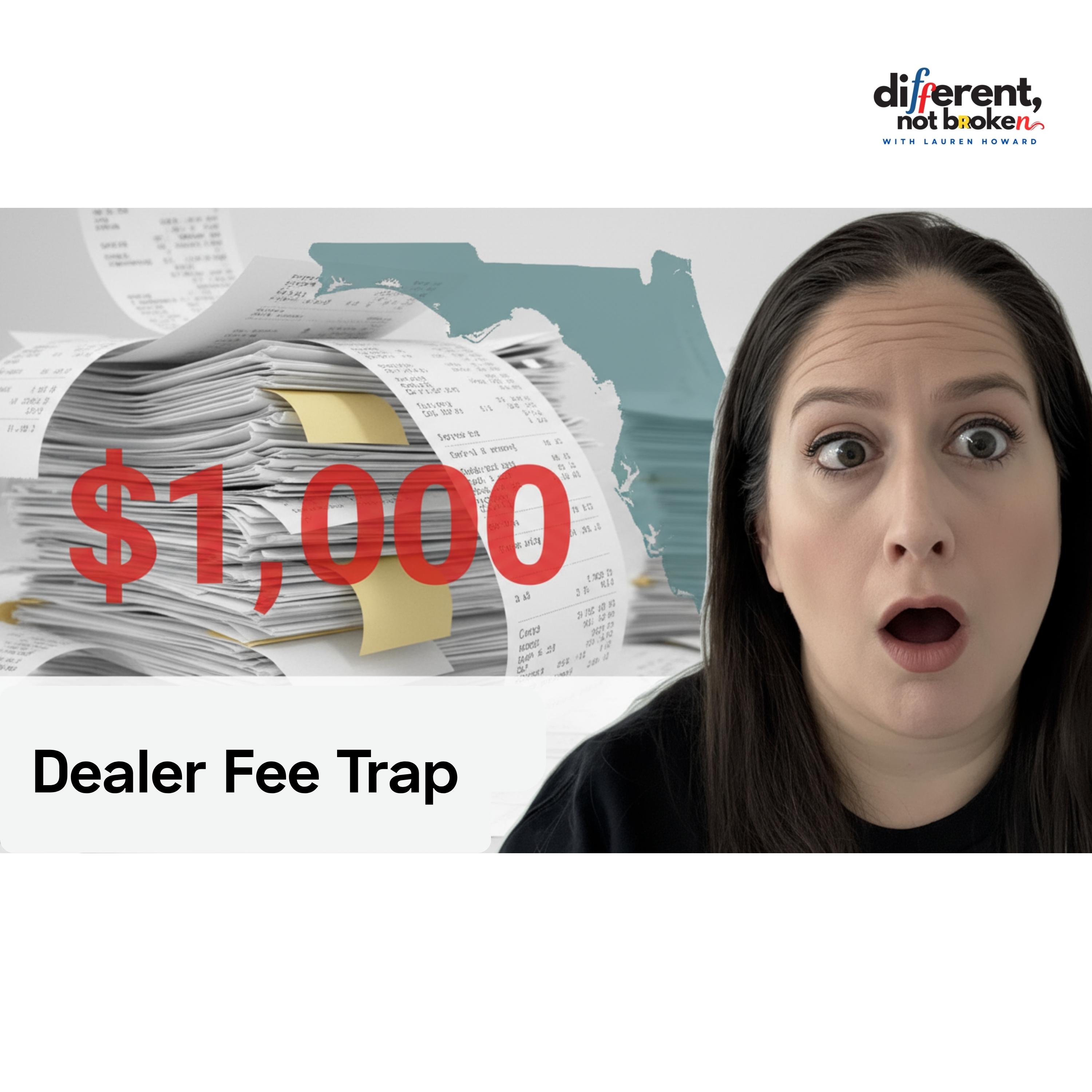
Cause not only do we have like thousand dollar dealer fees here where you just have to give the dealer a thousand dollars for existing, they tack it on and you can't get around it.
Years ago there were dealer fees and it was like 3, $400, which was still a lot of money, but like now it's like $1,1200.
And it's just money you're handing them.
It doesn't do anything because they make money off the car.
So.
But they also, and this has been a thing for a long time, but it has also gotten very expensive.
They also put on their aftermarket packages of very important stuff like pinstriping and tint and shit.
I never asked for that.
You have no choice but to pay $2,000 for before you can get the car.
You either wrap it into your financing or you pay it, whatever.
And like the number of dealerships that it's like, here's the MSRP price, here's the added packages from the dealer.
Oh, and we also, you know, we at.
But Fart Honda have added pinstripes and fancy air to the tires and we had it kissed by a sea witch.
That's going to cost you $2,000.
My steadfast steed of the shore, you carry the tides with grace.
And I'm like, I don't, I'm not going to pay for that.
And they're like, well you have to or else you can't have the car.
And they're like, well then I guess I'm not getting a car.
Because first off, the number of cars that they add this pinstriping package to that don't actually have pinstripes.
They didn't Put the pinstripes on the car and then they charge you for it.
Not that I want pinstripes, because I don't, because this is not 1997, but multiple vehicles that we looked at over the weekend had a pinstriping package on them that all together was like 1500 or $2000.
And I think of them, two of them actually had binstripes.
So they're literally just like, give me all your monies.
And we're gonna say that there's something important that we put in the car, but we're not actually gonna do it.
Like, this is literally just a money grab because you're not gonna check to see if the car actually has pinstripes.
We're just gonna assume you don't have eyes.
So anyway, if you live in a state where that is not the case, I doubt it.
But if you do, let me know what state that is that I need to move to, because I would like to have fewer headaches trying to just buy a stupid car.
Also, maybe I don't buy a car.
Maybe I get a bike, or maybe, maybe I'll get a four wheeled motorcycle with a sidecar because that's street legal and you can put a kid in it.
And now we'll go to Allison, who has this week's small talk.
I always feel like I'm doing therapy wrong.
How do I know if the therapist is actually treating me?
How do I know if there's healing at the end of it?
Does therapy actually end?
What is the metric for success?
Just because I have a diagnosis, does that mean I actually need treatment?
Where is the balance between mental health treatment and physical health treatment?
There were a lot of questions there, and all of them are very, very good questions.
And I want to preface all of them with the fact that I am not a therapist, I'm not a psychiatrist, I'm not a clinician.
I didn't go to any of the fancy schools to get all of those designations.
I'm just like a person who runs her mouth a lot and has worked in mental health administration a lot and was raised by a psychiatrist, which makes you kind of acutely aware.
There are other things that make me very acutely aware, but those are for another trauma dump.
So with that preface, there's one thing that you said that I want to start with, actually.
So does having a diagnosis mean you need treatment?
And this is true of almost any diagnosis, not just mental health treatment.
No.
There are plenty of diagnoses where the right intervention is no intervention.
There are plenty of Mental health diagnoses that are not really affecting you in any way.
And so you decide that no treatment is the right solution.
You know, we have people come to us all the time and say, like, do I need an autism diagnosis?
I'm pretty sure I'm autistic.
Do I need to go get a diagnosis?
And my answer is always, I don't know, do you?
Because that's not for me to decide.
It's not for a clinician to decide.
You have to decide what the reasons that you would seek diagnosis are and if those are worth it to you.
So we tell people if you need accommodations, if there's access to services that you need, if having a validation from a clinician would matter, if those things, if there's not a reason and the end result is just going to be, you have a piece of paper that says a thing, then save your money, do something else with it.
I don't know that that's valuable to you.
And you can always do it later.
It's not, you know, it's not a thing that is necessarily going to change your life in any positive way if you don't have a reason for doing it.
Validation from a clinician is legitimate.
I want to be clear about that.
You don't need validation from a clinician.
Self diagnosis is valid, but some people don't feel like they can begin that journey until they sit down with somebody who confirms their suspicions or tells them otherwise.
And so if that's what you know, that's a real reason to go.
Just because it's not going to result in some giant change of lifestyle, it's still a real reason to go sit with a provider and get a diagnosis.
That said, there are so many situations where in any illness, the right thing to do is nothing.
And that's between you and your clinician and your family and whoever's involved.
One of the things I will say, and this is one of the harder parts of being in mental health treatment, this is something my dad always used to say, the person who's suffering is the patient, and sometimes that is not the sick person.
So let me explain what I mean there.
So if you have a family and everybody in the family is really, really struggling because one member of that family is a drug addict and is in active addiction and everybody else is made miserable about it, but the drug addict is fine with it and is not interested in changing their behavior, then the patient there is not the drug addict.
It's the family, because the family's suffering.
Somebody in the family who needs help, they go seek assistance for what they're going through, even though it's technically precipitated by someone else in that situation.
For the quote unquote sick person, the right intervention is no intervention.
Because the person doesn't want treatment.
You can't force them to get treatment.
You can't convince them to get treatment.
You can't bribe them to get treatment.
None of those things work.
The sick person is not the patient in that situation.
The patient is the person who knows there's a problem and wants to get better from it.
There are times where a clinician will say, this needs intervention.
And the patient will decide, no, that's the patient's right.
They get to do that.
And so that's also a situation where no intervention is the right thing, even though clinically it might not be the right thing.
That was the patient's decision.
I won't say that therapy ends, but there are natural, maybe not natural, there are pausing points.
There are points where you decide that you would like to go action on the things that you've learned over an extended period of time without repeated intervention.
And that's kind of a progression of the therapeutic process.
Are there people who've been in therapy for 10 years, 12 years, 15 years continuously?
Yes.
I won't say that that's good or bad, but, you know, I had a friend.
I had a friend come to me probably three or four years ago and say, I think I need to find a new therapist.
I love my therapist.
I think we've gotten to the point where she knows me too well now, and it's time to move on to somebody who can kind of challenge me in new ways.
And her concern was like, how do I break up with my therapist?
Which is like a real thing.
That's a thing that people have to do sometimes.
And I think she thought I was going to hand hold her through that process.
And I think I actually eventually did so because that was what she wanted.
But my question was, why do you need another therapist?
Like, what's going on in your life that you feel like you need additional intervention for?
And she was like, well, I just want the support.
And I was like, for what?
Because, like, you go to therapy to treat something and if you still feel like you need the support, what is the support for?
And she couldn't really verbalize it to me.
She just didn't know.
She just had gotten so comfortable with the idea of being in therapy.
She wanted to go find new things that she could work on and improve on.
And I'm like, I don't know that that's therapy.
I don't know that that's what that's for.
We did find her a new therapist.
I think she's been with them a long time.
She's doing well.
But that you can graduate from therapy.
You can grow out of therapy.
You can grow out of a, a therapist.
You could decide to take a break.
You can decide that maybe this isn't right.
If you're not certain that you're getting something out of therapy, maybe it's not the right therapist.
This sounds really awful, but if you don't leave therapy feeling either way better or way worse, there's probably something amiss.
I don't want to set the expectation that therapy makes you worse, because it doesn't.
And I'm a big believer in therapy.
But there are times you're gonna go to therapy and it's gonna be like ripping a band aid off and you are gonna feel like every ounce of you has poured out onto the floor and you are just picking it up in a bucket with the hopes of putting it back where it belongs.
It will rip you open.
And that doesn't.
It's not like you get to time at the end of a 45 minute therapy session and now all of your insides go back where they were before.
That's like the work takes time.
It takes time between sessions, it takes time to recover from.
It takes all sorts of parts of you, both physical and emotional, that don't happen in the session.
And so if you leave therapy feeling worse because you're doing work, not because you feel like you're not being heard by your therapist, not because you feel like your therapist isn't connecting with you or you disagree with them fundamentally on some things.
If you leave feeling worse, that's kind of like when you go to the gym and feel sore the next day, that's a sign that something's happening.
Now, if you go to the gym and you can't walk the next day because you injured yourself, that's not what we're going for.
Soreness means you exercised, injury means you did something wrong.
It's kind of the same thing.
We're not looking for injury, we're looking for soreness.
We're looking to build muscle memory.
We're looking to create new patterns.
And that requires a lot of work.
Your therapist also should just be able to make you feel better about some stuff.
Like, there are gonna be times, and your therapist will know this, there are gonna be times where you just need to feel better about a situation.
And if you say it to your therapist and they confirm that you're right about the way you handled it, or that yes, that person is doing exactly what you think they're doing and I'm sorry for that.
Or have you thought about this?
Or have you thought about how this is not your fault because of X, Y, Z, or that's not how these patterns work.
And here's why.
You're probably going to leave that session feeling a lot better and getting validation and getting support and.
And that's what you're running out of therapy.
If you leave therapy every time feeling like you talked about the same stuff and it wasn't super actionable, you're not sure how it's helping you, then it might be time to either take a break or maybe look into finding a new therapist.
That doesn't mean that you're not getting something from it.
It just maybe means you need a little bit of space and time to kind of conceptualize what you were getting from it.
The other thing is, have this conversation with your therapist.
That's okay.
Conversations about the mechanics of therapy are kind of a part of what's happening.
And if your therapist says, like, I see huge changes in you and here's where I think you're improving and here's where I think we still need to work and and is open and positive about that conversation, then you're probably in the right place.
Or if the therapist says, listen, I think you're running into the same challenges and maybe you need somebody who's trained in XYZ again, that's a good recommendation.
If the therapist is not cool with that conversation and doesn't want to have it because of whatever reason, like maybe that's the wrong therapist.
There is no one answer to any of the things that you've said.
But there are lots of situations where no intervention is the right intervention.
And also you should feel safe enough to say almost anything to your therapist.
And is this working?
Should be part of it or can be part of it.
That was a very long small talk.
That was more like a long talk.
Thanks for being here, guys.
Have a good day.
Love you.
Mean it.
My kids said, why do you like ugly cars?
And I was like, I don't know.
I just prefer cars when they're ugly.
When they're big and boxy and ugly.
That is what I like.
I like ugly cars.
I like things that are ugly.
And my 9 year old looked at me and said, do you like yourself?
I was so proud.
I was so proud.
I laughed, but I also just, like.
I took this, like, sharp inhale, like, that was a sick bird child.