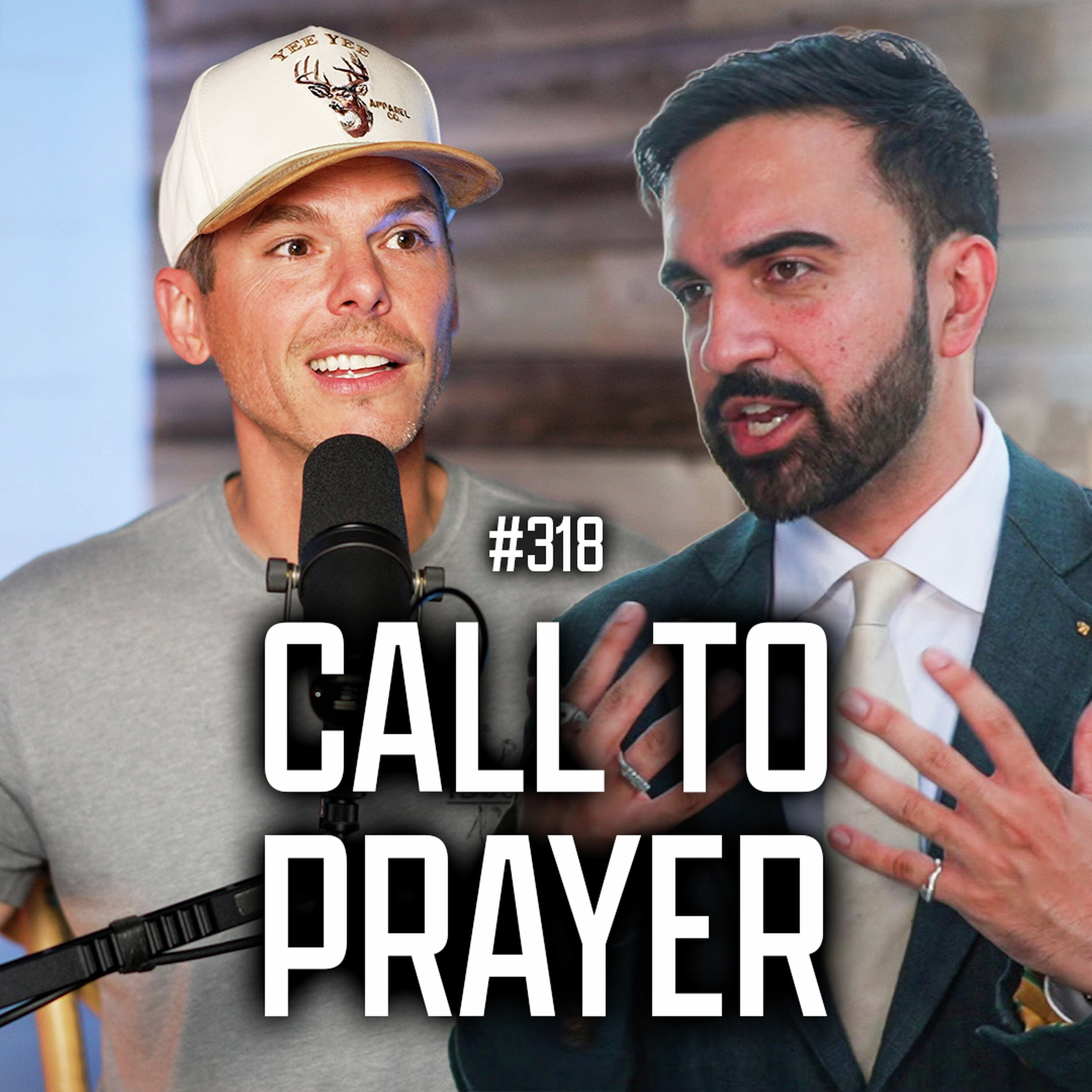
·E318
The Call To Prayer Now In NYC!
Episode Transcript
So we have a Muslim as a mayor of New York City.
Speaker 2Now do yeah call to prayer?
A lot of people from New York City?
Speaker 1Now, Oh, is it really?
Speaker 2I would assume isn't that right?
He's the mayor of New York City than we are.
Didn't we start getting the call to prayer?
Speaker 1Interesting?
I do know that.
Let me say a couple of things, And I know that this is a third podcast about Islam, and I'm not going to make a fourth when I promise you, I promise not listeners, not in a row.
We'll have many other trials probably, but not in a row.
I promise you.
We're gonna switch directions next week.
But but I think one more video on this, because now we do have a Muslim mayor, and I've just been hearing a lot of chatter about this.
I have a group of I was in E two in the core of Cadets at Texas A and M to the class of two thousand and two, and we have a signal group.
In fact, we have a listener to this podcast.
Andres Gomez listens to this podc Yeah, Oh, I love Andres, And I don't know if he's listening right now, but for years.
I know he's at least checked in and out occasionally.
Speaker 2And saying I heard the latest or yes.
Speaker 1And the guys, you know, the guys were freaking out about this, about this Islamic invasion, which is the title of last week's podcast, and Andre's actually comes in there and posted like just a link to this podcast, like hey, gout it.
Granger addresses this quite a bit, but it doesn't really matter whether I address it or not.
People are only going to hear what they're going to hear.
And the scary thing is that social media is really dictating so much of how we think these days.
I don't remember you and I talked about this.
I believe it.
It's been maybe a couple of years, but I remember specifically speaking to a man from Africa.
I don't I can't off the top of the head, I don't remember who it was, but it was a man in Africa, and he was telling me that because of the algorithm for Facebook, they the the all social media algorithms, what they want I'm speaking of they in terms of AI algorithm.
What it wants is people to engage.
It has no other bias, it has, it doesn't care if it doesn't care if it's good or bad.
It doesn't care if what political ideology, religion, doesn't care.
Its goal is get people to engage, get people to bring the app back up.
Speaker 2I would almost say that it actually encourage you, encourages you to disagree, because when you disagree, then other people have opinions.
Sure, when people agree, they tend to just go, oh, you agree with that, and move on and don't actually write it.
Speaker 1Sure, so this has happened in Africa and I'm sure other places that I'm not aware of, but wars have broken out because of disputes about tribes in Africa that have been elevated because of a disproportionate popularity of a post on a Facebook no account.
Speaker 2Wigh.
Speaker 1You know, like, because algorithms will rev something up so much that's not a big deal, but they'll rev it way up to be a big deal, and then it revs up the other side to be a big deal.
And for somebody that's focused on one thing, that algorithm is going to sneak in the exact opposite of what you think, so that you turn that direction and engage.
Once again.
It's not it's it's morally neutral.
It doesn't care.
It's not right or wrong, or good or bad.
It just wants you to look because that's what it's programmed to do.
It's so if you get really sensitized by something, really offended by something, really into something, you're going to see the opposite on your algorithm.
Point being, when this whole mayor thing came up in New York, everyone that's like super against that started getting started seeing the people that are super for that.
And what we noticed on our little chat group on Signal was there was a fake AI videos of like Islamic riots in New York City.
Oh wow, And so guys were posting on there like it's already begun here.
It is our worst fear.
It's already begun.
A few minutes go by, and one of my other buddies was like, that was a video from seven years ago in another city with Times Square put in the back.
Look that Times Square, that's that's not the gap doesn't is not there anymore or whatever whatever it was, And all of us are like, oh but still we're like people are still like, but I'm still mad.
Speaker 2But I'm still mad.
Yeah, it didn't make mad that way.
Yeah, man, all that to say, they didn't even readirect the mad, did it?
Speaker 1It didn't.
Speaker 2Yeah, it didn't.
You didn't all of a sudden become mad that it was AI.
You're still mad about what the AI actually showed you.
Yeah, unreal, dude.
Speaker 1All that to say, Uh, judging by these last few podcasts we've done, people are mad at me.
People are mad at me because I believe, and and I told you this before we recorded.
I've given out a lot of opinions about this type thing.
Sure, and and as a believer, I must constantly be in check back with a word and back in a group of accountability that could speak into my life and say, brother, I think you're off on this.
I think you're wrong on this, and let's go back to scripture.
And here's why, you know so, I need to always be in that available to be corrected.
I must have a heart that's constantly willing and available to listen and be corrected.
That's all of us.
That's not just me.
Speaker 2That should be all of us.
Speaker 1And as far as Islam, I have yet to hear an argument yet that says you're wrong, granger.
We should actually mount up arms and fight against this as as they did in the Crusades.
I can't find a biblical argument that says Dad, that's right.
I'm sorry I'm talking too much a man, but no, no, I guess I'm kind of setting this up and this idea that I've been accused much over these last few weeks of being weak and passive and compromising and soft.
I mean, that's what I've been accused of, and accusations just don't don't mean anything unless you're in my circle.
But I'm trying.
I'm hesitating because I don't want to say this in a way that puff that sounds like I'm puffing myself up.
But I think it requires more courage, more boldness.
I think it requires a stronger man.
Once again, I'm not talking about me.
I'm just in general.
A stronger man says, hold way, trust, don't react, don't attack, don't defend, don't pick up arms.
A stronger man says, I trust, I trust my Lord, I trust my God.
Often I think about the meek horses in ancient Israel that Jesus was referring to meek.
Have I told you about this before we talked about us?
That word meek?
Blessed are the meek?
Yep is often thought of, especially in America, as weak, but the context of that word is incredible, an ancient and an ancient near East.
If you wanted, if you wanted a mustang for battle, you would go get a wild one.
But you'd go to the mountains, and you'd go up through the valley, past all the horses, and you'd go high into the mountaintops looking for that one wild mustang that was so strong and so strong willed, and so so resilient and rebellious, that that one that took days and days and days to track and finally capture.
If you got it, and you put your will onto that horse, then that horse would trust you through anything, fearless, bold, That horse you could take on as a warrior.
If you tamed that one wild mustang that no one else could tame, if you could get it, if you could capture it, and then you could run that horse right into the enemy lines without stopping until you command it to stop.
Any other horse would be weak and fall out and stop, But that one horse would run straight towards the enemy lines, trusting not itself but in the one who tamed it, the one who rules over it.
The idea is power under control, that's the meek horse.
Plus that are the meek power under control of a greater power, the sovereign one, the almighty one over us.
Yeah that's good, And so now I've been accused of so many things, But who who would be stronger?
The horse that just box and goes and tries to go fight, fight, fight, but gets on into the enemy lines and folds are the one, the one that says, I trust you who tamed me.
Speaker 2It isn't take any self control and any strength of any kind to spout off and say the first thing that comes to your mind.
In fact, the Bible talks a lot about your tongue and about how your tongue is not tameable.
But you know, the same thing that comes out of the same mouths are blessing and cursings.
Yeah.
And the difference between the two is the time, the thoughtfulness, the listening to all all side and taking your time and waiting to hear from the Lord on something before you spout off something a reply or a response to a video or or to someone in a moment.
You know, I'd much whether you listen to everything I have to say and have nothing to say, than to just immediately go on the defense.
Yeah, because that is that's easy to do.
Your flesh gets instantly offended, and gets offended very easily.
It takes restraint and control to go.
That's not how I'm going to respond right now.
Let me run this through the filter of God's word before I before I actually throw down a response to this.
Speaker 1Yeah, yeah, for sure.
I only I only have this, Yeah, I only have this book.
Where else would I go?
What else?
What else would I stand on?
But the word of God that testifies of itself in tewod Timothy three sixteen, that all scripture, all sixty six books, all scripture is breathed out by God, improfitable for teaching, for a proof for correction, and for training and righteousness, that the Man of God may be complete, equipped for every good work.
Where else would I go?
Speaker 2Yeah?
Speaker 1Than that?
And that tells me that it must obey his commandments.
And his commandments are this love.
Your neighbor is yourself, That's right.
Who's your neighbor?
Well, Jesus his disciples ask him that, and Jesus describes who your neighbor is, and he gives it through a parable the one that we've all heard.
The good Samaritan, a man that's a Samaritan that's not on the same page as the Jews, that is not a friend of the Jews in the term of friendship.
Speaker 2That we would think, Then what's a Samaritan in twenty twenty five?
To a believer, it's a good question.
Speaker 1Maybe a Muslim?
Interesting, I mean, Jesus, it couldn't be more clear.
Who's your neighbor?
A neighbor is like this to you, a Samaritan?
What a Samaritan.
I wouldn't I wouldn't eat, I wouldn't walk in the house of his I wouldn't go through a village.
I wouldn't make eye contact with the Samaritan.
Jesus says, that's your neighbor.
Love him.
And if he couldn't be enough clear in that, he says, later, love your enemies, right, love your enemies, and do good to those who persecute.
Speaker 2You, which just undated the Bible.
Yeah, if you if Samaritan dates the Bible and says, oh, this is only applicable to this time, enemy instantly enemy, absolutely, So who's your enemy applicable to any time?
Speaker 1Somehow?
When we think about these things, and we're we're also we also hear those things, and we think that it has no benefit to us.
We're just like monkeys like sheep that just do do do the will of another entity and has no benefit to us at all.
And that would challenge anyone to test that.
Speaker 2Try it.
Speaker 1Wait till a guy cuts you off on the street on and he's road raging.
Try two options.
One road raid with him, Go try to you know you guys, go battle it out on the interstate.
See how you feel that night.
Speaker 2Yep, number two, been there.
Speaker 1Number two, I'm so sorry, my friend, I I cut you off.
Speaker 2You were right.
Speaker 1How will you sleep at night?
One of those two options, love your neighbor, love your enemy, do good to those who persecute you.
So that brings us to this debate because then everyone says, yeah, granger, but that doesn't mean it doesn't mean lay down and let the Muslim invasion come and take over our neighborhood.
Oh yeah, that had never said that.
I never said that.
Don't go to the voting polls or you know, like.
Speaker 2What he did say was exactly what the word says, do not fear.
Yeah, that's what you have said, and those are God's words.
Do not fear because you have said that on the podcast, like people are feared and scared of this.
I tell you what Jesus tells us this, do not fear.
Speaker 1Yeah, in this world you have trouble, but take heart, I've overcome the world.
Look at this first.
John four, you you made me think of exactly verse eighteen.
John says there is no fear in love, but perfect love cast out fear, for fear has to do with punishment.
Whoever fears has not been perfected in love.
We love because He first loved us.
If anyone says I love God and hate his brother, he's a liar.
For he who does not love his brother whom he cannot see, or whom he does see, cannot love God whom he cannot see.
In this commandment we get from him, whoever loves God must also love his brother.
This is this is clear.
And yet and yet we want to put constraints on this idea and say, unless it unless it takes away my comfort, unless it it unless I have to see people that don't look like me all the time, unless they're worshiping Allah, because that's bad.
They're my enemy now, or this is the most common, Unless they don't love me back Romans five.
Romans five says, and if we're to imitate Christ, Romans five says, while we while we were still week at the right time, Christ died for the ungodly.
For one will scarcely die for a righteous person, though perhaps for a good person one would even dare to die.
But God shows his love for us, and that while we were still sinners, Christ died for us.
Roman's five is incredible, since therefore we've been justified by his blood.
Much more will we be saved by him from the wrath of God.
For if we were enemies, we were reconciled to God by the death of his son.
Much more now that we are reconciled, shall we be saved by his life.
And more than that, we also rejoice in God through our Lord Jesus Christ, through whom we now have received reconciliation.
We were once enemies of God.
God said, love your enemies, and He did that to us by sending his son, and who died for us while we were still enemies, while we were still sinners, not when we were good, when not when we be decided to died first while we were going on the the other direction.
You want to play this video real quick.
Speaker 2Yes that this is a clip from last week.
Speaker 1It's a clip from last week's podcast.
Speaker 2And the vitriol that has happened yeah on social media since this.
Speaker 1Yeah, but I knew this was good.
I knew it was coming.
But here's let me put.
Speaker 2Read what you wrote.
Read the caption for the video.
Okay.
Speaker 1The caption says, I feel pretty alone in this view.
If I wanted a million likes, I would say the exact opposite.
I would say, let's fight Islam.
Let's protect our children from the invasion, Let's take our guns and resist.
I would get so much applause from that.
But what if we saw foreign cultures moving into our neighborhoods as an opportunity for evangelism.
What if the mission field has come to us?
Would we fight for comfort and complacency or would we fight for souls for the living God?
And what about our children?
Do we desire comfort and ease that breeds cultural Christians or opportunities to heighten the urgency for a closeness to the Lord.
What does loving our neighbor really look like?
Would I desire windless days if my trees are full of dead branches?
These are questions I wrestle with.
Speaker 2Yeah.
Speaker 1So the video says this thing, I recognize when I hear I called a prayer in a mosque, I can aloud speaker.
I recognize my need, my proximity to evil, my proximity to the Prince of the power of the air.
Here Satan, who's the king of the world right now, I feel my proximity to that, therefore my closeness to the Lord.
And I'll pray every time those called it.
Like, for instance, I was asleep one time and this was I think in Dubai, woke up.
They would do the call to prayer about four thirty in the morning, okay, And I just made it a habit that every time it woke me up.
Because you're sleeping with the windows open and stuff, and it's just very loud.
You can't avoid it.
So I would just make it, make it a thing when that woke me up, which I looked at it as a demonic voice, then I would start praying to the Lord.
That's cool, and and I just feel I have I have a desire, maybe a strange one, that my kids would feel that kind of urgency and not be lulled to sleep, which is much more of a demonic tactic on us that you could just be load to sleep by just nice little suburban lives with no pressure.
Just you want to go to church, go if not, if you're not, if you have a headache, don't go to church.
You're you read your Bible, but don't be a Bible thumper.
You know, it's more about loving people to the truth.
And you know we're living a Christian nation that you just slow yourself to sleep, the demonic battle that's waging around you just becomes less clear, a little blurry, and we don't Maybe I should say me, I don't.
I don't feel it.
I don't feel the battle.
I don't feel the urgency.
And so when dearborn Michigan is freaking out social media because a mosque is now there, sure, I just think what an opportunity for those people to witness, to reach out, to have them over for dinner, a Muslim family, and on top of all that, to feel the urgency in the air around them.
Okay, could I rack just a few things with that video?
Speaker 2Yeah?
Please do.
Speaker 1So once again, and the last time we'll get into this.
But people went wild against me on this on all the different social media platforms, and Hamber had to tell me, like, stop looking.
Speaker 2At that because of the responses.
Speaker 1Yeah, She's like, stop looking at those comments.
And usually I make a habit to not look at comments, but for the sake of us recording today, I was like, yeah, you're right, I'm not going to look at anymore.
But but so many personal attacks against me and some people from Dearborn, you know, reaching out said you have no idea, you shouldn't speak about things you don't know about, or you know, you you need to be educated more on Islam, or you need to read the Koran, which we have copyrighting here.
You know, we've read.
You have no idea the hatred that they're bringing, or what they're trying to do, or the the mission that they're they're coming to convert.
You know, all these things we've taken into account.
All we've taken account all of these things.
You know, you and I have have been in the Near East with around plenty of mosque and plenty of call to prayers, just just you and I and not considering all the other travel.
So I do believe I don't think we're missing something here.
But here's here's an example.
Well, this one just came in, by the way, while we're talking.
While we're talking, this one just came in.
I see your point that there is the fact that they want us dead written in their text.
They want us dead.
Once again, that's not that's not that's not a stipulation.
Love your neighbor, unless your neighbor wants you dead.
Yeah, love your enemies, do good of those who persecute you, unless they want you dead.
It doesn't say that.
Speaker 2How many times in Matthew, Mark, Luke or John have you seen looking for an opportunity to arrest or kill Jesus?
Yeah, that was that's in there, multip I just I just read through all four gospels again, Yeah, like detailed how many I should counted those?
Speaker 1Or Paul or Peter?
Speaker 2Of course?
Speaker 1Yeah, I said just those four now or did you just just said at the beginning?
Now, there are times when they let Peter down in a back I excuse me, Paul down in a basket outside so he could escape.
There were times when Jesus disappeared into the crowd so they wouldn't get him.
And there are other times when they willingly offered themselves to be taken.
And so there's there's that.
But but it's it was never a resisting never, it was never a fighting.
It was never a mount up.
Let's let's fight evil.
You know, because I get so many comments say, grangeur, we're commanded to fight evil, resist evil.
I guess I say, I've asked you before, how and you always go on my knees and I go, I don't think that's what people think.
Speaker 2Yeah, it's just a mindset that I have.
That that's where I instantly go.
But I mean, and and sometimes we have a bias of thinking what we think is what a lot of other people think.
Yeah, look, just because the language isn't Yeah, it doesn't mean that that it means to go fight, but some do.
We've seen that language in detail on some of these comments as well.
Speaker 1I'm I'm starting to forget what I talked to you about before we started recording.
What recording.
But but I also want to say that I am a weak man, I am a flawed sinner, and I constantly need to be evaluating what I say.
When I say things like if a mosque moves in down the road, we need to be do we see that as an opportunity or as as a as a battle?
And I need to go.
What do you think, Ranger?
You know, what would you think?
Because people in Dear Dearborn Mission or Michigan are calling me on this, and I think it comes down to two looking at looking Do we look at them as souls potential souls to be one to the Living God.
Or do we look at them collectively as like a that they're too far gone and they're already they want to kill us in their enemies.
Or do we look at that, look at them as almost like being trapped in a a a ideology that the Gospel could break them out of.
And as we've said many times on this podcast, a person that could face we could face in heaven that goes it was you against all odd It was you.
I heard the gospel.
If you're trying to get a gift for someone that you think has everything, how about a special video message from me.
It's easy to do.
Go to cameo dot com slash Granger Smith and you put in the prompt what you want me to say.
I get that message on my phone.
I'll say happy birthday, happy anniversary, What what ever personalized message you want me to say to whoever you want me to say it to I send it to you, and you give it to them.
It's pretty cool.
Go to cameo dot com slash granger Smith.
Speaker 2Well, you and I I've shared this with you a couple of times.
Is that some of my I've really tried to change my morning routine a little bit, like little things that the Lord reveals to me I try to then incorporate to become part of my routine every morning.
One of those is repentance.
Stop looking at the word repentance as a negative and it being this thing of oh, you send now you need to repent and turn back to the Lord.
Yeah, what if before you ever did anything, you turn back to the Lord?
Speaker 1Yeah?
Speaker 2What if before you ever started living in this world each morning and letting the world influence your thoughts and attitudes and actions, you turn from it.
That's repentance, turn to the Lord before that ever happens.
And the kind of reclaiming that word is being something joyful.
But the other aspect here is what I think that this can help do is change a mindset of stop living in this algorithm of fear and everyone is out to get you.
Everyone is out to take what is yours.
Everyone, all these people are out to take the freedom that you your forefathers fought for and go What if this is an opportunity instead of it being fear?
Yes, of course.
If there's a vote on whether something should be built, a moss should be built down the road, and you have the opportunity to vote, of course, go vote, go vote.
You say no, I don't want that here, I don't want that in my community.
But not what if it happens, something happens.
What if the mayor gets elected that's a Muslim mayor?
Do you look at it as an opportunity to go?
Man, what if while he's a mayor he gets saved?
Did you ever think about that?
Now?
What he would?
Then you have a believer as a mayor in New York who was what we view as complete opposite.
What are the opportunities that a true?
Maybe that says more about what you think about God.
Speaker 1It does, It does, and you said earlier, it's also it's also recognizing that that if a Muslim gets elected as mayor, it's somehow slipped past God.
It was on us, y'all screwed up, Like he's looking at a Yeah, didn't didn't didn't know, didn't know or.
Speaker 2It didn't a point.
See the Bible says that he points those people to their positions.
Your leaderships are it ran through his decision making, his his will for them to be in a seat that they are in.
That's yes, you get an opportunity to vote, but you think you have the final decision.
Absolutely not.
Speaker 1It also comes out of the this idea that we protect and covet our comfort and our ease.
Speaker 2That's easy, guilty of day.
Speaker 1It sure feels nice to be comfortable.
Speaker 2Do you know why?
I have another can of ice cold waterloo.
I like it.
It's comfortable.
Speaker 1Sure is nice in this room right now.
That's air conditioned.
You know, it's like weather resistant.
If it rains, we're gonna be sure is nice, you know.
But but we But in the long run, the more we try to protect that and cultivate it becomes an idol for us.
And I use the analogy in my caption here because it's actually a section I wrote in the book I'm writing right now on cultural Christianity because comfort breeds cultural Christianity.
Culture cultural Christianity exist when when Christianity is easy and acceptable to society and it doesn't cost you anything, it's cheap, it doesn't cost anything.
True Christianity, true grace is costly.
It will cost you everything, but it's worth everything, and the benefit is everything.
But unless we realize it's going to cost me that we live in a country now where it's just cheap.
It's cheap, and we want to keep the cheap.
Don't mess with me.
My life is comfortable right now, so don't mess with me.
And that was part of my argument in this video is that I don't want my kids to just be in a bubble of comfort.
So we want to introduce difficulties for them like we do with anything, Like when you're working out, you introduce difficulties to your muscles so that they break.
And so I don't want a life of utopia for my kids.
They're not going to be good from that.
All of this that have grown, we've grown through struggles, and so that's part of the argument is like what are you fighting for comfort?
It sounds like here's another here's a comment right here that's that speaks to this, says Granger.
They're not coming here to love thy neighbor.
They're coming here to take away your suburban life.
The commenter says, they will make you worship Allah.
That is not God.
Have you been asleep all this time?
You're starting to sound like a feel good Christian.
Just love each other.
There is nothing wrong with mission trips, but when they try to come here and take away our way of life, that's not right.
You see, you hear that.
You hear what's happening in there.
Speaker 2You're you're stealing our way of life.
Speaker 1The suburban life is the idol is your God.
You know, during one of the the worst atrocities in human history, Western American slavery, you know what they were doing.
They were going on mission trips around the world and coming back home and beating their slaves waves because they're idol of comfort and wealth and and and indulgence was fed and grown by their slaves.
So they would go to Africa, India, the Amazon and evangelize the local tribes, come back and beat their slaves that didn't even have scraps at their own table.
This is this is this is the same mentality.
Islam's coming to make you worship all.
Well, they're not gonna make me worship Aula.
Make you worship Aula?
Speaker 2Is that all it takes?
Yeah, they told me I need to worship alla.
Speaker 1Now, and you're starting to sound like a good Christian that says, just love, isn't that what?
Who's that guy in here starts with a j if somebody said.
Speaker 2That Joseph Jacob started with it was Jesus.
Speaker 1But here's that line.
There's nothing wrong with mission trips, but when they try to come here and take your life away, that's it.
Exactly what the slaveholders thought they went to church on Sundays and worshiped.
You know, the stairway right here coming up to this room has Frederick Douglass right here, and he would he has an excellent memoir about about his life as a slave, as a runaway slave, and he would hear these people going to church and worshiping and coming home and beating their beaten their slaves.
Well, it's the same mentality right here that goes, I don't want these Muslims.
They look different.
They there, you know their book.
Granger says, they want to kill you their evil.
I don't think you've ever talked to a Muslim, grangeer a lot of these comments, I don't think you've ever talked to a Muslim docked at few docked a few few anyway, Sorry, I've cut you off like three.
Speaker 2Times, not at all.
I just it just reminds me that that the the road to hell, the gatetail is wide and it's comfortable.
It's easy, and narrow is the way to life that is uncomfortable.
But the we had we had an illustration at church the other day.
There were cones.
They were so to get in was really easy on one end is really wide and open, and it led to destruction at the end of it.
But the but but the other way around is getting low and small, and then when it opens up, it's to everything that you ever dreamed of.
Speaker 1Wow, this guy says, We're no, it's Darlene.
It's a woman.
We're supposed to love our enemies and pray for them.
Are we up for that challenge?
Somebody commented, wake up.
Speaker 2To her?
Wake up?
Speaker 1Yeah, okay, and she says, I am wide awake, and I guess praying for you.
Good for her, he says.
He says, I haven't.
I'm just reading this out loud.
I haven't read it yet, so I'm reading and processing at the same time, the guy said, but not wide awake about demonic Islam.
I was born in a Muslim country to missionary parent parents.
We were kicked out just for telling people about Jesus.
Speaker 2Good, kind of Lord, kind of joy.
Absolutely, yeah, you didn't live through it, man Granger.
Speaker 1Yeah, anyway, it's just negative comment after negative comment.
Speaker 2Amberg just text me and said, you need to stop reading.
Oh yeah, yeah yeah.
Speaker 1Somebody said, I remember the darkness I felt the first time I heard her call the prayer in the Middle East.
I am horrified this is happening in America.
It's interesting.
Yeah, final thoughts about this before we close this chapter for a bit, pray, how do you fight evil?
A man?
Speaker 2Pray?
Speaker 1Yeah?
Speaker 2What with your sword?
Your sword, not the physical sword, the sword of the Bible.
Go read the armor of God.
That's how you can.
Speaker 1I say, I want to return to that.
I don't want to say the slight little thing because I remember that a lot of people commented about Neemyah.
He was in the Bible.
Neamyle was rebuilding the wall outside of Jerusalem, and he had as he was building with his tools in one end he had a sword and the other ready to fight the enemy.
Speaker 2And a lot of all the guys did yeah, And a.
Speaker 1Lot of people are like, yeah, that that that's what we need to be.
Like literally, a guy said, one hand on the Bible, one hand on your glock.
Stop putting, he said, Granger, stop putting both hands on the Bible, and put one hand on your Bible and one hand on the block, just like Namiyah.
Way out of context.
The Lord told Namiyah to go to Jerusalem, to leave Babylon and go to Jerusalem and rebuild the wall.
The Lord commanded him to do this.
The Lord's not commanding us to keep our suburban cities.
How many times have we put America in the context of Israel in a wrong way.
We are not Israel, We are not the old the Israel.
The purpose of Israel, the purpose of the Lord blessing that country monetarily and spiritually, and raising up kings and judges and prophets.
All of that was pointing towards the Messiahs that would bless the nations, all the nations, including the purpose of that the purpose of the promise to Abraham that your offspring will be like sands on the seashore, and one day, through your offspring, all the nations of the world will be blessed.
And the process of preparing for the Messiah all all of that was to bless the nation.
So we can't take that out of context and go see that was happening to Israel.
We should do it here anyway.
Let's go back to how you would pray?
Speaker 2Yeah, how would you?
How I would fight?
Speaker 1How would you would fight?
Speaker 2Yeah?
Speaker 1And you said I would pray.
What are you praying?
Speaker 2Well, one for Lord's will and to open up the hearts and the minds of those that you are come in contact with, Like if they're encountering you, are they encountering God or they encountering your flesh.
That's just me, that's not I mean, if if that's God wants you to look at it, then then awesome.
But that's I look at me first, Like, man, if I can't sit here and live one way and tell you something else, So that's what I would pray.
Like you know, I have you know, Jovah's witness to come knock on the door, and I have you know, the missionaries.
I haven't invited them in to eat yet.
You have U from you're talking about like Mormons, Yeah, yeah, yeah, Mormons.
Yeah.
Speaker 1There are people my my friends in the Church of Jesus Christ and Latter day saints we have.
It's been years now that the missionaries here come over and they and we'll spend hours together.
But there they tell me stories of being yelled at, cussed at gas stations, people telling them to get out, people slamming doors in their faces.
The same thing with Jehovah's witnesses, the same thing with Muslims.
Where is the Lord?
Where's the love of God in that?
I know that's what you're saying.
Speaker 2Yeah, yeah, that's what I'm saying.
And you're gonna and listen.
They don't proselytize the same way those two do, being Muslims.
Speaker 1Yeah, it's hard to compare.
Speaker 2Yeah, it's weird.
Speaker 1The Karan and the Book of Mormon cannot be compared.
Speaker 2But are you not talking to them because they moved in next door?
Or are you side eyeing them?
Or you calling h O A on them?
Are you calling you?
What?
Are you?
Speaker 1Know?
Speaker 2Are you?
Speaker 1We have to get a little uncomfortable.
We have to get uncomfortable, and and sometimes being uncomfortable means I don't know a lot about this topic.
I don't know a lot about the Quran, I don't know a lot about your religion.
But that doesn't equal.
I fear you, but I think sometimes fear comes from the unknown of I think, Well, just.
Speaker 2Like they're going to make you worship Allah.
Speaker 1Yeah, they're gonna make you worship.
Speaker 2Is it that easy to make you worship all?
Are?
Speaker 1They're coming in here with a bomb strapped to their chest.
You know, like you see you see a Muslim family move down the street.
This is happening everywhere.
It's happening here in Georgetown.
Seem moved down the street.
You know, a husband and wife and three little kids.
Are we to think, like, I better better have my glock in my hand.
This family moved down here.
I'm gonna have my glock ready because they're coming.
Man, They're coming to take my comfort and my life.
You know, they're coming to influence my kids.
They're making me start worshiping their God.
They're not They're not a religion of peace.
That's what every everyone's been saying.
Forget about forget about what the Koran says.
Forget about the religion.
Let's look at the souls.
Well, what if I could love them?
What happens if I love them?
Not not contingent on if they love me back, not contingent on what they do.
But what if I love them, what happens?
What happens to me and what happens to them?
That's a question we all need to wrestle with, including me.
Speaker 2I agree.
All right, it's good stuff.
Speaker 1Moving on, Yeah, I love you guys.
We'll see you on the video reactions and the Q and a coming up right.
Speaker 2Good one coming up on Wednesday Reactions Friday even Friday Q and a YEP with a jingle.
Speaker 1Cool y'all, y, thank you so much for hanging out with me on this episode of the Grangersmith Podcast.
I appreciate you being here.
If you're listing right now, go ahead and rate today's podcast.
It helps more folks find the show.
And if you're tuning in on the iHeartRadio app, you could actually set this podcast as one of your presets, which is cool that way.
I'm just one tap away.
If you're watching on YouTube, don't forget to hit like and subscribe so you don't miss any new episodes.
And if you've got a question you want answered right here on the show, just email me podcast at grangersmith dot com.
I'd love to hear from you.
Thanks again for being here.
We'll see you next time.
Ye