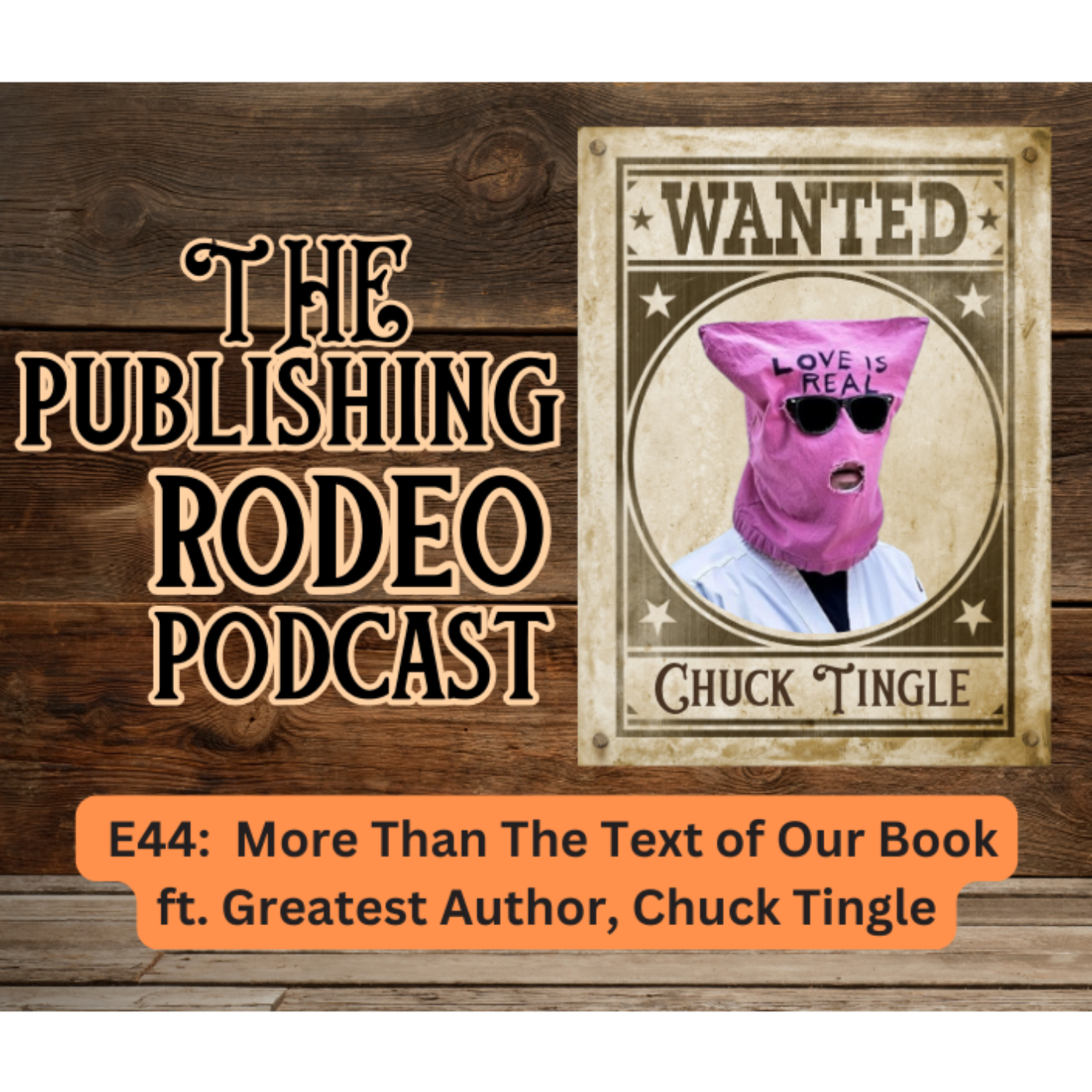
E44: More Than The Text Of Our Book, ft. Greatest Author Chuck Tingle
Episode Transcript
[00:00:00.000] - Sunyi
Hi, I'm Sunyi Dean.
[00:00:03.320] - Scott
And I'm Scott Drakeford.
[00:00:05.840] - Sunyi
And this is the Publishing Radio podcast. In 2022, we both launched debut novels in the same genre with the same publisher in the same year. But despite having very similar starts, our books, and subsequently each of our careers, went in very different directions.
[00:00:20.700] - Scott
That pattern repeats itself throughout the industry over and over. Why do some books succeed while others seem to be dead on arrival?
[00:00:29.850] - Sunyi
In this podcast, we aim to answer this questions and many more, along with how to build and maintain an author career.
[00:00:38.090] - Scott
Everyone signing a contract deserves to know what they're really signing up for. In an industry that loves its secrets, we'll be sharing real details from real people. We'll cover the gamut of life as a Big Five published author, from agents to publishing contracts, finances, and more. I I don't know what's inbounds and out of bounds for this conversation, given your preferences here, Chuck.
[00:01:06.640] - Chuck
Oh, yes. I was just saying, go nuts. I think a lot of Buckaroos, very kind, are apprehensive that Oh, there's things that I shouldn't, topics I shouldn't broach, which is so kind. I do appreciate the respect of my privacy, but I am also, shockingly, a pretty open book. If If there's anything I'm uncomfortable with, I won't answer, but just go for it. Really, I am not possible to offend in that way. I think it would be pretty strange of me to present myself like this. For the listeners, I usually wear a pink bag over my head and obscure a lot about my identity. I think it would be silly for me to get all up in arms about folks inquiring. That would be very silly of me to assume that no one's going to care.
[00:01:59.980] - Scott
Well, so I was just going to mention that I live in Kingston right now, but I actually grew up in Utah. I can't remember where I heard it, but I heard that you may have grown up in Utah as well.
[00:02:10.900] - Chuck
It is entirely possible that I may have roots there. That is correct. Although I don't think many are from a home of truth where legend has it, that I originated. But I have traveled quite a bit. I spent most of my youth trotting around. Imagine Jack Kerouac novel, but with a pink bag over the head. Traveling cross country. I've been to so many dang places. I spent a lot of time just wondering in my youth. It's nice meeting Buckaroos and they say, I'm from here. Most of the time I say, Oh, here's this memory I have.
[00:02:49.370] - Scott
Yeah.
[00:02:49.940] - Sunyi
Wow. I first heard of you years and years ago, Chuck, I think, back before I was ever on Twitter and was on forums. You were famous/infamous even then, I think, with the very iconic book covers, and especially when the political one started coming out. I think most the people who know you will know quite a lot about you. But then again, Scott doesn't know that much, actually. I wondered if we could, just as a starting point, go through some of your early writing life and also the sad puppy stuff that exploded, because I think that's all really interesting genre history.
[00:03:24.670] - Chuck
Oh, perfect. Yes. Yes. A little historical rundown. Okay, This is the perfect time before I jump into to just say, I am so honored to be here. I do a lot of dang podcasts, and this one, I am a huge fan. I think I've listened to every single episode, Maybe some of them multiple times. When I found out that you were going to trot on some more, it is really an honor, and I am deeply moved to be here. It's a very full circle, and I hope that during In our conversation, there are some classic things that get to happen. My dream is that I think Scott has a wonderful laugh. There we go. There we go. It's already happening. I thought, I just want to make Scott laugh. Then, Sue, I really want you to tell me that it's okay we're going to edit that out. That is what I would love from you.
[00:04:26.980] - Scott
Just so you're aware, when she says that, she then does not edit But anything after that.
[00:04:30.950] - Sunyi
I do sometimes.
[00:04:32.560] - Chuck
Well, I noticed. You know what I thought? I will say as a listener, starting off from the beginning, that would happen so much that I thought, Okay, I don't know if they're labeling their files correctly. Do I need to send a concerned email and say, Listen, just so you know, the ones you're uploading are not the edits because there's a lot of talk about how you're going to edit. It's still in there. I think it's a very fun little trope of the pod. Anyway, I Just get ready because I ramble. I apologize.
[00:05:03.560] - Sunyi
You're fine. I have to say I'm just honored that you know it exists, to be honest, because I think definitely in writing world, Chuck Tingle is autistic icon, which I know is not something you set out to be, but you feel the role better than Elon Musk.
[00:05:18.170] - Chuck
Oh, yeah. Well, thank you. It's funny because you know what? I think I did set out to be that. There was a conscious point where I thought, I'm going to talk about my autism more. I I didn't at the beginning. I was diagnosed with what they say Asperger's. That is not a politically correct term anymore. That is fine, but that is what I was diagnosed with. The course of my life, my autism has really not been a problem for me. In fact, I think it's been very good for me. I am thankful to be autistic. I think it's super cool. I feel like I'm in the cool kids club. All my heroes are autistic. David Byrne Autistic Andy Warhol. I don't know if it's confirmed or any of these people. When I got my diagnosis, I was like, heck, yes, this is the greatest thing ever. So excited about it. I also then later realized that most buckaroos have the opposite reaction. It just doesn't feel good to them. There's a lot of difficulties that come with it. There's a reason that it is listed as a disability, and that's very important because there's folks that need help.
[00:06:27.060] - Chuck
With that, I always thought, do I really need to talk about my autism? Am I just taking up space from all these more tragic stories about this? And eventually, I realized it's not a monolith. There's a bunch of different experiences. And along with the tragic stories, we need to express the positive side of it, too, and show that that diagnosis doesn't have to be this terrible crushing weight. There's another version of it. So that's why I did, I really did set out and think, yeah, I I would love to be an autistic icon like David Byrne was for me.
[00:07:05.730] - Sunyi
Is that David Byrne of the Talking Heads?
[00:07:07.440] - Chuck
Yes. That was my original thing.
[00:07:13.100] - Sunyi
It was like my partner's favorite band Oh, okay.
[00:07:17.080] - Chuck
Well, yes. I mean, honestly, it's up there for me, too. I remember seeing David Byrne on Letterman when I was a young buckeroo and thinking, wow, why is this person acting exactly like me? Why are their mannerisms the same? What's happening? And I started to do some research, and I found out that he self-identified in that way. And then it just opened up a lot. And then later, when I was seeing a therapist, I brought it up and they said, Yes, I think I agree with you there. Would you like to get an official diagnosis? And then I said, I don't know. What's the deal? And they said, Well, we're going to have to check your insurance because if I give you an official diagnosis, you might lose it. You might not be able to come anymore because that'd be a pre-existing condition. So I said, No, let's not do the papers. We'll just know that it's the truth. And that speaks to another thing. The reason I like to tell that story is because just the United States health care system and how horrific that is. I mean, that's a whole... I don't know how long we got on this pod.
[00:08:21.130] - Chuck
If we got five hours, we can deconstruct health care.
[00:08:25.000] - Scott
I would be happy to. I don't know if Sonja is on board with But yeah, it is. I mean, and a salient point there just with current politics, though this is very much not a politics podcast. I have been very surprised how many people in my own life I have talked to that don't understand what the implications of doing away with the ACA and the protections on pre-existing conditions are. And if you say, But your family member that is covered under your plan has this, this, and this. Aren't you worried about that? Oh, well, I guess, yeah, pre-existing conditions shouldn't be considered in coverage decisions then. I was like, But that's not what you just voted for. You don't get to pick and choose once the person you voted for is in.
[00:09:19.610] - Chuck
There's a wild ride coming our way. That is for a dang sure. Okay, politics. You know it's funny? Here's how much I heckin ramble. You just asked to give a brief bio, and I will call that back.
[00:09:34.460] - Scott
You are from Utah. Chuck, you are from Utah. You are not hiding that from me now.
[00:09:40.060] - Chuck
I have the ramble?
[00:09:41.450] - Scott
No, the heckin.
[00:09:42.530] - Chuck
Oh, there you go. Yes. Well, so the political part, I will say, so I started out, I was writing Tinglers, which are short form erotica. A lot of buckaroos know me from that. I call it surrealist erotica, or even, I think stylistically, what I write is magical realism erotica. But originally, I set out because I would say there was a political thought behind it as a piece of art and a personal. The political is that for a very long time, Conservatives, especially in old Chuck's youth, would talk about how the sanctity of marriage, when they were arguing against gay marriage, they would say, What's next? Is someone going to marry a tree or two big feet or the Loch Ness Monster? There was always this slippery slope argument. I remember since the very beginning, I always thought, What would be wrong with that? What is actually the issue here? They would paint it as a dystopia, and I would think, That's actually a utopia to let everyone love who they want, for consenting adults to have whatever pairings they feel. And so a lot of the vision for the Tingleverse was taking that like, conservative fever dream nightmare to its final conclusion and showing that actually that's a utopia.
[00:11:09.500] - Chuck
It's like this wonderful, sex-positive, fun, funny world. So I started writing them for that. And then personally, and this is related to my autism, the way that my autism shows itself is I'm very regimened. Everything is strict. If you were going to use Freud's Teachings as an example, which should be taken with a huge grain of salt. But if you were, just for the symbolism, my superego extremely overdeveloped. Everything is disciplined. I would lose it over a tiny mistake. I started expressing myself in this way that was, Okay, I'm just going to let my it out, which is the opposite of the superego. I'm going to let myself not care about those spelling mistakes. I'm going to let myself write whatever in my heart. I'm going to put it out. I'm going to edit it once and then release it the next day, and found this method of expression by not letting myself get bogged down in those things that totally changed my life. I had chronic pain. I was going to the ER. I went to so many doctors who did not know why my body was clenched so tight. I thought I would probably have to live on painkillers the rest of my life or not live at all.
[00:12:25.750] - Chuck
I mean, it was that bad. The more than I expressed myself through Chuck, the more that pain started to go away because that super ego that was just crushing me, which is not my autism, but I think related to the way that that manifests in me, that regimented pattern, discipline. For me to exercise this other part of myself, I started to relax. The pain went away. It really did save my life. I think of it as punk rock writing. That's how I see it. There's punk music, which is a little sloppy, a little fast from the heart more than anything else. If you do that in music, everyone says, Oh, wow. They don't listen to a punk song and say, Oh, wow, that's out of tune. You say, Oh, that's a great punk rock song. You do that in writing and everyone says, Oh, there's this spelling air, and this needs that, and that. I hope to be pioneering, at least philosophically, the idea of punk writing.
[00:13:27.000] - Scott
I like that.
[00:13:27.970] - Sunyi
I guess at some point that How do you say? I'm trying to basically lead that into all the sad puppy stuff because I think that was something that really exploded you.
[00:13:39.020] - Chuck
Oh, yes. It's so funny. I feel like when I was talking, I thought, Gosh, I'm talking too dang long. Let me finish this up. And I didn't even cover the dang sad puppies. Okay, so it's funny because the legend is that that blew me up into the spotlight. In reality, I was already pretty well known, but the legend is more So I will say a little of both. But in the Hugo Awards, a conservative voting block called either the Sad Puppies or the Rabid Puppies, or both, who the heck knows? But they saw my books and picked them with the tongue-and-cheek reason of essentially saying, this is the worst art we could possibly find, that this is completely devoid of value. If you ask them or if they post about it, even today, they will say that that's not the case. They will try to tongue in cheek, wink, wink, nod, nod, and say, Oh, no, that's not really... We really like it. They did not. They did it as a joke. They nominated me not knowing that, one, I am very sincere about my art and that there is something I think very valuable behind what I'm doing, and two, not understanding that my politics are very far left to their conservative alt-right sensibilities.
[00:15:02.630] - Chuck
I use that as an opportunity to speak politically on a lot of things. They started with Gamergate. I said that if I win, Zoe Quinn, who was a target of Gamergate, would accept my award. I wrote a lot of tinglers about it and spoke out against them a lot. That was, I think, an origin story for a lot of Buccero.
[00:15:23.780] - Sunyi
I guess I wanted to start with all of that context because for someone who's ended up in trad publishing or hybrid publishing, I guess, you do have a really long and unusual journey and really interesting. Well, I'm going to get into something else in a second, but I guess the first thing I wanted to say is I've read, oh, shoot, what was it called? Not Bury your Gays, the first one.
[00:15:42.270] - Chuck
Camp Damascus? Camp Damascus.
[00:15:43.500] - Sunyi
Yes, Camp Damascus. When it came out. Just while I get the chance, I remember reading it and feeling really struck by the total oppressive mind fuck, and that for me was captured really well, and I really did enjoy that book on lots of different levels. But Anyway, I was going through all that context first, and I'm rambling now, too. But the reason for that is because I remember you saying to me when we were chatting a bit on Blue Sky that you disagreed with a lot of what we have to say, and I'm really fascinated to hear that. I can't wait.
[00:16:14.580] - Chuck
Well, all the listeners, I should preface this with saying that this show is amazing. I am so honored to be here. I think that what you are doing It's an interesting situation because it is so... Your audience is so limited, right? I mean, you've posted publicly about, Are we going to keep doing this? I'm so damn glad that you are. But you deserve so much credit because by the nature of this show, it can never be... It's not going to be Joe Rogan, not that you would want to be, whatever whatever huge podcast you can think of, simply because the audience is very, very small. It is specifically for people who are entering traditional publishing, trying to break in, or just, I guess you do self-publishing stuff, too, but it really is the traditional publishing journey of which there is almost no information. I want to start by saying that I think what you are doing is this outrageously public service. I have endless gratitude for this show because you are putting in all this effort for something that is just helping this small amount, but an amount that has no help. There is really no information about this.
[00:17:46.780] - Chuck
For someone like old Chuck, despite coming from a very different background, I think that it was helpful even for me. I just want you to know how many buckeroos you are helping. That's my premise. That's me talking you up. My compliment sandwich, if you will. That's very funny. It's not even... I mean, this is not even the aggressive middle. I would just say that upon listening to your show, what is fascinating to me is that we are all on the same journey and that my experience could not be more different. I think that our journey through publishing has been complete opposites in a lot of ways as far as the way that maybe we feel the industry works, different things like that. I mean, we can just go through, but the amount of times that something will happen on the show, and I just think that is literally the opposite of my situation. I think it speaks to the show in that I still love it. You know what I mean? But gosh, where can we even... Oh, I know where we can start. I'm sorry. You know what? You ask the I was going to go on a tangent.
[00:19:00.990] - Chuck
You ask the big questions.
[00:19:02.850] - Scott
What I'd like to hear, Chuck, is... Well, first of all, thank you for the kind words. I hope people know how much work Sunyi has put into this in particular. She's going to get very embarrassed about this, but she is a remarkably altruistic person in a way that I am necessarily-
[00:19:18.835] - Sunyi
That's not staying in.
[00:19:22.380] - Chuck
I necessarily am not. No, you got to keep it in. You got to keep it in because that's the word I was looking for. You are doing a service that is an altruistic service with this podcast. Absolutely.
[00:19:34.630] - Sunyi
That is very kind of you, and I do appreciate it, genuinely. But I also feel compelled to say that I feel like it isn't really altruistic, because even if it has benefited other people, I'm not sure that was ever the goal. It was more like we just wanted to get it out of our system and have these chats for our own sake, whether it was a good idea for Scott's career or not. And we didn't necessarily think too much about the consequences. But anyway, anyway. Yeah. Thank you.
[00:20:06.970] - Scott
So anyway, sorry, Chuck, the question for you, my buckeroo, is, how did you get into Tread. So I know about the tinglers, at least on a superficial level, I've known about you and of you. But then when your Tread books started coming out, I thought, oh, hey, that's cool. That's interesting. That looks like... So how did that transition happen? What were the connections that were made that led to that?
[00:20:37.250] - Chuck
Yes. So very different path right off the gate. This is a great starting point. And not only Trad, but Macmillan, so Big Five Trad. When people are talking about indie publishing, do they say Trad? I don't even know this.
[00:20:55.280] - Scott
We're usually referring to Big Five or Big Five. Okay.
[00:20:58.690] - Chuck
Yes. This is how I'm such a... I will say I am a complete outsider to this. I did not go to English school. I do wear this mask, but I am not familiar with the writing industry. So I come in completely outside. And when I first started out, I had these tinglers, I had a large fan base. I wrote a novella called Straight that was me doing queer horror for the first time, just because I've always loved horror, and I was like, Okay, will the audience like this? And everyone loved it. Straight did very, very well. So then I just sat down, I had this idea for Camp Damascus, and I wrote it. I wrote this novel, and then I went on Twitter, and I posted, I have written a full horror novel. Would anyone like to publish it? Then MacMillan Tor, Tor commented, Yes, we would. So that is how I got my publishing deal.
[00:22:03.270] - Scott
The Tor Twitter account?
[00:22:05.240] - Chuck
I think so, or Nightfire. Yes. Either Tor or Nightfire. Because I'm on Nightfire, which is all... Yeah, it's all the same. It's like the horror division of Tor. So I just tweated. I tweaked, I would like big... I said, I think I said, I would like a big traditional publishing deal. And then they said, okay. So then I got this ding email. They said, send it over. I sent it. They Loved it. They said, We really want to publish this. Do you have an agent? I said, No. Then I went and got myself an agent, and the rest is history. Then we signed a two-book deal, Camp Damascus and something else, with an option for three. Now that I have done Camp Damascus and Barry Graves, then we just negotiated another four-book deal, and I stuck with Nightfire. I just signed a four-book deal with them. That is the process. I think that's the short, silly version. You could say, Oh, Chuck just tweeted, which is technically true. But also, you could also say, Chuck spent six years self-publishing, building a massive social media a following and then leveraging that into a deal. They're both unique stories.
[00:23:20.790] - Chuck
One is certainly funnier than the other. I don't know which one is the most realistic one, but I think that ties into the first big I think that I disagree on with not just people who come on this show or these wonderful hosts, but I think most artists really do not like the fact that they are expected to be more than an author. I think that most buckaroos, and pretty much everyone who comes on, is very upset by the fact that they need to have a social media, they do all this stuff. I would argue, as an artist, we are always is more than the text of our book. We are always the story going on outside of it, and that what a big corporation like a MacMillan is actually buying is not necessarily the text of the book. It's not what's in between the pages. It is the story around it. You could say that it's what you had for breakfast on the way to writing your book, how you felt, your life circumstances, all these things. But really what they want is something that someone will pick up the book and buy, not just because of the text that's on the page, but because of everything else.
[00:24:35.040] - Chuck
I tend to think that many think of that as branding and go, Yuck, I don't want anything to do with that. I think of it as part of the art. I think of everything that we do is a giant artistic expression, and that the real art is not writing the book, but the multimedia experience between the author and the reader of what it is to pick up your book, What is the gift you are giving? I can extrapolate on that a lot, but I think that's the first big thing that I think I differ on.
[00:25:08.660] - Scott
I would love to go into this.
[00:25:11.050] - Chuck
Yes.
[00:25:12.410] - Sunyi
I agree with that, but I also just think that I can't do it.
[00:25:18.460] - Scott
I do and I don't. So I'm going to ask you this, both of you. Go for it. Can you name three other people that you read regularly because of their social media or their online presence?
[00:25:31.930] - Chuck
Yes, but I think that I would expand it farther than that. First of all, I would say that another thing that I'll get into, and that I think it's important to admit because I think everyone comes to art in different ways, and I am an outside artist. I don't read very much. I read almost all, very little at all. I only read to give Buckeroo's blurbs. Sure. It is a little harder for me. But I would say that social media is this new invention, only a couple of years old. What I'm talking about, and what I would rephrase that is, can you name three people that what you know about them frames the way that you enjoy their art and why you pick it up? Because social media is the newer version of this. For instance, if you went to the library and you saw Huckleberry Finn sitting there and had never heard, who is this Mark Twain person? What do they represent in American literature and stuff? I don't think that you would necessarily pick it up. I mean, you wouldn't even know about it. You'd say, Here's one of 10,000 books. But we have this story, and the art of who Mark Twain is, is about the legend of Mark Twain.
[00:26:43.800] - Chuck
That is a wonderful story, but there's all this extra context that we bring from life. I would say, not only can I name three, I would argue that literally every single writer you have ever read, you bring to that art something that is outside of the art, and the ones who find financial success are the ones who have managed to somehow leverage that. I mean, off the top of my head, because I will try to directly answer it, I would say someone like Anthony Bourdaine. Great example. I love Kitchen Confidential, and I only read that because I know his personality. I think, who is this person? I would say someone, and this is stretching the meaning of it a little bit. But even someone like Edgar Allan Poe, who I read that and it's so… I would say that it is relating in the ways that I'm not necessarily scared, but the mood of it, who he was, knowing his biography, makes it much creepier when you actually think this thing. It's things like that. I think that As a up and coming writer, what I would encourage Bucceroos to do is to think, if I'm going to a publisher with my book, not only how good is my book, because we should still write the best book that we can, but think, What is my story?
[00:28:16.940] - Chuck
What is it that I'm giving them that is not the same as these thousand things? Because I truly believe every single person, alive or dead, has a completely unique story that is if framed the right way and if presented the right way and if they can pull it out of themselves, worth attention of everyone. We have beautiful stories that we all have.
[00:28:41.730] - Sunyi
We've talked a bit about in the past about how there's the three types of reader or writer, the communer, the projector, the escapist, and that a lot of people, if you read to see yourself in fiction, that's different from people who read to just get away from their life. And that's different people who commune with the creator through the art. I'm definitely communer. So I do gain value from... For me, it's part of the joy of reading Jean Wolf is finding out about this man. Every book is like a puzzle. It's like you're unlocking this puzzle and you're engaged in this little game with him. But I wouldn't have read about him first and then gone to his books, I suppose. But I guess the other thing is that while I enjoy that communing aspect with readers, I have never felt social media was the best place for me personally to do it because it just triggers that rejection sense of deforio, and people are nasty online, and I don't cope with that well at all. Oh, yes.
[00:29:36.470] - Chuck
Well, and I think that's fair. I think that I would not want to be misconstrued in thinking that what I'm saying is that everyone needs their social media. It's really not like that. It's more a recognition of the idea that we all, as artists, want our art, whether you are a painter or a musician or a or a writer, we want our art to exist in this science lab where the world around it has no effect on how it's perceived. That just doesn't exist. Not anymore. No, certainly not anymore. I would say, too, that if you really start getting really sit in that for a while, you realize it never did, because even knowing nothing about an author is something. It does bring another their tone to it. I mean, look at me. Granted, I have other things, but no one knows my legal identity. If you did, people would be interacting with my art in a completely different way. All that I encourage, if it's not social media, that's fine. Maybe it's the opposite. Maybe it's that you submit this and they try to look up anything about you and you've never existed on any government database.
[00:30:58.190] - Chuck
There's other things, but it's just what these companies are looking for, because I think what they've realized is that they are essentially selling a story, and we all have a story, and that story is not necessarily the book we wrote. I think that a lot of folks find that very disheartening, and I understand that. It's a lot to take in. But I think once you accept that, you can start to think, Well, what is my story? And I think everyone has a pretty amazing story. You can get creative with it. It doesn't have to be social media. It's something we haven't even thought of.
[00:31:38.840] - Scott
Yeah. And I want to clarify why I asked that, and I want to clarify that I don't disagree, right? I think what you're describing is a very valid path, and it's obviously worked for quite a few people. And whether that brand comes from the work or comes before the work in somebody's path, I don't know that it necessarily matters, because what you're saying is absolutely correct. I mean, obviously, your story is unique for various reasons, but I don't think the path is very different from, for example, the several other indies that have been picked up by Tor Nightfire in the last several years. I could name a few who were picked up because they had gained a following, mostly with their work, but they had gained a following as an indie, and then Tor picked them up and blasted it into the trad world, and as far as I can tell, very successfully, right? And so that's awesome. That's a great path. What I would argue you may not appreciate just from our conversation here is how unique you are and how unique what you put into the world is and how compelling it is compared to what maybe even another excellent writer could produce.
[00:33:04.880] - Scott
I think that if you are going to try to prescribe, which is a mistake in and of itself, but try to prescribe a path to success, that is difficult for most people to achieve.
[00:33:19.370] - Chuck
Oh, yes. No, I agree with that. I am fully aware of how unique my situation is. It is not one in a million, one in a hundred billion. It is so earth-shatteringly rare. That being said, I do think that there are other versions of how rare what I did are that can be discovered. The reason I can't give examples is simply because they haven't been discovered yet. My path came about in this very strange way that I do not think people should try to repeat because they won't be able to do it. But I do think that they have another version. I will also say that I think that similar to what you said and to agree with it, there's It's almost like a survivor bias. It's like, of course, Taylor Swift goes out there and tells you, Anyone can be in my position. And that is not the case.
[00:34:28.080] - Scott
Just write your songs and you'll be massively successful.
[00:34:31.530] - Chuck
Yes, exactly.
[00:34:32.580] - Scott
That's work for everyone.
[00:34:33.700] - Chuck
I definitely don't want folks to come away thinking that that is what I am saying. It is really just an acknowledgement, I think of... And what is most important to me out of all these points is not necessarily... It doesn't have anything to do with the rarity of my situation because it is incredibly rare. What I would to help folks take away from it is the fact that when you submit that book, the book itself, the story of a book being so good that it is just undeniable and becomes a best seller simply because it is so good, while that happens, is about the rarest story you could think. It's rarer than mine.
[00:35:26.590] - Scott
That's true, too.
[00:35:27.640] - Chuck
I agree. They are Not all rare stories, but that the most plausible, despite being million to one and not 10 billion to one, but the most plausible is to come to these large companies with a story that is more than your book with something, whether it is your social media presence or whether it is your lack of it or whether it is, Hi, I wrote this and I'm going to write 50 books over the next 50 years of my life, and it's going to be one for every state. I just thought of that because that's what Soufian Stevens did and how Soufian Stevens blew up. But you can come with something that is outside of that, that is part of your art, and that suffocating feeling of all this is branding. I think that no matter how much we get upset by it, it just won't go away as we live in this horrific capitalist hellscape. There's a way to integrate it into your art.
[00:36:30.380] - Scott
Yeah. And I think what you choose to write and the authenticity with which you can write that matters a ton. Sonye's debut, at least my read on it, was deeply about parenthood and motherhood And growing up, I don't know, Sunye. Stop me if I'm saying anything embarrassing, but being raised in an impressive way in various ways, right? And the corollaries to the real world are very poignant because she can those things with authenticity, right?
[00:37:02.720] - Sunyi
I think for me, it was about the realization I had as an adult, that just because I couldn't imagine things didn't mean they couldn't happen, which is a thing I think people run into a lot. A lot of people be like, I can't imagine what my life would look like if I quit this job I hate and chase something. Anyway, that's very abstract.
[00:37:22.210] - Scott
Yeah. Well, and this doesn't necessarily need to go into the final edit, Sonja. But Chuck, you may I appreciate this if you did, in fact, grow up in or around Utah. I mean, that's one big reason why... I'll keep writing sci-fi and fantasy, and people will see more from me in that space. But that's why I chose to make my next work and what I'm going to try to sell next, something that is, I think, at least somewhat unique to me and my perspective and how I grew up, et cetera. I guess maybe exposé is too strong of a word, but an exploration of the true story around the founding of Romanism because a big part of my life was growing up Roman and then learning that real history and being absolutely blown away by it, that, I think, ties into exactly what you're saying and speaks to me. Oh, yes, 100 %.
[00:38:19.450] - Chuck
That is 100 %. Honestly, I have my camera off right now for those listeners. I am I'm almost moved to tears hearing that. That is 100 % what I'm saying. And it's like there is a power and a radiance beyond our understanding when we let the art, when we stop pretending that it's in this science lab, when we say, no, it has its tendrils in every part of my life, and this is going to connect to... When you bring that up, it's so easy to think like, Oh, I feel weird about this because am I using this important thing in my branding? And I feel like that has been beaten into us so much that we shouldn't advocate for our stories when in reality it's like, no, that is your art. That is the kernel that we've been trying to drag out of ourselves since we picked up a pen. That's the point of all of this. And I don't know what it is that has beaten down artists into thinking like, no, you can't let it spill into these other things that's disingenuous to. Anyway, I am so moved by hearing it. I think that's wonderful.
[00:39:42.010] - Chuck
I'm not exaggerating. I am deeply moved by that. I think that's such a great, cool thing that you're doing.
[00:39:49.220] - Sunyi
Can I ask a quick question? This might actually be something we have to edit out depending on how I phrase it. What do we think about authors? For For example, Brandon Sanderson is probably the iconic one, I think, that comes to mind. For me, part of what makes him successful is his ability to not show himself. I hope that doesn't sound horrible, but I'm pretty confident that behind closed doors, he's a fairly standard, right-leaning, conservative, Norman guy, socially conservative. I think he's very aware that that's a career death sentence.
[00:40:24.350] - Chuck
Oh, interesting. Well, I think that dichotomy and that tension that you're talking about, that is sometimes this thing where I'm talking about the art and stuff, we can't really control what it is. Sometimes it's negative. Sometimes it is a scary thing. I mean, the safest version that I think most can agree on is someone like JK Rowling, where it's like, look at how much the person has affected how we interact with the art. Now, that for me makes me not want to like it. This power of appreciating the way that the art connects to the world, It doesn't always have to be positive. As far as that, Sanderson goes, I will say I have always asked whenever I trot to... I don't read his books, but when I trot to events or folks that know him, I remember saying, Out of curiosity, is he a good hang? And every single person that I have asked says, Great hang. So I don't know. I don't know how much true they are, but everyone Great hang. I think it'd be fun to a party in that way and see what happens. I don't know. But yeah, I think that not all the time.
[00:41:41.710] - Chuck
I don't think it's always a good thing. I think that it's just this endless story that we're constantly writing and that that's the way the art goes.
[00:41:48.112] - Sunyi
Yeah, and to be clear, I'm not in any way slugging him off. He seems like a really nice person. I've heard that he's really quite genuine and quite kind. It was more just a comment that our industry does lean politically and socially quite far to the left. So I think, you know, there is an element where he maybe feels he has to be cautious because even for those of us who are very socially and politically left, we still have to be cautious. But yeah.
[00:41:50.930] - Scott
I'm actually really glad you brought that up because I talk enough shit about Romans and Romanism, and we talk enough shit about Conservatives, that it's worth bringing up that I think there is a problem in this industry, in particular, being able to treat people as an entire person and accepting the good with the bad, or maybe not even bad, the things that we disagree with. Because I think there are a whole lot of people, and I'm guilty of it as much as anybody, willing to write and cancel for what may be reasons beyond somebody's immediate control, even if those are personality and belief type reasons.
[00:42:41.270] - Chuck
Sure. Yes. Well, I think, honestly, my relationship with that, honestly, is I think that too often, buckaroos try to create a one sentence rule about what they are or are not going to interact with, and then try to implement that on others, whereas I see it as a personal choice. I do think that that is fair. That's okay. I think that a lot of what folks say is cancelling or something like that, I don't even really believe in it because to me, it's just a choice of admitting what I just said, which is so JK Rowling, perfect example. Folks talk about separating the artist from the artist. If you really believe what I just said about the story being outside of the book, there is no separating it. And really what it comes down to is more, does it make me feel the way that it used to feel to interact with this art? And it doesn't. So I don't purchase it. You know what I mean? If it makes me feel so bad that I feel bad about other people who read it, then that is, I guess, a fair artistic interaction, too. But I still think that those are steps of personal choices of, did this person say something I didn't like, or is this person a sexual predator, or all these different things that are all various levels that are all going to depend on the person.
[00:44:13.190] - Chuck
And really, I don't even see it as a conscious choice to not do it. I think the thing that I always think of is if I say, Oh, I'm not going to... What's an example? If I say, I'm not going to listen to a Chris Brown album, and people say, Oh, well, Are you just not getting that because of the things you got to separate that? I just think, No, I just don't want to listen to it. It doesn't make me feel good because I know what happened. I always think, What do you want What do you need to do? Buy the album I don't like? Buy the book I don't like? What is this? I don't know how many people are getting cancelled as much as people don't like what they're creating because the story outside of the book is no longer pleasant to them.
[00:45:02.130] - Scott
Yeah. And to be clear, I'm certainly not advocating that we need to, especially on a personal level, need to accept everybody for who they are, no matter who they are. Like JK Rowling, I completely understand and it simplifies with how the things she said really hurt people. And I was more aiming those comments at my own. I've had people ask how I feel about Sanderson and others given my personal vendetta with with mormonism. But I mean, I've had to have conversations recently about Trump nominations. So Gates is the latest one and about how I believe that His personal conduct absolutely makes him an unacceptable candidate for attorney general. And I've had some people say, Well, if he did this thing wrong in his personal life, does that mean he's not going to be a good lawyer, a good attorney Ernie General, and my answer is, Absolutely, yes. I don't want to get rid of that guy. He should absolutely be canceled.
[00:46:07.040] - Chuck
Yes. And then that interaction is the same as I think that we've really had beaten into our heads that we can't do that with a painting or something. And the truth is, you can. You don't have to make a rule about it. You don't have to say every single person who's done that. Or you can just look at it and say, You know what? I'm going to... There are other artists, because I mentioned Chris Brown for musicians, where it's like, Okay, I understand their story, and I will still listen to them, but I'm not going to name them on a podcast or something. It's like we each get to say how much we're going to promote, how much we're not, and how much we're going to interact with. And that's fine. It works itself out that way.
[00:46:54.270] - Scott
Yeah, absolutely.
[00:46:56.320] - Chuck
Can I just say, I am loving this, and I feel like either we're going to do a two-parter, epic episode or I'm never getting invited back.
[00:47:09.640] - Scott
If anybody's getting invited back, it's you, Chuck.
[00:47:12.120] - Chuck
There we go.
[00:47:14.490] - Sunyi
I won't go into every single author, but I think definitely as you hear stuff come out. I remember I loved Hyperian at university. It was a landmark read in my life. Then I think it was in recent years that Dan Simmons revealed himself to be an unhinged, autism-hating loonie, and I was a bit like, Still like the book. It puts me off other things he's written.
[00:47:38.230] - Chuck
Oh, no. I didn't know that. I'm literally looking at a copy of The Terror right now. And the way I look at it before my eyes has shifted, it's like the saturation has gone out of the room.
[00:47:51.970] - Scott
Yeah. My version of that is David Eddings. His books were the first fantasy I ever read. And then I found out much later in life that he had some shit in his personal history. But we could go even deeper into that, but I won't.
[00:48:10.210] - Sunyi
I had to explain that to my partner about locking children in basements and tormenting them.
[00:48:14.300] - Chuck
Oh, my goodness.
[00:48:15.070] - Scott
Well, so the interesting thing is, yes, that is accurate. So he and his, and I may get some of these details wrong, but he and his wife adopted some kids, and their method of discipline was locking them in a basement, I guess. And they were actually convicted and served time for child abuse for it, right? So obviously, horrible, horrible. But I also read an academic article about this situation, and Whether We Can Read Monsters. And I guess I can send you a link, if I can find that article. But the whole point of the article was, yes, David and Lea Eddings did horrible Horrible Things, and they were convicted. It's not a question. They did horrible things. But the article went into how... That's how David Eddings grew up, and he was subjected to even worse than that as a kid, and apparently had written the Belgariad and some of those books as an attempt at self-redemption and an exploration of how a better way growing up might be. And maybe some of the shit, the awful shit, snuck into that and tainted it. But I thought the question... There's so much nuance when you get into art versus a person and what that art was to that person, and whether that person was a shit person and still remained a shit person or attempted their own redemption arc, et cetera.
[00:49:53.740] - Sunyi
But anyway, complicated. I think it's very different. Everyone's got different thresholds, different things trigger them. I remember I stopped reading Orson Scott Card because he is a douche. But also the book that I threw at the wall, I can't even remember. He has a series about a drunken Indian man, he calls him, and this white savior kid. It was just the most atrocious. For me, that was not just the author, but his books had actually become the worst propaganda.
[00:50:21.010] - Chuck
Yes. Well, the book itself, the art itself changes. Art is not static. Everyone wants to think that it's frozen in time, but it's not. It interacts with time. It is always changing. It is, to use the word, I think you said, intricate. It is so intricate, and I would argue that I try to reframe it as... What you said the article is, Can we read it? I reject that. I think what it is, is a question that we pose to ourselves of, Can I read it? And that's all that matters. And that's going to vary for each person. And I think that when you start saying, Can we, not you saying it, but these articles, and that's generally how it's framed, you take the... It's a rejection of the responsibility that you have as part of this multimedia project where, no, it's going to be your decision. If you want to read that and support that, then you're going to have to deal with that, and that's fine. But it's not about what we do, it's about what you do. Anyway, wow. This is a blast. Gosh, I feel like we've gone on this journey and we're so close, and I'm going to blow it apart because this does remind me of the second big, big disagreement number two looming above us.
[00:51:55.590] - Chuck
I will present it like this. So I have a mask, as we have covered for the listeners, and my legal identity is hidden. But I've spoken before about the fact that I am a known, in some ways, creative buckeroo. I I will say I've been a creative my whole life. I have never had a day job because as a young buckaroo, I entered creative fields. I will say that I have been to the heights of Whatever we call the big publishing deal on a big five. I have done that in other industries. Use your imagination for the big film studio, the art museum, the Michelin Star restaurant, the big record deal, whatever you want to think of it, the equitable in a different art form.
[00:52:52.260] - Sunyi
Actually, you're Swift, aren't you?
[00:52:53.170] - Chuck
Yes. I will say, book Publishing by far the best, by far the fairest, and the kindest to the artist, unlike anything I have ever seen. You compare it to these other big systems. I'm just going to throw out, for example, something like the Hollywood system and the way that folks are treated with contracts, the way that all of this stuff goes. When you sign a book deal in any other art from the night, I do have personal experience in publishing The people working in publishing care about the actual art over the dollar, not entirely, way more than any other industry I've seen. It is shocking. And so I do feel like it is easy to get down on some of the things that happen in this industry. But I guess the big bomb I'm lobbing into the mix, I actually think it's pretty dang good compared to what I have seen. Across other mediums.
[00:54:02.420] - Sunyi
No, I do actually agree with that because I think we talked about it a little bit at D. B. Bishop about how TV writing is much worse and more cutthroat and acting and like, comedy is fucking brutal. I'm not a comedian, but I like comedy a lot and follow some comedians as their pitfalls and stuff. But I think for me, the main difference I encounter is expectation that for some reason... Most people who go into film, they know that it's brutal. People have a general awareness that if you're trying to be an actor, it's going to be a gaumlet. I think most people have an awareness that it's tough to try and break into music. But for some reason, everyone thinks that publishing is different, which is really odd.
[00:54:45.180] - Chuck
Oh, that's interesting. You know what? I've been personally trying to figure out the why of all this, and I have a couple of theories. That's an interesting take, is that the legend of what it is to be a published author the bar on the legend is set lower in our minds. When in reality, I think there's some statistic, it's like you're more likely to be in the United States, if you go with the census or whatever jobs, you're more likely to be a professional athlete than a published author. It's just this amazingly difficult thing to do. My theory, honestly, there's a couple of things, because I was trying to parse this out why it seems to be more art-focused. The obvious top version is that I'm just lucky, but I do think that it seems like at Tor, specifically, there is a genuine interest in what is a... They're fans of the genre, almost, in a legit way that someone at a studio is like, I'm producing this horror movie, and I don't care about horror, but what are the numbers? I I do think that, at least, Tor seems to have that going for it in a positive way.
[00:56:05.080] - Chuck
I think that the book industry is older than all these other industries. It's by hundreds of years. So maybe some of the kinks have worked out. I think that it could be the fact that a lot of the buckaroos in it aren't paid that well, so they don't have the... They have to be there if they love it. I really don't know. But there is something going on in the industry that is It is just... I mean, there's the saying, what is it? In Hollywood, it is yes until it's no, which is in Hollywood, everyone says yes. And then in publishing, it is no until it's yes. And I have found that to be absolutely true. If someone says, Oh, yeah, we're going to sign this deal, and you are waiting and waiting, and you don't have those papers, and you're like, What the heck is happening? It always comes. I'll tell you, in something like Hollywood, you're going to have 10 people who say yes, and all of them don't actually happen. So it is weird in that way.
[00:57:07.620] - Scott
I would like to clarify personally that even given my experience, that we've gone over ad nauseam on the pod, I have encountered far more genuinely wonderful, intelligent, awesome people at tour and in the industry, generally. And I do mostly share your enthusiasm for the people that we get to interact with, right? And I can't really comment on Hollywood or any other artistic creative industry. I came from corporate and tech and engineering, and I'm very sympathetic to the business side of publishing, of publishing needing to make money, et cetera, et cetera. Where I grow frustrated and was personally frustrated, and thank God is not the case anymore, I believe strongly that people's experience in this industry depends heavily on their editor and not just on a good, bad scale with an editor, but fit with an editor, right? So that's everything from artistic compatibility, communication style, et cetera, et cetera. So, yeah, it's highly variable. And I think on the subject of why is publishing better than other industries, I do think you hit on something with, well, a, people being lower paid. But the turnover and the power structure, such as it is in publishing, I think, is more accessible to people who care about art, who care about other people making the art than it might be in other industries.
[00:59:03.030] - Scott
It seems like the power structure in Hollywood, for example, is very concentrated, stays with the same people for a very long time, and they get to act like assholes and not have accountability because they are rich as fuck, and they have all of these people they're connected to. And I think that does exist in publishing to some degree. But you have a whole lot of editors who get to make quite a few decisions who are in publishing for the right reasons. And I just don't think that exists in Hollywood.
[00:59:36.040] - Chuck
When you said that, you triggered something. It could also be just as an art form, because books take so long to read that it's not like... If you're at a record label, you can say, Oh, I listened to that. It took me two minutes, and I decided I don't like that song. But you have to read an entire book. You better care writing. If you're going to be in the book industry, you better care. Whereas a lot of these other things, even watching a two-hour film, that doesn't necessarily have to be someone who loves films. That can just be someone who got their business degree and then got a bunch of promotions and ended up somewhere where they're choosing things about films, but certainly not a fan of them. Whereas I don't think anyone's going to be reading all these books unless there's something within them that cares about that.
[01:00:35.070] - Scott
Yeah, hard to agree.
[01:00:36.220] - Sunyi
I do think author expectations are a big factor, just in my anecdotal experience, because you never get actors who are like, The director told me how to do the character in a certain way. There's an understanding that the art they're making through film is collaborative and is informed by different cooks in the kitchen. Whereas I think the last time I was at someone's 50th birthday party a few months ago and my mom writing friends there were like, Oh, no, don't you find it really hard? You don't get to have your book exactly the way you want. An editor has input. It's like, no, because it's still really creative. What other job would you have any scope? But I think authors are very protective of their work sometimes. Sometimes people do react badly to being told this is collaborative.
[01:01:20.190] - Chuck
You are right in that it is in the rare medium where it is essentially one person making every creative. Even in music, it is generally like a four person band and a producer or the record label or in film, it's an entire 100 person crew. So I can understand where in writing, someone would write every single word and turn it over to an editor and think, wait a minute, they want me to change what ends up being 5% of my book? And it's like, Wow. Do you realize what it would be like to be the one actor in a film of 20 other actors who are all part of that art? So, yeah, I think you're right. It has probably a lot to do with the fact that the author is making the whole thing. It's such a precious baby.
[01:02:20.190] - Scott
The other thing I wanted to comment on where I do think the industry, generally, and I don't know exactly who the person is in each publishing company to point that, Where I do think the publishing industry is culpable is something you yourself mentioned at the very beginning of this podcast, which is there is not information available, right?
[01:02:42.540] - Chuck
Oh, yes, yes.
[01:02:44.190] - Scott
Especially for people who did not come into their publishing career with some brand or platform or a large deal that the publisher is going to have to work hard to earn back. Understanding the decisions you're making in your personal life associated with that creative dream and what you think/hope will be a career is difficult because not only is there not information available, at times the information you are given or expected to act on is bad and purposefully bad.
[01:03:26.530] - Chuck
Oh, wow. Yes. I mean, it is true. It is a It's a real black hole of information, isn't it? It is fascinating. I guess getting with a good agent can help. But even then, I feel like a lot of buckaroos starting out feel like they don't want to bother their agent, or they're like, Sneaking around, or are they going to drop me because I wrote them two emails in a week? There is a fear there that I do think... I will say I have way too much confidence. I Maybe not too much because it has served me well. But still, even me going into it when we signed the Camp Damascus deal, just the first few months alone, when you're waiting on the difference between the deal points and the actual paperwork, they don't tell you that that's going to be five months. It is so long that I feel like most authors would just lose their mind in that part of the process, the first thing you do.
[01:04:36.180] - Scott
I do want to mention on the topic of agents, since you brought it up, you're right. An agent can help guide a career and set expectations, etc. But I do think a lot of agents have acclimated to the industry being what it is and publishing careers not necessarily being a viable career. And some of them view, and I think many authors even would agree with this, some of them view their job as to get the best deal possible and not necessarily to make sure that each deal is a livable wage, for example.
[01:05:17.540] - Chuck
Oh, sure. Yes. Well, my advice that I would give, and I give to the the listeners on this across any art form, which I will preface I get it by saying, I do understand that many are not in this position. I guess I'm saying that find a way to push yourself into this position, like I was saying, to create that story of who you are. But I think that the best way to avoid all of this and how I have approached any deal that I have ever done against a behemoth Corporation, whether that is a Macmillan or anything else, is I think that it is always a mistake to look at the deal itself as your savior, to look at it like something that is going to sweep you off your feet and, Oh, I'm so lucky to have gotten this opportunity, and you're going to take me away and make me a big star. I think that any time you approach someone like this, you should be coming at it from an even negotiating thing. If you're not there yet, whether is a internal confidence or a literal numbers of what you're selling in your self-published things, I think that it's a very easy way to be taken advantage of.
[01:06:39.520] - Chuck
The example that I always use, honestly, is the show American Idol, hit show where the prize was to get a record deal. No discussion of what record deal, what the terms were, anything. And they were competing against this just to get that. That mentality is so pervasive. And really, any time that these deals come up, I would hope that artists realize, You need to be coming at this as an equal partner saying, How are we going to make each other better? That's what you're looking for. It is not a lot of ticket.
[01:07:14.610] - Scott
Exactly. That's the exact issue with how I approached things when I was coming into the industry with that first offer. I did absolutely think of that deal as a lot of ticket, and that was the exact wrong way to approach it. So perfectly put.
[01:07:33.990] - Sunyi
I'm curious, if you feel like answering, what deal did you get with Tor?
[01:07:37.990] - Chuck
Okay. Gosh, this is what I love about this thing, podcast. You, Bucker, dive in. Okay, so my first deal, I want to try to put it in terms of the modest terms of the Publishers Weekly fake- You could use that as fine. Those fake things. I don't actually know what it is. On this podcast, I think, what do we agree? What do we think that the average deal that just someone is... I mean, isn't it something like $3,000? It's not large at all, right? Or is it- I think last I heard, it's about for a big five in our genre at all, SFF and whore, it's like 7 to 25K per book for the middle tier.
[01:08:23.620] - Sunyi
Then I would say at least 75 to 100K per book for the the bigger tiers.
[01:08:31.330] - Scott
For a debut.
[01:08:31.550] - Sunyi
Then I've heard in romance and stuff, they're all over the map and in between. In a historical, they routinely get six figures.
[01:08:40.360] - Chuck
It's so funny because to discuss these numbers is always funny because it is so dependent on genre as well. There's so much in there. Let's see. Okay, based on those numbers, I would say that my first book deal was higher than the high end of that. But interestingly, and I think Buckers will find this interesting, to go with what I was saying, we did not go to auction, even though we could, because I wanted to be with Nightfire, because I liked them. When they did that, I had this book, and I think one strategy would be, Well, let's talk to the others, and you try to get them to bid against each other. I wanted to go with them because based talking to them, they understood what I was doing. We're going to have no problem with me self-publishing my erotica while I'm doing this, and I understood how important that was to my expression. And it was a big enough deal. And basically, what we got to negotiate with was I knew how much those books would make if I self-publish them. So it didn't have to be like, okay, what is Harper Collins say versus MacMillan?
[01:09:57.010] - Chuck
It was, okay, MacMillan, I really like Nightfire. I've hung out with you all, buckaroos, and at, dang, Comicon, and I like your vision. So if you're going to offer me this, I'm going to tell you that I could make... I think that I could calculate it that I would probably make like 30 $3,000 or something per book if I self-published it. And so it was like, Okay, I'm going to do that. So make it worth my time to do these other things. And so that was slightly larger than what you have said. Then in my four-book deal, it is closer to what you described as the lead title thing. But to me, too, a lot of the negotiations are... This is going to sound wild. I don't actually care that much. What I care about for the number amount is how much making sure that it is going to be a lead title, to which I would say is probably around, I'm guessing maybe to 50 to 100,000 per book. If that's the advance, then you know that's going to be the season's lead title, because that means that you're going to get a bunch of promotion behind it and stuff.
[01:11:17.380] - Chuck
And that's why you would want to go with the big publisher anyway, is to have them helping you with your distribution and promotion. So as long as it's big enough in that range, you start thinking, Well, maybe someday I'll get a million. I don't necessarily know if I would need that because I always earn out. I think Camp Damascus and Bear Your Gaze earned out on pre-orders. The size of the advance doesn't necessarily matter because that's still just an advance on what you're going to make. To me, what matters is that's a symbolic commitment to say, Okay, we're going to put in this money and lock it in and say, Yeah, that's how much we're going to spend on ads or promotion or press. For me, specifically, putting me on tour because my tours are slightly more expensive because I need Buckers to go with me to get me from place to place. It basically costs double for them to put me on tour. I like to tour a lot. I do a big show and everything when the books come out. I've been advancement enough that I know I would do that because if I earn it out, then it just It just means it's going to take a year longer to actually get to me, basically.
[01:12:34.250] - Sunyi
Do you think Chiro sell books once? The wisdom is that for debuts, they don't. But I wondered if they do for more established authors if they help?
[01:12:42.720] - Chuck
Oh my gosh, do my tours sell books? Yes, absolutely. But I'm a such a different monster in that sense than most authors. I did not tour the UK, but for Scott's reference, my Seattle show on this tour, we sold 512 tickets to my book event. And then people also buy multiple books. So I think we sold probably like 400 books just in the one stop in Seattle. So it's a little different because it's where most folks just show up and read from the book or have a conversation. Generally, we like the bookstore to book me in a theater, and then I do a full show. That's like a one-man show thing. And so that atmosphere does drive sales. And then we also... There's things that they do where it's like, you can buy, the ticket will get you into the show and it comes with a book, which counts as a sale. I prefer to just do cheaper tickets to shows, and then folks like what they see and they feel like a part of the community, and then they want to buy a book. So if it was up to me, it would just be a cheap show, and then you can buy a book when you're there.
[01:14:03.480] - Chuck
But a lot of bookstores like to do it the other way. And then, honestly, a big part of me signing this next deal for these four books was the guarantee of, Okay, the touring thing, we're doing this like a show. Are you going to let us step this up in a way with how we sell the tickets and do it more like you would of a theater tour or a music tour and stuff? And they're on board. So it's like, I'm coming at this from a different way. But to answer your questions, yes, for me in particular, they really sell books to the point where I think when my books come out every summer for things like New York Times or things like that bestseller lists. I'm probably going to do seven shows in a row on that first week because I sell so many books because it can automatically just put me on a high up on a ding list.
[01:14:56.630] - Sunyi
I really think they need to revamp how they do events for authors. They're I'm figuring that out in the UK. When we were doing the ice and stuff, and I've noticed now that Waterstones is running a lot of multiple author events where you come and there's other things going on and there's entertainment. It really does work. If it's an interesting evening, people will come out. I hate the idea of doing a traditional tour, but I would do something fun. Oh, yes.
[01:15:22.200] - Chuck
I started this way, and I think it's because, like I said, I don't come from the publishing industry. So a lot of these things that are assumed, I don't start with any assumptions because I don't even know what they are. And so doing the tours was one of them. I just thought, Okay, so I'm supposed to go here and I'm supposed to read a section of this book that no one's read and then answer questions to spoil the book they're about to buy and read. It is just an absurd premise that this is how we've set up how authors do things. From day one, I just I fully rejected it and came up with my own version of it. I don't know why. It's always a huge show in Seattle. So Scott, next summer, you're on the damn guest list. You're coming.
[01:16:13.870] - Scott
I appreciate that. I don't know how much of this I want to make it into the show, but I have personal health concerns that have limited my public participation the last five, going on five years.
[01:16:31.150] - Chuck
Wow. Okay. Well, if I can see you there, then I hope that I could.
[01:16:36.840] - Scott
I would love if you dropped me a line, regardless.
[01:16:40.600] - Chuck
Yes.
[01:16:41.720] - Sunyi
It's really personal. You can obviously not answer what your family think of your life and career?
[01:16:47.270] - Chuck
Well, I will start off by saying I have a very... I used to post much more in a way that I would see as symbolic. This is an honest expression of myself, but for my privacy, I was shrouded in metaphor. There's things I will say about my family that actually represent something else. The best example I could give, I always say, if I tweet, or I guess if I X or skeet now, that I pet a cat, maybe I pet a dog. I always shift what's going on and use a, to speak of the art outside of the art, have a lot of symbols that if I'm feeling a certain way about death or aging or these different things, I'll post about it, but I hide it in this, the layer. Yeah, exactly. That's a perfect example. I will hide that. Although, funny enough, the lonesome train is fully a real train that passes by at night. But yes, I can use that as a metaphor to talk about death and all these different things. I do have all of those, but But in the very real sense, I can say that my family did not know about this for a very long time, and that on a recent tour, I said, Hey, get the whole family together and come down to this show.
[01:18:18.230] - Chuck
I'm not going to tell you what it is. And just, why don't you go? I'm going to get you all ding tickets and see what happens. And they came and sat in the audience of the book tour and it was a big old thing. I think what's funny is because I am bi and also in the hetero-presenting relationship. And after the show, I thought, I said to my manager, wow, what a way to come out to your family. I did not even realize what I was doing. But yeah, they said, Okay, I did not know what that was going to be, and that's how I I revealed everything. Then to answer your question about the evangelical stuff, which I will be honest about, and it is a compliment, I will take it to my writing, I actually really do not have a history in that. That world is not something... The way that I worked on that on Camp Damascus was, I did travel a lot in my youth, and a big portion of my youth was staying with and becoming very close with some very religious Bucaroos. This was at the time where there were examples in that book.
[01:19:39.950] - Chuck
It was about that age of like, I went to some root beer keggers when everyone happened to be of drinking age, one where the police literally broke it up and said, okay, we're going to arrest some of you. And then everyone said, no, that's just root beer. And they did not believe. They said, there is no way you're all getting arrested. And we said, no, have a cup. And it was root beer. So there are certain things from that community where I had very good close friends in this community that served as a big inspiration Then I also, as an older buckeroo, have a very close bud who was in a cult more than just however we wanted to find some of these larger religions as potential cults or whatever you want to say. But I mean a cult as in a limited members, you would watch a documentary on Netflix about it cult that actually some folks know of. And so I did a very long interviews with them and recorded them. So that is actually where that came from. And I would say that the thing that's more a book written from my experience and what is most personal and revealing thing I've written is probably actually bear your gaze.
[01:21:06.910] - Chuck
That's where I've thought, wow, I am really exposing myself here. You got to for art. Camp Damascus, I think, exposed my relationship with autism, but barrier gaze is more closer to my life.
[01:21:25.530] - Sunyi
I'm going to have to read that one now.
[01:21:27.770] - Scott
I have just one question that goes way back to your story of how you got your trad deal, and it's a nuts and bolts of the industry question. So you said that the Tor or Nightfire, it doesn't matter, I think it's the same person, account, tweeted back at you, and that's how the whole thing started. I'm curious who emailed you after that and whether they became your editor.
[01:21:52.720] - Chuck
Oh, that's interesting. Okay, well, this is actually very nice. I will go into this. Gosh, there's so much wonderful, beautiful serendipity. So when I was self-published, I would go to Comicon all the time just because Buckaroos knew who I was. I'd fly down. And generally, Troma, who is an indie, I think, and I use this endearingly, I don't even say this, but they would probably say a trashy indie horror and sexploitation silly film company. They did Toxic Adventure and stuff. Wonderful Buckaroos would always bring me down and say, Oh, Chuck, why don't you just hang out at the trauma booth? Because I have an unusual presentation and they make unusual movies. So I would always go down and trot around the booth with them, be on a couple of panels. And while I was down there, I walked by the tour booth, and they would wave and say, Chuck, because I was in publishing. And there was a buckeroo named Laura there, and we started talking. And so I just knew Laura at Tor. Flash forward to me posting that, and I can't remember if it was Laura. I think it was someone other than Laura, but they essentially forward it to Kelly, who is my editor at Nightfire, who is amazing and wonderful.
[01:23:19.210] - Chuck
And I believe Kelly messaged me, and Laura became my press person. The Laura, who I met at the booth many years before and who we knew, now does all my publicity stuff. Then Kelly is my editor. Honestly, the other thing that's nice about TOR is they let me do whatever I want. I think that it is because there are authors that you could sign that you know, Oh, we're going to get this adaption deal, and they're going to do this. They're very utilitarian in what they do. I think that's a great thing. There's a lot of directors like this, too. It's a really wonderful... It's a very good career and an important skillset to have. I think that with someone like me, because my sensibilities are so unique, they're not going to spend a bunch of money for Chuck Tingle and then not want a Chuck Tingle book. When it comes to my editing, Kelly's a very good editor in that she lets me do my thing. I don't think there's ever been a note that I haven't been I don't get many notes, and the ones that I do get, I am always, especially with Kelly, that's genius.
[01:24:38.940] - Chuck
Yes, that is what it should be. That's amazing. They very much respect that.
[01:24:43.900] - Scott
That was just an interesting story to me because obviously the people behind a social media account, which I actually don't know if she's behind the social media account anymore, but the person who was has always been incredible. Just a wonderful mind person.
[01:25:00.800] - Chuck
But- Do you know who it is? I might know who's the one running it. I can't remember.
[01:25:06.470] - Scott
It used to be Rachel.
[01:25:08.100] - Chuck
Oh, it is Rachel. Rachel's the best. Rachel, I think, still does it.
[01:25:11.880] - Scott
She's so nice. She got a promotion recently, so I didn't know if that- Oh, you're right.
[01:25:17.250] - Chuck
It could have changed. I don't know. All these buckaroos, there's a whole dozen of them that I've been there long enough that they start getting promoted and stuff. And so I'm always like, Oh, I come I guess you're the vice president now or something. Just such a silly... It's really wonderful. And that's honestly with Nightfire, too, that's the reason that I wanted to sign the next... Like I said, I didn't go to anyone else. I didn't want an auction. I basically said, Okay, as long as it's enough that it's going to be the lead, because I'll make back the advance, I just want to be here because I like that there's just a really nice family thing. I've been there for years. I know everybody, and there's a personal thing there. So that's really wonderful. I think what's funny, speaking of my arrogance, my inflated world's greatest author ego. But it is funny because I do remember in the negotiations, specifically being like, well, the one thing that I'm going to negotiate is, obviously, we want less books in our deal because if I get less books, then as I become even bigger with every consecutive book, then we will make more on the next ones.
[01:26:41.970] - Chuck
I think that it was very funny talking to other authors who seemed to be, like we said, in the lotto ticket mindset of, Oh, you don't want more books on your deal? I thought, No, I want them to have to pay more as I explode into the stratosphere and renegotiate. And they said, Oh, you're just assuming that. I said, Oh, yes, I am, Buckeroo. It's a very funny mentality, I think, that many folks have in the face of these bohemoth corporations. The other thing that's funny, I have to disguise my voice because I've done interviews without the mask under my legal name. I have to change it slightly. Folks always think, Oh, okay, well, then you must not really use all those words like buckaroo. I just think, If only you knew my friends and how often I'll text someone and say, Hey, buckaroo, you want to go for a morning trot? And they say, Oh, I thought that was just the Chuck thing. I say, No, the boundaries between me and Chuck have fully melted away at this point. There's just one in the same.
[01:27:59.670] - Sunyi
No, it's all right. I was just curious. I thought I'd ask. But yeah. I mean, if you're all right, Scott, I was going to take the time to ask you, Chuck, if there is a petty hill that you would die on, because I always enjoy hearing about those from authors.
[01:28:17.580] - Chuck
Oh, no. There was the petty Hill. I got this. You know the problem is that I am known for my Positive takes on line. It's almost like I have really dedicated myself to not having petty hills, and I genuinely don't. But it's almost like the opposite. Well, it's It's quite the opposite of a petty hill, which is this. It does bother me, and this isn't quite a petty hill, but the idea of a guilty pleasure. I have really tried to eliminate that because I think the art that I make is a rejection of the difference between high and low brow. I just think that there is pleasures. It's almost like I very much in my life tried to eliminate the idea that something is a guilty pleasure or that I am doing something ironically. I really want sincerity. I think my Petty Hill is that because it's fine. We can talk, we can gnaul We all live our own lives however we want, be as ironic as we want. It's totally fine. But for me, I just always think, no, no, that's just a pleasure. There is no such thing as a guilty pleasure.
[01:29:40.600] - Sunyi
I love that. That is awesome, actually. I love it. Thank you. I'm happy with that. If there's anything else you want to throw in or disagree, feel free. But otherwise, I'm cool that.
[01:29:55.000] - Chuck
We've disagreed enough. Oh, my gosh. I am so thankful to come on. I opened with this, and I would be remiss to not close with the fact that there is this podcast. My agent actually has writing excuses, which is another great- I love that. Yeah, that's actually a very good resource, especially because it's all like... I think there's some writers, but they're very established, like many years and a lot of agents. So that's very helpful.
[01:30:29.780] - Sunyi
Yeah, I love their- Yes, Dungwan, they're my agent.
[01:30:35.520] - Chuck
So Dung Wan is the best. So yeah, that is a big recommendation. And then there's a book that I got because I think you mentioned it. Is it after the book deal or something?
[01:30:48.310] - Sunyi
That's right. Before and after the book deal. Courtney Mom.
[01:30:51.140] - Chuck
Before. There you go. So that's also another good one. But it is astonishing how little this is. We talked the lotto ticket thing, and it's almost like... I talk about it. I literally say this. People think that it's a lotto ticket, your chances of being a successful artist, but really, it's actually two. It's like you have to win the lotto to then enter the second lotto that is just as difficult as the first one, where, oh, great, I'm here and I get my ticket in the form of a book, and then I have to win the lotto again to make a career out of it. If you think about that, it's like the audience for these things has to already have won that first lotto ticket. It is tiny. The heart and the love and the care and the service I do not think there is any amount that I could say to really show... I don't even know if the listeners realize this. That's why I think I want to drive this point home is just if you're out there listening, know that the audience for this is you. There is not that many resources.
[01:32:06.730] - Sunyi
I do feel really embarrassed now, but thank you.
[01:32:11.910] - Chuck
Oh, no.
[01:32:12.950] - Sunyi
Sorry, being embarrassed is my life.
[01:32:14.830] - Chuck
Well, can I attach this to what we said? I will say, sometimes we think, what's that story outside of the story? This podcast, for the two of you, If is that. You know what I mean? It is an interesting thing where it's like, we never know what that's going to be, how the art is going to reach out. But now, I would say if, but it'll be when because I am such a big fan reading your books is going to be colored by this. There's going to be people who find it from there. I don't know. It's like you are giving everyone a gift, and I just wanted to Thank you, Chuck.
[01:33:01.850] - Scott
Thanks, Chuck.
[01:33:02.900] - Chuck
Yes.
[01:33:03.440] - Sunyi
I've got to ask you to plug yourself as well on the off chance that some people don't know where to find your books or you.
[01:33:09.340] - Chuck
Oh, yes. Okay. Well, I am on pretty much every social media, but right now, Blue Sky is tickling my fancy. I like this guy. Yeah, it's pretty great. It's just @chucktingle. You can find me anywhere. Barrier Gaze is out now. Then summer... I'm going to Basically, I'm going to have a new queer horror novel out every summer for the next five years now. No, four years. Yeah, because this is the first book of my next four. Each year I'll be doing that. Then this next one is a book called Lucky Day that you can pre-order. And pre-orders are a very big deal. I hope everyone knows that. I think that video games, I have heard give pre-orders a pretty bad name because they put books up for... Or games up for pre-order that finished. Books, pre-orders are that tells bookstores how much shelf space to dedicate, that tells your publisher how much ad revenue and press. So if you are a fan of a book and you think, I'll just pick that up the day it comes out, I'll remember, go out of your way and give a pre-order. It's really, really helpful to writers and artists more than, I think, any other industry, really.
[01:34:26.620] - Sunyi
Yeah, I hadn't even thought of some of those points, actually, especially with regards to shelf space.
[01:34:31.500] - Chuck
Oh, yeah. I mean, it's across the board. It's all dang pre-orders.
[01:34:36.540] - Sunyi
All right. Thank you very much. I will hit stop there, if that's all right. You've been listening to the Publishing Radio podcast with Sonja Dean and Scott Drakereekford. Tune in next time for more in-depth discussion on everything publishing industry. See you later.