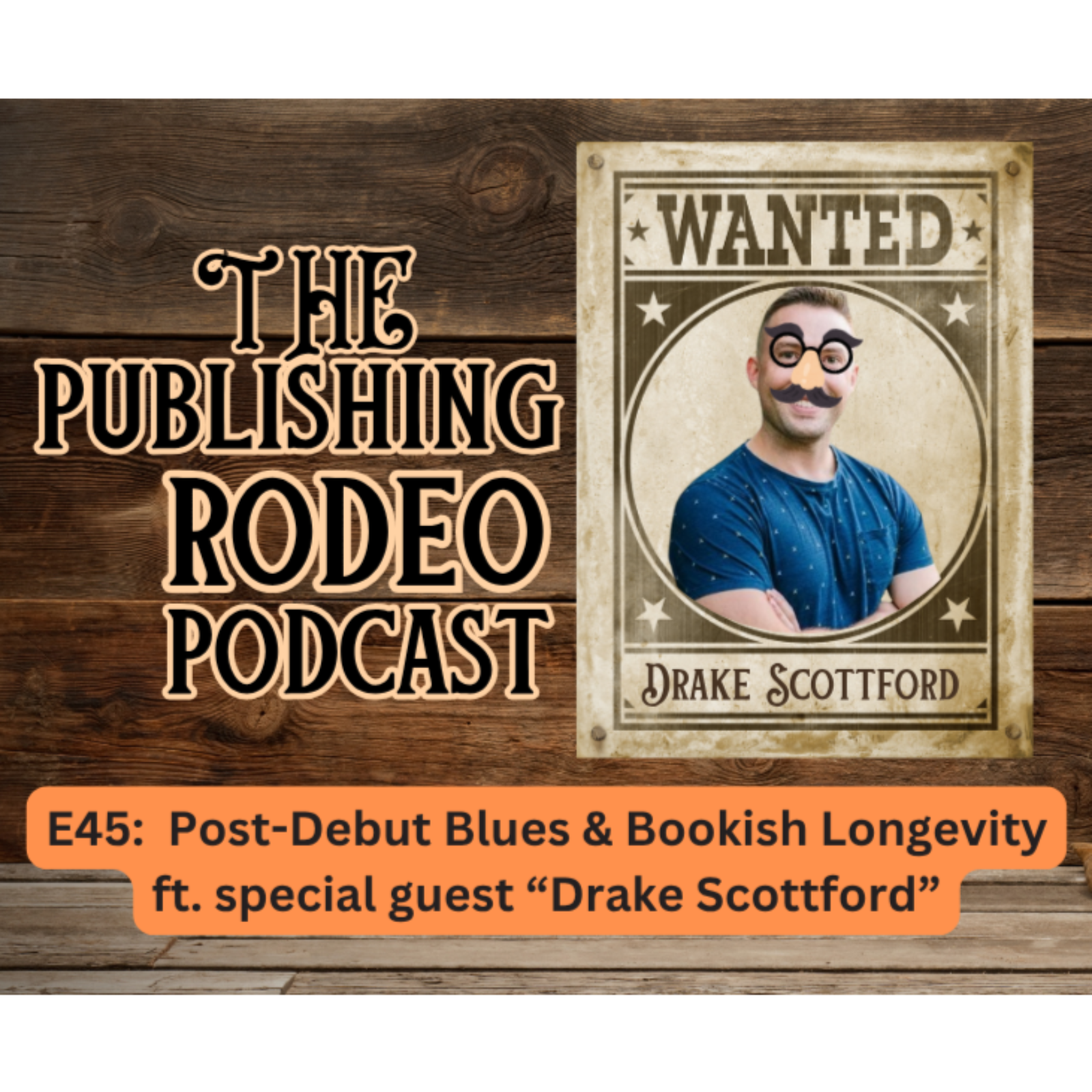
S2 E45: Post-Debut Blues & Bookish Longevity, ft. "Drake Scottford"
Episode Transcript
Hi, I'm Sunny Dean.
And I'm Scott Drakeford.
And this is the Publishing Radio podcast.
In 2022, we both launched debut novels in the same genre with the same publisher in the same year.
But despite having very similar starts, our books and subsequently each of our careers went in very different directions.
That pattern repeats itself throughout the industry over and over.
Why do some books succeed while others seem to be dead on arrival?
In this podcast, we aim to answer those questions and many more, along with how to build and maintain an author career.
Everyone signing a contract deserves to know what they're really signing up for.
In an industry that loves its secrets, we'll be sharing real details from real people.
We'll cover the gamut of life as a Big Five published author, from agents to publishing contracts, finances, and more.
talk about the absence at the start do we at least acknowledge it time has passed and what brings us back to it which is I think we stopped when we ran out of things to say and had books to work on and we wanted to record one again because we fucking felt like it and we don't need to do this for sponsorships we have no rules and we have no bosses we have no schedule we need to follow no baby jesus dolls that we need to sell they never gave us that sweet sponsorship huh we talked about having a guest for this one and i think actually it just takes a lot of stress out to not do that As much as I have enjoyed all of our guests, and I don't regret any of the ones we recorded, including the ones we couldn't air.
There were like four or five episodes, I think, in the end, which never actually made it out.
Due to either the episode had to be pulled, or guests felt they kind of changed their mind, which is totally within their remit, or they just didn't have the time to get around to edits and approval.
that's fine.
But man, it, you know, it adds a lot of stress and time basically in a lot of edits and maybe we'll bring one on again sometime, but I'm not fussed at the moment.
And nobody really wants to talk about how shitty it is after a first contract is gone and what the state of the industry really looks like.
So I guess it's just us, huh?
I think that's the heart of the issue.
There has been a lot of chatter this year.
I guess everyone's on the same zeitgeist wave about career longevity and life after debut.
And that's something that obviously we have been dealing with ourselves and we've been talking about a lot with our friends.
The kind of the heart of what's even driving this brief revival from the grave, which we shall shortly climb back in, is the fact that we probably know fewer people now who are...
agented or in contract than we did when this podcast started and that's not because our friendship group has changed uh that's because a lot of people are just not or even like if there are some some people are there but they're like career ghosts i want to say I remember reading that statistic about how a lot of books fall off.
A lot of authors get kind of bumped out of the industry after the first couple of books, their contract wraps up and thinking, that's so high, surely it won't be that bad.
And a few years down the line, I'm looking at it going, actually, that's about right, I think.
Probably at least 40 % of the people we know are struggling to stay in or are totally gone.
And that includes some very big books where the first book didn't actually do very well.
And so the second book is kind of there, but has like no reads or anything.
I mean, my second book has like 37 Goodreads ratings or something a year after release.
Like basically just friends and family and not even most of those have read it.
But that's somewhat expected given the circumstance, right?
But yeah, for that to happen to big books or at least a big debut and then their second book.
lands like that i mean you're just never safe the thing that we keep coming up against again and again is we have friends that like their book does not even badly uh and not even like middling sometimes the book does really quite well like hitting sunday times list i i know that that's that doesn't mean what it used to because nowadays the you know crateflation and listflation is such that hitting the list is like a minimum rather than you know a great celebration for publishers they don't they just see it as whatever but you know books that earn out and they do really well and they hit lists and they make award lists and the publishers then turn around and go still not good enough we think your second book is not going to sell right and that's That's just crazy to me because there is a drop from debut to sophomore and publishers seem to know it is.
And when I talked about it a bit on Threads, the wonderful Chuck Tingle commented and he said that he'd been told by publishers that, yeah, your second book generally sells about 30 % less.
And publishers just seem to know this and they just seem to take it for granted.
Instead of like...
kind of supporting book 30 more i guess i don't i don't know they just seem to kind of bake that into their future predictions and go oh well based on this we think your next book is going to do like that and they don't calculate your say your they don't calculate your crates they assume that's not going to happen they assume that all the good things that lined up the first book won't repeat um so they end up with this very low prediction for what your second book is and based off that they then don't offer contracts or my my new least favorite thing which is offering people telling people oh if you pitch your option now we won't buy your book yeah so why don't you wait till the sales come through for your second one and try again and like a lot of people are hearing that i think from different publishers and to me i personally can't see the advantage for authors i feel like if you if you wait for those sales to come back they're not going to be good because book two is not going to get pushed and you're then going to have to you're going to get rejected anyway but you're going to have to go and sub with a bad sales record as opposed to an unknown one well and i mean the drop in sales makes sense from book one to book two for a series right for i mean typically we're selling trilogies because there's just naturally going to be a drop off of people who read the first book and and didn't like it enough to continue and nobody there at least nobody sane is reading a book two without having read book one but for you know, a contract like yours, where you have a contract for three standalones that just, I mean, minus those big things you mentioned, like crates, Barnes and Noble picks, et cetera, that are much harder to account for.
That makes sense.
Stripping those out of, or at least applying some modifier to represent not being able to count on those happening again.
for sales projections makes sense, right?
But absent those, there's absolutely no reason for a publisher to just assume that a second book not in a series is going to sell worse, especially given the name recognition that the first book will have built in the fandom.
The only reason would be lack of publisher output, right?
Lack of publisher effort.
It, unfortunately, they dictate how our careers start, they dictate how our careers progress, and then they get to set the terms for when and how we sign a second deal.
The unfortunate thing is that it's not cut and dry either.
Like I can think of at least a dozen or more authors who signed either low or middling deals for debut contracts right and they finished out that contract they didn't get a second contract based on the option that they turned in but they didn't just like stop writing and that's why they haven't been picked up again they're still writing they in their minds are still a published author and i mean they are right yeah but a lot of people are pushed out of the industry and are just spinning their wheels on this dream and hoping to get back in when I just don't see that happening other than a few instances where people are switching genres or changing names, et cetera.
And even then, it seems very, very rare.
We actually, we collected some responses to talk to people about this, which came with the caveat that they were happy.
not the caveat, which came with the condition they were happy for some of them to be shared.
And it was just, it was about different people's experiences because not everyone necessarily wanted to talk about it, but some did.
And, you know, some people, so some of the questions that we asked were basically, you know, what year did you debut?
Because I think that makes the difference.
I think people, I find generally people who debuted a bit earlier seem more optimistic, possibly that's self -selecting because they debuted earlier and they're still here, they've survived.
But let's see.
I don't think I've seen this.
I don't, I don't, I don't think I've seen the responses.
So I'm very interested.
Okay.
Can, can you actually see this?
So, well, okay.
We can edit through it as needed, but basically it was like, were you a lead?
You know, how are you published?
Most people responding were big five.
And it's a mix of things.
You know, what was your experience like working on book two?
You know, so one person said they felt the biggest difference is a systemic thing that went beyond publishing.
Even though book two is a better book, there wasn't debut buzz.
So I think that is a real thing that that is legitimately an issue.
You're not new and exciting anymore once you've published your first book.
And this is something I'm thinking about a lot because I feel like I had a really good start.
My book did probably as well as I could have hoped for it to do.
And I'm staring down the barrel of book two, and I'm very acutely aware that all the things which lined up for book eaters are not going to line up the same way again for Girl of a Thousand Faces.
Just all the different special editions that we got, you know, all the different book of the month, you know, that's out of your control.
The things that made the biggest difference to my sales, I don't think I will necessarily get.
And that means I'm relying on track record, which I'm not convinced sells books.
and the publisher putting in the effort a second time, which you need with the standalone.
Yeah, that is interesting because, well, I haven't read the final draft yet, but I've said it before, but as much as I love book eaters, I do think Girl with a Thousand Faces is better.
I think it's better, but it's not a high concept book.
I think the cover helps to make it high concept in a way.
It really needed that.
And I'm tracking all kinds of metrics, right?
So the first time around, I tracked Goodreads ads for book eaters month by month.
Again, and I'm doing the same.
I'm way behind compared to book eaters at the moment.
I tracked cover reveal, but I think, oh, we did this, didn't we?
We talked a bit about the cover reveal and went back through all of Tor's cover reveals the past two years and put it in a data sheet.
And I think, honestly, the overwhelming trend was that the...
response you get to a cover reveal is actually reflective of how big your platform is already rather than indicative of organic excitement around the book you know obviously brandon sanderson gets like like his cover reveal is just like they don't even do them sometimes they're just like oh we've there's a new brandon sanderson book coming out with like kind of blank template and that'll get like 15 000 likes because you know You could, you could do like clip art of just some stick figures and it wouldn't matter.
His readership will buy it because they love his books and they love him.
So he doesn't, he almost doesn't need that.
But anyway, I got totally sidetracked there.
Yeah.
So I, I mean, yeah, I hope it goes well.
I feel like you've got a lot of fans out there, especially amongst booksellers.
And I hope that translates to at least the book getting a shot to be on shelves.
So some people felt like most things were the same.
Some people felt like there was a steep drop off in support, interest quality, you know, no print arcs for second books.
That's quite common.
Oh, really?
Tor were like, oh, of course there will be arcs.
Why wouldn't there be?
But I did have to push a little bit on the UK side, I don't think.
they saw the advantage except that they didn't want to match the energy level kind of thing from the states it's one of those things where when publishers say well we're not sure arcs help and you think well then why the fuck do you print so many of them for like lead titles and i i mean yes i think basically like what i get from all these responses is that it is hard to sustain internal momentum with your team And I think that is one of the really the big drivers.
There's this great article from the bookseller where they were talking about all these articles that have been coming out about career drop -off.
And it has this quote from David Headley where he's like, well, the biggest impact on sales is staff turnover.
People leave and no one cares about the book.
Where's it gone?
David Headley.
Sales truck is an issue and it is rarely the author's fault ever, says DHH Literary MD David Headley.
He points out the high staff turnover in publishing houses as one of the major issues driving poor sales.
An editor buys the book, then the editor leaves.
An assistant takes over.
There is no marketing spend.
There is no real passion because it was not bought by that editor.
So how does that affect the author's career?
Heidly says this happened to one of his authors recently.
The book sold 275 copies.
It was a lead title, but the editor left and the book was orphaned.
And that is the reality of the situation.
Publishers need to get control of what they're doing.
It's kind of a brutal statement, but he's not wrong.
A lead title sold 275 copies?
If there's no internal hype, there's no hype at all.
I think you've got to be passionate about your book and then your agent and your editorial team and the sales team and then all that feeds all the way down.
I think more and more that that is such an important component and you have to find ways to drive that hype.
Either you're so fucking big that everyone's terrified.
No one's going to let Brandon Sanderson's books down, are they?
Sorry to keep using you as an example, Mr.
Sanderson.
But no one's going to let...
yeah i mean even like jk rowling right like i bet you're a staff fucking hater but they're not gonna do anything to not push those books yeah but i and i mean even a uh i don't want to say a tear down because that's rude but a tear or two down right and i'm not gonna name names after i say something like that but it does seem like your only choice is to get big enough that you have your pick of publishers and therefore your publisher knows that they're going to lose a moneymaker if they don't put out or run the gauntlet, right?
You're in a lottery where everything has to line up correctly.
And it seems like the number of people who make it out of that gauntlet to that one of those tiers doesn't have to be that Sanderson tier, but one of those tiers where you effectively have your pick of publishers and...
therefore get the treatment that you should as a business partner is very small, right?
Like I can't, I don't know anybody personally who has made that leap from okay sales or even a debut lead title up into that.
They can go anywhere they want.
I know one or two.
So Pretty much everyone we know, I think their contracts, they've either been offered the same money more or less or less on the second contract.
Gareth Brown is one person who's bucked that trend.
I think he was like a kind of 500K range advance the first contract.
His next book is higher.
But obviously the first book did sell like really, really well.
It was a two book contract, right?
So his second book is kind of out now.
Another one, Nick Bench.
If you remember, he had all the stuff with film deals going on.
He was offered more.
Yeah, I'll get back to you on that if I can think of anyone else.
I mean, they do exist.
They do.
But generally, it is the people who are getting more the second time around were like lead titles the first time or lead debuts.
Richard Swan got a bit more, didn't he?
It was like a little bit more though.
Like if you account for inflation, it might be less.
And that, I mean, that's probably one of the examples that surprised me the most because his debut trilogy sold extremely well.
He is very, as far as I can tell, He's very easy to work with from the publisher side because he hands in very clean drafts.
He's very productive.
He's a very good writer, in my opinion.
And still, despite sales, despite all of those other intangibles, or I guess perhaps tangibles in some cases, didn't really result in a huge outcome.
And hopefully he still has a huge outcome coming in the future.
Well, he's diversifying, isn't he?
So, I mean, that's the thing.
So I think Andrea Stewart was also on here.
She's very transparent about her finances.
I think she had essentially the same deal again.
Most people I know either did not get an option or did not get an increase if someone offered on their option.
I think for Tor, the people a year before me and our year, I think I'm kind of...
the only one of like the the actual debuts like that was in quotation marks not um not people who have had a self -pub history which i'll get to in a second who's maybe still standing i'm not including like nightfire and and tour .com i think ronnie's still in limbo uh i've not heard from him recently obviously your situation is um kind of you can talk about that or not if you want i think other than that yeah people like nisha tooley and chuck tingle they're doing really well but they had a self -pub platform that they brought with them yeah um and basically just i'm always going to sound like i'm wailing on reddit but because i think reddit reflects a lot of author opinion and you know there's all i remember there being a lot of discussion on reddit about the things that we say and how there's a general sense that oh you know if you keep your head down keep working you can work your way up the advanced ladder and my difficulty that is it just feels like bullshit because i don't feel like that's happening for most people we know Maybe we just have shit friends.
I don't know.
Unlucky.
I don't think that's the case.
Cause I mean, we've, we've kind of tried to keep tabs on, on general outcomes, right.
Of, of people who.
Yeah.
Yeah.
Well, I mean, even beyond friends.
So like James Rollins, right.
He debuted quote unquote with his.
fantasy around when my debut came out my first book came out and obviously he came from uh writing thrillers where he's a new york times bestseller and i think his books did okay um but i don't think they hit it out of the park and i don't know i don't think i've seen an announcement at least for a follow -up after that original trilogy that he signed for That's a big name, an established writer who, as far as I can tell, might be on the way out of sci -fi and fantasy.
I don't know.
I should probably look him up and maybe edit his name out.
Well, this is the thing that kind of fills me with quiet terror is there's a very real sense that what publishers are looking for is a bestseller not just a great bestseller that hits list and drops like a stone but a bestseller with good sell through hardback and paperback and all that buys you is the next day of execution you know to borrow richard's amazing phrase and for me it's just it feels a little bit like being the miller's daughter in rumble stiltzkin right where Someone has told the king that you can spend gold and you managed to spend gold one time.
And so he comes back and is like, here's more straw, make more gold.
And obviously, you know, the difference there is I'm choosing to be here and the miller's daughter isn't.
And I choose to be here because if you can spend enough gold, one day you get to be the pretty little publishing princess and you can live safe for the rest of your life in the castle and not have to spend anything.
Or rather, it doesn't matter what you spin or don't.
But of course, the other difference is there's no Rumpelstiltskin to come and do it for me.
So I have to actually spin this shit myself.
But yeah, I feel more secure than most of our friends.
I'm in a better position than a lot of people.
And no, I'm very privileged in that way.
And I still worry about it.
It still keeps me up at night because I look at that next book and think, everyone is assuming it's going to do 30 % worse than the first one.
And I think it could do.
you know if it doesn't get picked book of the month then it's the paperback will sell far worse than 30 i think you know it's not gotten all the different special yeah there's this it's you stress about it and you don't want to be that person who a year from now some other podcast is like oh yeah and then sunny dean fucking disappears oh my fucking god yeah i mean it does yeah and i don't recall exactly who was mentioned in this article but there was an article shared in our discord about how it was tony morrison yeah okay it was tony morrison that's right uh you know authors had a chance to to work up to building themselves a career and uh you know developing a style and whatever else whereas now that's just not the case you don't get three or six or ten books And over 10 to 15 years to just keep taking shots, you get your first book basically.
And if that book doesn't break out, you're fucked.
It feels like that at the moment.
I subscribed to the bookseller and I was following the Frankfurt Book Fair, which we talked about before this started, but because my agent is taking Girls a Thousand Phases to Frankfurt as like a hot list book.
And I didn't go to Frankfurt with book eaters because American agencies, unless they're massive, don't tend to go as much, I think.
But yeah, one of the articles there, this guy was saying, in Frankfurt this year, there are two genres, romanticism and non -romanticism.
And you read stuff like that and you think, oh, fucking hell, only one genre seems to matter at a time.
Everything has to be a breakout or it's dropped.
And once it is a breakout, you have to keep being a breakout.
You and I chatted this week about, hey, we should put together a little e -book or pamphlet or whatever with all the things we've learned or think we've learned from doing these interviews.
And I think one of the big ones really is editor influence.
But especially as a debut, how in the hell are you supposed to know?
what the internal politics of a publisher's editor group looks like.
The best you can do, really, is take shots at editors who have produced very big sellers in the past, but then, I mean, this is what I'm sweating about right now with my historical fiction.
historical fiction about the founding of Mormonism is on sub right now.
And it's on sub with a whole bunch of big time editors, which is awesome.
But it's also very difficult because they undoubtedly have very large submission piles that I have to stand out in.
And they have very high standards of what books they're going to take.
And even then, you still just don't know where it's going to land, even if one of them were to take it.
You don't know where it's going to land on their priority list, which then determines where it lands on the publisher's priority list.
So it's a very opaque industry.
Feels hard to make informed choices that improve your ability.
And it feels like writing an awesome book isn't enough.
And especially writing an awesome book isn't enough.
If it doesn't happen to be your debut somehow.
And fall right in line with what people are looking to acquire.
I think this response.
capture something really well for me six books and i'm more worried than i've felt since i debuted i feel like i was steadily building momentum but i'm now being harmed by the sales track record that comes with starting with smaller publishers i'm moderately confident i'll secure some form of publishing deal but not remotely confident it will be equal or larger or at the equal or larger publishers than my current one which makes the continued workload and health slash family cost of publishing side of writing harder and harder to justify there are some positive responses in here but uh I guess I look at the ones that reflect how I'm feeling and the things that I worry about.
I'm glad that some people have survived and are feeling a little bit better, but not everyone does.
Yeah.
Yep.
Yeah.
You know, one thing I've been thinking about is I'm actually quite glad.
that I published under not my real name for my debut.
And I mean, there's no harm in publishing under your real name and then going to a pseudonym, but it does leave, you know, more options open for me for future pseudonyms to try.
We'll be hearing from Drake Scottford very soon.
Drake Scottford?
Maybe.
Maybe.
And, you know, I am never going to give up on the Scott Drakeford stuff either.
So that name will die hard.
But I mean, it's a real thing to consider, you know, like all these people submitting to publishers and then overjoyed that they get a deal, any deal.
I mean, if you take anything from our podcast, just.
buckle the fuck up and make contingency plans because the best way to make it in this industry is to make it from day one i think it's interesting that there is a spate of people talking about these situations and that there's a there is a real sense of anxiety that's worth looking at and not just ignoring i think yeah I think there is something there beyond just social media hysteria.
A lot of people are feeling very insecure.
The turnover is insane.
I don't, I don't, I've not kept track of the US side so much, but like Harper had a crazy two years here.
Simon and Shuster in the UK has also had a crazy couple of years.
And what was the other one?
Hodder in the UK.
Oh my God.
You mean editor turnover and staff?
Editor and staff turnover, which then.
feeds all the way down the line to authors um yeah orbit well i think on the u .s side are having an interesting time it's everywhere basically it's it's sort of every imprint at least in our genre um and i don't i don't know what i want from this discussion other than i deal with anxiety by like drawing everyone into my circle of anxious until they feel anxious too which is essentially what this podcast is for and i guess if there's merit in telling people that you know you've you know you're not alone or whatever or maybe we're just talking to the wind Where has that guy gone?
10k sales threshold.
I wonder if we have time to seg into that.
Unless you've got anything else to add into this wall of gloom.
But mostly I just wanted to highlight a range of experiences and be like, look, this is how it looks from where I'm stood.
Maybe if you're on a different patch of ground, it's better.
It's more hopeful.
Maybe everything comes in waves and it just happens to be that because, you know, the same way a lot of my friends debuted within...
a narrow bracket of years a lot of us are facing tricky times at the same time maybe yeah i don't know yeah yeah i i mean i personally just think it's helpful for people to know what they're aiming for right and to know what that means for them going forward i mean there are publishers popping up now and i think more in the uk and You know, the ones that come to mind are the ones that are associated with the subscription boxes.
So Daphne with IC and then the Broken Binding with their subscriptions that I think fund a lot of excellent risk taking.
But I think there are new models emerging where people who really care about books are building publishing companies that.
can do pretty cool things.
Right.
And so we've mentioned it on the podcast before, but I offered my rights in the UK free of advance for a reason.
And that's because I believed very deeply in these people that I offered it to, and there should be an announcement forthcoming.
And because I'm essentially trying to Get another shot at relaunching, getting in, you know, maybe some editing that lines up with the story that I am actually trying to tell.
Getting the book in people's hands.
That are hopefully closer to the target market, that kind of thing.
So, I mean, we're not trying to preach a hard and fast rule of either you're a super lead or.
you have no chance and there's nothing else you can do.
And that's the only kind of deal you should take.
However, I mean, what we're seeing is pretty stark.
However, we're seeing that the, you know, the people I know personally who are doing okay or better than okay are disproportionately, disproportionately people who had a big advance out the gate.
And by okay, I don't mean like, Cause there's this thing where people go, Oh, but you know, you can, you know, if you're sold making a few grand thousand grand from your books every year, that's okay.
That's not what I mean.
I just mean like they're in the industry at all.
It's the, the issues is just, there's not, it's like you're not in the industry or you're doing really well.
And there's very, very few people who are clinging onto that middle kind of.
Yeah.
That's a really good point actually, is that, you know, a lot of people, bring up oh well i don't mind if i just sign deal after deal where my book only gets me a ten thousand dollar advance or whatever right yeah and the thing is i don't see anybody doing that i other than very established authors um i don't see any recent debuts that do anything other than get to that level of repeat six -figure offers or they're just out so i see it at the indie press level uh and this is where i'm quite sad because we we did one interview with broken binding and one with um george sanderson who runs titan and we weren't able to air both of them in the end for various reasons that are not the faults of those those people but you know one of the things that that matt talked about broken bindings he thought that there would be an increase in smaller publishers and one of the things that i loved about titan I do know authors there who routinely get the same advance, not start over, who routinely get kind of steady advance levels and they're not making like mega bucks, but they are kind of like improving and building and growing in, in that way that authors kind of used to the bigger publishers where I think it, it's getting, it's getting harder to, to stay at the top.
Yeah.
But it's not.
Can you think of a similar example in the US?
Are there any publishers doing that in the US that you know of?
I don't know the US as well.
I'm sure there are some.
I mean, Orbit itself has a functioning midlist still, although I hear that's changing a little bit, but I can't comment on that.
No direct experience.
I can't think of anybody who...
debuted with a smaller deal with them and got another similar deal.
It's all been six figures and up that have are still around.
Yeah.
Yeah.
And even then there's some six figure deals that disappeared into a black hole.
Haven't heard from those authors in like a couple of years.
Yep.
Um, yeah.
And I, uh, tower maybe.
Um, Maybe, but I mean, they're the ones that did.
Yeah, but that's an outlier.
A lot of their books are smaller.
I mean, you get it in other genres, definitely like romance and contemporary and Harlequin scholastic, places like that, which are not big five, but are big.
They have mid lists of various types.
Anyway, sorry, didn't mean to interrupt and derail.
No, no, not at all.
I do think, I will say some positives.
So I think for me this time around, some things that are a lot easier is I am a lot better positioned to help my publisher in a way that I was not for book one.
And I know we talked about your internal team having hype or not.
And I would actually add a third category, which is they're excited, but they don't have the time and resources.
You can do things for them.
Sometimes that can really help, right?
I, so like this time, you know, I didn't know anyone when I first got published.
This time I was like.
I have a spreadsheet and it's got like 50 names in it.
And these are people you can ask for blurbs or send arcs to or reach out for.
And they're all like categorized by country with contact details, how I know them or don't know them or why I think they're suitable.
My publicists love that on both sides.
Like, oh, cool.
This is great.
And we're all kind of working out the doc.
And that way we don't have to like waste time emailing each other.
You can be like, okay, they've emailed.
that person i've emailed this person you know we divvied up the labor you can see responses they come in when i get a blurb that's come in you know they check every so often and they kind of stick it on like the editorial section on amazon or whatever things like that i feel like because i know more what's going on i can anticipate things better yeah i can call on favors uh i have my own links with bookshops now stuff like that does make it easier And things that I wouldn't do as a debut, like I wouldn't go and set up an event.
I am this time.
I'm setting up my own launch and my own after party and actually having people who will attend.
There are things you can do for yourself when you're not a debut that you cannot do as a debut.
When you are a debut, you do need your publisher to like haul ass.
So in some ways, the fact that they not as much ass as being hauled, that sounded terrible for sophomore books because the debut buzz is just gone.
you can kind of mediate it a bit maybe i don't know not not you're in a series though if you're in a series you're a bit fucked sorry you are a hundred percent yeah that should have put that caveat first because the problem is your series is really just a long continuation of book one it is whereas this feels like we are rebooting me because it's been four goddamn years since i've or will be oh fucking hell but i mean I keep saying this as well, but that initial deal of three standalones is so smart.
So, so smart.
Yeah, totally my idea.
No, it wasn't.
But it's a boon.
I'm very glad I haven't been writing Devon Book 2 this whole time.
This may be a good point to second to an article that we've talked about some, which is why publishing is becoming...
like this a little bit and i think there's lots of different reasons but there's this great article from what's his name todd satterston we talked about having him on as a guest and we were too lazy to organize it decided we'd just talk about this article without him here and it's called the magic number um and i found it really really fascinating and actually really quite hopeful because basically he's he's saying that There is a kind of magic sales threshold, similar to when Dr.
Cary Prey was saying there's like a magic marketing threshold that you have to hit for books to actually succeed.
And he's saying there is a magic sales threshold that books have to hit within a certain timeframe to have a chance of success.
And he was looking at nonfiction, but I found that I think it's broadly true for fiction as well.
Yeah, I mean, I'll link to it in like our notes and stuff, but...
Let's scroll down.
So he used a data set of 6 ,775 titles.
Again, business and self -help published between 2012, 2015.
So it's quite old now.
So there's this magic number that apparently comes up in publishing of 10 ,000 copies.
And the idea is that if you can get 10 ,000 copies into the marketplace, it reaches that point, which Richard Swan has talked about with it.
He quoted his editor, James Long, the point where a book has a chance to grow its own legs and is not just relying on marketing push.
And so one of the things he goes into is the fact that, you know, when a book has a big burst of sales at the start, but that's 95 % of all the copies it's ever going to sell, that indicates that the publisher was marketing well, but the book has not, for whatever reason, found its longevity, found its audience.
It's not self -sustaining.
It didn't get into that book orbit that they want where it's just circling.
That long tail is a much better prediction.
Long tail across six months or a year is a much better prediction of how a book is doing.
Then that initial list hit.
Yes.
So he found if a book doesn't sell 10 ,000 copies in its first year, there's only an 11 % chance that title will ever sell more than 10 ,000 copies.
Only a 2 % chance sales will exceed 25 ,000 and it gets worse from there.
Yeah.
And this is like a lot of data.
I realize you're like listening in a car and trying to pay attention to traffic.
But if you can get in the 10 to 25K copy range for the first year, you've got a 42 % chance of selling more than 25 ,000 copies.
And essentially what he's saying is the higher you can get into any bracket in the first year, the more that predicts your long -term sales, which kind of makes sense, right?
Like we know that like when Richard Osman releases a book and he sells 140 ,000 copies in his first week, we know that that means he's going to sell more.
It's not like the next week he drops to zero.
What he's saying is that there is a floor for this, which is you can't hit that 10k sales threshold in a year.
The book is probably going to struggle long term and not explode and not pick up.
But I found that hopeful because, firstly, to just have the number.
Firstly, long tail matters.
So, you know, continuing to promote a book after it's out.
It doesn't have to all get that in the first week.
It's not all about that.
And secondly, it basically suggests that quality does make a difference.
It might not in terms of like the advance you get, you might not get a flashy advance, but if there's enough support to get the book to the basic threshold, if it has staying power, it will stay.
That said, it has to get to at least 10 ,000, if not 25 ,000 in that first year, which I mean, that's attainable.
That's a very attainable number in trad publishing.
But as far as I know, It's mostly books that are debuting with six figure.
Yes.
Advances that are getting to those numbers.
So, I mean, he went into more specific.
So he said a book that sells consistently, for example, 300 copies a week for 50 weeks has.
statistically is better positioned for long -term success versus a book that sells most of its 15 000 copies in the opening 10 weeks so he's not even talking about crates but it really applies to crates yes that if most of your copies sell because you were in a crate and there's nothing else going on um and that's relevant to publishers because i think there is like a little bit of laziness going on in the uk this kind of sense that like oh the book got in the crates we don't have to do jack shit now we just collect those sales treat the book as finished a finished product where we made a fixed number of sales that we can bank on which we then don't factor into your success when offering you a new contract because we can't count on you getting that again which is which is wild right it's like oh we made all this money from your crate sales but we're going to assume that it won't happen you won't lightning won't strike twice so We're going to say, actually, if you discount crate sales, your sales sucked, even though that's the publisher's responsibility and all.
Well, and I don't think it's any secret that even on the U .S.
side that publishers will put a lot of effort into the lead up to a debut and maybe in the few weeks or if you're lucky, a few months after debut.
But very rarely am I seeing at least.
significant effort put in in those months you know three to twelve that this study suggests are actually the critical months for sustaining sales and he's not the only person to say that i've heard from uh the publicity lady that showed up in that reddit where she's saying it's ridiculous that actually i assume it's a she it could be he they said they that they think it's ridiculous that like the push stops you know three months after after the book comes out because actually there is momentum to be had yeah um and if the goal is to sell 10k copies consistently steadily in the first year that's the biggest help you can give books if we have the link if we have the link to that ama we should definitely put it in because that was so good yeah so back up people listening there was a kind of big five publicity person who came and did an ama marketing read it on marketing sorry yeah um and they had a lot of good answers one of which is like how do you drum up internal hype for your book and the answer is you don't you have an agent who puts the fear of fucking god into your editorial team so that they are terrified every time an email arrives from them i thought that's hilarious they they were very in favor of mean agents and doesn't that run contrary to the be nice yeah stuff Or maybe you can be nice, but your agent better be a dick.
Yeah, and better stay on top of stuff.
And I mean, I wish I had that pulled up and had read through it right before.
I should have been prepared for that.
But the things that stick out to me were her giving very clear answers to things like, what kind of time are you giving to the lead titles in any given season versus everything else?
She was saying that, you know, there are however many two or three lead titles in any given season that they're working on.
And then potentially what up to a dozen or more other titles that they are covering for that same season.
And they said straight up that something like 70 to 80 % of their time and effort and money and everything is going to those two or three lead titles in that season.
And the remaining 20 % of their effort slash money budget is going to that other bucket of, of books that, you know, hopefully they can find something to do for them, but often it's likely going to be just putting the ebook on net galley.
That was the thing that I did notice when I was going through the two years of cover reveals that actually perhaps what was more relevant was not.
the likes an individual post got but the repetition of likes for books which were expected to be big hitters so if you're a big hitter you get like the deal announcement or you know if if it's part of a bigger deal the the announcement that there will be a book and then you get like the cover reveal and then you get um you know a post when they have arcs coming out and you get like when there's a giveaway and then oh this book is out soon and oh book birthday the book is out now and oh don't forget this book is out now and yeah and now it's out in paperback right but if you're kind of mid list it's more like deal announcement for one deal you don't repeat it for subsequent books didn't seem like um cover reveal happy birthday book is out and that's kind of it so um i think the it's it's not even sometimes the money i think she said in one of her comments it's about like the creativity that they're allowed to devote yeah um the the mind brain power that you're allowed to devote to certain books you've got to put that emphasis on on the bigger ones and thinking of the uh re -release i think this is a i know i know people aren't always keen on hardbacks but having that hardback paperback release means you do kind of stay in line the the this field of vision for your publisher that little bit longer because that is a thing the paperback coming out it just extends longevity of your book like you get two launches so all the all the best things that happened for my book really on the u .s side where the paperback all the different promos and things when it becomes more affordable book of the month picks and stuff so Yeah.
Anyway, that was like a very hodgepodge kind of collection of different thoughts, gripes, some bright spots.
If people aren't used to us rambling by now, they never will be.
No, I mean, I kind of organize it when I do it later.
But oh, you found it, the Alma thing.
Yeah, we will link it because it was an interesting read.
But that's just kind of where we are and what we're doing now that we're both trying to survive.
Second book.
to get to the second contract in your case on submission.
If you can say that, I think in my case, I'm tracking everything that I can track about my book to see, not because I can change the outcome, but because documenting it, it doesn't, I was going to say it makes you feel better.
That's a lie because I, because I feel compelled to do so.
I feel compelled to document it and see what's different and what's the same.
whether some of the things i think matter didn't matter which i didn't have a sense of last time around you know it might might release might do better than book eaters but have like terrible goodreads rating or something i don't know i don't think it will and and for what it's worth i do think it makes sense in your situation to be putting effort into maximizing a good first contract a very good first book that earned you a lot of goodwill and a lot of fans that makes a lot of sense and yeah in my case I'm straight up trying to pivot anywhere I can relaunches and I'm on set with historical fiction and the work in progress is one that could be sold as historical fiction or fantasy probably historical fantasy under a different name most likely But maybe the same name if this relaunch in the UK goes extraordinarily well.
Different situations call for different decisions, for sure.
I don't know if I have anything to add to that other than this episode is going to need a lot of unscrambling because I think there's a narrative thread that we were both all over the place.
And if that's too much work, it can just be a hangout for us.
That's fine.
It doesn't have to be released necessarily.
I think, I think, I don't know.
I think I enjoy it.
I think I no longer really care if like only five people listen or 50 ,000 people listen.
I think.
Yeah.
I think in some ways all our worst content often ended up being our most popular worst as in least nuanced, you know, a lot, a lot of people fixated on carry price thing.
And their takeaway from that is trad pub doesn't care if your book is garbage, as long as they market it, it will sell.
And that's not really true.
Yeah.
because there is a base level of quality involved.
For sure.
I don't know.
I'm very uncomfortable with this kind of inbuilt assumption, this insinuation that successful books are just sort of garbage by default until proven otherwise.
I don't.
Yeah.
In fact, I want to mention something.
So I stayed up until 3 a .m.
last night reading Kristen Hanna's The Women.
Oh my God.
She is so good.
She is like my, she is like my favorite author, at least of the year.
Like I've burned through.
I bet I have a bunch of them behind me.
Yep.
The Nightingale, The Four Winds, The Great Alone.
And I think it's very popular, especially in like publishing or maybe not publishing, maybe like aspiring publishing or heavy reader groups, right?
Or circles.
It's very easy to get into the habit of trying to find things wrong with people who have found more success or whatever.
But I mean, the truth is there is a very real bar of quality that matters.
And Kristen Hanna, you live like 20 miles from me.
I can probably see your house from mine.
I am a huge fan.
Then maybe cut that.
That's an extremely creepy thing to say, but the women, very good book.
Or keep it, whatever.
We say weird stuff all the time.
I'll just get a - But then you reveal your location.
I think just say, oh, I can say you're a huge fan.
I'll get a restraining order in the mail.
Yeah, it's a good book though.
I don't know if you've read any of her stuff.
I haven't.
I don't even know what she writes.
Is she historical?
Yeah.
So she writes, and I mean, they're super popular, so I'm not like finding a new fantastic author.
Tons of people know about her, but she writes historical and her thing, at least, so she's written a whole bunch of books, but these ones that she's written in the last, I don't know, five, seven years have been.
Very, very popular since the Nightingale, I think, was her first mega hit.
And it's about a woman in France in the lead up and then during Nazi occupation in World War II and what those French freedom fighters went through, etc.
But she puts these stories into some sort of a historical setup.
but it's almost always a young woman who has some sort of major challenge, but is falling in love at the same time.
And spoiler alert, most of, if not all of the people that she falls in love with die or almost die in some fashion.
And so they're not necessarily like happily ever after stories, but yeah, she's just a great writer.
I mean.
I get sucked into her books every time and I lose a lot of sleep to them.
No, that's really nice to hear.
And, you know, I struggled for a long time with that.
I want to call it writer arrogance, the kind of turning your nose up at things, something just because it's popular, because I did actually grow up reading a lot of like really fucking weird niche books.
I mean, this is like.
in case anyone's like it has ever read you know the etch city by kj bishop uh you know that's that's like a kind of class cult classic new weird book that's 95 imagery five percent plot has head hopping it's experimental it's all kinds of stuff you know things books like that yeah and then i write i've been telling people it's like a joke when they ask oh i write commercial shite and i don't think i told you this story I went to watch as like an audience member, not a guest.
I went to watch a panel that had Dave Ragg, if you remember him, and RJ Barker.
Yeah, of course.
And Adrian Tchaikovsky in it.
And we went out to dinner afterwards and Adrian's wife, who's very nice, her name's Annie, and she asked me what kind of books I write.
And I said, commercial shite.
And instead of laughing, she just looked at me in like this kind of quiet horror with like, why would you say that about yourself?
And it was actually this real moment where I was like, oh.
fuck I feel really bad like maybe it's not really that funny to just like call myself shit all the time I'm gonna stop that so that won't be the last time I ever say that but yeah I write very commercial and I read very weird eclectic literary and that means I produce this writing that is not the kind of thing I normally read and I did really struggle with that for a long time um and I don't know if you've read it but Patrick Stewart had a memoir out a couple years ago And one of the themes in that is the fact that, you know, he comes from like this kind of literary Shakespearean background, but the thing he ends up being best known for is Star Trek, like fucking Star Trek.
And how he can, there's this moment where he does really come to terms with it and the whole kind of, but it means something to people.
And sometimes.
you don't need a deeper meaning to art other than people enjoy it.
And that it's a shared experience and how meaningful that became to him in a way that was like different.
And I think I'm kind of in that place now where I can enjoy commercial fiction more reading it and writing it.
And admit that, you know, I did really like Michael Crichton novels as well as KJ Bishop.
Not Dan Brown though.
That's, that's a step too far.
um i haven't even tried his book i'm a little bit afraid to there's an interesting review of it in the guardian where you can you feel like the the reviewer hated it that he was like basically paid to write a glowing review so it's like it's the most damning praise filled review you've ever read um i'll send you a link to it later but yeah Yeah, it's a good thing to hear nice things about books anyway.
Yeah.
I probably better let you go.
It's nearly 10 p .m.
here, and I've got to go watch TV, which is obviously very important.
I just spend my time.
Well, it's always lovely getting to hang out and chat with you.
Well, see you at JT's Jeremy's thing.
Oh, yeah.
When's that?
Oh, shit.
That's not today, right?
Okay.
You've been listening to the Publishing Radio Podcast with Sunny Dean and Scott Drakeford.
Tune in next time for more in -depth discussion on everything publishing industry.
See you later.