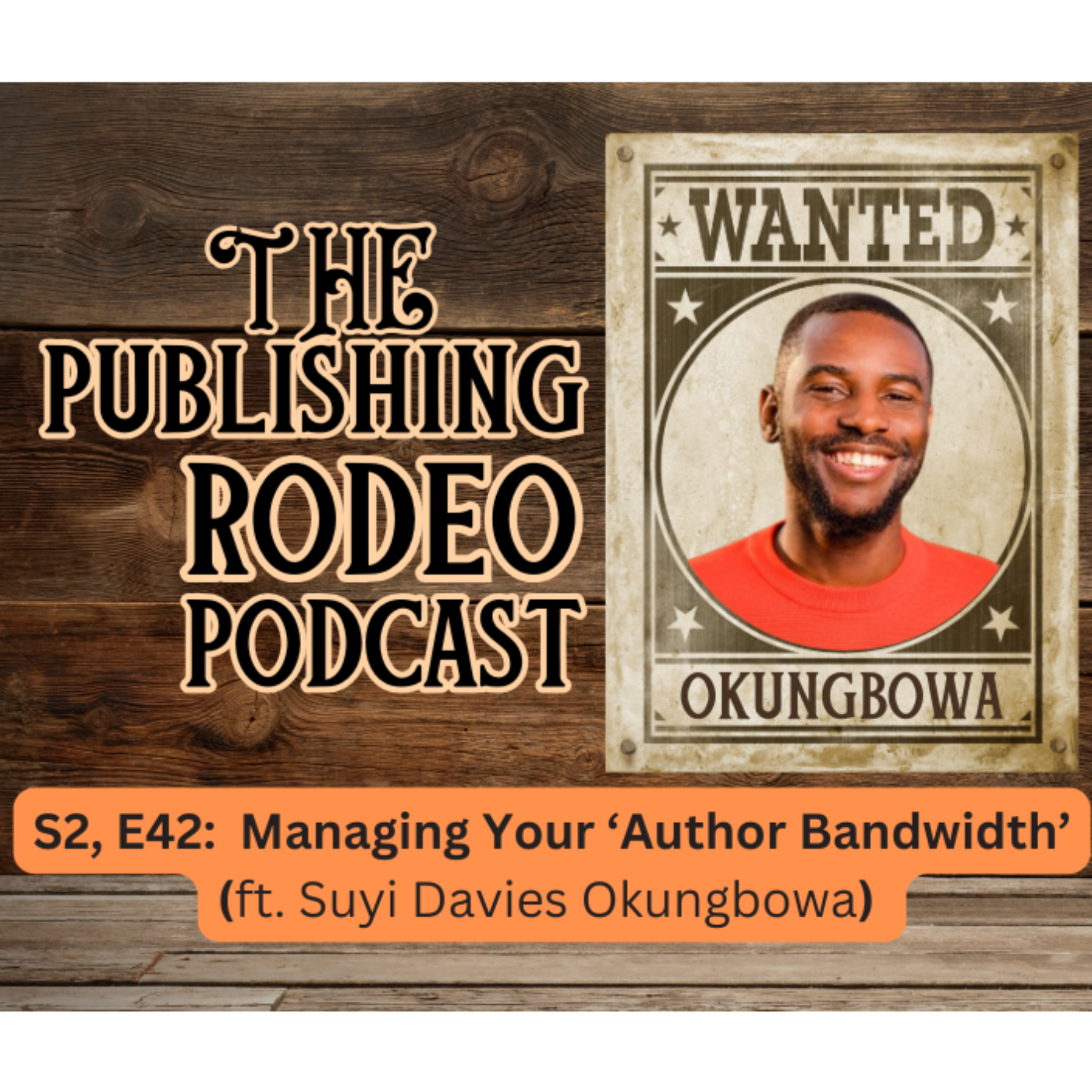
S2 E42: Managing Your 'Author Bandwidth', ft Suyi Davies Okungbowa
Episode Transcript
[00:00:00.000] - Sunyi
Hi, I'm Sunyi Dean.
[00:00:03.020] - Scott
And I'm Scott Drakeford.
[00:00:05.840] - Sunyi
And this is the Publishing Radio podcast. In 2022, we both launched debut novels in the same genre with the same publisher in the same year. But despite having very similar starts, our books, and subsequently each of our careers, went in very different directions.
[00:00:20.700] - Scott
That pattern repeats itself throughout the industry over and over. Why do some books succeed while others seem to be dead on arrival?
[00:00:29.850] - Sunyi
In this podcast, we aim to answer this questions and many more, along with how to build and maintain an author career.
[00:00:38.090] - Scott
Everyone signing a contract deserves to know what they're really signing up for. In an industry that loves its secrets, we'll be sharing real details from real people. We'll cover the gamut of life as a Big Five published author, from agents to publishing contracts, finances, and more.
[00:00:59.930] - Sunyi
Are you wanting me to do the intro, Scott?
[00:01:02.130] - Scott
Yep.
[00:01:05.780] - Sunyi
That's fine. Welcome to Publishing Rodeo. This week we have with us, Suyi Davies. I feel really bad. How do you say your surname? Because I've not heard it said. I've only read it in interviews.
[00:01:15.990] - Suyi
Oh, sure. It's Suyi Davis, Okungbowa. Okay. Yeah.
[00:01:19.400] - Sunyi
Thank you. In our ongoing quest to interview all sci-fi and fantasy writers who have studied engineering. I'm half joking. We seem to get a lot of It's engineers, and I find that absolutely hilarious. Can I get you to introduce yourself, Suyi, who's... I'm sorry, I'm saying your name. It's so similar to mine, and I find it really funny.
[00:01:41.020] - Suyi
It doesn't mean anything. That's okay. It doesn't mean anything. Let's hope we can get through this without... Yeah. Does it mean anything? Yeah. Is that what you're asking? Yeah. So Suyi is actually short for Osasuyi, which is my full name, my government name. It means God is worthy of honor in the Bini language of Southern Nigeria. Suyi is pretty much the short form that my parents have used since I was a kid, but it is an atypical way to shorten that name in Benin City in Nigeria. Because I think- So I am one of very few Suyis from that region. So no, go ahead.
[00:02:24.570] - Sunyi
No, I was going to say Caucasian names, they have meanings, but people don't tend to think about them in the same way, I think, in the West. So Gary means spear holder, right? But no one is calling their child Gary thinking, oh, but he's an adult. He's going to hold a spear really well. You just don't do that. That's fair.
Scott
My name means nothing at all.
Sunyi
What? That can't be true. I'm googling it now.
[00:02:49.780] - Scott
Oh, I mean, I'm sure there is a meaning, but that was certainly not-
Sunyi
It means from Scotland.
[00:02:54.500] - Suyi
That's actually very much on the nose. Yeah, there you go.
[00:03:00.690] - Sunyi
Mine means God's child in Chinese. It's very direct. So there you go. Anyway.
[00:03:08.940] - Scott
Very religious in both respects. That's interesting. So, yeah, I'm interested. I'm not interesting. I'm interested to hear about your engineering background being an engineer myself.
[00:03:23.100] - Suyi
I mean, I can start there.
[00:03:24.920] - Sunyi
Yeah, start there in how you got to publishing.
[00:03:27.110] - Suyi
I studied engineering. I studied engineering Pretty much a civil engineering, actually. I went to the University of Benin. I did my internship in foundation engineering. I moved to Eastern Nigeria, where I did work in construction, structural work, Bridge Foundation. Specifically. I worked with teams that would put piles at the bottom of water bodies to run bridges over them. My own engineering focus was in was between geotechnics, which is soil engineering and structures. I did most of my thesis work in those regards. I touched base a lot, but I think I knew very much very early after taking between studies and some of that work, I knew I wasn't going to be in engineering much longer. First of all, for the reason that in Nigeria, at least, Only certain kinds of engineering really point you in any success in a way that matters. I think it's mostly engineering that's tied to oil exploration, drilling, et That stuff. So petroleum engineering. Every other kind tends to be highly politicized to the point that if you're not tied into the politics of it, then it falls apart. It doesn't really pick up for you. I had a fair idea of this.
[00:05:00.940] - Suyi
I also lived in a region that was very tied to oil in the South. I was very aware of all these things from the beginning, and I was like, No, I think I'm good. I did my stint in the trenches. I did a lot of engineering stuff. I was talking about this in an interview recently. I've gone on rigs, offshore rigs, offshore locations, and onshore locations. I have been in the thick of construction and all that stuff. I was like, No, that's enough. For me for a lifetime. I pivoted, and that pivot took me here, and here I am now. Now, I'm a professor of creative writing at the University of Ottawa. It was not any like, I love construction or whatever. It was really just a very, Oh, that just makes sense. Do it. That's how I ended up there. I'd always, always been writing, even while I was an engineer. I did a lot of work in the writing fields in many different ways. So I always knew, therefore, that writing was somewhere in that future. I just didn't know what form it took, but I knew I was going to get there at some point.
[00:06:12.300] - Suyi
And so I was just really trying to find opportunities that will point me in directions. The MFA that I did, I did my MFA at the University of Arizona. It ended up being a massive turning point. But even prior to that, I had already done stuff. I published my first novel before I got my MFA, so I already knew I was on that path before I made those moves in that sense.
[00:06:37.510] - Sunyi
Yeah. Yeah. So am I right in thinking you got your start in short fiction, and that's a way that you've recommended in the past to other writers who are trying to break into the industry and don't have the connections.
[00:06:50.230] - Suyi
Yeah, sure. But I started publishing while I was still living in Lagos in Nigeria. I'd been writing before then. I really started taking writing seriously around, say, 2012, maybe. That's when I was like, Okay, I actually want to write stories and get them. Prior to that, I was doing a bunch of different things that involved writing, but I wasn't really invested in professionalization in any sense. I think my first pro-publication came in 2016, if I remember, or 2015. I can't remember the year exactly, but it came around that time, and it was in a newly started magazine called Mothership Zeta. It was run by Merrill Lafferty at the time. I think it's defuncted now, but that was a point as well. One of the points for me where I was like, Oh, this is a thing that I can actually do and get paid for and publish. Of course, as a young man writing in my makeshift dining room in Lagos somewhere, I was just thinking, I want to just write this thing and get it read. But I think that opened a door just a bit wider to say, maybe you can actually do more than this.
[00:07:49.890] - Suyi
I was like, Okay, I'm just going to write more stories. I kept trying to... I started learning about the wider field, looking at magazines. At the time, I was Again, because I was from the outside looking in, I wasn't very entrenched in, say, any specific spaces. I was actually looking at magazines both in the UK, but also the US. Enter Zone was a good example of a place I did submit in the early years, as well as places like, I don't know, Lightspeed, Stranger Horizons, et cetera. I got rejected a lot, by the way. I don't know if I've said this, but I have been rejected by, I think, pretty much all the magazines, all the major ones at some point, I think for me, I just kept trying to do things and trying to write things, and I'd get stuff published every now and then. So I was touching base in this way and building community. There were some SFF writers in Lagos that I'd gotten to know. I got to know people over in the US as well, some in the UK. So I think that first time was the first one. And then that's when I started writing the novel.
[00:08:55.190] - Suyi
I was like, okay, maybe I should try and do something longer. And I started writing David Mogo Godhunter, which became my first novel. I started writing it after work. And I don't tell the story a lot, but my newsletter is called After 5. And that's actually why it's called that, because that's how I got my writing start. After 5:00 PM, which is when I'd close from work, I'd then go write for about three hours-ish before I'd go home. That was how I wrote my first novel, so I named my newsletter after that. What happened was Rebellion Publishing in the UK, put out an open call and said, If you're writing anything, submit it. This was like a once in a forever moon thingI think I've seen one since then ever from them, and that barely happens. So they put out an open call and I was like, Okay, I'm writing this thing that's about a demigod who hunts godlings in Lagos. And I was like, This is some fun stuff. And it was only a portion, but I just sent it to them and forgot about it.
[00:09:56.950] - Suyi
And at some point, they got back to me and were like, we like this. We want it. Is it still available? I was like, sure. And that's how I started my time with David Moore, Rebellion. He's an excellent dude.
[00:10:15.010] - Sunyi
He's up for Hugo this year.
[00:10:16.910] - Suyi
Yeah. I was like, A long time coming. He was very much a soft landing for me in publishing because I don't think a lot of people get that with editors as much these days. He was very much a soft landing. He would tamper my expectations and tell me what was what. And he was very dad in publishing type figure. Oh, yeah. Yeah. In the way he didn't let... I think I came in with my head on my shoulders in that way, and he was very fair with everything he did. Two things happened in succession. The interest in David Mogul got under the manuscript, but something also happened. I started applying. So outside of publishing stories, I extended my investment in applying for fellowships. And of course, as someone who didn't really understand how much the divide between, say, literary field and genre was such a huge thing, I was applying across the board and obviously getting rejected by all the literary fellowships. But something happened. Millford, Science Fiction and Fantasy Writers Conference in the UK, one of the oldest workshops/ conferences, started bursary that was funded by Easter Con, which I'm guessing is British fantasy?
[00:11:35.740] - Sunyi
It's the British Sci-Fi.
[00:11:37.350] - Suyi
Yeah, BSFA, I think. But anyway, they were funding some bursaries for writers of color to actually attend Milford, and I think that was the first instance. I came across that. I was like, Oh, this is fun. I can take my manuscript, go there, and try to get some feedback. I applied, and I actually got it. And that was the first time I actually went for that outside of the local meet that I do with friends or the online workshops that I had already attended. So this was the first in-person one that I'd done and beyond the local communities that I'd set up. I went to Millford, and that was another turning point because a lot of people I met there are still cheerleaders in my work to this day. They really put me on game, if I should use that expression. They told me everything I needed to be told. Some of them ended up being referees for my MFA application, et cetera. And then when I came back from that revision and David Mogul was purchased, everything that set the ball rolling. When I moved to the US, I'd had my MFA. I was already working on the trilogy for The Nameless Republic, the series which became The Nameless Republic, starting with Son of the Storm.
[00:12:49.320] - Suyi
All of that just... Those turning points ended in this snowball thing that just picked up. And from that point, it's just been, I guess, books, books, books. That's where we are now.
[00:13:01.540] - Sunyi
In advance of interviews that we do, I tend to read interviews with the guests we have if they're available. For non-authors, that can be difficult, but for authors, there's generally some. Thank you for doing interviews. You get a sense of the person and topics that interest them. But one thing I did notice, which we talked about a bit before the recording started, is that your Twitter account was defunct. It's something that's come up a lot that I feel like we've been talking about more and more among friends on and off the podcast, the fact that a lot of people are leaving Twitter. I was curious what your experience of social media was, particularly as a writer of color, but just as a writer, generally, and what led to that decision. Yeah, anything you felt like saying around it.
[00:13:45.930] - Suyi
Sure. Man, I could talk about social media forever. But I think it starts with I was predominantly on Twitter and Instagram. Twitter was like the stream. I mean, this is the same thing for everyone. Twitter was like the stream of consciousness thing, it was the thing where I could be an author and a person. And then Instagram for me was the place where I only wanted to be an author. I didn't want to show any part. So if you're not very keen on sharing any parts of myself there. Every other social media platform that has passed through YouTube, Facebook, TikTok, whatever, I have never really been interested. I have tried to take a dip into some of them, but I have found that my bandwidth can only take at a time. So I opted for Twitter and Instagram. It didn't take too long for me to figure out that I didn't want to inside. I didn't want to do Twitter anymore because... I mean, obviously, for all the obvious reasons from that dude who took over the Twitter platform, whose name I won't mention. I wouldn't grace with a mention. I think it was a hard call because I had I don't know, 20 something.
[00:15:01.720] - Suyi
I can't remember how many. 15k followers? I don't know. But I was like, These mean nothing, I think. I think there was a point where I was like, These actually mean nothing. By that time, I actually run my newsletter for a couple of years, and I was like, Max, I'm getting what? I think my newsletter has like, what, a 30 something to a good day is 40 % open rate. I was like, that is the same amount of people that listen to me on Twitter. Why do I care? So I was like, you know what? I'm no longer interested because just the amount of upkeep, so many things, the security part, the time consumption, the needing to always be there on there, saying something, responding to something. I just didn't have the bandwidth for it. So I was like, no, I'm done. But as I explained, I didn't want... I stayed there for a while without saying anything for a long and kept the same account. But then I decided that in order to not really participate, and this is why, when the platform really started swinging away from any sensible discourse and became just a hellhole of uselessness, of nonsense, and just absolute rubbish, I was like, Okay, I can't contribute to this.
[00:16:24.790] - Suyi
I can't be party to this. So I just struck everything, deleted my deleted all the followers permanently. But I went back and started a parking account. So I have parking accounts across everything. I don't have one on Facebook, but I have on TikTok, et cetera. I don't use those accounts. What I do is I register one and I have my assistant upload two videos or something just to see that I have stuff there, and then that's it. And then that account just stays there. The other The other thing, too, though, that helps is that people can actually tag me and say, Oh, this is... And I can actually see if this course is happening around things that I'm doing, like interviews. So I'd see it. I typically don't respond, but I'd see it, and I know, Okay, this is happening, and they can tag me. But there's zero followers, zero posts, everything. And the only place I am now online is pretty much Instagram. And my newsletter is really where I do everything. That's where I do all the talking, everything I have to say. I post on my blog and I send it via newsletter.
[00:17:35.510] - Suyi
That's it. Even Instagram, I deleted all my posts on Instagram. I have a strategy now where And I'm not talking archive. I deleted them. Not even, I just deleted everything. I have a strategy now where I only post one thing, and there's only one post that exists at a time. When I want to post something else, I delete that one and post a And the reason I'm doing that is because I've done all these things to remind myself of the transience of social media, because you sometimes forget. I think we become entrenched in this expectation of permanence of it or measure of... I don't know. I feel like I want to keep reminding myself of how temporary it is and how not baked into our existence it needs to be. So that's why I do this thing with Twitter. Sorry, with Instagram. That's why I remove what was there because it doesn't need to stay up there forever. It just needs to exist for the time that it's useful, like a notice board or something. If you have a new ad, you take out the old one, you put in a new one. Anyway, so I'm using it like that, and I want to keep doing so.
[00:18:54.920] - Suyi
But my newsletter is where everything's at. My blog is where everything's at. I think at At this point, I'm not even concerned if people don't really read it. I'm thinking of them more... I'm thinking of that more as a repository because that's what I control. That I can control, and that's my repository, and everything else is just transient. That's really my approach. Also, do my publishers care about this? Maybe. Do I care what that they care or what they think? I don't think that I care that much anymore. There was a time There was a time where they email me stuff and be like, Oh, BNN order 25% off. You should share it to people. I'm like, I'm not doing that. Or sometimes I just be like, Thanks, but I never post any of those, actually. If they give me something and they say, Here's an audible code. You can share this with your followers and do a giveaway. I do the giveaways on my newsletter instead. I just do it. It's the same people who I know actually read my newsletter, so they're actually avid followers. They get to benefit. Otherwise, no, nothing on Twitter.
[00:20:01.970] - Suyi
I don't do any of that stuff anymore. I don't have the time. Sorry. I don't even have the time for it.
[00:20:10.260] - Sunyi
I'm hoping that we are moving into a post social media phase at the moment because I feel like so many people are leaving, and I feel like so many people have realized that it is pointless, that I think it gives you a really false sense of control. You feel like I've done a thing. I know that some people see some results from it, but I just... I don't know. I feel like if all authors were just not... If everyone was off Twitter, publishers would stop saying, You've got to be on Twitter, because there just wouldn't be anyone there. If we all abandoned it, we wouldn't have to do it.
[00:20:44.530] - Suyi
I feel like with publishing, it tends to be a double-edged sword in that sense, where it's like, on one hand, they're like, You don't have to be there, but on the other hand, they send you stuff to post there. So you're like, Which is it? Do I have to be there or do I not have to be there? So what I felt I'm going to make this decision for you. I am not going to be there. So if you send me anything, that's great. But I am not going to post it because I'm not on there. And that's just the way it is. You can decide. If I turn in my next book, at Acquisitions, you can be like, But Suyi is not on social media. What are we going to do about that? And have that discussion there. But if you come to me and you make an offer, just know that that offer comes with the expectation that I'm not going to post anything, not because I don't want to post anything, but because that is labor that I just cannot afford. I can't afford that labor at this time. I don't know if I will ever be able to afford that labor, so I'm just not going to do it.
[00:21:42.490] - Suyi
But I will like it. If you post something, I will like it. I may even reshare it if I have time for that, if I have the energy for that. If I can do that labor, I will repost it. But otherwise, mostly, possibly not. And I'm fine with that. That is It's like a sacrifice I've decided I'm going to make, if I could call it that. And that's just my position. It's not even like some entrenched belief. I'm not anti-social media. I'm on Blue Sky, and I respond to I go there, but it's because it's very low stakes. I don't. But otherwise, I'm just like, no, no pass. I'm going to pass on that. So that's really why my Twitter account looks the way it does.
[00:22:28.940] - Sunyi
No, that's fine. And I honestly think there's a lot of merit to that position. I think for me, I feel like I'm doing my publishers a favor by not being on Twitter anymore because I have a big mouth and a hot temper. I just think, do you really want me starting a fight in the wrong place and just causing drama.
Scott
Yeah. I want that. Haha.
[00:22:47.320] - Suyi
That too. And that's the thing with being an author. You don't even need to be wanting that. You just need to exist. And as you said, especially as an author of color, you're just talking about anything. I've had a couple of viral tweets and one or two viral posts, and they've all often revolved around me saying something that has been me trying to think through something out loud in public and that thing resonating in a way that I didn't expect it to. But then, of course, with the good side of that virality comes the insane abysmal side of it where there's these random people from everywhere that I wouldn't touch with a tent pole on any day, just randomly my DMs saying the most egregious things. There was a day someone described, and I think this is where it really stuck for me. It was someone describing it as standing in the middle of a marketplace with a megaphone and just randomly shouting out your business. That's what social media is like. And then welcoming any Anyone who has something to say in response. The description of that... I mean, if you know anything about Nigerian markets, then you know why this is insane.
[00:24:12.280] - Suyi
It would be insane to do that. That's what it felt like for a long time. That's what it feels like. I'm like, I'm not just... Anyway, so that's the summary of why I'm like, You know what? I don't want to be that person standing in the middle of the market just shouting stuff. I'm not going to contribute to that. Everyone can have the market. They can go there. That's great. I can pop in there every once in a while. But most of the time I'm going to try and do the things that actually got me interested in being a writer in the first place. I don't know, like reading books.
[00:24:46.410] - Scott
And writing them.
[00:24:48.740] - Suyi
And writing them, exactly.
[00:24:50.980] - Sunyi
Let's not get crazy, Scott. It's not even that social media is broken. It's working exactly the way it's supposed to be, which is basically being incredibly annoying and polarizing.
[00:25:05.120] - Suyi
I'm fine with not being in the know anymore all the time. I think it's a bit too much everything everywhere all at once for my liking. So, yeah.
[00:25:17.350] - Scott
Yeah. I mean, you've been putting out a lot of books because in addition to all of that original work that you've been publishing, you have IP work that you've been doing as well, right? Yeah. Sonye, if you're okay with me getting into that real quick. Su Yee, I'm very interested to hear how that works because we've talked to a number of authors who have gotten into IP work early in their career. But I'd love to hear whatever specifics you are able and willing to share about why you did that in addition to your original work and your feelings on it going forward.
[00:25:58.830] - Suyi
Sure. In I was actually already talking about this with somebody before.
[00:26:02.150] - Sunyi
Yeah, a bit before. I'm a big Stranger Things fan, so I was like,.
[00:26:10.640] - Suyi
So, yeah, IP work. Again, this is funny because I think one of the That's what I love. The thing that tends to happen when you're coming from outside of, like I did, outside of what I call the centers of industry, is that I tended to not really carry a lot of the baggage that I found along the way or I discovered was actually So I didn't even really know and or care that that divide was there. And here's why, because when I was growing up, I didn't have as much access to books. So literally any access to books that I would have, I would cherish it. And this means that you could get what would have been poppy paperbacks in this sense, and I would cherish them as much as I get a hard cover. In that way, I'd also read a lot of tying novels at the time when I didn't have, say, access to go to this theater to see Star Wars or something. So I would read a Star Wars novel instead. It was just the thing. So the first one I wrote was Minecraft, actually. What happened was I told my agent that I wasn't interested in being constrained by anything that had to do genre.
[00:27:21.870] - Suyi
I was just not interested. I said, Listen, if any opportunity shows up, let us discuss it, and then we'll know for sure. At the time, Minecraft was looking for someone going to work on their middle-grade novel, but they wanted it to pull... Because with Minecraft novels, you had two options. You could set the story in the Minecraft world, or you could set it around people who played the Minecraft game but are in the real world. You could do that Those were the two options, right? There were Minecraft books. Yeah.
[00:27:50.870] - Scott
My daughter reads a bunch.
[00:27:53.640] - Suyi
Yeah. They're actually quite popular amongst kiddos. So that was something I didn't even know at the time. But what happened was they were trying to step outside of... They wanted some of the books that were set outside of the Minecraft world, but we're trying to step outside of what they believed were becoming the image of the kid who plays Minecraft being too centered in very specific places or ideas of what those kids looked like or where. So they're trying to break out of that. And they were looking for people who were interested in setting Minecraft-related works outside of I was in those centers. And so my agent came to me, my agent at the time came to me and was like, Are you interested in this? And what used to happen is that I used to play Minecraft with my brother, especially because I'd moved, and we would play Minecraft as a way to connect over time and space. I was like, Yeah, that sounds like a thing that would be of interest to me. And we ended up doing that. I remember it was 70K worth. I can't remember. It wasn't It was very long.
[00:29:00.680] - Suyi
I wrote it in three and a half months, maybe. That's the actual writing. But the period of planning, chatting, talking, the team at Mojan, which produces a game, was very... I think the team is in Switzerland or something. They were just like, We don't care. Just do whatever you want, except this, this, this. I sat with the editor at Delray. It was still Delray then. Now the imprint is called random house worlds, I think. But I don't think it was there. It might have been Penguin. But there was still some division then between who did the IP and whatnot. But I sat with the editor there and we hashed out a plan and I wrote it. And I remember writing that right after I had done some work on my thesis. So even this Lost Dark Dreaming was occupying some mental space at the same time as this book at some point. So that went out the window. And then here's the thing that What happens? I did that one, and it was just like, after that, everyone had a thing that they were like, Are you interested in this? Because I'd done that one.
[00:30:08.080] - Suyi
And so there was always something down the horizon. I'd been approached for pretty much a bunch of I said no to a lot of them, actually. I said no to a lot of them just because... Well, some of them, it was just that doesn't pay enough. No, pass. Some, it was just I don't have the time. That would be excellent, but I don't have the time. So I got some for some video games that I thought, Oh, that looks good. But then I was like, No, I can't do it. But then the one that I eventually decided, Okay, I'm going to do this one, was Stranger Things because it's Stranger Things. I was a big fan of the show, and I was like, This is a huge property. I love it. Also, I, like most people, was very incensed by the fact that the character of Lucas Sinclair was not given enough screen time and enough development in this show. I was being given the opportunity to, quote, unquote, rectify that. I was like, Of course. Why Why wouldn't I take on this huge responsibility? And so, yeah, I took that one out of a service to the world.
[00:31:11.790] - Suyi
I like it. Yeah. And then It helped that. I was a fan of the show because it was such an exciting thing. They sent me the Season 4 script before Season 4 came out. So I'd already read the whole thing top to bottom. I mean, I signed an I couldn't say anything all the time, but they sent me the script. I had to read it, and I remember standing up from my chair at different points and going like, What just happened? But then TV, of course, is very different because the TV team was very, very... They were in my sleep. They haunted me in my dreams because every five, I would write 10K words and send it, and they would give me feedback before I'd written the next 10K words. They'd be like, No, change that. Can't say that, can't say this, can't do that. There was so much... It was good. It was like being in a writer's room, but it was a lot of people, but they were all nice people, so that helped. And they took me out to comic Con when the book came out, and I met some of those folks.
[00:32:15.500] - Suyi
I met some of the Netflix folks there, so that was fun. Also, again, in service to the world, I will do this for humanity, but also for a good chunk of money. There you Do you have a threshold in mind for this is just a cut off or too low for IP work, or does it depend on what's in the contract? Yes. I think it depends. So honestly, with IP work, I don't even look at the royalties They say that there's all this stuff about like, oh, it's nominal royalties. I'm like, I don't care. Nominal means nothing. Even my actual non nominal original royalties also mostly mean nothing because how many times we get to collect those royalties, right? So really, I'm always I'm thinking, what's the advance? And in this case, it's not even an advance. It's literally just a fee that you get paid. Here's how my benchmark worked. I'm not even going to talk about a debut novel at all. For my series, it was 25K per book, which is very standard for Orbit. It is. It was 25K per book. And I said, Well, first of all, because it's all orbit, it's joint accounting.
[00:33:34.220] - Suyi
What is the possibility of actually collecting royalties at some point? It's negligible. There was a part of me that said, Well, if you can match my original work, it is the same thing, in essence, outside of the fact that I don't want to work. That's how I thought about it. I was like, Okay, if you can match that, great. The first book didn't match it, but it came close, the Minecraft one. The second one matched it, I believe, if I remember that correctly. The third one, by that time, I had already published multiple books. I was able to negotiate way more than my original work. In fact, as I speak to you, my IP works collectively have paid me more than all my original works till date. Okay, that's awesome. I mean, that's not the reason I did it, but it's also the reason I did it.
[00:34:28.850] - Scott
Yeah, of course. Yes.
[00:34:30.270] - Suyi
Yeah. And I think it helps. As I was telling you, it helps when you're a fan of the property itself. It really helps the experience. It becomes less about just the writing and more of a playing in the sandbox contributing to... I mean, it's not really thought of as canon, but contributing in some form to the general essence of the thing. I always felt like I was part of something bigger, and I feel like that's useful. I think as a creator, it scratches a different edge than your original work. I liked it as just a thing that I was doing that also paid me, so of course. It was a useful way to think about it.
[00:35:16.710] - Sunyi
I've got a lot of friends who want to write for Games Workshop, and some of them have been able to. And even though Games Workshop, I think they pay like 3 to 6 grand or something a book, it's not very high given how much they sell. But It's about the experience, I think, for a lot of people. You grow up with those little models and minis and you want to be involved in it. And yeah, you should ask for fair pay because you have to do a lot of work with the whole team, it sounds like.
[00:35:47.850] - Suyi
I'd say more than fair. Honestly, and I keep saying this, anyway, the way it works, I think with IP, it's not that different from actually being commissioned for pretty much anything. If you to a point where you can command a fee or whatever, I'd say go for it just as hard as you go for your original work. I have an author friend who said she's only going to write IP going forward, that she's not writing anything original because it doesn't put any burdens on her. She's not responsible for the... Anything. She's not responsible for marketing. She doesn't even want to do marketing. She doesn't have to promote anything. She just gets money in her back and moves on to the next project. She started as an original in SFF, was on an award shortlist and stuff. She was like, No, I'm not doing that anymore. I just want to write my little IP levels and just have a fun life.
[00:36:49.600] - Sunyi
It's a unique skill set. I wouldn't be able to do it. I have a lot of respect for people who can. And it's just another way of making art. And like, oh, man, I think for some people, the idea of being paid for fan fiction is the dream. That would be... I think I do it for a wheel of time.
[00:37:03.170] - Suyi
That's true. Yeah, that's a good point.
[00:37:09.620] - Sunyi
What is that noise?
[00:37:13.090] - Suyi
That's mine.
[00:37:13.870] - Sunyi
It's fine. Oh, okay. No worries. No, you're fine.
[00:37:16.420] - Scott
You're totally fine. We are a very laid back production.
[00:37:21.140] - Suyi
Oh, I do hear a lot of the background stuff. It's funny. It does add color to it. It's good.
[00:37:29.050] - Sunyi
Yeah. You can tell when my kids have not gone to bed.
[00:37:32.830] - Scott
Or Gwen gets restless or I see these or whatever.
[00:37:39.780] - Suyi
And Scott always says, When you say she's going to edit that, we'll see. But every time I hear you say it, I'm like, I sympathize because it would drive me nuts listening to two hours of footage and trying to scrub it. It would drive me nuts, so I completely get it. Please keep leaving it in, no matter how many times Scott complained.
[00:38:07.000] - Scott
I'm not complaining.
[00:38:10.340] - Sunyi
Not the bits we leave in, you're not.
[00:38:12.520] - Scott
Yeah, well, that's true. I see I suppose.
[00:38:16.400] - Sunyi
That's funny.
[00:38:17.860] – Scott
Yeah. I'm just curious. We just spoke a little bit about Suyi having an assistant and how that enables a lot of his writing time. I'm curious to hear your take, Suyi, on what the highest value things you hand off to an assistant are.
[00:38:40.540] - Suyi
Let's see. Highest value. I'd say somewhere between, I don't know, maybe preparing invoices or designing social media stuff and posting them on my behalf. Sure. But I think the biggest one might be that my current assistant handles a large That's the part of the fellowship that I run. Cool. Does a lot of the liaisons and puts together, like collects the entries, hires the judges, gets them to read it. So I'm only coming in in some parts of the process just saying, Okay, what is running here? What is blah, blah, blah? My current assistant, Miriam, she's very adept. We've worked together for a long time. And I've worked with multiple assistants. Sometimes I bring in an extra hand for a period. So when there's a book launch, I would bring in someone and be like, Okay, Miriam, you handle this stuff, but you handle this other stuff. So I pitch a lot. I don't know if I've said this, but I actually pitch a lot my books. So when I have a new book coming out, my publisher will be like, Oh, these are things we're doing, and I do the other stuff, but I don't do them.
[00:39:50.290] - Suyi
I just give Miriam the list and say, Okay, we chat, and I'm like, Oh, let's pitch that person. Let's pitch that person. And she draughts up a pitch and sends it off. If there's an arc, she says, She sends out the arc. If I have to ship the ARC, I can easily do it. If my publisher has to ship the ARC, she emails the publisher to ship the ARC. So she does all that work. And so I can actually try to get some stuff done. So sometimes I would get more publicity than I would have gotten because if I had to do it myself and I didn't have the time, but because she's there, I can say, You know what? Pitch five people today. Pitch that podcast, pitch these people, pitch these people. And I can just walk away. And know that even if they don't respond, it went out, something like that. And sometimes I do get good responses. Lost Ark Dreaming has really gotten a lot of good feedback in terms of these avenues. And a lot of that comes down to having somebody there doing this stuff while I can focus on other things.
[00:40:51.630] - Suyi
I think she does a bunch of different things in different ways that that are very crucial, even when they're not necessarily even high value. They're high value to me because the time and labor it would take me is precious. So just saving that little bit of time is so precious. Even if it's an hour, you know how many words I could write in an hour in the morning. It's like... Yeah, that's exactly what I- It's very much worth every penny.
[00:41:21.070] - Scott
Yeah, that's awesome.
[00:41:22.330] - Sunyi
Thank you. Yeah, because I was reading that Empire article this morning that everyone is sharing. It was talking about the top 20 % of authors who make an all basically have private publicists. But to be honest, a lot, what she's doing is basically publicity. It's just that you're directing it. That's probably better value than a publicist, but doing the same kinds of things.
[00:41:41.140] - Suyi
We will do the same thing. I read this, and everyone should probably subscribe to this newsletter because it's run by this lady who I think is super smart and very amazing. It's the Pine State Publicity is the name of the company, organization. She's someone who's gone through pretty much all the authorial publishing, and now she runs a publishing company, but she writes these newsletters in Substack, I think, where she talks a lot about what the process is from an individual book publisher. And they only work with small presses, so you can actually see how they step outside of the language we often receive from Big Five and stuff like that. And you actually listen to what they think about and what they... And I think that has really helped me think about publicity differently in the sense that A lot of the markers that we tend to have for what it should look like only exist in very specific spaces in a way that it doesn't actually even make sense outside of the spaces to do those things at all. This is literally the bread and butter of a lot of what you folks talk about on this podcast anyway.
[00:42:47.980] - Suyi
And so that really helped me reorient and say, Okay, the first thing I do is I go to the publisher and say, What are you doing? What are you going to do? And then they tell me, and mostly some of the time, the answer is nothing or something that amounts to not much. I've come to understand the different ways they say that in so many words. But I just like, Yeah, I know what that means? So it means nothing. Okay, great. Fine. And then I know the amount of background work. And then I call Miriam and be like, Okay, let's strategize. Let's see what we're going to do for this book. A good example with Lost Ark Dreaming, the folks at tor.com didn't necessarily spell out what they were going to do. But what happened was I was getting a strong sense of it very early on to just have a fair idea because I was seeing the work happening behind the scenes. I was like, okay, I know what's happening. And therefore I knew with this book, for instance, I decided to push most of my efforts locally because I was like, okay, tor do a lot.
[00:43:56.630] - Suyi
In Ottawa, where I live in Canada, it's not like the SFF feels massive. So I was like, how do I make this more of a big Ottawa thing? So I actually decided to put a lot of energy there. I told them I wasn't necessarily going to tour. I wasn't interested because I didn't really want to travel at this time. So I was like, okay, instead I'm going to do a local event, I'm going to go on a local radio station. And so I pitched those people. I pitched a local art gallery, pitched a bookstore pitch. And my book launch is actually in two days. It's at the Art Gallery in Ottawa. And it's like, I got a bookstore to come in. I got a bar to come in. So it's like bar con/book launch. So, yeah, I managed to rope in my department at the university. I roped in a local arts organization, and it ended up being just its own different thing and its own different publicity than, say, the Nameless Republic, where I actually went to places and did virtual... Well, I did more virtual events because it was during the pandemic. And then even when most of the times I've gone to conferences, I was at the Toussaint Festival of Books in February, March, earlier in the year, and it was a lot of the work I did there was around the series because I taught a world building workshop.
[00:45:18.590] - Suyi
So it was very much centered around the Warrior of the Wind, which had just come out in November. So that felt more like a thing that was within the in a typical realms. But for this, I was like, Okay, let's reorient a bit. And a lot of the work that happened locally was just my assistant and I sitting down and saying, I was saying, Okay, you pitch this person, you send this person this email, you do this, I'll follow up with them, I'll mail them an ARC or whatever. That's really how pretty much all the stuff that you see on the outside end, that's how a lot of it happened.
[00:45:55.760] - Sunyi
No, that's really cool. It's also good to hear as well because I'm not I'm not really as busy as you, but I did reach this point where I felt like I was just drowning a little bit. My partner is actually stepping back from his work to be my assistant, which we'll see how that goes.
[00:46:09.610] - Suyi
That is not as uncommon as you think. That is actually very, very common amongst a lot of people I know, actually. Well, unsurprisinly, perhaps.
[00:46:20.700] - Sunyi
It just saves a lot of time. I think he sat down on one morning and he basically got the accountancy software and he sorted out all my accounts and my receipts and the things that were just piling up and getting it into order before it spiraled, worse than it already was. And I'd been trying to invoice this publisher for this thing and they were unhappy with how I'd done the invoice and he got all that sorted. It just saved me four hours. It's like, oh.
[00:46:49.360] - Suyi
Yeah. Yeah.
[00:46:49.870] - Sunyi
Yeah. But no, it's good to hear that.
[00:46:54.110] - Suyi
That's what you get when you become an author.
[00:46:57.730] - Sunyi
Yeah. And I'm not nearly as busy as you are, but I don't know. You spend a surprising amount of time doing paperwork, I guess, which is not something I expected.
[00:47:09.600] - Suyi
It is very typical. This is not that much different from being a professor. In fact, actually, being a professor is worse. You do twice that amount of paperwork and very little, not as much teaching as you would think. A lot of that, a lot of it is paperwork. But I've also gotten to the... I guess some of it is also temperament that I've embodied. And I think for me, it's like, I have decided to embrace a good dose of not giving a shit in order to navigate this, I have decided that I'm just going to have to not give a shit about some things, and I have to decide what those things are and that I'm okay with not giving a shit because some of those things will actually backfire, to But I have to be okay with that, too. I have to be okay with when those things, where that backfiring is going to come from and know that, okay, that's not an avenue I can go down anymore because that bridge was burned. But I have to be fine with that. I feel like, as you said, I feel like authors, especially the ones who don't come out of the blocks, like swinging it or whatever, have to make these decisions.
[00:48:30.000] - Suyi
Decisions at some point. Even those folks have to make these decisions at some point, even if maybe they might have different resources to make those decisions. I feel like if you want to stay in the game, you have to make those decisions. And they are hard ones, but you have to do them because I found that most of the people who drop out of the game do that because they can't make those decisions or they're thinking, you know what? I can't do it. I want to have this or nothing. And they choose nothing, which is fine, too, because I think if you want to maintain your sanity and health in this industry, you got to make choices.
[00:49:05.000] - Sunyi
Boundaries.
[00:49:06.300] - Suyi
Yeah. So, yeah.
[00:49:09.580] - Sunyi
That was brilliant. Thank you. Sure. But yeah. So if you were talking to young writers who are living outside the close fortresses that the US and the UK are, and they're trying to find their footing and break in, would you have any specific advice for them?
[00:49:30.200] - Suyi
Yeah, actually. In fact, I actually run that. So I run a fellowship for Emerging Writers resident on the African continent. If you go to my website, you see all the details. And we just got two new fellows this year. And they're all living on the continent. And so it's the same thing I tell them. I try to walk them through the same process that I follow. Because while I did make a lot of... I wrote my first book while living in Nigeria. I published it or at least sold it while I was still living in Nigeria. So I always start from there and say, Okay, how did I get these things? And a lot of it first starts with you have to put in that investment is really what I tell them. Social media feels like a shortcut because you just feel like you can be on there and be a sponge and collect all the information. But I think it helps to be maybe a bit more specific, more focused and say, What am I trying to do? So I noticed a lot of people haven't asked that question. They're just like, if I'm there, then I will know stuff.
[00:50:35.780] - Suyi
But what are you trying to know? What are you trying to do so you know what you're trying to know? And what I do with the fellows first meeting, I'm like, before you come to this meeting, I want you to write what you actually want to do with your writing. Do you want to just read it to your family and friends? Do you want to get it published by Penguin Random House? I need you to write it down. And the reason is because there's a pathway from where you right now to where that is. The question is, what are you going to use to bridge it? And then the next question I ask them is, what resources do you have? Because again, and this is something that because I grew up in Nigeria, I can actually attest to not everyone has an intern Access to the Internet in the same way. Not everyone has access to power. Not everyone has access to a laptop, computer, or just literally a writing device. And so I always ask, Okay, what are the resources you have and what pathways exist for you to maximize those resources? Some people are like, I can travel to a writing conference in the US.
[00:51:39.910] - Suyi
I can go to Clarion. If I apply to Clarion right now and I got in, I could go. And So I'm like, your path definitely then, therefore, it's not that massive. So I can even say, oh, this is what you should do then. But for this person, that's a different path. So typically for those who want to be in community, because I've met a couple of fellows who be like, I need community. What I'm lacking is I don't have connections to things. That's when I then say, okay, my first piece of advice typically is to ask them to join a closed community. Not the open one, a closed one. So something I was on, I joined... What's the name of the one? Codex. That's it. I was in Codex for a while, for a long time, actually. And I think my account is still But I was in Codex for a while, and that was where I learned a lot of stuff about the industry. The SFWA Forum is a good example for another closed system where you can actually learn stuff. So I usually advise that don't go into the big bad world of Twitter.
[00:52:47.910] - Suyi
Don't go to the Mad Max side of things. Stay in an enclosed place, which can be a dystopia of its own self, which is fine, but it's managed at least. And so I try to point them in specific groups. Another good example is before I got into my MFA, I joined a group on Facebook for folks who were trying to get into MFA's. In the US, UK, and Canada from all over the world. And that was how I learned what to do, how to apply, where to go, what schools to select, etc. What schools are good for people of color? What are going to accept you if you write speculative fiction? That stuff. That was a Facebook group. Is it Reddit? You can find good things on Reddit if you're not looking for the typical Reddit folks, if you know how to bypass those folks, you know how you can get to what. So I feel like communities... I think that idea of just starting a Twitter account and just following a lot of book people or being on Book Talk and be just like, I want to connect to the Book Talk community. I feel like that's I'm just going to throw spaghetti to the wall and see what sticks approach.
[00:54:03.920] - Suyi
I'm like, what are you trying to do? And try to find the specific things? And I tend to favor closed communities over open ones because in close communities, you can be very specific and you don't have a lot of random stuff coming at you. Only I feel when you've gotten that, then you can start maybe branching out to wider ones if you feel you need to. But yeah, that's typically how I tend to direct them.
[00:54:27.900] - Sunyi
No, I genuinely think that's really wise because I feel like I talk to so many newbie writers where you ask them about their goals, and their goals are essentially, Well, I think I'll just write this thing and then see what happens. And they're just hoping if they write it, the book will magically succeed. And as far as I know, that doesn't ever happen. You can't guarantee a goal, but you have to work towards it to have a shot.
[00:54:51.240] - Suyi
Yeah, exactly. I also sometimes read the publishing on subreddits, or the people who are aspiring authors who are publishing subreddits, and I'd see what people would ask. And you could tell that for a lot of them, it just feels like, if I do this thing, then this thing happens next. And I'm like, no, there's 10 steps between those two things. And you don't need to know all the 10 steps, but you need to have some idea of how you're going to navigate them in order to get there. And I think that part that you mentioned about just having a goal tends to get missing, which I find strange because I'm like, you're literally a writer. That's what writers do. You set goals and try to hit them even with the literal book that you wrote. So it's the same. I press the fellows a lot on their goals. I'm like, Why that goal? What do you mean by that? Is that goal even the thing that is in your control? If you said, I wanted to be a best, and I'm like, Absolutely no one except the publishing house has control over that. That That is literally a thing where someone in a decision making capacity in publishing house is like, make that person the best seller.
[00:56:07.490] - Suyi
You can do nothing about that, except maybe that's your dad or your parent. That's how I think about it. So I try to get pushed them to a goals that they actually are in control of. Can you apply to 10 MFA programs if that's your goal? If you want to go for an MFA program, apply to 10 this year. Can you afford 10 application fees? All right, apply for fee wai for all 10 of them. See what you get. That's the concrete stuff I try to push them toward.
[00:56:45.750] - Sunyi
No, that's awesome. Thank you. Are you good, Scott?
[00:56:50.550] - Scott
Yeah, I just wanted to- Am I interrupting you? No, you're totally fine. Just one quick comment about closed versus open. I like that distinction a lot because, yeah, there's no guarantee that people in a closed environment are going to actually know what they're talking about. But in an open environment, there are a lot of people obfuscating the truth because of ego and other things, or they just had a lucky as shit path into wherever they made it. I like that a lot.
[00:57:26.550] - Sunyi
So we're now at the part of the podcast where we get to ask people what the pettiest hill they would die on is. Oh, this one. If you're used to that. I remember this one.
[00:57:35.680] - Suyi
Do you? Okay, I'm going to say a very petty one. That's probably going to raise a lot of... So get ready for-
Sunyi
It's all right, you're not on social media.
[00:57:46.090] - Scott
Okay. He said he's going to be answering your hate mail.
[00:57:50.360] - Suyi
So this is one that I... So here it is. I think there's such a thing as bad books.
[00:58:02.860] - Sunyi
Oh, I agree.
[00:58:03.840] - Suyi
Yeah. I do think that. I think there is objectively a thing, such a thing as bad books. And I'm saying this because this is a thing I say to my students, by the way, and they are like, What do you mean? But they're like, That's insane. Don't say that in public, or whatever. But here's the thing. I think the idea, and I see this a lot, especially amongst us writers, there's people who's like, No, there's not such a thing. And I think they mean well, but it's false. There's such a thing as bad books. If we started from the base level of that, there's literally books that have bad content that shouldn't... The That shouldn't exist. Even at the barest definition of that are bad books. But then there's even stuff that I think someone is, and this is how I think about it, there is There's books that are struggling on a craft level in the sense that internally, not even externally, not in the sense of I like these kinds of books, and this book isn't that. I'm not even talking about that. I'm talking about the fact of the craft choices aren't internally serving what the story itself aims to deliver.
[00:59:22.100] - Suyi
It doesn't mean that the author is a bad person. It means that the book... Not like the former example where the author is a bad person. I'm talking of where the author is trying to achieve something, but the book doesn't do that. Sometimes the degree to which there's a discrepancy is so much that that book ends up being a bad book. Sometimes the discrepancy is there, and you can be like, Okay, I see what you're reaching for. It's okay. I can take that. Sometimes it's so far away. You're like, No, this is absolutely not good for that reason. And I think that's an objectively sensible reason. And I I mentioned internally because I'm trying not to apply external matters of things like tropes or stuff. I'm talking about the book internally itself, attempting to do something and failing at that. I feel like if it feels hard, that's a bad book. And I think that that's an okay thing to say, which is, again, also very different from a mismatch of reader and book. If my that kid was reading, I don't know, Piranesi, they'd be like, This is a bad book. It doesn't mean Piranesi is a bad book.
[01:00:36.310] - Suyi
It means that they're mismatched with that book. But if they're reading a board book where it's like C for cat, they would absolutely love it. It doesn't It doesn't mean that's a good book. It just means there's a mismatch. In the same way, I think a lot of what we tend to think of bad, good is in that mismatch. A lot of it tends to fall in that mismatch. But outside of that mismatch, there are objectively bad books, and I think it's okay to say that. But of course, Stan culture wouldn't let you do that.
[01:01:05.820] - Sunyi
No, I completely agree. And I think as well that actually people, like you say, they're confusing two things. People go, Oh, but are you going to say that Chuck Tingle is bad compared to Gene Wolfe? It's like, no, because Chuck Tingle sets out to achieve exactly what he wanted to do with each and every tingler. Actually, I think they're quite fun, just as an aside. You compare it in terms of what he's achieving, the same way that like, Gene Wolfe, he's achieving what he sets out to do, and they're just in different competitions with themselves. But Ayn Rand’s, the Fountain Head does not achieve any of the things it tries to do, which is why My definition of one star is that novel. I'm really sorry to Ayn Rand fans, but actually I'm not.
[01:01:50.500] - Suyi
I mean, no, I'm not. No one is. No one should be. Okay. So, yeah, that's my petty thing. And I'm not shy to say that, but I say that all the time to people. I'm like, listen, bad books exist. Don't put me on that. I said it.
[01:02:16.320] - Scott
You've got our stamp of approval.
[01:02:17.330] - Sunyi
Creative writing professor. Yeah, creative writing professor says that it's true. Can I get you to plug yourself, CE, if that's okay, and tell people where they can find you and what your newest books are coming out Absolutely.
[01:02:30.880] - Suyi
So my latest is a novella from Tor, tor. Com, which is Lost Ark Dreaming. It is out as of now. It was out on Tuesday. So as of now, Oh, congratulations. So as of now, recording this, or whenever you're listening to this, it is out now. It is what I like to describe as a vertical snowpiercer in the middle of the ocean, but that doesn't really do it as much justice as you would think. So you would still be surprised, even with that description, I can assure you. That is my latest, but prior to that, you might know me more from the Nameless Republic trilogy, which starts with Son of the Storm, Where if the Wind came out in November. The last book of the trilogy will be out next year. You can find me on Instagram at SuyiDavies, or literally everywhere at SuyiDavies, because that's the same name I use across all social media accounts, but I'm only really ever on Instagram. I also don't really I'll post anything there. So if you really want to find the most updated thing from me, the best place is my newsletter, which you can find at www.suyiafterfive.com
[01:03:39.100] - Suyi
Com, or just go to my website and you'll find the newsletter there. I send it once monthly. Yeah, that's pretty much it.
[01:03:50.280] - Sunyi
That's awesome. Thank you. I will start recording there. But that was a lot of fun. You've been listening to the Publishing Radio podcast with Sunyi Dean and Scott Drakeford. Tune in next time for more in-depth discussion on everything publishing industry. See you later.