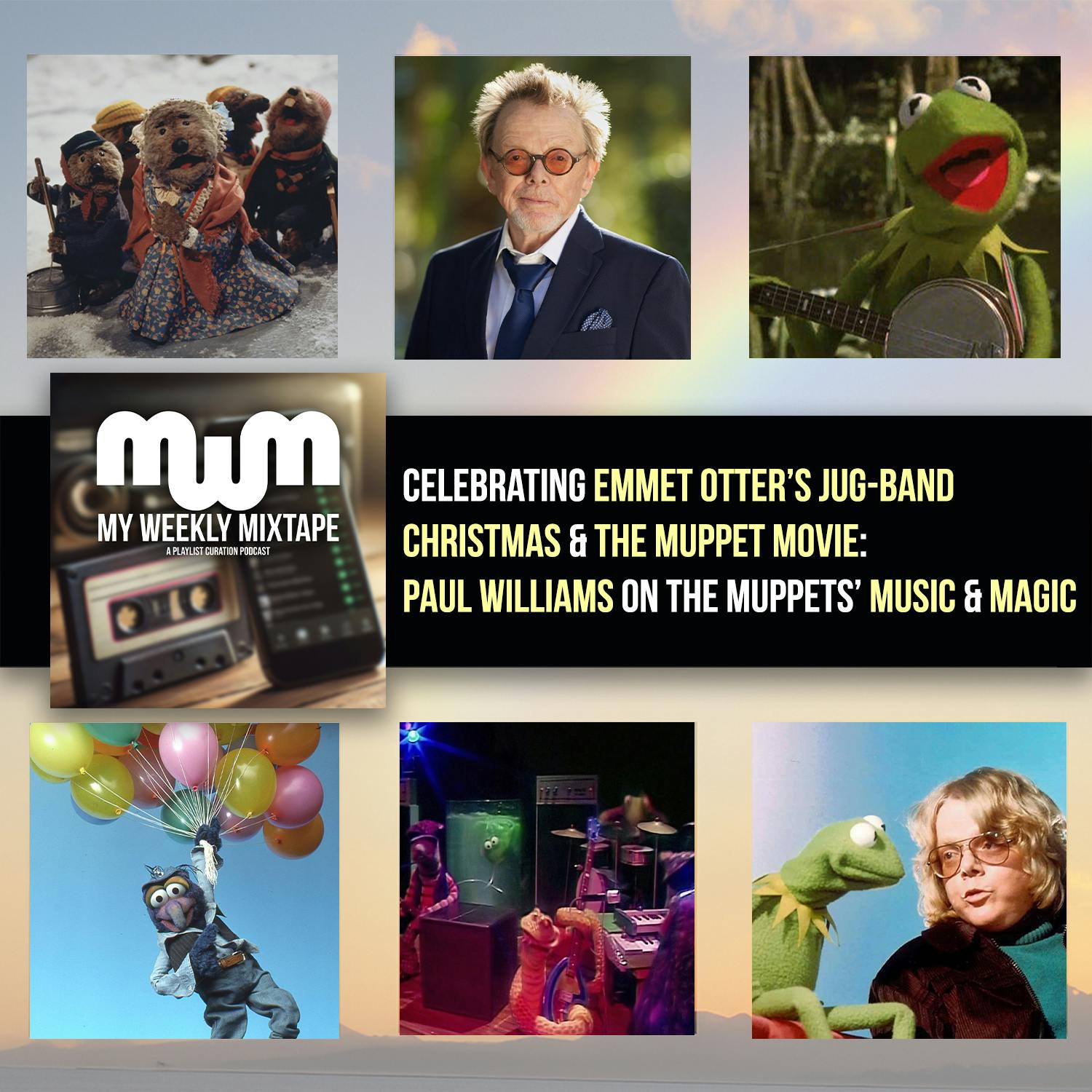
Celebrating Emmet Otter’s Jug-Band Christmas & The Muppet Movie: Paul Williams on The Muppets' Music & Magic
Episode Transcript
What is going on, friends?
Welcome to My Weekly Mixtape, the show that takes the classic mixtape approach to building a modern playlist.
I'm your host, Brian Colburn.
I hope each and every one of you had a fantastic Thanksgiving weekend.
And if you're listening outside of the United States, I hope each and every one of you had a fantastic weekend.
But now that Thanksgiving is out of the way, Black Friday is out of the way, today is December 1st.
Cyber Monday, you are all probably going crazy on all of the sites, trying to swap up all the deals you can, and I'm here to provide the perfect soundtrack for doing so.
I have been blessed over the years here at My Weekly Mixtape to talk to some of my favorite artists and songwriters, and one of them was on my list since the first ever podcast that I recorded for TuneStyles back in 2017.
And that person is none other than Paul Williams.
Last year, I had the honor and privilege to sit down with Paul the week before Christmas, which for me was truly a Christmas present in and of itself, because I got to talk all things Muppets with somebody that couldn't be any closer to the Muppets musical universe than Mr.
Williams.
of my favorite Muppety things, including one, my favorite holiday special of all time, Emmett Otter's Jug Band Christmas, and two, my favorite song of all time, The Rainbow Connection, written by none other than, you guessed it, Paul Williams, as sung by Jim Henson or Kermit the Frog, depending on who you ask.
Now, Paul has been intertwined in the Muppet universe.
since the days of The Muppet Show, and this is a conversation that I feel last year did not get its just due.
There was only one week prior to Christmas that this was out in the universe, and that's the week leading up to Christmas, the week where everybody's going crazy, buying last -minute gifts, finalizing plans, running all over the place, but now we are at the beginning.
of the holiday season.
So last year, I made a promise to myself that this episode would run not only in December of 2024, but also December 1st of 2025 to give it the full spectrum of holiday joy that it deserves.
So I think the best way to lead into this episode is to get the frown off your face.
We're going to replace it with a grin and a dream come true because This episode of My Weekly Mixtape is truly a dream come true for me.
So sit back with your cider nut wine, maybe grab a mess of mama's barbecue, and enjoy this celebration of Emmett Otter's Jug Band Christmas and the Muppet movie with the one and only Paul Williams.
There are simply no words to express how grateful I am to welcome tonight's guest.
He's written hits for Three Dog Night, The Carpenters, Barbra Streisand, The Monkees, and Daft Punk, just to name a few.
He's appeared on screen in Smokey and the Bandit, The Muppet Movie, Oliver Stone's The Doors, and many others.
And along with that, he's the president of the ASCAP Board of Directors, an essential resource for songwriters, composers, and music publishers.
But most importantly, for me at least, He is the songwriter responsible for my favorite song of all time, The Rainbow Connection.
It's my absolute honor to welcome the one and only Paul Williams to my weekly mixtape.
Thank you for joining me, Paul.
Thank you, Brian.
I really appreciate it.
You know, the one great thing about what we do for a living, we don't have to give up our fan card.
I mean, you don't give up yours.
I don't give up mine.
So when you talk about the Muppets.
You're talking about Jim Henson and Brian Henson and the Henson family and some of my dearest friends, Gonzo and Kermit and the gang.
So this is something I love talking about people that I love and whatever Gonzo is.
Well, before we get to the good stuff, I always like to start by asking my first time guests, what does the word mixtape mean to you?
Ah, I remember my daughter when she was in high school, had just been accepted at Tulane.
And she said, Dad, I asked her about something, what she was listening to.
And she said, well, my mixtape is, and she had everything from, you know, from reggae to Sarah Vaughan to, you know, and it's like, and.
There was an immediate reassurance that I had a culturally diverse and a daughter, but beyond culturally diverse, it's, I would say, genre diverse and time frame as far as point of creation, curiosity, which was wonderful to hear.
You know, so it's like the idea that she could have a Hank Williams record.
And then after listening to that, listening to Edith Piaf or something, you kind of go, wow, and then jump into Daft Punk because you got to pay attention to dad once in a while.
Well, there are so many areas of your career that we could dive into, but tonight we're going to hone in on two specific soundtracks that you played a major role in.
Now, given the time of year it is, I think it's only fitting that we start with what is, in my humble opinion, the greatest Christmas special ever, that being Emmett Otter's Jug Band Christmas.
This was the special that I grew up watching year in and year out, and my wife and I have been lucky enough to be able to continue that tradition with our children each and every Christmas Eve.
Paul, when Emmett Otter was in its earliest stages of development, what were you working with when you were composing these songs?
Was it just the script?
Or did you have an idea of what these characters would already look and sound like?
Well, first of all, where the title appeared before me for the first time was on a book that Jim Henson handed me in England.
I went over to do The Muppet Show.
I was on the first season.
I think it was like the fifth episode or something, fifth or eighth, I don't know.
But it was the first season of The Muppet Show.
And I was already a huge fan of the Muppets.
I mean, all the way back to Jim with his slinkies on the Ed Sullivan show.
I loved them.
On the road, my band and I watched Sesame Street probably more than the evening news in those days.
I always joke that there were members of my band that learned how to use a fork watching Sesame Street.
So I was a big, big fan.
And when I went over to do the Muppet show, It was like stepping under, you know, I felt, you know, in Emmett Otter's Jugman Christmas, the guys have a treehouse.
And I felt like when I walk on the set of The Muppet Show, I felt like I was in a treehouse with a gang that I belonged to.
I had never felt a more immediate connection to a group of performers.
The Muppet performers were like instant family.
You know, we treated each other with the same respect.
and disrespect humorously.
It was great.
And so I had the best time I think the gym did and the whole gang did.
It's just an amazing environment to work in.
But he handed me a book and he said, you know what?
This is an amazing little story by the Hobans.
We're going to do a one -hour special based on this.
It's called Emmett Otter's Jug Band Christmas.
And I would really like for you to write the songs for it.
And, I mean, I was thrilled, of course, first of all, to have him want to do something specifically with me.
Okay.
When you work with Muppets, you act like a Muppet every now and then.
But, you know, so what existed was, first of all, the book, and then Jerry Jewell's script was the next thing I was handed.
There are actually some of the titles of the songs are in the book.
There's a song about the bathing suit.
I mean, there's no lyrics, there's no song, but there's just, you know, Amon and Amal were rowing down the river, whatever, singing the bathing suit that Grandma Otter wore, or a title that was close.
But, you know, I went off and wrote the songs.
I approach writing anything where there's a story and characters.
as an actor i mean i started out as an actor i couldn't make a living at it and i i evolved in you know one door slams down sometimes on your fingers so you open another one and the one that i opened it was open for me was to write songs so all of a sudden i'm sitting looking at these characters there are two goals in writing songs for a a show like eminata or or the muppet christmas carol or any story with characters First of all, you don't want to bog things down for a song.
You want to keep the story rolling.
So it's like advance the story and let's learn something about the inner life of the characters.
So those are my two goals.
So I can write a song like Hole in the Bathtub.
or in the wash tub rather, that advances the story, you know, like everything is super in life, you know, head full of good thoughts, belly full of grub, you know, money in your pocket when there ain't no hole in the wash tub.
And at the same token, write a song, you know, like When the River Meets the Sea, which speaks to kind of maybe an interfaith, you know, where Ma and Emmett are about the fact that they've lost the potter.
He's on the other side of the veil.
So there's a little inner life there and all.
But basically, the stylings of the songs is pretty much Americana.
And I mean, beyond my knowledge of Stephen Foster or whatever, I mean, that was not the genre that I had ever really, really written for.
And I didn't really research it.
What I wrote came out of the characters.
And I was told after the fact, you've been writing basically Americana music.
with your words and music to songs like When the River Meets the Sea and the like.
So it's a long, long answer to a really good question.
Well, how much was Jim Henson involved during the songwriting process?
Because I'm sure he had a vision for what would be shown in the film during the performances of these songs.
Well, he had a script about what was going on, the songs I wrote, and he, thank God, loved them.
One of the things that was most unique about Jim was that he was not somebody who micromanaged the people that he worked with.
I think that applies to all of the Muppet performers.
It was a classic moment when I was brought in to do the songs for the Muppet movie.
And I think in a lot of ways, Emma Daughter's Jug Band Christmas was kind of an audition for me to see if I'd be the right guy for the Muppet movie.
I said yes, but I also decided to bring Kenny Asher in because his music is more sophisticated than mine.
So beautiful.
We write words and music at the same time, so we do both.
I'm basically lyrics, he's basically music and all.
But one of the first things we did is we met at my house in the Hollywood Hills with Jim and Jerry Jewell, the script writer.
I think Frank Oz was there and talked about what the Muppet movie would be about, a road picture of frogs discovered in the blah, blah, blah, blah.
And walking Jim to his car, and I've told this story a lot, walking him to his car, I said, you know, Jim, this is a big deal for you guys.
I know that, and for me too.
And we're not going to surprise you when we're working on the songs.
I want you to see what we're doing.
Make sure we're headed in the right direction.
And he said, oh, Paul, I'm sure you didn't say Paulie then, but oh, Paul, I don't need that.
Yeah, I'll hear him in the studio when you're recording.
And I was like, did I hear that right?
He was, in fact, I think so secure with the choices that he made.
And I think he was smart enough to realize there's a certain point where you don't try to guide.
somebody, you know, towards a very specific goal beyond.
That's the point in the horizon that we're sailing to.
I trust you to find your way to it in your own way, and it's going to be appropriate to the story and the characters and all.
But I think the other thing that he was capable of was being totally surprised by what he heard and not just rejecting it based.
on the fact that it was not in his original vision.
I think part of the joy of being a creative artist for Jim, and it's a supposition on my part, but I think I saw the way he laughed at stuff that Dave Goldsch would do with Gonzo or some of the other characters or Jerry Nelson.
And he was the first observer of...
of some great performances.
And I think, I think that kept him solidly in that place where he allowed the world of, of his creators to surprise him.
Well, then I want to kind of hone in on that for a second, because in Emmett Otter, there are instrumental moments throughout the show that are kind of driven by the songs talking about carrots, the dancing horse or the acrobatic squirrels.
Was there anything written in the script that would say, we're looking for whimsical, we're looking for circus?
Or did you just kind of read the script and those sounds just popped up in your head?
I don't remember the specifics.
I mean, it might have said, you know, like a somber mood, you know, like the, you know, the candle lights are blown out, you know, it's the end of the day and there might be like a ballad to come, whatever.
But, you know, he was not.
I mean, if I could read that script and not know what that should feel like, I was the wrong guy for the job, you know.
But the other thing is that there are several things that I recorded and wrote and recorded and produced through the years where I was on the road with my band.
I had a fantastic road band.
And they knew me so well.
I mean, that's like literally with, you know, I don't know if you're a fan of Phantom of the Paradise, but there's all these different kinds of music in there.
And I would go in with a chord sheet and a lyric sheet that I had on the road.
We'd do like Thursday, Friday, Saturday, Sunday gigs.
Monday, Tuesday, and Wednesday, we'd sneak into a studio.
A lot of times it was Sigma Sound in Philadelphia.
I'd pass out the chord sheets, and this is something I just wrote.
And I'm like, okay, so it's...
And they start playing, you know.
On Phantom of the Paradise, it was a matter of sitting down and going, okay, Beach Books.
I was not myself last night.
I lost the fight.
My woody barely run.
They delivered amazing performances immediately.
And it was a creative relationship that was just, I mean, I don't know that I could have done any of the scores.
And also on Emmett Otter, all that background music was, we just, there was no click track.
There was no, it was, we would screen, you know, like that first scene with the, I'm trying to remember what the opening cue was.
But I would look at it, and I'd sing or play what I wanted for the guys.
Guitar.
Maybe, you know, and the guys would play it.
So we're, you know, with, all right, roll tape, and we would play a cue, go on to the next cue.
And that's the way I worked on that.
Then you find me later on with things like, you know, the Anne from Burt Reynolds, or even the Muppet movie, where it's...
I'm sitting there with a great orchestrator next to me, you know, and with that orchestrator, I'm going, I'm hearing...
I'm hearing arco basses there, and I'm hearing a flute at the top, maybe with high strings.
Every now and then he'd turn to me and he'd say, congratulations.
you just killed a horn player because the horn player can't get into that register you know because i have no training so i don't know what i'm doing but it's like you know it's like the bumblebee cannot fly it's been scientifically proven that the wings aren't big enough but the bumblebee doesn't know that he can't fly so he does the end of the movie being there Chauncey Gardner does not sink in the pond because he's so naive that he thinks he can walk on water.
So he does.
I thought I could do music when I was asked to.
So I did.
Well, now you were talking about your band playing these songs.
There's no denying, even though they're the antagonists in Emmett Otter, the impact that the Riverbottom Nightmare Band had on both the special itself and then the hearts of us who grew up watching it.
That song was obviously either inspired or influenced by the psychedelic rock scene of the decade, like Iron Butterfly, Jimi Hendrix, The Doors.
Was that how you presented it to the band?
You know, the fact that I write certain kinds of music, for example, you know, when I first started out, I was a very middle -of -the -road writer.
I loved, you know, the Laurel Canyon crowd and wished I was a part of it, but I was writing for, you know...
Thank God, the Carpenters and Three Dog Night and amazing bands and amazing musicians, but not really the Metallica crowd.
Incidentally, I saw Metallica live at the Library of Congress when Elton and Bernie were given the Gershwin Prize.
And I had never seen Metallica, and I somehow missed that the opening band was Metallica that I did not recognize.
But I went nuts.
I was, oh, my God, the guitar work.
I like that.
That's Metallica.
I went, oh, that's Metallica?
You know, it's like Michael Keaton in Starman when he tastes apple pie the first time and he goes, that's apple pie?
So there's, I mean, when I was writing for, you know, before I had any hits going, I was writing album cuts for Steve Lawrence or, you know, the Peppermint Trolley or whatever.
or when I was writing for the Carpenters and the like, or Helen Reddy, or Stryson.
The music I was listening to was the original Delaney and Bonnie and Friends.
I was a huge fan of Poco, and my taste was much more rock and roll than what I was creating.
So when I sit down and I have a chance to write for Dr.
Teeth, you know, you know, or the Riverbottom Nightmare Band, I was like, I dive in.
I love it.
Well, the one question I want to ask you from a songwriting perspective for Emmett Otter, when you were writing Our World and Brothers, the theme of those songs, and I hope I'm not spoiling the ending to Emmett Otter here.
If you haven't seen it, skip over this part.
the theme of those songs are the fact that they work better together than separate.
So when you were writing it, did you write the combined version first and then break out the two other songs?
Or did you write each song and say, how the heck am I supposed to put these together now?
You just kind of described it perfectly.
It had to be a...
The way that it came together was realizing that they had to fit at each piece.
So to write two separate songs and try to do that would have been crazy.
So I went, we're close.
We're closer now than ever before.
How much alike we are.
Perhaps we're long lost brothers.
You know, there's love in our world and we're showing it more.
We even think we're the same.
You know, there may be others.
I wrote the second song as kind of an answer to each line of the first song.
And then I got out musical scissors and cut them in two and went, we're closer now than ever before.
There's love in our world and we're showing it more.
So they each existed separately and enough to be an actual song.
I think that they're both equally sentimental.
And it worked.
I mean, it was wonderful.
It's one of those things where you go, you know, you can write it and try to put them together and hope it fits, or you can write it as a two -piece thing and hope that it works as two separate songs.
And it did.
And, of course, you go back to the way it was played.
If you haven't heard it, My Morning Jacket, there's an album called The Green Album.
Yes.
And My Morning Jacket doing...
Brothers in our world, it's stunning.
To me, it sounds like a Beatles recording.
It sounds like something that could have been on a revolver.
And I'm talking about the performance, not necessarily the songs, although it's a great surprise when you hear somebody perform in a way that just makes it brand new and really exciting for the creator.
And Jim James really did that for me.
I mean, with with Morning Jacket.
And one last holiday related question here, because you did bring it up in one of your other answers, as you also wrote the music for The Muppet Christmas Carol.
However, in this instance, you worked with Brian Henson, who made his directorial debut on that film.
Given your work with Jim in the past and your connection to the family and all the other Muppet performers through the years.
What were the similarities and differences between working with Jim and Brian?
Well, you know, Brian had always been a part of the Henson experience for me.
I mean, he worked on the early projects in various capacities.
I mean, he just, it's in his DNA.
And the fact is, and there are differences.
I mean, it's like there was a focus and an intensity.
to Brian, you know, and Jim was very kind of laid back and, you know, play a song for Jim.
And I remember, for example, played, I'm going to go back there someday for him, a song that was not called for in the script.
And Jim was like, oh, oh, my, oh, it's pretty.
He wandered off.
It was like, that's the way Jim said no.
You know, I think Brian would have gone.
It doesn't work.
But what Brian did with the Muppet Christmas Carol is still stunning to me.
And what Jim did is, of course, equally stunning.
But it felt like in some ways Brian just, God, I mean, what a debut.
Jim developed his career through the years and never lost that playfulness or that.
that sweetness and the edgy humor that went with it.
And Brian has those same elements, and it seems like he did it off the starting line.
A lot of people have said through the years that the Muppet Christmas Carol is the best of the film Christmas carols.
I mean, just to be included with the original, the earlier films is amazing, but I also see what they're talking about because I think there's a heart to the Muppet Christmas Carol that is rare and really touching, and it's pure Henson.
It's the Henson family, the Henson performers, you know.
And you know what?
I'm just a good fit with those guys.
I feel my heart is tugged at the same places theirs are.
Well, for the mixtapers listening tonight, if you'd like to hear the songs we're talking about in this discussion, be sure to visit the episode page at myweeklymixtape .com, where I'll have all the songs embedded in a playlist for your listening pleasure.
Now, Paul, let's pivot now to 1979's The Muppet Movie and the soundtrack that, once again, you played such a pivotal role in.
You had mentioned earlier that your working relationship with Jim Henson on Emmett Otter was kind of like the tryout for The Muppet Movie.
How did that pave the way for you both to essentially up the ante in every aspect for the first Muppets theatrical film?
Well, I don't think, I'm not sure we did any of that and paving the way or whatever.
Like what we did is the next sweet thing we got to do together.
You know, there is, you know, I mean, I'm hesitant just, you know, it's called the present because it's a gift.
Something about being in the moment and involved in something that is so much fun.
so impactful on just your basic psyche.
Because when you sit down to work with the market performers and under the leadership of Jim, you're stepping into a world that it's impossible not to just take big breaths and go, how did I get here?
Oh my God, how did I get here?
And then you are, in my case, I was awash with gratitude and, To be working with Kenny, and it's interesting, you know, the classic case of two guys that are really right for something, writing something is easy to sell.
What a lot of people don't know about is those two guys sitting down and writing, for example, the first verse of a song like Rainbow Connection.
where you just write something where at the end of those first couple lines, you look at each other and you go, eek, what have we done?
Think about it.
Why are there so many songs about rainbows?
And what's on the other side?
Rainbows are visions, but only illusions.
Rainbows have nothing to hide.
And we looked at each other and went, oh, crap, wait a minute.
Well, now we've done it.
Look what we did.
We just denied.
the existence of any magic, any mystical anything other than just an illusion, you know, to rainbows.
But what happened then is a pure gift from the muse or the big amigo or the universe or what, but what happens next is Kermit sits in the next line, walks away from the podium in a sense, stops being the teacher or the mentor.
And he sings, so we've been told and some choose to believe it.
I know the wrong way to see.
Someday we'll find it.
The rainbow connection, the lovers, the dreamers, and me.
What happens in that moment is he truly becomes a member of the audience.
And we're sitting there and now they're telling us it's just illusions.
And later on in the song, who said that every wish would be heard and answered when wished on the morning star?
Somebody thought of that.
And someone believed it.
Look what it's done so far.
There is elements of a faith in there that is very personal to me.
I believe that what we dwell on, we create.
If I keep thinking, I'm not going to get that job, I'm not going to get that job.
Why should I bother?
I'm not going to get that job.
It's like I'm absolutely giving the universe my plans for this immediate future as opposed to, wow, what's coming next?
Oh, that would be a great job.
But if I don't get that, whatever I do get is probably going to be better.
That mindset, I think, has a solid influence on maybe in a co -creator in my future.
It's almost like delivering your list.
You pull up to the window at a fast food place and let them know what you want, and they give it to you.
I'm not suggesting that I am turning the universe into a fast food window.
What I'm saying is that our intention.
Our intention speaks louder than we do sometimes.
And so that amazing moment in writing Rainbow Connection with Kenny is something that I look back on and I go, you know what?
I don't know who else's names to put on the sheet music, but it feels like there's a lot of energy and a lot of brilliance hovering overhead sometimes when you're sitting there and you're like, what am I going to write?
So you postpone it, but you don't get to it right away.
And then when you finally, it's like trying to remember a name, it pops into your head, it pours out of you.
It's a really long answer.
I hope that it was somewhere close to the question you asked.
Are you kidding me?
I mean, look, I have to kind of do an aside here because I started podcasting in 2017.
And my co -host, Jay Sweet, and I had a show for several years called Tune Styles.
And the whole time when we were building that show and getting our feet under us and getting this podcast thing going, I kept saying, I want to talk to the people whose music meant something to me.
And I created a list of people that I wanted to talk to at some point in life.
And at the top of that list was Paul Williams because of Rainbow Connection.
This is the song that I danced with my mom to when I was still in preschool.
She would put the record on because it was my album.
The Muppet movie was one of the first albums my parents bought me.
And I remember vividly walking over and dancing with her to that song, to the whole soundtrack.
But Rainbow Connection was the one that always resonated most with us.
So fast forward many years down the road.
And in 2005, my wife and I got married.
And my mom said, whatever you do, if you play Kermit the Frog.
For our mother -son dance, I'll never be able to make it through.
And I said, don't worry, Ma.
I promise you Kermit the Frog will not start our mother -son dance.
And I was very honest about that.
Because what I did was, being an audio engineer, is I took Kenny Loggins' version of the Rainbow Connection.
And I played the first few lines of the song.
And she whispered in my ear and she says, okay, very good, Brian.
She goes, because if I heard Kermit, I would have lost it.
Right at the end of the half of the verse that you talked about where it went into Kermit walking away from the podium, I actually crossfaded the two songs and had Kermit finish the song.
And I'm literally, I'm welling up right now talking about it because this song just means so much to me and so much to my mom.
And she's still here.
She's going to listen to this episode.
I really don't have an end to that, but this interview means so much to me.
Let me tell you that that's what I call a heart payment, you know, because it's like when I hear a story like that about you and your mom and then the fact that it was a part of your wedding and all that means I was there in some way.
I mean, what a gift to return to me to share that.
So on behalf of Kenny Asher and I and on behalf of Kermit, Thanks for the invitation.
Thanks for taking us to the party.
And thanks for letting me see your heart, you know, because that's all about heart.
You know, my minister gets very, very passionate and touched by things when he's speaking.
His name is Jim Terrell.
And every now and then he gets that thing in his throat where he just can't make a sound.
You know, it's like...
And he'll wait till he can actually get it out.
And he always says, God's punctuation.
So that little thing in your throat, when you're touched and all of a sudden your throat tightens up and you can't speak, that's evidence of a big, big open heart.
And maybe it's God's punctuation.
Like I refer to the big amigo as the big amigo because it's a very friendly.
presence.
I'm 34 years sober.
So part of us getting sober is finding a higher power of our own understanding.
And I always said, I don't understand my higher power, but I don't understand electricity either, but I use it.
It lights up my life and the same thing with my faith.
So thanks for sharing that.
That's a big deal to me.
Well, because I've said all of that, I have a lot of questions about this song.
I've waited 45 years to ask.
So the first one is, when you were in the studio and Jim Henson recorded this vocal track using Kermit's voice, what was your initial reaction to hearing this song, hearing your lyrics, your and Kenny's creation come out through Kermit?
Well, I produced the album, so I was in the studio with Jim, and Jim walked up and he sang it beautifully, but something was missing.
It fell away.
And I can't even tell you what it was or why, but it was a guy named Gary Elmer had a great little studio where we recorded, and Jim was just at the microphone singing.
And somewhere along the line, I don't know if I suggested it.
I don't know that he suggested it.
I think it was me, but I'm not sure that he got Kermit.
And he brought Kermit in and sat down with a mic in front of him, but he had Kermit, and he sang basically one take.
It just went, lay me down, please, Lord, that's magic.
And here's what I think about today instead of then.
I think that it's very possible that the vocal to the first one was exactly the same as the vocal to the second one.
But what happened is when you cast it as Kermit and you see Kermit, your heart responds, or better yet, my heart responded at that moment to everything Kermit meant to me and means to all of us.
And to hear Kermit delivering that exact same performance.
Might have just been the difference.
In other words, I think that Jim needed to sing it better.
Perhaps I needed to listen more lovingly.
Well, the follow up on that question, you did appear in the Muppet movie in the bar scene as the piano player.
I'm curious, were you on set the day that Jim performed Rainbow Connection as Kermit for the movie?
Were you on set the whole time or?
On set was that big tank with all that water and everything.
And Jim was underneath that in like a little bubble, you know, a tank with his arm up through, you know, what the Muppet performers go through to deliver the amazingly textured and layered performances that they do is just, I mean, God, it's amazing.
They have serious back issues, many of them, shoulders and whatever.
But no, I was not there for that.
And I think I was probably on set for probably a couple of days is all.
I mean, I don't remember being around for most of it.
And that's not uncommon for me.
I think it's, you know, you...
You know, you're off doing the next thing.
You know, I'm booked to go back and play the piano player and steal the movie.
And so it was great and all, but I remember seeing it the first time with the camera coming in from, you know, the great overhead shot down into the swamp and all, and Kenny's beautiful strings and the like, and just going, wow, you know.
But also, you know, I scored, I mean, Kenny and I wrote the songs together, and as soon as...
We'd done the songs and the movie was shot.
It was time to cut.
It was time to score the movie.
Kenny was going to score the movie and do all that beautiful music underneath.
And Kenny's wife had a baby.
And he sat in front of the moviola for a couple of days.
And he went, you know what?
I've got a brand new baby at home.
It's where I'm supposed to be.
I cannot stop thinking about that.
And it was like Jim and I both went, go, go.
He slid over and I sat down and started out with the very first cue.
And I just, I wrote the, you know, all the background music and all based on mostly what we did.
And I think all along the way, you know, you kind of get into like what's doing, doing what's right for the piece and then you go away.
And then you come back and it's changed a little more and the sound effects are put in there and all.
And it's just, it seemed the first time I saw it with an audience and it was absolutely finished.
I was like, wow, Jim Anson, wow.
So I have to ask, the song ended up hitting number 25 on the US Billboard Hot 100 and number 14 on Australia's Kent Music Report.
How did you...
Kenneth and Jim react to that news that Rainbow Connection was a top 40 hit?
Well, we loved it.
We loved it and was, you know, obviously very, very excited.
But I think that was absolutely gravy, you know, to know that away from the film, the song had a life.
We didn't know how much of a life it was going to have.
And, you know, I recorded it with Willie Nelson, a duet with Willie that was like, God, like a childhood dream come true for me, just like, oh, my God.
One of my favorite voices in the history of voices has got to be Willie Nelson, you know.
But all the fabulous people that assigned me to do it with Jason Mraz.
But, you know, it was, again, there's something about the now.
You work on it, you're, you know, and.
A lot of that emotion that you're talking about, of just the gratitude for how exciting it is to see the success, a lot of that I'm getting right now.
I mean, it's like I've still got to, you know, you talk about ASCAP.
The American Society of Composers, Authors, and Publishers is a million members.
We license and collect the royalties for our membership.
We're 110 years old.
It's a full -time job.
But I'm also still writing.
And I'm doing Pan's Labyrinth right now with Guillermo del Toro.
I just wrote all the lyrics for that.
Gustavo Santaolalla's music is amazing.
And it's Jeremy Hunger writing the book based on Guillermo's script.
And it's just, I mean, it's headed with, for uh for london first and then back into new york and it's you know jj abrams producing so it's real you know and i love the work i'm writing with a group called portugal the man a lot you know and and i love portugal the man john gorely and all the guys are like family so i stay busy and i've got you know a great family two great kids two great uh step kids as well and four grandchildren And I live on airplanes.
I get to see them all.
Well, I feel bad going back to Rainbow Connection.
I have one other question for this one, if you don't mind.
But song was also used in Disney's 2011 movie, The Muppets, as both the Muppets lounge act version, as well as the grand finale to the movie.
Were you involved in any capacity with that or just the initial songwriter?
My involvement in that is, I mean, I had no involvement in choosing it.
I was grateful that they did.
I had no involvement in using it the ways they did twice in the film, and I'm grateful for the way they did.
And I have a continuing relationship around the Muppets with Disney that is a really good relationship.
And talk about not giving up your fan card.
I sobbed at Bambi.
I mean, Snow White and the Seven Dwarfs was like, talk about a cinematic history that is royalty, absolute royalty.
And to have a relationship with Disney is pretty wonderful.
Now, talking about the Muppet movie soundtrack as a whole, because we did spend a lot of time on the Rainbow Connection, but there's so many amazing songs on this soundtrack that are such a huge part of my childhood.
It seems like every song in the movie kind of shined a spotlight on a different character in some facet.
Moving Right Along was for Fozzie.
Never Before, Never Again was for Miss Piggy.
I Hope That Something Better Comes Along was for Rolf.
I'm Gonna Go Back There Someday for Gonzo.
And Can You Picture That for The Electric Mayhem.
Now, unlike Emmett Otter, you already knew the Muppet characters because of your involvement with the Muppet show.
So did it make it easier or more challenging to write these songs, having already known the characters through the Muppet show?
You know, the fact is, before I did the Muppet show, I had a relationship with those characters.
I loved them and I loved.
I loved the depth of the characters because Kermit and Gonzo, for example, Kermit is like the Jimmy Stewart of...
He's every man.
He's every frog.
And then Gonzo is this innocent that also has just the wisdom of a Yoda.
I mean, there is...
And Gonzo is a landlocked bird.
And there's something about...
Gonzo, as a landlocked bird, I'm an old skydiver.
I made 100 jumps before I quit, and I used to love free fall.
I used to love relative work.
I jumped with the Golden Knights.
I made a seven -man diamond that I fired out of for the Circus of the Stars.
So I love the freedom of being in the air like that.
There's a limit to it.
I mean, we got 80 seconds of free fall with the Knights or 60 seconds and civilian jumps.
But so I've got this connection.
And there's that wonderful scene in the desert when they break down on their way to Hollywood and Kermit's kind of beating himself up about it.
But Kenny and I are going, look at this.
Gonzo's sitting out there looking at that sky.
You look at each other and it's like.
what's he thinking?
And it's like, if he's truly a landlocked bird, does that look familiar to him?
And so we wrote the song and we played it for Jim.
And you remember the imitation I did of him rejecting a song earlier?
That's exactly where that happened.
Because we showed it to him and I sang it and he was like, oh, so pretty.
And then kind of just left.
That's it.
You know, it was not listed as a place for a song.
I guess there's not going to go a song there.
But a couple of days later, Jim shows up.
And he goes, listen, what do you think of this?
What if Gonzo buys a bunch of helium balloons for Camilla, his also landlocked bird girlfriend?
And he experiences, it takes him up into the air, and he experiences flight.
But instead of being scared, he's, well, the term I would use now is awakened.
His spirit is awakened to who he really is, where he really belongs.
And that gives a meaning to the song later on that is already there, but to somebody watching the movie, you see the trigger to it.
That's what created that opportunity for that emotion to be expressed by Gonzo.
That, in a story, in about three sentences or four, says volumes about who Jim Henson was, I think.
Life is a movie.
Write your own ending.
Keep believing.
Keep pretending.
We've done just what we've set out to do.
Thanks to the lovers, the dreamers, and you.
Was the Magic Store the last song you guys wrote for the film?
Because the callback to the Rainbow Connection, as well as the way it plays out at the end of that movie, I mean, the hair on my arms just stood up reading the lyrics alone.
It couldn't have been the more perfect choice.
We felt really good about it.
We knew that we wanted it.
There was a listing for it.
First of all, there's the whole beautiful ending.
where they build a rainbow and it all falls apart and there's an explosion, and then the universe provides a real rainbow.
Wow, I just got you.
I feel like Jim just put his arm around me.
And so it was a reprise of Rainbow, but we wanted to do something more.
And we wanted to, you know, the thing is, sometimes you need to button the lesson.
You need to remind people of what they've just seen, because with all that travel and all this stuff that's gone on and everything, and this movie, what has happened?
The line is, life's like a movie.
Write your own ending.
But also the whole message is keep believing, keep pretending.
We've done just for you.
Well, the keep believing and keep pretending is a call back to who said that every wish would be heard.
And if somebody thought of that and someone believed it, and it's...
This is a footnote, in a sense, that reminds us of the truth of that probability that that can happen again, that somebody thought of it and someone believed it.
Life's like a movie, right?
You know what I mean?
Keep believing, keep pretending.
We've done just what we set out to do.
Thanks to the lovers, the dreamers, you, and that and you.
totally now puts Jim, or Kermit rather, back in front of the audience and reminds them that they have all been a party to the success you're witnessing.
My entire career, incidentally, has been like that.
When I get calls from the guys at Daft Punk, who saw Phantom of the Paradise 20 times and then decide that they're going to start a career as a rock band called Daft Punk.
And then they wind up, you know, coming to me and I write a couple of songs and they ask me to sing one of them.
And we win the Grammy for album of the year.
That entire thing is almost, it's almost a sidecar to what the Muppet movie promises, what Jim promised that Kenny and I think we're able to say.
fairly clearly, hopefully.
And if not, it's just a great movie.
A great bunch of people to work with.
A great bunch of furries.
My favorite furries in the world.
Well, Paul, to say that I'm grateful for your time today would be the understatement of a lifetime.
So instead, I'm simply going to thank you for the decades of sing -alongs.
dance parties, and loving memories that your music has brought my family over the years.
This has truly been an honor of a lifetime for me, and I thank you for joining me on my weekly mixtape.
You've got a big heart and an open heart, Brian.
I said it before, and I said, and don't let anything, I mean, like, we're living through some really interesting, scary times and all, so we need that big open heart from you.
and the people that love your podcast.
And I'm really grateful and honored to have been a part of it, my friend.
If I'm being perfectly honest with myself, if that ended up being the last episode of my weekly mixtape ever, I feel like the show would have went out on a high note.
But if nothing else, Paul's words inspired me to keep this thing going and work as hard as I can and to continue to put out.
the positive musical discussions that I try to put out each and every week.
And 2025 has been no doubt an extremely tough year for myself as well as my family.
But being able to sit back down on this microphone and talk music with everybody once again brings more joy and gratefulness to my heart than words can ever explain.
And I've got so much in store for 2026.
you better sit down and buckle up because I don't know if you're ready.
Because hell, I might not be ready for it.
If there are topics that you'd like to hear me discuss on My Weekly Mixtape, be sure to reach out to me at myweeklymixtape at gmail .com.
You can also hit me up on all the social media haunts at myweeklymixtape.
You can join the Mixtaper community over at patreon .com forward slash.
My Weekly Mixtape.
It's free to join and there are other tiers as well if you'd like to support the show a little extra.
Then to hear a playlist of all the songs we discussed in this episode, as well as check out the full catalog of My Weekly Mixtape episodes, you can do so over at myweeklymixtape .com.
If you're listening on Apple Podcasts, Spotify or YouTube, please leave a thumbs up or a five -star review.
Say some kind words about the show.
It really helps me spread the word about what I'm trying to do here at My Weekly Mixtape.
And I appreciate all of the wonderful feedback that you guys continue to provide me week in and week out.
My name is Brian Colburn.
This has been my weekly mixtape, and we'll see you next week with another fun musical topic.
But before that, be sure to wash your hands, because remember, the sauce mama makes will stay there forever if you dare to get it under your nails.
Have a great week.
We'll see you next time.