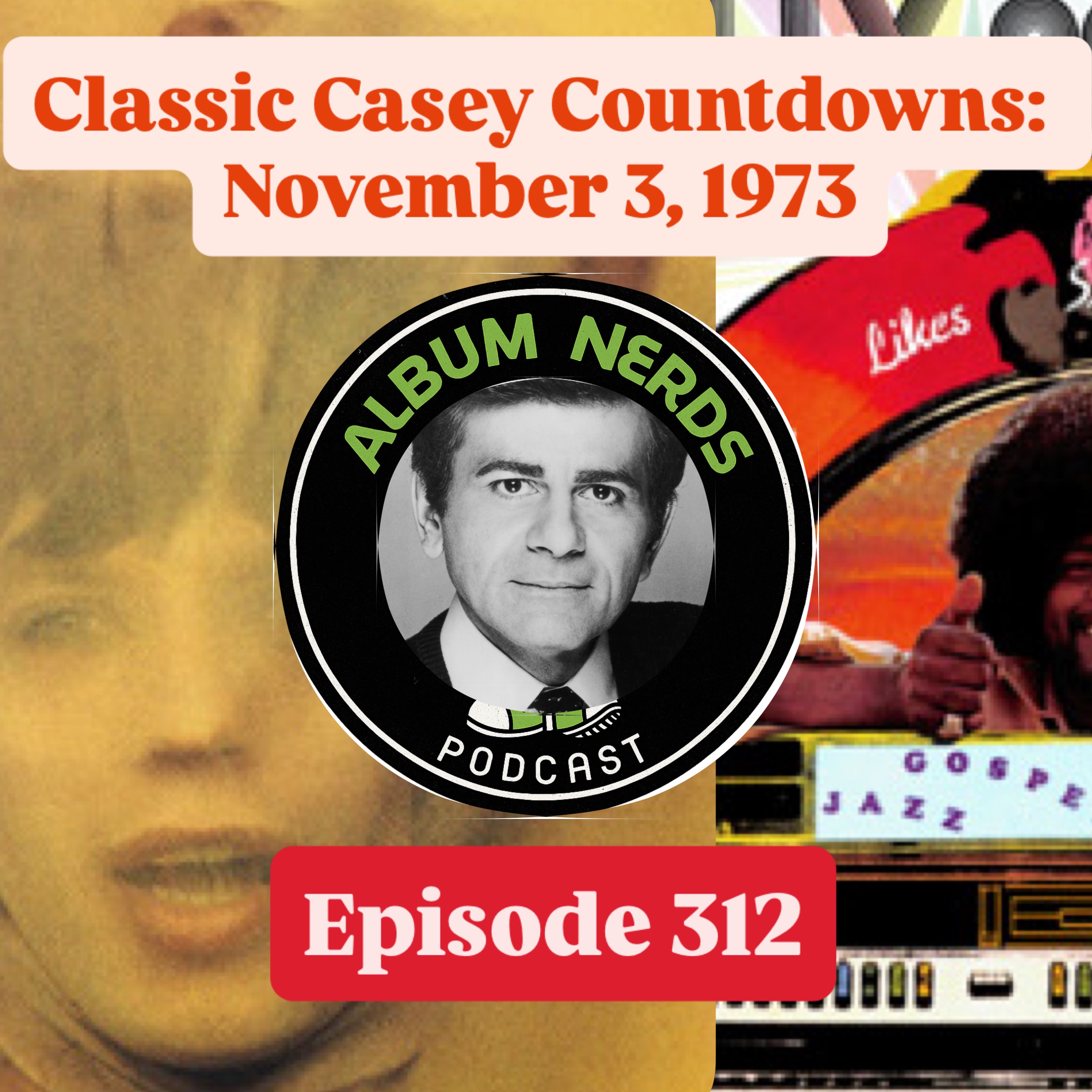
·E312
Classic Casey Countdown (November 3, 1973) : Billy Preston & The Rolling Stones
Episode Transcript
Welcome to the Album Nerds podcast with your hosts Don and Dude.
Now it's time for a request and dedication.
It's the Album Nerds podcast.
I'm Dude.
I got Don with me.
How you doing there Donny boy?
You ready to talk some Top 40?
Yes, I'm keeping my feet on the ground.
I'm reaching for the stars.
That's right.
All right, so this is the Album Nerds podcast.
We love albums in the album format, all those songs.
put together lovingly by their creators.
And we find all kinds of ways to talk about them.
All right, we got a great show for you today.
We're going to be taking a journey through musical space and time, revisiting some Casey's Top 40 and American Top 40 Countdowns from various years.
A radio show that we both grew up on and a lot of the music we were aware of was because of Casey Kasem.
So this is a little tribute to him.
So we're each going to pick an album from an artist that makes the top 10 of the chosen week.
And then, of course, Don's going to ask us a deep question.
We're going to have some shout outs to some other albums and album related items we're digging.
And then we'll spin the wheel of musical discovery to learn what week and what year of Casey's Top 40 or American Top 40 we'll be discovering on the next episode.
This week is all about 1973.
That's what I'm talking about.
Casey Kasem was a legendary radio personality and voice actor who launched the nationally syndicated show American Top 40 in July 1970.
He was famous for his warm delivery and signature phrase, Keep your feet on the ground and keep reaching for the stars.
American Top 40 was a weekly countdown of the top pop hits based on Billboard's charts, featuring biographical sketches and memorable listener dedications.
The program quickly became an institution and American music culture running for decades and shaping the way audiences engaged with popular music.
Today, each of us will present albums with songs that appeared in the top 10 on American Top 40 this week in 1973.
Yeah, so that would be November 3rd of 1973.
The show will be.
working off of.
A lot of good stuff.
Yeah, not a bad list.
Memorable things, stuff that some artists that continue to influence and be known.
So we worked off of the top 10.
So at number 10 was All I Know by Art Garfuckle off of the album Angel Clare.
At number 9, we'll be covering.
Number 8, Let's Get It On by Marvin Gaye from the album Let's Get It On.
I did think about that one, but it's...
It's a little too get -it -on -y, I think, for today's discussion.
Ramblin' Man by the Allman Brothers Band from the album Brothers and Sisters.
I was strongly considering that one.
It's a lot of fun.
I mean, they just sound so cool.
Heartbeat, it's a love beat at number six by the DeFranco family featuring Tony DeFranco.
You ever hear this one, Don?
Now, I didn't recognize it when I saw it on the list, but after, you know, checking it out.
Yeah, I do recall hearing that.
Yeah, it was like a Jackson five rip off, you know, some with a little kid, Tony DeFranco.
Paper Roses by Marie Osment off of the album of the same name.
I couldn't find the album.
I found the song.
She was like, you know, Donnie and Marie Osmond, the Osmond family, and she had a solo career that was focused on country music.
She was a little bit country.
Yes.
And Donnie was a little bit rock and roll.
For those that don't know, it means nothing and isn't even funny.
All right.
So Halfbreed by Cher from album of the same name.
Keep on trucking part one by Eddie Kendricks off of the album Eddie Kendricks.
I think he was the most successful solo artist from The Temptations.
Then at number Two, we'll be talking about that, but number one, the number one song of November 3rd, 1973 was A Midnight Train to Georgia by Gladys Knight and the Pips off of the album Imagination.
So lots of good stuff to think about.
It's tough when you're looking at a top 10 of songs.
It's like these songs are all great.
Then the albums, it's like, that makes it a little tougher.
So the picks are in.
We're going to make Casey proud.
Let's get to our cha -cha -cha choices.
Choo -choo -choose me?
My selection is the number nine song from that week, and it comes from Billy Preston.
It's the eighth studio album from the keyboardist and singer -songwriter born in Houston, Texas in 1946.
The album's called Everybody Likes Some Kind of Music.
Billy Preston is an acclaimed solo and session keyboardist.
He had worked with, I mean everybody, but the Beatles most famously and the Rolling Stones, Little Richard, Sam Cooke.
So he had a hit record on this album and it was called Space.
And that's what reached, actually I don't know where it peaked, but it found itself number nine on the countdown this week in 1973.
Sounds like the theme song to like a lighthearted cop show or something from 1973.
Was it?
Yeah, actually, it was used as the theme song for American Bandstand in the late 1970s, I guess, the mid to late 1970s.
So Space Race is a funk instrumental with an uptempo groove built around a clavinet and synthesizer layers.
It's got swirling keyboard riffs, nice punchy rhythm section, some brass in there.
It's yeah, we don't do a lot of instrumental songs on the on the show, except like in the progressive realm.
It's interesting, you know, to have an instrumental track like this as a top 10 song.
Yeah.
Well, I think that like that was a new sounding to people is futuristic sounding.
And at that time, it's it sounds so dated now.
Yeah.
Like not futuristic.
But it's cool.
But yeah, if you kind of go beyond sort of the dated sounds, there is some kind of fun energetic interplay between the keyboards, guitar, and horns.
You've got guitarist David T.
Walker on there.
The string and horn arrangements are by Paul Reiser, not from Matt Abagu.
And more recently for the kids.
Stranger Things.
Oh, that's right.
That's right.
It's hard to qualify what an instrumental song is about, right?
Yeah.
But maybe, you know, energy, fun and experimentation.
And it's just like infectious grooves, I think, kind of showing what he is capable of, what the instruments are capable of in a new way of.
expressing that also in the theme of the album.
Everybody like some kind of music, and this might have been a new kind of music for people to potentially enjoy or like.
So I like that.
Yeah, he's he's an incredible keyboard.
So, yeah.
And it's the it's the fun kind of space, you know, not the 2001 dark, depressing space.
It's like Jetson's cartoony space.
You know, we're all excited about.
Yeah.
Alright, well let's hear the opening track from the album.
This one is called Everybody Likes Some Kind of Music.
I like how he gives examples of each thing he mentions.
It's like a guy that would come to an assembly at your school and say, hey, here's jazz.
Here's all the different kinds of music, kids.
There's more to it than the rock and roll.
I remember a guy coming and playing the opening line to Van Halen Jump.
And we're like, oh.
I wonder if they do that stuff anymore at schools or if it's all like school assembly, we're going to watch a YouTube Ted talk.
Everybody likes some kind of music is the opening track.
It's not quite a full song, a little over a minute, but it serves, I guess, like an overture, setting the scene for the album.
Don't we revisit it later in the album?
We do, yeah.
At the beginning of side two, we get the reprise about 18 seconds of it.
I think that's a cool thing about Billy Preston is I don't think he's just labeled as one kind of artist.
I think because he has the rock cred having worked with the the stones and the Beatles yeah some people think of him as a rocker but he's also soul and r &b yeah i mean just to throw it out there the probably the best known Billy Preston and the Beatles stuff was on let it be Yeah, in fact, he's the only artist I think ever credited on a Beatles record, like, because I think Get Back, the single is actually listed as the Beatles with Billy Preston.
Yeah.
Just for context for listeners.
So there's a choir in there that's actually the Church of Divine Guidance Youth Choir that provides some support for Billy.
Yeah, it's kind of a manifesto that's taken on a...
negative connotation, but it is like a mission statement of what the album is.
It's an exploration of little touches of different types of music and also, like I said, introducing Middle America to new types of music.
He had a unique position to do this, having been involved with the bands he had been, it gave him a lot of cred to go do whatever he felt like.
So it works well.
So was there a track that you wanted to highlight?
Yeah, I wouldn't say it's my favorite on the album, but I just thought it was in line with the theme of what he's doing.
This one's called Sunday Morning.
So it's it's not really an R &B song, you know, it's gospely a little, but it's got this like gentle banjo or banjo style guitar.
I couldn't figure out which.
I read both.
Read the ganjo.
Yeah, I think I think that's another thing.
People smoke the ganjo, right?
I feel like the Statler brothers are going to jump in on this.
Yeah, yeah, that would have been nice.
Some some harmonies there, but it appears mid album.
It's upbeat, but it embraces.
Again, like country a little bit.
Everybody likes some kind of music, right?
And I think playing around, not just completely going like it wasn't like Sunday morning, like I went to the hood out with my friends.
It wasn't like that.
It was just bringing in touches of this to say, hey, this is a universal thing.
Music is something we can all love and all share and bringing elements of all kinds of music.
So maybe you'll find something on this record that you like, you know.
That's what it felt like to me.
Obviously, I can't speak for Mr.
Preston, but that was what it made me feel.
Yeah.
That song is co -written with Bruce Fisher.
In fact, all the tracks except for one cover are credited to Billy Preston.
Okay, so we arrive at the end of the album with another instrumental track.
This is Minuet for Me.
That was unexpected, I gotta say.
First time I listened to it, I had to double check that it hadn't gone to a different album.
What is this?
Yeah, well, he couldn't leave out classical for all the different types of music.
So as you could hear, it's a piano -heavy classical piece showing his, he actually had formal training and versatility.
Actually, I think he grew up, he was sort of self -taught, but I think at some point he ended up taking formal lessons.
So minuet for me blends Baroque style minuet structure.
So apparently a minuet is like a short piece that's written for dance.
What's the difference between minuet and minute?
Why do they do that?
Who came up with that?
It's confusing.
But yeah, so it's not a straight classical piece, right?
So it does have some kind of modern soul touches to it.
Yeah.
It's something I'm really glad I...
chose to focus on this album because it's not what I expected.
Yeah, it was.
That was exactly what I was going to say.
It was unexpected.
Every turn, every song, we're like, what?
Like slamming on the brakes like, excuse me, what are you doing now?
And normally that's disruptive and I don't like it.
But because of the whole idea here of featuring these different types of sounds and everybody's got something to like, I was able to enjoy it.
And the surprises around every corner.
And that song provides closure, although I'm kind of surprised he didn't finish with a funky flourish or, you know, kind of a thing to usher in these new sounds.
But probably if I were guessing, the choice was made that if people haven't made it all the way to the end, then this will be a nice surprise, you know, for those that do.
Well, this is a good time to rewind and reflect on everybody like some kind of music.
I'll start off with my clickbait headline.
It's all right, ma.
I'm only grooving.
So that's a reference to the Bob Dylan cover, which is I'm all right, ma.
I'm only bleeding.
Yeah.
So despite the journey through different types of music, I think most of it has some sort of groove that you would expect from Billy Preston.
And it does kind of pull you along.
All week I've just had everybody.
Just that.
But it's it's just it's fun, but it's also interesting.
Yes.
You know, so that's I think that's what what makes the album nice.
There's moments where you almost laugh.
Yeah.
Not like, you know, oh, this is pathetic kind of way.
But in a way, you know, like how delightful.
Yeah, I suppose I could describe the album in a clickbait headline.
The fifth or sixth Beatle goes full gospel funk.
Billy Preston's album that loved all music.
It's maybe you should play like number five.
Well, you know, there's some there's always is Stu Sutcliffe, the fifth Beatle is, you know, George Martin, George Martin, the fifth Beatle.
So one way or the other, Billy Preston, honorary Beatle.
But it just showcases his versatility, his talent.
Well, funk is the foundation.
All those diverse styles help build the rest of the album.
Jazz elements.
gospel and pop and classical and even that little tiny bit of country.
Yeah, I mean, it demonstrates his ability to transcend musical boundaries and create something unique that has the understanding built in that we all love music and it's all created equal.
Funk is the foundation would be a good compilation.
All right.
Killer to filler.
I mean, it sounds like we both like a lot of the tracks.
I mean, because each one sort of represents a different sound.
So there is the Dylan cover that I mentioned, that it's all right, ma, I'm only bleeding.
Yeah.
I think that's a pretty interesting rendition of that.
I mean, so Dylan's 65 original critiques societal hypocrisy, commercialism, and this kind of bleak world where authority is untrustworthy.
And Billy Preston kind of offers a hopeful gospel infuse.
interpretation.
I read that, um, he omitted some verses to focus the, the focus, the course of transforming the message into one of comfort and resilience, emphasizing that things are going to be okay despite pain.
So that's, that's, that was.
That was one of the more interesting moments for me, because when I dug into it and went and listened to the Bob Dylan one, I was like, oh man, these are like totally different songs.
Yeah, I like that.
Very cool.
He definitely made it his own.
What about Space Race?
I mean, I like it, you know, and I mean, in some ways to probably pave for pave the way for the the Gary Newman and Depeche Mode and stuff.
I was thinking more that it was all happening at the same time as like your Stevie Wonder.
Oh, yeah, that's it.
All of that.
They were feeding off of each other's keyboard prowess and finding these new sounds.
Who could do it first?
You know, you're so unique.
Thank you.
You're welcome.
Oh, so silky and soulful.
It kind of has a Curtis Mayfield vibe to me, you know, all still more of that same funky family tree that was going on back then.
Yeah, I mean, it's all it's I I'm struggling to identify fillers.
You got any?
Well, kind of.
How long has the train been gone?
Oh, yeah.
More gospely.
I just didn't find it particularly interesting.
It felt kind of repeaty.
Yeah, maybe it might be the bluesiest tune.
Yeah, that's true.
That's true.
I mean, I think maybe because of its placement on the album, I don't know.
I just was like, but they're all short.
So even if you're like not loving that one as much, it's onto the next so quickly that it never really bothers you.
But no, I mean, not really, not really any fillers, nothing that's no stinkers.
So the production, Billy Preston basically produced the album himself.
He did have the help of engineer Tommy Vacari.
It is pretty complex.
I mean, you got strings in there, a lot of instrumentation and it's mixed well.
I think you can hear the vocals, there's separation between the instruments, which is exactly what you want.
Yeah.
It's really tight and very bright too.
The keyboards shimmer.
I think they really sound very light and there's something going on, they're sparkling.
True.
All those sounds bring this kind of communal feel that connects the genres, even though.
They're disparate in some ways.
He finds a way to make them all fuse together nicely.
Replay value?
Yeah, I'm in, and it's a short record.
It's fun.
I could play this anytime.
Yeah, and it'd be anyone that never heard it before that you're playing it around would be like, what the hell is this?
And I guarantee they'd find something they like on it or at least were interested in.
It's a conversation piece.
Yeah, it's relentlessly positive and hopeful.
And the whole idea that music unites us is kind of...
there, so yeah, I'd listen, I'm gonna listen to it some more too.
Yeah, and as far as the legacy, I mean, I don't know if people cite it as being influential or anything, but I mean, I think it is an example of fusion of a pop artist trying to fuse several different genres, so I think it's somewhat innovative in that way.
And that open -armed approach to style makes the record like a forerunner to all the later crossover stuff that.
curses as we started running, running out of things to do.
you know, rap and metal got put together and country and rap and all that kind of stuff.
And, you know, Preston, I mean, he's you can't really say he's underrated anymore because he's in the Rock and Roll Hall of Fame.
But I think, you know, sometimes we forget about him.
And it's not just his keyboard playing, which is obviously fantastic.
But I mean, he has a great soulful voice as well.
I mean, he's not, you know, Otis Redding or Marvin Gaye.
But I mean, yeah, that's not his vocals are in service.
of the keyboards and piano.
That's true.
That's what he's trying to do there.
We don't know if he could have done, maybe he could have done the other stuff, but it was a complete sound.
His piano and his voice are equal parts.
Everybody likes some kind of music is proof that mixing lots of styles can be a good time.
Billy Preston is a master at showing off music's possibilities and power.
Check it out.
Excuse me.
I'd like to ask you a few questions.
It's time again for Deep Questions by Don.
If your life had a weekly top 40 style chart, what's currently holding your number one spot?
We could focus on entertainment and pop cultural related things, because obviously your family and this podcast would be at the top.
As it should be.
Well, this this kind of relates to family because it's time I spend with my nephews who live.
several hundred miles away.
And we play Fortnite on Saturday and Sunday mornings, mostly Fortnite, sometimes Minecraft or other things, but it's actually fun.
And, you know, right now it's this Halloween theme thing.
So you can, you know, Scooby and Shaggy, you can get those skins.
So I've been running around as Shaggy and, you know, to heal, you can eat Scooby snacks.
Can you be Billy Preston?
You can't be Billy Preston, unfortunately, although I do have all the members of Metallica.
So sometimes I run around as James Hetfield or Lars or whatever.
But it's fun.
It's a way to interact and talk with friends and family.
And it's just goofy fun.
So I would say that's on my top 40 because I do enjoy my time on Saturdays.
And you play this on a computer or on a console?
Consoles.
I mean, you can't play on a computer.
It's all cross platforms.
So if someone playing on like I was playing with my nephew when my sister was driving, he was on his iPhone and I was on a PlayStation is a moving car and we were playing.
So, yeah, it's fun.
And I know I'm an old man playing the young man's game, but whatever.
What about you, Don?
Well, mine, I guess, is kind of entertainment and pop culture adjacent.
I've been I really want a motor home.
You know, like a small class C motorhome.
Part of the reason is, you know, I think it would be great for like tailgating for football games and stuff like that.
You've got a bathroom right there that that you can use or, you know, before before concerts.
But I spend I think.
an embarrassing amount of time just watching videos.
Yeah, just all the walkthroughs of the the motor homes.
It's so fascinating.
I've gotten caught in the loop of van life people.
Yeah.
Yep.
It's easy to get sucked in.
It does.
It is an appealing escapist sort of thing to watch.
Yeah.
And it's just cool how they just utilize space.
Yeah.
You know?
So you're going to do it?
I mean, that's the hope.
Yeah.
Saving up.
You can have a YouTube channel?
Need the podcast to take off, start generating some revenue, and I'll start recording remotely.
There you go.
Recording from dude's driveway.
All right.
What's at the top of your chart?
Let us know on social media like Instagram and Facebook at Album Nerds.
So I picked my favorite number number two How old do I have to get when that stops being it doesn't get old funny to me Number two was the Rolling Stones With their hit Angie, which I think did eventually go to number one But the Rolling Stones were formed in London in 1962.
Everyone knows Mick Jagger, Keith Richards, Brian Jones, Charlie Watts, Bill Wyman, the original members.
And their 11th album, Goats Head Soup, is what we'll be talking about today.
Came out August 31st, 1973.
Rock, blues, little bit of funk.
Kind of marking a departure from that raw energy of Exile on Main Street, which was one of their Hallmark albums, double album, uh, kind of in this negative space for the band, kind of dark.
And this sort of leans back into, although it's gritty and dirty, it's more traditional rock and roll with some new sounds of the early seventies brought in.
The album covers kind of creepy.
portrait of Mick Jagger enveloped in a pink chiffon veil.
It's somehow dark, even though it's, you know, it's always struck me as a creepy album cover.
I'm glad they didn't go with like the literal goats head soup.
I guess there was some photos taken of a goat head like in a in a vat or something.
They considered it.
But yeah, I think you're right.
They they made the right decision.
Not vegetarian, by the way.
So the album was recorded across various locations, but I think the majority of it was recorded in Jamaica.
So why don't we kick it off with the hit song?
It was number two on the charts at the time, Angie.
So many people speculated that Angie referred to various women, including David Bowie's wife, Angela Bowie, or Keith Richards' daughter.
Richards clarified in his autobiography that the name was just chosen arbitrarily during a period of detoxification in Switzerland.
He was strumming on his guitar and just started singing Angie.
I wonder how many periods he had like that.
Perhaps today, who knows?
He said it could have just as easily been Diana.
I've also read that Mick Jagger's lyrics may have really been talking about his relationship with Mary Ann Faithful.
Oh, yeah, yeah.
Which makes sense of why it sounds so real and forlorn and Jagger getting into that register that he doesn't very often, like way up the A and J, like it sounds painful.
I think that's kind of the point.
What were your thoughts on this one?
Yeah, before I started really getting into the Stones catalog, I had assumed that this was an earlier number from more of that psychedelic period.
I put it in there with Ruby Tuesday.
Oh, I see that.
But it does, it makes sense now that it fits into this blues dark era.
I mean, it's a classic song.
I'm a fan of the melancholy.
I mean, sometimes I kind of roll my eyes at like his really dramatic, you know, draw that me.
I love, you know, when he sings, I don't know.
I was like, as a as a kid here in the song on the radio, like on classic rock stations or whatever, I was like the engine.
Pardon me when he whispers.
He does a lot with his voice.
He's got a lot of little subtle things that he does that just gives it character.
He established a new way to sing, the way that he uses the accents and twang.
Like he uses southern drawl sometimes that somehow really works.
The initial version lacked the string arrangements.
They later added those in London.
I think I might have enjoyed it.
to straight up to, I don't know.
What do you think about it being, you know, a number two, number one hit in America?
It's kind of surprising to me, you know, because it just feels, you know, kind of depressing.
And yeah, I don't know.
Although, I mean, I guess the I mean, the 70s, you know, we're kind of depressed.
Yeah.
Well, you know, and.
I mean, Exile was just 1972 and this was 73.
They just kept cranking out the records.
They must've been exhausted, man.
I feel like this was sort of the beginning of resetting of what the stone sound was going to be moving forward.
More standard, you know, rock and roll with whatever the modern influences as touches in the stone sound.
And the song, I think helped get this album into people's collections.
Yeah, for sure.
Big hit.
All right so why don't we get back to the opening track and we kick off the album The Goatshead Soup with Dancing with Mr.
D.
See like when he says West Virginia, I love it Freaking love it, but it would be ridiculous if like a country singer was doing a British accent But that cut if that country singer has established himself to be of Mick Jagger levels, then he can try so Garth Roshi.
Yes Well, he tried but the cool Chris Gaines thing, right?
So this one was written by Mick Jagger and Keith Richards It kind of delves into themes of mortality, temptation.
I mean, these guys have been leading hedonistic lives or probably what 30s by this point.
Some of the consequences of their actions are coming back to bite them.
So dancing with death.
Now, some people think Mr.
D is the devil, but most think it's dancing with death and they probably all came close at some point.
But yeah, it's got that funk rock influence.
And Billy Preston plays a little Clavinet on this one, which I thought was fun.
He's on the charts in many ways.
What were your thoughts on Mr.
D, Mr.
Don?
Yeah, it's a good start to the album.
I like the kind of dark raunchiness to it.
I mean, it definitely feels like a cut that could have been on exile on Main Street.
But it's maybe a little more funky, you know, and I feel like I feel like Miss You is coming soon, you know, foreshadowing.
Yeah, it's it is gritty, but it also does sound more rooted in traditional Chuck Berry rock and roll riffage.
You know, there's some there's some slide guitar in there, which I think that's Mick Taylor.
Probably.
Yeah.
So done is a short album.
This.
It's a great album, I think, underrated.
What cut floated to the top of your goat's head soup?
I just picture like an eyeball coming through.
Well, there were there were several places I could go.
I just ended up picking 100 years ago.
So kind of a reflective ballad again with some country vibe to it.
Lots of tempo changes in there and mood changes, but it seems to focus on nostalgia and aging, which probably makes sense.
These guys are, as you said, in their 30s, probably maybe starting to feel, what's the word, mortality.
Yeah.
Also, especially when they've spent approximately 10 years at this point where their worlds got turned upside down, the life of just living as a kid in a neighborhood or whatever must feel even further away than when you kind of take the more traditional trajectory of slowly growing up and going to college, all those landmarks in life.
where their landmarks were a completely different set.
So this simpler, normal life is long ago.
Yeah.
So Mick Taylor, I mean, he must have fallen in love with his wah -wah pedal.
Every man falls in love with his wah -wah at some point in time.
Because it's used on several songs, and this is one of them.
I mean, people who maybe don't study the Stones, I mean, you tend to think of Keith Richards as being like the, you know, the guitar in the band.
But I mean, a lot of times he's playing a rhythm, which is often interesting and complicated, but it's a lot of the lead parts are played by whoever the lead guitarist is at the time.
For their particular song too, you know.
Yeah.
So in this case, you know, Mick Taylor, you know, I think really shines on this song and others.
Yeah, it's a lot of good stuff on here, but As always, we're going to check out the closing track, see how goat's head soup settles in our bellies.
This one's called Star Star.
You're not hearing that wrong, people.
The original title was Starfucker.
Changed.
surprisingly due to explicit lyrics.
I'm shocked that the label allowed on the album.
And this is pre -parental advisory days.
Yeah, well, he says it in a way where a kid could probably make an excuse and make up that it's Star Waka or something, you know.
It's not completely clear.
But Mick and Keith wrote this one Chuck Berry style rock and roll.
guitar work.
Just when I think these guys are getting serious, they.
Yeah.
Well, Angie finishes outside A, right?
So you kind of get that heartfelt stuff out of the way.
But there is another really lush ballad type song called Winter that we'll probably get into in a little bit.
But besides just the words in the song, there was some I guess the record label didn't want to.
I didn't want to do it because they mentioned Steve McQueen.
I think John Wayne's in there somewhere, too.
But I guess they actually got permission from Steve McQueen because the record label was worried that Steve McQueen would sue.
They got written permission from him.
What I read.
Nice.
But it is audacious.
It's about the hedonistic.
rock persona, the famous people now they can have whoever they want and all that.
But using the words they used was just even in their thirties, the stones being like, we have the power, we can push this song on our record and you can't stop us.
We're going to say fuck.
on a record and they did.
What were your thoughts on this one?
I think what I, you know, initially hearing it, especially coming out of like winter, you know, where I'm like, you know, moved and then, you know, then I hear this, I'm like, oh, what are they doing?
But then, you know, I kind of, you know, I realized that it's, they're not just being, you know, dorks or whatever.
They're actually making a comment here, you know, so they're, they're sort of capturing that celebrity culture and groupie culture and all that.
So it's actually, I mean, it's a, it's a really good song.
Yeah.
It is.
I mean, it's a little awkward as I was driving around in my truck singing it.
Lucky it's cool enough out that the windows were up.
It feels a little awkward.
Alright, so this might be a great time to rewind and reflect on Goats Head Soup.
Alright, so my overall vibe for the album can be summed up in a clickbait headline.
Go Ted soup.
The stones cook up a recipe for a number one hit, one Angie, some Mr.
D and two stars.
So it's often overlooked album.
I think I think it's pivotal blending beauty and honesty as well as rock and raunch swagger and introspection.
And I think it foreshadows their evolving sound, uh, as they move forward, getting more into the arena, rock sounds of the eighties and all that stuff.
It's a hazy, elegant hangover, right, from the previous years and the previous critically acclaimed albums.
They sound a little older, a little slower, but more honest.
And that melancholy that's sprinkled in the grooves works really well for me.
Yeah, it kind of feels like a band, like on the verge of like making some changes, you know, not quite ready to turn life around, but we're thinking about it.
Yeah.
So my clickbait headline is You can say this is satisfied.
That doesn't really work.
I still love the stones.
OK, anyway.
Yeah, another album I'm thrilled that we we got to spend some time with because.
I don't know the Stones catalog the way I do the Beatles.
Of course, it's a lot bigger.
Oh, God.
I know.
It's daunting, man.
Yeah.
But when people list their top Stones albums, I feel like this is not like in the top three or the top five usually.
And listening to it, I mean.
I love it.
I like Exile on Main Street.
But this one is like you can listen in one sitting.
It's short.
It's got like all the blues and the raw energy of Exile.
But it's got more darkness to it and a lot of beauty.
I like the touches of strings and stuff.
I think the melodic guitar work is excellent.
So I mean, right now, it's You know, moving up several notches on my countdown of stone albums.
So discussing the whole killer to filler thing.
I mean, come on, there's not a bad song on here, but there are some that are better than than others.
All of the songs we talked about are killers.
Winter, which we mentioned.
Yeah.
A blush, slow ballad of isolation and longing.
Taylor's slide guitar in there is very dreamy.
Jagger's delivery is tender and haunting, you know, as he can do.
Yeah.
Supposedly Jagger's playing rhythm guitar on that one, too, and there's no Keith on it.
Cool.
You know, how did winter make you feel?
Made me sad and contemplative, I think.
But yeah, that's a great that's, you know, that might be my favorite track.
I like the bit about a coat.
You know, yeah, trying to keep your keep your loved ones warm.
Yeah, winter's great.
I mean, dude, dude.
How many dudes is it?
Five dudes and a heartbreaker.
Yeah, I mean, that's a good one as well.
I think you've got more Billy Preston on the clavinet on that.
Yeah, it's it's funkier and it kind of has a little bit of urban despair.
Yeah.
Police brutality mixed in there.
Yeah, maybe.
Would this be right after Marvin Gaye?
What's going on?
Yeah.
Probably, I think a new tone was set by that record.
Probably a lot of artists were like, hmm.
Yeah, and the Stones now, so even when they have a more rock and kind of funkier track, the subject matter is still very serious.
Yeah.
What do you think about Coming Down Again?
Yeah, another one I like, I think, because it's got sort of that sadness to it.
Yeah, a little saxophone and piano in there.
But it's Keith, you know, I think he's singing on this one, right?
Yeah, yes, I think.
Yeah.
Yeah.
Yeah.
And it sounds weary and confessional, like his vocals often do.
They just sound so raw.
Yeah.
I mean, it's any any other big ones for you that you wanted to.
They're all good.
Even Silver Train is.
Yeah.
It's really good.
You know, a real blues rock number there with more slide guitar.
Yeah, slide guitar and wah wah.
I mean, maybe hide your love.
Kind of repetitive.
But yeah, I guess if you had to pick one, if you had to.
Yeah.
OK, so production wise.
Jimmy Miller's, he worked with the band through Exile and a lot of those other Landmark albums.
This was his final production for the band.
It's warm and murky, lots of reverb.
I think maybe being in Jamaica and in this sort of humid atmosphere, it kind of feels like that.
It feels hazy.
Yeah, that's true.
I don't know if that was reflected in the production, but it sounds that way to me.
What were your thoughts?
Yeah, I agree with that.
I mean, I maybe wouldn't have picked it out without knowing, but knowing that it was recorded in Jamaica, it kind of makes sense.
Oh, I definitely wouldn't have picked that up.
It sounds more like Bermuda.
That's when decisions are made based on the information that you've gathered, not on feel alone.
Replayability.
Yeah.
Yeah.
Oh, yeah.
You loved it?
I mean, I loved it and now I'm going to live it.
Watch out stars, Don's on the move.
Gross.
It's a mood record like I think sweaty summer nights, but it really anytime the subtleties reveal themselves slowly, which I think is what I really like about it, like ingredients in a fine, fine soup.
It's a grower, not a showstopper.
But it actually may be one of my favorite Rolling Stones albums, because it's it captures so much of the cool stuff they were doing before and does a better version of what they were doing at the beginning.
And the kind of is ushering in this new, slightly more mature group of guys.
So I really dig it.
Yeah.
I'm going to see if I can find anybody online who thinks this is the best Stones album, because that might be those might be my people.
I was listening to a podcast called My Favorite Album with Jeremy Dillon and he interviewed singer -songwriter Sadler Vadden who's a guitarist with Jason Isbell's 400 unit and this was his favorite Stones album and he went into detail of listening to it growing up and it was a good interview and very interesting show as well where he brings on artists and actors and such and asked them about their favorite album.
So, yeah, I think it's out there.
I think it's getting out there.
As far as legacy goes, I think that kind of ties in with what we were just talking about.
Although initially overshadowed by Exile, this album has been reevaluated as a classic, I think, over time.
It shows them human, vulnerable and musically mature without losing their bite and set the stage for what they're still doing.
I heard they're making a record right now.
Sheesh.
Yeah, I mean, I think it's just, you know, further demonstrates their ability to kind of shift from one sound to another on the same record.
So, you know, and I particularly like the darkness to this.
Well, everybody likes some kind of music, right?
So I've heard.
Yeah.
So straight from the week when Angie ruled the airwaves, Goathead Soup shows the Stones trading swagger for soul.
That's classic 73 right there.
Check it out.
Can you dig it?
Can you dig it?
So we took a trip back to November 1973 and discovered some some great albums.
Did you discover anything great on your way back?
I did.
Thank you for asking.
Sweet of you.
So as far as new albums go, there's a new one from Mammoth called The End that was just released.
Mammoth, formerly known as Mammoth WVH.
Wolfgang Van Halen.
I guess there was some fight for the the rights to the name.
Hard rock project of Wolfgang Van Halen, who writes, performs, records everything himself, carrying forward a legacy of rock entirely his own vision.
And this one is the third studio album called The End.
Why don't we listen to a little bit of the title track.
So this is recorded at 5150 studios produced by Michael Elvis basket Wolfgang plays all the instruments and handles the vocals as I mentioned ten tracks 39 minutes arena ready anthems introspective moments and addresses You know the usual stuff anxiety self -reflection hope in uncertain times But this guy is trying to find his own way his own voice his own legacy outside of Eddie Van Halen But more guitar virtuosity on this record than the first two.
And he can play.
Sounds like he can sing too.
Yeah, very, very nice voice.
Good alternative rock voice.
But then on the vinyl side, you know, I like digging into my collection.
This talk of 1973 went with Stevie Wonder, Intervisions.
The copy I have is a beat up old one I got at a record shop, but it sounds good.
And it's just so nice to have in hand Stevie Wonder, of course, legendary American singer -songwriter, multi -instrumentalist, whose classic period in the 70s really transformed soul music.
Why don't we listen to a little bit of living for the city?
I mean, living for the city.
Living for the city.
City just came out so natural.
He stole my sette.
So, InterVision marks Stevie's full maturation, recorded largely alone, blending funk, soul, jazz, electronics, and tackling social issues like racism, drugs, politics, featuring songs like Higher Ground, Livin' for the City, and Don't You Worry About a Thing.
Won a Grammy for album of the year back in 73, so yeah, love having that one around.
What are you digging on there, Donnie Boy?
Well, I haven't seen it yet, but I'm actually going to see it tonight.
So there's a Depeche Mode movie.
It's called Depeche Mode M, a film by Fernando Frias.
Why?
Why is it?
Why does it sound so?
Snobby.
Yeah, well, it's a Mexican filmmaker who's basically, he chronicles like three performances that they did in Mexico City, I think.
But I'm not sure exactly how he does it, but supposedly he's exploring themes of mortality and like Mexican traditions or surrounding death.
So like the, was it Dia de los Muertos, whatever, the day of the dead.
So.
Yeah, I'm interested in seeing what it's like.
And to correspond with the release of the film, they do have a leftover song from the Memento Mori Sessions.
It's called In the End.
Oh, my God.
I just put on some guy liner while we're listening to this.
All right, well, another very Don pick here.
I feel like we talk about these guys a lot.
So Duran Duran.
And it's always around Halloween time.
So Duran Duran, they just released, just as a single, a re -recording of the track Shadows on Your Side, which appeared on Seven and the Ragged Tiger from 1983.
So they're doing it in kind of that dance macabre style.
So remember the album, the Halloween album.
Dancy.
So last year they added a bonus cut new moon on Monday and then this year they've added shadows on your side.
I don't know if they're going to put it like if they're adding it to a deluxe deluxe version or if it's just a standalone but here it is.
Donna Summer meets Duran Duran.
And by the way, I think that is actually Andy Guitar.
Andy Guitar.
By the way, that would be a nice nickname.
Andy Guitar.
I love it.
That's actually Andy Taylor adding some guitar on the original member of Duran Duran.
Nice.
So yeah, so I wonder if they're just every year, they're just going to keep re -recording songs in the Halloween style.
Why not?
All right.
Well, what are you digging?
Let us know.
Join us on the socials, Facebook, Instagram, threads and blue sky at Album Nerds.
It will be a discovery of extraordinary value.
We're here once again at the time in the show, and I'm reminded of the words of radio and TV personality Ryan Seacrest, who, by the way, now does the American Top 40.
He says.
Casey's Countdown was the soundtrack of America.
He set the standard for connecting songs with stories and made you feel like you were a part of it every week.
With that in mind, let's bring out the wheel of musical discovery to find out what classic Casey Countdown we'll be talking about next time.
You'll be taking the biggest hits from this week in 1984 and diving into two of the albums they came from, exploring the sounds, stories, and artists that defined the neon -soaked spirit of the 80s.
Look forward to it.
What's your favorite album from 1984?
What else are you listening to?
Email us at podcast at albumnerds .com or follow us on Instagram and other social media at Album Nerds and visit albumnerds .com to listen to all 312 episodes.
And the best way to support the show is to share it.
Please subscribe, rate and review on your favorite podcast app.
Thank you so much for joining us here on the Album Nerds podcast.
We'll catch you next time in Sweet Sweet 84.
Andy, when you gonna come back and record?
Oh, that is so heartfelt, Don.
Andy will be back.
I think we might be seeing him at the end of the year.
To a long -distance dedication to Andy.
Dear Andy.
Dear Casey.
Keep your feet in the ground and keep reaching for the stars.
Yay, Casey!
See you next time.