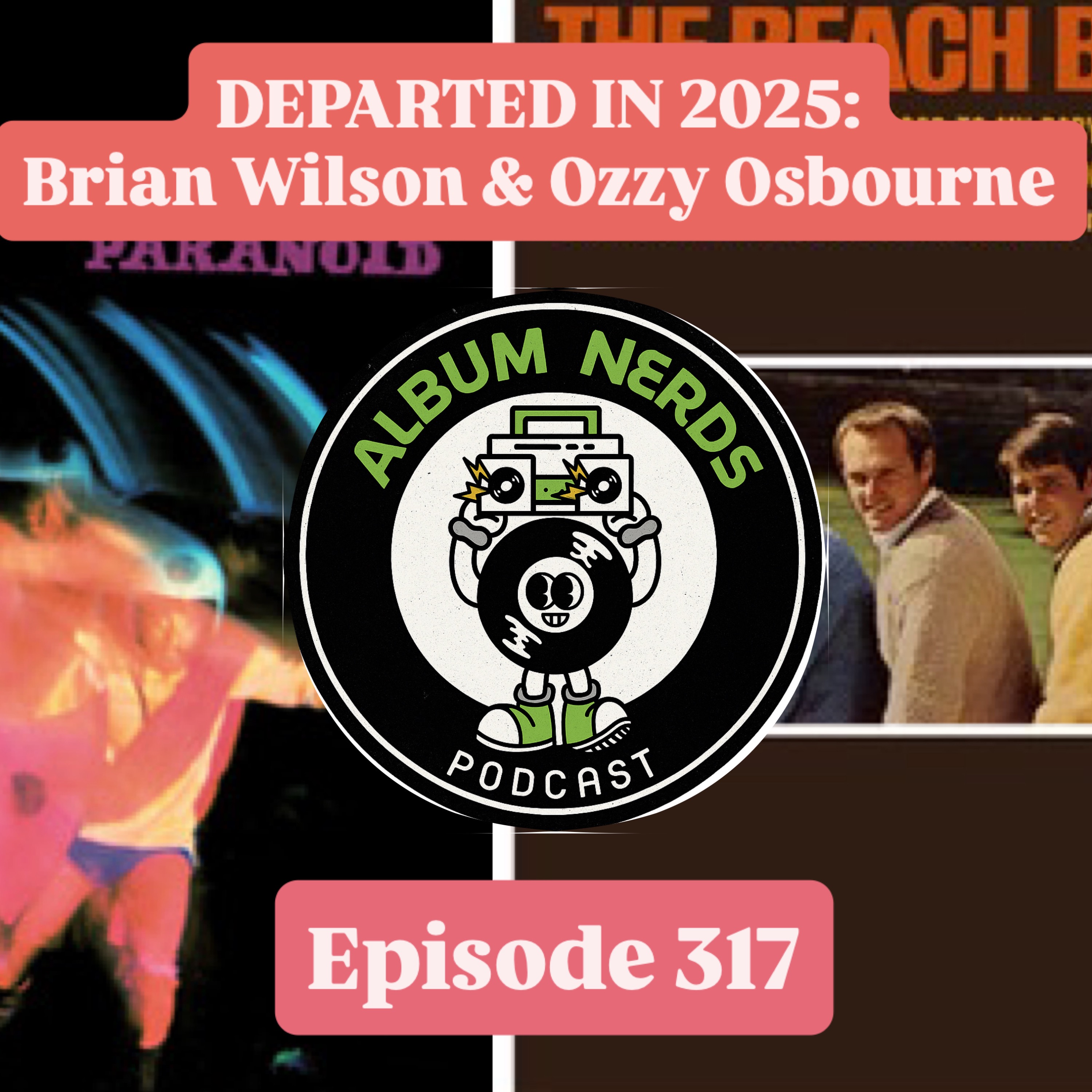
·E317
The Departed (2025): Brian Wilson/The Beach Boys & Ozzy Osbourne/Black Sabbath
Episode Transcript
Welcome to the Album Nerds podcast with your hosts Don and Dude.
It's time to pour one out for the dearly departed.
This is the Album Nerds podcast.
I'm Dude.
I got Don with me.
Little somber to start, but it'll get fun.
I'm sorry for our loss.
Everybody's loss.
So this is the Album Nerds podcast.
We love albums, the album format, the collection of songs put together for our listening pleasure.
We've got a great show for you today.
We're going to be paying homage to some of our fallen heroes in the music business.
So Don and I each picked an album from an artist that passed away in the year 2025.
It's always sad.
That's always a depressing realization of mortality and how old we're getting if people that have always been there are not there anymore.
Well, let's let's not focus on that and let's let's just celebrate these great artists.
Right on.
And of course, Don will be asking us a deep question.
Then we'll give some shout outs to some other albums and album related items we're digging.
And then we'll reveal what festive motif we'll be taking on next time.
But this week, it's all about the Dupat.
You're going to have to pardon me.
That movie's in my head at all times.
Are you a corp?
I'm not a co -op.
That's what I'm talking about.
The losses the music world experienced in 2025 invite renewed listens to the albums that define these artists' lives and shape their eras.
As album nerds, we will focus on records that capture creative peaks and reveal how the works of these artists continue to resonate beyond their passing.
We will each present an album from an artist who departed in 2025.
They departed.
Yeah, it's a really big list.
And there's a lot of people who were in, you know, crucial parts of bands that maybe weren't as well known names as well.
I mean, it was an exhaustive list.
We'll go over a few that would have been in consideration this week for us.
Sly Stone from Sly and the Family Stone.
So make sure and check them out.
Funk R &B pioneers.
Yeah.
Mary Ann Faithful, kind of a how would you describe her?
She's kind of known as like a rock and roll muse or something, but she had a lot of her own, you know, stuff.
Yeah, but sort of sultry yet scary at the same time and in all the right ways.
Roberta Flack, you know.
70 is probably the peak, but R &B singer, beautiful voice.
Yeah.
Ace Freely from Kiss, the guitarist from Kiss, the Space Ace.
Oh yeah.
D 'Angelo, three albums in his whole career, but they're all spectacular.
Yeah.
We've done a couple of them.
Yes, we have.
David Johansson from the New York Dolls.
Just did that recently.
Pioneering glam punk artists.
Garth Hudson from The Band.
Which what band?
The Band.
Okay.
They were Bob Dylan's backing band, but then took off on their own.
Chuck Mangione.
What's that horn that he plays called?
Oh, he plays flugelhorn.
The flugelhorn.
That's awesome.
I don't know what that means.
I know it looks cool.
Rick Davies from Supertramp.
Mark Volman from The Turtles, beneficiaries of Beatlemania.
Brent Hines from Mastodon.
We've talked about them several times.
One of my favorite bands.
Go listen to the album Leviathan.
He's guitarist and vocalist, co -vocalist, Jimmy Cliff, foundational reggae figure, great vocals and socially conscious lyrics.
You know, I can see clearly.
Everyone knows that song.
Yeah, I'm on.
Don't do that.
And then a personal favorite of mine, Todd Snyder, American singer songwriter, folk country rock blend, kind of under the radar a bit.
But I guess he had very compelling live shows and self satirization and stuff.
And I've enjoyed several of his records over the years.
So that's just like a tiny slice.
We couldn't do them all or we wouldn't be able to talk about any albums today.
But the pics are in.
Our black suits are on.
Our graves are dug.
Oh, Donald.
It's time for our choo choo choo choices.
Choo -choo -choo's me?
In 2025 we lost legend Brian Wilson, born Brian Douglas Wilson in Inglewood, California in 1942.
He's a visionary songwriter, arranger, and producer behind the Beach Boys classic California Sound and the groundbreaking album Pet Sounds.
That's always near the top of those lists of greatest albums of all time.
Created hits like Good Vibrations that showed his innovative studio techniques and helped redefine pop music.
He even enjoyed some solo success later in his career.
But today we're going to focus on one of his earlier works with the Beach Boys.
The Beach Boys today released in 1965.
It's all relative though, right?
This is like their eighth album or something and their first one was like.
Two years before.
And then like Pet Sounds is two albums later and it's 1966.
This album marks a shift away from the earlier surf and car themes with more mature material, I guess.
Right.
Side one is filled with kind of bright up -tempo songs while side two is more reflective and orchestrated ballads.
Kind of widely seen as a key step towards, you know, the more elaborate pet sounds version of the Beach Boys.
Anyway, here's the opening cut.
Do you wanna dance?
What a wonderful time when holding hands was like enough At least for a while This is is the one cover actually on the album it was originally written and performed by Bobby Freeman I mean, Brian Wilson has done a lot of covers over the years, and he always makes them uniquely his own.
It's got just sort of your typical, hey, let's get up and dance kind of thing.
But it's got the unique Beach Boys harmonies and that orchestral sound.
The lead vocals are actually done by Dennis Wilson, which is not common, the drummer.
Yes.
Although, you know, that's another thing.
This is one of the final albums where I think Beach Boys are actually performing instruments on the album.
Yeah.
They start to rely more on that wrecking crew, you know, that group of studio musicians.
It's because Brian was making the records while the rest of the band were out paying the bills by touring.
Yep.
Yep.
That is for sure.
But yeah, I mean, I mean, they talk about how this is a more like mature album or something, but it is.
still, you know, somewhat juvenile sounding.
Right.
I mean, but they were late teens, early twenties, probably.
And I think though, if you think about being a young person, like at a school dance or whatever, I assume this still happens.
Maybe they all just wear VR headsets at school dances now don't actually touch each other or talk to each other.
But getting up to.
the courage to ask someone to dance was a tough thing.
And I think songs like this probably like reflected that feeling and then maybe gave some young people the courage to go ask someone, do you want to dance?
Yeah.
And then, you know, in retrospect.
The lyrics just aren't that important.
Even on Pet Sounds and stuff, I think a lot of the lyrics are just kind of there.
It's just more about the sound and the craftsmanship of the arrangements, I think.
I think maybe from Brian's perspective, but from listeners' perspectives, I think the lyrics do matter.
All right.
Well, let's move on to side two.
Here's a song called Please Let Me Wonder.
What was Brian's inspiration for these detailed harmonies?
Was it like the Four Freshmen or something like that?
Oh yeah, he was into all the, you know, the Everly Brothers, the Four Freshmen.
Because that's really what is the foundation of all of this, regardless of string, lush string instrumentation and stuff.
those harmonies are the key to who the Beach Boys are.
Yeah, and they're much more sophisticated than, you know, your basic, you know, three part or four part harmonies.
You know, the chords that they're forming are, you know, a little unusual and sometimes, you know, a little kind of dissonant or off -putting, but they're, yeah, they're significant.
And then, I mean, you think about, you know, groups like Crosby, Stills and Nash, you know, I think they were definitely influenced by these kinds of harmonies.
I read somewhere that this was the first song Brian Wilson wrote under the influence of marijuana.
Yes, I read that too.
I know he he suffered from anxiety and I don't I'm not going to diagnose, but other psychological conditions perhaps.
But, you know, this song centers on a man's fear that a woman will reveal she doesn't love him, leading to prefer the fantasy that she does.
You know, that's lonely and I think that's probably why people connected with this stuff is the music and the sound all captures that feeling of sort of like, I just want to wonder, I don't want to take the risk.
Yes.
Yeah.
I guess Mike Love contributed the lyrics to the song who I think was not partaking in the drugs.
So yeah, this sign too, I think is Maybe a better preview of what's to come from from Brian, you know, much more orchestral using a lot of harpsichord and just other goofy instruments.
Whereas, you know, previous Beach Boy songs, you know, were mostly your traditional rock and roll instruments.
Yeah.
It's when he starts deconstructing songs into little parts and.
dealing with each piece or instrument like individually and then kind of stacking the sounds.
There's also throughout these songs a lot of Phil Spector wall of sound.
Stuff.
I think he was inspired by that as well.
Yes.
And in fact, this was supposedly supposed to be kind of a quiet tribute to Phil Spector.
I think that happens with everybody.
You're sort of influenced by people and you're paying tribute to them and then you end up stumbling onto your own thing.
Right.
Well, was there a track that was particularly close to your heart?
Yeah, one that's much maligned, I think now because it is so dated lyrically.
And we had this record my parents did from their youth.
But this was one on that record that my dad used to play a lot.
Specifically, I think he was probably early thirties at the time and thinking about his own youth.
And this song is called When I Grow Up to Be a Man.
So written by Brian Wilson and Mike Love, peaked at number nine on the US charts.
This song shifts from earlier those surf fun themes to be more introspective, existential about the anxieties of growing up.
And I think back then too, there was more of a, I don't know, a pressure in society to learn to be, when you're a little boy, to learn to be a man.
Your dad was there to teach you how to be a man, you know, and that can be stressful.
And wondering all this stuff.
Well, my kids think I'm a dork.
Well, I still like the same things I did.
You know, there was terms like, well, I will I dig the same things that turned me on as a kid and read some things where it's like, oh, that's sick.
What is it about kids being turned on?
Like because people used to say stuff, turn them on, meaning it was cool or they liked it.
Right.
And then the countdown of the count up rather from 14, 15, about the years going by, how quickly they go by.
So I could see how it'd be viewed as corny, but I grew up thinking it was cool and wondering myself what it would be like when I grew up.
And then my dad used to turn it up at the end to hear how far out, I think it goes to like 33.
And I don't know this for sure, but I always felt like he was.
going to be sad when he was older than the ages that were listed.
That's funny.
A lot of the Beach Boys songs, and I think a lot of early rock and roll, it feels like it's really geared towards teenagers.
A lot of the subject matter is for the teenagers.
So it's interesting because these guys are already probably in their late 20s at this point, I think.
I think Brian Wilson was 23 when this album came out.
Mid -20s.
And then he has two younger brothers too.
But teenagers was kind of a fairly new concept as far as American society goes.
Before World War II, when you got to be 12 or 13, you went and got a job and helped contribute to the families.
You know, that's what my grandfather did.
But then by the time my parents were kids, there was these teenage years where you got to kind of find yourself, chill out, work at a bowling alley, listen to rock and roll records.
You know, it was a, you know, a period of Being able to figure it out instead of being forced into adulthood right away.
Right.
Yeah.
Now you can, you know, I mean, you can live with your parents into your thirties.
God.
Why would you?
I don't understand why you'd want to.
I know.
And this, you know, this is another song that has the harpsichord in it, giving it kind of that Baroque feel.
Is this where like the term Baroque pop came from?
I'm not even sure.
Probably.
I kind of associate it with Brian Wilson.
I think what's brilliant about these songs and a lot of the Beach Boys stuff from this era was that, yes, there's all those layers, but to the average listener, it just sounded great, but they wasn't being picked apart.
Like you say, there's harpsichord.
I'm like, oh yeah.
But to me it's just this full, you know, musical hug of all this stuff.
And I'm not, the ingredients aren't as important as the dish, you know?
Gotcha.
Wow, that was a lot of mixed metaphor.
Much like in many of these songs.
Alright, well we move into an odd closing cut here.
It's not actually a song.
There's a little piece of it.
Yeah, that's right.
They didn't even burn the hair off of it.
It's sitting there looking at you.
The whole European...
French bread.
The whole Europe.
The only thing that stuck out of my mind is the bread.
People don't say they're having bowl sessions anymore, but that used to just be...
I mean, it was usually like guys or whatever, but just shooting the shit, right?
Uh, yes, yep.
So yeah, so this is just the band chatting with journalist Earl Leaf in the studio.
So it involves, you know, Brian, Carl, Dennis, and Mike.
So yeah, so even, you know, I think Brian's wife Marilyn is bringing in food.
Al Jardine is missing from this session.
And he's really missed, I think.
Yeah, so this is two minutes on this track from a 20 -minute spontaneous conversation, right?
Yes.
You know, I think it plays to their self image and like these.
I think it was like a getting to know you thing.
There wasn't.
It's kind of like the Beatles at the time with Hard Day's Night and whatever these silly lads that have their adventures.
I think that was part of what this would have been fan service, essentially.
Yeah.
Kind of peeling back the curtain or something.
Yeah.
Probably as a Beach Boys fan in 1964.
This would have been cool.
But yeah, now it's kind of like, oh, I want to throw a, you know, one of those demos you didn't finish on here or something.
Sure.
All right.
Well, let's stop rewind and reflect on the Beach Boys today.
I'll begin with my clickbait headline.
When I grow up to be an album nerd, I will still play this.
So.
I never paid a ton of attention to the Beach Boys growing up.
It seems like you did because you really have a Brian Wilson infatuation.
Yeah, that happened in college.
I took a pop music class and I saw the beauty of all this stuff.
Of course, they start with pet sounds and then over time I've kind of gone back and learned to appreciate the earlier stuff.
And yeah, this, this is a really good album.
I mean, it's, it is transitional.
Um, but I like that.
So it still has kind of that early innocence, but you, you do feel the, you know, it getting more sophisticated.
You can see the evolution just like with the Beatles, you know, and I just love that about both of these artists.
By clickbait headline to describe the Beach Boys.
today.
It's just Mike Love today.
Yeah.
Oh, and Bruce Johnson, I think.
Brian Wilson's brain plays Beach Boys harmonies equals pop music.
So perfect.
It feels like sunlight in mono or stereo.
I prefer the mono version of this.
I do, too.
So the LP does have those two distinct moods at bright, authoritative pop on side A and on side B, the more inward, slower tempo introspective.
It's like a kind of vocal counterpoint to the side A.
Again, pointing to that transition you were talking about, but it creates kind of a cinematic effect.
Like the first half is daylit and welcoming.
The second is nervous and private, you know?
Yeah, it's it was radically personal for for mainstream pop of this era.
And I think that's part of what wasn't just let's go to the malt shop, do op, do op.
It was a little more serious and getting into anxieties and real feelings, not just having crushes and holding hands and all that stuff.
All right.
Well, killer to filler.
One of my favorite songs is on that second side, the she knows me too well.
She knows me too well.
That wasn't the worst I've heard you do.
But yeah, I mean, I really like those quieter tunes with the interesting arrangements.
Kind of underrated.
about jealousy and insecurity, sort of jazz inflected chords.
Yep.
Vocal arrangement is very intimate.
And I think this really sums up the mission of the today, right?
This is who we are.
The Beach Boys are we are what we were, but we're also this.
Yep.
That's a good point.
You've got Help Me Ronda on here, but it's actually not the version that got a lot of radio play.
Yeah.
So I guess.
Brian Wilson felt like it was unfinished or that he could do it better.
And so he rearranged it and it was released as a single and ends up on the next album.
Yeah, there were some subtle changes.
I mean, I don't know if you'd notice it.
No, probably not.
But did they do on the on the second one, did they do the weird fade out thing?
No, I think that's gone.
I don't understand that.
Yeah, it's just these random like fade downs.
Help me run, help, help me run.
Maybe he felt at the time that they needed more punch on the help, help.
And so fading it down, I'm not sure.
The other big hit from the album, I think, is the dance, dance, dance.
That's another, that one feels like a more traditional Beach Boys song.
Dance, dance, dance, dance, dance, dance, yeah.
But yeah, they got the super surfy sounding stuff.
There's just no mention of surfboards.
Yeah.
Another interesting one, in the back of my mind, that's the second to last track.
It's really off -putting.
I feel like the rhythm is kind of changing.
I think he's messing around with like kind of speeding up and slowing down the vocals.
I think it's kind of groundbreaking because the Beatles went on to do that kind of thing.
So I would say it's killer in that way, but it doesn't quite fit with the rest of the album just because it actually has kind of a psychedelic vibe to it.
Yeah.
And then, you know, for filler.
I hesitate to call any of them filler, but because we have to.
That I'm So Young, I apologize.
I had said that Do You Wanna Dance was the only cover.
I'm So Young is also a cover from the doo -wop era.
So ashamed of you.
I know.
We hate to get things wrong here on The Album Nerds.
But we do.
Better to face it now than have the throngs of angry listeners.
Yeah.
Any any stinkers for you?
Well, good to my baby.
She's my girl and good to my baby.
I don't know.
It's OK.
It's cute, but it doesn't have the weight that a lot of the other songs do.
The arrangement and all that is not as boffo.
How about don't hurt my little sister?
That's yeah.
Did you used to have to sing that to?
People know that was what they were telling me.
Don't hurt your sister.
Actually, most of the time she was like, like bite herself on her arm and then say that I did it.
Gosh.
Yeah.
Diabolical.
All right.
Production, well, it's produced by Brian Wilson and involves, again, the famous wrecking crew, all those big session musicians, including Glenn Campbell, who ended up joining the Beach Boys for a while in the touring band.
You've got eight -track recording, which is just giving Brian more things to be able to do.
More layers.
Make that stinky onion stinkier.
As I said, he's starting to mess around with changing tape speeds and stuff like that.
I think Brian maybe was starting to think about having an album be an entire work or a single work rather than just a collection of songs or singles.
Yeah, I mean, the odd sounds and harmonies were anticipating pet sounds, I think, as you were just kind of alluding to.
But he blends the band and session parts and arranged chamber pop and all that stuff into three minute songs that are meticulously arranged like small symphonies.
Yeah.
And that's where the, you know, probably the muse took over and Brian started to disappear into it, you know?
Yeah.
Really.
well thought out experimental production at this time.
Yeah.
And it does have the the wall of sound thing going on.
Although I think the one difference is with Brian Wilson tracks, like if you're really listening, you can kind of pick out the various instruments.
Whereas with with Phil Spector, I think it's harder to do because it feels like just one sound.
These are the Beach Boys after all.
So it's a it's a tidal wave of sound, not a wall.
Very good.
I like that.
I'm a genius.
Replay value.
Yeah, I like this.
I think of like the earlier Beach Boys albums.
This is probably the one I'd go to.
Yeah, I mean, for me, it's more nostalgic listening to.
I don't listen to this one often, but listening to it this week brought me back to being a little kid and grabbing a tennis racket and playing guitar along with the Beach Boys.
So yeah, I'll go back.
Yeah.
But I won't be strumming a tennis racket.
In the legacy of this album, well, I mean, it was big at the time, obviously, but I think, as I said before, it's kind of a transitional album.
I think this is probably when Brian started to hear the term genius for his arrangements.
Genius.
It's more a Beach Boys album than Pet Sounds.
So if you want the Beach Boys sound, I think this is maybe the album to pick.
Whereas Pet Sounds is...
Something else, you know, it's a it's a Brian masterpiece or something.
Yeah, I mean, this is kind of cited as the proto chamber pop blueprint.
But yeah, it's a it's an important building block in their lineage.
They're very accelerated artistic growth.
Very quick.
Well, the Beach Boys today still sounds like a bunch of kids singing about surfing in cars, but you can hear an adult mind quietly reworking what pop music could be.
Check it out.
Many great artists departed in 2025.
Departed.
We also had many actors who departed in 2025.
He just won't do it, will he?
Departed.
So which actor's departure was most significant to you?
Yeah, I mean, there were a lot of legendary people like Robert Redford and Diane Keaton and Gene Hackman and Lonnie Anderson, which, you know, the Caribbean Cincinnati.
and Michael Madsen.
The list goes on.
George went from Cheers.
So many, unfortunately, passed.
But Malcolm Jamal Warner particularly got me.
It caught me by surprise because it was an accident.
He wasn't sick.
I think he was only in his 50s.
But he was like, watching him as Theo Huxtable on The Cosby Show as a kid.
It was like he was a big brother.
I thought he was cool and I loved his storylines the most.
I've seen him in stuff over the years and always happy to see him whenever he's on a show or movie.
So that made me a little sad.
Yeah, I was thinking, you know, I mean, Robert Redford is probably the one that was maybe most significant to me.
Baseball movie.
Actually, no.
I mean, he's really good in that.
But I have issues with that film just because, you know, they change the ending from the from the book.
You know, he actually strikes out in the book.
It was a spoiler alert because I never made it all the way through the movie.
I didn't know there was a book, so I guess it isn't.
But like the film All the President's Men, I showed to my students in a media law class.
So I pieced this performance and that was really good.
But I was actually thinking about the Michael Manson departure.
It made me feel a little weird because it's hard to mourn the loss for somebody who played that character that was so terrible.
So it was Mr.
Blonde in Reservoir Dogs.
Well, he played bad guys.
He played cops and stuff, I think a couple of times, too.
But yeah, I mean, he he was really good at that tough guy routine.
So, yeah, I'm sure he was a sweetheart in real life.
But yeah, it's it's funny, you know, mourning musicians and actors and such, because we don't really know them.
We only know our perception, but they're still they still have great impacts on our lives.
And so it's a it's a different kind of sadness, but it's still sadness.
Which actor who departed in 2025 will you miss the most?
Let us know on our social media, like Instagram and Facebook at Album Nerds.
Okay, so I went with probably the one of the biggest headline gathering losses of 2025, John Michael Osborne, otherwise known as Ozzy Osborne.
It just sounds so different, John Michael.
Born December 3rd, 1948 in Birmingham, England.
Grew up working class and dropped out of school.
Co -founded the band originally called Earth.
Of course, becoming Black Sabbath and helped pioneer Heavy Metal as lead vocalist with this doom -laden sound.
So Black Sabbath will be covering one of their albums today.
Ozzy Osbourne on vocals.
The Prince of Darkness himself.
Tony Iommi lead guitar, Geezer Butler bass, primary lyricist helped shape the Dark Occult inspired themes and Bill Ward on drums with a jazz influenced style that really does some interesting stuff with these heavy, doomy riffs.
Ozzy also had a successful solo career launched in 1980, but we will be focusing on Black Sabbath's second album Paranoid from 1970.
rapid follow up to their successful debut, I mean, with less than a year, recorded quickly in London with producer Roger Bain.
It became one of the earliest and most influential heavy metal albums, raw, unpolished sound and those thick Iomi riffs with his modified guitar.
And then he had lost some fingers as a youth, so he had plastic.
fingertips with leather and downtuned guitar so this injury informed this sound that he created.
Musically paranoid established heavy metal with all those downtuned minor key blues based riffs.
The dark lyrics they confronted themes like war, mental illness, apocalyptic anxiety, and it distinguished Sabbath by confronting grim realities instead of being all about sex, which a lot of heavier rock was about at the time.
and remains a foundational album in heavy music history.
Why don't we listen to the opening track, Warpix.
Written by Ozzy and Tony and Geezer and Bill.
They're always all credited for the most part on these songs.
According to Geezer Butler, the band changed the song's concept From a satanic view of political leaders what I guess originally Walpurgis.
I'm not sure yeah, it's satanic Christmas.
Yeah, geez They changed it to one about generals and politicians Sending the poor to war right because those are the real devils Yes, and I think you know that was kind of the idea there the Satan Flaps his wings was more like the evil of war, not really about the devil himself.
A slow lumbering doom laden march with clear blues roots.
This was Sabbath defining heavy metal vocabulary before there was any.
But long instrumental intros, multiple riff based sections.
What do you think about this, Don?
I love this track.
Yeah, particularly, you know, as the Just the long instrumental section that goes on till the end is just so cool.
And it shows off each instrument so well.
I mean, Iommi is just like a riff master or something.
I mean, I'm not sure that he's a virtuoso.
Yeah, it's not Jimi Hendrix or Jimi Page.
Tar solos per se, it's more riffs.
Yeah.
The drumming is really interesting as well.
A lot of toms, I think, and a lot of different tones.
Must be a pretty big kit.
Yeah.
Yeah, there's just so much going on here.
There's a lot of that exploration of different riffs throughout one song and they all come back around somehow.
It's very jam band ish.
Yeah.
Just, you know, dark and heavy.
And Ozzy's voice is kind of different on this than other songs.
He doesn't sound crazy in this one or dramatic.
You know, he sounds kind of more serious, angry, I guess.
And yeah, I mean, he he really delivers on this.
So let's move on to another one that I think has been misunderstood because of the title character of the song.
I think of Robert Downey Jr.
Iron Man.
Yeah, that's not the Iron Man we know from Marvel.
This was not based on the comic book character.
Nope.
Not that the Iron Man movie makers didn't utilize the song to its fullest.
Yeah, so this is the fourth track on the album.
It's a dark sci -fi narrative, not about the superheroes we established, but originated from Ozzy Osbourne saying that Tony Iommi's riff sounded like a big iron bloke walking about, and they were going to call it iron bloke.
Americans would have been like, what?
lyrics by geezer butler a man time travels season apocalypse returns is turned into a steel metal man by magnetic storm then he's rejected and mocked when he can't warn humanity his good intentions curdle into vengeance he eventually unleashes of destruction he foresaw embodying themes of alienation betrayal and tragic fate sounds like a twilight zone episode it does it really does but ozzy's haunting delivery matches that the weight of it, you know, it sounds like this sad killer, you know, Iron Man.
I really like the the it kind of makes me laugh when it's like I am Iron Man.
I heard somewhere that they used Ozzy singing through a fan.
Oh, for the sound, I'm not sure if that's true.
There's also, there's the Leslie speaker, which has like a horn in the middle that like spins around.
It could have been that.
I think that's, they use that on Planet Caravan.
Innovative stuff.
So Iron Man, besides being connected to the comic book character, also just has had an enduring, you know, pop cultural influence and has kind of come to embody heavy metal, you know?
Yeah, that riff is right up there with smoke on the water, I think.
Yeah.
Yes, I would agree.
All right, Don, any particular tracks you'd like to focus on?
Yeah, I figured it was important to discuss the title track, which would be Paranoid in case you forgot the name of the album.
I always think of Daisy confused the movie when I hear this.
Yes me too So this song was kind of written at the last minute.
Yeah, they needed a another track I guess I only came up with the riff and geezer came up with the lyrics quickly and they you know Just banged it out in the in the studio.
I hear a lot of punk rock Coming from that sound there.
It's a little more accessible, I guess, for them, a little more zeppelin -y, I think, you know.
Mm hmm.
It is.
It is very zeppelin -y.
But it also still has that hard chug that zeppelin wasn't pulling off.
Yeah.
It's interesting how everybody is like in unison.
So like Ozzy's singing exactly what the guitar is playing and the bass is just providing the low end to the same, you know, to each note.
So it's it's simple, but it's it's cool.
Yeah, I think the label liked it probably because it was short and catchy.
You know, it's funny, the album is named Paranoid, but the album cover, I think was what I read was the artwork was reflective of when they thought it was going to be called War Pigs.
Yeah.
And they didn't change it.
So it's kind of I remember being like, why the hell is there's a guy with a sword?
It's just kind of like an astronaut or something.
So it's weird.
But yeah, the lyrics are about emotional detachment.
hopelessness, not clinical paranoia, but more like self -loathing.
But yeah, that locked in riff is impossible to escape.
Yeah, and the soloing is, you know, kind of kind of fun as well.
Yeah.
There are times when I'm listening to this, like it did remind me of like some like Southern rock, like the way the, you know, the long instrumentals, like I was thinking of like skinnered, but just, you know, a little more twang to the skinnered or something, but.
I'm not sure, you know, to what extent Skinnerd might've been influenced by Sabbath and, you know, who knows.
Yep.
All it takes is one listen to something and it gets stuck in your brain and the next riff you write is influenced and you don't even know it.
Yeah.
And I'm not sure how important it was at the time to label something metal or Southern rock.
It was just rock, right?
Yeah.
Yep.
That came later.
Marketing, focus groups, et cetera.
All right.
So the closing track is a weird one.
would expect nothing less.
It's called Fairies Wear Boots.
So this being the closing track, it does kind of serve as the album's surreal blues psych come down after a lot of other genre -defying heavy metal sounds being established before our ears.
The original longer title began with Jack the stripper and fairies wear boots.
Jack the stripper was the title of the kind of intro guitar riff that isn't directly related to the groove of the rest of the song.
Yeah, I don't know if like the American, because that was on the US pressing.
I don't know if the American label was just afraid that to have song links that were too long or something.
Yeah.
I think that confuses people to some extent of what to expect from a song.
But there's two stories of what the song's meaning is.
Ozzy has said that the song was inspired by UK skinheads harassing the band and yelling at them because they had long hair saying that they were fairies wearing boots.
And then Geezer has said that the song is mostly about the paranoia and blurry reality.
caused by smoking a ton of weed during the band's early days.
But there's surreal imagery of the drifting scenes and the confused narration is definitely there where it does sound like a bit of a freak out.
Yeah, yeah.
There's a lot of and I didn't remember this because I've been a while since I listened to the album, but there's definitely a lot more psychedelic elements than I than I remember.
Yes.
A good example of Ozzy's kind of theatrical vocals.
Very bouncy.
That sounds a little bit more of what he was doing later as a solo artist, I think.
All right.
Well, why don't we take the time to rewind and reflect on Paranoid?
All right.
To capture my overall vibe, I'll share a clickbait headline.
Before the Bats, the TV shows and the memes, Ozzy was busy with Black Sabbath, inventing heavy metal.
on Paranoid.
I mean, we've kind of we've hinted at this a bunch, but it's kind of the foundation of Heavy Music's DNA.
The debut invented the sound, the doomy distortion, I guess, occult blues, you could call it.
But Paranoid sharpened it into a faster, darker, more modern form.
And the album's lean, even though some of the songs are a little long for the time, but it's fueled by riffs and urgency.
And Ozzy's vocal identity is like a central piece there.
It's haunting, it's youthful and it's unsettling, claustrophobic, but still catchy and proves heaviness could be melodic, hook driven and universal.
Yeah, well, my clickbait headline is fairies wear boots, Sabbath fans wear headphones.
I had a few really good moments listening to this album on headphones.
I'll probably talk more about it when we talk about the production, but just walking around listening to this, it was hard not to start doing air guitar.
Yes.
The tragic middle -aged guy moves.
Yeah, started, started drumming too.
Hey, I saw a product that you can buy now.
You clip it onto like your fan vents in your car.
It's a symbol.
Oh, really?
So when you're drumming on your steering wheel, that sounds dangerous, but you know.
All right, so there were, you know, this album is chock full of interesting stuff to listen to.
Some other tracks that I wanted to mention that I think are killer.
Electric Funeral, it's a dark psychedelic doom, the exploration of nuclear apocalypse, societal disintegration and Sabbath's ability to create tension and dread in this heavy metal framework.
But man, what's going on with the sounds there, Don?
Yeah, the guitar.
I actually, for a second, I was thinking it was the Peter Frampton thing, the, what do you call it?
The talk box thing?
The talk box, but I think it's just the wah pedal, but that guitar just the wah, wah, wah, wah, wah.
Yeah.
Yeah, that's, I enjoy that one a lot.
And even that one kind of has a tempo swing later in the song.
Yeah.
And you got a nice instrumental part.
I like, and this might be controversial, but I like Planet Caravan a lot.
Yeah, I do too.
It's probably just the only one that feels a little out of place, but I think it's there for a reason.
Yeah.
I mean, you got the goofy vocal effect on Ozzy's voice, but you know, the guitar is quiet.
The drums are, you know, I mean, he's just all over the place on the toms.
It's just a...
cool trippy experience.
Yeah.
I mean, I could, I guess it could be viewed as a palette cleanser.
Yeah.
In the album, but right.
Cause that's coming right after war pigs and paranoid.
Yeah.
It's musically fascinating.
I love it.
There's really no filler on the record.
Sure.
Rat Salad, drum focused jam with Bill Ward's technical prowess coming through.
Yeah, I mean, I guess that if I had to pick a filler, that's I would just say that just because the drum solo has become such a cliche.
Well, but maybe it wasn't at the time.
You know, that raw improvisational energy that you were kind of talking about, that's on full display here.
And I think it's crucial to what this record.
was doing and what they were building toward.
I'll mention Hand of Doom also about the horrors of addiction.
But yeah, I mean, it really shows their dynamic range and the vocals and instrumentation really convey that menace and despair that can be felt in addiction.
So we can probably talk about all the songs.
I think we've gotten pretty close here.
So why don't we jump over to production.
This was recorded really quickly.
The rough edges, I think, add to the tension and I miss that in music.
Everything's too clean.
Iomi detuning his guitar, those darker tones, that bass is high in the mix, adding to that doomy feel.
But Ozzy's vocals were mostly first take, raw and urgent.
And that's part of the magic of this album.
And the imperfections are what enhance the emotional intensity, in my opinion.
Yeah, I mean, they did a lot of.
And this is, I guess, what I picked up on headphones and then read about it after the fact.
They were like double tracking a lot of the guitar and the bass.
So they would have one where the mic is close to the amplifier, and then they would have one where the guitar or the bass is going directly into the board.
And then they would split that into the two channels.
So you can hear.
You know, in the left channel, you know, the guitar up close and you can hear like the the pick in the.
Yeah, I was like the overtones and stuff.
Yeah.
And then you're getting the, you know, the the whole sound over on the right channel.
So pretty innovative.
Yeah.
When I was younger, whenever I heard fret sounds, I'm like, oh, this is real.
You know, replay value.
Hell, yeah.
Yeah.
Yeah, me too.
Very high.
I mean, I listen to it all the time anyway.
Is this your favorite Sabbath?
Probably.
I mean, I like getting out of the Ozzy era.
I think Heaven and Hell is pretty cool.
It's Ronnie James Dio, but it's very different.
The band's very different by that point.
It's a different time, different sound.
But yeah, I'd say so.
I mean, the first three or four are all great.
Legacy Paranoid created that blueprint for Heavy Metal.
Every track has influenced other bands and sounds.
And the album also immortalizes Ozzy's early voice, now resonating even more after his 2025 passing.
Yeah, I mean, this really establishes him as the heavy metal front man.
And I like in these early days because he's not a complete goofball yet.
Right.
Yeah, the Prince of Darkness persona kind of started later on.
It doesn't always happen when we're listening to these great albums, but I definitely felt my mind being blown this week.
And I was just thinking about how cool it would have been.
to be around at the time and to hear these, you know, for the first time.
Would we have appreciated as much or would we have taken it for granted?
Because that's just what was happening.
That's what I wonder.
Because you move on so fast when you're young.
Yeah.
Paranoid isn't just an album.
It's Ozzy Osbourne's voice, raw, haunting and unforgettable, carried by Sabbath's crushing riffs.
With his passing this year, it stands as a timeless testament to his talent, his charisma, and the indelible mark he and the band left on heavy music forever.
Check it out.
able to you know sometimes you wonder if it's appropriate yet to be able to like turn on the radio or listen to music you know because you're well especially with the streaming because it feels like then the labels are profiting yeah so what are you digging the max and their album bonanza m a x m a cks max they're a rock band out of portland oregon formed around 2015 by brothers joseph and ben winheim along with sam full weiler Jacob Michael Paris and Aiden Harrison.
This is raw energy psychedelic noisy and some experimental textures.
Let's listen to a little bit of a dually of man.
So Bonanza was released on Devil Duck Records.
It's a genre blending album.
I guess marking an evolution for the artists.
I'm not really super familiar.
I just happened upon this record and thought it was fun.
It's chaotic.
Yeah.
And it stitches together a bunch of different sounds.
Overdriven guitars, heavy bass, swirling synths, reverse tape loops, lots of texture.
And it made me think a little bit of a different era, of course, but Brian Wilson playing around with all that stuff.
So also thinking about our list of people who passed, Mary Ann Faithful came to mind.
And I don't really have her records or listen to them very.
I think we talked about one on the show at some point.
I mentioned her recent one on.
OK.
Yeah.
OK.
But I always think of and I know this sounds terrible, but I always think of her vocals on Metallica's Reload, their 1997 seventh studio album.
She was featured on the track The Memory Remains.
I remember seeing this performed on Saturday Night Live and I was just like, I just thought the song was so cool and she added so much texture to it.
The haunting.
It really is haunting.
Yeah.
Very cool.
But yeah, it's a good record.
I have the CD from 97 when it first came out, but the vinyl copy I have I think is a 2014 reissue.
It's a gatefold and it's nice to put on, but it's a kind of a pain in the ass to have four sides of a record.
What about you, Don?
What you digging?
Well, thanks to the Pandora algorithm, I discovered another kind of folk -ish group called Just Desserts.
Apparently, they've been around since 1987, but they've only come out with four albums.
It's a duo, a filmmaker named Larry Fessenden and songwriter Tom Laverick.
Here's a song called Spark.
That sounds like my kind of thing.
Kind of reminded me of like the Jayhawks a little bit, sort of that, what do we call that scene?
All country.
All country.
Yeah.
But I'm not sure if I meant it.
So the album's called Curtains.
Curtains.
Supposed to reflect on post -COVID life, mixing sadness and heartbreak with unexpected moments of enlightenment.
There you go.
And well, it seems like I've got a lot of films.
You know, all my artists are making movies.
The Cure have a new concert film.
It's called The Cure, The Show of a Lost World.
So when they released their most recent album Songs of a Lost World last year, on that day, they did a show at the London Troxy and they performed the whole album plus a whole other set and encores and stuff.
So this documents that whole concert.
But here's a clip of a song from that performance, A Fragile Thing.
I can't believe how undifferent he sounds after all these decades.
It's really amazing.
You know, if they really wanted to get artsy fartsy, they would release a concert movie that's a silent film.
Well, and then you have to play your own soundtrack to it or play the album to it.
Right.
Yeah.
Well, what are you digging?
Let us know.
Join us on the socials, Facebook, Instagram, threads and blue sky at Album Nerds.
It will be a discovery of extraordinary value.
Well, it's about time on the show as we reflect here on the dearly departed, when I'm reminded of the words of Helen Keller from her 1929 piece, We Bereaved.
What we have once enjoyed deeply, we can never lose.
All that we love deeply becomes a part of us.
It's nice.
That's really true with music artists.
You can still connect with them listening to their records.
So go out and do that.
With that in mind, perhaps we switch moods, moving from the sadness of 2025 and onto the gladness of 2025, the holidays.
So we will be once again having an Album Nerds Holiday Spectacular featuring a couple of our favorite holiday albums and a whole bunch of other stuff probably.
Thanks.
I'm ready.
I'm not, but I will be.
All right.
What are your favorite holiday records?
What else are you listening to?
Email us at podcast at albumnerds .com or follow us on Instagram and other social media at albumnerds.
And you can visit albumnerds .com to listen to all 317 episodes.
And the best way to support the show is to share it.
Please subscribe, rate, and review on your favorite podcast app.
Thank you so much for joining us here on the Album Nerds podcast.
We'll catch you next time with so much holiday cheer.
Now the time is here for Album Nerds to spread cheer.
Hey.
I got more, but you don't want to hear it.
All right, so now the holiday season is officially kicked off next time.
You did it.
See y 'all next time.
Sharon!
No.