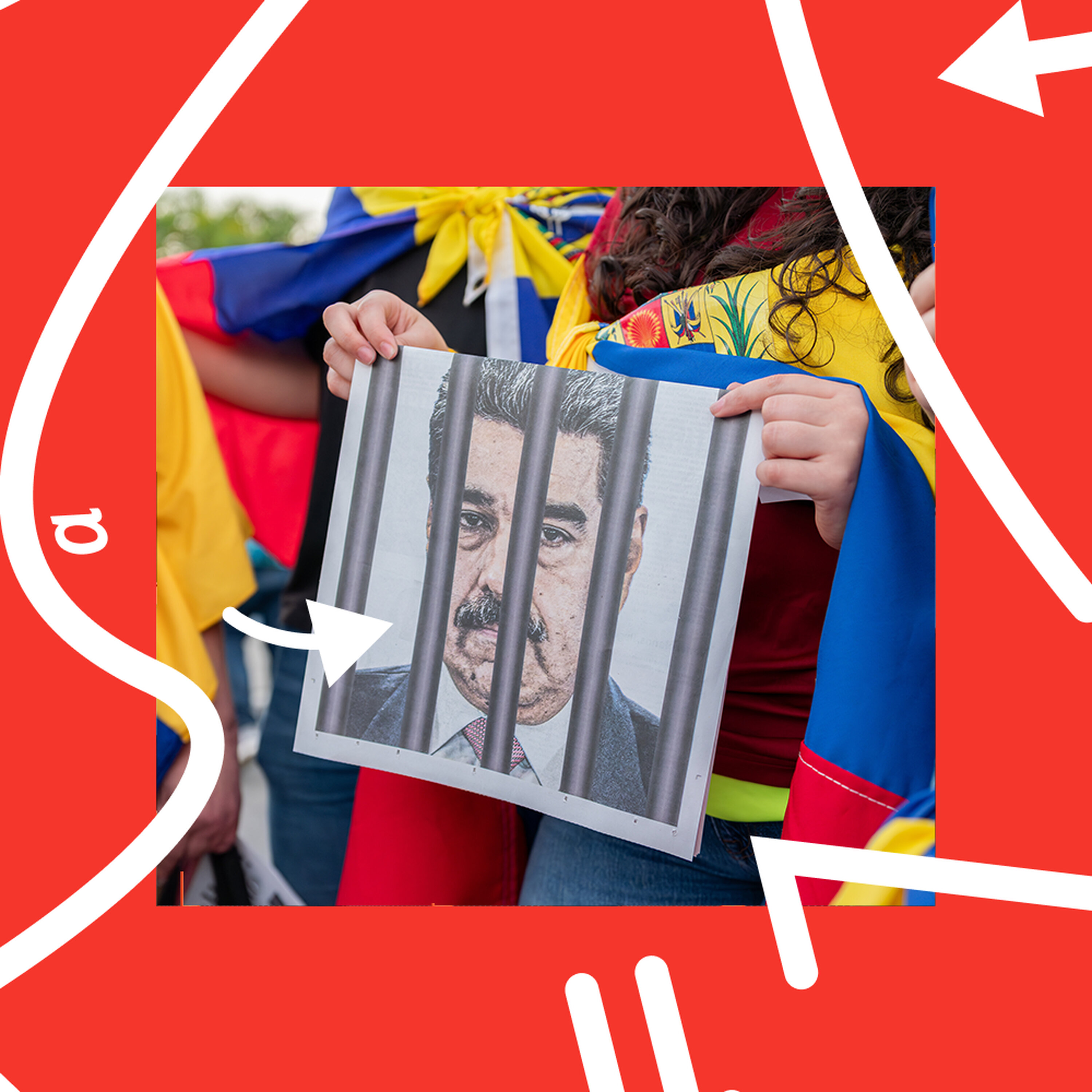
What Trump's Venezuela Attack Means for the Global Economic Order
Episode Transcript
Bloomberg Audio Studios, podcasts, radio news.
We're going to run it, fix it.
We'll have elections at the right time, but the main thing you have to fix it's a broken country.
Speaker 2I'm Stephanie Flanders, head of Government and Economics at Bloomberg, and this is Trump Economics, the podcast that looks at the economic world of Donald Trump, how he's already shaped the global economy, what on earth is going to happen next?
This week, we're asking what the US operation in Venezuela means for America's economic statecraft and the global economic order.
So the US government began the year by seizing and arresting Venezuela's president.
His deputy is now formally in charge, but the country, according to President Trump, is going to be run by the US for the four seeable future.
No boots on the ground, no US casualties to speak of, but some pretty weighty implications for what we thought was the world order, and a slew of questions around what happens next.
Since this is Trumpnomics, we're going to focus on the more economic part of it here, at least initially, Venezuela has the largest proven oil reserves on the planet.
And President Trump has talked a lot about that in his comments since the US went in to extract President Maduro at the weekend.
Speaker 1We need total access.
We need access to the oil and to other things in their country that allow us to rebuild their country.
I'm also meeting with oil companies.
Let's go.
You know what that's about.
We're going to have our very large United States oil companies, the biggest anywhere in the world, go in, spend billions of dollars, fix the badly broken infrastructure, the oil infrastructure, and start making money for the GUADJI.
Speaker 2If the US in effect has control of those reserves from now on, what does that mean for oil markets and for America's power.
That's my first question, and Javier Blass here in London is the perfect person to answer it.
Tavier is a Bloomberg opinion columnist covering energy and commodities, and also the co author of the World for Sale, Money, Power and the Traders who Barter the Earth's resources.
Haveavier lovely to have you back on the show.
Speaker 3Thank you for having me.
Speaker 2But listening to the way the President and other administration officials are now talking about US foreign policy, I did also have a broader question about that whole approach, the economic state craft that emerges out of this operation.
Here's White House Deputy Chief of Staff Stephen Miller, for example, on CNN this week.
Speaker 4You can talk all you want about international niceudies and everything else, but we live in a world, in the real world, that is governed by strength, that has got governed by force, that is governed by power.
Speaker 2For decades, most of the US foreign policy machinery outside the Pentagon spoke mainly in terms of furthering US interests through global alliances, agreements, rules.
Now those so called niceties have been stripped away.
What will it feel like for the diplomats and others on the inside for US foreign policy to be considered solely in terms of raw power, physical control over resources, and territory.
Or some might say, it won't feel so very different because this is what the US has been doing all along, not least in Latin America.
Speaker 1Well.
Speaker 2Chris Kennedy was on Secretary of State Marco Rubio's policy planning staff until last summer, when he joined US as the lead analyst for economic statecraft at Bloomberg Economics.
He was also director for International Economics on the US National Security Council under the Biden and Trump administrations, and he's in the Washington studio today.
Chris, thanks for joining us.
Speaker 5Thanks for having me.
Speaker 4Stepanie.
Speaker 2Have you you read a column that I think a lot of people read at the beginning of this week as we were all sort of thinking about the implications of the operation in Venezuela.
The headline was Trump now has his very own oil empire.
How big is that empire?
Speaker 3We can do the match, and let's focus on carr and oil production.
Let's not talk about the reserves, because that's oil that is underground and it may or may not be produced.
And starting with the United States, then at Canada, then at the whole of Latino American and obviously that includes Venezuela from Mexico all the way to Argentina and everyone in between.
And that comes to roughly almost forty percent of the wall's oil production.
There is a question, you know what word you want to use to what Washington is doing without oil production?
Is a controlling it said, overseeing, It is just simply benefiting from that.
But certainly I think that Trump has put a huge portion of the world's oil current output under the American umbrella.
That means the US has a lot more leaver to keep oil prices lower than otherwise, and we are seeing that.
I mean, one of the reasons that the oil price is around sixty dollars a barrel is because the Americas is booming today with oil.
And that's not just the United States itself, but production is rising in Canada, is rising, in Brazil, is rising in Guiana.
It's rising in Argentina of all places.
So that's one.
The second one is that and it comes alongside lower oil prices that all the Southern Typically, the risk of an oil spy was in the minds of I suppose diplomats like Chris and particularly military planners in the Pentagon, and that was a constraint from the ability to the US to conduct foreign policy.
That constraint is now still there, but it's certainly a lot lower they used to be.
And we have seen some examples.
You look back to twenty twenty five, we have some actions in American military power that really indicate that oil is no longer than constrained the use.
One was the bombing of the nuclear facilities in Iran.
The other one is that effectively the White House gave Ukraine the green light to attack Russian oil refineries.
Both would not have happened if the Americas, and particularly the United States.
Let's not forget that of that forty half of that is US oil productiony on, if the Americas was not really booming with oil.
Speaker 2You've immediately moved on to some of the foreign policy implications.
So I'm interested whether Chris Kennedy reads it the same way, just in terms of how effective control, which is not completely changed by Venezuela.
As Heavier points out, the US already had a lot more kind of room for maneuver around oil thanks to the shale boom, thanks to all these other things.
Do you agree, Chris, that has effected in a real way what the US feels able to do or comfortable doing, for example.
Speaker 5In I absolutely agree.
So I think if you go back to the conversations around the oil price cap after Russia's invasion of Ukraine a few years ago, we saw there was a real constraint put on the ability of the Biden administration to implement strong sanctions on Russia's oil industry, in part because of concerns over energy prices.
Oil prices were much higher at that point.
Now we've seen prices come down, but you know, this is part of a longer term trend.
You know, for many decades, our foreign policy was very much constrained and even focused on ensuring that we had consistent, reliable access to energy for both US and our allies, and that has changed.
I think that Trump very much understands leverage.
I think that this administration very much understands leverage, and so being able to exercise control over an additional large source of production in the Western hemisphere, of course that increases leverage, but I think in Venezuela it's also a unique case because it's very much denying other adversaries access to this oil, which our prior approach to simply sanctioning wasn't really effective at doing.
I think Cuba is a very good example of this.
Heavily reliant on Venezuela, has a long term agreement with Venezuela to exchange medical and other services for oil, and now Cuba is really in a tough spot.
So it's both the macro side being able to control this resource and not being constrained by potential shocks to oil prices that would have domestic ramifications, but it's also denying adversaries access to what has been a very consistent source of energy.
Speaker 2Of course, we've all been sort of thinking about what the meaning of the word run is.
You know, when you talk about running empire, it does seem that Secretary of State Rubia has a slightly different sort of spin on it than many others.
I wonder whether it's we could end up thinking that they are running quote unquote Venezuela the way they've been running Mexico in the sense of just using leverage to massively influence the administration there, or you could say running the UK more controversially, we certainly have enormous influence over over UK policy and key areas.
But have you the piece of this, the immediate piece, And you mentioned in your column that that as well as a game change, and not because of the oil it's producing now, but the oil it could potentially produce in the future more similar to what it had in the past.
So what's the difference in scale and how difficult will it be to ramp up production.
Speaker 3Well, let's take first a look at the history of what Venezuela has done.
Is one of the places that we have been producing oil for a longer period that the oil industry really starts at the beginning of the previous century, and oil productions start around nineteen twenty by American and Riti's Dutch companies are both what is to their exomobile and Shell and the heyday of Venezuela was the nineteen seventy where it produced juice over three point seven million borrows a day of oil.
It was another big recovery in the nineteen nineties and around the time that Ugo Chabe has won elections in December nineteenninety eight, Venezuela was producing over three and a half million barrows a day.
Today is less than a million barrels a day.
So the potential for increasing production is there, the geology is there, but obviously going back to that is very difficult.
But here is the thing.
A lot of people are talking about, Oh, we're going to take ten years to go back to what it used to be and we will need one hundred billion dollars, and that's true.
But at this moment, every oil analyst when they were penciling their forecast for twenty thirty, Venezuela and oil production have used a million barrels a day or perhaps even less than that.
So any additional barrels that you are put in, they are really tilting the market into potentially sartpluses because you are putting more oil coming from Venezuela and there are some barrels that they can come relatively easy.
And I emphasize relatively, and talking about relatively in the oil industry means a lot of effort and a lot of money.
But you could increase production by focusing on the conventional oil in Venezuela.
Whether you could do two hundred four hundred thousand bars of the incremental over a period of say eighteen to twenty four months is a bit of a question mark, but certainly you could increase production somewhat in the near term.
You want to go back to what Venezuela wants, you know, in the seventies or in the late nineteen nineties.
That's going to take a lot more effort.
But I think that at this point the biggest obstacle for any oil recovery in Venezuela is not what is underground, but is what is above ground.
Executives are going to need to know who is going to be in charge and not what Rubio or Trump is in charge, But who actually in Venezuela is in charge and who is going to be in charge six hours from today, six days from today, six months from today, and we don't know.
I mean a lot of people I speak to in the oil market have a number of scenarios of how this plays out.
We can see any time I couldeta.
There are a number of permutations that everyone is looking at, and we get a bit of clarity on that.
We are not going to see much action other than various speculative attempts to raise some money, see if we can grab something, et cetera, et cetera.
But the oil is there, the geology is there, the reservoirs are there, and some of them are easier than others.
There is low hanging fruit, quick winds, and there is things that they will take a lot of it for.
Speaker 2And I'm just trying to get a sense of perspective.
When you talk about they're now producing about one million, but it was moved through three and a half billion in the heyday.
Saudi production is what day or nine?
Speaker 3Yeah, it's about nine.
It's a big country.
We need to also take in account one thing, and is we are not back in the nineteen nineties in terms of what the incremental oil demand growth is going to be.
This is a limited market, so the oil market doesn't need perhaps two or three million borrows a day of incremental Venezuela and oil.
A few hundred thousand borrows a day of incremental oil from Venezuela over the next ten years could make a difference of where the price is just because the growth in oil demand over the next few yes, particularly the moment that we reach nine twenty thirty, changed materially from what we have been used to.
Whether do you believe peakcoil or not?
On demand growth is going to low a lot.
Speaker 2Okay, Chris Javier was saying rightly that it's going to matter an awful lot to these oil companies.
Even though they're getting assurances from the president and one gathers meetings with the Energy Secretary and other things, it does matter who they think is going to be in charge in a few weeks or a few months or even a year.
Do you think that if your former colleagues in the State Department know who's going to be in charge or even what the policy is in Venezuela.
Speaker 5I do think that there has been a lot of thought that's gone into Postmaduro Venezuela, But as Javier pointed out, the situation is very fluid, and Moduro's deputy, Dulcie Rodriguez, is in a very tight spot having to placate the United States while managing factions on the ground.
Also, Javier pointed out, it's going to take a lot of invest into Venezuela to really materially change the oil production in the near term.
There is some low hanging fruit, but we're in a very low oil price environment right now, and for these companies to take these sorts of risks in the country, I think they're going to want to have a better sense of where things are in terms of what the State Department knows.
I think it's going to be very challenging.
Clearly, the State Department and the Trump administration have decided that Vice President Delsea, now the acting ruler of Venezuela, is best positioned to ensure the country does not in the near term devolve into chaos.
I think Trump is counting on leverage, but Rubia has obviously been speaking a lot about this in the past couple days.
The blockade will still be in place.
There's the threat of additional potential military action if Rorigaz does not follow through on requests from the Trump administration, including going after the drug trafficking, expelling Iranian and Colombian gangs from the country, and allowing infrastructure to come in.
But of course, if we do see something resembling a more stable environment emerge over the next month or so, and perhaps a credible plan for a democratic transition, that might whet the appetite for US oil majors to make some more solid commitments.
Speaker 2I am interested because you were sitting inside various bits of the foreign policy machinery of the US for so many years.
Is the State Department well geared to working with companies to pursue US corporate objectives, which is clearly going to be the case here.
You're going to be helping American oil companies find a way into Venezuela navigate the difficulties.
Is a good machinery for doing that in the State Department or elsewhere.
Speaker 5So the State Department has obviously been hit with cuts, like the rest of the administration.
I will say that what I see in the Trump administration right now is a pretty unified approach delivering on what the president wants.
The objectives are clear.
At State, Yes, there are certainly leaders with a lot of history working with companies.
I think Deputy Secretary Chris Landau is one of those.
I think Rubio is certainly in regular conversation with industry.
Chris Wright, the Secretary of Energy, comes from that world.
Does the State Department alone have this No, but we have other agencies that can support.
The US Export Import Bank, the Development Finance Corporation doesn't necessarily have the resources to really make a huge dent in the oil infrastructure needs.
But I do think that this administration is very much in constant contact with industry, which does mark I think a substantial departure from the previous administration.
Obviously, the priorities were different for that administration, so we'll see.
But in the end, these companies are going to have to make their own decisions on how much and where to invest, and market conditions are going to be one factor.
And then, of course Xavier said, what's happening on the ground in Venezuela is going to be very important to the path of investment that we see over the next twelve to eighteen months.
Speaker 2Avier, we were talking earlier.
I mean although it does seem to be all in line with the US policy, and that one can say there's a sort of consistency here in the US approach.
But one thing that's missing is usaid.
Would that be helpful right now?
Speaker 3It would be massively helpful.
I think that the State Department is going to come to really not to use the State Department, but the whole US government is going to come to me USA.
The Venezuela is a hungry country.
It has been a hungry country for a number of years.
There are shortages of all kinds of basic staples and be able to parachute or these charts by poor and those famous bags that we have seen in other places, mostly in Africa and some places in Asia, the bags full of wheat or American food with American flag on the bags.
I think it will go a long way to compensate for the capture of Maduro, even through Maduro loyalists.
Is a bad business to try to do anything on a hungry country.
We have seen that that they're famous.
Says in the commodities industry that revolutions start with the stomach, with an anti stomach, and I think that's the part of the American diplomatic apparatus that I'm missing now the most.
It could come very handy whether the current administration of what we think is administery and Venezuela will admit accept that that does handouts.
It's a question matter.
I don't know, but I think that it will be good for the US to be able to provide basic aid to the population.
Let's not forget that about a third of Venezuela population has fled the countries.
About eight million people have left the country over the last few years.
Speaker 2It would be good for US farmers as well, or a few of them.
Speaker 3And it's always good business for the US farmers, which are facing low prices for the commodities.
So it has many wins.
And particularly you are thinking of the midterms, buying from farmers in the Midwest maybe one thing that it could facilitate trums also electoral objectives.
Speaker 2We broaden it out again in the spirit of this sort of accumulative tendency that the administration has expressed.
If you're just thinking in terms of valuable commodities in today's world, and then you think of the countries or territories that have been mentioned as possible targets for President Trump.
How would you rank them?
How does Greenland look versus Cuba?
If we're really thinking in those terms, you.
Speaker 3Are thinking only in terms of natural resources or commodities.
I mean, Greenland doesn't rank unless you are in the business of buying a lot of eyes on a snow.
Speaker 2I remember you pointing this out to people previous.
Speaker 3Are not that many.
Yes, there are some deposits of rare arth that they will require quite a lot of investment, but they are not that material in the greatest scheme things.
I mean, you are after red Earth.
You are much better use trying to develop the resources that they are already in the United States, in Canada where on red albs, and in Australia.
Cuba has on notatur resources, has used to have a booming sugar industry.
It has on Nicol, which is also valuable today, but Nichol.
Speaker 2It's one of the biggest producers.
Speaker 3Yeah, it used to be a big producer.
It has come down significantly just because mismanagement, etceterac.
But I don't think that either Greenland or Cuba are interesting for not what resources perspective, Chris.
Speaker 2I mean, obviously, the Secretor of State does have a particular interest in Cuba, and there's a sense that he's been very influential in this policy.
But it's also true that the way he describes the policy and the way that the president describes the policy is pretty different.
I'm fascinated, given that you've were sitting in his state department for a while, how you view his influence right now, because he really does seem to be saying things that are slightly different from the president.
Speaker 5It's been striking to me watching how Rubio has evolved over the past year in this administration.
I remember meeting with some European diplomats during the transition last winter who had been at a briefing from a MAGA aligned think tank, and we're told that Rubio would last a couple months and he was only appointed to free up his Senate seat for somebody who would be more aligned with the president.
Obviously that has not come to fruition.
I think Rubio has been very effective.
He's executed on the president's agenda, He's proven himself to be loyal, he hasn't embarrassed the president, and there's been a lot of missteps from other cabinet secretaries.
But I think more importantly, he hasn't really made news, he hasn't taken the spotlight away, and I think that he's been able to consolidate control over a lot of the foreign policy vision of this administration, the National Security Strategy, which was released in early December, Western Hemisphere, Front and Center.
That's obviously been a focus of Mark or Rubio's career from the time he was in the Senate.
He's Cuban, and he's had a very close connection a strong understanding of Latin America.
He may not be the sort of insider still with Trump, but he's also made some really good and strategic alliances with people like Stephen Miller and been able to frame his policy preferences in the context of things like immigration and cracking down on drug trafficking.
And I think that's been quite effective in helping to direct the focus of this administration.
So I see a lot of fingerprints from Rubio on the actions so far and to Trump's language versus actions.
I have to always remind myself every morning to not take them literally.
I think if you look at this operation, it has and is being framed by other administration officials as a law enforcement operation.
You know, they used FBI officials to come and arrest Maduro.
It's similar to the arrest of Noriega in nineteen eighty nine in many ways.
I think you could point to the invasion of Iraq in the early two thousands as much more of a departure from the rules based order as compared to this operation in Venezuela, and Rubio has been very careful in the way he's been describing this, and for that reason Bloomberg on our geoeconomics team, we don't think we're necessarily going to see a move to one of these other countries that has been mentioned, whether it's Greenland, Colombia, Cuba, Iran, Mexico.
The list is probably growing as we're speaking.
In the case of Cuba, though, I think Rubio certainly has his eyes set on Cuba and he would love to see regime change in Cuba.
I think he's cautious, though, and right now, the trajectory in Cuba, as Javier can probably speak to, is not great.
Cuba was heavily dependent on Venezuela and oil, not just for energy, but diverting some of that oil for hard currency to China, and so they're in a very tough spot.
Cuba's other traditional allies don't appear to be stepping up in any real way at the moment, and I think what we're going to see from this administration, well, nothing is certain but a wait and see for a little bit, and that makes sense.
They have their hands fall then as well as going to be a real challenge over the next couple months.
Speaker 2Okay, So I'm going to channel the more political parts of the administration now and think about whether we think in ten months time that this operation has helped or hurt the president in terms of his mid term prospects.
And it seems to me that there's kind of two big things that would come out of that.
My first question to you, Chris is what are the chances that he can keep this quote unquote control over Venezuela, this operation virtual, Because one gets the sense that what would be costly to him is this sense of a foreign entanglement, which was a quagmire that was involving casualties, boots on the ground.
If it's just asserting control with very little physical manifestation in the country, then that seems, you know, for his base, that would seem to be much safer.
Do you think he can keep this virtual.
Speaker 5I don't know, but I think there's other options.
I mean, Erik Princess, for instance, has talked a lot about Venezuela, and he's close to certain individuals and the administration.
That's right, Yeah, and so there are other private military contract options.
I think that would be really challenging in terms of the view of the US among other parts of the world and in the region especially.
But I don't predict US having boots on the ground in Venezuela in the near term.
Speaker 2Okay, but of.
Speaker 5Course things could, things could be chaotic potentially.
Speaker 2It's not a quo mile.
Can he deliver cheaper oil out of this, because that would be the other cheaper gas price has already gone down.
He's already very proud.
Speaker 3I think that he is almost there.
I mean, you look at the price that really matters for the next midterne election.
That's not the price of oil.
It's the price of gasoline.
At the pomp the average price in the United States is about two dollars on eighty tens per gallon.
If Trump can get down that to two and a half dollars per gallon, he's there.
I don't think that he needs much lower price.
Perhaps it needs a bit of a drop in refining margins, but the world's economy seems to be gearing towards a lower oil price because things are slower in China, they are not really picking up a lot in India, and the production continues to boom everywhere.
There are big question marks because it's not just Venezuela.
There are demonstrations in Iran as we speak that we don't know where they're going to go.
And I think that you are in the oil market, and I've been talking to a lot of traders over the last few days.
I mean a lot of them were completely focused on Venezuela, but a number of them were saying, don't lose sight of what's happening in Iran.
We don't know where the conversations between Ukraine and Russia and the United States are going, and whether the sanctions are going to be lifted at any point in the oil market.
If I have learned anything in the last twenty five years, and suturally there was a good reminder, is that anything could happen at any point.
I was not really expecting to wake up and you know, visiting my relatives in Spain to the news of my father saying the Americans are bombing Kracas.
Speaker 2Anything can happen.
Have you a blast, Chris Kennedy, Thank you so much.
I was fascinating.
Speaker 3Thank you, Thank you, Stepani.
Speaker 2Thanks for listening to Trumponomics from Bloomberg.
It was hosted by me, Stephanie Flanders, and I was joined by Bloomberg opinion columnist Javier Blast and Bloomberg geoeconomics analyst Chris Kennedy.
Trumponomics was produced by Samasadi and Moses and with help from Amy Keen and special thanks this week to Rachel Lewis Chriskey in Washington.
The sound design was by Blake Maples and Aaron Casper and Sage Bowman is Bloomberg's head of podcasts.
To help others find this show, please rate it and review it highly wherever you listen