·S15 E23
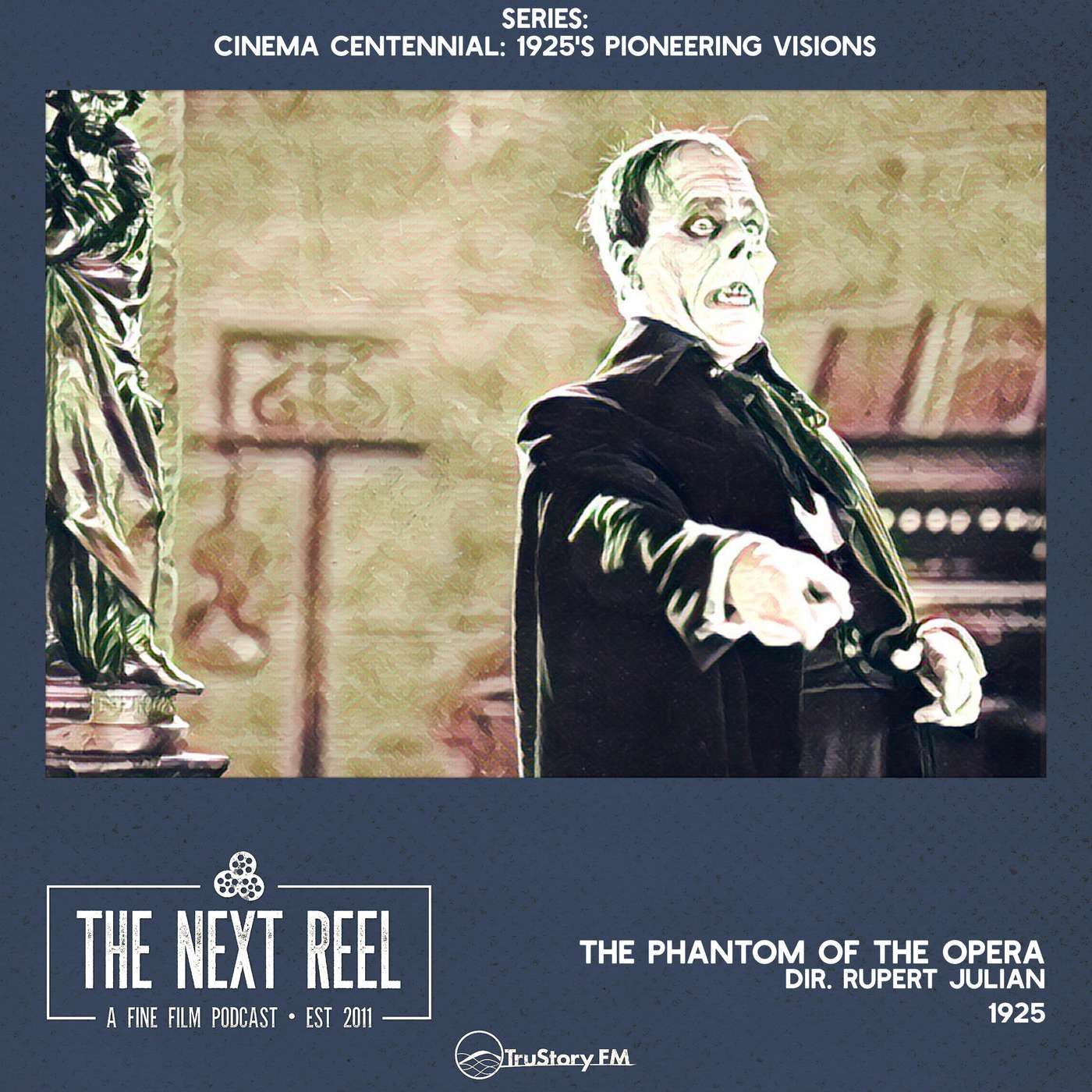
The Phantom of the Opera
Episode Transcript
I'm Pete Wright.
Andy NelsonAnd I'm Andy Nelson.
Pete WrightWelcome to the next reel when the movie ends.
Andy NelsonOur conversation begins.
Pete WrightThe Phantom of the Opera is over.
Feast your eyes.
Glut your soul on my accursed ugliness.
Andy NelsonThat was the line that I was like, I bet Pete's gonna pick that one.
Pete WrightOh god.
Was the line I said, I'll bet Andy thinks this is the line I'm gonna pick.
Andy NelsonI mean, he's right.
So we were on the same page.
Pete WrightI'm glad.
Yeah.
Yeah.
A 100%.
There was this or well, we'll talk about it.
Anyway, Phantom of the Opera.
I'd never seen it.
And now I have, and now we're done.
Andy NelsonYeah.
Well, this is then now we're done.
That's the end of the show, folks.
Pete's seen it.
No.
This Yeah.
This is part of our cinema centennial hundred nineteen twenty five's pioneering visions series.
We're, over the course of this season thus far, we've largely been moving backward through time every twenty five years looking at at films.
And here we are in our last series of this particular run looking at films from one hundred years ago.
And we're kinda right in the middle with The Phantom of the Opera, Rupert Julian's film that is an adaptation of Gaston Leroux's book from 1910.
So a fifteen year old, book that that Universal adapted.
And, but, Pete, I wanna start with you Mhmm.
Your history with this story.
Because I feel like I don't know.
I'm curious if we both started with the musical and then kind of expanded from there.
Pete WrightI started with the musical and didn't expand at all.
Oh.
Like, is this is the first expansion.
I've never read the book.
Interesting.
I don't think I ever gave any thought to the fact that like, I'm I mean, I knew that it was an adaptation, the musical, but I don't think I ever gave any thought to wanting to go see more of it.
Andy NelsonOkay.
Interesting.
The musical is where I started as well.
But then there was a TV movie of it in, like, 1990 that I think Charles Dance was in that I was kind of like obsessed with.
I thought it was such a great story.
I've never seen it since I actually do have no idea if it holds up in the slightest, but I really enjoyed that version.
And then I read the book and I was like, okay.
I'm totally into this story.
I loved the story.
Pete WrightReally?
Andy NelsonYeah.
Yeah.
I I really got into it.
Like, there were a few of those classics like this and the hunchback of Notre Dame were two that I ended up after seeing a version of it, then I ended up kind of reading the text.
And I think because they were they weren't the crazy long books like Les Mis, I never thought of that book because it was a tome.
So I read it and, you know, I I saw another well, I saw the '23 is it 1943?
I can't remember the other version.
With Claude Rains.
And really hated that version.
It's just not a good I I don't know.
I just didn't like it.
It changed so much of the story.
It was really kind of stupid.
And so, yeah, I I really got into this tale.
And then I kind of stopped.
And I just like, I haven't like, I still listen to the music from the soundtrack from the musical.
And I had seen this too, I think, in one of my film classes.
So this was in my memory.
But I don't think that I had tapped into anything Phantom related, again, other than the songs since, like, the late nineties, early two thousands.
So it's been a long time since I've kind of dipped my toe back into this world.
Well, you said some
Pete Wrightthings in our text chat last night that were a real surprise to me.
Because for me, as a musical theater kid, like, I didn't pay much attention to story of this one.
I it was like, we we just sang the songs and use the songs as audition pieces.
And so really workshopped just the Lloyd Webber music.
And I I don't know before seeing this movie, had you quizzed me, hey, Pete, what is the Phantom of the Opera really about?
I don't know that I would have been able to tell you.
I would have been able to tell you about the dope chandelier in the in the Broadway performance because it's dope.
But everything else, I don't I don't know that I would have been able to tell you at all.
Andy NelsonNor would you have been able to tell me his name was Eric.
Pete WrightEric.
Andy, it's so dumb.
It's so dumb.
Andy NelsonI love that that was the sticking point for you last night.
His name is Eric?
Pete WrightHis name is Eric.
Andy NelsonEric?
Dumb name for
Pete Wrighta phantom.
They have all these great names.
The ghoul, the cast.
Oh, also Eric.
Get your pitchforks and your torches.
We must chase Eric.
Andy NelsonI said he's he's probably friends with Tim the Enchanter.
Right?
You know?
It's like and I and and then I was thinking about other universal things.
And I'm like, oh, there's also Larry the wolf man.
Like Yeah.
What where else can we go with this?
So yeah.
And that's it it is funny.
I I guess it makes more sense when you have read the book and you you there's more about this guy named Eric and his history and everything.
Pete WrightYeah.
You said it with such confidence.
You were like, that's his name everywhere, Pete.
I'm like, Andy, you're not laughing right now?
Oh my god.
Andy NelsonOh, I laughed.
But then I was like, but but it's there.
Like, that's the thing.
Pete WrightYou know what
Andy NelsonI was seeing it on
Pete WrightIt's there.
It's seeing it on the title cards.
Right?
When it's written out or when you see a letter where he's it's it's the close-up of the letter and it says, you're gonna sing this part.
And afterwards, you're gonna be forever forever mine.
Yours, Eric.
It just seems so dumb.
Andy NelsonYes.
Well, okay.
Aside from the name issue, I I understand that there is something funny with that.
But well, and it's interesting because I can't remember honestly, I can't really remember the book.
And I can't like you, like, my memory of the musical is now so focused on just the songs that I can't remember what the actual story was between all the songs.
And I finally is like, you know, I've never actually watched the 2,004 Joel Schumacher adaptation of the musical that he did with Weber.
And so I'm like, should finally watch that.
And so I watched it and, you know, it it's fine.
It has definitely has its issues.
Pete WrightRoller skates in neon?
Tell me there's roller skates in neon.
Andy NelsonYeah.
It was really weird.
But it helped him get down to the sellers really fast, man.
I tell you.
No.
But, like, there's a whole sequence in that where gosh.
And I can't remember her name.
But Miranda Richardson's character.
She's like the the dance instructor who secretly knows more about Eric than anyone else.
And so she's kind of tapped into all of that and knows that he's coaching Christine, all of this stuff.
She reveals that she's known about him since he was a child.
And she saw him when she was a child at, like, a gypsy or I should say Romani festival or something.
And he was like the devil boy.
And he was chained up and with a like, the had a mask that he made out of a sack, and the guy the the guy would take it off and, you know, like, it's carnival freak show sort of thing.
Mhmm.
And he got really upset after the show and strangled his master, I guess we'll call him.
And as a young girl, she's like, here, I'm gonna free you.
And she takes him and runs and hides him in the opera house.
And then she kind of like, I don't I it really isn't explained.
As a child, she's raising him?
Like, I had no idea what was going on with that.
But anyway, somehow she knew this whole thing.
And I was like, was that in the book?
Because I couldn't I I didn't remember that at all.
Maybe it was.
Maybe it's in the musical too, but I also didn't remember it.
It's certainly not in this version.
No.
But it's interesting because like this version certainly, speaking to like Lon Chaney's makeup, which is fantastic.
I love just kind of the freaky way he did his face up.
Gaston Leroux and and people who've read the novel say that's the closest to what the book describes his look as.
And he's been that way since birth.
And that's one thing that the '43 version screws up because somebody throws acid in his face, and now he's all disfigured, and he's angry and running around, and and it's kind of dumb.
And that's something that some of the other adaptations have done is come up with a reason that something happened to his face that made him get all angry.
And we don't have that here.
Pete WrightDid they do that in the Lloyd Webber?
In the No.
Andy NelsonBut and that's what I was saying.
Like, they never explain it unless that story about her saving him as a child is actually just dialogue, but I didn't remember I didn't remember it at all.
And I can't remember it well.
I can't remember the book well enough to say if that's where it came from.
But that's kind of like that's what we get here.
And so I guess talking about the nature of Universal monster movies, because this is really the first of Universal's monster movies.
And he's a monster.
And that's kind of what we get.
And that's like you were saying, you kind of forget what the story is.
Like, you couldn't remember like what how things go.
And when revisiting the Andrew Lloyd Webber, it really struck me that so many of these stories afterwards have changed him into like this tragic figure.
And he's so sad that he just needs a person to to be with, and all of this stuff that's very dramatic.
But he's kind of a monster.
He's killing people.
He's I don't know what he's doing with Christine.
Is he hypnotizing her?
Because like, she seems to always like, ugh, and her eyes go soft, and she kind of wanders down the dark passageways with him kind of willingly or half, like, stumbling along or it's it's strange.
And I guess I don't know.
In the scope of the story, how does it work for you as a monster movie?
Pete WrightWell, I I wanted it to be more of a monster movie.
Right?
And and this we should say this predates the the talkie era monster cycle for Universal.
But we need to talk about it in partnership with Dracula and Frankenstein and The Mummy, etcetera.
Because I I I think the case has been made by smarter people than me that Universal would not have pursued those films so aggressively were it not for any of the success of Hunchback and Fan of the Opera.
And so this guy is one of the the proto monsters.
Right?
He's he's just human.
Right?
He's not quite so horrific as Dracula and Frankenstein created a created man.
He's not right.
He's not ancient like the mummy.
He's just a a troubled man who is disfigured, and maybe that's one of the things that separates him from monsters.
Right?
Same thing with hunchback.
Yeah.
Right.
Right.
Building a monster ethos around disfigurement of humanity, and maybe that didn't latch on with any sort of longevity because it's kinda mean spirited.
Right?
Andy NelsonYeah.
Pete WrightIt's not so symbolic.
It's just mean.
But still, what I feel like I wanted out of this movie was more of the later monsters when they kinda figured out how to do it.
And, you know, I I have to admit, I had some of the same feelings that I had with our movie last week with the big parade that there are long stretches that are delivered, you know, almost too comedically with the with the guys who buy the the theater and they take control of it.
And, by the way, snicker, you might see the monster.
You might see the ghost.
Right?
And they're like, Zoinks.
What?
And then they see him once in Bach five, and then they run out again, and they're they shake their heads.
Cookie, cookie, cookie, cookie.
Let's go back in, and he's gone.
It's all of that stuff.
Andy NelsonYou inserted the the funniest Scooby Doo sound effects in your head into this.
I love that.
You went down you went down like the animated Looney Tunes route.
Pete WrightWhy?
You Wait till we get to the Augas later.
Oh, excellent.
Excellent.
And so so much of it is like, I I wanted the movie to take itself more seriously than it was for much of it.
And that is a weird problem to have because I think what it says is either I did not connect with what the movie was selling me or the movie didn't figure out what it was trying to be until, you know, much later.
Right?
And and I feel like I am I'm accustomed to I mean, we've watched enough of these silent films from the era that I feel like I'm accustomed to the tropes of the silent era.
Right?
And and both of these movies back to back, I found interesting that it took longer runway than I would have wanted for them to just get started, to get to the scary parts, to get to the parts that were that were threatening, to get to the monster.
And there was a scene.
I would I I don't have time code for it, but I was laughing very, very hard, where they were projecting his shadow on the wall, but the wall was tilted away in perspective.
And so his body was huge, but he had little tiny hands, and he looks like a Tyrannosaurus rex.
Andy NelsonIt's the learning years of cinema, Pete.
It's the learning years.
Pete WrightIt is definitely the learning years.
Andy NelsonEventually, they'll have directors who say,
Pete Wrightcan we tilt that wall back a little bit more?
Andy NelsonMake it look like it doesn't
Pete Wrighthave T Rex hands?
Can we just make it less T Rex hands?
So I you know, I don't know.
I know the this movie has all the DNA of Universal Monsters.
Right?
It definitely you can feel where it's going, and it was successful enough to create something to to create something great for the era.
And I think its reputation is made larger by what came after it.
Andy NelsonWell, yeah.
And I think at this point, it's worth discussing a little bit of the insanity of getting this released.
Because I don't know if I've ever heard a story of a film production that has been as much a mess as this one has.
Right?
Yeah.
Did you end up watching that link that I sent you?
Or which version did you end up watching?
Pete WrightThe Wikipedia one?
It was not Wikipedia, but I think it was I went down the TCM rabbit hole.
But I did get color the the color treatments and the red mask and
Andy NelsonRight.
Okay.
Pete WrightIt was a complete assembly of what we think is the movie.
Andy NelsonRight.
Yeah.
So 1925, first of all, Rupert Julian, who directed this, apparently was largely disliked by the cast and, crew of this.
It sounds like Juan Chaney had a difficult time.
The other actors had a difficult time.
And it just wasn't something that you I don't know.
He didn't seem to click with the studio heads like Carl Lemley, didn't seem overly happy with him.
Like, nobody really seemed happy with him, and he didn't seem happy with the project.
They finished the movie, and they have a preview screening of it in January 2025 in LA and then one other place, it goes poorly.
The ending of the of the story at that time was and I I wanna say closer to the book, but honestly, I again, I can't really remember the book.
At the end of the story, he recognizes that Christine needs to be with Raul and the people who aren't creeping around in the in the attics and cellars of an opera house and lets her go with Raul.
And the two of them flee, and he dies of a broken heart over his organ.
And that's kind of the end of the story.
Audiences cracked up.
They thought it was terrible.
They didn't like it at all.
And so Carl Lemley said, we need to rework this.
We need to figure out a better way to end this film.
And so they bring on a different director, Edward Sedgwick, who would direct Buster Keaton in, The Cameraman a couple years later.
He ended up reshooting the bulk of the film.
He was very much kind of a comedy director, but he was kind of just like a studio stock director.
And so, you know, they just like, you know, this is the studio era.
So they just switch people around.
They threw him in.
He had them do a bunch of rewrites, and he wanted to take the dramatic thriller aspects out and make it more of a romantic comedy.
So they shot a whole bunch of new scenes, and they added some new characters, some new comic relief characters.
It it totally changed the story.
That previewed in April 2025.
Again, audiences hated it.
The the only thing I think that they that he did that really worked is he changed the ending to what we saw, where it's like the phantom flees with in a carriage with Christine.
The carriage crashes, and he runs because he's being pursued by the masses with torches.
And he ends up by the Sen, and they tackle him and throw him into the water and beat him and everything.
And that's kind of the end of of the Phantom.
People were happy with that, but they hated this comedy version of it and booted off the screen, and it was terrible.
And so Universal then brought in a few of their editors to take they said, here's all the footage.
Figure out how to make this movie work.
So they took the footage from the Rupert Julian version.
They took the footage from the Sedgwick guy.
The other interesting thing is when they were filming all of this, they would often film with two cameras side by side so that they could have I I I couldn't really figure out the reasons.
It sounded like one was for like an international cup, but I'm like, I don't know why they wouldn't just use the same footage.
So I'll have to dig more into this to figure out why they were using the two cameras.
But they have, like, literally two cameras side by side that they filmed the entire movie with, which is why you can also find three d versions of this movie now.
Because essentially, without realizing it, they were shooting stereoscopic.
Stereoscopic.
They made a three d movie.
It's incredible.
Crazy.
So anyway, so these two editors took all this footage and cut it all together and made the version that ended up getting released September 1925.
That ended up being something audiences liked, and that became the official release of the film that people enjoyed.
And it was a great great movie.
Pete WrightAnd that's the end of the story because everybody was happy.
Andy NelsonOh, yes.
Everyone was so happy.
Well, Universal then was like, this was a great success.
We wanna make a sequel.
And they actually got permission from Gaston Leroux to make a second movie called, I think, the return of the Phantom.
Then they realized, you know what?
There's all of this new sound release happening where people are taking these older movies like we've discussed.
Like the big parade, they re released it in 1930 with new sound effects and a music track and everything.
They said, let's just reshoot some of this.
So again, they brought the actors back and shot new scenes again, but now they added dialogue of conversations between these people.
They didn't bring Lon Chaney back because he was at MGM.
And I don't know.
It's hard to say because Universal contractually couldn't do anything with Lon Chaney.
So they kept all of this stuff with the Phantom silent, but then they added another character as the messenger of the Phantom.
And he pops in sometimes, and he'll talk with the the Phantom's shadow popping up behind him.
He'll talk to Christine, and it's just really crazy the way that they did this.
And Lon Chaney ended up being pissed that they didn't ask him and was very upset and wouldn't work with Universal again.
Anyway, now you have all this sound footage.
And then it sounds like somehow they at some point, they lost the soundtrack to the sound version.
And so they only had the silent version, and then they started making these prints.
And this must have been a thing at the time where they were actually printing movies on 16 millimeter to play at home, essentially early VHS.
Right?
Yeah.
Or DVD or whatever.
They would just release 16 millimeter, and people would buy these.
And that ended up being the only version, like all these 16 millimeter prints that had a lot of this actual footage from all the way back to the 1925 Rupert Julian version.
And so through history now, because it's been such a cobbled mess because people don't really know, like, what was the original version?
It's all kind of guesswork.
And then and then Universal was dumb, and they didn't apply for copyright, protection.
In twenty seven years, 1953, they lost the copyright to this.
So all the footage is, like, public domain now.
And so people have been collecting.
Like, there's, preservationists who are pulling all of this footage from these 16 millimeter prints from this.
There was an Eastman print of the sound version in the fifties that is a really pristine looking print.
And so a lot of the nice footage that we see comes from that.
But they also printed it in both twenty and twenty four frames per second, so it's a little confusing.
And so you have all this crazy footage, and all these people have been trying to assemble versions of it.
And so if you look online on YouTube, there are just a lot of versions of this of all sorts of different lengths because and and I ended up playing side by side the one on Wikipedia, and then another one I found on YouTube that was similar that also had color and music, and I wanted to have the music.
And I decided, I'll just play them side by side.
You're watching like the same scene, but it's from the two different camera angles.
So, like, on one screen, I was watching the performance from the one camera.
And then on the other screen, I was watching the performance from the, like, the a camera and the b camera.
Pete WrightThat's insanity.
Andy NelsonAnd I'm like, what is going on?
Pete WrightSo were they the same length?
Did you notice a bunch of cuts?
Andy NelsonYeah.
No.
You can they were about the same length.
Yeah.
There's one sequence that was completely shifted to a different part of the movie where he hangs the prop man.
Yep.
But otherwise, was largely the same.
But there are some moments where there's a whole bit of movement getting from a to b where they shortcut it in the other version, but then it had something else.
So they ended up is is really weird.
So it's a mess.
Like, there's just tons of footage.
It's like people are just having fun making their own versions of the movie now.
So that's kind of where we are.
And that's why it's very hard to figure out what do you what do you really watch?
I think on the Blu ray, if you watch that, most people have latched on to the Eastman print because it was a really nice print.
It's leaving a lot of stuff out, and so they've kind of filled some holes with some 16 millimeter footage.
But it has the color, you know, and all of this.
And so it looks it looks largely better.
But yeah.
So anyway, it's it's a mess.
I feel like
Pete WrightI got lucky.
I don't know if I watched the Eastman print, whatever TCM has, but it it did have the color.
And and because of the color, some of the standout sequences that I loved loved loved loved, like the ball, the the red death.
Those sequences were extraordinary, beautiful, and fun incredibly fun to watch and make the movie those kinds of sequences.
Like, you can really feel, oh, this is the future of movie making that they're doing right here.
They don't they probably don't know it, but this is this is where we're going.
Andy NelsonI I think that's largely true, is you can see some amazing stuff in this.
But I think also, perhaps, and again, I can't say for sure, but you were talking earlier about some of the funnier stuff.
You're like, like, that's so goofy.
Was that from Rupert Julian?
Or was that some of the stuff that was shot when Edward Sedgwick took over and wanted more of a romantic comedy and put more of that comedy in?
So who knows?
Pete WrightYeah.
That nails it.
I mean, when you see when you think about all the hands that were in this movie, not just making it.
But but to the point where Lon Chaney reportedly just stopped listening to Julian directed himself.
But it was just like, I'm not gonna talk to you anymore.
We're just gonna do the scene and I'll take care of my own Right.
Pieces.
Andy NelsonYeah.
Wasn't it like he wouldn't even like, he everything was relayed through the first AD because he wouldn't even listen to the guy?
Right.
Yeah.
Yeah.
Crazy.
Pete WrightYeah.
So there is a lot of of spectacle, but my response of this being a movie that doesn't know what it is is a rational response to a movie that legitimately the people who were making it didn't know what it was.
Andy NelsonYeah.
I think this is very much a testament to how a film ends up when you don't have that that center voice who is, like, standing up for speaking for the film, making it everything, all of their choices on their own.
I mean, with everybody else, but still, it's like that central figure.
And you don't have that.
I mean, I guess you could say Carl Lemley largely was because he was the one picking the people and but again, he was just mostly focused on how can we just fix this to make money with it, which he did.
So I guess he got what he wanted, but it sure turned into a just a big mess.
Pete WrightYeah.
Yeah.
It's a big mess.
And and all of the things that normally you would say, I I guess from an from an academic perspective, right, when you're talking about pacing and tone and consistency and things.
I mean, these are things that in the silent era are to be taken along with watching these films.
Right?
This one is yanked between prestige melodrama and gothic horror and comedy in some very hard left turns.
And and that's a thing that makes this movie challenging.
These genre boundaries that we're we're kind of accustomed to, having them feel a little bit fuzzy are off the off the map.
It it's it's crazy.
It's patchwork.
Andy NelsonIt does make me want to look at at how the silent version of the Hunchback of Notre Dame plays with Loncini to see if that plays.
I mean, honestly, I still like this.
I had a great time with it.
I do have a lot of issues and and some struggles that we we'll certainly talk more about, but I'm curious, like, how that one plays over this.
Like, did it have a better singular voice crafting the story and made it making it into something that stands up a little bit?
Because I always feel like the hunchback I mostly hear about is the '39 version, the one that got a lot more accolades and everything.
And so I don't know.
I guess I'm I'm curious to check his version out and and see how it plays.
Pete WrightI am too, especially because they're effectively the same stories with the exception of height.
Right?
Disfigured humans, one goes down under the Paris Opera House, one goes up in Notre Dame to the Bell Tower.
Right.
Right.
Right.
But there are still pitchforks and and torches.
Andy NelsonRight.
In both cases.
And, you know, your point is actually very interesting.
The fact that in both cases, it's a human, and it's you know, we're we're in the world of Todd Browning's Freaks, and the portrayal of these people as monsters as opposed to actual monsters like, Frankenstein, Dracula, Wolfman.
And so that's an interesting element that it does make these stories, you know, strike a little bit in a
Pete Wrightway where it's like, yeah, I can see why you may need to find other ways to kind of, like, modify the story through today's eyes.
Because it's like there's no metaphor to lay on top of of the difference between these groups, the the things that are terrifying and the things that terrify, or the things that we are terrified of.
Right?
This is a a human being, and these stories are stories of humans that are bad to each other.
And once you have Dracula and Frankenstein, and you can lay metaphor on top of it and be able to have whatever symbolic relationship you want with the movie, it can mean whatever you want it to mean, and it can mean things in different eras.
These are just movies about humans scared of each other and be doing bad things.
And that's just different.
Right?
But it also it it it it seems to me to be foundational to why these characters didn't take off as part of Universal's, where we started this question as part of Universal's monster canon.
Andy NelsonWell, although this does always fit in their monster canon, but it's just the forties version.
And that's what I think is I I think that largely it's just because of the copyright idiocy that they, showed back then by not locking this one down.
I have a feeling we'd probably see this in the canon just because it's a great specifically because of Lon Chaney's makeup.
Like I think specifically in the lineup of when you see the different faces in, like, a, like, a collage, having that, I think, stands out so much more than than Claude Rains just in his mask.
You know?
I think this shows the real what they were trying to achieve with that.
Pete WrightWell, and and it was the musical that ended up really landing on the romance because you look at the character design of Michael Crawford, and you have a phantom that is deeply elegant.
Right?
That mask is sex on a face.
Andy NelsonYeah.
Right.
Right.
That's what it is.
So let's talk a little bit about the story because I I feel like you, where I don't think about I like, I haven't thought much about the story through the musical and everything until watching this and then the other the musical adaptation of this weekend.
And really going, this is a strange story.
And I I struggled so much more with the Andrew Lloyd Webber version when I was like, this is like a stalker, a kidnapper.
He's doing something.
He's either hypnotizing her or drugging her or something to kind of lure her along to make her think he's like her father's ghost and all of this crazy stuff.
Like, she's kind of coming along quote willingly.
It's not like he's like putting a bag over her head and taking her.
Like, he's kind of there's some sort of magical realism element that is going along with how he's getting her out and down into his his his cellar.
Right?
And he kills people.
Pete WrightWell, but hear me out because I think this is a this is something that I've gone back and forth on.
This is also a story about fame and about desire for success.
And between these two women, they have a deep desire to be the lead performer in this show.
And some of We're
Andy Nelsontalking about Christine and Carlotta.
Pete WrightYes.
Thank you.
The the double c's.
Yep.
I think they have there is a duality in their role as they work toward being the principal voice in Faust.
And I think Christine, there there's also this piece where she's just gaslit.
Right?
She is lying to herself about the value of having a secret patron, and I think she is intoxicated by the opportunity that is presented to her by this this faceless voice, that is promising her success.
And I I think she's coming down because she she believes she has let herself believe that if she follows him, she will be successful.
She does, you know, turn away in fright once she sees him.
And there is that That that again, weirdly out of place comic moment where she takes his mask off.
Her fingers creeping over Nope.
Creeping over his shoulder.
Nope.
And then finally rips the mask off.
That is, like, that's an interesting relationship to me.
I kept thinking, I this doesn't feel as supernatural as I guess I I initially thought that maybe she's just she convinced herself that fame was worth it.
Fame was worth the trade and got herself embroiled in a very complicated relationship with this guy.
Andy NelsonSee, that's interesting because I I mean, I guess I can see that there, but so much of it, I also think they really play up this idea that her father had died, it seems somewhat recently.
I I don't remember it brought up in any of the other versions, but her father apparently was like this famous scientist that we hear in this version.
And had said, you know, I will come back and visit you as a spirit, an angel of music to to help you.
It's a weird story because it starts I mean, they say start in media rest and this one definitely does, but I think that it could have used a little more because A little less in media rest.
Yeah.
We're starting like she's already been getting trained by him and thinks of him as this angel of music, this ghost of her father.
And it's like, I would have liked some build up to that to get a sense as to how, like, broken she was at the loss of her father that she buys into all of this.
Because that's the thing I really struggle with with this story.
And that's why I think this one actually works better than anything Andrew Lloyd Webber did because at least it's a little more monstrous.
Like, he just seems a little more manipulative and and less romantic and all of that.
You know?
He, like, he's a very possessive sort of creep in this version.
So I I appreciate that we're getting that from this, but he's really tapping into this thing like, this is a broken woman.
I'm going to play up this angle with her dead father.
Like, he seems to know all of this and and purposefully is making her think like he's the spirit of her dead father so that she kind of goes along with it.
Pete WrightAgain, gaslighting.
Right?
Yeah.
Fundamental theme.
Yeah.
Andy NelsonAnd taking a broken woman and just like just manipulating her through her own grief.
Yeah.
And it's it's kind of dark.
But again, I just I can't help but feeling like there could have been a little more setup of that in the story to kind of get us to that place where I I don't know.
It just like, I find I found it that much harder to just click with that whole element of the story when it just like, we're already in it.
And I'm like, I just I wanted to understand her background a little bit to understand why she would buy into all of this.
Pete WrightYeah.
Yeah.
I I I mean, I totally agree.
And I think so much of the of the the movie is, you know, or the story is built on some fairly thin melodramatic kind of binaries, right, that are just, you know I I mean, let's take Raul, the paper thin caricature of a romantic alter ego.
He's, you know, he's there.
He's a normal male lead.
He is something to confront the monster.
But really, like so many of these relationships, we just have to take on faith that that they are relationships of motivational trauma.
And that's what we get with Carlotta and with Christine and with the phantom.
Andy NelsonYeah.
And then, you know, we do get the sense that she and Raul had known each other from their youth.
So there is that that backstory.
But it also, like you're saying, maybe they're relying a little too much on that backstory to just fill in the romance that we have between the two of them, you know?
Right.
So it's yeah.
It's a bit of a struggle, but it's an interesting enough story.
And I guess I guess what I am drawn to is just the nature of the monster elements of it.
Just kind of like the the creeping around in the dark cellars.
And again, Longhini's makeup that he did himself, he came up with this, like the stories that he, like stuffing cotton up up into his right under his cheekbones to pronounce them and and wearing like rotted dentures and and putting like thin things in his mouth to hold his lips up, putting things inside his nostrils to force them up, like doing some traumatic stuff to his face that he said, like, he would be often bleeding and have to like, you know, clean up after the mess that he was making with himself.
And it was very painful.
But I mean, it delivers.
It's a great great look.
And I that's one of the things that I really enjoy about this is just how how he he took this to such a frightening place.
And I can imagine for audiences a hundred years ago, I know you're kind of laughing about in through today's eyes watching Christine creep her hands up.
I'm gonna put your face up.
No.
I'm not.
I'm gonna put your face up or your mask off.
It it's kind of silly.
But I can imagine people knowing the book.
Again, we're talking about a popular book of the time.
Sure.
And knowing, like, there's this horrible creature behind this this mask.
I can imagine an audience like like on the edge of their seats full of tents just anticipation as they're watching her getting closer and closer until finally that reveal.
I mean, reportedly people fainted at the sight of him when he pulls his when she pulls his mask up and stuff.
And, yeah, by today's eyes, it is very funny.
But you can imagine, like, for the first time seeing essentially, like, a creature like this in a movie, I can you can see why people would react that way.
Pete WrightYes.
No.
I I absolutely agree.
I mean, it's his his performance is the standout, or his presentation is the standout presentation in the in the film for sure.
I think set you know, the the second place goes to the incredible set design and the the sewers and the the Paris Opera House underground, the torture chambers beneath the beneath the opera house.
There's some crazy alternate dimensional stuff going on down there.
Andy NelsonIt's a dark place.
Yeah.
Where he had been chained up.
Like, it's it's like a dark story that we have with him.
Like, was we find out, like, he had an escapee from Devil's Island.
But before that, he'd been, like, chained up in the basement here forever.
And it's like, well, this yeah.
You can see why this is a person who's just been.
Again, I I think this version paints a much better picture of a human who suffered from whatever it was that made him look the way he does.
And then society, because of that, pushed him into this place where it just they continued to break him and break him and break him until society turned him into a monster.
And I think that's the version that we end up getting of this version of the phantom.
Pete WrightYes.
Yeah.
I agree.
I agree.
Do you wanna talk about the the romantic part?
Well, we should talk about it a little bit.
Andy NelsonI mean, specifically, are we talking about the the full on love triangle that we have here?
Because the Phantom again is obsessed with Christine.
He wants her to be only with him, but she's also drawn to Raul.
This is Mary Philbin and Norman Carey, two actors.
And she and Raul are we know that there is there are two romantic leads that we're we know are supposed to be together.
And Raul has to save her from the phantom, and that's basically our love triangle that we have here.
You know what?
It plays.
I mean, it's fine.
I I the when he saves her and takes her up to the top of the of the opera house and they're on the roof having that conversation and and then the phantom is revealed as having also being up there.
This is after the the costume ball masquerade, and he's up there listening in the painted red cloak that he's in.
I mean, it's it's beautiful.
And I think it plays.
I mean, it plays.
It's the nature of the story.
And I guess that's what we get here.
You gotta buy into what's going on with this story in Christine and Raul.
Pete WrightYeah.
I and, you know, I I buy into it because it's prescriptive, because you kind of expect that this relationship is is happening.
There has to be a foil against which the illicit relationship between Christine and the phantom bounces off of.
And so I don't mind it.
I don't mind that he's he ends up being sort of part of the mob at the end.
It gets we get a good weird chase at the end, and it leads to the abrupt ending of massacre of the phantom.
I don't object to it.
I think it's it's exactly as thin and as thick as it needs to be in the story.
I don't I just don't have a lot to say about Raul.
Andy NelsonI think that's just the I don't know.
Sometimes I also think that there's a struggle in silent films when it's reliant on dialogue text on screen to kind of help convey relationships, you know.
And and I think that this is one of those ones where you just kind of have to buy it because the way they're looking at each other and everything, you know, and and the connection that they have from their youth.
So, yeah, I I buy it.
I think it's fine.
I think for the purposes of the story, I think that it plays.
Pete WrightWell and and I think, know, that same point to the end of the movie when Raul is part of the mob, and they're all chasing him down, and they end up killing him, throwing him back into the river.
This all represents a studio's belief that audience tested audiences wanted catharsis and not individual human tragedy.
And we get catharsis at the end of this movie, and Raul is an agent of catharsis.
Andy NelsonYeah.
Exactly.
Yeah.
Yeah.
Kill the monster.
That's what
Pete Wrightwe get.
Andy NelsonYeah.
Anyone else stand out?
Do we need to talk about
Pete WrightCarlotta and her wackadoo mom?
Andy NelsonI don't know if I had her mom.
Her mom popped up in reshoot segments of the talkie version.
Pete WrightOh, interesting.
Yeah.
So you didn't have her coming into the owners and saying showing her the showing the letter and saying, you know, look at what we got.
This is you can't do this.
My daughter is going to be the one to sing.
Andy NelsonAnd now that you say that, I'm trying to remember.
Maybe I did, but I I can't remember if it was just Carlotta or if there was another character with her.
So, yeah, crazy.
Okay.
Yeah.
Okay.
That's what's weird about this movie.
It's like, again
Pete WrightWho knows?
Andy NelsonWho what version are you looking at?
Yeah.
Pete WrightYeah.
Right.
So we don't need to belabor too much about that relationship other than this was a relationship where she was the one who was supposed to sing.
She was the the one who needed to sing, but the phantom was was driving toward Christine and not Carlotta and sending all these letters saying, you know, you you're not gonna sing.
It's Christine's gonna sing.
Christine, you're gonna sing, and you're gonna be mine forever.
There's a lot of manipulation sort of shell game going on, to make that happen.
And that's where we we end up with Christine on stage for her last performance.
Carlotta is again, she's she's sort of the the other Raul.
We have the love triangle, and we also have the the professional triangle, the performance triangle.
Rivalry.
Yeah.
Yeah.
The rivalry.
And and it's about as substantive.
Andy NelsonWell, but again, I I think it just it's the nature of the story.
And this is one of those things where they're trying to adapt a a famous book.
The director perhaps was not the right choice, and perhaps they could have found other people to bring on board to tell this in a stronger fashion that could have made it work, and it could have been a singular voice kind of crafting it.
And I guess that's what we're we're left with.
And I don't know, like, I don't know, would you say that Lon Chaney of the of the voices of the film might be the most singular because he's working the best to try to define what we're getting of this of this creature.
Absolutely.
That's absolutely the case.
Pete WrightI mean, you get a little bit of was it the is it the policeman, the detective?
Andy NelsonRight.
Leroux.
Leroux.
Leroux.
Pete WrightLeroux.
Get a little bit of of a sort of stoicism that comes from him as they do the the investigation under the under the the cavern.
And there is a there's there's some interesting pieces there where, you know, they do fall into one of the torture chambers and he and the phantom turns on the heat.
Right?
Andy NelsonRight.
The oven room.
Yeah.
Pete WrightThe oven room, which, you know, some of those things are interesting to see these characters go through this sort of investigation part before the mob starts off.
But really, the the character you're watching in this movie is the phantom.
And that is that goes to where I started with this conversation that that until we get to the Phantom, the movie feels like it's overstaying a bit of its welcome.
Okay.
Well, I wanna move on because he is the reason to watch this thing.
Andy NelsonYeah.
Yeah.
So.
It's funny that you bring up Leduc because that's another interesting change to the story.
They shot in the book, there is a Persian, like a mysterious Persian character who's an acquaintance of the phantom.
And I think they kind of pulled some of that and brought it into, like, Miranda Richardson's character in the later versions, the Andrew Lloyd Webber versions.
He was shot by the filmmakers as the Persian, as this mysterious person who hangs around the opera house, but who also knows him.
They changed all of that when they wrote their inner titles.
And they changed his entire character just through the inner titles and turned him into a police inspector.
So all of that changed just by the way that they wrote their the cards.
Pete WrightOkay, Andy.
That is absurd.
Wait a minute.
Hold up.
Hold on.
I know.
I know.
There is a scene in the masquerade where the characters are trying to flee
Andy Nelsonfrom the phantom.
Yeah.
This is after he's come down the stairs and Right.
Pete WrightThey had they come to a fork in the stairway, and there is the mysterious guy with a lot of eyeliner who points one way, not the other way.
Right?
Is that the guy you're talking about?
Andy NelsonThat's him.
That's Ledoux.
Yeah.
He's the police inspector.
It's like, why is the police inspector telling them where to go?
Pete WrightRight.
That is absurd.
That is absolutely absurd.
And I I so didn't want to believe that because we get him again later, and I had convinced myself it was a different guy because it does not make sense.
Andy NelsonYeah.
Right.
He's the one who comes into the police department and tells them this is Eric, the escapee from Devil's Yes.
Pete WrightYeah.
Okay.
Yeah.
That is ridiculous.
It's crazy.
I
Andy Nelsonknow.
It's just what a weird production history this film had.
There's also
Pete WrightThe stuff they go through, how are we even watching this movie today?
Like, how did this movie survive?
Andy NelsonI know.
I know.
Sheer sheer luck that we have.
It's like Nosferatu.
It's just, you know, happenstance that people have found all these different versions.
Like, there was they they shot a color ballet ballet sequence also, and like the two tone, Technicolor process that we saw in Ben Hur when we talked about that in our member bonus episode.
It's not in any of the versions, but it has since been found in Netherland Film Institute, E Y E Film Institute of Netherlands.
They actually found the ballet sequence, which is also color.
So and it hasn't been I don't think it's been put into anything unless somebody's put it into one of their versions.
But, yeah, it's it's crazy.
The whole thing is just
Pete Wrightcrazy.
It is crazy.
Andy NelsonSo yeah.
Honestly, I'm I think that we should be thankful that, like you said, like, that the film makes any sense at all when we're watching it.
Pete WrightThat's exactly it.
Yeah.
How does this movie make any sense at all?
It does, but we're we're just lucky
Andy Nelsonthat it There's also in a version, or I don't know which version honestly, But there's a guy that they call, like, the lantern guy, and he opens the film.
And he's standing in the catacombs, and he's holding a lantern up, and he's talking.
You can see his lips moving.
He's talking directly to the camera, and then the phantom's shadow comes behind him, and he goes and hides.
And then the phantom walks away, and he comes back out and continues talking.
And people still don't know, like, was this guy designed to be was he part of the talky version of it?
Or some people think that he was in the original silent version of it and was somebody that would be talking, and they would have a script for somebody in the theater to read while this guy was talking to kind of set up the story.
So it's like Fascinating.
It is crazy.
It's just so crazy.
So yeah.
Wow.
Wild wild journey this film has taken.
Pete WrightYeah.
It is a crazy journey.
Andy NelsonAnd you mentioned the production design, which is spectacular.
This opera house, they actually built it on Stage 28 in Universal, and, it it was huge.
It was one of their biggest sets.
It supported hundreds of extras.
They actually made it, like, with steel girders and concrete and everything, and it lasted until 2014 is when they finally dismantled this set.
They had used it for all sorts of other movies from 1925 through TV shows and everything.
But and then they did try to preserve as much of the Paris Opera set as possible and put it in storage, but they did demolish the stage in 2014.
But it's amazing that it lasted as long as it did.
Pete WrightYet another marker of the weird legacy of this movie.
Andy NelsonYeah.
And did you notice the the boat bed?
The boat bed.
Yes.
Of course.
That we we talked about in Sunset Boulevard.
Yeah.
Pete WrightYeah.
Legendary boat bed.
I know.
I mean, we're seeing the boat bed so much.
I wonder if we're going to be the seeds of a resurgence of boat furniture.
I wanted a boat bed now a little bit.
Boat couch in my office.
Yeah.
Andy NelsonRight?
You bet.
That'd be great.
Pete WrightLet's boat it up.
Andy NelsonYeah.
It's it's crazy.
I I actually think it's a really interesting movie.
I had a good time watching it.
There's a lot of problems.
And I think Yes.
I appreciate this version so much more than the Andrew Lloyd Webber now, as much as I still love the music.
Because I just feel like at least, and again, I don't like the idea that, as you said, they're taking just a a person who's suffered with kind of deformities and turning him, this human, into a monster.
But it makes more sense, honestly, for the story to have a stalker, obsessive, kidnapping, hypnotizing, creepy guy who drugs this lady and kills people.
It makes more sense to make it a monster movie than a romantic tragedy.
So I I I like this version, I think, the best of the versions that I've seen.
Pete WrightWell, you're way up on me.
And I have to say, I don't know if this movie has inspired me to watch any other versions.
I may be finished.
I have the musical Yeah.
Which I did see in the theater, and I have this.
And now maybe I'm really finished.
I don't know.
We'll see.
Andy NelsonYeah.
Well, we'll talk about remakes and other adaptations here in a bit.
But, I mean, I don't feel the needs to go watch any of them, except maybe the Hammer Horror version.
I don't know.
We'll see.
But I will say, I am curious to revisit the novel and just see if I find it as problematic, you know, through today's eyes as I, did the films.
But I'm curious.
I'm curious to see.
So who knows?
Maybe I will.
Pete WrightAlright.
Alright.
I'll let you know if I do.
Andy NelsonOkay.
I think that's it.
So we'll be right back.
But first, our credits.
Pete WrightThe next reel is a production of True Story FM, engineering by Andy Nelson, music by Space Train Unlimited, Heron Veil, Bishara Haroni playing Bach, Oriole Novella, and Eli Catlin.
Andy usually finds all the stats for the awards and numbers at d-numbers.com, boxofficemojo.com, indb.com, and wikipedia.org.
Find the show at truestory.fm.
And if your podcast app allows ratings and reviews, please consider doing that for our show.
Ah, the Universal Monsters Club.
How merry they are gathered in their candlelit salon, raising goblets and toasting their immortality.
Dracula lounging in the velvet chair.
Frankenstein's monster grunting appreciatively at all the inside jokes.
Even the creature from the Black Lagoon has a seat dripping all over everything, but they adore him.
And me, Eric, the phantom of the opera?
I am not invited.
No seat at the table.
No portraits on the wall, and yet they laugh.
Laugh while I stand outside on the coddle stones, rain soaking into my cloak, pressing my pale face against the window glass.
They do not wave.
They do not nod.
They do not even acknowledge the dramatic power of my mask.
Fine.
Let them have their little soirees, for I have found a truer refuge, a sanctuary where I am welcomed, cataloged, logged, reviewed, hearted even, and starred, Letterboxd.
On Letterboxd, anyone may proclaim the genius of my film, even you, especially you.
Simply go to Letterboxd and use the code Next Reel at checkout for 20% off a pro or patron membership.
Yes.
It even works for renewals.
The invisible man insists on reminding me of that even though no one ever asks him anything.
Support the next reel.
Catalog your cinematic passions, and perhaps, perhaps, one day, if enough of you log the Phantom of the Opera with glowing admiration, those other monsters will look out their window and whisper, should we invite him?
No.
It's too late.
I have returned to my subterranean kingdom with Letterboxd as my companion.
Next reel at checkout, 20% off.
Use it before the chandelier falls.
Andy, let us I mean, should we is there a spin off podcast we need to do?
Maybe just a bonus episode that's just you reading adaptations of this thing?
Andy NelsonGood night, Nerds.
Yeah.
It would probably be an entire podcast where there are so many adaptations, inspirations.
It's a very this story has really pulled a lot.
I'm not going through everything that's been inspired.
For example, the 1930 Oswald, the Lucky Rabbit cartoon, spooks.
I'm not gonna do all of them.
Oh.
But I will say, just just some of the films and stuff.
In 1916, there was a German adaptation, actually.
It is now lost.
There's this version.
China, actually, their first feature film talkie adaptation was song at midnight from 1937, adapted from the book.
The Claude Rains version from '43 that we've talked about, Hammer Horror's version in '62, Phantom of the Paradise, Brian De Palma crazy one in '74.
Robert Englund was in a kind of a creepier, goreier one in '89.
Dario Argento, that's one I'd probably be interested in checking out in 1998.
Joel Schumacher's musical musical adaptation in 2004, so many more.
Plus tons of TV versions.
I already mentioned the 1990 version with Charles Dance that I loved at the time.
Plus all the different theater versions, not just Andrew Lloyd Webber.
That's the most popular, but there have been so many other theater adaptations of the story as well.
There's also been radio and literature and children's literature and comics.
I actually have, Scrooge McDuck comic, kinda like the Phantom Docker.
I can't remember it.
But it's like a comic version of the story.
So I have like one of those.
Music, games, and the list goes on.
It is crazy how influential this story has been.
Pete WrightMan, I don't get it.
I don't get it.
Does that make me a curmudgeon?
I just don't understand.
Andy NelsonI feel like I used to get it, and now I feel like as I've been thinking about the story more, I struggle with it a lot more, you know?
Okay.
Pete WrightI'm glad I'm not alone.
How did it do an awards season?
Andy NelsonI you know, again, for its time.
Okay.
Four wins with one other nomination.
Ah, the photo play awards, of course.
It won bet in the best pictures of the month in May, 1925, it won.
And best performances of the month, May Lancini won.
Then, of course, the National Film Preservation Board in 1998 added it to the National Film Registry.
And then in 2012, the Academy of Sci Fi Fantasy and Horror Awards, those Saturn Awards, which we love so much.
It was nominated for the best DVD slash Blu ray special edition release, but lost to the Giorgio Morador presents Metropolis release.
Last but not least, 2019, the Online Film and Television Association added it to their hall of fame.
So there you go.
Pete WrightAlright.
How did it do at the box office?
Go, Andy.
Go.
Andy NelsonWell, for Julian's adaptation, he had a budget of apparently exactly $632,357.
I don't know.
That's crazy.
But that's the data author Michael f Blake listed in his book, The Films of Lon Chaney, at any rate.
So I'm just gonna go with it.
That would be just under 11 and a half million in today's dollars, which seems insane just for building this set alone.
Pete WrightA set that lasted almost a hundred years.
Andy NelsonYeah.
Right.
I know.
The movie, as we've said, had a bunch of different early premieres, but the official premiere was New York City 09/06/1925 before a wider release November 15.
And then because of the invention of sound, we talked about this, they made the sound version slightly shorter, released in 1929.
Although they called the 1930 version, think it's because they released it, like, right at the end of 1929.
This earned 2,000,000 on its initial release and another 1,000,000 in that 1929 sound version, which is 54,300,000.0 in today's dollars, landing the film with an adjusted profit per finished minute of $400,000.
All in all, not too bad.
Pete WrightNot too bad.
$400,000.
Wow.
Andy NelsonI'd take that per minute.
I'd take that
Pete Wrightper minute.
I yeah.
You probably don't have the spreadsheet open.
I am curious in terms of Anthem, what the oldest, most profitable film is that we have on the list.
Andy NelsonOh, I well, I think we talked about that last week.
I think it was I think it was The Big Grade.
It was the most
Pete WrightOh, it was The Big Grade.
Profitable,
Andy Nelsonwasn't it?
Or was it Ben Hur?
One of those two was or Ben Hur, I think was the most expensive.
And then I think the big parade is
Pete Wrightthe most profitable.
Andy NelsonYeah.
Until Gone With The Wind.
Pete WrightAlright.
But they're all in the same class.
That's interesting.
Yeah.
Indeed.
Indeed.
Well, I'm glad we talked about it.
And I'm I gotta tell you, I'm ready for next week, for sure.
Andy NelsonYeah.
I I I honestly, I did like this quite a bit.
I would watch it again.
I think it does have its problems, but in the scope of the monster movies from Universal, I enjoyed it.
So yeah.
Well, that is it for today's conversation.
As you said, Pete, I'm looking forward to next week too.
It is time for a laugh.
We are shifting gears and joining Buster Keaton in his film, Seven Chances.
Pete WrightKeaton.
Andy NelsonHave you what have you seen much of Keaton?
Pete WrightI've seen some Keaton.
I
Andy Nelsonlike What have you seen of his?
Can you remember?
We're
Pete Wrightabout gonna talk it next week.
Andy NelsonOh, okay.
It was a surprise.
Pete WrightYeah.
I wasn't prepared with my catalog of Keaton Okay.
Andy NelsonFor today, Andy.
I see.
I gotcha.
Alright.
Well, I'm looking forward to this one.
It's gonna be it's a really funny there's one this the crazy sequence toward the end is just nuts, and I can't wait to discuss it.
So
Pete WrightYes.
Alright.
Andy NelsonWe'll be right back for our Welcome, my dear audience, to a world of unparalleled cinematic delights.
I am your guide, your maestro, your phantom of the silver screen.
For too long, you have been content with the mundane, the mediocre, the films that play but once and are soon forgotten.
But I I can show you a world beyond your wildest dreams, a world where cinema is king and where the power of the film reigns supreme.
And the key to this world, a membership to the Next Real Film Podcast.
With this, you will have access to a realm of cinematic wonders, early access to episodes, ad free listening, exclusive bonus content.
These are but a taste of the delights that await you.
And it's not just the next reel, my dear.
Oh, no.
CinemaScope, the film board, movies we like, sitting in the dark, they are all a part of my domain, all part of the grand opera of film that I have composed just for you.
But to truly appreciate the grandeur of what I offer, you must immerse yourself completely.
You must let the music of the movies fill your soul.
Let the passion of the filmmakers become your own.
Only then will you understand the true power of what I offer.
So take my hand, my dear audience.
Join me in this fantastical world.
Head to truestory.fm/join and sign up.
$5 a month or $55 a year, a trivial price for a lifetime of cinematic rapture.
In this realm, you are not just an audience member.
You are a part of the grand opera of film.
Your thoughts, your emotions, your very soul will become entwined with the magic of the movies, and I, your humble phantom, will be your guide through it all.
The next reel, truestory.fm/join.
Let the opera begin.
Pete WrightLetterbox, Andy.
Letterbox.com/nextreel.
That's where you can find all of our ratings and reviews.
What are you gonna do for this movie?
Andy NelsonYou know, I have a lot of problems with the story.
As I said, it's just the kind of this creeper dude.
But after watching the '19 or the 2004 adaptation and reminding myself of the what's in Andrew Lloyd Webber's version, I was like, you know, I like this version better.
It's there's there's more of the monster and more of the just the creepy nature of this.
And yes, there's, you know, some problematic elements to today's eyes, but I still enjoyed it.
I had a good time with it.
I don't know if it's quite like four star.
I'm gonna say three and a half, I think is where I'm gonna sit with this one.
I don't know.
I almost I would give five stars just for Lon Chaney.
Like everything that he does in this is fantastic.
Like, he's so creepy, so good.
But I I think for the rest of it, I think three and a half.
Pete WrightOkay.
I I think you and I are in this a very similar ballpark.
I I am free and a heart.
Again, it is largely for Lon Chaney.
There are a lot of challenges with this film.
We talked through the works.
But it is a movie I'll watch again.
Right?
I I don't I certainly don't have a problem with with that part of it.
Like, it's it was entertaining, and I really appreciate so much of what it does in the back half of that movie that that it's it's worth seeing again.
And I really enjoyed watching it in the headset.
It's it's fun watching these old movies on the big screen, so to speak.
It's a real treat.
Andy NelsonI would love to hear your thoughts if you could track down.
I think on YouTube, they might actually have the stereoscopic version and see how that plays.
Just the fact that that exists accidentally, I think is fantastic.
Pete WrightI it's just so strange.
Andy NelsonBut yeah.
Pete WrightThat's really funny.
Andy NelsonIt's crazy.
It's an interesting movie.
It's one that I would love to really see.
Like, if I watch it again, I'll probably do what I did this time.
And I'll probably like, maybe I'll put like four or five versions up on the screen at once and just kind of play them all and just like watch the insanity of all these different edits.
It's a it's a weird experience.
So yeah.
Okay.
Pretty interesting.
Well, that averages out to 3.25 and a heart.
And I don't know if I said, but I'm giving it a heart as well.
3.25 and a heart, which will round up to three and a half and a heart, which you can find on our account over at Letterboxd at the next reel.
You can find me there at Soda Creek Film.
You can find Pete there at Pete Wright.
So what did you think about the 1925, the Phantom of the Opera?
We would love to hear your thoughts.
Hop in at the Show Talk channel over in our Discord community where we will be talking about the movie this week.
When the movie ends, our conversation begins.
Letterboxd giveth, Andrew.
As letterboxd always doeth.
Pete WrightAlright.
What how'd you how'd you sort your picks this week?
Andy NelsonI I landed just I I sorted by activity and ended up at a three and a half, very short and sweet by Andrea, who just says this, average theater kid experience.
Pete WrightI saw that one and related.
Andy NelsonYeah.
I know.
Yeah.
Having been in theater.
Yeah.
You could yeah.
There's there's always a ghost.
Every theater always has a ghost.
You know?
Pete WrightAlways has a ghost.
Andy NelsonI wonder if this I wonder if that whole thing came from this story.
Wouldn't that be interesting?
Pete WrightOh, that would be really funny.
Yeah.
You can convince theater kids of anything.
That's pretty true.
Yep.
I I had a no star, no heart from Graham, and it just says, is it just me or does Lon Chaney's phantom look like a 100 year old minion?
Again, not wrong.
Not wrong.
Oh, it's so funny.
Thanks, Letterboxd.