·S15 E21
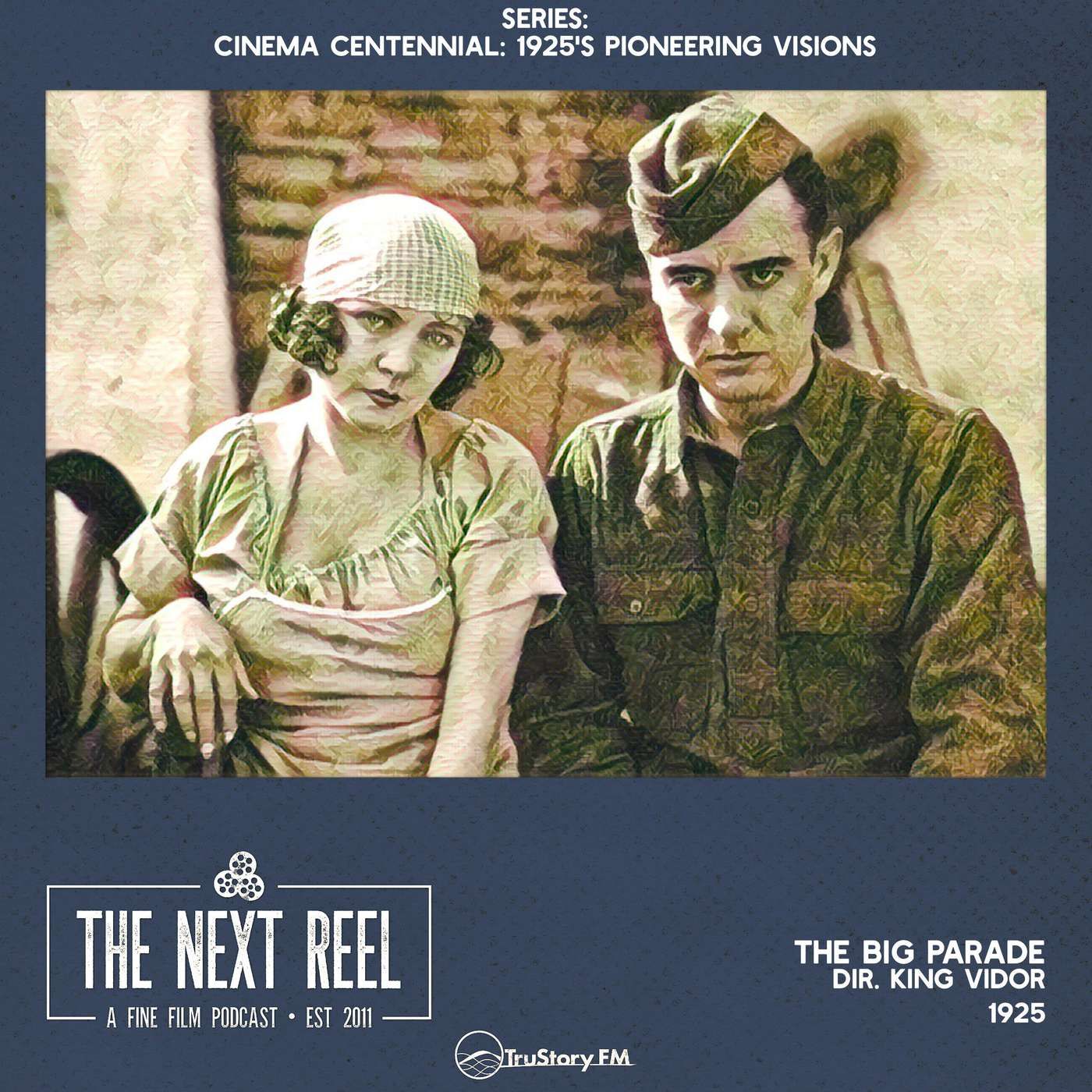
The Big Parade
Episode Transcript
I'm Pete Wright.
Andy NelsonAnd I'm Andy Nelson.
Pete WrightWelcome to the next reel when the movie ends.
Andy NelsonOur conversation begins.
Pete WrightThe big parade is over.
I'll meet you in Berlin.
Andy NelsonIs that how you think bull sounded?
Yeah.
Pretty much.
Pete WrightThat's all of them do.
All of them sound exactly the same.
It's just the same voice talking to each other.
Andy NelsonYou kinda do that that New England accent for all of them?
Pete WrightMhmm.
Yep.
Alright.
The Big Parade.
You had seen this movie.
Andy NelsonRight?
I had not.
This is the only one from our list that I had not seen.
Yeah.
Pete WrightI because of the way we record these, I knew that there was one you hadn't seen, but I get I don't know which one it is until we are on it.
So you hadn't seen this movie, as I said confidently.
So now we're talking about the big parade.
You hadn't seen it.
I hadn't seen it.
I understand what a big parade is now in military parlance.
There are two in this movie.
They tell you you gotta go out.
They don't tell you you gotta come back in.
Finest hours.
You're welcome.
And now we get to talk about an hour and a half of the most insufferably boring silent film that leads to a very exciting, oh my god, last hour of another silent film, then they smash them together.
That's what I thought of this movie.
Andy NelsonI see.
Okay.
I I can see we're coming in hot with, opinions on this film.
Yes.
You know, and I can understand that.
I didn't feel that way.
I actually thought there was an interesting like, a very interesting setup in this film that we do spend getting to know these characters and really getting a sense of, in some sense, kind of the tedium that can be war when you're not out in the field, like on the front lines or anything like that.
And so here, we end up following our troops as they train, and then they go to France.
And they are set in a village, and then they have to wait.
And they just wait and wait and wait.
And so they get to know the town and the the women and our our hero falls in love.
And and all of that is kind of the first part of our story as we're kind of getting a sense as to what life is like with these sorts of characters.
For me, that getting to know you part, and and I suppose, like, with some of the stories like this, you're putting yourself into a mindset of, like, watching a 1925 film, a 100 year old film.
It really helps you get to understand who these characters are, their connections, and everything.
So once they actually are given the call to go fight on the front lines in the trenches as they fight the Germans, you really get a sense for how painful it is to suddenly start suffering these losses and dealing with these issues.
And so for me, that worked.
But I can absolutely see why, especially when we're watching a film that is made this way, that it can end up playing, more roughly.
Pete WrightYeah.
It's just I like the intention, and I feel like that is very much part of the story, but it is a lot of it.
It's just a lot of it.
And I didn't need quite so much of it.
I do think it's fun to watch the way the family dynamic is portrayed before he even goes to war.
The fact that he's he's sort of shamed into going to war because the girl at home says that she'll be more proud of him than ever once he signs up to go to war.
And he's like
Andy NelsonOnce he shows up in that outfit, that uniform.
Yeah.
Pete WrightRight.
Once he enlists.
And so he enlists, never thinking that he was going to enlist.
He's from clearly a privileged family.
His dad hates him because he's he's a layabout.
And and so His mom
Andy Nelsonmom is terrified of him actually signing up.
Pete WrightYes.
Terrified because they kiss too fondly on the mouth too often.
Let me just tell you.
No one kisses their mother that way.
And that comes full circle at the end when she's cradling his head romantically.
But I feel like it's just interesting to watch those relationships.
And that part, I loved.
It was the stuff in France that became an exercise in comedy, and part of that is because of, you know, twenty twenty five eyes watching a 1925 movie.
Everything is a little bit funnier.
I don't know that it was intentionally funny.
Maybe it was.
But it took took me out of the film, a lot of the French homestead stuff.
And I I felt like that was a bit you coulda cut a solid thirty minutes from that sequence and had a a really tight one twenty that gives me the whole story, and I would have been happy.
So I you know, I'm not I'm not saying I'm not saying that you're you're absolutely not wrong.
I I do find it sometimes challenging to put myself in the head of of a nineteen twenty five viewer, but also I'm not a nineteen twenty five viewer, and this movie felt belabored.
Andy NelsonIt's interesting.
I think one of the things that actually weirdly helped me engage with this film is just by happenstance.
I watched the day before an Italian film from 1959 about Italians during World War one fighting the Austrians.
It was a similar tone in that, like, there was a lot of levity in it.
Now it was more balanced throughout of levity and the horrors of war, and the levity and the horrors of war, kind of like throughout.
And and honestly, I think that that probably played for me a little better.
It kind of that way of having more of that balance throughout.
And I think the Italians really find a great way to balance comedy and horror like that.
Anyway, it it worked really well, but it immediately put me into this mindset of jumping into another World War one film and watching a film where I spend so much time with these characters, and there's a lot of levity, which ends up balancing with the horror.
And so it really kind of put me in a mind space to be ready for this.
And I thought that was actually interesting.
And and thinking about, like, the scope of, like, this film was made in 1925, and we're just just past World War one for all of these people involved in the story.
Like, it's very fresh in their minds.
It's like watching Apocalypse Now in the eighties.
Right?
You're you're just fresh from having lived through Vietnam, and now here you are watching a film kind of looking back and and and exploring what actually was going on there.
So all of these people knew people who like the people acting, the people watching had probably known people who had served.
And the author of the original, story, Lawrence Stallings, had fought in World War one.
He'd been there and wanted to tell this story about these people and, like, what life was like.
When they made the film, they brought in military divisions to help with the production.
And these are people who had actually fought in the war, and they were reenacting battles that they had fought.
And so it brought authenticity to the battle scenes and everything.
And as they were filming, King Vidor and his team would get stories from these privates and everything.
And these stories ended up really becoming a big part of why they told the film that way.
And I actually found a program of when this film came out in 1925.
And, like, there are some interesting there's a whole interview with King Vidor in this.
And I just wanna read one part because there's one character who I was like, this guy is nothing but a caricature.
And it's Slim played by Carl Dane, who's always chewing tobacco, like his lips are stained with the tobacco Yeah.
It's really, really revolting.
And this is the quote that he has about Slim.
The extraordinary looks of Carl Dane in the role of Slim suggested to vets many incidents of actual front happenings.
As soon as a legionnaire saw Carl, he would laugh till the tears ran down his cheeks and recall some tale of a real leather neck who looked and acted just like that.
Slim is certainly a type.
We built up his funny role out of the stories these vets told us.
So while we're watching this again through, you know, eyes that are a hundred years after the fact, the people at the time, like, recognized everybody in this.
Like, they saw friends, family, people that they knew in all of this.
And so it really felt incredibly authentic.
And so it's I think I appreciate all of that work that they went into telling these stories and making it feel real.
Again, yes.
Could they have probably shortened it?
I think they probably could have.
I would not want to lose the conversation about frog for sure.
One of the funniest things in the entire film.
But but largely, I found it to be just an interesting, like, window for me to look through to see what life was like in in 1925.
What looking back on this fresh war was like.
Pete WrightYeah.
And I and I don't wanna completely dismiss the experience on the farmstead for exactly that reason.
I mean, the part of what makes that the inclusion of that part of the story important to the whole story is that it documents the massive, terribly prepared army that we sent to France, right, during a really pivotal part of the war.
And and, you know, the entire buildup is a a dopamine response of patriotism that allowed, you know, almost 3,000,000 people to be to be drafted under selective service, and all of them I don't wanna say all of them, but a lot of them very enthusiastic as propagandized in this movie.
And they need that part in of the movie before the real stuff begins of war to pretend to sort of cosplay as soldiers, right, where all they're doing is walking around and the you know, sort of parading through the countryside without having anything really serious happen.
You need I mean, you need that as part of the story because that's part of growing up as as a soldier in these stories.
And I I totally get that.
And and it's interesting.
The the piece that I don't need is is so much of the flirtatious romance stuff, which I understand is also a part of very big part of the story of of US military going abroad and having relationships and having you know, getting married and having children and sometimes having children and not getting married and then coming home, and it's very, very serious.
So all of that I understand, and and I think is is fascinating the way this movie, you know, says and and I really wanna highlight what you were saying here.
Like, the The US entered the war in 1917.
Right?
And this movie came out in 1925.
The proximity to actual fighting, we must highlight again and again and again.
Like, these these kids were largely still kids when the movie was being made about their experience there.
That is crazy to me.
That's crazy.
Andy NelsonYeah.
Really, it it gives them a a glimpse into reality, and it's so different now.
Like, we really don't have a way to get a full perspective of how people in 1925 were glimpsing what was going on ten years before during the war.
I mean, yes, they as newspapers would would make it to them eventually, like photos from Europe would get over to The US and then finally make it into the papers.
It took weeks, if not months, for information to, like, get passed around and everything.
And and it was a much slower system of information spreading and dispersal than we have today.
Like, today, it's instantaneous.
We find out immediately when something on the other side of the world has just happened.
And back then, it was it was a very slow process.
And it was all just images.
It was photos that they could see.
This was like the first real chance that they had to get a sense as to what it was actually like to be there, to be living through all of this stuff, both the the leisurely days of waiting for things to happen and the awful stuff that was happening in the trenches.
And so, yeah, I think that's a really important perspective to just think about with this.
It's just like how how valuable this was as a resource for people to just even understand what was happening over there.
You know?
Well, the the fact that he comes back an amputee, it was and, you know, having seen a lot
Pete Wrightof war movies, that part was shocking to me because we'd only seen him in a cast up to his thigh.
Yeah.
Right.
Right.
Right.
And, I mean, as far as I can tell, he largely marched and hitchhiked across the countryside in pajamas and a robe and his cast with a and in order to see his lady, but she was already gone.
And then the next time we see him, he's in a car with his dad, and they start with a close-up on his face, and they're having a conversation.
And then he gets out of the car, and we see that he's an amputee the first time his mother sees him.
And that moment was really impactful for me.
I mean, I thought that was an important thing that the movie had had held secret from me.
I didn't see it coming, and it it dropped at the at the most important moment when you see the impact of war on the family, on the family's reaction to what their resource, their child had endured on their behalf, on behalf of the country.
All of that was really felt progressive to me for this time.
Andy NelsonYeah.
And valuable, especially when you look at something like this and the best years of our lives, like films that really show you the realities of war and and these amputees coming home from battle and just the lives that they now are gonna have to figure out for themselves in a new their new reality.
And so I think it's important to show these.
And I just gotta say, the binding work on John Gilbert's leg was astonishingly good.
Like, was like Astonishing.
How tight did they have to tie his leg up for him to I mean, it it doesn't look like you see it from the side.
He's moving around.
I'm like, what?
Is this guy, like, double jointed?
Pete WrightWhat happened?
Poor guy's knee joint is extra I mean, excruciating.
Excruciating.
He never I'm sure he never walked the same again after
Andy Nelsonthese scenes.
It's like, wow.
That was that was because I was like, okay.
Surely they cut to somebody else who is an amputee.
And, like, no.
That's still we're seeing John Gilbert's face.
Like, how like, that that was that was impressive work.
Pete WrightIt wasn't luckily, it wasn't long.
Like, the scenes that he was writing.
Andy NelsonBut, you know, that's still I I mean Yeah.
Pete WrightThe time it takes to bind and then put the pants on and then get ready to shoot and then shoot and then take it off.
Yeah.
Oh my god, man.
Oh my god.
Andy NelsonYeah.
Oh, yeah.
Yeah.
Yeah.
Let's talk a little bit about so you mentioned the family, and I think that's important because we certainly get a of of John Gilbert's character, Jim, as this very idle rich boy.
Right?
He's he we meet him when he's getting shaved by their, I don't know, presumably not, slave.
We'll just say their their house servant and, is getting a shave.
And so we get a sense of of him and his life.
And and this is a person who, as you said, is probably not gonna sign up for war.
It's only because his girlfriend well, even she doesn't completely convince him.
It's really his friends that he runs into who are like, hey, everybody's doing it.
And so that kind of gets him.
The the the parades marching by and his feet are tapping, and he's like, okay, fine.
I'm gonna go do it.
He signs up.
But we also meet other people, and we get a sense of the people in town.
And not necessarily just this idle rich boy, but we get a sense of of Bull, this guy who's managing a bar, and we get a sense of Slim who's just running, like a jackhammer working on on framing for a building.
And so we're getting a sense of of people of different classes, and they all end up in the troop together and end up befriending each other.
These three people, Bull Slim, and Slim is the one who's always chewing tobacco disgustingly, and Jim.
And that becomes kind of our core trio.
And so I think the family bit is very important.
But I also wanna talk about kind of like the the bonding and the friendships that become kind of a key part of the military story.
And here it is between Jim Bull and Slim.
How does that story kind of like the the growth of that friendship and how it's portrayed over the course of the film play for you?
Pete WrightBack up for a second.
Let me ask you a question because these faces came by pretty quickly.
There's a part where there's the the first big parade, but it's just a parade.
It's It's not a big parade.
It's the parade of all the people who are enlisting going down the main street.
Andy NelsonThe town was ready for that enlistment notice because as soon as that was in the paper, they have a parade going down the street.
Yeah.
It's like, wow.
They're ready.
Pete WrightYeah.
There's like business guys and teachers, and like everybody's just like, I'm done.
And there a car goes by in the parade.
Jim pulls his car up into the to an intersection
Andy Nelsonand it's and just stops.
Right?
The parade blocks his path.
Pete WrightThe parade blocks his path, and he stops, and he stands up, and he's tapping to the tapping his feet to the marching band, and the car goes by.
The the guys in that car were either were any of those guys slim and bull?
No.
They're He just didn't meet them until
Andy NelsonRight.
Right.
He met them because they're not his class.
Those were the other, like, rich guys, the rich kids from town that are all signing up.
And so he they convince him to go.
Pete WrightYes.
Because then yell, we're all doing it.
Yeah.
We never see them again.
We also, I don't think ever really see Jim's car again, which as far as we know, he just left at the intersection because he doesn't present their car with them.
Andy NelsonI was laughing about that because that like
Pete Wrightpretty good.
Andy NelsonHe doesn't even pull it into a spot.
He just leaves it in the intersection and runs off to join the army.
Pete WrightThe lesser people will take care of it.
Andy NelsonThat's right.
That's right.
Pete WrightRight.
So that was okay.
So, yeah, the we need a trio.
Right?
And I think we have this trio that actually works perfectly because, you know, we get to see how each of the different classes respond to struggle.
Right?
We get to see how slim does.
We get to see how Jim does.
We get to see how bull does.
You know, we get conversations or or we get sort of conversations.
We get stories of rank and how what rank means before the war when rank is just patches, you know, when they're tip putting patches on and taking them off for tiny infractions and misunderstandings versus when it really matters when they're in, you know, stalemate trench warfare and witnessing massive massive casualties, of friends all around them.
I thought I think it's really it it's it's important, like you say, in these movies for that to be critical to the narrative, and I think this movie shows it off.
Andy NelsonWell, and in the scope of war films, you know, I I don't know if this was I'm assuming this was one of the earliest World War one films.
There may have been some other ones, but certainly one of the biggest at the time.
And certainly one of the more prominent war pictures that had been made at the time.
And I think it has become such a, just an expected part of what we see in war films of the camaraderie that you build with your fellow soldiers in a war story.
And so it's just like a part of it that it's like, that's just what how they play now.
And so it's it's over a hundred years of watching war films.
Like, this is such a critical part of what to expect in them.
Right?
Of, like, finding those people you're gonna get along with, maybe some people you're not gonna get along with, but you're all end up working for the same side.
And once you're out in the field, you're all there together to serve one purpose.
And I think they play that really well.
And I like watching the story of these three, how initially after, after Melisand is introduced, all three of them are pursuing her, and you've got kind of a, you know, a little bit of a disgusting scene as the three of them are all vying for her attentions and keep grabbing her and touching her and stuff.
I'm like, yeah.
Okay.
Hundred years ago,
Pete Wrightthat's Yeah.
Andy NelsonThat's one of those things that you just have to really kind of like, yeah.
That's not doesn't play as well today.
Yeah.
Didn't care for but I do like the way that we're following these characters, and just like the camaraderie, and just the the back and forth of the of things.
Like, I I loved the little flipping or, you know, pulling a a thing out of the hat to say who's gonna have to who's gonna go get the barrel so that we can make ourselves a shower?
Slim writes a thing on pace pieces of paper and puts him in a hat.
Jim pulls it out, says, I got it.
And so he's like, okay.
I have to go get it.
And doesn't realize that Slim and Bull have already kind of, like, done this before and all three of the pieces of paper all say, I got it, but neither of them reveal that to Jim.
Like, played really well.
Like, loved those moments as as we have this.
And it all built to a really strong end when, as you said, with as as it came to rank where Slim is like, you know, I'm I'm the ranking officer here between the three of them.
They're all stuck in a shell hole out in the field in the middle of the night, and they're trying to they've been ordered to try killing this machine gunner who's pinning everybody down.
And Slim, they kind of do another little contest, but it's a chewing tobacco spitting contest.
And of course, everybody knows Slim is gonna win because he's really good.
He's just like, hey, I'm the commanding officer.
I get to do what I think works best.
And so he does that purposefully so that he goes out there and ends up getting killed as he's trying to do this.
And so
Pete WrightWhich was incredible, by the way.
The the long march to death of Slim after he shot for the first time.
He just like keeps covered back until they do the helmet shot and the blood coming down his face.
Right.
Right.
They really Gruesome.
Andy NelsonYeah.
Yeah.
Yeah.
It was tough.
I mean and I think that's what is important about these moments of getting to know these characters.
As disgusting as Slim is, you do kind of grow a sun sense of fondness for him so that once he's out there in the field dying, it's it's rough.
And then you can see why Jim is so taken to anger when he comes across, Slim and and then just storms and the storms ahead and kills everybody.
So it's, yeah, it's tough.
Pete WrightHe has that he has that rant.
Right?
Who are who's fighting this war?
Orders?
Are orders fighting the war or men?
Right?
That
Andy NelsonYeah.
Pete WrightThat where he sorta comes undone was was really, really impactful.
What a great moment.
I think the last hour of this movie is some of the best just sort of war movie that I've seen.
Like, it's it's incredible.
Andy NelsonIt really is powerful.
You know, the gassing and everything else that goes on and his rant.
And I think it plays so well.
It's the one part that it's it's trickier in a silent film, but as we find out, Slim is laying out there in the field just moaning.
And they are just left hearing him moan as he's slowly dying.
And that's what kind of like drives Jim crazy.
Jim and Bull are just like but Jim, especially, is just like, I have to do something.
And he breaks, and that's when he has to go out there.
He and Bull finally go out there.
And then Bull also ends up getting killed.
So not he doesn't get killed, but he gets he gets badly wounded.
Or does he get killed?
No.
He gets killed.
Pete WrightI think he gets killed because I for a while, I thought at the end, we or near the end, Jim is in the hospital, and he wakes up, and he's in gray flannel pajamas that I think have flowers on them, and I made a note of that.
Andy NelsonMaybe not flowers, but yeah.
Pete WrightAnd the it keeps cutting back to a guy who was clearly shell shocked, clearly dealing with some some trauma.
And he's roped.
He's tied into his bed, and he keeps trying to get out and screaming and screaming.
That was hard to watch.
And I I can tell if it was if that was bull.
I don't think it was.
Andy NelsonI don't think that was Bull.
I actually thought the other guy was Bull that he looked across the way to and saw another guy who was missing an arm.
And I was like, is that Bull?
Yeah.
So I I think but I I don't know.
I think that we both probably the fact that Bull is laying there and is like, I'll see you in Berlin.
It's like, okay.
That was a clear sign that he's gonna die.
That's kind of just the tragic end of Bull.
Right.
Calling his shot.
It was it was rough.
That was and it plays.
Like, all of that really plays.
Pete WrightYeah.
Andy NelsonYeah.
So now let's talk about our, the loves in Jim's life because that's the other big part of this story.
Initially, it is Justine.
Did you I j u s t y n.
I thought it was Justine.
Yeah.
Pete WrightI called in my head.
I called her Justin for the duration of the movie, and then Kira saw title and said, oh, so that's a funny way to spell Justine.
And I said, yes, it is funny way to spell Justine.
Andy NelsonI saw that too, and I was like, Justin doesn't sound right.
Pete WrightNo.
Andy NelsonIt is probably Justine, but it's very interesting spelling.
Yeah.
This is a story of a man who's who has a love at home, Justine, who is, again, as we said, kind of is the one who pushed him into doing this, or or or one of the one of the many that nudged him into doing this.
He's engaged to her.
I wanna get a sense of this.
Did we have a sense of how much in love with her he was?
Pete WrightRight.
That was that was my central question.
Right?
That it felt like she was she was the boss of him, and he did things for her not because he was in love like, necessarily in love with her.
Maybe he thought he was in love with her, and, you know, there's you know, they had this weird dynamic about I don't know.
It just felt like a very she felt like a very domineering person in his life, and their relationship was not authentic.
Because the moment he goes to France and meets the farm girl, my first reaction was, thank god.
Let's move on from Justine.
Right?
Interesting.
Yeah.
I was not I I was not in it for Justine and Jim.
They needed to move on from each other.
Andy NelsonWell, she's not a good cook.
She makes it well, I I couldn't decide.
Is the cake did she make it just a terrible cake?
Or did it was the joke that it had got stale because it took so long to get here?
Pete WrightYeah.
Either way, they ate it, and that I think was statement in and of itself.
Yeah.
Yeah.
But they split it.
Broke it over his knee.
Andy NelsonWhatever the joke.
Yeah.
That was really funny.
Yeah.
I struggled with Justine also.
And so but it was one of those things where I'm like, I don't feel like it quite set enough up for me that Jim was like wavering, you know?
Like, it seemed like he was kind of fine because he's this idle guy.
I I I just wanted a sense that it was just kind of a relationship of convenience or something, which may be more of a modern way to kind of include that.
As it was, I I think it plays okay.
But then once he goes to France, like, he's instantly has the hots for Melissand, this, Renee Outerre's character who lives in this little village.
Easy to fall for her.
She's very beautiful.
But I was like, Jim, are you forgetting something?
You got you know, it's like
Pete WrightAnd then he got the letter from Justine and the picture and and was clearly distraught because of his, you know, new love for Melissand.
That, you know, he he had to reckon with that there on the farm.
But the the relationship joke comes full circle and yet is unresolved.
And here is where we get the payoff.
He comes home supposedly to see his bride to be, Justine.
As he's driving down the road with his dad, mom's at home, opens the door to their house, and sees Justine kissing the accountant.
Andy NelsonThat's his brother.
That's his brother.
Pete WrightOh, that was his brother?
I thought that was, like, the CPA.
Andy NelsonHis brother well, his brother is like an accountant at the firm.
Okay.
Like, he works for dad at the firm, but that's, yeah, that's his brother.
Pete WrightI totally missed that.
So she falls for his brother.
Now he gets home and everybody kinda hugs him, which is great, but it never comes out that she and his brother are together.
And he lays down on his mom's lap and tells his mom, I found this French woman.
And the mom, who now knows the entire story, says, oh, well, the only thing that matters is that you go to this French woman.
Everything will be fine here.
You need to go to the French woman.
He never finds out that Justine has given him up for the brother.
Yeah.
Come on, mom.
Andy NelsonYeah.
They they're probably could have been a little cleaning up with that as far as, like, letting that revelation actually come out that that this is what's going on.
I did write in my notes, we've suddenly entered a soap opera here.
Yes.
Soap opera territory with that whole thing.
I was like, wow.
Okay.
Just a quick way to get Justine out of the way.
Let's have her fall in love with Harry.
Pete WrightIf you're gonna give soap opera, I'm gonna judge soap opera.
And as a soap opera, this is incomplete.
It is insufficient.
It's it's not.
Andy NelsonYou're right.
It's not all there.
And so it was really funny.
And and I will say, like, there were there were more laughs at the end than there really should have been with that whole bit.
And then we cut to France, and it was like women of France is the intertitle.
And we see we see Melissand and her mother working the fields, tilling a field with a pull pulling a plow behind a cow.
And then she there's a a long shot of the village in the distance and a hill, and we see the silhouette.
And it's it's you don't wanna laugh, but it's really funny because it's one legged Jim and his scratches in silhouette in a very long shot.
He's a tiny little dot just, like, working his way across the very, very tippy top of the hill.
Pete WrightIt's like it's like a python shot.
It's the and he's hobbling.
All what you you you know it's him because
Andy Nelsonof his distinctive hobble.
Yeah.
Right.
And it reminded me of, like like, when kids go to a carnival and the little shooting thing with the little animal figures moving across the top that you're shooting.
Like, it was just like this little robotic little guy moving across the top of the hill.
Again, I don't mean to laugh at this poor amputee working his way across the top of a hill, but it just played funny.
It played funny in silhouette.
And, but, you know, it is the reuniting of Melisande and Jim.
And so I did like that he does walk across France to find her, I guess.
Pete WrightWalk across France to find her again.
Again.
Andy NelsonAgain.
Right.
Pete WrightRight.
The the other unintentionally funny bit is that she waits at that plow for a really long time.
A really long time before she closes the distance.
Like, she makes him hobble most like, really all the way down that stupid hill before she's like, oh, I get it.
Like, she's curious from the way back at the start of the field that she just keeps plowing.
I think that's really funny.
Andy NelsonWell, but did you see what she had to go through?
Like Yeah.
She's like, I'm not gonna go until he's closer because I have to scramble down entire, like, hill of, like, rocks and boulders just to get down to the road.
It's like, where like, this is what they go through just to go plow this field?
Like, they have to get through this.
I mean, I get it.
It's postwar.
The earth is torn up.
But they picked, like, the worst and hardest place to actually go plow.
Pete WrightIt was funny because, like, they never gave us any context.
They showed us that she's in a field in a medium shot, and they show the hill in a at a shot from a great distance.
But they never, at any point, show us what's between that, like, that road
Andy NelsonYeah.
Pete WrightUntil she has to do some bouldering to get to it.
Like, they may as
Andy Nelsonwell throw have thrown a river in that she also had to, like, swim across.
Just threw
Pete Wrighta river in.
Oh my god.
What is this lava field?
Sharks?
Andy NelsonAre there really sharks?
A bit of work.
Oh my goodness.
Pete WrightShe has to fight a bear.
Like, it's just a lot.
But
Andy Nelsonokay.
All of the joking aside, though, I actually really did enjoy the relationship that developed between Melisande and Jim.
And it was interesting.
And it's even more interesting, I suppose, in a silent film because they don't speak each other's language.
Right?
She's speaking French.
We only get one intertitle that pops up of French as she's talking.
And the rest is just him with his Problematic.
Not just him, but any yeah.
Him, Jim, or Jim, Bull, Slim, anytime they're parley voo, like Franta.
All it's all written out phonetically kind of on the on the inner titles.
And it's very funny, I suppose.
But, yeah, you're getting the sense that these are people who I mean, they've got their little dictionary, but you don't really get a sense that he's working to improve on his French, or she's working to improve on his English.
They just seem the entire time to just always be unable to actually effectively communicate.
Yeah.
Pete WrightBecause it's the language of the language of love, Andy.
Andy NelsonIt's the language of love.
Pete WrightYeah.
Right.
Unspoken.
Andy NelsonBut I do enjoy their love story.
And I like like the fact that she brings him into the house when everybody's over there.
Like, they say that there's this weekly or monthly, I can't remember how often, but this thing that they do where all the letters that have come in, the French from the French families, they all meet in Melisson's mother's house, and they read the letters out loud so everyone can kind of find out what's going on with people that they know.
And she brings Jim in to kind of be part of that, and everyone was kind of okay with it.
Like, I I enjoyed these moments that felt like, okay.
They're they're kind of working on building a a real relationship here that doesn't just feel like I don't know.
You got a sense that a lot of the other soldiers, like, as they were leaving, they each have, like, women on their arms and stuff.
You kind of get a sense like some of these might be love.
A lot of them might be just sex.
You know, you just kind of get a a mixed sense of what's actually going on.
Pete WrightBut, Andy, when he leaves her, that's enmeshment because they we won't stop kissing until people are dragging them as a couple to the cart.
And then when he finally gets up in the cart, she's hanging on him and being dragged through the truck.
Andy NelsonShe is a hardcore.
Pete WrightAnd then she stands up and is waving to him, and he just starts taking off stuff and throwing it at her to the point where she has a necklace like a locket and a shoe.
Yep.
Holding a shoe to her chest.
I mean, I know that's supposed to be romantic.
I was dying.
I was dying at that bit.
Andy NelsonYeah.
It was pretty funny.
Pete WrightIt felt like the jerk.
It felt like in a moment, she's gonna pick up a lamp and no phone book.
And all I need The is this
Andy Nelsonfact that she grabbed onto the chain and was dragging by the truck, that for me, I was like, wow.
Okay.
Okay.
We might have got a little too far with this with this thing here.
But but, you know, it allowed for moments.
It allowed for moments.
Like, after everybody leaves, there's this beautiful shot of her as this last person standing in this wide shot of this empty road.
Like, there were some moments that made it actually play.
And I felt I felt the connection between the two of them.
And I guess that's one of the things that I thought was important is building a sense of this actual growing fondness and this love that these two have for each other.
Pete WrightSure.
It goes from playing a little bit hard to get flirtatious to I'm being dragged through the mud by your truck pretty quickly.
Like, that's a hard turn.
But but I get it.
Like, I I definitely get it.
Andy NelsonYeah.
It's it is pretty funny.
But, yeah.
So that's kind of a sense of the story.
And then so we get all of that.
We are and then we talked about the war bit.
Any other bits that you wanna talk about that really stand out in moments of the war specifically or the marching?
A lot of big parade marching as they're going to and from the field.
Pete WrightThere is a lot of marching.
There are some sequences of of impeccably used tint once we get to the the actual war.
I mean, the way they color night and some of the graphic fighting, a lot of soldiers marching by in in a really dramatic fashion.
But there is one sequence that I thought was kind of horrifying just as an example of how we wage war, where the entire platoon, I don't know, battalion, whoever whatever they call their ranks, are spread out marching into a wood.
And in the woods are the opposing forces, and they're all camouflaged.
Snipers.
Yeah.
Snipers.
And they're camouflaged poorly.
In some cases, once you see one, you see them all.
But the way that was shot, the way the snipers are just shooting our friendlies, I thought was captured in a truly horrifying way.
The the act that it it just felt like we were doing nothing.
We, the American forces, were doing nothing to prevent themselves from being shot.
It it felt like the you know, when you look at the revolutionary war and the colonials who, you know, we're gonna fight from the trees.
You know, we saw the Patriot.
We wanna fight how Mel Brooks fought while the British are fighting in their bright red coats in the middle of a field.
You know what I mean?
That's what it felt like a little bit to me.
Like, it was we're gonna we're gonna just make this a really obvious and difficult thing to watch as as the allies get mowed down.
And ultimately, you know, there weren't that many snipers, but it was a it was a powerful sequence.
Andy NelsonThat was a a fantastic sequence because we're seeing it from the perspective of the side of the Germans looking forward at our troops.
And often, it's specifically Jim, Slim, and Bull, and other people.
And we're watching them just kind of on a slow march forward.
And then as you're talking about, like, people behind them just drop.
Like, one guy drops.
And then we cut to another shot, and people are walking, and just and it's just quiet.
You just see people fall getting hit.
And it's it's really, like, haunting, like, the way that that plays.
It really kind of it hit me quite a bit too.
And just I loved that the way that King Vidor chose to construct that, as you said.
It was very impactful, and it worked in just really haunting ways of showing what that reality was like.
Of we're just we have to keep marching forward knowing that people are getting shot and picked off.
And we just have to keep our eyes open and hope we can spot these guys before other people get killed.
And it's it's it's pretty pretty rough.
Pete WrightYeah.
They did get one early on who was high in a tree, and then it was none for a long time and just watched their people get shot.
Andy NelsonYeah.
Right.
Right.
Where do you stand on King Vidor as far as directors?
Have you seen much of his films?
Pete WrightHave we done a King Vidor film?
Andy NelsonNo.
This was the first.
Oh, okay.
Pete WrightYeah.
Andy NelsonKing Vidor worked, you know, through the silence quite a bit, and then into the sound era.
I've only seen a few of his films.
I've seen Stella Dallas, which is a great film.
I saw, The Citadel.
Oh, what is the other one that I saw of his?
There's one more that I'm blanking on.
But, yeah, not I I like the stuff that he's done.
I just I have seen I haven't seen a lot of it.
I The Champ is a big one that he directed that I just haven't, haven't seen yet.
The Crowd, that was another one that I highly recommend checking out if people like, Sunrise, a song of two humans, which is one of the first films nominated, the first Oscars.
The Crowd is another one that year, and it's very similar to Sunrise in many ways.
It's a little bit of a darker film, but it's an excellent excellent film.
So that's probably my favorite of King Beador's films.
Pete WrightSo it's interesting that of that that his IMDb top four, The Wedding Night, War and Peace from 1956, Hallelujah, and Show People.
I haven't seen any of those.
But it seems like I should have seen the Audrey Hepburn, War and Peace.
Andy NelsonYeah.
Yeah.
Put that on the list.
Yeah.
But but I know he's like a very prominent director and and was big for I I think after this film, he became actually, there was a a financial deal.
We'll talk about the money here in a little bit, but there's a in his contract was a note that entitled him to 20% of the profits.
I don't know.
The way that this is written, it doesn't sound like he knew that this was in his contract.
I'm not exactly sure.
But the lawyers from the studio called a meeting.
They said the picture cost even more, and they downgraded the their estimates for how successful they thought the film would be.
And they convinced him to sell his stake in the film instead of taking a percentage, just get extra cash.
So they tricked him into basically saying, oh, the film's costing so much.
It's probably not gonna do well.
Just take a cash deal instead.
And so he did.
And then the movie went on to make insane amounts of money.
And so while he didn't get that extra money, he ended up becoming one of MGM's top directors at the time.
Pete WrightWell, it was in the name all along, Andy.
King?
Who names their kid King?
Andy NelsonYeah.
You gotta be confident.
Pete WrightThat's bold.
That is very bold.
Yeah.
Andy NelsonJohn Gilbert is our lead.
I didn't mention this when we talked about Ben or when we were talking about Ben Hur in our member bonus episode.
But he is yet another of the faces at the chariot race in the stadium.
So he's another person from the studio who's watching the chariots.
So I thought that was funny.
Pete WrightThat's funny.
That's very funny.
Andy NelsonAnother actor who I don't think I've seen much of.
Another dandy.
Pete WrightHe's very he's a very fine lad.
Andy NelsonYes.
Indeed.
Indeed.
Pete WrightYou see that kid, and you're like, send him to war.
That's right.
I believe that.
Andy NelsonAnd sadly, Renee Adore well, what's interesting is she was actually from France, living in Belgium during the time of World War one, and would have been essentially one of these villagers had her family not, like, gotten her out of there, when World War one got started.
And so she ended up moving getting moved out of the country.
But yeah.
So she she was very much familiar with this these people.
She sadly she became very famous after this film, but a few years later ended up contracting tuberculosis and died at the age of 35.
So a very sad end for her.
Tuberculosis, man.
Oof.
Ay ay ay.
Pete WrightBut, yeah, I liked her very much.
I think she's great.
Hard not to imagine her as a dark witch because every time I hear Melisande, I hear Melisande from Game of Thrones.
That's really funny.
That's where I go.
So I kept waiting for her to do something really bad.
Andy NelsonYeah.
That is funny.
Mhmm.
Oh, you didn't mention when you were talking about the tinting, but there was one moment where it was there was a hand painted bit in the film.
And it was after the battle in the in the fields, and he's left in the fields.
Oh, and in that moment when he, like, almost knifes the guy through the throat, the the German guy, and then he sees the young kid that is in front of him, and he kind of has that moment where who what am I doing?
Stops, and the kid ends up dying anyway after he tries to give him a cigarette.
Yeah.
Very tough moment.
But then, he after the battle, he we see the next morning, and the Red Cross truck comes up, and it's got the red cross painted.
I was like, oh, what a great use of actually hand painting again.
I love seeing these in these old silent films.
Pete WrightAnd it's a Red Cross truck that gets stuck in the mud Yeah.
But gets out.
Andy NelsonGets out.
Right?
Pete WrightIt's it's it's actually a bit of an optimistic turn.
It is.
Indeed.
Indeed.
Andy NelsonYeah.
So I think it's a really strong film.
I totally appreciate that it's a a film that feels of its time, and there are elements that that definitely feel like it can drag a little bit.
But for me, I found that it worked pretty well.
So I had a great time with it.
I'm glad we had a chance to chat about it.
Pete WrightMe too, for sure.
Andy NelsonAlright.
Well, we will be right back.
But first, our credits.
Pete WrightThe next reel is a production of True Story of M, Engineering by Andy Nelson, music by Ian Post, Kash Kashido, Doctor Paranoid, Oriel Novella, and Eli Catlin.
Andy usually finds all the stats for the awards and numbers at d-numbers.com, boxofficemojo.com, imdb.com, and wikipedia.org.
Find the show at truestory.fm.
And if your podcast app allows ratings and reviews, please consider doing that for our show.
Andy NelsonAttention movie lovers, cinephiles, dreamers.
The world of cinema needs you.
The forces of mediocrity and unoriginality threaten to extinguish the light of true artistry in film.
But there is hope.
There is a place where the brave and passionate can gather to defend the honor of cinema.
Letterboxd.
Letterboxd is a rallying cry for those who believe in the power of movies.
It's a community of warriors ready to fight for celebrate the films that have shaped our lives, and to discover new masterpieces.
By joining Letterboxd, you are enlisting in the greatest cause of our time.
And now, we are offering you a chance to join the ranks of the elite.
Head over to the nextreal.com/letterboxed or sign up directly on letterbox and use the code next real to receive a 20% discount on your membership.
This code works for both new recruits and seasoned veterans.
With a letterboxed pro or patron membership, you'll be fully equipped to take on the enemies of art with features like ad free browsing, personalized stats, and streaming service notifications.
So, brave movie lover, will you answer the call?
Will you join us on the front lines of film, ready to defend the honor of cinema?
Visit thenextreel.com/letterbox, or sign up on letterbox now with the code next reel, and let the battle begin.
The fate of film rests in your hands.
Enlist now.
The future of cinema depends on it.
Pete WrightSequels and remakes, Andy.
Has there ever been another World War one movie made since this one?
Andy NelsonThe next big parade.
This no sequels or remakes of the big parade, but certainly, this set the stage for how people would want to approach World War one stories at the time.
In fact, this film is listed as a very big influence on All Quiet on the Western Front, which would come out, I think, five years later.
And so it's an important film in that sense.
But, yeah, it doesn't actually have any specific sequels or remakes.
Pete WrightOkay.
But I know this is the part we've all been looking for.
How did PhotoPlay magazine, treat this movie?
Andy NelsonI'm glad you brought a PhotoPlay magazine, Pete.
Very important piece of history, of course.
PhotoPlay magazine Certainly for this series.
For this particular series in the silent era, it is essentially our awards segment.
Segment.
It's how did it do with PhotoPlay magazine?
Actually, this film ended up doing quite well with PhotoPlay magazine.
It won, best picture of the month in January 1926.
Best, best actor of the month, John Gilbert, or I think they could just call it best performances of the month.
John Gilbert won, and Carl Dane both won all in the January 1926 issue of it.
And what's perhaps more important and more telling, the medal of honor for best film of 1925 went to this film, the big parade, in PhotoPlay magazine.
Some people say this is kind of a precursor to what people would say were the Oscars back in that period of time, is when they would actually win this medal of honor.
And so it really was the only film award at the time.
So people essentially view this as kind of the big award of the year.
So, yeah, in a way, it kind of won best picture of 1925.
Pete WrightCan you imagine if we
Andy Nelsondid Oscars every month?
That might improve things.
I don't know.
Pete WrightWere there any others of note?
Andy NelsonYou know, over at the San Sebastian International Film Festival in 1983, it, had an honorable mention win with the OCIC award, which is the International Catholic Organization for Cinema and Audio Visual.
And then, of course, the National Film Preservation Board, it was placed in the National Film Registry on in 1992 as a very important film in the history of cinema.
So there you go.
Pete WrightAlright.
Once again, we have a segment to talk about, Andy.
How did it do at the box office?
Andy NelsonI gotta say, Pete, I love that Eddie Mannix.
Oh, man.
These these films, MGM.
I gotta love him and MGM because I actually do end up with Data.
The movie costs 382,000 or 6,900,000.0 in today's dollars, which seems insanely low for what they accomplish in this film.
Veedor's film opened either 11/05/1925 or November later.
This was one of the biggest hits of the entire decade, going on to earn 5,000,000 domestically and 1,100,000.0 internationally on its initial release.
It was so popular, it would go on to get rereleased around the world throughout the twenties and thirties.
And in the end, they estimated it went on to earn between 18 and 22,000,000.
Now I'm assuming that's non adjusted figures for all of its very releases various releases.
But as I don't have any breakdown, we're just gonna assume it earned 22,000,000 for our purposes, which is 398,200,000.0 in today's dollars.
It lands the film with an adjusted profit per finish minute of almost 2,600,000.0, earning back almost 58 times its budget.
So, yeah, The Big Parade ended up being MGM's most profitable movie until Gone With the Wind, fourteen years later.
It's also sometimes proclaimed to be the most profitable film of the entire silent era, though people still argue about whether it's this or the birth of the nation actually taking that record.
Since date is so weak, it's just one of those things we'll never really know.
Regardless, this was a massive success.
That is crazy.
Pete WrightYeah.
Crazy for a movie with such a boring first hour.
Andy NelsonBut again, remember, people at the time really felt like they were watching people that they knew.
And so you can see why this film would play so well at the time.
Pete WrightYeah.
Crazy.
Well, I'm really glad to get it under my belt and get it in my in my catalog.
Worth talking about for sure.
Yeah.
I think
Andy Nelsonit's definitely an interesting glimpse into World War one that, you know, it's it's I think it's a valuable when you're trying to look at World War one like this, I think, a valuable glimpse into it to understand how people so close to that war, people who could have been in the war, were now making this film, telling this story.
And so I think that's just a valuable thing to think about when you're looking at this.
So I I really liked it.
I had a great time with it, and I'm glad to have, who added this to the list of films that I have seen.
Pete WrightMe too.
Andy NelsonAlright.
Well, that is it for today's conversation.
Next week, we are looking at Rupert Julian's 1925 film, The Phantom of the Opera.
We'll be right back for our ratings.
Now I one thing that we didn't bring up at all, Pete, just real quick.
This film, the only existing version well, I shouldn't say the only existing version.
The only version that we have access to right now is the 1930.
They lost the 1925 version.
They re released it in 1930 with a score that had, synchronized sound effects.
But they but that audio, they have not released.
They found it, but they haven't released it.
The only way we can watch the movie right now is a nineteen eighties new score by, I think, Carl Davis with, again, synchronized sound effects and such.
And I think that he took the theme, the Melissand theme, and integrated it into his score.
But otherwise, it's not.
It's like we're seeing this nineteen eighties score of the picture, which is really strange because they found the score, but they've just not released it.
For some strange reason.
Yeah.
Yeah.
Little little thing to know.
Pete WrightAttention, film lovers.
A mighty call has gone out across this great land of ours, and it calls you to action.
The Next Real family of film podcasts is assembling a brave and noble company, listeners who believe in the power of cinema, the joy of conversation, and the solemn duty of supporting the shows they love.
And now is the hour to step forward.
For only $5 a month or 55 a year, you can join the proud ranks of our membership forces.
As a valued supporter, you'll march at the front of the column with ad free episodes, early releases, members only bonus shows, live streams, and access to our bustling community on Disc Discord where spirits are high and camaraderie is strong.
Let no one say you stood idle when the cause needed you.
Your contribution keeps our microphones steady, our episodes flowing, and our cinematic mission alive for listeners everywhere.
So don your virtual uniform, straighten your cap, and answer the call.
Visit truestory.fm/join and enlist today.
The Next Real family for cinema, for conversation, for us all.
Letterboxd.
Andy.
Letterboxd.com/thenextreel.
That's where you can find all of our reviews and our hearts and our stars.
What are you gonna do for the big parade?
Andy NelsonI, again, really liked this film.
It worked well for me.
I'm gonna say four stars and a heart.
Pete WrightOkay.
Okay.
I mean, I definitely am giving it a heart.
The question was three or four stars.
I think I'm gonna give it four stars because Oh, okay.
Yeah.
Yeah.
I I mean, that last hour is why you show up for this movie.
It's For me.
It's impeccable.
Andy NelsonAnd it's incredible.
So Yeah.
I also was like, there's a moment when they realize that they're launching gas and they have to put on their masks.
Pete WrightWhat are those gas masks?
Andy NelsonWell, they're high they're under their helmets.
But the way that John Gilbert, like, he puts his on, and it looks like his goggles, like, folded inward.
Yeah.
And and he keep like, they keep filming it that way.
I'm like, man, that must have been a really uncomfortable way to have to wear that mask for as long as he did because it just doesn't look like it's on his face.
Pete WrightRight?
I mean, that's easily just what he endured.
Between that and the leg binding, that's worth a star alone.
Andy NelsonOh my gosh.
Yeah.
Yeah.
Film.
Well, that averages out to four stars and a heart, which you can find on our account at Letterboxd at the next reel.
You can find me there at soda creek film, and you can find Pete there at Pete Wright.
So what did you think about the big parade?
We would love to hear your thoughts.
Hop into the Show Talk channel over in our Discord community, where we will be talking about the movie this week.
When the movie ends, our conversation begins.
Pete WrightLetterbox give it, Andrew.
As Letterboxd always doeth.
Yes.
It does.
Now I will say mine, I know I know already that you went low even though I don't know what it is, but I assume because you went low, it's probably got some humor to it.
Andy NelsonThere's a there's a hint of humor.
Yes.
I have no humor at all.
Pete WrightSo can I set the table with some non humor?
Andy NelsonPlease.
Yes.
Let's do that.
Pete WrightThis is from our friend, comrade Yui, who I believe we have done reviews from comrade Yui before.
The image of a long line of men marching mechanically to their deaths, slowly being picked off by machine gun fire, organized in such a way that they can and must overwhelm the enemy because there's simply too many of them for the German enemy to kill, Widor really understands the radical absurdity of twentieth century warfare.
The naturalist beauty here isn't overly thought out, isn't contrived.
It simply communicates the basic humanity of an inhumane situation.
Orders, who the hell is fighting this war?
Men or orders?
Five stars in a heart.
Very well said.
Andy NelsonYeah.
Very well.
Yes, indeed.
You know, it's interesting.
That reminded me, I had never heard of the piece that Rudyard Kipling wrote called Boots until seeing the latest, twenty eight years later.
Mhmm.
And it's where they, Danny Boyle, integrated that recording into the film and in the trailer.
And it just really struck me because it's just like, I've marched six weeks in Ellen certified.
It is not fire, devil's dark or anything, but boots boots boots moving up and down again.
It's like this constant, thing of just like this worst thing that these boots just have to keep going, and you can't get out of it.
And it's just like this never ending.
And and I think that spoke to that a lot, you know, the horrors of of just the reality that you have to deal with this.
So.
Pete WrightAnd now you bring the jokes.
Andy NelsonI've got I was a joker just like, woof.
I got a one and a half by Avery Clark.
The Big Big Parade, my first silent film.
Oh.
I don't know if this bodes well for Avery.
Let's just I had to watch this for class.
It was better than I expected, but it dragged on for way too long.
The guy who kept chewing tobacco was actually so gross.
I was so happy when he died.
Pete WrightOh, slim.
Andy NelsonI was like, oh, I'll just yeah.
I think through today's eyes, slim is a little much to take.
Yeah.
Like, Slim is a little much.
Is just disgusting.
Wow.
Yep.
So there you go.
Well, thanks letterboxed.