·S15 E25
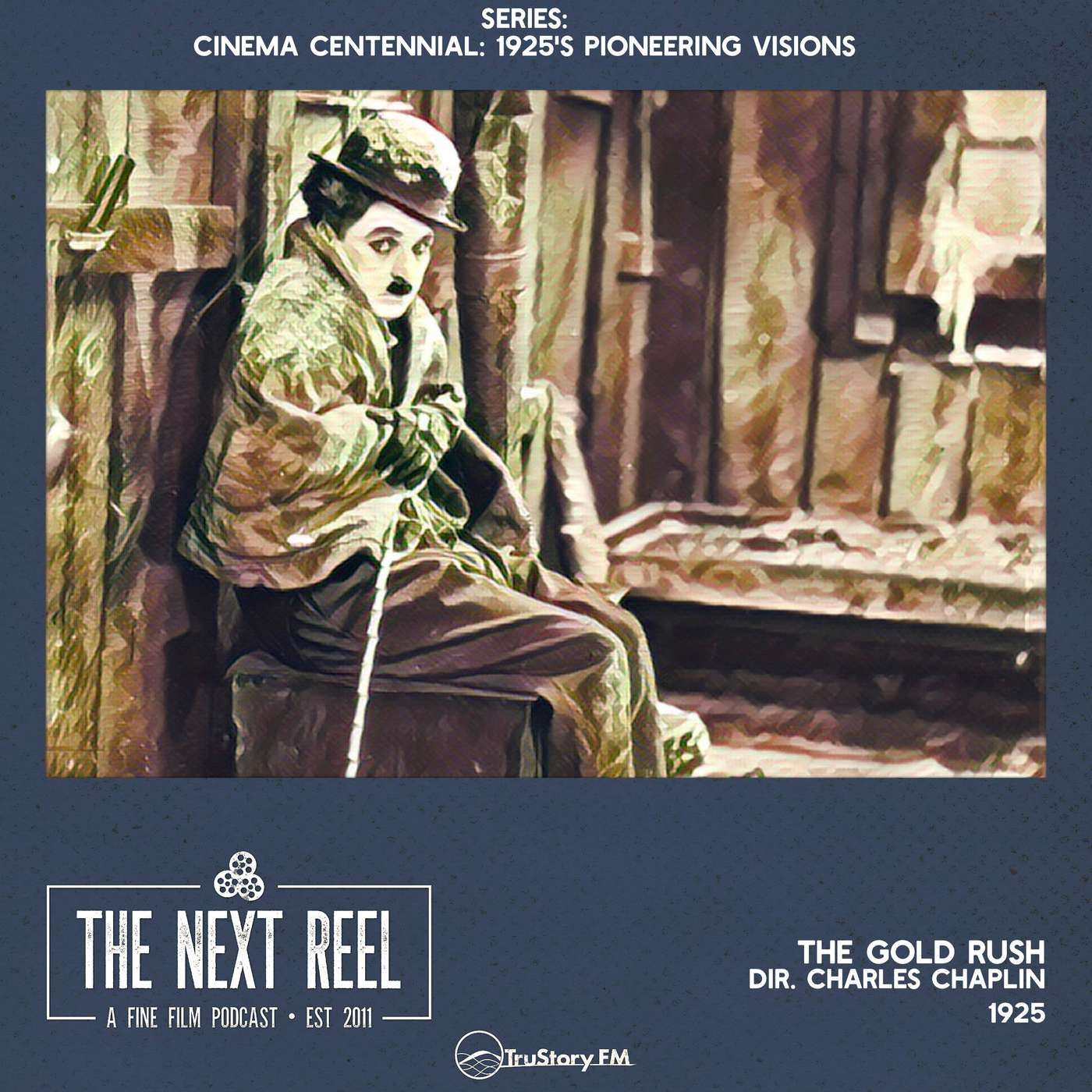
The Gold Rush
Episode Transcript
I'm Pete Wright.
Andy NelsonAnd I'm Andy Nelson.
Pete WrightWelcome to the next reel when the movie ends.
Andy NelsonOur conversation begins.
Pete WrightThe gold rush is over.
Gee.
This will make a wonderful story.
Okay.
Andy, this is this is a horror movie about starvation and isolation, social and otherwise, and real social judgment and relationship struggles.
It's abs might as well have been made by Jordan Peele.
Also, were some jokes.
There were some visual gags.
Andy NelsonYeah.
That is very funny because you're not far off from what Chaplin was going for with this when he came up with the idea.
He, had was inspired by photos of the Klondike Gold Rush up the the famous hike up, the the pass in Alaska, the Chilkoot Pass.
That's the famous photos of the Gold Rush of, like, the line of people just kind of going straight up.
It was the Chilkoot Pass that, into Yukon territory that, was so popular.
So that image and then paired with the stories of the Donner Party and all the starvation that they went through and the cannibalism.
And so he said, yeah.
Let's combine all of these stories of deprivation and horror and make it a comedy, and here
Pete Wrightit is.
Outstanding.
He did he did great, kid.
Andy NelsonYes.
He did.
He did.
This is the
Pete Wrightlast of our pioneering visions series, 1925, and it's the last of our silent films.
Right?
We get to we're jumping forward in time starting next week.
So this is it.
Andy NelsonIt's the last of our entire, yeah, chronological reverse look at the last hundred years of cinema starting in 1920 or 2025 with ballerina.
Then we did every twenty twenty five years, we jumped back.
2,000, we did the Juwan series.
1975, we did more pioneering visions of global cinema.
1950, we did the best actress Oscar race, and now we're at 1925.
And this is the end of all of this kind of journey through a hundred years of film, which has been pretty interesting, just kind of seeing the changes in the stories.
Pete WrightWell, I don't wanna put you on the spot, man, but I'm going to because this was your series.
This is your idea, this whole arc of a hundred years of cinema.
How do you feel about what we've learned?
You feel like you've unlocked some new things in yourself having watched all these movies?
This was these were your picks.
Andy NelsonYeah.
It was an interesting opportunity to just kind of dip back into kind of film history and just look at some of these, a number of which I hadn't seen before.
And so it was kind of exciting to see how things changed.
And I know we we weren't going forward.
So in a bit in a way, it's kind of like our what do we call it?
The Benjamin Button style David Fincher series where we we did his Classic
Pete Wrightnext reels.
Yeah.
Yeah.
Andy NelsonAnd having the opportunity to kind of look at these little bits of of film history, it's just interesting to see these films that are celebrating their 20, fiftieth, 70, and hundredth birthdays.
How much has changed?
How much still resonates, and how the medium has just evolved so much.
And it's interesting, especially with this film, which is definitely not quite as stunt heavy, although we have few little things, but definitely, like, effects.
And then last week, seven chances and the world of stunts, and then having started this whole thing with ballerina, just kind of seeing the full evolution of that.
It's been really interesting.
I agree.
Pete WrightAnd and I think this movie, particularly what it represents in terms of Chaplin's sort of authorial control of, you know, creating this smash hit of a film at the time of what it represents for United Artists, of his sort of legacy as a as a creator, and the fact that it's a movie about the gig economy in 1925, which I think is really funny.
I couldn't help but think all these prosecutors are you know, all of their descendants are delivering DoorDash.
And, and so I think that it just represents a lot of really interesting things to to the history of film, the history of the film business, and I I think that's it's important stuff Yes.
Absolutely.
What Chaplin has done here.
So where would you like to start?
Andy NelsonLet's start with Chaplin himself since, we've this is the first film we've ever discussed featuring Charlie Chaplin.
And so it's interesting to kind of now tap into this.
This is you know, I mean, he had done plenty of short films before this.
He did, I believe, one feature before this.
His role is small as a woman of Paris.
But then the rest of his his feature films, I think this set kind of a a standard for where he would kind of go with this.
And this is, I think, the only one he really did in the silent era because but it's interesting because the tramp was such a kind of core element of who he kind of became as a performer, as an, you know, somebody that we all wanted to see when we saw Charlie Chaplin on screen.
So by the time he was doing the circus and city lights in modern times, and, I mean, even to a certain extent, I suppose you could say his his, barber character in the great dictator, all are kind of the tramp and all kind of operate in the world of silent films.
So even though they're technically sound films, he was still kind of doing it in a way that kept that character largely silent.
And I think that's a fascinating element of him as a creator who recognized so early on that this character was one that that's how he would continue playing him.
You know?
Pete WrightI've never heard it, but I wonder just how much of Chaplin's tramp is in Teller of Penn and Teller.
Like, there is something really special about comedic performers who commit to the bit to the extent that Chaplin did.
And Chaplin ends up having to do it at a time where the expectation has radically changed.
The expectation is there's going to be sound, and you're going to do you're gonna choose to to play this character the way you play it.
I think that's really fascinating.
I think it's it reminded me so much that of of what there is to appreciate about Chaplin's, again, commitment to this character that made him so iconic.
And, you know,
Andy Nelsonit's interesting as somebody who started, you know, in so many performances with the Keystone Cops films and and Mac Senate and and those, and then slowly moved into the world of not just acting.
And this is a person who acts, directs, writes, produces, writes his own music.
Like, he's very involved in his stories.
And it started as an actor and then started acting, writing, directing, eventually started producing, and then doing his own music.
So really kind of as he went through the period of the shorts, that is really kind of like how Chaplin developed his craft and figured out what he wanted to do with his projects and everything.
And then by the time he was over with Mutual, that's when he was really kind of producing, and that again led into eventually where he and his, other actors would form United Artists and create this new studio where they were making their own stuff and and, releasing these projects.
And so and the Gold Rush, I think, is a is a is a fun one for him to do as, really kind of like his first full performance as a in a feature where he's the tramp, but he's this guy who's a prospector, and he's I mean, he develops this story that requires a mountainous snowy kind of world that they're in.
And and I think it it creates a lot of fun of the sets that they've created.
They did film up at a pass in California, to kind of create they brought in, like, 600 extras, and, like, I think they just hired a bunch of homeless people and brought them out, and they basically had them all walking up this mountain pass up in California.
That's the only thing that they actually shot on location.
All the rest of it was, was filmed, in the studios.
They built all of these sets.
But then also, it allowed him to really play in the world of special effects.
And we have, I mean, simple things like, okay.
You're gonna eat a shoe.
What can we do with that?
I know.
Let's make it out of licorice and end up having this this shoe that you can eat.
Then you have the, like, the spinning cabin that lands on the cliff and and is tipping, and you've got all those gags as they were kind of like figuring out how to manipulate the set and tip it up with the actors and everything.
And then you have this fascinating dual printing process that they were coming up with to create these shots where the first time we see it is when black I wanna say Blackbart.
I know that's not his name.
What is his name?
Black Larson.
He has, you know, knocked big Jim out, taken all the gold or taken a lot of the gold, and he's gone off on the on the sleigh, and he's by the cliff, and the whole cliff cracks, and he crumbles off.
Falls off.
That was a processing shot that they they figured out how to do this, and it's really fascinating.
I don't know.
There's an interesting, like, behind the scenes effects bonus feature.
Did you end up watching that?
It's on the Criterion channel.
Pete WrightI had no such bonus feature.
Andy NelsonOh, the Criterion channel has tons of stuff.
So if you ever wanna look at it.
But there it was a two two process filming thing.
And and the camera actually had instead of just two reels of film, it had four well, two reels, and and one reel would spool from one to the other.
This one had two.
So it was two reels spooling from one to the other.
And it would it would lay and when it went through the film, it would put the two pieces of film next to one another, and one had already been shot.
And that was like the the footage of they would have a pure white set, and they had, Black Larson, the actor, Tom Murray.
They'd have marks where he had to walk very carefully, and then they'd have to time it and say, okay.
And now the cliff is shaking, so you gotta move around.
And now it's falling.
And so he had to act all of this out, and then they process that film, and they put it in the other reel on this, and then they filmed this the model.
And they had to time it.
So as it was going through, they had to time the cracking of it and everything to happen exactly when he started moving.
It couldn't be too early or too late.
And so they did that here, and they did this later when you have Chaplin, like, jumping out of the place.
So the effects are like, for 1925, they hold up quite well.
I I just think it's so interesting that this film gave Chaplin a great opportunity to really play around with more of those sorts of tools and and kind of advance, film technology as it were.
Pete WrightWell, it it especially interesting on the heels of watching last week's movie, the the with Buster Keaton, seven chances, where you see because Keaton and Chaplin Chaplin are are spoken spoken of of often often in in so so much much the same sort of breath, to watch the way they approach filmmaking comparatively, I think, is fascinating.
The fact that Keaton is so but is so much more physical than I remembered, and Chaplin is so much more cerebral than I remembered.
And you can see why their celebrity was unique because they were doing very different things.
They were they were different kinds of comic actors trying to achieve similar goals.
Andy NelsonYeah.
I think that's very true.
And Harold Lloyd often is put into that group too.
They have different approaches, and they also have different emotional ways they craft their stories.
And I think that also leads to people are always comparing them in the same breath.
But it's interesting because every one of them has its own fans.
Right?
But, like, for me, I'm a Buster Keaton guy.
I just love his stone face.
I love the way that he plays to the camera and all that.
For me, I think sometimes Chaplin can get a little too treacly sentimental with his, with his stories.
Sometimes it works fine for me.
Like City Lights, I think is the strongest example of that.
In this film, I think he gets a little too a little too sentimental, and and sometimes I find it a little more sappy.
But that's just the approach.
And I I do think it's especially interesting having put these two back to back where we're getting an opportunity to really look at Keaton in one of the films that he has that really has some crazy stunts and a lot of just kind of very funny humor, broad humor.
And this one, which definitely has some of of Chaplin's most famous moments, like the roll dance is, like, absolutely one of the things that always is repeated.
Pete WrightNo.
One of the most famous individual sequences in film history.
Andy NelsonIn film history.
Absolutely.
Yeah.
Eating the shoe, I think, is also one of the his most famous bits, and then, of course, the the whole thing with the cabin at the end.
I I and that's what I've always latched onto with it.
And so I I think it's telling.
Like, that that's what I find most enjoyable in this film, and the love story is the is the part I always, struggle with a little more.
Whereas in in Keaton, I think he also isn't as enamored with telling the love story, and it's just there.
It doesn't feel as sentimental and, you know, and dragged out.
You know?
Pete WrightYeah.
Yeah.
Totally.
But this one, you know, the love story in this one, I hate Georgia.
Like, I just low key I was done with Georgia.
I was that whole their whole little click playing tricks on him, I didn't care for that one bit.
It made me just like, can I fast forward?
Should I fast forward?
Like, I just wanna be done with this.
I didn't fast forward.
But my god.
I it was it it took it to the point that was out of context sort of hateful.
And when you're in this this period with a with an otherwise sort of joyful contradiction in character choices.
Right?
That that he is he's already the baggy pants tramp, the oversized clown shoes, but he's trying to maintain the the manners of a gentleman.
Right?
He's doing the work, in other words.
And I feel like this is a guy who shows up, and you see this is where the class story comes into into play, where all of these people are just so outright mean to him and use all of that against him.
And I think for the narrative purpose, it's it works very, very well, I think, in the movie.
I didn't care for it.
It made me feel uncomfortable.
That's the purpose.
But it was it was to a point where I was like, I'm done.
I'm I'm done with you.
Georgia, move on.
Let's give the guy a little bit of hope.
Andy NelsonIt's interesting because I we definitely also have to talk about his reedited Yeah.
Version for 1942.
But before we get there, I just like speaking to this whole the story with Georgia, he does work to give her her own character arc.
Right?
Like, she's the one who has the character arc in this story, and and he's the change character, and she's really kind of like learning and growing and becoming a better person because of him.
She finally gets away from Jack and decides to leave Alaska and, I don't know, go out on her own.
And that's kind of where we see her at the end when he discovers her on the ship.
And so there is that character arc with her, but I agree.
It's like she's been kind of a hard character to care for too much because they are just they're they're always just kind of just kind of like the the nasty people who like to make fun of other people.
And that's their whole shtick the whole time.
Every time, it's always more of that.
Right?
Even when she discovers under his pillow that torn picture that she'd thrown away of her and the flower from when they were dancing, they don't use that.
Like, that's not the thing that starts changing her.
That's an opportunity for, oh, let's just play with him some more.
Like, it they just keep doing it.
Right?
Pete WrightYes.
Keep doing
Andy Nelsonit.
And I think this is an area that I end up getting frustrated with with Chaplin in situations like this.
The lone prospector or the tramp character is so is so kind of like, I don't know if naive to the world, maybe just blind, like purposefully deliberately blind to some of these sorts of realities.
But that's kind of the way that he often makes this character where he's like, I am so in love with this one person that I am going to look past any potential things that they're doing to me and just focus on the fact that I get to sit next to her and hold her hand.
And I find that a little a little frustrating with the character.
Huge it's hugely frustrating.
It's hugely I mean,
Pete Wrightit would be frustrating had it just been a bit.
And this movie is such a commitment to him being stepped all over for such a long period of film that it's it's becomes fatiguing.
The the other pieces I mean, there's so much of Chaplin that feels like Chaplin in this movie.
I mean, this is essentially his own childhood.
Right?
Like, this is with Chaplin eating a rubber boot, he's kinda not acting there.
He grew up destitute.
He grew up Dickensian.
He was he was a a kid with parents who were the worst and never really there and destitute and hungry all the time.
And I mean, he was he was Oliver Twist.
And so to have him make this movie, right, he's it's like staring out from the outside in on the New Year's party.
Chaplin isn't guessing what that would feel like.
And I I feel like he's he's leaning in really heavily on portraying what starvation looks like, what it looks like to be hungry if you were if you had to keep on a happy face.
There is something to that.
Right?
There's something to that as in his performance, which is, you know, here's a guy who's making the the biggest comedy of the year, and it's practically autobiographical.
That's incredible.
Andy NelsonYeah.
That is very interesting.
Yeah.
And and I think that there's an element to that of of recognizing the realities of what he of of what he went through and kind of suffered.
And and I think you hear that with a lot of actors at this time who are who are breaking in, who had struggled and, you know, James Cagney, certainly.
And but it's interesting that he actually builds it into the story here as somebody who is struggling and starving.
I mean, is a whole starvation sequence that we have with him and and, Big Jim when they're at the cabin, and this is after Black Larson had left, and they're theoretically is gonna be bringing back stuff from town, and they're starving.
And this is the whole bit with Big Jim seeing him as a chicken and wanting to eat him and everything.
And it, I mean, it plays for laughs.
And I think that's what I think that's what Chaplin recognizes is the best way to handle those sorts of stories of starvation or what whatnot is to and the horrors of all of this is to play it up for laughs, and it makes people remember, and you recognize, like, you see those sunken eyes on him as as they're sitting there staring at this shoe, like, alright.
Who's gonna take a first bite and see if this is something that we're able to actually stomach?
You know?
Pete WrightYeah.
Yeah.
Do you think the movie, particularly the romantic parts, would have been different had Georgia been played by the young Lita Gray.
Andy NelsonYou know, this is this is an element of Chaplin that always kind of grosses me out because Lita Gray was his wife at the time.
They married when he married her when she was 16, and she was pregnant at the time ended up getting pregnant at the time this film was getting made, and so he had to, recast her, and that's when he brought Georgia Hale on to play it.
And then by the time, like, they were filming this movie, their relationship was already on the rocks.
And when he had that scene at the end of the film with Georgia where they're they're kissing in front of the camera, Georgia Hale, the actress said, that was kind of for real because he was done with that marriage.
And and that but, yeah, Chaplin was with a lot of women, and I think he was with he never married Georgia Hale, but I think they were together for a while, you know, as he'd kind of continue his run of of women, and usually young women that he had to, like, run off to Mexico with to marry because he couldn't marry here in The States legally.
I mean, it's just his choices were pretty disgusting generally, and that's that's largely him.
You know?
It's it's kind of gross.
But yeah.
Pete WrightYeah.
You wonder how much of that is in some of that sadness.
Like, this having to the stress of reshooting because because of what was going on in his own marriage, having her pregnant again, having to recast, like, when he is looking particularly melancholy, I wonder if that's not a bit.
I wonder if it's just, oh my god.
My life is falling apart.
Like, let's put that on film.
This is just an extraordinarily expensive movie.
We built all these crazy sets.
It's taking too long.
We're we've gotten more footage than any movie that we has ever been captured.
What what are we even doing here?
I am sad for real.
Andy NelsonI wouldn't be surprised.
I wouldn't be surprised if we're seeing some of his real feelings there as he was dealing with all this.
Yeah.
Oh oh, Charlie.
Charlie.
Pete WrightYeah.
It's pretty gross.
Andy NelsonIt is pretty gross.
Pete WrightYeah.
Yeah.
Whatever happened to Lita Grey?
Did she end up with a career?
Andy NelsonThat's a good question.
I am not actually sure.
I didn't follow her career as much.
She was in some of his shorts like she was in The Kid, She was in Gold Rush.
She did end up in this film.
She's an extra somewhere.
I'm assuming like at the New Year's Eve party or something like that.
Pete WrightMhmm.
Andy NelsonSo, yeah.
She'd been in a number of his shorts.
It looks like her filmography did continue largely just in kind of like a a minor sort of way, and often in things like she was in this is your life, and she was in a chaplain documentary and things like that.
So
Pete WrightSo I'm thinking to myself, I'm thinking whatever happened to Lita Grey, it turns out, you know, she had the the moniker of the child bride of 1924 for a long time, and she ended up dying in 1995 at the age of 87, outliving Chaplin by eighteen years, which seems symbolic for some reason.
Her marriage to Chaplin disintegrated very, very publicly in 1927 and was incredibly bitter.
And her divorce complaint was 40 pages long.
It was sold on street corners.
It exposed damaging and very intimate details about Chaplin's behavior.
She ended up winning a divorce settlement to the tune of $825,000 in those days, 14,000,000 today, the largest divorce settlement in American legal history at the time.
And it ended up completely blacklisting her from major Hollywood productions to come.
The industry sided with Chaplin.
She ended up doing touring as a vaudeville singer for a while.
She she was trying to capitalize on the name Lita Chaplin Lita Grey Chaplin.
She was in nightclubs across Europe.
She married three more times.
All enter ended in divorce, but did end up raising her two sons, Charles Junior and Sidney.
Both became actors.
Charles Junior died young in '68.
Sydney ended up performing on Broadway and won a Tony.
She was a clerk at Robinson's department store for many, many years and ended up writing a couple of memoirs.
The most notable one, which I am actually curious about, was called the wife of the life of the party, where she got a chance to kinda shed the moniker of the bitter ex wife.
What an incredibly interesting post chaplain entire life from 1927 on, and she died of cancer in LA.
Andy NelsonJeez.
Well, and probably had been set up where she didn't need to really work too much after winning that divorce settlement.
So
Pete WrightYeah.
Right.
God.
Right.
$19.25 dollars, you know, you invest that right.
You're doing fine.
Andy NelsonNo kidding.
Jeez.
Pete WrightI hope she was doing fine.
Andy NelsonI hope so.
I mean, the fact that she had to work at a department store for a few decades may make that not seem the case, but maybe she was just bored, needed to do something for fun.
Pete WrightExactly.
They said it was a very open secret in Hollywood apparently that the polite woman selling you a scarf was the same woman who had once brought the biggest star in the world to his knees.
Fascinating.
Fascinating life.
Andy NelsonYeah.
That's very interesting.
Well,
Pete Wrightenough of that sordid gossip.
Andy NelsonYes.
Enough of that.
Okay.
So Chaplin, we've talked about quite a bit.
And, you know, we already mentioned as the director and producer and writer and composer, like, was very involved in this film.
Max Swain plays Big Jim McKay.
He is an absolute delight of an actor to be part of this, and he'd been working with him since the since the Keystone Cops days.
Like, he'd been around for quite a long time.
I'm trying to remember if he worked with Buster Keaton at any point.
I can't remember, if he did.
But anyway, he is somebody who had just I mean, he's been in you know, he was acting through the teens all the way up into the thirties.
His final role was in 1935.
You know, he died at the age of 59.
But, yeah, what do think of him as as big Jim McKay?
Pete WrightWell, you know, you need somebody who can, who can work opposite the diminutive Chaplin.
Right?
You need somebody who can who can be that gruff I you know, I I wanna say straight man to Chaplin, but that's not really it.
Right?
He's funny in his own right because of just the way he moves and the choices he makes, but he's just so counter to what Chaplin exists.
Part of the reason that conflict is funny is because he's so big, and you believe that if he survives in this extreme environment, he must be incredibly good at everything he does and incredibly terrifying.
And the fact that Chaplin just bounces off of that is is what's funny.
It endears him, I think, to the audience.
It endears him to me as a member of the audience that in a way that that I think is pretty special in these in this environment that I'm constantly thinking, I would be dead.
So how is how is Chaplin doing it?
And and part of it is because he's so you know, because of their relationship is so endearing.
Andy NelsonI think that's a part of it.
And I I think the fact that they had worked together in a number of shorts and everything, like, it just helped that they knew each other and how to how to work with each other.
His character plays really well as this kind of wall of a man when he first walks in, and this is after Chaplin had already ended up in the cabin with Black Larson.
And we have big Jim come in, and he's, like, not somebody who's gonna be threatened by Black Larson holding a shotgun.
Right?
He takes the gun and and but the way that you have Chaplin playing off that to kind of like, oh, yeah.
Yeah.
We're totally together.
You gotta, you know, do what we say.
Like, that whole thing.
It plays really well.
And I think it's funny as the story progresses, there is an evolution in in the relationship as they I mean, they go through a lot together.
He gets, lost in the snow.
He get after getting beaten up by, Black Larson and kind of like, you know, it seems a little bit kind of like he's got amnesia for
Pete Wrighta
Andy Nelsonspell, ends up bringing him back, and they become millionaires.
And then by the time we have the last moments where he's getting a manicure, and you just have Chaplin, like, poking him, like, sticking his his cane into his ribs, and just like he ends up it's become very you can see the relationship develop into something that's much more congenial.
You know?
And I thought that was a lot of fun.
Pete WrightI do too.
I do too.
I mean, we we talk about Black Larson as the ultimate sort of villain on the mountain.
We we don't get a sense of any sort of frivolity or joy from Black Larson.
Andy NelsonZero.
Zero.
He's exactly the villain that Chaplin needed for the movie.
He's never cracks a grin.
He's always just this mean person.
I mean, he kills the two.
I thought it was very funny that there's two detectives.
Like, they they go out into the wilds of Alaska to look for people.
Is that is that a good use of It was a different story.
A
Pete Wrightdifferent time.
Actually, true to the last season of true detective was based on this.
It's just all Alaska wilderness.
Andy NelsonYeah.
Arctic.
Yeah.
Well, that was very funny.
I I thought that that he and then he stumbles across them and kills them both out there.
You know, his bit plays.
It's fine for the movie.
I think it works.
Not an actor who's who did a lot.
I think he'd been in, at least one Chaplin short.
But otherwise, I think it's just, you know, I think he works.
He's he's fine for the role.
Pete WrightWhat else is on our list?
Andy NelsonWell, I wanna talk about some different sequences of the film.
I think there are a number of sequences that are are worth discussing and just like whether it's different effects or just what they're doing.
The film, you know, we already talked about how it starts.
It's kind of like a the same setup of the kind of like that those images of the Klondike Gold Rush of the Chilkoot Pass.
And and we have images that they created out in the the pass in California to to do that.
And then we meet the lone prospector.
And this first time we meet him, he is wandering along what made me think of cliff's edges just like the hobbits and and the the fellowship have to go through in Lord of the Rings.
Pete WrightA 100%.
Andy NelsonIt's like this little mountain sidewalk that's just, you know, on the side of a mountain.
There's a whole gag with a bear, which we we have the bear repeat itself a number of times in this film.
Pete WrightThat was a good bear costume too.
Andy NelsonFor later in the film.
Not at this point.
It's the actual bear.
Yes.
But
Pete WrightIt's the actual bear.
But later, the the it looks like the bear.
Andy NelsonLike, I was pretty good job.
Yeah.
Pete WrightI was very surprised when it stood up.
Andy NelsonAnd this is a great moment of some early effects where they have essentially kind of the the plate in front of the camera creating that whole cliff look that he's actually so it seems like he's about to fall off, but that's kind of how we meet our character.
I'm just curious, like, how does that like, as far as our introductions, does it play well?
Does it work isolating like this?
Like, we don't meet him on the mountain climbing up that in the line with everybody.
Pete WrightNo.
And I think that's perfect because I get you get the feeling that he's kind of he's lost.
Right?
Like, I I get the feeling that he's lost.
I don't wanna speak for you, but I get the feeling that he's this dopey guy who's wearing his street clothes on this icy cliffside, and he's just making his way.
He's just making his way.
Because at this point, I think the tramp you always get the feeling, even though he's met with hardship, he doesn't think things aren't going to work out.
Andy NelsonNo.
Right.
Pete WrightRight?
He doesn't think that far ahead.
And that's what makes him that's part of the charm.
Part of the charm of seeing him in this incredibly harrowing situation is that he thinks everything's gonna be fine.
Andy NelsonI think that's a good part.
And I you know, to your point, he's lost, but I think there's an element of the tramp where it makes sense that we're meeting him isolated alone, and which makes sense because he's lost, but just the fact that he's not in that line of all of the people gives us a better sense of who he is as an individual.
Pete WrightWell, and it, you know, it's a glass half full, half empty kind of thing.
Is he a pure individual, or has he just put himself in a place where everybody has abandoned him and he's off on his own because no one will be with him?
And that's sort of the great sadness of of Chaplin, of the tramp.
And I think in hindsight, I deeply prefer to think that he's forging his own way, but I I think he probably intended to intended it to be more of a sign of abandonment.
And, he gets through it because of charm and wit and fun.
Andy NelsonYeah.
I think that's a lot of the elements with him as a character.
From there, he ends up stumbling into Black Larson's cabin.
We've talked about this a bit already, but we see him.
When we meet him, he's burning his wanted posters to to warm up the stove.
I thought that was, fun.
But then and then and eventually, like, the two of them are there, and then we've got big Jim who we know he's out there, and he's struck it rich.
And the three and he's trying to get back to the town and gets lost and ends up at this cabin with these two.
Now we have the three of them in this big storm, and we've got a lot of gags with the storm of, like, Black Larson trying to tell the little the tramp to get out, opens the door.
It's so windy that he's kind of like and the floor is so slippery that he's kind of, like, ice skating across the floor.
Like, that's
Pete Wrightan incredible sequence.
Andy NelsonYeah.
Pete WrightYeah.
It's an incredible sequence for a number of reasons.
First of all, the size of the fan that they must have used outside that that I don't know how they did it.
Did they put it on a gimbal and have him
Andy NelsonI think it had to be a fan.
Like, something because they probably iced the floor up really well, you know, and had, like, one of those jet engine sorts of things blowing at him.
Pete WrightIt also highlights just how balletic he is.
Right?
The way he moves.
I think that and the chicken, you know, chicken work, his later chicken work, both shows how interesting his body is as as sort of a dancer.
I find it really, really fun to watch from that perspective.
Andy NelsonYeah.
I agree.
That whole sequence kind of shifts to the point where now they're starving because the storm has taken so long to blow out.
And they draw lots to see who's gonna go back to town and get food, and Black Larson goes out.
That's when he goes out and discovers the the mine, kills the police, all this sort of stuff.
And then you've got the tramp, and this is the bit where we've got them both starving because they're waiting for Black Larson to show up, and and we have the whole chicken bit, which you just talked about.
And and how funny that plays, the the way that the chicken work worked as far as watching delusional Big Jim start seeing the tramp as a chicken clocking around.
Pete WrightA giant, giant chicken, which once he becomes like you I mean, this is this is dark.
But once he becomes a chicken, I'm thinking, okay.
That's a disgusting chicken.
Bring back Chaplin.
I mean, if we're gonna be cannibals, which one looks more appetizing?
Andy NelsonIt's just a genetically modified chicken, Pete.
Pete WrightIt's GMO.
Yeah.
You're right.
You're right.
Yeah.
It's a it's a it's a good sequence, and it's a good sequence when, you know, when Chaplin puts his foot in the fire, you get this whole sense of, like, everything tastes, smells, sensorily overwhelming, any hint of of something that could be consumed.
And when, of course, he he finally boils the boot and wraps his own foot up in in fabric to keep it warm, eating that shoe becomes such a feast.
You know, he puts out silverware and plates, and he's he's as he's dismantling the shoe, he's he's sucking the sauce off the nails.
Right?
Right.
Right.
It is so magnificent a meal that these two share.
Andy NelsonI love when he takes the the nail and does like the wishbone and holds it up to Yeah.
Big Jim.
Like, oh, you know, like, grab the other end.
Pete WrightLet's pull.
The way he he does the the shoestring on his fork, like like pasta, is just everything is such a is such a massive show to you know, you just feel like he's he is so deeply in this moment, right, of eating for the first time.
Yeah.
That I you believe.
You believe.
Absolutely.
Absolutely.
Andy NelsonAfter all the stuff they get, the the the storm ends, they get the bear, they get fed, He goes into town while Jim's going to try his finding his gold.
And so this is the whole moment where Chaplin ends up at the bar, falls for Georgia, the whole bit where he dances with her for the first time because she's doing it, to make Jack jealous.
And and you've got kind of like this whole setup of that relationship leading to them discovering him.
He there's a whole gag where he feigns starvation to make this this good Samaritan bring him in and feed him, which and then give him the keys to the kingdom basically, and say, here, take care of the place while I go out hunting.
And and then George and her friends end up there, and we've got this whole bit where, you know, and they said we'll be here for New Year's Eve.
And so he kind of gets everything set up and has this he falls asleep at the table, has this whole kind of dream of all the girls there incredibly happy.
Georgia is just in love with him.
And that's where he does the roll dance, which is one of his most famous things, as you said.
In context of the film, I think it plays well.
But, I mean, how does that stand out for you as as this moment of this movie?
Pete WrightWell, it's so funny because it's it's an incongruous moment in the movie.
It's a guy who's just kind of showing off at the table, and it happens very quickly in the context of our, you know, hour and a half, whatever runtime.
And had it not been picked up by someone, right, as as a piece that it that I completely identify as Chaplin, it's easy to see it as just a piece of this film that moves on through history.
And and I I think its promotion later is so fascinating because it has essentially become Chaplin.
Here, it's just a a piece of the movie.
Right?
I it doesn't it wouldn't have made sense to me why that bit would have would have transcended the film had it not been for somebody who saw something in it greater than I did.
Because this is seeing that now identifies Chaplin so clearly to me that I feel like I already knew who he was because I was expecting that sequence to come up.
I don't know.
I'm I'm talking in knots just but but I think a lot of it is just like it's just a guy doing a doing a plate gag.
There have been plate gag or dinner table gags in film throughout history.
Why does this one stand out so much?
Andy NelsonWell, and that's yeah.
I think that's it's interesting because it's it wasn't the first time it had been done in film.
The the there had been a previous, was it a German film?
No.
I think it was actually, never mind.
It was it was an American film.
Was Roscoe Arbuckle.
So Fady Arbuckle.
He had done it in the 1917 film, the rough house, which, Buster Keaton had been in, But I just don't think that was as memorable.
This one just kind of became so memorable.
And I think it's largely just because of how Chaplin does it.
Like, watching his face as he does it, it just it became such a key element of of who Chaplin was, kind of
Pete Wrightlike the the way that he would kind of create these little worlds.
Yeah.
His his sincerity on his face is is standout.
Right?
Like, you can see how intimate he is in this moment.
You're right.
He's he's creating a world in his reverie here.
It's pretty special.
Andy NelsonOne big moment that I I think that we have to talk about happens after this, and I wanna talk about it because, you know, we've already mentioned in 1942, he would remaster this film with a soundtrack, his narration, take out the inner titles, and do some editing.
He changes the context of the note.
So basically, what happens here is he hears the the revelry at midnight of New Year's Eve and realizes he's alone and is sad, and he goes out of his cabin to the downtown bar and sees everybody celebrating.
At the same time, Georgia, who has now made up with Jack, they're very much happy together, it seems, and and all of her girlfriends, they say, hey.
Let's go see the little fella and let's, you know, let's do a whole thing.
We'll scare him.
Pete WrightLet's mess with him.
Andy NelsonYeah.
And she goes in and recognizes all the stuff that he had done, sees the stuff that the gifts that he had set out for her and all of this stuff.
Jack is just like, oh, well, give me a kiss.
And she's like, no.
Can you stay away?
What happens next is we're back at the bar, like, the next day, and she's written an apology note to Jack saying, I'm sorry about last night.
Let's still be together sort of thing.
You know?
Jack decides, hey.
Let's have fun with the guy.
He has the bartender say, go give this to him, and don't say it's from me.
Say it's from her.
And he gets all excited when he gets this letter because he thinks Georgia still loves him and is sorry about all this stuff and is over the moon.
This is the exact same time that big Jim finds him and goes off to the cabin and all this.
But so that's kind of like her thing, and she gets mad.
She sees what what Jack had done, and that's when she breaks up with him.
And she's like, you're you're just a jerk.
In the 1942 version of this, he chopped out a big chunk of that.
Like, this is probably the story thread that most gets changed.
And basically, he legit just has her write a note to the tramp.
The whole thing as being faked, like she writes it to Jack, and Jack gives it to the tramp, and all this, that's all gone.
It's just she writes a letter to the tramp.
The tramp sees it and, goes you know, Jim takes him off to discover the mine.
They become millionaires.
He finds her on the boat.
The the other big change though, is at the end, instead of having him come upstairs and the two of them kissing in front of the camera, he cuts or he fades to black as they go up the up the stairs back to the upper deck, and it fades out to the end.
So we don't get that final kiss of the two of them on the boat.
Pete WrightWhy?
Why does that why make that change of all of them?
Andy NelsonI I don't understand that.
Especially because he's now set it up where she really does like him.
Yeah.
He's taken out that whole final moment between her and Jack as a thing and makes it so she seems to really like this guy.
And now we're getting rid of the kiss.
Isn't that interesting?
Pete WrightI don't understand it.
I don't understand, but I I haven't seen the '42 version.
Have you seen it?
Andy NelsonI actually just watched it, again.
I just finished it.
Pete WrightSo how does it play?
Andy NelsonI've never liked the '42 version over the '25 version.
And it's interesting because Chaplin prefers the forties version.
He thinks that that's the, like, the definitive version of it.
I'm not exactly sure why, but he really prefers that one.
And it just seems like I mean, yes, we're getting less of the the kind of the treacly love story, and I'm happy with that.
But at the same time, it just seems to change some of that.
Like, he's almost trying to make her nicer by cutting that whole moment.
You know?
And I just I just had a hard time buying that she was, like, I I don't know, buying that she had changed her mind and really loved this guy now.
You know?
Pete WrightThere are two parts of that.
Right?
One is cutting the piece that shows she that that she's got some darkness to her too.
Right?
Yeah.
And that is different than cutting the kiss because the kiss happens no matter what.
Right?
In my head, even if you cut to black as they're walking upstairs, my sense is it's walking upstairs romantically.
Am I wrong?
Andy NelsonNo.
I mean, they're they're going upstairs.
Right.
They're they're heading back up.
Well, because and it still has that whole moment where the reporter is just like, who is this woman?
And you get him like, buzz, buzz, buzz.
I mean, he literally it's funny because Chaplin cuts all the eater titles, and he just narrates the entire thing.
And when he does that, he literally goes, buzz, buzz, buzz.
Buzz, buzz, buzz.
Like, I mean, I laughed out loud hearing that.
It was kind of funny.
So you get this sense that he's saying something like, she's the girl I'm gonna marry or something like that.
And and so you still get this sense that they are gonna be together.
And so by just eliminating this kiss, I don't know.
I guess I don't know why why he felt he needed to because it I don't feel in either way, changes the ending and the meaning.
You know?
Yeah.
I think I read something where he felt it made it more wistful or something, but I was like, I don't think it did that for me.
You know?
Yeah.
Pete WrightI don't know that I buy that.
I mean, maybe that's a cultural thing.
Maybe it's just, you know, through the arc of history.
I I can you you know, there's certainly that.
It's not like he was cutting for time.
The movie isn't that long.
Is it weird hearing his voice in this movie after watching these back to back?
Andy NelsonNo.
Only because it's narrating.
It's not like we're hearing it as he's speaking.
It's just like the narrator.
You know?
And so it didn't it didn't come across in a way where because he's also voicing, like, he'll still say say the lines for big Jim or Georgia or whoever.
You know?
Pete WrightThat is that part's weird.
Andy NelsonWell, it but it's not like he's saying it.
It's like he's narrating it.
You know?
It's like, and Jim was like, blah blah blah.
You know?
So it's, you know yeah.
So it's
Pete WrightYou're saying that's not weird.
I think that's the part that's weird for me.
Yeah.
Well weird.
Andy NelsonYeah.
I think it would be weirder if he was like, oh, I'm Big Dip.
Like, if he actually is doing voices, that be weird.
Yeah.
Pete WrightThat would be amazing.
Andy NelsonI'm Georgia.
I'm Georgia.
I'm sorry.
Pete WrightAlright.
Alright.
Chaplin did the score apparently for the 42?
Andy NelsonI don't think he did the score for the 42 version.
I think that was what was his name?
Max Tur did the score in 1942.
I think for the '25 version, Chaplin had put some of his own music on that version.
And I think the score, I think they had lost it, but I think when they redid the soundtrack for it, like, on one of these re releases, I think they had a composer take that original score and and craft it in some way to kind of fit it more.
I I can't remember exactly the story with the score here.
Pete WrightOh, this is why I was confused.
Charlie Chaplin, he composed and added his own musical score along with the narration for a sound version of Gold Rush, adapting the 25 silent film for a new audience and receiving the Oscar Oscar nominations for the music and sound.
Is that possible?
Andy NelsonThe film did.
Yeah.
We'll talk about that.
I guess I'm confused because Max Tur is the one who's credited, and it was got the Oscar nomination.
So I'm not sure
Pete WrightHe worked with Max Tur on this version removing as they removed the inner titles.
So so Chaplin
Andy Nelsonmight have composed some of it, but Max Max is the one who got credited.
I don't know.
Pete WrightThat's fascinating.
Yeah.
Well, just, I mean, look at at Chaplin as a just a a complete auteur in this case.
Right?
He's doing he's even that he's participating on the score with Max is is fascinating to me.
Andy NelsonOne other name that we definitely should mention as it comes to, Chaplin and his films is is Raleigh Tothero or Roland Tothero, his DP, who was such a key part in his films his in his storytelling.
And what I learned as I was revisiting some of the the features with this, that I don't think I realized is how the cinematographer at in this particular period of time was viewed as the person who was in charge of the visual effects.
Because they knew the camera, and they were the ones who had to figure out.
So he was the one who had to figure out this double layering of film to create those those effects or figuring out the model work or the matte painting work.
So I find that so fascinating that he is really the one who's kind of behind so many of these effects that we see in Chaplin's, short films and feature films.
That is fascinating.
Pete WrightI wonder how early that started to shift as visual effects got inherited by other by another department.
You know?
Because it does it makes a ton of sense at this point why you would do that because everything's camera based.
Everything's in camera.
Andy NelsonWell, and you see, like, the voyage to the moon and those early early silence, and they were really trying to figure it all out in camera.
And, yeah, absolutely.
It was kind of like that person with the camera was the one who had the knowledge of, like, what the camera was gonna capture.
So, yeah, very interesting.
Pete WrightYeah.
That's incredible.
Andy NelsonYeah.
Well, I think it's a solid film in Chaplin's resume.
It's definitely not my favorite of his films, but it's one that I always have enjoyed.
I I where does it stand for you?
Pete WrightWell, I, you know, I wish I could say.
I I'm I'm with Chaplin.
I'm kind of in the same space as I was with Keaton, where I've seen some of the the the principal films, and I haven't seen a lot of the catalog.
Yeah.
I mean, I feel like I'm I'm missing some holes.
I've seen dictator.
I've seen city lights.
Maybe that's it in in my catalog.
Do you see modern times?
Oh, yeah.
I've seen my I think I watched modern times when you were doing some sort of a thing.
I saw it pop up.
I was like, I should watch that too.
Andy NelsonIt was peer pressure got me to watch that funny.
Movie.
Pete WrightYeah.
So but but not a lot.
But I I find him incredibly charming, sort of haunted by his history, and a problematic human being.
A complex problematic human being, but such an interesting story.
Where do you stand as its Chaplin adjacent?
Where do you stand on Chaplin the film?
Andy NelsonI haven't seen it, since the nineties.
So I can't completely speak to it, but I remember really being impressed with Robert Downey junior.
I weirdly always remember it's like Kevin Kline, I think, is his brother.
Right?
Yeah.
I think so.
I just remember Kevin Klein in the movie.
There's a lot of things I liked about it.
After it was after revisiting this, I kind of got it in my head.
I'm like, I should really rewatch that and see what I thought and how they treat some of these young relationships that they that he had and everything.
Pete WrightI don't remember much, but I remember when he discovers the walk of the tramp.
Like, that scene, for some reason, was foundational for me watching RDJ discover that as an actor.
That was incredible.
That's a a really neat performance.
Andy NelsonI think the other time Chaplin has been brought up most in one of our shows when we when we not during our conversation about the movie Cloot, but when we talked to Andy Lewis, one of the writers, and and we had our whole, written conversation with him about his, history as a writer before he shifted careers and became an architect.
But and how when Chaplin received an honorary Oscar, I think the 1980 Academy Awards no.
It wasn't.
It was it would have been whenever Klute was nominated for best original screenplay.
So 7273 Mhmm.
Chaplin needed a wheelchair.
His brother was in a wheelchair, and for some reason, they took him out of the wheelchair and gave it to Chaplin even though he he literally needed a wheelchair.
And that was his memory of that Academy Awards is that they stole his brother's wheelchair so that Chaplin had one.
Pete WrightWow.
I guess that sounds about right.
Complicated dude to the end.
Right.
Andy NelsonOh my gosh.
Alright.
Well, it's a it's a fun film.
I enjoy watching it.
So, yeah.
I guess that's it.
We'll be right back.
But first, our credits.
Pete WrightThe next reel is a production of True Story FM, engineering by Andy Nelson, music by Zip Moran, Tony Peterson, Gil Kita, Oriel Novella, and Eli Catlin.
Lin.
Andy usually finds all the stats for the awards and numbers at d-numbers.com, boxofficemojo.com, imdb.com, and wikipedia.org.
Find the show at truestory.fm, and if your podcast app allows ratings and reviews, please consider doing that for our show.
We've all been there.
It's New Year's Eve.
You're trapped in a small wooden structure teetering precariously on the edge of an icy precipice.
Your roommate has developed a thousand yards to air and is beginning to mistake you for a rather large succulent chicken.
And, naturally, the only thing on the dinner menu is a boiled boot, size nine, served al dente with a shoelace reduction.
Reduction.
It's a situation as common as it is delicious.
But frankly, the sole is always a bit rubbery.
Wink.
Stop gnawing on the leather goods of desperation.
Upgrade your cinematic diet with Letterboxd.
Right now, you can save 20% on a pro or patron account.
It removes the ads, unlocks deep statistics about your viewing habits, and ensures you have better taste than a man eating his own footwear.
Just use code NEXT REAL at checkout, and it works for new members and renewals.
So please, before that cabin tips off that cliff, go to letterbox.com/pro and use code next reel for your 20% discount.
Andy NelsonGood.
Pete WrightSequels and remakes, Andy.
Oh, do we have a spin off, a teetering cabin spin off?
Andy NelsonYou know, we don't.
No one ever did, any sort of remakes.
And and in the scope of reusing elements of it, I guess that's the closest we have, where, again, it's the roll dance has become a repeat that people have kind of paid homage to over the years.
The Three Stooges, we talked about them with seven chances.
You know, here they are doing the same bit in their film, pardon my scotch.
Anna Carini's character in band apart makes reference to it.
And, again, we already talked about RDJ doing it in the film chaplain.
The one I weirdly always remember the most is Johnny Depp doing it in Benny and June.
Like, isn't that the that's a weird one to, like, have pulled up as the
Pete Wrightone that happens.
So funny.
Andy NelsonYeah.
Grandpa Simpson does it in episodes of The Simpsons.
Amy Adams does it in The Muppets.
Yeah.
And then interestingly, the hanging cabin on the edge of the cliff sequence has been used in two Indian movies.
So, yeah, a lot of people love to reference Chaplin and these great moments from his films.
Pete WrightHow many of them won any awards, Andy?
Do we get to talk about photo play because everybody needs to drink?
Andy NelsonRight.
Exactly.
Get your drinks ready because there definitely are photo play magazine awards here.
This film had seven wins with three other nominations.
The PhotoPlay magazine awards, best pictures of the month in the month of September 1925, it won.
And best performances of the month, Chaplin won as well.
Then 1927, the Kinima Junpo Awards, the film won for best foreign film.
Jumping up to 1942, back to the PhotoPlay magazine awards, best pictures of the month rerelease in June 1942, it won.
And June 1942, Chaplin again won best performance for a rerelease.
Then at the nineteen forty three Academy Awards, it was nominated for best sound recording, but lost to Yankee Doodle Dandy, and best music scoring of a dramatic or comedy picture, but lost to now Voyager.
Then jump to 1992.
The National Film Preservation Board added this to the National Film Registry.
In 2004, the Satellite Awards, nominated for best classic DVD release, the Charlie Chaplin collection, but lost to the Lon Chaney collection.
2010, at the online film and television association, it they put it into their hall of fame.
And here's last but not least, 1958, The film ended up being voted number two on the prestigious Brussels 12 list at the nineteen fifty eight World Expo by a margin of only five votes behind Battleship Potemkin.
So Battleship Potemkin.
Another favorite around these parts.
Starting with that one, and here we are bringing it in at the last conversation.
Yep.
Pete WrightHow did it do at the box office?
Andy NelsonThe film did well for itself.
For Chaplin's initial silent release of this film, he had a budget of $923,000 or 16,700,000.0 in today's dollars.
The movie opened 06/26/1925 and was a massive success both in The US and abroad.
It became the fifth highest grossing silent film in history, earning 2,150,000.00 domestically and 2,100,000.0 internationally for a total gross of 76,900,000.0 in today's dollars.
That lands the film with an adjusted profit per finished minute of 634,000.
And, again, that's just the 1925 version of the film.
It's crazy.
Yeah.
Crazy.
Very successful movie.
Pete WrightYeah.
Amazing.
Well, I'm glad we talked about it.
I'm this was a a fun series stepping back through time, and I'm glad this was a nice way to a nice way to end it.
Andy NelsonYeah.
And here we are close to New Year's ending with a film that, has a New Year's scene, so a little bit of holiday celebration as well.
Pete WrightHas a New Year's scene.
Yeah.
Yeah.
Absolutely.
Look at what we did there.
It's like it's movie magic right here on a podcast.
Andy NelsonIt's like it was all planned.
Yeah.
Alright.
Well, that is it for today's conversation.
Next week, we are shifting gears as we move away from our look back on the last one hundred years of cinema.
First up, we tap back into our film noir series with Jules Dassin's great film, Night in the City.
Hey, Pete.
We're gonna talk about some movies you picked.
Pete WrightI don't remember what my role is on this show.
Andy NelsonAlright.
Good time.
So I'm looking forward to it.
I think it'll be fun.
Me too.
So we'll be right back for our ratings.
Well, howdy there, strangers.
Name's Cappy.
I've been prospecting these hills for longer than most of you have been alive.
And let me tell you, I've seen my share of Goldrushes.
But there's one thing that's been keeping me going all these years, one that's more valuable than any nugget or vein, and that's the rush of a good fill.
Now I know what you're saying.
Happy, what's an old timer like you know about them moving pictures?
Pictures?
Well, let me tell you.
I know a thing or two, and I know that if you wanna strike it rich in the world of cinema, you need to stake your claim with the Next Real Film Podcast.
With
Pete Wrighta
Andy Nelsonmembership to the Next Real, you'll have access to a mother load of cinematic riches.
Early access to episodes, ad free listening, exclusive bonus content.
It's like having your own private gold mine.
And it's not just the next reel.
Oh, no.
Cinemascope, the film board, movies we like sitting in the dark.
They're all part of the same rich vein of film knowledge.
But this ain't just about the perks, prospectors.
This is about the joy of discovery.
Every film is like a new claim, a new chance to strike it rich.
And with the next reel as your guide, you'll learn to see the gold in every frame frame to appreciate the craft and artistry that goes into every movie.
So what do you say, partners?
Ready to join the rush?
Head to truestory.fm/join and sign up.
$5 a month or $55 a year.
That's a small stake for a chance at the biggest claim of all, a lifetime of cinematic gold.
The journey won't always be easy.
There'll be times when the vein seems to run dry, when the film seemed more like pyrite than gold.
But that's when you've got to dig deeper to trust in the knowledge and the community that the next real provides.
The next real.
Truestory.fm/join.
There's gold in them, thou films prospectors, and with a little luck and a lot of gumption, we'll find it together.
Pete WrightLetterbox, Dandy.
Letterbox.com/thenextreel.
That's where you can find our HQ page where all of the shows, reviews, and stars, and hearts are loaded.
What are you gonna do for the gold rush?
Andy NelsonYou know, last time I revisited this film, I I gave it three and a half and a heart.
And I probably the 1942 version is probably like three and a heart.
But I think on this watch, I appreciated so much more all of the stuff that I really do enjoy with this film.
So I think it's a four star.
I I mean, I still struggle with everything with Georgia and, like, every time he's in town.
But largely, like, the rest of it is just so enjoyable.
I I think four stars in a heart is is fair.
Pete WrightI'm going to be four stars in a heart for very much the same reasons.
I I struggle with the with the New Year's town y Georgia stuff, And but the rest of it is classic Chaplin goodness.
Andy NelsonYeah.
Just stuff that's unforgettable.
Absolutely.
Yeah.
Well, that will average out to four stars in our heart, which you can find on our account on Letterboxd at the next reel.
You can find me there at Soda Creek Film, and you can find Pete there at Pete Wright.
So what did you think about the Gold Rush?
We would love to hear your thoughts.
Hop into the Show Talk channel over to our Discord community, where we will be talking about the movie this week.
Pete WrightWhen the movie ends
Andy NelsonOur conversation begins.
Pete WrightLetterbox giveth, Andrew.
As letterboxed, always doeth.
Sometimes it does.
Sometimes it does.
I ended up with a five star and a heart.
Can you beat that?
Andy NelsonI well, I'm at a four star and a heart.
Pete WrightOkay.
I'm gonna go first because it's it's not funny at all.
It is in the language that you I like.
It's the the language of my style, so it feels very homey to me.
The language I like is English.
It's in English.
I can read it.
I don't know where I'm going with any of this.
It is a five star and a heart from Neil Bahadur.
Absolutely beautiful.
One of the most perfect works of cinema in which the desire for gold, the lurch for success, even the hopes and dreams of the future of the average citizen is merely the sometimes, if not often, misguided redirection of the desire to just be loved, appreciated, recognized, accepted.
The yearning in this film is unparalleled.
The yearning.
I think that's really beautiful.
Andy NelsonYeah.
Yeah.
Yeah.
My four star, just has this.
Four stars by Travis who says, mastering the rotating set a century before inception.
Indeed.
Indeed.
All the work that they had to figure out with that whole set.
Point.
Well, we have to just point out our favorite one.
Right?
Yeah.
By sand.
Five four and a half.
Pete WrightWait.
Wait.
Wait.
Do it in the voice.
Do it in the
Andy NelsonI thought you was a chicken.
It's probably my favorite inner title ever.
Pete WrightSo good.
Thanks, Letterboxd.