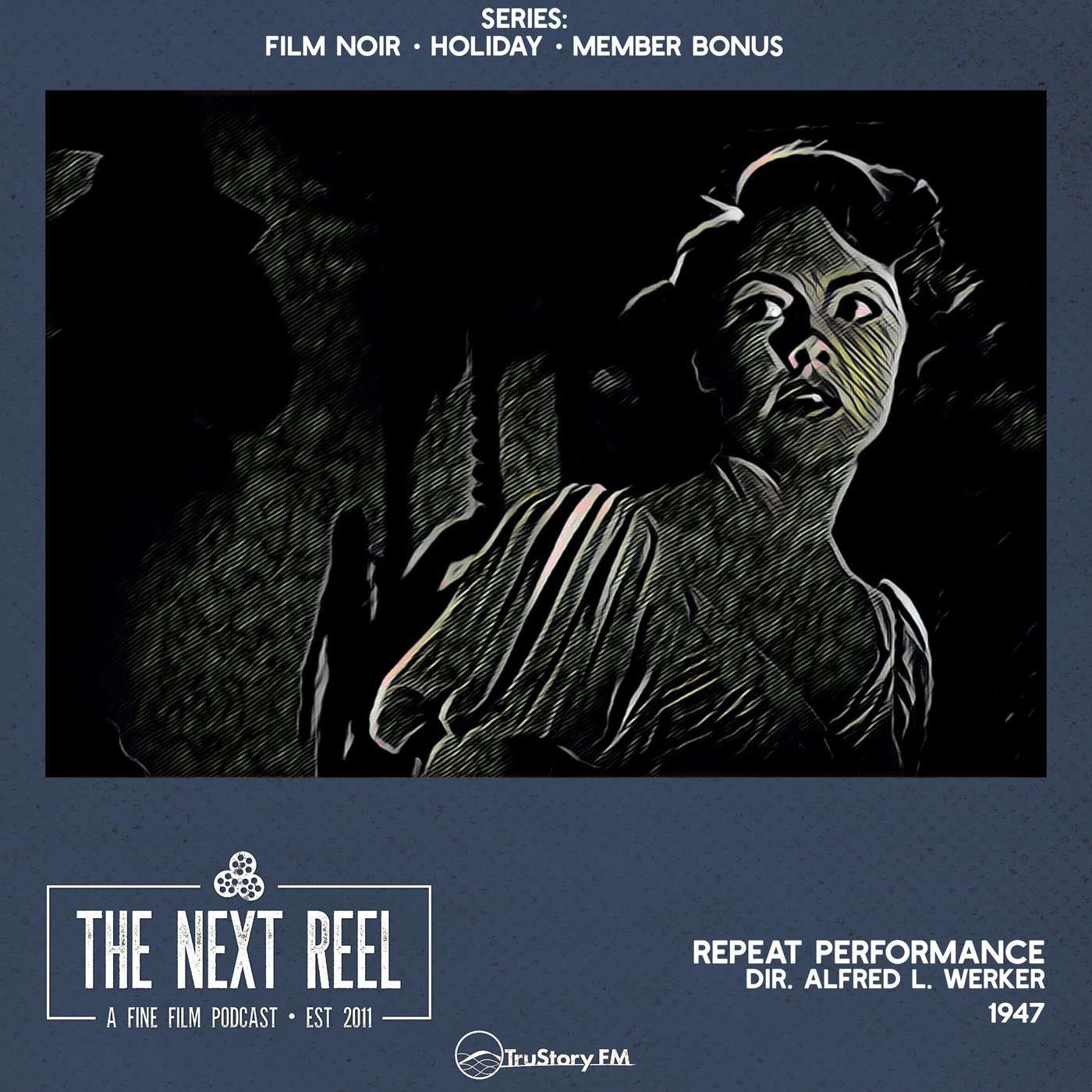
·S15 E27
Repeat Performance • Member Bonus
Episode Transcript
Hey, everyone.
It's Andy from the next reel here with a special holiday message for all of you.
As we celebrate this festive season, Pete and I wanted to take a moment to express our sincere gratitude for your ongoing support and dedication to our podcast.
Your decision to tune in and join us on this cinematic journey means the world to us, and we truly appreciate each and every one of you.
In the spirit of giving, we have decided to do something special with our December member bonus episode covering the 1947 supernatural film noir, Repeat Performance, we are gifting all of you with a full episode so you can experience firsthand the kind of exclusive content and in-depth discussions that our members enjoy.
As a member of the next reel, you'll gain access to a host of benefits, including early access to ad free episodes, additional content, and the opportunity to engage with us and your fellow cinephiles on a deeper level in our members only channels that are part of our Discord community.
If you've been considering joining our membership program, now is the perfect time to get a taste of what it's all about.
For just $5 per month or $55 per year, you can unlock a whole new world of cinematic exploration.
Visit truestory.fm/join to learn more and sign up.
That's trustory.fm/join.
But for now, let's all come together and delve into the shadowy world of repeat performance, where the lines between reality and fantasy blur and the consequences of our choices echo through time.
Join us as we unravel the mysteries of this captivating film and discover the enduring power of the stories we share.
From Pete and myself, happy holidays.
May the magic of the movies continue to bring inspiration and connection to your lives now and always.
And with that, let's step into the intriguing world of repeat performance.
Pete WrightI'm Pete Wright.
Andy NelsonAnd I'm Andy Nelson.
Pete WrightWelcome to the next reel.
When the movie ends,
Andy Nelsonour conversation begins.
Pete WrightRepeat Performance is over.
Destiny's a stubborn old girl.
Alright.
Hi, Andy.
Hi.
We're talking about repeat performance.
I don't think either of us had seen this.
Right?
I think this was a curiosity.
Andy NelsonNot only had I not seen it, I hadn't heard of this before.
Pete WrightMe neither.
I mean, don't don't pretend you're the only one who was in the dark.
Oh, I was in the dark.
Oh, good.
I'm glad that we both were in the dark.
We were both in the dark.
Based on a book, it is a gender reversing adaptation from the book.
Now I kinda wanna read the book, but it seems like it's way darker.
Andy NelsonBut supposed to be quite good from what I was reading.
Yeah.
Pete WrightYeah.
But real sad.
Real sad.
Everybody's bad.
And William Williams, who is Hayes coded gay in the movie, is a cross dressing transsexual in the book who goes by and appears as William sometimes and Mary sometimes and Andy, I think that's gotta be a jab at the college or or the university, William and Mary in Williamsburg, Virginia.
And so I went down a deep rabbit hole on William and Mary, which was, did you know, the first US institution with a royal charter in 1694.
It was founded in 1693, this this school in Williamsburg, Virginia by by William and Mary, William the third and Mary I who was that?
Mary, queen of Scots.
I don't know.
Yeah.
Queen Mary the second.
Anyway, it's a a lot of firsts, and I think that's
Andy NelsonI think they're making a jab.
There's gotta be making a jab.
You know, having never even heard of that school before, I knew nothing about it.
So you're you're bringing all new information to me.
I had no idea there was even a school.
Pete WrightAndy, I got more.
George Washington received his surveyor's license and served as William and Mary's first American chancellor.
Thomas Jefferson, undergraduate graduate from William and Mary.
James Monroe, undergraduate.
John Tyler, undergraduate.
This is where presidents go to school.
This is where old money, old American money goes to school.
That's really amazing.
School?
It is still a school.
It's yes.
Absolutely.
It is the first to boast a full faculty.
It was the first to confirm metallic prizes, which were gold medals donated by Lord Botetourt, governor of Virginia.
It was the first Greek society.
First, phi beta kappa.
It was the first elective systems of study and honor code.
It was the first law school in America, which was also made it the first university, the first school in the country to be a university in 1779.
Andy NelsonIt was the second oldest.
Oh, second oldest higher education institution.
Okay.
Yeah.
Yeah.
Known as a public ivy.
Interesting.
Pete WrightYeah.
First to offer programs in modern languages, political economy, and modern history.
That's crazy.
Andy NelsonThis is this this conversation about repeat performance Yeah.
Sure is off to a rocking start.
Pete WrightThis is why members show for this.
Andy NelsonMore about the history of William and Mary College.
Pete WrightNot many universities can say they've canceled classes because the British invaded.
That's right, Andy.
William and Mary can do that.
That's probably true.
That's probably true.
Not many people can talk about that.
Let's let's talk about repeat performance.
Now that we've gotten all that out of the way.
Andy NelsonNo.
Thank god.
We got all the William College of William and Mary Yeah.
Out of the way.
This is a, the members voted on this.
This is our, December member bonus episode, and we are adding on to the film noir series, of which we just had one edition, Night in the City.
And it's also conveniently adding to our holiday series because it is a New Year's film.
So it's a double bill as far as what we're getting out of this movie, with, Alfred l Worker's repeat performance.
Very interesting film.
One might argue we need to put this on the the holiday list twice.
Oh oh, I see what you said.
Pete WrightDid there?
I see what you did there.
Yeah.
Andy NelsonAlright.
So this it it's an interesting film.
And we mentioned up top that this is a film I hadn't heard of, and as it turns out, you hadn't either.
Spoiler.
Spoiler alert.
And I I think a lot of that is because this film really kind of disappeared for a very long time.
And it was only in 2007 that they did a screening of this movie, and it was, the condition was poor, but people were intrigued by it.
And that spurred on the UCLA Film and Television Archive and the Film Noir Foundation to spearhead a restoration of this film that took from 2007 to 2011, and I think Flicker Alley ended up releasing the Blu ray and DVD of this after it had been restored.
And it for a film that many people had never even heard of before to suddenly have this very unique entry in in noir come out, I think really excited a lot of people because it's it is very different.
It's a story of a woman who has started the film, has made a bad decision, and wishes she could change it.
And lo and behold, Destiny essentially gives her a chance to relive the year and just see if she can outwit Destiny over the course
Pete Wrightof that year.
Okay.
So let's first start with the conversation about destiny, the mechanic of of the, we'll we'll say, Groundhog Day, although now we should say repeat performance day year, how that works in the film for you.
Because the way it manifests, she shoots her husband, Barney.
That's how the the doors blow open.
That's how the movie opens, is she's standing over him with a gun.
Yeah.
He's laying on the floor, very dramatic.
She goes to see her friend who says we should go see our other friend.
And as they're walking up the stairs, the camera sort of crops him out of frame, and then she turns around and he's not there.
And she is just suddenly she doesn't know where he went.
She goes in.
She starts telling Friday, hey.
What's going on?
Friday is the other friend.
John Friday.
Is the other friend.
Right.
She's wearing different clothes, and now we're a year earlier.
How does that whole mechanic work for you?
Andy NelsonI thought it played pretty well.
I thought that they made it work in a fun way where you kind of get this this I mean, it happens in any of these stories where somebody it takes them a while to kind of puzzle through the pieces of what actually is going on.
And we certainly see that here with her trying to, like, figure out, like like, wait a minute.
You're you're commenting on this dress.
This dress, as she realizes, is a year old.
I've I've worn this dress.
Like, last year, I was wearing this dress.
And so she's starting to she's starting to pay attention to all of these little details, and I I thought it played.
And the idea of being given this opportunity to figure things out again.
Because as as we learn from the beginning, we're getting the sense, okay.
She's upset.
Something had happened between her and her husband.
It sounds like, as she described it, he was trying to kill her, and so she kind of shot him in self defense.
As she's talking to to her buddy, her confidant, William Williams, she says, you had a terrible year too.
Like, your year was awful.
We don't know why.
We just know he had a terrible year.
She sits down for a second under a a poster on the wall behind her.
We see that there's a play produced by John Friday.
She's the star, and it's written by somebody named Paula Costello.
We don't know who that is yet, but we do find out as she's talking, like, if if if I could change anything and I wouldn't have gone to London, maybe Barney never would have met Paula.
So we're getting all these pieces, and and that really like, once we get to that point where she's at John's and is realizing what's going on, I I thought it played.
I thought it played really well for her to go, oh, this is a year ago.
This is about when all this stuff happened.
I can now make these changes.
Pete WrightYeah.
Right.
Right.
I think it does too.
I I think practically, the act of just disappearing William on the stairs is really effective.
And it's it's more effective than the trope that many of these time loop movies use, which is you go to sleep one night, you wake up, and it's a different it's it's that night again.
Right?
This go to sleep time loop wake up thing.
This is is a much more sort of active time loop.
We don't understand the mechanic.
We just see something changes, and it's right in front of our eyes.
And I thought that was a bold swing for this movie, and it it really, really worked.
It really worked for me.
Andy NelsonI think they they come up with a way to handle the mechanics that that does play.
And I I think it creates a mystery of having William disappear on the staircase.
Right?
Yes.
Like he he kind of, as you said, he kind of stops.
The camera keeps moving with her.
When she turns around, he's just not there on the whole staircase going all the way down.
And then it leads, like, all the way up to the doorway as she goes to John's door, and is just looking around trying to figure out, like, what the heck is going on?
Like, senses something.
I don't know.
I think that there's a an element to the way that that all worked that I I thought was, it it plays nicely.
Pete WrightYeah.
I think so too.
Andy NelsonI think also Joan Leslie, who's playing Sheila Page here, does it really well.
Like, I buy into her confusion with all of this.
And then, I mean, there are moments in the course of all of this where I do feel like, okay.
Some of this feels like it's 1947 acting and screenwriting the way that it's some of the little pieces are playing.
But largely, I mean, I really did like her in the role.
I thought she did a great job.
Pete WrightI do too.
And and I was reading some of the criticisms of of Joan Leslie's performance, and most of these were contemporary to the film being released, which means they're also based on people who had an affinity to the book.
And because the book is different, right, the gender swap, having Barney be the the time travel victim, in the book, he actually shoots his lover that he's having an affair with.
And she, meaning Joan Leslie's part, is the wife, and she's an alcoholic, and she's really struggling too.
Apparently, part of the reason they did the gender reversal was because Joan Leslie had such a reputation of being pure and the ingenue on screen, and they didn't wanna sully that.
So one of the grand criticisms of this of her role here is that she is the too perfect heroine, that she's written as impossibly virtuous.
And I don't think I saw that in my watch of this movie, impossibly virtuous.
The, quote, absolute untarn tarnished saintliness of Sheila Page dramatically undermined any emotional complexity the film might have had.
That was from a contemporary Letterboxd review.
I did not see that.
Did you see the two perfect heroin problem?
Andy NelsonNo.
I mean, it's interesting because in the context of the original book, I can like, she was she was gonna be like a alcoholic, and there were like, her character in the book was a much darker version of what we end up having with with her husband, Barney, who is the alcoholic in this case.
And definitely darker and kind of like the the idea of her playing that, I can say I can see, okay.
Yeah.
They wanted to change it so she didn't so she wasn't the one who was the alcoholic because audiences might have a hard time buying into that.
As it stands, I don't have that issue.
I don't see that as a problem.
Like, I don't think that she's too virtuous.
I think that, or what virtue she has, like, I don't see that as a part of the problem.
Right?
Like, she's a woman who's trying to keep her marriage together, largely, is the is the case of the story.
She's in love with Barney, and she knows he's an alcoholic.
He's gonna fall for Paula when she goes out of town to to London, and that's gonna kind of, like, drive a wedge in their marriage that leads him to kind of attack her, and then she ends up killing him.
And now she's trying to fix all of that.
And so I don't know.
I I it's odd to have that as a complaint as, you know, that somebody might find her virtuosity to be too much for the film.
I don't I don't see that.
Pete WrightI think so too.
I I don't see it.
I think some of the criticism is levied because she is the virtuous one in a sort of pond of malevolent women in this movie.
Like, they're all, to some degree, either overtly or covertly malicious in how they manipulate either Barney or the family, whatever.
But to me, this is a a woman who is uncomplicated by that sort of darkness that we get in these other women because she's so busy trying to figure out how space time has been manipulated around her and how she is living the year again and why she has all these memories.
And I don't think her being a perfect heroine, too perfect heroine enters into that discussion.
Let her just figure out her place in the mystery.
I was here for it.
Andy NelsonYeah.
I you know, I don't know.
It's it's interesting.
She's an interesting performer, particularly at this point in time, because she had signed a contract with Warner Brothers in '19, '41.
So at the at the start of this decade, and she was a big performer for for the studio.
She was in High Sierra.
She was in Yankee Doodle Dandy.
And really, like, as as a young performer in these films would often, like, upstage some of the performers she was with.
Like, she people noticed her.
Sergeant York is another one.
She was getting, put in a lot of things and or or being offered a lot of roles, and she was really dissatisfied that because, you know, it's the studio system, and and you're kind of like, whatever the studio wants you to be in, you had to do.
She wanted to be in some more serious roles, some more mature roles, and she was always being portrayed as this ingenue.
And and so she and her lawyer actually took Warner Brothers to court to get out of the contract, and they it was it was quite an ordeal, quite a big issue, and it was like one of the early times that an actress or a performer did this.
Jack Warner pretty much blacklisted her, tried to blacklist her.
And so that's why she ended up in this movie because this is Eagle Lion films.
This is kind of that that with all the series of Poverty Row Studios.
It's not one of the majors, and so they didn't have as much money.
So she did two movies with Eagle Lion.
She did this in in Northwest Stampede, and then just kind of kept working and then raised her kids and everything.
But it was a it was a struggle for her because of Jack Warner putting his might behind the, studio system to kind of, like, keep her from working in the studios as much as possible.
And so coming out of all of that into this, I think people walk, especially at the time, walked into this movie kind of expecting to still see that ingenue character that she had always played.
And I I think for her, and I think for us, we're seeing that there's a lot more of an interesting and complex character that we have in this performance than just simply the young starlet getting a chance.
You know?
Yeah.
For sure.
Pete WrightAnd I you know, that sort of makes this the fact that this movie was lost such a mystery because eagle lion I mean, I'm I'm excited to actually hear the budget.
I haven't peaked ahead, but it my in my reading, it seems like they put some money behind this.
They made this a real showcase because they were so excited about her to get this thing out there.
I just yet again, another weird data point as to why did this movie disappear for so long.
It seems like it it could have had a much more robust history.
Andy NelsonYeah.
It's just one of these issues with and, you know, possibly just because it was with, the small studio here.
I mean, Eagle Lion, their library, they had joined they were part of PRC, Producers Releasing Corporation Studio.
They established Eagle Lion, and then, Eagle Lion eventually merged, and I think it ended up becoming part of the new united artists.
So with all of the changing hands that often happens with these movies, it's just possible that it was just something that was in a vault, and they just weren't you know, they probably saw as one of their poverty row pictures, and they just weren't pushing.
You know?
Everybody has a vault these days, Andy.
Put it in the vault.
Pete WrightYeah.
Indeed.
Indeed.
Yeah.
So she's she is I I think Joan Leslie, she ended up having a a career.
It there was, you know, there were some smaller things in the fifties, but, you know, she and she did ended up doing a lot of specials in TV and and a lot of things.
Like, her IMDB is full of, like, the twentieth century Fox Hour and the Chevron Hall of Stars and General Electric Theater, like, full of all those kinds of of things after, you know, after this period of her career.
But I I thought she was fantastic in the movie.
And I think didn't didn't I read she was, like, 21 when she finally when she did this movie?
I mean, was young.
Andy NelsonShe was really young.
She was born in 1925.
So, yeah, by the time she that it came out,
Pete Wrightshe was 22, you know.
Yeah.
That's it's amazing.
She definitely she pulled her weight in this movie.
Andy NelsonYeah.
I think that I think it works well.
And and opposite opposite Lewis Hayward as Barney, I I think that, you know, I buy them as this young actress who meets this writer who had written a play that she starred in and became a success, and they fall for each other, and that's their they are together now.
And she has gone on to be, you know, a famous actress in all these other performances, and he has been kind of the struggling writer, never able to get another success, and always trying but never quite getting there.
And now he's an alcoholic.
And I like, it plays.
Like, that sounds like the type of story that you hear often in in these sorts of, like, relationships between creatives.
Pete WrightYeah.
Did you buy his angst Oh, yeah.
Over the course of the film?
You did?
Andy NelsonYeah.
I I mean, I well, okay.
So, again, like I said earlier, some of it does feel very forties and the way it's performed.
I I buy it.
Like, I can see that sort of stuff, you know, bothering somebody to the point that this is how things are gonna how their relationship is gonna play.
He's gonna fall back into drinking very easily.
He falls for this other woman.
Like, I buy all of that.
I think it all plays well.
Is it always, performed or directed as well as it could be?
Are the lines as strong as they could be?
Not always.
And I think that's some of the struggle I have with it.
But I buy the I guess I buy the concept of what they're what they're going for.
Pete WrightYes.
I buy the concept, and I I buy into the emotional arc even though I honestly struggled with him a little bit, with Lewis Hayward.
And maybe not Lewis Hayward's fault, but to your point, was this part written, performed, and directed the whole cauldron of this character, the way to really honor the angst as it builds across this across the arc of the film.
It just if stars fall for me, it is this relationship where it where they start to fall.
Because he felt actually a little bit too sort of emotionally overwrought, too early, and I didn't always understand his motivation.
Like, what was it about her that drove him to because that's that's his whole thing.
He's blaming her for so much.
And what was it about that that motivated him down this path of darkness?
Now does it always fit into the theme?
Yeah.
Because the theme of the movie is about determinism and and, you know, can we outrun fate?
Can we change our our fate?
That's the premise of the of the film.
And the film's ideology ends up saying, no.
You really you really can't.
Things are the way they are.
But he was he was a weaker link for me.
Andy NelsonYeah.
And I I I see that.
I I I guess for me, I just I didn't see that Lewis was the problem.
Again, it just boils down to how some of it is written.
Like, I struggle sometimes with elements of the story where, you know, she has I mean, and it's it's you can see why Groundhog Day simplified it to a day.
Right?
Like, giving somebody an entire year to redo There's
Pete Wrighta lot.
Andy NelsonYeah.
Requires a lot of time to go through stuff.
And and there are moments where I feel like, okay, you're being a little loosey goosey with your decisions, Sheila, as far as like, okay, let's do this.
Now everything's better.
And and she just kind of lets things go and doesn't think about the fact that I still have to be paying attention to all of these things.
Pete WrightLike Yeah.
Andy NelsonShe decides to do this play again that she knows that that, Paula had written, and she totally trusts that everything will be okay.
She trusts that John is gonna keep Paula away.
She doesn't realize Barney's gonna draw her in.
And then once he does, it's like she still is just kind of going along with everything.
Like, it's gonna all gotta be okay.
Like and I think if there are frustrations I have, it's it's some of the the workings of the story and how they put it together and just the construct to kind of keep keep things moving as best they can, but still, you've got an entire year to do it.
And so it makes it a little clunky as far as the way that they have to shift things and move things.
And and so, like, you know, they go to California and and make changes.
Like, she's making active changes to her entire life that she knows theoretically are doing things the way they should based on on how they went to the previous year.
She knows they you know, she didn't go to London, but now mysteriously, Paula has decided to come here.
She goes to California, and then John brings this that script to the new play.
Like, everything still pushes in, and so she's not active enough in in making this those changes.
And that plays with Barney also, who like, she she sees all of this, and she's trying to to fix things.
But I just don't ever get a sense that she's actively working on the relationship.
And as you said, like, why does Barney seem to hate her so much?
Maybe that's what she needs to be doing instead of just taking them off to California.
Right.
Right.
And in in that regard, I
Pete Wrightmean, you get me thinking.
Like, maybe this should have covered the first week of the year instead of the whole year.
Right?
Like, maybe it was just the last week leading up to the New Year's party.
Andy NelsonYeah.
From Christmas to New Year's again.
Pete WrightYeah.
Yeah.
From Christmas to New Year's.
Because there is just a lot of sort of hand waving we have to do to end up believing that their emotional arcs are are paced appropriately.
And and that's that I think is it is a is the way to to frame the falling stars.
I like that.
Andy NelsonYeah.
Which I mean, it's it's an issue.
It's still I mean, it still plays very fun.
Think in the general concept is a lot of fun, it works.
And in the scope of, like, if you step back and you say, okay.
Barney is just a hateful person because she has they both had this huge success.
She's the star that came from it, not him.
And, like, there's just this bitter jealousness that jealousy that he has, and he can't let that go.
And I think that drives into him over and over to the point that that's why he hates her so much.
And so I buy I I I do buy that.
It's a lot of those other plot elements are what make me struggle.
Pete WrightYeah.
What about the other friends?
We have Friday and William Williams.
Andy NelsonI think Friday is just a a good figure to, like, bounce things off of in the course of the story.
Right?
Like, he works well as, Tom Conway plays him, and I think I think he just delivers that sort of role that we need here.
So I I enjoyed him.
I thought I thought
Pete Wrighthe was fun.
He's kind of a nice engine for plot engine.
Right?
He worried about moving things forward?
Don't worry.
Friday's here.
He's gonna take you to another room where more things will happen.
That's that's kinda what he does.
William Williams is interesting because, first of all, he's he is one of the earlier sympathetic depict depictions of gay characters on screen.
It is deeply coded, but that plays for me.
He's such an interesting character, and he is also pivotal in a way that Friday is not.
Right?
He's pivotal because a lot of the greatest acts of malice happened to him.
The fact that he is not once, but twice institutionalized by by missus Shaw.
So he's institutionalized, and, yeah, he realizes, oh, I can walk out of here on New Year's Eve.
He does that twice, but he also ends up being such a huge sort of enmeshed part of her life and her trying to rebuild her memory and her the the structure.
But after reliving this year, that he ends up saving her and being the one who shoots Barney.
Barney ends up dead anyway, but William Williams is the one to pull the trigger and is taken away again.
He is the dramatic punching bag of the story.
Andy NelsonYeah.
It's an interesting, an interesting character.
And yeah.
It's interesting.
They say they say that the way that he's kind of written is coded gay, and I suppose maybe that is because of how the character William and Mary was written in the book.
Right?
Where he was, transvestite, and there was a much different way that his character was portrayed there.
So my hunch is that they kind of say he's coded gay because of that.
But honestly, when you watch the film, I I didn't think of him as coded gay.
I thought he was actually in love with Sheila and wanted her, but knew that she was with Barney and and was just, you know, wanted to be in her life regardless and just, you know, just always pining for her for the thing that he would never be able to have.
So that's that's kind of how I saw that relationship.
Pete WrightThat's interesting.
I I saw it as coded gay.
I saw it as coded gay the moment he comes out.
He's kind of a he's they call him the poet.
I guess that's the thing.
Like, he's the poet, and that He's a poet.
He is a poet.
Andy NelsonRight.
It's because he he writes poetry.
Pete WrightHe writes poetry.
Right.
So, yeah, they don't just call him the poet.
Well, I mean, I understand that.
They call him the poet.
He rides in for the
Andy NelsonThey call us podcasters, but are we
Pete WrightHe's actually a blacksmith.
Right?
He's he's really a poet.
He's the poet.
They call him a poet because he's a poet.
And that to me felt like just an additional bit of coded language that that, like, I don't know that that Tom maybe Tom Conway could could be called a poet.
Lewis Hayward would never have been called a poet.
Richard Behzhardt is playing a guy a guy that could be called a poet.
How about that?
Andy NelsonOkay.
Okay.
Pete WrightI just I I felt like he was like he had he was he was exuding sensibilities that felt coded gay to me.
And but I don't know, man.
Who knows?
Which is interesting because sometimes they do that because the actor themselves is gay.
Right?
Mhmm.
Andy NelsonAnd that's not the case here.
No.
But again and and maybe that's why I read it like he just he's he wants her, and he just can't have her as opposed to the book, which and so it's very interesting, very different.
You know what I think is funny about Richard Basehart that I don't think I ever would have been able to tell you, but he is the voice he's the character of Wilton Knight in Knight Rider, and then which we only ever see in the very first episode.
And then he's the voice in Kit in the or the narration, sorry, in the rest of the series.
Pete WrightReally?
Yeah.
A man who does not exist.
That's him.
Andy NelsonThat's him.
Yeah.
It's because he's got that great voice.
Pete WrightYeah.
He does.
He really does.
You might say the voice of a poet.
Or the voice of a
Andy NelsonI was gonna say voice of a car.
But again, he's not the car.
Pete WrightHe's not the car.
Right.
Right.
He's a billionaire industrialist playboy.
Andy NelsonExactly.
Just like Batman.
Pete WrightAlright.
Anyhow, I felt like this sort of cadre of performers was was really fun.
Andy NelsonWhat did you think of missus Shaw, Eloise Shaw, the one who she she's essentially the older rich woman who knowingly takes on these younger people like William Williams just so they will essentially be her.
She's she's their sugar mama.
And that's kind of her whole thing.
As long as they're good to her, mom will be good to you.
That will still be good to you.
Yeah.
Did you recognize her?
Pete WrightIt it was one of those things.
She was very familiar to me, and I admit I could not place the face until I looked her up.
And oh my god, man.
Oh my god, have I spent time with this woman.
So much time.
Andy NelsonAs soon as I saw her, I'm like, Gilligan's Island.
Pete WrightYeah.
Andy NelsonLike, I she's missus Howell.
Like, I pinned it immediately.
She's just so familiar to me.
Pete WrightYeah.
That was so funny.
That was the tip of my tongue.
Like, I was very frustrated by the the fact that I could not I could not figure out who she was.
So I regret that.
I'm grateful that you were able to have that experience.
Andy NelsonThat was very very satisfying.
Very satisfying.
Pete WrightYeah.
She's great.
She's funny.
Andy NelsonShe's fun.
And Virginia Field plays Paula.
She's another actress that is, you know, very familiar in a lot of projects in the, in this period of time, and, you know, good British actress.
Like a Connecticut Yankee in King Arthur's Court she was in, and, what else was she in this?
Oh, Eternally Yours.
That's a good one from 1939.
I don't think I've seen that.
Yeah.
Yeah.
But she, you know, she plays kind of I don't know.
It's interesting.
I was reading a a review about this, and because this is called a a film noir, and there are a lot of people who argue about whether this actually is a film noir.
Glenn Erickson, in his review of the DVD, he said, repeat performance also reminds us that noir is a style, not a genre.
The definition of noir has eased to include, sometimes grudgingly, thrillers with overt supernatural content, like Night Has a Thousand Eyes or Alias Nick Beale.
This film plays out in a realist realistic cinematic space even with its twilight zone like aura of mystery.
So I I don't know.
I'm curious where where you land as far as how this fits into noir.
Like, would we call Paula a femme fatale?
It's very shadowy.
It's about crime.
There's kind of an inevitability to the story that we have here as as we build to the end and realize destiny isn't gonna let any of these people out.
Like, where
Pete Wrightdoes where does that land for you?
That's really interesting.
I I I I like that that we're easing noir into the term of style, not genre.
That I I think that is primarily its its strength as a visual style.
But there's enough fatalism and determinism conversation that that I think it it definitely fits.
It's not a it's not a happy it doesn't give us any sort of joy.
This is not a typical joyful holiday film.
The femme fatale so Sheila is emphatically not a femme fatale.
Right?
She gets to be our virtuous protagonist.
Andy NelsonI think she would have been had they not reversed the the genders, and and she had been the alcoholic.
Pete WrightRight.
So Paula gets to be, you're right, the destructive sort of female presence.
She's the one who pursues Barney.
She's the one who enables his worst impulses.
She's the homewrecker.
I I but she's kind of secondary.
She's like a displaced femme fatale because her overt sexuality, I guess, disrupts their domestic stability, but she's not a principal she's not a sort of the principal character that we would normally associate with the the role.
I think Barney is the the doomed male.
Or is he the om fatale?
Om fatale.
Did you just make that up?
I did.
Andy NelsonYeah.
I tried to come up with something French sounding.
Pete WrightThat was good.
Om fatale.
That was really good.
Clip that.
Somebody clip that, social media.
We just made a thing.
Nice.
Nice French.
So all the other things, right, all the other tropes, crime and violence and social commentary and, you know, our our as you mentioned, the poverty rogue sort of pedigree, it all fits.
It all fits.
You do have to have to embrace the sci fi fantasy kind of time loopiness.
But I I was never taken out of the noir experience in this film because of the hand wavy time loopiness.
Andy NelsonWell, here's a question regarding destiny, I suppose, and the time loopiness and how it fits into noir.
In the original, you know, the original ending of her situation, Barney had been coming at her.
She had found a gun and and shot him, and that's kind of where we start the film.
And now she's trying to figure out how do how am I gonna go get away with this?
And I loved the line that they say, should I go to call the police?
And he's like, no.
They have such one track minds.
They'll only arrest you.
Was just like, this is very funny.
And then that leads to this whole thing.
And as we build to the end, we get, again, a repeat of the situation where Barney comes at her, and this is the change.
William Williams, because she's kind of given him enough information to buy into everything that she's reliving everything.
Like, all of the stuff that he warned her against missus Shaw, yet he doesn't listen, and he ends up in this in insane asylum.
And so he gets out.
He is now the one who kills Barney instead of her.
Is that a fair way for destiny for one to let her off the hook and for a film noir to let her off the hook?
Pete WrightYeah.
That's a it's a good question because, like, in that regard, this is more hopeful than any other film noir would permit if we were being pure classicists.
Yeah.
Because she gets to live.
She is, as you say, off the hook.
She's freed from the abusive husband.
She's not going to prison.
She's not going to prison.
That's all the elements of, like, standard wish fulfillment that cuts against the irony of, like, the bitterness of traditional film noir.
Even though Williams is arrested, Barney is dead, everybody around her ends in what I would argue is a classic film noir fashion.
It's grim for everybody but her.
And in that regard, maybe that's what is grim for her.
The fact that the world around her tends to collapse even though she's off the hook, she has to live with it.
Andy NelsonYeah.
She's living with the fact that destiny said no.
William Williams will still be in the asylum.
Your husband will still be dead because of all
Pete Wrightof this.
And the price you have to live with, Sheila, is that you have to know that you did everything you could and you couldn't escape it.
Andy NelsonSo, okay, so then this is an interesting question.
So why does Destiny let her try it again?
Yeah.
I don't know.
Is the entire point for Destiny to say, see?
And now she has to live with the fact that she lived that entire year twice and wasn't able to change anything, which I don't know, maybe make you feel okay in the end that, you know what, it's it's out of my hands.
It's Chinatown, Jake.
Pete WrightIt's Chinatown.
Right?
Like, you I I do think there's something to that.
Right?
That she is like, that you're doesn't matter what you try.
Even if we let you take a stab at it, you will never escape inevitability.
Yeah.
That's I mean, that's in this in the context of this movie, I think it's exactly as hopeful as it needs to be, which is not very.
She learns a very valuable lesson.
Even though she doesn't go to jail, she's still going to be imprisoned by the experience and by the fact that she's lost her friend and her husband, and she had to to essentially do that twice over the course of two years.
Right?
She lived two years in one, and that's grim.
Yeah.
Right.
I am more sad about this than I was when we started talking.
Andy NelsonYeah.
Like, can you imagine the state it puts her in at the end
Pete Wrightof all this?
It's crazy.
Andy NelsonYeah.
It's it's dark.
So maybe it is.
Maybe that does lend to the very noirish nature of it that, you know what?
There's there's no way out.
I mean, it could have just been called no way out because there really is no way out of this.
There's no way out.
Yeah.
You're trapped in this in this vicious cycle that destiny has has created for you.
And as you said right at the top, destiny is a stubborn old girl for sure.
Pete WrightI I think it gets muddy when you it's the number of people that I've read talking about this movie saying it's got a twilight zone vibe.
Yeah.
It is well, I'll just say it's too many.
I think that's too easy a way to catalog this movie as something other than direct noir.
It does have the opening sort of narration and the whole philosophical kind of premise, the what if premise.
I mean, you can kinda read this as a Rod Serling homage, but I the more we talk about it, the more I realize I think this film is trying to say something something more.
Andy NelsonThere's definitely something interesting with the nature of, its messaging as far as you can't get out.
Like, this is I I think it's really just like when you make choices, you have to live with them.
Like, you're gonna have to live with them, and and that's life.
Like, life can be unfair, and so you're just gonna have to deal with the consequences and and find your way through that, which, again, she has to do twice now.
And so, yeah, it's it's, it it makes me wonder where she'll go from here.
You know, her husband's dead.
William is, back in the back in the asylum, and she's still in the play with Paula's the Paula's play, produced by Friday.
And so, yeah, it makes you wonder if she wants to continue that or if she's gonna find a new direction.
Go out to Hollywood again.
Pete WrightIt does make me think, and I don't I don't know that we've ever talked about this.
Like, when you you asked how does this fit as a noir, and I guess it it implies the the like, are you a generous do you have a generous view of what is inclusive of noir or more of a strict sort of classical view, a historical view?
I mean, when this movie came out, noir wasn't a thing.
Like, the we had no words to define what noir was.
And I think I come down sort of more productively that this is a a film with a lot of stylistic hints at noir, but but it resists kind of super easy categorization.
And I like that it's got some instability to it.
Right?
It is noirish.
It's melodrama.
It's fantasy.
It's domestic thriller.
And I know that there are people out
Andy Nelsonthere who are gonna say, well, it's not strictly noir.
What are you?
Are you generous?
Are you strict?
Are you classical?
You know, as I have been working on my Cinemascope podcast where we you know, I explore different genres and subgenres and film movements, I have found that I've become a little more, loose as with terms and descriptions and everything because I think everything is so malleable, and there are so many different films that we have.
And I think it's you can see why certain things they wanna cut off and say, well, film noir really only is from 1941 to 1957, and anything outside of that is neo noir or something else.
And it's and all of these rules, like, there's gotta be, it's gotta be black and white and the femme fatale and all these different things.
And I think that, you know, especially in the scope of something that was kind of categorized after the fact, I I think that it really is just like more of the tone.
And so I I find myself much more generous with with the with the descriptor.
And, you know, I mean, yes, a style, but a genre is a style.
So I think it's fine calling it a genre, but I don't think it has to be a genre, like a rigid genre with, like it has to have all of these rules in order to fit.
So for me, it feels very much like a film noir.
The tone, the the bleakness, like
Pete Wrightthe Philosophical pessimism.
Right.
Exactly.
Andy NelsonYeah.
So Yeah.
I think it's for me, I'm fine calling it a noir.
Okay.
Pete WrightWell, we're in violent agreement.
Lucky.
Andy NelsonWhat else?
I feel like I mean, we talked about the the book, which I think is is crazy.
I I but again, I really wanna read that now, especially just to get a sense of the whole shift of of genders and everything.
Pete WrightYeah.
William O'Farrell, 1942.
If anybody's looking for the book.
I haven't checked to see if it's in Libby.
Andy NelsonHave we talked about l William O'Connell, the cinematographer, before?
I don't believe we have.
Definitely a very busy cinematographer who's ended with three films, Jigs and Maggie.
You had a lot of Jigs and Maggie films.
I've never heard of the Jigs and Maggie films that came out right around this time.
Pete WrightInteresting.
Andy NelsonYeah.
Not a not a cinematographer I'm very familiar with.
From the silent era all the way.
Oh, he stuff with, Howard Hawks.
So it's maybe entirely likely that I've seen something that he did then.
Well, the look, I think, works well for noir.
And I think playing like, it's not as, like, deep shadows and stark contrast and everything, but it definitely has, like, a lot of night and kind of, you know, everything kinda still feels of that world.
Pete WrightHe does play close too.
His his he's he's pretty intimate.
And I think, like, there are some striking shots of Joan Leslie just exuding mood, sometimes crying.
And I think he's he captures that sort of intimacy very, very well and very naturally.
I love the opening shot, right, as we move in toward the apartment, toward the balcony, toward the doors opening.
I think it's really super dramatic.
I think it's he's got a really nice sense of classic noir techniques.
Right?
Churroscuro effects.
I I he's really playing with texture and tone, and a lot of the the sort of backstage kind of melodrama that this movie lives in gives him a lot of room to play in lights and darks.
So I'm I think it's really impressive.
Andy NelsonYeah.
Yeah.
Alfred Worker, though.
Our our director.
Yeah.
Pete WrightYeah.
What do we what do we know?
Have we seen anything of him?
Andy NelsonYou know, I have seen some stuff.
Things like he worked on for Disney, he worked on, like, the reluctant dragon.
So, like, things like that that he had worked on, but not much.
You know, I haven't I I don't feel like I've seen much of of his work.
Yeah.
I I have not either.
Pete WrightI I'm looking at at at some I I mean, some of the stuff that he's he's done, he was apparently known as something of a film doctor, you know, stepping in to finish works that were struggling, both as director, editor.
He was he was kind of all over the place.
But, you know, I I don't even I maybe I saw the adventures of Sherlock Holmes, the 39.
We didn't talk about it, but it does remind me we should do more.
We should do we did Baskerville.
Andy NelsonThe heart of Baskervilles.
Yeah.
Pete WrightWe should do more Holmes.
I miss Holmes.
But yeah.
No.
I I haven't seen anything else that he's that he's done of note, of memory.
Andy NelsonYeah.
I there he did some Laurel and Hardy stuff, so it's possible I've seen some
Pete WrightOh, yep.
You're right.
Andy NelsonAs well.
So Yep.
One last note I have.
George Anthiel.
I'm not sure how you say his last name.
The composer, which I I loved the music for this.
He, along with Hetty Lamar, developed the radio guidance system for Allied Torpedoes that used a code stored on punch paper tape to synchronize frequency changes.
It was the which they called frequency hopping between the transmitter and the receiver.
They were inducted in the National Inventors Hall of Fame in 2014.
I'd always heard about head Hedy Lamar doing that, but I didn't realize that he was working on it with her.
And I think that is very interesting.
Pete WrightThat is really interesting.
Apparently, they called him the bad boy of music in the nineteen twenties.
Andy NelsonHe looks like it.
He looks like it.
Pete WrightI would want I was wondering if you'd like to be the bad boy of podcasting.
I thought I already was.
Okay.
Andy NelsonYou're right.
Yeah.
Yeah.
Well, it's a fascinating film.
I think that's it.
So we'll be right back.
But first, our credits.
Pete WrightThe next reel is a production of True Story FM, engineering by Andy Nelson, music by Quentin Koblenz, Oriel Novella, and Eli Catlin.
Andy usually finds all the stats for the awards and numbers at d-numbers.com, boxofficemojo.com, imdb.com, and wikipedia.org.
Find the show at truestory.fm.
And if your podcast app allows ratings and reviews, please consider doing that for our show.
Do how many times do I get to watch remakes?
One time.
One time.
Andy NelsonJust one times.
And interestingly, it is a remake of this and not of the book.
Again, it is the woman who wishes for another chance and gets one life to your live over again.
It's the TV movie, turn back the clock from 1989, starring Connie Selica, the name I feel like I haven't heard since probably the eighties to '89.
Generation.
Yeah.
Pete WrightVery much of that era.
Yeah.
Andy NelsonI don't know.
I'm curious.
Joan Leslie does appear in it in a cameo, so I thought that's nice.
Pete WrightThat is nice.
And I'm we're gonna skip awards because apparently this movie had already disappeared by awards season.
Yeah.
They lost the print.
Nobody saw it.
Andy NelsonYeah.
And these, you know, poverty row films, I don't think people are making films there with the hopes of awards or PhotoPlay magazine even.
Pete WrightAlright.
So how to do at the box office?
Andy NelsonWell, it's hard to say exactly how much Worker had to make this movie.
In Tom Weaver's It Came From Horrorwood book, someone says the budget was $600,000.
But according to Brian Foy, Eagle Lion's production chief, this film set them back 1,300,000.0.
Maybe that's prints and advertising.
I don't know.
It's possible either are right.
But for our purposes, I'm going with the higher number, which is 18,500,000.0 in today's dollars.
The movie opened 05/22/1947, and, unfortunately, I have no idea how it did.
So we're just gonna have to leave it there.
My hunch is it did okay, but not well enough for them to manage the prince very much better, you know?
Pete WrightYeah.
Well, I really enjoyed my time.
Is it a five star in a heart?
I'll spoil it.
No.
Not quite.
But did I have a great time with the movie?
Absolutely.
I think it it it does exactly what it needs to do.
Yeah.
Even with the sci fi twist.
This is
Andy Nelsonsci fi.
I'd say fantasy.
Pete WrightFantasy.
Even with the fantasy twist that that might dial it out of the noir range for some.
I think it works very, very well.
Andy NelsonYeah.
I have a I have a lot of fun with that.
So alright.
Well, that is it for today's conversation.
Next month, we'll have just started our True Lies series, so we are adding on to that.
The members voted for us to discuss Steven Soderbergh's 2009 film, The Informant, starring Matt Damon.
Have you seen that one before?
Pete WrightYeah.
Andy NelsonI don't really remember it at all.
So I'm curious to to check it out again.
I remember I liked the score a lot, and that's all I remember about it.
Pete WrightBut it's Soderbergh, so It's Soderbergh.
Well, Soderbergh's was he retired when he made this movie?
Was he not
Andy Nelsonretired when he Was he a manager?
Pete WrightNo roller coaster.
Real roller coaster.
Andy NelsonYeah.
Yeah.
Alright.
Well, hey, what do you
Pete Wrightsay we do our ratings?
Letterbox.com/thenextreel.
That's where you can find all of our reviews and ratings for the movies that we talked about on this show.
And, yeah, what are you gonna do?
Andy, how many hearts?
Where are they coming from?
That's the rule.
You're not gonna follow it.
Andy NelsonGo.
I I had a really good time with this one.
I I thought it was an interesting spin on a story like this.
It felt very you know, it was kind of a nice surprise.
I do struggle again with some of kind of the way the story is constructed, some of the elements that drag on over the course of the year.
But largely, I still had a lot of fun with this.
I think this is a fair three and a half and a heart for me.
Pete WrightThree and a half and a heart.
As you know, no half stars right here.
So the question is three stars and a heart or four stars and a heart?
I think I think just because of the kind of day it is, I'm trying to combat some rain soaked environmental woe and recording in the point where it's still dark.
I think I'm gonna choose glass half full, Andy.
It's four stars and a heart.
Wow.
Look at that.
Repeat performance.
Interesting.
I really enjoyed my time.
Andy NelsonYeah.
That was a lot of fun.
Yeah.
And it did look great.
I mean, the restoration they did was was beautiful.
It's beautiful.
I mean, I don't know where you watched it, but I watched the restored version that's on Canopy.
Big screen, baby.
Big screen.
Huge In the headset.
Well, averages out to three and three quarters, which will round up to four stars, which you can find on our account at Letterbox at the next reel.
You can find me there at Soda Greek Film, and you can find Pete there at Pete Wright.
So what did you think about repeat performance?
We would love to hear your thoughts.
Hop into the ShowTalk channel over in our Discord community where we will be talking about the movie this week.
When the movie ends, our conversation begins.
Pete WrightLetterbox give it Andrew.
As Letterboxd always doeth.
Where'd you go?
High, low, popular, cool?
Andy NelsonI ended up at one and a half stars.
Pete WrightOne and a half stars.
That's that's near the bottom of
Andy Nelsonthe barrel.
Toward the bottom.
Yeah.
I know.
Pete WrightOkay.
What'd you get?
Andy NelsonI went one one and a half by TB Kane.
Listen, girls.
Don't aspire for better things because you drag down your friends too, is the moral of this movie, I think.
I just it's not that it isn't well acted.
It's just the husband is such a giant man baby that throws a fit anytime he doesn't get his way.
By halfway, I was wanting him to die again so Sheila could be free and much happier with someone else.
He doesn't have any redeeming features.
She's stronger than me because if I ever caught someone cheating like that in front of all my friends and coworkers, oh, divorce would be filed the second the courts open the next day.
It's just he has nothing to redeem himself or show why Sheila likes him.
He'd think he'd have something, but nope.
It's also so weird that every woman in this film is evil and conspiring against our lead besides her maid, like they all go against her wishes at one point and intentionally seem to sabotage her life.
It's just a boring way of doing characters.
Pete WrightWow.
Okay.
Alright.
I get one and a half out of that.
I've got three from Gentry Austin.
In your right hand, a smoking revolver.
A very bitchy cast of characters in this time travel New Year's noir poverty row studio, Eagle Lion, which opens with the end at the end of a terrible year, the worst year ever, with Auld Lang Syne playing like a funeral dirge.
You can tell the b movie studio had lofty aspirations for the film because the opening credits are in cursive.
It's a solid entry in the pantheon of great noir films that open with a woman, in this case, Joan Leslie, holding a recently fired gun.
Leslie is good as the befuddled actress trying to course correct, but finding fate more stubborn than she expected.
But the real draw is the supporting players, Lewis Hayward as a bad bitter husband, Tom Conway as the platonic friend, a warm refuge, and Richard Bazhardt as the tragic gay poet who is institutionalized when he turns down the advances of a moneyed older woman.
Beshart understandably got a lot of praise for his sensitive unexaggerated portrayal of a closeted man in crisis, his character arc more devastating than anything Sheila Page goes through, sacrificing his freedom for the cis white woman's life.
Three stars.
Yeah.
Wow.
Andy NelsonI just think he loved her.
Pete WrightI think you might be an island.
Andy NelsonI I I think he loved her.
Pete WrightYou might be on an island.
Andy NelsonI was watching him, and I'm like, this man is in love with her and just can't do anything about it because she's with a buffoon.
Pete WrightYeah.
Yeah.
I think there's a tweak maybe to to some of your some of your read the room sensors.
Andy NelsonWatch it again and see how it plays.
Like, I and I will too.
Okay.
Next time I watch it, I'm gonna be I'm gonna be checking.
I'll be keeping my eye on that.
Pete WrightOkay.
Alright.
I'm good.
Thanks, Letterboxd.
Andy NelsonAlright.
Brian.
Brian is clearly in your camp as far as
Pete WrightThousand percent coded gay.
Andy NelsonOh, let's see.
I appreciate making the husband an egotistical menacing shrew, one of those nineteen forties era hittable faces and broad performance styles.
Do you think the acting style serves this movie well?
Pete WrightYeah.
I do.
I mean, it dates the film.
Right?
For, I I guess, modern viewers, it it can feel like maybe an obstacle to to engagement.
But, you know, I I think the period was much more accustomed to externalized raw performances, and I think Hayward's sneering was great.
Not hammy, but but that's that was what we we ex were to expect from these performances.
And, you know, this is a movie that paints in broad contrast as so many of these movies did.
And and sometimes it's just like, here's a giant paintbrush painting in the color villainy, and it it just has to be that stylized because that's that's the movie we're in.
It is exactly the movie that they're they are all in the movie that they need to be in.
Andy NelsonYeah.
I agree.
I agree.
Do you think Rod Serling or other Twilight Zone writers saw this and were fans of it or the book?
I I would imagine.
Pete WrightYeah.
I think they were.
Andy NelsonYeah.
How bold is it for someone with the last name Williams to name their son William?
Right?
Yeah.
Yeah.
It's like if your if your child's daughter's last name is Wood and naming them Holly.
It's any of those sorts of things.
It's like Right.
Very Andrew Andrews.
Yeah.
There you go.
Yeah.
Would you call the melodrama campy?
I guess this just goes into kind of what you're just saying about the acting style.
And, you know, campy isn't something people generally set out to do.
It's just something viewed by later generations as to how it was portrayed.
And, I mean, I could see some of this falling into what you would say is a campy style.
Well, interestingly though, do you
Pete Wrightthink that undercuts the noir?
Does it go further toward undercutting noir?
That's what I
Andy Nelsonwas about to say.
It's like, I don't I don't know if I'd read it specifically as a camp film because of the noirish nature of it.
You know, I do think that the noir is it the is it the is it the camp undercutting the noir, or does the noir end up kind of, like, toning down the camp?
You know?
Because I mean, I've seen plenty of noirs that are also have the same sort of over the top acting style.
And I just I feel like it's maybe I just read that more as just part of the noir elements of it.
Pete WrightYeah.
Maybe.
Andy NelsonYeah.
Alright.
Well, that's it.
Great movie.
Thanks.
A lot of fun.
I'm glad the members picked it.
And Me too.
Yeah.
We will be back, next month to talk about The Informant.
And then before that, we'll be back to talk about Once.
Yeah.
As we kick off this other thing.
So this next series.
So Right.
So many movies to talk about, Pete.
I know.
Pete WrightSee you tomorrow.
Okay.
Bye.