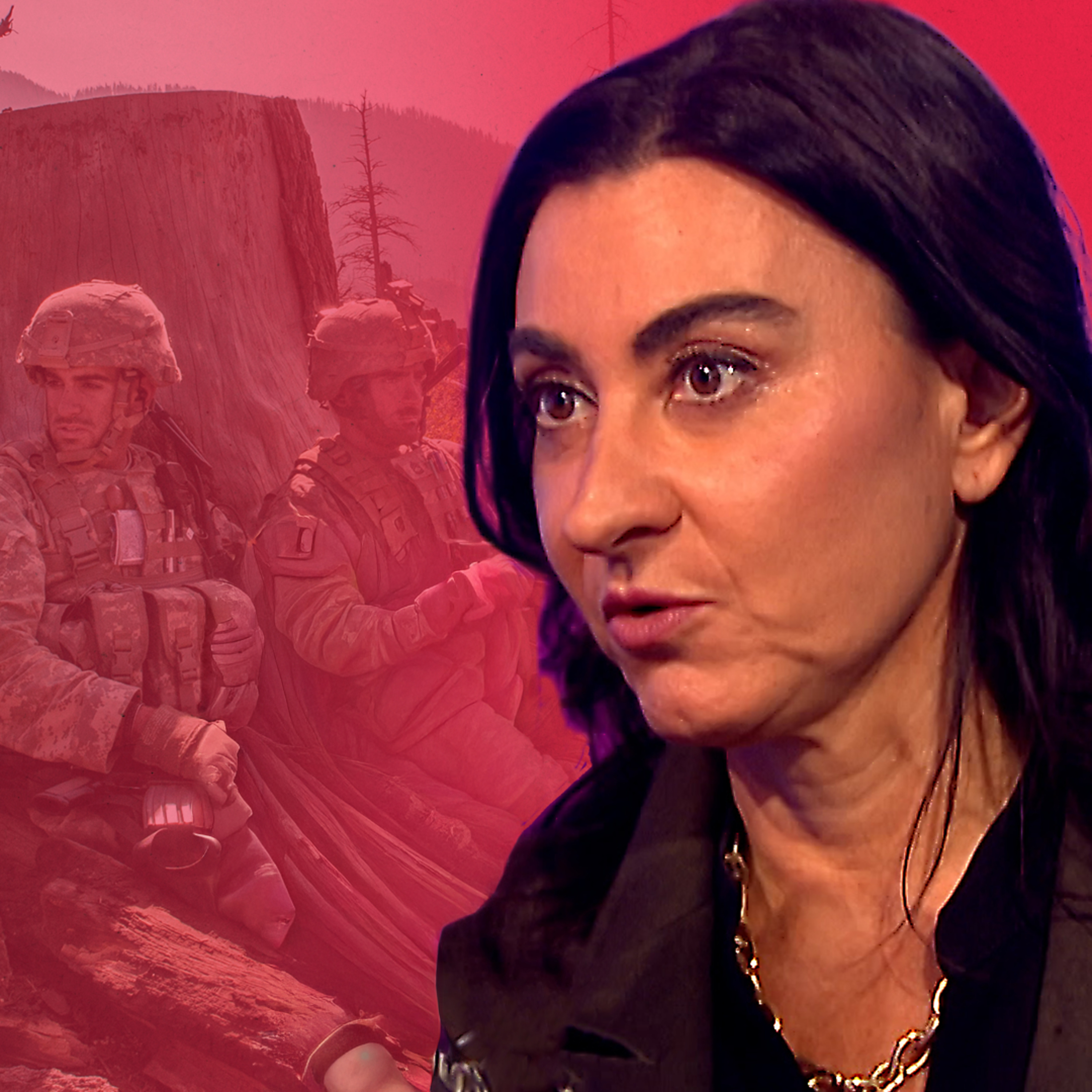
Why I risk my life to show the truth - war photographer Lynsey Addario
Episode Transcript
I've been kidnapped twice.
I've been thrown out of a car on a highway in Pakistan, I've been in a Taliban ambush, I've been ambushed by the Iraqi insurgents.
It goes on and on, and I think that somewhere I have to convince myself that I will come home.
I don't know how many men who do this job with children.
Hello and welcome to Ways to Change the World, the podcast in which we talk to extraordinary people about the big ideas in their lives and the events that have helped shape them.
My guest today is Lindsay Addario, A Pulitzer Prize winning American photojournalist who has spent two decades covering conflict and humanitarian crises across the globe, travelling to the front lines of some of the world's most dangerous countries, including Afghanistan, Iraq, Sudan and Ukraine.
She has a string of alarming personal stories to go with it.
She's been detained by the Libyan army, forced to go through an X-ray scanner three times by Israeli forces who knew that she was pregnant at the time.
She's now the subject of a featured documentary about her life as a conflict journalist, wife and mother called Love and War.
She once said, I realise with every assignment I do, there is a chance I might not come home.
Lindsay, welcome.
Thank you.
If you could change the world, how would you change it?
I guess I'm working on that right now with my work as a journalist, as a conflict photographer.
With every assignment, I set out to try to change the world just a little bit for the better.
I'm trying to enlighten people, educate people, show them a different perspective, maybe change their minds and foreign policy, and that's sort of the little part I can play in changing the world.
Yeah, I mean, you're, you're very upfront about that in the in the film, but obviously you're a journalist.
Yeah, you work for the New York Times.
Freelance.
Yeah.
And you know, and and and journalists don't necessarily take defined positions on things.
So when you say you want to change the world, what do you really mean?
I mean, do you do you, do you?
Do you go to a place and go I want this to stop, I want them to win.
Or what do you mean by that?
Well, I think what I'm trying to do more than anything is inform the world, right?
I'm trying to show what's happening on the ground from any perspective, from all perspectives that I'm given access to as a journalist.
As you know, a lot is determined in our coverage by what we can access.
And I think in Ukraine, we've been covering the side of the Ukrainians because as we see our colleagues who try to cover from the side of Russians or sometimes and often detained or disappeared.
And so I think for me, it's always about informing the public.
It's about not taking a side personally, but really about sort of showing what's happening and documenting.
Now, I, I think the thing that's perhaps different about you as a photojournalist compared to a lot of us who go to these same, same places, is that you, you, you really want to get to the front.
You know, if I go to a war zone, my aim is not necessarily to get to the shooting bits of the frontline.
You definitely want to be there, don't you?
Well, I trust my mother is not listening to this podcast because she's in America.
But yeah, I think often the most interesting and compelling stories are happening at the front and happening in the most dangerous places because they're often the stories that are being under covered or that are more difficult to cover.
So I think it's not always I want to go right to the front, but certainly in the beginning of the war in Ukraine, for example, that's where I wanted to be because I wanted to show what was happening in the impact of the conflict.
But now, for example, three years in, a lot of the stories I'm doing in Ukraine are pulled back.
You know, they're they're on regular people and how three years of war has affected lives around the country and not necessarily on the frontline.
So I was documenting a young girl with retinoblastoma who which would have been treatable, but her chemotherapy was interrupted by the full scale invasion.
And she died last August.
And I spent the last three months of her life with her.
And so to me, that is a consequence of the full scale of eight invasion and it's important to cover that.
What's your approach then to the photography?
I mean, you know, there are some photographers who just who go around sort of spraying and then find the image they want.
Are you do do you compose more?
Do you take?
Your time.
So I think when there's news evolving and breaking news and you're at the beginning, the first week or few weeks of a war, so much is happening everywhere.
So it's really sort of reacting to what's happening.
And of course, I've covered war for 2 1/2 half decades now.
So I know kind of what to anticipate, you know, and that's in the sense that there will be this frenzy to evacuate.
I knew that would be some indication of the fear.
And so I'm looking to convey emotion.
I'm looking to convey the fear.
I'm looking to look at the civilian toll of a conflict.
Certainly as the war goes on, I'm making sort of mental tallies of, of ways I'd like to tell the story.
And I, I'm always doing reporting.
I'm always looking at what's being published and I'm always thinking it's not.
It's not just about going out and taking a photograph.
It's really about thinking, researching, reporting, and then figuring out how to convey the story.
I think the other thing that comes over really strongly in the film is, is what your role is.
And I think maybe you should explain that because I think a lot of people think that there are journalists and there are photographers, you know, and the photographer just takes the pictures and obviously those visiting the industry know that you are the journalist.
Just explain how you work.
I mean, what's your role?
Yeah, I mean, I, I, I don't know if the way I work is unique to other photographers, but I know it's, it's definitely how I've developed my profession is that I'm largely A journalist.
I mean, I, I, I am a journalist.
I do a lot of reporting and I do a lot of interviewing and I photograph, of course, but my photographs are not that.
They're secondary, but they, they're in tandem with the reporting, you know, and a lot of the reporting I do informs how I photograph.
So it really depends on the assignment and the war.
For example, I was recently in Sudan for The Atlantic and I was working with Anne Applebaum, who is a very celebrated journalist, very respected journalist.
And so she did the reporting and I was just a photographer.
So I went along.
I took pictures I had, I had ideas in my head of the important themes that I wanted to cover.
And so we worked sort of together to make compromises on where we went each day.
But it was really about she did the reporting.
When I'm on my own, I'm often pitching stories.
So I'm finding stories, I'm pitching them, I'm reporting them, I'm doing long interviews and I'm photographing them and often shooting video as well.
So it's really comprehensive, but it depends on the publication.
It depends on the assignment.
And yeah, but I think overall, I'm definitely not just a photographer.
I'm really a photojournalist and I'm doing both.
But this whole question of risk, I mean, you know, when you, when you say things like, well, you're aware you might not come home.
I mean, in a way that's true of all journalists and all wars.
But, but I think it's it's perhaps more acute for you because you want, you do seek out the front lines and the the dangerous places.
Do you, do you think about it or is it just, is it only in reflection?
Somebody asks you thinking about the risk and and the implication of the risk is you're a mother of two.
No, I think about it all the time.
I mean, I, I think when I'm packing for a trip, it's sort of in the forefront of my mind.
You know, I'm thinking about it all the time.
I'm thinking about why do I feel the need to tell the story?
What can I contribute to the story that is not being told?
Or what angle can Ioffer that's not being done.
You know, what will happen if I don't come home?
How will my kids react?
And I think that it's a, it's a constant dialogue in my head.
And I think I have to, on a sort of, on one hand, I have to just accept that that's a part of my job.
And that is a decision I've made in in leading this life and having a family and thinking I can sort of have it all.
And on the other hand, I just tuck it away and I say, you know, this is a reality and I have to move forward.
But how, how do you get to the point where you say, well, that's just a reality and I might not come home and my kids might be without a mother?
Well, I think I've been doing this so long and I've had so many close calls, and yet I keep coming home.
I mean, I I've been kidnapped twice.
I've been thrown out of a car on a highway in Pakistan.
I've been in a Taliban ambush.
I've been ambushed by the Iraqi insurgents.
I've been, I mean, you in Ukraine, I had a mortar land 20 meters from me and killed the family on the other side of the spray.
I mean, it's just it goes on and on.
And I think that somewhere I have to convince myself that I will come home and I do.
It's not like I'm out in the field taking these insane risks that are not calculated.
I mean, I'm constantly working with my colleagues, with security advisors to minimize risk.
And I think that I think that there is a reason I'm still alive because I'm not just making sort of these careless decisions to go to the front line with no sort of forethought.
You know, I think there's a, a, a real series of steps we take to minimize the risk.
And that is the reason I think I'm still here.
What what taking part in the documentary has revealed, though, is that the decision is perhaps more acute for the family you leave behind.
Correct.
I mean, I think, look, there are, I don't know how many men who do this job with children.
And I, I, it does fascinate me that no one really fixates on men that have children that that are frontline correspondents.
But the fact is, I'm a mother and I'm a woman, and it's natural to wonder how a woman could do this.
And I think.
But that that conversation does happen with men.
I mean, it happens with all journalists.
Not very often.
Not as often as with women, I mean.
Not as often.
Not as often certainly.
I mean, it's a question that I've been asked since like 3 months after I gave birth.
I'm saying, you know, I'm, I'm always asked that question and I think it's fine.
It's a absolutely valid question and I think it's important.
But the fact is my husband and I are are a team and we're partners.
And when we decided to have children, this is how we set it up that he would be the person at home in the primary caregiver caregiver.
And I think I definitely, since I decided to become a mother, I, my risks have sort of lessened them.
Certainly before I had kids.
I'm not working on frontline bases as much as I as I was.
But war has changed.
You know, we US doesn't have troops in Afghanistan and Iraq and on the front line anymore.
So I'm not doing those military embeds in Ukraine, for example.
It's like drone warfare.
So for me, the risk calculation is not really worth it because, for example, if there's something I want to do, you can't.
Drones can go 20 kilometers away from the front line.
So everywhere is a risk.
And so it's really, I often I've sort of pulled back from working on the front line in Ukraine because you can't make those calculations.
And so I'm constantly thinking about it.
It's really, it's, it's not like I'm just sort of throwing myself into every trench I see.
You know, I think for me, it's really about what is the story I want to tell?
How can I tell it in a way that is the most safe and in a way that I can come home as a mother to my children?
I mean, I should say I'm I'm only asking you about this because you've revealed so much in the documentary.
About these?
Things and the way you've been asked about it in the past, how much of A conscious decision has that been on your part to embrace this within the dock?
I don't know how much control you've had over the dock itself or whether they just made the film that they wanted to make.
They made the film they wanted to make.
I mean, I'm a journalist.
You're a journalist.
And, you know, when we cover a subject, the subject doesn't have a say in in what we do.
And, and that's sort of how I approach this.
When I agreed to do this documentary, I agreed to do it as a subject.
And I wanted to enlighten people as to the nuances of this job and, and why I do this work.
I wanted to have the the protagonist be a woman rather than a man because we've seen in so many fictional depictions as well as nonfiction that that the, the person in focus is often a man.
And so I thought, well, it's nice that for once it's a woman and that they can see how hard it is.
They can see that I come home from 7 weeks in Ukraine and my kids are sort of throwing stuffed animals in my head and telling me they don't like me.
You know, some of that's not in the movie, but that is the reality, you know, and I think the reality is it's it's life.
And I would do no service to men or women by showing that it's easy.
You know, I think that it is a difficult life and it's a life I've chosen and I'm volunteering to do it.
It's not like, you know, I was born into war like so many people around the world who don't have that choice.
And so it's a real privilege for me to make this decision and to have the ability to go in and out and to have a family.
And that's something that my husband has been incredibly supportive of.
And so that's, that's why I thought it would be interesting.
And it's also interesting for people to see a man in a different role.
You know, he's the one staying at home with the kids.
And I think that's also important.
I mean.
How comfortable were you being the subject of the of the portrait rather than the person behind the?
Camera, you know, I, I was fine so long as the the people I was covering were not implicated or didn't feel uncomfortable.
I think for me, once my husband, me, my children, once everyone sort of said they felt comfortable, then it was fine.
I mean, I really, I am very blessed to have been raised with parents who taught me to be comfortable in my skin and to really believe in my decisions.
And so I'm sure there will be judgement, but that's OK.
So to.
Talk a little bit about where you were born into then.
So.
How you became a photographer.
So I was raised in Connecticut.
I was I my parents are hairdressers.
My dad came out as gay when I was 8 years old.
He left with my mom's best friend, Bruce, and they've been married for 45 years.
They're still together and we're a very close family.
I have three older sisters and we're still, we still spend Christmases together and vacations together, all of us.
And we were raised in this very open household, a household where there were constantly people coming in and out of the house, people from all walks of life.
There was never any judgement.
It was very much sort of, we embrace people, certainly people who live on the margins of society.
And I think that's only taught me to be a better journalist because for me it's really about meeting people and, and listening to them and providing them with a voice without judgement.
So.
Was that ever a possible of you being a hairdresser?
Never, never.
I just had no interest.
I think because I was raised in such a creative family, I thought, Oh no, I'm going to have a very intellectual profession.
So I thought I'd be sort of working at the UN or traveling and doing something.
And when I graduated from university, I studied international relations in Italian.
And when I graduated, the only thing I wanted to do is photograph.
So I realized with photojournalism I could sort of combine both.
And and how did you, how did you learn to be a photojournalist?
Because that is a particular type of photography, isn't?
It, yes, and it is one of the few professions where you can still have mentors, you can really still learn from mentors.
And so in the beginning I was living in Argentina.
I went there to study Spanish and I started kind of taking pictures on the street and then went into the local English newspaper, the Buenos Aires Herald, and basically begged them for a job.
And they kept sending me away saying get out of here, get out of here, you don't speak Spanish.
I learned Spanish.
I went back and these two guys who just sort of chain smoked were the photo department.
They would just pull pictures off the AP wire and fight.
And I kept going back.
And then finally one of them look to me and he's like, OK, you want a job?
If you can sneak on the set of Madonna filming Evita at the Casa Rosada, get a picture of Madonna, we'll give you a job.
And I was like, OK, so that was my big challenge.
And I went, I remember I went to the Casa Rosada in Buenos Aires, and there was like a perimeter of New York bouncers, essentially.
And I went up and I basically begged my case.
I said, you know, can you let me through?
And he's like, you have a press pass.
And I was like, no, but let me explain to you, if you let me in, I'm going to get a picture of Madonna and I'm going to be a really famous photographer one day.
And he kind of looked at me and he's like, you are so pathetic.
And he just let me in.
So I got the picture and I got a job.
And so I stayed there for a year.
And then I went back to New York and I did the same thing essentially for The Associated Press and I freelanced and, and, and then I had this incredible mentor, Bibito Matthews, who every Saturday, he was a photographer for the AP, but every Saturday who worked as an editor.
And he would call me in every Saturday, send me deep into the Bronx and all over New York to set to take pictures.
And when I came back, he would just sit with my negatives and go through them one by one and say, like, you're too far away, get closer.
What's his composition?
Where's the light?
Where's the light source?
You know?
And, and he taught me.
And so it was like 3 years of working at the AP that really taught me.
So what is the essence then of of photojournalism photography and how does it differ from art photography?
The essence is telling stories with pictures, right?
It's it's you.
It can be anything really.
I mean, some people focus on news, some people focus on sports.
For me, it's humanitarian crises, conflict, women's issues.
And so it's about going in and documenting a story the way you would with words but with photographs.
Now given you, you're very open about wanting to change the world with your work, then I, I guess people are going to say, well then how how much is in the control of your composition and what are you leaving out?
And do you come to your photographs with with an agenda?
I think, I think some things are in my control, some things are out of my control.
I mean, I sometimes I'm sent on assignments or I was for most of my career that I would just go and document because the New York Times said go and do the story.
And I did, of course, because I would do anything for the New York Times.
And so I, I think now when I'm sent to Ukraine, if I'm watching a missile strike on a school or a missile strike on a residential building, obviously I will go in there.
My agenda will be to cover civilian casualties, right?
Because that is a byproduct of war.
Now, whether that makes me biased toward the Ukrainians or the Russians, I don't think so.
I think that just makes me a human being, right?
Because I'm always looking at the human toll and I'm always looking at sort of a humanitarian crises like in in Chad and Sudan, right?
So we're seeing a fair amount of malnutrition, starvation.
We're seeing people displaced, hundreds of thousands of people displaced from Sudan because of the ongoing fighting.
And so I'm looking to tell what are the byproducts of that.
So it's malnutrition, displacement, families torn apart, sexual violence, rampant sexual violence.
And so I go in there knowing that there are certain tenants of a story and I'm trying to tell them and document them.
And how, what's the way in with people and, and do you get access to some things that's male photographers are gonna struggle with thinking about Afghanistan and access to women in Afghanistan?
Sure.
I mean, I've actually made a film in Afghanistan about violence against women and I filmed in woman's shelters and I spoke to women in these places.
But I would imagine it would have been a lot easier had I been.
Yeah, yeah, absolutely.
I mean, I think would you, Afghanistan is sort of the extreme case, right?
Because it's a society totally segregated by gender.
And so it's very difficult for men to get into those closed spaces.
Whereas for me, I'm allowed in.
I'm a woman.
I'm, you know, I'm they're open.
It's not to say women will automatically speak to me because I think people, especially in the age of social media, are much more conscious of what they show and reveal to the world because they know it can be everywhere, you know?
And so I think that's a whole other discussion.
Would women in Afghanistan take the burqa off with you in a way?
Yeah, Oh, yeah.
I mean, in fact, what happens when I go, when I enter a home, no one has failed.
But when I take my camera out, everyone flips A burqa down because they can't be photographed showing their faces or their brothers and husbands or fathers would be very angry.
And so to say the least.
And so I think that that it really depends on where I am, my gender.
I use my gender as an asset where I can.
And sometimes it's a hindrance in the sense that when I'm doing a military embed, certainly there is the initial skepticism when I show up and they sort of see a woman.
And women are not traditionally on the front lines, especially, you know, the Pentagon for years did not allow women on the frontline, although I would say women are on the frontline.
You know, they're they're flying Blackhawks into hot zones.
They're I mean, they're constantly on the front lines.
So I would say that, you know, for me, I have to prove myself.
I have to show that I can I can keep my cool under fire, I can keep up physically.
And once I do that then it's fine is.
That still the case where he's got a reputation then?
I don't no, I mean, because U.S.
troops are not really on the frontline anymore.
When I've been in Ukraine, Ukraine is, I mean, Ukrainian women are all over the frontline.
Actually, Ukrainian women are, I, I think some of the toughest women I've ever seen, you know, and I think.
Is it unique in that respect?
I think I think it.
Probably is.
It is.
I mean, for me it's I, I've not except for the women fighters in northern Iraq, Syria, the Kurdish fighters.
I mean, I've not seen women on the frontline as much, yeah.
And, and how you know, what do you, what do you take from the differences in Ukraine?
I mean, look, the, the, the nature of war is changing so much and it's changing through the lens of Ukraine right now.
And so it's hard to say.
I mean, I think all the tools, at least from my perspective as a war photographer, all the tools that we have developed over the years to know how to cover frontline fighting and to be able to tell these stories have disappeared with drones because you cannot, there's no way to stay safe.
You know, you really, there's, there's nothing you can do.
I mean, there's Russians have eyes and Ukrainians have eyes from above.
And so you really can't, you can't walk around positions.
You can't do what we used to do.
What difference has everyone having a mobile phone done for your job and and photojournalism in general?
You know the the proliferation of images from citizen journalists and just ordinary people.
Yeah, I mean.
In a conflict in in terms of telling the story.
It used to be that people were totally reliant on foreign correspondents and photographers to tell stories, right?
I mean, the first time I went to Afghanistan in 2000, so 25 years ago, there were no mobile phones, there were no phones at all.
There was no television, no nothing.
And so I would go there and essentially re emerge a month later and it's like I'd been on Venus, you know?
And so all of the stories I gathered there I had a responsibility to put out to the public as these platform, you know, and I think now people are telling their own stories.
Look at Gaza.
I mean, no international media has been allowed into Gaza.
And so we are totally relying on Palestinian and journalists, which is incredible that they've taken such risks and done such an amazing job.
But it's also unfair because they're documenting the funerals of their own families.
They're they're photographing and and reporting with no food, they're being displaced.
And so, you know, and it's also easy for the Israeli government to dismiss them as Hamas.
So when you don't allow international media into a place, it's easy to discredit local journalists, which is ridiculous obviously, because we know that we've been completely reliant on local journalists to tell that story.
And had you been allowed into Gaza, do you think journalists would have been targeted in the same way?
In other words, would you?
Would you?
Do you think the risk to us being there would have been much, much greater than any other conflict because journalists were clearly being targeted?
Or do you think that would have just changed the behaviour?
I think the risk would have been there because we've seen that journalists have been killed all over West Bank, Gaza, Israel, for many, many years in the region.
But I, I think, and I could be wrong, that it would have been less, I think that there would have been a lot more international backlash if international media had been killed and targeted.
But I could be wrong.
So what?
What difference do you think not having international journalists in Gaza has made to the conflict?
Well, I think that it's been easy for the Israeli government to be dismissive of the coverage and just say it's fake news or it's not, it's bias.
But obviously we know that's not the case because we've seen the footage.
I mean, we've seen the how Gaza has been decimated and we've seen the civilian casualties.
We've seen the numbers that it's over 67,000 people.
And there are names and faces to every one of those people.
And so I don't know if I think if international media had been there, there probably would have been less collateral damage, there would have been less targeting of journalists specifically.
Do do you think journalists are more targeted now?
Yes, generally.
Than before 100%.
I think when I first started out 25 years ago, we used to tape TV on our cars and announce ourselves as press.
And I think in 2004 journalists started getting kidnapped.
I myself was kidnapped for the first time in 2004 and I think that there's been a wave since then.
I think journalists are routinely targeted with impunity.
I think Marie Colvin was killed intentionally by Assad and his forces.
I think, you know, we see journalists targeted, targeted for their coverage to silence the voices.
And so I think that it's it's pretty clear it's rare that those cases are actually tried.
And so people who do not want journalists in positions where they will tell stories they don't want told, they kill them or they silence them.
And.
What?
What?
What do you think?
But I suppose you're, you're, you're talking over a longer period of time because if you include Marie Colvin, which was quite a while.
Yeah, yeah, yeah, of course.
I mean, I suppose I, I think back to Bosnia where people were also saying for the first time the TV markings and the press fest don't matter.
You know, you, you'll be shot anyway.
But I suppose over the long periods you're talking about an increase in, in targeting.
What?
What do you think that means for international journalism and your ability to tell the story?
Well, it's one thing to say TV marking yourself as a journalist doesn't matter.
It's another thing to do anything to not look like a journalist, you know, because you know that you will be targeted.
You know, it's not just it may happen and now it's a, it is sort of a they're deliberately targeted.
And so I don't, you know, I don't.
Know you have to sort of act undercover effectively or hide.
I mean, I sometimes I just go low profile and I just go in a low profile vehicle or I wear, if I'm in the Middle East, I'll wear hijab.
Like I just try to blend in.
And I think that that's sort of the best way for me to work is to just work as a, as a regular person.
So I suppose what, what what I'm getting at is, is, is how you see the future of your trade, you know, do do you think it's being closed down or do you think there's still.
I don't think it's being closed down.
I think that there are obstacles and I think that we need to just work harder to tell, but it's harder to do.
It is harder.
It is harder, definitely.
It's harder.
And I think access is harder.
I think people are more scared.
I think that because there's, you know, when we are working in certain places, I can say I'm going there to represent the New York Times.
But then that those those stories, those images can go viral on social media.
And then the people feel like they they realize they have to be very judicious about what they share with the world because it does.
It's not just contained to a publication anymore where as it used to be.
And in and in terms of changing the world and changing the way people view a particular conflict, I mean, do you see yourself as able to affect change yourself or are you, are you a cog in a machine?
You know, how should you know people who aspire to be in your job?
Think of you know what the goal is?
You know, it's like, can you change the world as one person or is it being part of a bigger thing?
I think it's both.
I think it's both.
I think I'm definitely a cog in the machine.
You know, I'm definitely one of many people doing this work and one of many extraordinary people doing this work.
I have incredible colleagues, but I also think that, of course, with every story, I'm trying to not so much change the world, but change the open people's minds, create perspective, educate people, flip some misconceptions on their head, you know, just really.
And maybe ultimately that leads to changing the world.
And are there any moments you could talk about the way where you feel you've done that?
Or that you've, I mean, in the, in the documentary, for example, there's a, there's a scene where I've photographed Mama C, say a woman who dies in childbirth and she hemorrhages and she hemorrhages on camera.
I mean, I'm filming.
And at one point I realized that I thought she was bleeding too much and I ran to get the doctor.
The doctor was in surgery.
I put on scrubs.
I go into surgery, he's busy.
I come back, they take her blood pressure, it's 60 / 40 or 60 / 30.
They carry her to the doctor, she dies.
And that story that I documented from start to finish, I went back to the village with her and her family photographed the funeral.
She, she had given birth to twins and then she died.
So that story was published across 8 pages in Time magazine, and it coincided with a very big women's conference in Washington, DC So Time magazine sent 3000 copies of the magazine to the conference.
Someone at Merck, the pharmaceutical company, saw the story, was so impacted by it that brought it, brought that and I don't know how many copies to the board meeting where they were discussing corporate responsibility.
And at the end of the meeting, they decided not only based on that story, but in part art to start Merck for mothers and they put aside $500 million to fight maternal death.
And so that was one of those moments where maybe I changed the world a little bit.
I certainly hope that that story prevented further maternal deaths.
And and the maternal death rate has gone down by like 40% I think since 2010.
There's a little moment in the film where your son, I think, is playing with a camera and you hear your husband saying you're going to be a photographer like mommy, and you hear you shouting off camera.
He's not going to be a photographer.
Yeah, I barely even let him go to the playground.
Is that how you really feel?
No, I, I mean, the gift that my parents gave me and my sisters was to empower us to let us do what we believed in.
And really the thing that the thing that they said to us from when we were very little is follow your heart and do what you love and you'll be successful.
And so for me, it's it's I hope that I can only do that with my children.
Lindsay Daria, thank you very much indeed.
Thank you so much.
Thank you for sharing your ways to change the world.
You can watch all of these interviews on the Channel 4 News YouTube channel.
Until next time, bye bye.