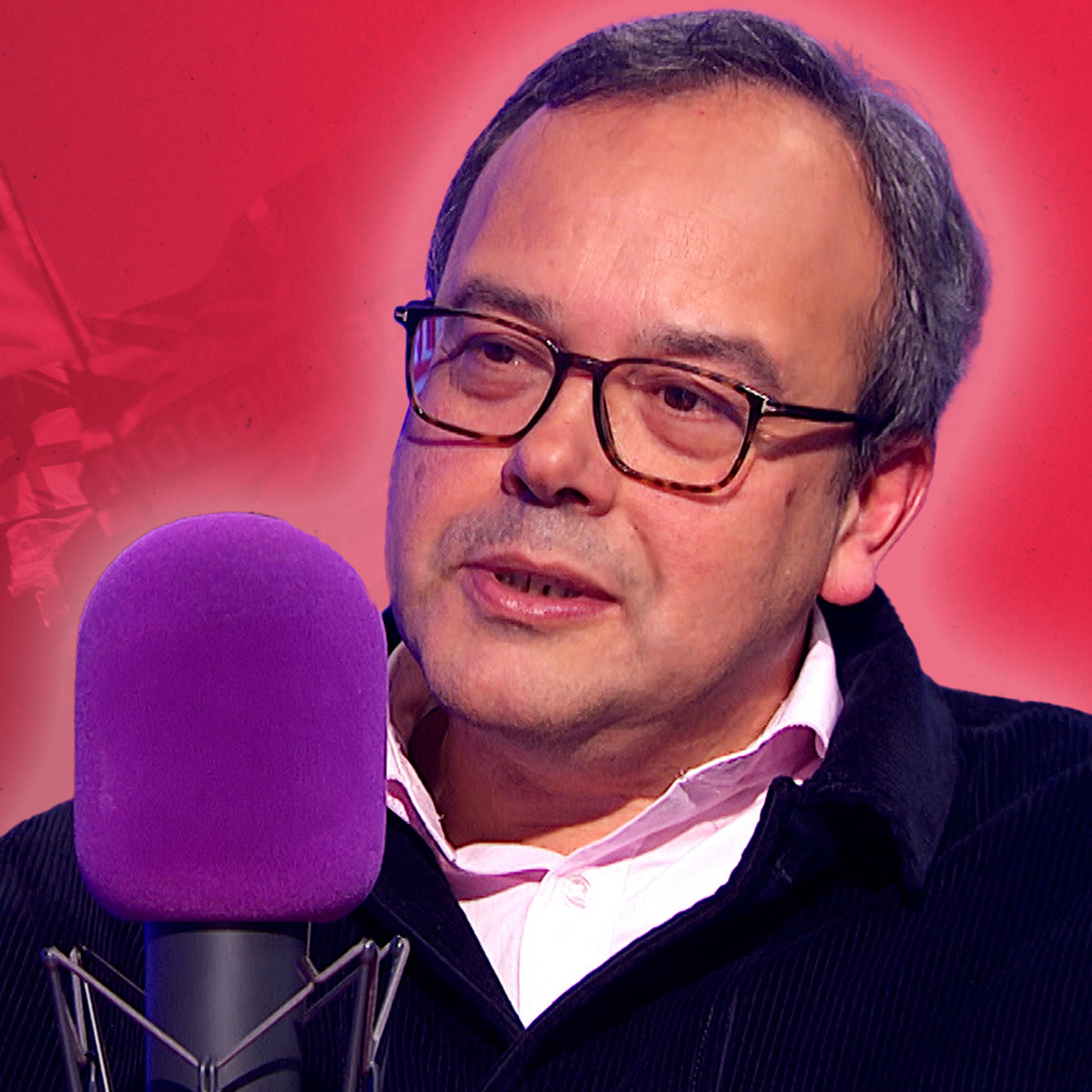
Why the far right keeps winning - and how to stop it | Nick Lowles
Episode Transcript
I think part of the problem we have is just how politics have shifted over the last kind of few, few years.
So views that are now probably considered fairly mainstream 20 years ago, 30 years ago would have been seen as extreme.
There is this ecosystem now where 20 years ago, 30 years ago, there was literally a social and economic consequence.
But for being a far right activist, you lost your job, you got shunned by your family and your friends.
Now you earn a good living and buy a good living.
I mean Tommy Robinson, where wherever his money goes down directly into his bank account or to other accounts, we'll earn millions every year.
Hello and welcome to Ways to Change the World.
I'm Krishna Guru Murphy, and this is the podcast in which we talk to extraordinary people about the big ideas in their lives and the events that have helped shape them.
My guest today is Nick Lols, who has spent three decades fighting racism and extremism.
In 2004 he founded the advocacy group Hope Not Hate, which became instrumental in defeating the far right British National Party.
Under his leadership, Hope Not Hate has become a leading voice in the UK against hate groups and far right extremism, whilst Nick himself has become the target of countless threats.
His new book, How to Defeat the Far Right Lessons from Hope Not Hate tells the story of how intolerance and hate have grown in Western societies and what can be done to counter them.
Welcome Nick.
I mean you spent a lifetime trying to change the world.
If we allowed you to just change this in one fell swoop, which lever would you pull?
What a question.
I guess what I'd say is we should all be nicer to each other.
If I could change one thing, we'd be nicer to each other.
We have better communities with better families, better communities.
We have a better society.
And things will flow from there.
I could talk about reversing climate change.
I could talk about, you know, alleviating poverty, curtailing social media companies.
But at the heart of it, I think people are the agents of change and I think that if we can learn to be better and live Better Together, then things will flow from there.
Those other things you mentioned are all instrumental in combating hate as well, which we can maybe come to, but I, I think we have to sort of define our terms.
You know, we live in a time where the right is on the rise.
But certainly in this country, Reform, Nigel Farage utterly reject the label of being on the far right or part of the far right.
And lots of similar parties across Europe do as well.
And they say we're not Nazis, you know, don't associate us with that.
We are not racists.
So, so who are the far right?
Well, so for us, the definition of far right is a kind of broad umbrella definition.
And within that you have those kind of radical right parties who operate in the democratic process.
But then you also have groups and individuals who are far more extreme, who look towards a more violent, violent answer.
But there's actually they share many things in common.
And why we would say that Nigel Farage and Reform fit into that radical right.
So that's the kind of moderate end of the far right is because in intrinsically they they hold a kind of racist, anti immigrant rhetoric.
They demonize the other.
They're authoritarian in outlook.
They are, while they engage in the democratic system, a bit like Donald Trump, actually, what they want to do is dismantle key pillars of liberal democracy.
And and so I think that, you know, they want to radically change the society that that that we live in.
And underpinning it is a kind of racialized identity about nationhood.
It's it's about expelling people.
I think part of the problem we have is just how politics have shifted over the last kind of few, few years.
So views that are now probably considered fairly mainstream 20 years ago, 30 years ago would have been seen as extreme.
And I'll give you one example.
In 1999, the British National Party had to drop its compulsory repatriation policy because it decided that couldn't even win it amongst its own supporters.
And now you have politicians, not just Nigel Farage and and Reform, but you've got other politicians basically talking about the same thing.
About taking away the right to remain.
Yeah, and it is totally normalized in society.
So I think the Overton window has shifted so much that actually the cordo sanateur that separated the far right of, you know, 30 years ago and mainstream society has collapsed.
I mean, again, you know, racism and racist is the other very, very hot word which again Farage and Reform utterly reject.
And they say, you know, they bluntly say we are not racist.
We've got people of all races in our party.
Zia Youssef, one of their most high profile people, obviously from an Asian background.
If you go to the Hope Not Hate website, I know you've got a full sort of list of why you think they are racist, but can you give me some examples of why you think it's OK to use that word with regard to reform based on what they're saying?
Well, I mean, I think you've got to look at both the rhetoric and some of their views of, of the individuals, including at, at, at a, at a senior level, some of the racist stuff.
If you go to reform counsellors, reform activists, reform politicians, they're littered with people who've made the most vile and crass racist and Islamophobic views.
But then you've also got policies as well and you know, a policy of really expelling, kicking out people, people of colour to me is a racist policy.
So I think that and the conspiracy theories that that, that, that, that go along with it.
Now sometimes when there's media attention, they have to suspend someone or kick someone out.
If they suspend them, they quite often allow them back in a few months later.
But you know, at the last general election, we helped identify the sorry reform had to had to get rid of 160 candidates because of racist things that they were saying.
So it's not the odd bad apple.
You know, there are many people and of course there.
Was also the Channel 4 News investigation.
Exactly.
Undercover with the reform campaign.
And, and, and I think that, you know, this is sometimes what they're caught in public.
I think that many reform members, and not all of them, of course, but many reform members will make jokes, will share racist things.
They will, you know, be abusive, particularly when they aren't.
They think that they aren't being being watched.
And how important is it do you think that you, you you are able to use those words and those labels in the fight against what you say is the far right, you know, because you know, they are quite skillful, I think now at at making it very difficult and a bit unacceptable to brand them anything other than a mainstream right wing party.
Yeah.
I mean, look, I think, I think we have to use these words carefully.
I think we can't just throw, throw labels around.
And also partly because the people that we need to engage with don't often see that as well.
Yeah.
But I mean, we, we, we've just completed a poll of 45,000 people, biggest poll I think ever.
And almost 50% of people see reform as a far right party.
Now, obviously that means a lot of people don't.
But I think for us, we, we, I mean, for a long time, and that was part of the reason we set up Hope Not Hate 20 odd years ago, that just calling people racist, calling people fascist didn't actually work.
You had to, you had to both understand why people were supporting the these groups and you had to talk to them at a level that they understood.
It's pointless just demonizing reform as racist or far right to people who don't think that because it isn't going to work.
We need to find other tactics.
We need to give examples of that, for example.
Because people who support them, a lot of people who support them, would also utterly reject the idea that they were racist.
You know, and you're talking about a party that is leading in the polls right now.
Now you you've talked about some of the polling that you've carried out.
And I suppose we, this is not literally carried out by hope not hate as it is commissioned by home and by proper pollsters.
Yeah.
Yeah.
So what?
What sense do you have of whether racism is is growing in Britain or not?
Well, I mean, I think that it is probably two things.
I think it is clear that opinion towards immigrants, people of color, particularly Muslims, has worsened over the last 12 months.
Now that's perhaps unsurprising given the political rhetoric.
Everyone's talking about them in very negative terms.
But what I would say, and and this is I guess gives me hope that actually the British public are in a more nuanced and I would say sensible position on many of these key issues than you would imagine from the political and particularly the social media narrative.
Even on immigration, of course, the majority of British people do not want people coming in who shouldn't be here.
They want to know who's here and they want to find a way to get rid of people in a in a quicker way.
The hotels people are people.
People don't like that.
But even despite everything we've had over the last few years, but the Rwanda plan, the small boat stuff, the majority of British people still want Britain to abide by international rules and look after people seeking asylum.
The majority of British people want to live in a multicultural society and see the benefits of it.
The majority of people, and we're talking about almost four and five, four and five people, want the government to do more to improve community cohesion.
So there is a narrative going around partly put by people like, you know, Nigel Farage, certainly put by people like Tommy Robinson.
But then you've got this radical right ecosystem that the country is at war, it's heading to civil war, communities can't live together.
That's not the real experience of British people.
And I think one of the things, and I think this is one of our big challenges, there is an, an absolute disconnect with people's lived experience.
So that overwhelmingly people think their communities are safe and friendly and people get along.
They like the diversity to what they think is happening on a national level.
And that's obviously what they're getting through the media, social media and, and politicians.
So I, I think that, you know, one of the things that both in the book and I've been arguing with politicians, you know, and particularly Labour stop running after the right wing media because that's not where the British public are.
The British public want to central debate about immigration.
They have some concerns, but they also see the benefits and they want immigration to work for Britain.
And I I think that we need we we we lack the courage of conviction of some of our.
But how?
How do you do that?
How do you address the concern without being accused of running after the rights?
Well, I, I think partly it's by talking about the concerns in a broader context.
The problem is at the moment, the whole narrative.
I mean, I, I can't remember the exact figure.
I think like 4% of people who arrive in this country come, come via small boats.
I mean, it's a tiny proportion.
And yet if you take the media or social media narrative, you'd think it's everything.
And I think the problem is the politicians, they talk about the problems without also talking about the benefits.
And I think that's where the British people are.
Yes, they see problems and problems that need to be addressed, but they also think actually we have a duty, not just because of the law and international law, but as you know, part of British values is about looking after people.
But also they see that a immigration has contributed to the society and also as a country with a the increasingly elderly population, we actually need immigrants as well.
Well, yes, except having the thing that has changed there that the basic economic arguments for immigration, which was always that they contribute to growth.
You look at all the OBR, you know, you know, growth predictions, it's all based on assuming a certain amount of immigration.
The opponents of immigration now have, you know this, you know what they think is a sort of a sort of a hammer blow, which is per capita growth down.
Yeah, but I mean, I, but I mean, I, I think also that we're in a situation where lots of people can't work, for example.
So how can they be economically productive if they aren't allowed to work?
So, you know, but I think it's more than just about economics.
It's, it's about contribution to society as well.
And I think that, you know, just the very fact that go anywhere in the world and people talk about Britain and they'll talk about the multiculturalism and warts and all, and there's always been problems, but warts and all, it's been a success story.
But now, partly because of Tommy Robinson and his world and and that media ecosystem, the whole concept of a multicultural society is now questioned.
Who is British?
You know, you've now got genuine, you've got mainstream politicians or political commentators trying to say that people who were born here are not British because their grandparent parents or grandparents weren't, weren't, weren't born here.
So I think that there is against all that.
It's unsurprising that there's growing concern because people are feeling that this is a big problem.
But actually, despite all that, the British public are still in a better place.
I mean, we we focused a lot on reform for obvious reasons, but actually the Tommy Robinson end of the far right is really where you have spent, you know, your your life, you know, campaigning, fighting, you know, you know, literally sort of political St.
battles.
I don't mean fist fights, but I mean all of that happened some, but I mean that that's been sort of very on the streets kind of activism and things have changed quite dramatically, haven't they?
As you say, in terms of the the mainstreaming of of a lot of these attitudes, The the book is sort of a very, very detailed account of how you fought campaign after campaign in in different areas.
Do you think the battle has moved away from the streets and activism into online?
It, it certainly shifted, but it's not moved away as in it's not happening there.
And I think, I think The thing is, you know, and in a way, going back to your first question, there is no simple answer to anything.
You know that there is clearly the Internet and the online space has transformed the fortunes of the far right.
You know, not only when I first started in the late 80s, unless you literally knew someone who was in the fascist group, you could never join.
There was no website, there was no office.
You couldn't buy something in a, in a, in a shop.
You had to know someone.
It was a very violent world then.
But I, I think and so, so the Internet and, and in a way, the far right have been much better at utilising new media platforms, partly because they've had to, because they've been taken off certain platforms, they've created their own.
Partly you've got super rich people in the US literally providing them with, with platforms.
But you know, there is this ecosystem now where 20 years ago, 30 years ago, there was literally a social and economic consequence.
But for being a far right activist, you lost your job, you got shunned by your family and your friends.
Now you earn a good living and buy a good living.
I mean, Tommy Robinson where wherever his money goes directly into his bank account or to other accounts will earn millions every year.
I mean, that's it.
That is the scale.
But I, you know, we, we cannot ignore the street as well.
Because I think what we've seen over the summer with the rising rhetoric around hotels, the protests, the flags, which is a kind of driven by Tommy Robinson's gang, the consequence of that has been rising racism in society.
Now I have many friends who are kind of British, Indian or British, British Muslims, whatever.
They're all feeling scared.
And they're people who probably haven't felt like that before.
They heard stories from their parents, from their grandparents about the 70s.
We haven't gone back to the racial violence of the 70s, but the atmosphere of intimidation, the atmosphere that you're not wanted, the confidence of the right is now palpable.
And So what happens online happens offline.
And that I would just give give you one example up in Burnley, done a lot of book work and I talked about Burnley a lot in in my book, there's this particular estate on the poorest communities in Britain.
There was a weekend in August where on face, on the local Facebook groups, people are offering flags going to put these flags up.
We've got 400 flags, put them up within 72 hours of the flags going up on lampposts.
And one of the poorest estates in Burnley, one of the poorest estates in Britain, 6 houses were attacked.
Now actually none of them had asylum seekers in, they were, they were people of colour.
Sometimes it's it, it makes race couples live there.
But that is the atmosphere that people who are racist and are violent are feeling encouraged.
And the rise of intimidation, the rise of threats.
The other thing that we've seen this summer is a coordinated attempt by the far right to harass, bully, threaten people in the progressive world, particularly in the volunteer charity sector.
So I think that, you know, online, offline, it's all connected and we have to fight on every level.
Just on flags, I mean, what's your understanding of of how the flags have happened?
Who's funded it?
Who's been doing it?
What's really going?
On so there is a small group based up in the Oldbury, Birmingham, Snevik area, a group of Tommy Robinson supporters, some of the people really closely aligned to him, some of the people who who are part of his security team.
They were the original people behind Ray Rays the colour.
So the the the X account that's it's run by them the the promotion, the fundraising to do flags.
Obviously it it, it kind of expanded out and both networks and individuals started putting out flags.
But the point of it was for those people organizing, it was about trying to assert an aggressive identity.
Those people, I mean, like one of the main people behind it has a conviction for his part in a racist manslaughter.
You know, these aren't just ordinary people who just feel proud of their country.
There is a political point to it.
They are so.
There's a massive naivety in mainstream media around this, isn't there?
Because, because it, you know, because you know, it goes way beyond that group.
Ordinary people start putting up flags as well because they think it's a good idea.
Newspaper columnists start saying, well, why shouldn't we be proud of our country?
Genrich runs around with his set bladder.
And it and it and it and it and it becomes one of these things.
Well, well, who?
Who doesn't want to fly a flag?
Where, where, where in where?
In fact, what you're saying is there is actually quite an organized and deliberate campaign with a name.
Yeah, totally.
And and it's all about, you know, probably predicting how people will react to it.
Some people will take it down.
That causes conflict.
People get angry.
But also it's that kind of it was all part of the summer about reasserting our identity as in quite a defined thing of what Englishness is.
Now, obviously they would say they're not and anyone can be English.
But actually, you know, for them, not everyone can be English.
And it's the same people who were who've been behind raised the flags, who have recently been in France trying to, you know, stop dingies who you know, who doing all that.
So it is a coordinated group or a small group of very political people who are Tommy Robinson security team.
Now the the international links are also interesting, aren't they?
Because, again, they are much more organized now, and much better funded and much more linked than most people would ever have imagined.
Well, I mean, it's one of the strange irony is because the kind of left historically always seen themselves as the internationalists and, you know, care about this struggle or that struggle.
And yet it is the right who are much more internationally linked.
But both in terms of ideas, in terms of people, and increasingly in terms of money.
One of the things that we've been seeing, and not just about Elon Musk, but one of the things that we've been seeing, let's say on the kind of extreme right of the kind of Christian world, literally millions are coming in from the US now to push social conservative agendas.
And, and what we're seeing, particularly in the Catholic Church, the rise of what we call post liberalism.
So it's the ideas around JD Vance which coincides with some of the kind of anti Muslim rhetoric of Tommy Robinson, that there is a clash of civilizations happening and that people can't be together because Islam is a supremacist religion etcetera.
And that causing it all is liberalism.
Soft liberals who like immigration and multicultural.
Who are naive about?
Exactly, exactly.
So you know, what we're also seeing is converging of religious, political kind of views.
And I think the other thing that's completely different, I I've been around long enough, I remember, I remember the day of the Oldham riots in 2001.
I was in Oldham on that day following this kind of gang, this far right gang, Combat 18, who had linked up with hooligans who were trying to instigate all day long, trying to instigate.
Police stood down 5 PMA few 3 taxi loads ran down the street attacking agents in the house.
That triggered the riots in Oldham.
But see, back in those days people saw everything on a very local basis.
It was a gang thing in Oldham as well.
It was about drugs, it was about whatever us, our area of town against your area town, they would put out the call on what they had those days, bulletin boards.
Come and join us, come and join us.
No one ever did because it was an Oldham problem.
Whereas now people all over the country, all over the world see themselves as part of the same cause and they will rise up as part of the same call and travel and travel.
And you know, and we see that we see this internationally.
So they are, you know, they, they don't read all the kind of, you know, the theoretical texts of post liberalism or whatever.
But like the the Civil War theory, which is now just everywhere on the right and the Telegraph right articles is civil war coming, etcetera.
You know, 2020 odd years ago, these were just a handful of people in the anti Muslim world who talk about civil war.
And now it's just commonplace.
Now people don't know the kind of they'll take bits of it and translate it to their daily lives.
Why is this your fight?
Part, well a large part of it was because my own upbringing.
So my mum came to Britain from Mauritius in 1961.
What's her ethnicity then?
Mixed.
So there's her mum's side of the family came from the Creole slaves and her dad's side of the family came from the French and it was mixed.
But of course in you know, and she's in the 1970s.
I grew up in Hounslow, W London and obviously I mean back then it was a very white place, but the National Front were on the March and I was, I grew up in a kind of political house.
We'd all watch the news together and even as a kid and I remember seeing the National Front part of the political broadcast, John Tyndall, the National Front leader.
And I had no idea how big or small they were saying that all people who weren't born in Britain will be sent back in six months.
And I was petrified.
I was petrified.
And they say I had no idea they would get 1% of the vote, but I just heard this bloke say it.
My mom was going to get sent home.
I then we then moved to Shrewsbury, which was again an even whiter area.
And you know, in the early 80s there was racism in the football grounds, there was racism on the streets.
The British movement were around and I was always, you know, I'm not dark and I've never kind of experienced the racism of some of my friends and some of my family or whatever, but I was always really conscious of it.
And so when I got involved in politics in the mid 80s, anti apartheid movement, I used to hitchhike down to London to join anti apartheid at 15-16 years old, anti apartheid activities in London.
Then there was a minor strike, Red Wedge.
I got involved in politics but anti racism and anti fascism was always a thing I gravitated towards and.
I think people don't, people don't realize what it was like in the 70s and 80s.
I mean, I, I grew up a few miles outside Burnley.
I, I wouldn't go into Burnley on a Saturday if I could avoid it.
Or, you know, we'd stay well away from the football crowd.
I mean, and I, you know, I mean, now I've got season tickets to my local club.
I mean, the idea of actually going to the football for a young brown boy was inconceivable.
Well, and, and The thing is as well, yeah, because understandably, people talk about the racial violence, but it's the impact it had on everyone, you know what I mean, of people of color, the fear and as you, I mean, even Shrewsbury.
I mean, you know, Shrewsbury is a polite market town, but I remember going to football in the early 80s and you know, and again, it might have only been 20 or 30 people, but it was in the main kind of shed end of, of Shrewsbury ground would sing racist songs, vile, vile racist songs actually were.
I'm a Leeds fan myself.
I mean, Leeds have got its own history of racism.
But I mean, again, it wasn't a lot of people, but there's no people of colour there.
And you know, it, it, it was frightening.
And I, I, I think that of course, we've not gone back to that, that level and Britain has changed massively since then.
But over the last six months I have spoken to and I've, I hear stories, people are feeling scared again now and people are feeling less confident about going out on their own or going out in the evening.
And even the flags I've got, I've got a friend, early 30s, works in the city, not necessarily interested in politics, family friend.
And she had, she comes from a British Indian background.
11 morning, she woke up to see a flag outside, literally outside the house in the lamp post.
And she felt scared.
She's a professional.
You know what I mean?
Who, whose life and who you know, racism is just not part of her life.
Racism is something her parents told her about.
And suddenly she just felt intimidated.
Isn't the other thing that has shifted, though, that, you know, racism is, is very different.
You know, it distinguishes now between racial groups and some racial groups are OK, you know, with some racists, you know, there, there's a lot of anti Pakistani feeling, a lot less anti Indian feeling because it's tied up with anti Muslim hatred.
And Indians are sometimes bizarrely seen as allies.
You know, I in fact, it's also works the other way.
I've been in India and people have come up to me and talked to me about their support for Tommy Robinson because he's anti Muslim in their eyes and they they were Hindus and were therefore also anti Muslim.
So there are weird alliances being set up as well.
Aren't they?
There are.
And I also think it's reflective that and this is something that's gone, I think kind of largely unnoticed in the political world, the rise in faith identity, which is now playing out in politics.
So it's increasingly playing out in how people vote as well.
So there has been partly partly in terms of the Hindu community, partly because of Modi in and you know that rise of kind of Hindu nationalism, you've had growing conflict or tensions between Hindu and Muslim communities, between Sikh and Hindu communities.
So it's working on these different ways.
And obviously that's been Co opted by people like Tommy Robinson say these are our friends, these are our enemies.
But what I'd also say though, that amongst I say, general racists, a black person is a black person, a brown person is a brown person.
You know, they don't always make that.
They, they might say, oh, well, they're not so bad.
But actually, you know, how many, how many British Indian people are getting abused and feeling scared now because of the situation?
So I, I, I think that, I mean, you know, so you know, the whole debate is Rishi Sonnet British, you know what I mean?
So, so yes, I agree with you.
There has been that splintering of communities.
And and also is that is that also a splintering of allyship between different groups because, you know, as as woke ISM has been undermined and sort of disrupted over the last few years, different groups being picked off on them.
Yeah, no, totally.
Both different groups have been picked off and also groups are trying to avoid being caught up in something.
You know, so for example, let's say the whole grooming situation, I, I remember this.
So this is going back probably certainly to Rotherham.
I think it before, I think it was before.
But you know, so for example, the, you know, when the I member of press release, one of the main Hindu community organizations, this, you know, we're attacking the media for saying Asians.
So it's not Asians, it's Muslims.
Then you had the Bengalis and East London put out statement.
It's not us, it's them.
So there's some of that.
But I I also think that this is a long term consequence of in the in the 1970s, that was a, you know, a big movement, kind of quite a secular cross faith movement about blackness and the youth, Asian youth movements, things like that.
That class came before race and religion, and that collapsed in the 1980s, partly because of youth unemployment and the collapse of kind of, you know, of Thatcherism.
It also collapsed as a consequence of religious communities because they were losing their young people, you know, so there's, I think what we're seeing now is also a consequence of 20-30 years of kind of religious communities trying to reassert their identity on, on their communities as well.
You are very critical though of your own side and of progressives on some of these key issues and, and and the grooming gangs is is one that you really go into in the book and you say that the progressives got this wrong, but.
I mean, I think, I think one of one of the key things that underpins, I think my own thinking is that we've got to be humble.
We're losing if we have an understand.
So if we're losing, obviously what we're doing is sometimes wrong.
On the grooming thing, I can, I get really frustrated because I cannot understand how we got ourselves into the situation.
And I look at Labour, how Labour got themselves into the situation.
To me it's quite simple.
Grooming and sexual exploitation is wrong whoever's doing it, and we need to think of the survivor and victim first and work out from there.
I think that generally the the left generally has been poor at it, wherever that's been, councils and councillors not taking a grip of the situation, wherever that's how we become so defensive about all this will be used by the far right or whatever.
We forget about the people who've been abused.
And I think that clearly there are, there have been some issues in areas about nighttime economies or, you know, vulnerable women.
I mean, many of the people who've been abused are vulnerable people.
The police haven't believed them because, you know, a lot of them are in care.
They, you know, they don't have stable homes.
So people kind of keep an eye out for them.
They might be involved in petty crime or whatever.
Their stories aren't believed.
And I just think that our failure to tackle it and then is one thing, and then our kind of demonization or being so scared to address it because, oh, you're then racist or you're feeding racist narratives has made the situation worse.
And I think we're now in a situation where in certain communities, it's now a toxic issue.
And we've allowed that to happen.
And I in the book I give an example which to me was a really vivid example in Rotherham.
So in, in 2014 to 2016 period, there's I think 15 far right demonstrations in Rotherham.
Anyway, there was, there was 1 demonstration that there was some former miners, Maltby 7 miles out of Rotherham.
And they were angry, They weren't angry at the Muslim community, they were angry at the council, their Labour Party.
Now these are people who'd gone solidly on strike for a year.
They were good people, they had joined with us fighting against the BNP in Maltby but they were so angry.
They wanted to show their opposition to what the council their the inaction of the council and the police but they didn't want to join the EDL so they took a coach and this you know, this is the mindset 7 miles they get coach in to Rotherham and they March at the back with a distance with the EDL because they don't want to be the EDL.
And they were walking through the streets, men and women, local people to be shouted and called racist scum and Nazi scum by protesters who probably weren't from Rotherham.
And they were so angry at this they thought if that's what you think about us, well sod you.
And they quickened up and joined the protest.
So they were pushed, pushed into the.
Yeah.
And we spoke to them after because we, we, I mean, I, I wouldn't let, I mean, we, we don't do those kind of counter counter protests or whatever.
But we heard about them being on the demo and stuff.
And we spoke to them a few days later.
We met up with some of them and we just said, look, why, why?
You know, they're going, yeah, but this is your, your, as in the left's fault because you've a, you failed to deal with the issue.
And then you just shout at us and we're not racist and we're not Nazi, but you've told us we are.
And you've done nothing to protect our kids.
So how?
How should anti racists on the left approach this new demand to look at whether particular communities, particular religions, Muslim Pakistanis on the whole, whether there is any specific problem culturally or socially, that means they've got a bigger problem, bigger issue with grooming than any other social or racial or religious group?
Well, I mean, I, I, I so in the book I support an inquiry.
Now, when I the 1st, when I wrote the book before it got kind of finally edited, the Labour government hadn't approved the, the inquiry and I was condemning him for doing that.
What I'd say is we need that inquiry to happen and it needs to be as thorough and detailed as possible because we're in that situation that anything less will this, this will still continue to, to kind of dog us.
But what I'd also say is that we also need to understand that on street grooming by gangs, which is the particular type we're talking about here, is one form of grooming, one form of child sexual exploitation.
And I think that we need, but rather than hiding behind that because some people do, oh look, you know, what about the 89% of white people or whatever, fine.
But we need to be proactive and say we need to understand all forms of child sexual exploitation.
And I personally don't believe it is religious.
I think it's about opportunity.
It's about, well, just in the, in the sense of, you know, what's the nighttime economy, you know what I mean?
It's about opportunity, people on the streets, people, you know, and of course they then they become criminal gangs or whatever.
But of course there are other groups who do this as well, maybe in different formats.
And we we also have to understand that, you know, look at the church over the years, look at the scouts, look at, you know, and.
There was a very big white working class gang recently.
Recently convicted as well.
Exactly.
But I mean, we can't dodge.
We can't dodge.
We can't large somebody's difficult issues.
Exactly.
And, and, but aren't we also, you know, being a bit silly in a way in that, in that if I go to Afghanistan, as I have done and made a, made a film about violence against women and said there is a huge cultural problem here, you know, in which, you know, young women are being effectively forced into marriages or abused, you know, by relatives.
And, and, and everybody says, well, this is, you know, this is, you know, amazing revelation, well done, You know, and then we we don't go, oh, but there might be a problem in this country with similar sorts of people.
And so I mean, again, in my book, I talk about, I think I talk about.
So I, I came across this issue first in 2004 up in Keighley.
So there's a Channel 4 edge of the City series which was following social Bradford social services and there was 1 episode about grooming.
And at the time it was running up to the European elections, all out local elections.
And there was a demand which then got accepted that Channel 4 should push back the broadcasting of the program to after.
So following that, we knew Nick Griffin was going to stand in Keithley.
And I went and met Angela Sinfield, one of the women who had made a Channel 4 documentary.
And her daughter and her daughter had been when she was 12 years old, had been abused by 29 men, most of them related to each other.
So she got passed around.
And she was 16 when I met her.
And she had only recently, her relationship with her mom had only recently come back together.
But there were real issues here.
And their issues, not just in terms of the abusers, but there are also issues in the sense of our communities doing enough.
You know, they've been stories in the media, some of these trials about, you know, a man in his late 60s driving around, openly driving around with his 13 year old white girlfriend.
And it's like people say this sort of thing.
No one's doing anything.
About it.
And, and, and I kind of feel that maybe we're in the situation where other communities were in maybe in the 1970s where we not that we turned a blind eye, but we didn't really think about it in that context.
So I think there is some there's some really difficult issues that that we have to have to address and we can't dodge them because it would just haunt us forever.
And and similarly when it comes to extremist violence and and and, and radical Islamist philosophy.
Yeah.
Look, I mean, I think that sometimes, sometimes we can forget our values and our values have to be consistent.
So for example, you know the English Defence League, you know clearly much of the left would be energized and come out against English Defence League and let's say Luton.
But of course the other side of the equation is Al Majaroon and the harassment they were causing.
People forget, I mean there was a terrorism as well, but what they were doing in Luton as well and actually they were part of the problem as well.
And it's like how could we go and win support amongst one group to say don't support the EDL if we're silent about the other group?
And also if you look at spikes of anti Muslim hatred, spikes in support of EDL and Tava Robinson.
They come about by trigger events, the Manchester attacks or the Westminster attacks or whatever.
A big Lee Rigby.
And we should we need to be not because just because of tactical or political reasons, but our values, that the values of ISIS and Al Majaroon or whatever are totally counter to everything we believe.
And it's like, you know, you talking about going to Afghanistan, the attitudes of Anjem Chowdhry and Al Majaroon, the type of what society they want.
It's this type of society we'd all be horrified by.
But again, sometimes we just don't think about it.
And sometimes we're kind of scared into, oh, yeah.
But you'll be playing into a right wing narrative, you know, this idea that all forms.
And that's where British people are.
British people just want the sense of fairness and actually the Islamist extremists are as much of A danger to the Muslim communities as the white extremists are to to the white communities and we've got to be consistent.
And, and do you think this is, this is doable?
I mean, you know, you, you acknowledge that effectively, you know, your, your side is sort of losing at the moment.
Do you think this is doable by mainstream politicians who can turn it around well or Or is it going to be about activist groups like Hope Not Hate who have to do the heavy lifting?
Well, I think I think a small numbers of people will need to do the heavy lifting, but actually we need the other elements to work as well.
I was really critical of Keir Starmer and the government over the summer and even before the Tommy Robinson demo, I wrote a letter to #10 which then got leaked to the Guardian.
But you know, and I was saying that your silence is creating a vacuum which has been filled by the far right.
People are getting scared.
People need leadership.
And it's not just about condemning the violence, because the violence is just one element of it.
It's a different world view.
And actually, people need protection by the state, not just physical protection, but they need to feel that people will are there to support them and look after them.
Now.
Now I think that, you know, Keir Starmer did his late party conference speech and that was a sea change from where he'd been before.
As he followed that through is probably another question.
But I'll tell you what has happened, which gives me encouragement.
The day after the Tommy Robinson demo.
Now I, I know the police say 150,000.
I've looked at the aerial, the drone footage, I reckon 300,000 people.
I mean, it was huge, huge and millions more would be watching it online.
And the day after I got contacted by ACEO of a big charity and he said, look, can you come on a call with a few of us?
We're all scared.
We don't know what to do.
And he said there'll be between 5:00 and 7:00 as CEOs on the call 3 days later.
And I got on the call and there were 48 people.
And this is like all CEOs of the top charities in Britain.
And people are saying, what do we do?
Because people are feeling it.
And also people are feeling that their type of society is under threat.
But do you acknowledge with that 300,000, let's call it, they would have been just like the miners in Maltby, a lot of people who do not associate themselves with the far right, no.
Look, I mean, I, I think we've got to be, you know, we've got to be, you know, people, people are drawn to it for all sorts of different reasons.
People are drawn to it.
They might be racist and might not think it, they might not be overtly racist and they might be angry about other things.
And this is just our outlook.
I've, you know, we've always taken the view, even going back to the BNP days, you never attack the people voting for them.
And but going back to the Tommy Robinson demo, so on the stage, obviously part of our job, we sit there and listen re listen to all the speeches.
Not a single speaker spoke about small boats.
And that was the media narrative all these people are angry about.
They didn't give a shit about small, sorry.
They didn't care about small boats.
What they talked about was how multiculturalism was a failed experiment, how Islam was incompatible.
And several speakers spoke about expelling Muslims from Europe.
You had you had this Christian leader from New Zealand who said that all non Christian Church, Christian places of worship should be closed down in the UK.
You had a great replacement conspiracy theory stuff.
The so the stage was a lot more hardline.
There were people there of all walks of life.
And we have to accept that.
And that should be the warning to us.
But I think that coming out of that, and we're in the process of doing it now, we're saying, well, actually loads of these groups, some of the biggest organisations in civil society say, OK, we can't rely on our leaders anymore because they're continually letting us down.
We need to do it ourselves.
And so probably in the spring, there's going to be something really massive by civil society and it's going to be positive, it's going to be based in our communities and it's going to be ultimately showing that every day people do nice things for each other, people get along together.
There are many, many issues and issues that have to be addressed.
But fundamentally, the vast majority of British people want to live side by side.
They enjoy living with people of different backgrounds, different communities.
And, and also what we find is that, and all the data shows this, the more people who are involved in community, in their community, the less suspicious or hostile or afraid they are of the other.
And all the data shows that.
So this is about a celebration of communities in Britain.
And I think that we we can no longer rely on our political leaders to take a lead because they are failing of all, of all political colours.
And obviously we want them to do stuff.
We want them to come on board.
But ultimately, I think there is power in communities, there is power in civil society.
Some of these big organizations, I mean some of the biggest charities you can think of saying actually we need to step up now.
And I think that that that is about to happen.
I just finally, I mean, do you think we're moving into a new gear politically as well?
Because now obviously Donald Trump is warning that we face civilizational erasure in Europe.
That's going to be, isn't it, the next stage of the debate And and somehow this has become normal politics.
It has become normal politics and certainly it's a throw down challenge, but what I'd say is that gives encouragement to the right.
They will love it.
Oh yeah, you know, he's right with this, is what we've been saying.
How long?
But actually what we need to do is that most people in Britain won't like that.
They won't like a Donald Trump, They won't like an American leader interfering in British politics or European politics.
People don't like Elon Musk doing that.
So actually in every threat there's an opportunity as well.
But what I'm saying, what I think is important is that we don't just be anti.
And that comes back to why we chose the word name hope not hate from the beginning.
We don't just want to be anti.
It's about values as well.
And we, you know, so it's what what kind of society do we want and what what do we believe in that brings us together?
And I think that we've got to push those values because values is about belonging as well.
And, and many of the people who are looking to the right now are doing so because they feel abandoned, They feel scared, They feel like, I mean, I think the big, the second stage of globalization is AI.
Now the government talks about it in a positive way.
You know, this, this is all great.
We can do this.
We do that.
I'm sure you can.
Millions of people are going to lose their jobs.
In our poll of 45,000 people, the one result that startled us, every time we do one of these big polls, we give people, you know, 1520 policy options.
What would you one thing the government should do, the number, the second choice chosen.
Sewage is always #1 punishing water companies always comes up #1 and we put this in as an afterthought, protecting us from AI.
And it was really stark.
No politicians talking about it.
But this is, this is what's coming down the line.
And this is going to disrupt many, many people and also people who've not been affected by globalization.
And it's, it's underpinning.
And you know, my book, I talk about this, I think quite a lot, underpinning a lot of this, not just in the UK, but across the West, is economic pessimism and economic insecurity.
And if a government cannot offer security to people, economic security, and that's not just about jobs and money, it's about community.
In the gel of community, people will look elsewhere for protection.
And I think we're in that stage where people feel the politics has failed of all parties and they're looking for some someone else.
And I think there are huge challenges ahead of us at the moment.
I do not think the political class has risen to that challenge or even understand it.
They're running behind it.
We need bravery.
But actually where things are happening and where I have the hope is that there are amazing people doing amazing things in communities up and down the country, often against the odds.
And I think my mission, my hope for Hope, not hate, is that we can help those people, empower them, upskill them, support them so they can do stuff on the bigger scale.
Nick Moles, thank you very much indeed.
Thank you for joining us and sharing your ways to change the world.
And that's it for this edition.
You can watch all of these interviews on the Channel 4 News YouTube channel.
Until next time, bye bye.