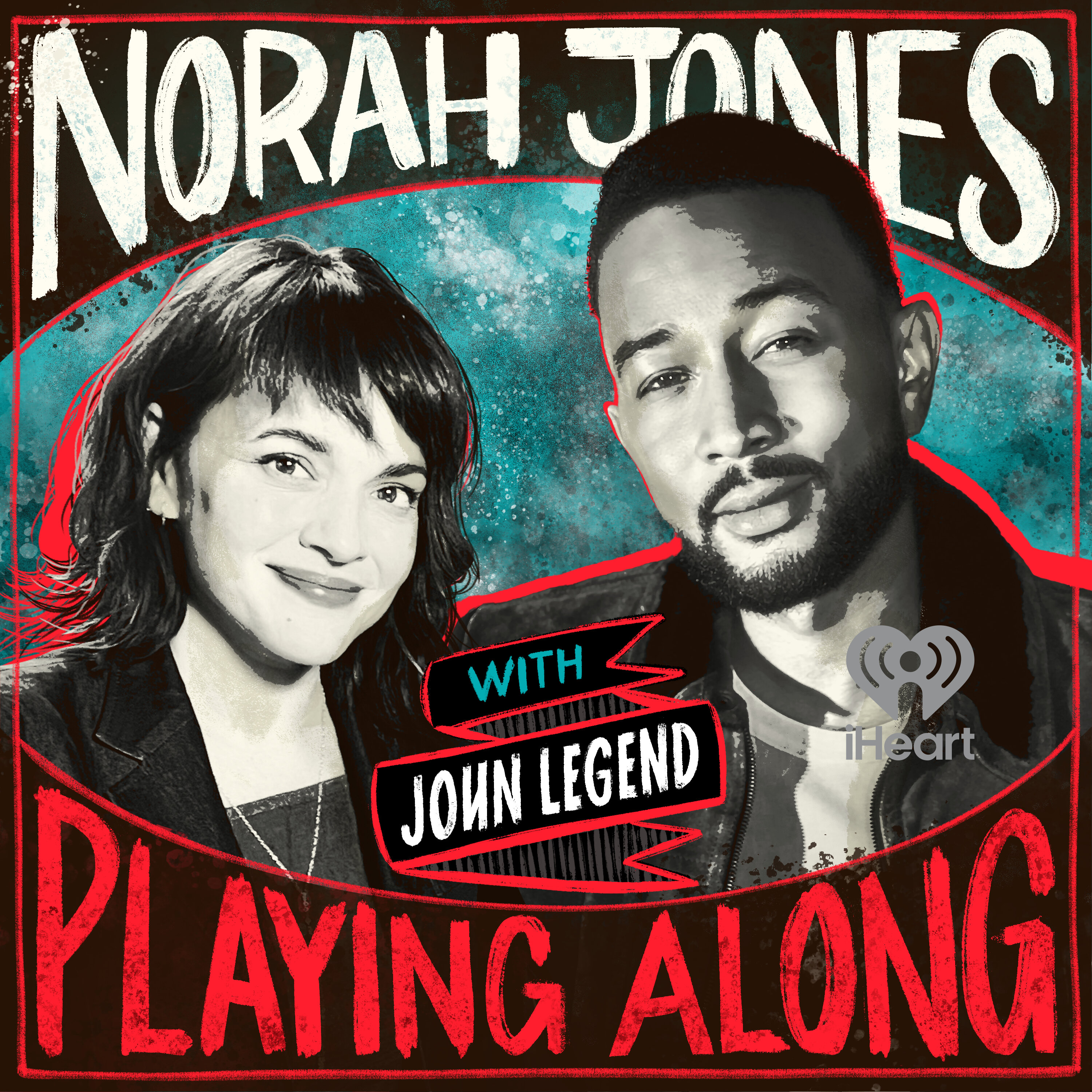
·S2 E10
John Legend
Episode Transcript
This episode is also available as video on YouTube.
You can visit Norah Jones channel and be sure to subscribe while you're there.
Hi, I'm Norah Jones and today I'm playing along with John Legend.
I'm just playing Louy, I'm just playing lone.
Speaker 2Hey.
Speaker 1I'm Norah Jones.
Welcome to the show.
This is my co host and friend Sarah Oda.
Hi.
Speaker 3Our guest today is the singer, songwriter, producer, and E Got artist.
Oh my gosh, that's right, John Legend.
Sorry, right, that's right.
Speaker 1I forgot about the you Got.
Speaker 3Part E Got Emmy, Grammy, Oscar, Tony, you got them all?
Speaker 1Somebody ever made that joke before?
I don't know, but I felt pretty good about it.
Speaker 3He's also a longtime coach on the Voice and founder of the skincare line Loved One.
He's currently celebrating the twentieth anniversary of his debut album, Get Lifted, with special tour and performances.
Speaker 1Which we went to last night.
M Yeah, and we Got Lifted.
We Got Lifted.
We went to see him play in New York City and it was really special.
He's so incredible.
I only met him for the first time last year, and when we recorded a song together called Summertime Blue, which we may do in this episode.
And I was surprised I'd never met him before that because we've both been like in the business for so long.
Speaker 3Yeah, And in this episode, you're going to hear about how you kind of have a parallel coming out moment as artists.
You're also gonna hear about the story of one of his most beloved songs, and also how you got the nickname track thirteen.
And the episode wraps with a little holiday nugget.
Speaker 1I don't know if I would want to call it that.
The episode wraps of the little holiday treat I like that better.
Yeah, a little bit of Christmas at the end.
So I hope you enjoyed this episode.
We had so much fun, the one the only John Legend.
Speaker 4Oh, summertime, summertime, summertime, you took home.
Speaker 5My love, summertime, summertime, summertime.
It's true.
Speaker 2I'm still thinking of you.
Left you in a day dream.
Now you lasson.
Speaker 5Summer time, summertime, Soler's time.
Speaker 2For hours, feeling good.
I was on the road.
Didn't let it show.
Speaker 6That I was falling for you, specially laughing love and just.
Speaker 2Like a fool was ever an undertone.
Speaker 1When a pooled and closed.
Speaker 7I now I'm wondering your castles come in too.
Speaker 5Summertime, summertime, summer time.
You took all my loby.
Speaker 4Summertime, summertime, summertime.
Speaker 2It's true.
I'm still thinking love here, hold you all day?
Speaker 5Now you wash a me.
Speaker 2Summertime?
Speaker 8Do you get you.
Speaker 9Still see there's some lie dancing off your hair, But at didn't.
Speaker 5Let you catch me dream.
Speaker 7My mind was running wild heat off your smile.
Speaker 5I was spent a while.
Speaker 10Since I've heard of you, and now wondering where you just passing through?
Speaker 5Summertime, summertime, summer time.
Speaker 2You took on my love.
Speaker 5Him, summertime, summertime, summertime.
Speaker 2It's true.
Speaker 7I'm still thinking out to lead that day.
Speaker 5Now you wash.
Speaker 2Summertime.
Speaker 6I feel it too, summertime smut SEMTI is too.
Speaker 7I'm still thinking of June day, j now you washy.
Speaker 2Summertime all because of it?
Speaker 1Yeah, yes, yes, that felt great, great, Yay, all right, I'm gonna move over there all right.
Sorry, Yeah, so thanks for doing it, thank you.
Yeah.
So we did this song together.
We released it this past summer with Greg Wattenberg.
Y.
Yeah, I've only known him like maybe a few years.
But how long have you known him?
Speaker 8It's been quite a few years.
Greg is a wonderful producer and songwriter.
He's just a lovely guy, and we had done a few songs together over the years.
My favorite is probably a song called Conversations in the Dark Nice that I did with him on which album was.
Speaker 11That Bigger Love album.
Speaker 8And he was working with you and he was like, I would love for you to to do something together.
And you guys had written this song or you had started writing it, and then we got together at my studio here in Los Angeles and finished writing it together.
Speaker 1That was fun.
Speaker 11That was so much.
Speaker 1Yeah, was there?
Speaker 8Yes, yes, so you Our studio is also in office and like the headquarters for her company, Cravings, and they just make food for a living.
So they make food that goes in grocery stores, and they make cookbooks and all these things.
So the house where we work is just always brimming with food and music all the time.
And that's like our work house.
And so you got to come to our workhouse have some rose with Yeah.
Speaker 1It was fun.
I felt like I was at your house.
And then I realized, no, this isn't their house house.
Speaker 11Yes, no kids there.
Speaker 8Yeah, but the kids school is actually down the street from there too, so they're there a decent amount to Sometimes we'll just walk to school and pick them up and have them come to the office.
Speaker 1And great.
Yes, that's the way to live.
Speaker 11I think it's a great way to live live.
Speaker 1Yeah, yeah, that's great.
I have a studio in my basement in New York and it's awesome.
Speaker 11Yeah.
Speaker 8I've once had a studio in the place where I actually lived here in Los Angeles, and I liked going away to feel like I was going to work, and so this is like away from home, but it feels like home too at the same time.
Speaker 1Yeah, I know what you mean.
It works well, it's a nice balance.
That's awesome.
I can't believe we've never met until we did that song in that wild we've never even met in past.
Speaker 8Yeah, you know, it's crazy not to be dark.
But I was thinking that about di'angelo today, because you know, we're filming this on the day that di'angelo passed away, and I was like, I feel like we know so many people in common, but I never talked to D'angela.
I never spent time with him.
I looked up to him and listened to his music a lot.
But some people, you just your circles are really close to each other, but you just don't run into each other for one reason or another.
But I'm so glad we finally did run into each other and that it was in the service of creating something beautiful together.
Speaker 5Yeah, it was.
Speaker 1Awesome because my first album came out in two thousand and two.
What year did your first album come out?
Speaker 11Two thousand and four, so it was not long after you.
Speaker 8We both were kind of like Grammy Darlings when we came out, and I think we both kind of had a certain amount of credibility because we played our.
Speaker 11Own instruments and we were writing our own songs.
Speaker 8And I feel like in a lot of ways, our careers are paralleled in some ways, but they just never intersected for some reason.
Speaker 1I know, I love the way you play pianos so much.
That's so beautiful.
And I wanted to ask, because you've been in this business since since long before your first album came out.
I didn't know that you played on Miseducation of Mill until maybe like a year ago.
I didn't even know that, Yes, how did that all happen?
Speaker 11So I started playing in the church, so I grew up.
Speaker 8So a lot of my style is just like old school gospel style.
I learned a lot for my grandmother, my mother's mother, and so a lot of my style came from her, and then I grew up.
Our job at church was basically like playing by ear all the time.
Yeah, You're like learning songs from CDs or tapes so you could play them with the choir and then if someone just starts singing in the middle of service, you got to find the key play along with them.
Speaker 11So you're just it's like a major ear training.
Speaker 1I have a question about that because I went to high school with a bunch of guys who learned in church that way.
Speaker 11Robert Glasper Yes, all.
Speaker 1These guys from Dallas High School as well Sean Martin who's now passed passed away, and they were telling me about it.
Is it a specific type of church that does that, because that's not so.
Speaker 8A lot of Black churches are like this, but there are some more like kind of traditional kind of old school churches that are more liturgical in the services.
But then I grew up in the Pentecostal church, and our church is much more informal when it comes to like the liturgy of the service.
There's not a lot of like written hymns that you play, and it's a lot looser and it's more fun musically, honestly, but it develops your ear in a way that it's just perfect ear training for anybody that wants to be able to on the fly kind of adjust.
And so a lot of the best black musicians that you'll meet grew up in the church because that's where they developed their chops and it just served them well throughout, you know, whatever music they end up playing later in life, that foundation was where they built their chops as musicians.
And you know, Jermaine dupri did a post that got circulated pretty widely in kind of the black music circles.
He was basically lamenting the fact that not enough black musicians.
Speaker 11Go to church anymore.
Speaker 8So we're losing, Yeah, we're losing like some of that tradition in that training ground for young musicians, and so you're just a generation that's less churched, which means, as a side effect, less of that ear training and that musical foundation.
Speaker 1That's really interesting.
Yeah, I went to high school with this group of people who were just the most incredible musicians I've ever known in my life.
Yeah, and yeah, it's exciting.
You're going to Dallas.
Speaker 11Yeah, I'm going to Dallas.
Speaker 1You probably know some of them.
Speaker 8Yeah, and if you if you look at my band, almost all of them grew up playing in church.
They're mostly from Philly and black gospel scene there is very big and almost all of them are like preacher's kids or grew up playing in the church in someway or another.
And you can just tell, you know, stylistically, but also just again the level of just chops are able to develop at a young age.
Speaker 11There.
Speaker 1It must be fun on the road too to have that kind of a musician on stage, because you could just be loose.
Speaker 11Yes, you can.
Speaker 1Go anywhere and they'll follow.
Yes, they have to be over rehearsed or.
Speaker 11Absolutely you know.
Speaker 8Yeah, and you know, we we have a plan going in, but it's nice that you have people that can adjust on the fly in case we deviate from the plan.
Speaker 11Yeah.
Speaker 1I love that.
When you started when you played on that Lauren Hill record, how did that come about?
Speaker 8Okay, so the Lauren Hill record, Sorry I got derailed from my story.
No, So it actually because I was playing in church is why it happened.
Speaker 11Because I was going to school in Philadelphia.
Speaker 8I went to UPenn and then on the weekends I found a gig playing for a church up in Scranton, Pennsylvania.
Speaker 11Which is a couple hours north of Philly.
Speaker 8And so I would drive up to Scranton every weekend and played at this am church, African Methodist Episcopal Church, and their church is kind of a blend of the more improvisational style and the more kind of classic liturgical style, where you know, there are certain beats in the service that happened every week, but then there were things that you did that were a little looser as well.
Speaker 11And so I played for this church.
Speaker 8I directed the choir wow, and I would teach them music every weekend and we would sing it on Sundays, and I would arrange for them, play for them, do all that.
So basically they call you the minister of music in that setting.
And so I was the minister of music for that church.
And one of my choir members had gone to high school with Lauren Hill, and so Lauren grew up in the Jersey area, like North Jersey around Newark, East Orange, South Orange, West Orange, all the oranges.
I forget which orange, but one of those oranges she grew up in.
And my friend Tara went to high school with her and was a little older than Lauren, but she was kind of like a friend and collaborator and mentor, and she ended up touring with Lauren for the first couple tours after Miseducation came out and she sang on the album, and so she was like, why don't you come to the studio with me.
Lauren's working on her solo debut, which you know, was coming after the Fujis and the huge you know, Killing Me Softly and all that, and so I was like, yeah, I.
Speaker 11Want to go.
Speaker 8I want to see what she's up to, because everybody was like, when's she gonna go solo?
And so she's making this, you know, epic solo album that ended up being one of the great albums of all time.
But you know, we don't know what's happening until we get there.
We get there and they're working on a song and we're in a studio and I'm just sitting there just kind of watching, trying to stay out of the way.
But eventually I'm like, you know, my friends like Johnny, you gotta play something for her, show her what you can do.
She's like, this is your moment, show her what you can do.
So I get on the piano and sang a couple of songs for her.
One of them was this original song that I've written called too Late, and Lauren was like, why don't you play on this record we're working on now?
And it didn't exactly sound completely like it ended up.
They changed the lyrical bit and rewrote some things, but the basic musical foundation for Everything is Everything's Crazy was built in that session and I played piano on it, and the you know, the interesting part is you never know what's going to happen when you just you just play on something.
Speaker 11You don't know if it's going to come out.
Speaker 8You don't know if your parts are going to be still included when it comes out.
Speaker 11You just don't know.
Speaker 8And then a few months later I got a call from a record label asking how to spell my name for the for the album credits.
Speaker 11I was like, Okay, it's gonna come out.
Speaker 8It's gonna come out, and so I'm like, my name is John R.
Stevens, which is my real name, and I'm like decided to give them the R in my middle initial for some reason, even though it sounds more like a lawyer or an accountant.
Speaker 11Or something, but I tell them it's John R.
Stevens.
Speaker 8And that's how it ended up in the credits on track thirteen of Mis Educational Barn, John R.
Speaker 11Stevens on piano.
Speaker 1That's amazing.
It's so wild.
I know that album linked the back of my hand, and I had no idea.
Speaker 8So many of us know my album so and I think you know, if you talk to any musician that came out right after that, Like we were all listening to that album so much.
We were also inspired by it, and it was like one of those albums that kind of showed us what we wanted to do, Like it kind of gave us like a north star of like what music is supposed to sound like, and how to make it eclectic and multi genre and honest and soulful and all those things that she was able to do.
It blended, you know, soul and hip hop and reggae and all these different sounds so beautifully and seamlessly.
And it was just one of those great albums that inspired all of us young musicians, and we all know it.
Speaker 11Like the back of our head.
We know the skits in between.
Speaker 8And the songs are so good they still hold up so well, so good.
Speaker 1Yeah, I think that's also what it's all about.
Yeah, Yeah, And you're such a great songwriter.
This song from your debut we were talking about doing Order People.
The song is so moving, thank you, and it's got energy, but it's solo.
I mean, it's just it's such a great first thing to hear of you when you came out.
Speaker 8Yeah, it was wild making that song because I was originally writing the chorus for The Black Eyed Peas.
So I'm friends with who I Am and the recipes, and we had the same manager at that time, and sometimes they would just we had written together before for my album, but this session wasn't supposed to be for my album.
It was supposed to be for the Black Eyed Peas, and he would just play me beats that he had made and I would hum whatever ideas came to my head.
And one of the ideas I hummed was the chorus for ordinary People.
And so it had like a backbeat, It had a hip hop kind of kind of energy to it, and a couple of days later, I had, you know, written this idea with him, and I was like, you know what, I feel like those other ideas work really well for you guys, but that ordinary People idea I feel like would.
Speaker 11Work better for my own project.
Speaker 8And I was finishing up Get Lifted at the time, and I had just gotten signed to Columbia Records, and I was like, you know what, I should probably keep Ordinary People for myself, but I'll let you produce it.
And so the original had a beat to it.
It hadn't it was kind of mid tempo, but it was it had energy to it.
And I went on tour with Kanye, and Kanye was touring in Europe at the time.
I was signed to his production company and he was executive producing my debut album, and so as we were finishing the album, I took a break to go on the road with Kanye for like a few weeks, and we were in Europe and I just would write all the lyrics to ordinary People every sound check, and I come back home and I record a demo of it.
Speaker 11It's just me on the piano.
Speaker 8But I was going to send it to Will for him to like arrange and produce up, but we decided eventually that we just liked it better simple, just me and my voice on the piano, and we ended up putting it out as the demo.
Speaker 11Basically, the demo is the version that came out.
Speaker 8And it's crazy because my first single was an up tempo song.
Speaker 11It's called used to Love You.
Kanye produced.
Speaker 8It is, you know, up tempo, soulful, hip hop, kind of grounded, and we were promoting it and that was the song we were going with and the label was going with.
Speaker 11But my A n R KP Kawan Praitha.
Speaker 8He had decided to slip a full version of Ordinary People onto the back of this sampler that we were giving out to radio stations and to fans at a small shows I was doing.
And this station in Chicago WGCI got ahold of it and they were supposed to be playing used to Love You, my first single, but they decided they loved ordinary People more and they started playing Ordinary People just out of the blue, without you know, getting permission or without it being promoted to them.
So Ordinary Peoples on the radio in Chicago and it just takes over the city, like all the R and B fans like it.
Blew up in Chicago, and that was the first place it blew up, and then it just caught fire all around the country because they would get all they called it research back then, so they get the research where they would, you know, see how well it was doing in the in the area, and it was just killing in Chicago, and basically the radio promoter from the label was like, we need to launch this everywhere and let this be the next single and move off of you Used to Love You Ordinary People as a song everybody wants to hear, and so it became my signature debut single.
Speaker 11But it wasn't the first single.
Speaker 8But it was, but it was it was a lot of people's introduction to me.
Speaker 1Really it was mine.
Yeah, and I wonder if that that stuff doesn't happen like that anymore, like for things to be played on the radio in one city.
Speaker 8Yeah, things are just well, radio is just less determinative in general of anything right now.
Now it's still it still can be kind of audience driven in a way, but it's just a different way of the audience driving it based on their streaming and you know, what they're using on TikTok or just them seeing it in a movie or you know, there's all kinds of random ways.
And it's also interesting because it kind of flattens time in some way, because songs can become huge now that came out like forty years ago, I know, And so it's so random sometimes how songs blow up now, and it's less determined by radio.
So it makes it kind of hard for artists to promote themselves and for record labels to figure it out, because sometimes it feels like there's no rhyme or reason to it, and there's so much music out there that it seems hard to break through.
Sometimes I feel like it was a simpler time, simpler when we were breaking Yeah.
Speaker 1Yeah, Yeah, it's a weird world out there.
You have to get good at doing all the jobs for yourself, you know.
Speaker 8Yeah, And you know, once COVID happened, we just got so used to creating our own content.
Speaker 1Now you don't want to leave your house.
Speaker 8Yeah, you're like, you do all your own interviews from from your laptop at home.
Speaker 11You got a room set up.
Speaker 1I don't have to go there.
Speaker 11I can do this at home exactly.
Speaker 8So so much has changed.
It's it really is a lot different from when we're.
Speaker 1Started it is well, I would love it if you could play this song.
Speaker 11Yeah, let's try it.
Speaker 1Would you be okay?
Saying something?
Do you say something like harmonies?
I got some crazy harmony.
Speaker 11Ideas in the original key and then see.
Speaker 1Yeah, I'm good with that.
Speaker 12Yeah, oh oh.
Speaker 9Girl, I'm in love with you with this, ain't the honeymoon, with past, the infatuation.
Speaker 12Fame.
Speaker 9Ride in the thick of love times we get sick of love.
It seems like we are you every day.
Speaker 5I know, I Misspeaka, you made your mistakes.
Speaker 10We bolls goden room left to grow, though loves sometimes hurts.
Speaker 5I steal but you first.
Speaker 11And we'll make this thing work.
Speaker 9But I think we should take it can slow wiz is all and learnty people.
Speaker 5We don't know it's trying to go call her people baby rings should take it, So take it sow beside it's long.
Take gets slow.
Speaker 9Oh oh, the tide will take It's.
Speaker 13Slow the same movie though, no very's out conclusion, y'all, I guess my confused who's in every day?
Speaker 10Sometimes it's heaven seen and we head back to hell again, kids saying we may go on the way I.
Speaker 14You call We ride and weave walk and we've feel jahs walk in the hard way.
Speaker 15Out learning bats we a second chance.
Speaker 7It's not the fast see I storm you to say, will.
Speaker 2Them people.
Speaker 7We don't know?
Speaker 16It's trekcause we are there people, Baby week.
Speaker 5Should take it?
So we of Lord, people.
Speaker 7We don't know try to go.
Speaker 5Because we are There's people.
Maybe weeks should take it.
So take its loss.
Speaker 15Oh this timeity, it's long, take it slow.
Speaker 7Oh oh this side it's slow.
Speaker 5Take its slow.
Speaker 2Slow.
Speaker 8This line will take it slow, take it slow.
Speaker 5Oh this side will take.
Speaker 11It's slow.
Speaker 1That's so pretty.
Speaker 11Thank you.
Speaker 12Yeah.
Speaker 1I was gonna play, but then I was just like, I know, I don't think so.
Speaker 8I still love doing that song.
It's still one of my favorite songs to perform.
That's great twenty years later.
Speaker 1Well, you know, it's a great song, first of all.
Second of all, I feel like when the audience responds with such excitement when they're excited to hear something, which I'm sure they always are with the song.
Speaker 8Yeah, it's infectious, right Yeah, And it feels like I'm just really grateful for the song too, because it changed my life and it's like so meaningful to me, and it means a lot to a lot of people.
Speaker 11People would always tell me like they stopped what.
Speaker 8They were doing the first time they heard it, and we're like, what's this Because if you look back at what the sound of like R and B and hip hop radio was at that time, it sounded so different from everything else that was on it, and so people always describe this feeling of like whoa what is this?
Speaker 11And it stopped them.
Speaker 8In their tracks a lot of times, and so it always feels like, Wow, we captured lightning in a bottle.
It was like a special, like lucky moment that we wrote this song that was supposed to be a hip hop song that ended up being the stripped down demo version, and that we put it out sounding so different from everything else and it worked.
Speaker 11It worked.
Speaker 1It's also just a great song.
Like the lyrics, it's a very it's it's I don't know, it's just deep.
It's a deep sentiment.
Speaker 8Well, what's crazy.
I was single at the time.
I wasn't even like going through like any kind of well.
I was dating, but I wasn't like serious with anyone.
And what was happening in my family was my parents.
They were like going back and forth.
So they had gotten divorced when I was like ten, and then they got back together.
They got remarried, like literally like did the whole thing, walked down the aisle again.
Speaker 11White dress, everything.
Speaker 8And that was like right around when I graduated from college, right around like ninety nine, two thousand and then right as I was finishing get lifted, decided to get divorced again.
And what does that do to you, Rixy or people?
Speaker 1Oh yeah, well that's heavy.
Speaker 8So I was like writing about like what my family was going through, but it wasn't me personally, like you know, in my own dating life at the time.
Speaker 1Yeah.
Oh that's really Yeah, that's pretty deep.
I love the little bridge section.
We didn't do it.
Speaker 14Oh yeah, maybe we live and learn.
Maybe we're crashing by.
Maybe you stay, maybe lee, maybe you returned.
Speaker 11It's high.
Speaker 5Maybe you're on a fight.
Speaker 7Maybe we want s rive, Maybe we'll grow never know.
Speaker 11Maybe.
Speaker 1Yeah, well that speaks right to that situation.
Oh my gosh, that's great.
Well that's insane.
That's a crazy little family story there.
Speaker 11Yeah.
Yeah, let's talk about bridges.
Speaker 1Bridges.
Bridges, that's a bridge.
Speaker 11It's a lost art, you know.
Speaker 1Yeah, I never write bridges I don't come from that school of songwriter.
Speaker 8Yeah, I pretty much do come from the school of writing a bridge.
I don't always do it, and I feel like a lot of songs don't have them anymore.
Speaker 11But I like it.
Speaker 1If it's a good bridge, I love it.
Speaker 8Yeah, and figure out a way to make it feel like it elevates the song and like it creates like a new twist and gives it a new tension.
Speaker 11It can be cool.
Speaker 1Yeah, well that's a good bridge.
Yeah.
I just love your playing.
It's so pretty.
Speaker 11Thank you.
Yeah.
Speaker 1Did you ever play jazz, like really get into playing jazz?
Speaker 11I never properly really played it.
Speaker 8So I did have one of those jazz fake books, and I would like learn like some of the standards and things like that.
And I loved listening to jazz vocalists, particularly especially like kind of the old school jazz vocalist like an Ella and a Saravon and Na King Cole, and really that music was kind of the pop music of its era in a lot of ways.
So in the Grammys they call it traditional pop now basically, Yeah, but you know, it was it was you know, some of it was you know, show tunes and and in film, and it was it was the mainstream music of that era.
But these vocalists were just doing beautiful, like wonderful things.
And I loved those vocalists and I still listen to them, Ella Nina and Sarah Billy like all of them, and I'm still inspired by them, and I would try to learn some of their songs.
Speaker 11But I was never like a real jazz cat, you know.
Speaker 8And I never really learned to like improv like they did.
Like I learned to improv and like, oh, I can learn a song, but I didn't learn the skill of like being a great soloist.
Speaker 1Yeah, but you know all those extensions I.
Speaker 8Can tell, Yeah, yeah, I know enough of them to get by.
And you know, I can learn a song and write out a chart pretty easily.
Speaker 11With that skill comes in handy and what we do.
Speaker 8But I never have had to be a good soloist, so I never kind of developed that.
I'm more thinking myself as a pianist who plays for the main thing, which is me as a vocalist and a songwriter.
Speaker 1Well, there's such a marriage between singers who play an instrument.
It doesn't matter if they're they have crazy chops.
It's about the marriage of the two things.
Speaker 11I'm playing in service of me singing.
Speaker 1It's so special for you to have this whole thing, like my thing is so what it is.
It doesn't mean it's good or bad.
It's just a thing.
It's its own thing and special we do.
Yeah, it's the best part.
Well, I wanted to ask you if you would do a Christmas song with me.
Speaker 11Let's do it.
Speaker 1Yeah for maybe maybe this will be a little Christmas episode, Let's do it.
This is kind of where the jazz sort of, I feel like Christmas songs, the old ones, yeah, standard ones are just so perfect.
Speaker 8That's the closest thing I've done to making a jazz album was with Raphael Sadek.
Speaker 11He produced my entire Christmas album.
Speaker 2He did, and we had.
Speaker 8Some great like great horn moments, some great fun great like solo So it was my closest to making a jazz album.
Speaker 11I didn't play any of the piano.
Speaker 8On it, by the way, Yeah, okay, we had some real cats playing, okay, Yeah, But I loved making the album.
I feel like as a vocalist, I feel more comfortable in doing jazz than I do as a as a pianist.
Got you, Yeah, I felt like more like I said, I've listened to a lot of jazz vocalists over the years, and so I felt at least like conversant in the way that I would want help approach the vocal for this, and I let the real pianist handle the keyboards.
Speaker 1That's cool.
When did your Christmas album come out?
Speaker 8It's been a while, twenty eighteen, twenty eighteen, we've done like kind of deluxe versions.
Speaker 11And all that sense.
Speaker 1Then got to do it.
Speaker 8I remember my baby boy at the time was Miles.
He's seven now, but he was tiny, Like he was on the photo shoot for the album cover and he was like literally this big.
Speaker 1Do you guys you have a big family?
Four kids, four kids?
Speaker 11And I was one of four kids.
Speaker 1Are you okay all right?
And do you guys have any special Christmas traditions that you've carried on from your childhood?
Speaker 11Well, this album has become part of it.
Speaker 8Not to sound you know, self promoting, but this album has definitely become part of it.
And music is always a big part of it.
And we love to cook.
Chrisy's amazing at it.
It's her day job, but you know, she loves to entertain.
We love to entertain.
So the family comes to our house a lot for either Thanksgiving or Christmas every year and.
Speaker 1We just just a huge, full house.
Speaker 11Yeah, it's a fool house.
Speaker 8And you know, Chrissy grew up in a smaller family, and it's interesting because I'm very comfortable in a large family, but she always wanted one and never had one.
And so it's perfect that we both you know, wanted to have four kids and have the extended family over a lot too.
Speaker 11And so we do holidays really big at our house.
Speaker 1That's great.
Yeah, I could see that.
Speaker 11All right, all right, let's figure this out.
Speaker 1Do you want to play on this?
Speaker 11I'll play this.
Speaker 8I can play it like I did it with Esperanzaka, the version we did.
Speaker 11Have yourself.
Speaker 9I marry little Christmas, that your heart be live.
Speaker 8From now on, our troubles will be out of sience.
Speaker 6Have yourself a merry little Christmas.
Speaker 2Make me you tie games.
From now our troubles will be in the way.
Speaker 5Here we are as a golden.
Speaker 7Days, Happy golden days.
Speaker 9Of your.
Speaker 10Favul friends who are here to us, gatherings.
Speaker 5To us words.
Speaker 13Through these we all will be together.
Speaker 5If the thase allowed.
Speaker 7A shine start along the high is bay.
Speaker 5A merry little races nice?
Speaker 7Yah?
Yeah yeah, Lea has.
Speaker 2A holden days.
Speaker 7Having molden days are gold.
Speaker 5Flatul brands.
Speaker 7You are did two arts, can lease two ards, swan swat.
We all will be together if the thing's all out.
Speaker 5A shame siding on the.
Speaker 7Who marry little Christmasma love.
Speaker 5Merry Christmases?
Speaker 12Have you.
Speaker 5No marry little Christmas?
Married little Christmas?
Speaker 15Have your sir.
Speaker 5Marry Christmas?
Speaker 9No?
Speaker 8Yeah?
Speaker 11Yeah, yeah, yeah no.
Speaker 5Rehearsal.
Speaker 11That was great.
Speaker 5That was great.
Speaker 1That's a totally different version.
Speaker 5Yeah, that's cool.
Speaker 1I love it.
She's so great, Esperanza, Esperanza.
Speaker 11So did you win Best New Artists?
Speaker 5Yeah?
Speaker 11Yeah, so so both of us won Best New Artists.
Speaker 3Yeah.
Speaker 8And I got to stand on stage and present Best New Artists one year and the all the you know, the talk was is it going to be Drake or is it going to be Justin Bieber?
That's right, and it was her, And and I opened the envelope and they don't tell you who's gonna win beforehand, and I'm just like shocked because it's neither Drake nor Justin Bieber, and it's Esperanza Spaulding and I got to hand her her Best New Artist trophy.
Speaker 11That's fun.
And years later we got to do this record together.
Speaker 1That's cool.
Who handed you yours?
Do you remember?
Speaker 11I feel like it was common.
I think this one was common and Fiona Apple, Oh cool.
Speaker 8I got to look back at the Yeah, I'm pretty sure it was common in Fion Apple.
Speaker 11Yeah, that's cool.
Speaker 8And I know Will i Am presented me an Award that night too, But I think that was a different that was for ordinary people, which was cool because you know he was involved in it.
Yeah, and then the Best New Artist was I think it was common in Fion Apple.
And I love Fiona Common as a friend of mine.
I didn't know Fiona before that though, and I got to meet her when she was handing me an award.
Speaker 1What a weird world.
Well, this has been great, so fun.
Speaker 11Thank you for joining me, Thank you for having me.
Speaker 1You're incredible and I hope I get to see you again.
Speaker 11Let's do it again, Let's make music again.
Speaker 8If I'm in your city, you're in New York, yeah, and I'm playing in Brooklyn where maybe we should do Summertime Blue and Sappy Grounds.
Speaker 11All right?
Speaker 1Yeah, that was amazing I'm in the Christmas spirit.
I feel jolly.
I feel jolly too.
His voice is insane in person, it just fills the whole room like he is truly one of the loudest singers I've ever experienced in my life.
Even he knows that.
We've talked about it before because I'm kind of a quiet singer.
So when we're singing together, I was like, oh, I got to step it up a little bit.
You know, he's got like crazy lung power.
Speaker 11Yeah.
Speaker 1Beautiful, so beautiful.
I really had a great time.
Thanks for listening everyone, If you would like to know what songs we played on this episode.
First song was Summertime Blue, which is a song I recorded with John earlier this year in twenty twenty five.
It's just sort of a standalone release digital release that is.
Second song is Ordinary People, What a Class?
That's from Get Lifted, which was released in two thousand and five.
Third song we did was have Yourself a Merry Little Christmas.
That, of course, is the classic Christmas song from the nineteen forties, written by Hugh Martin and Ralph Blaine.
It was introduced by Judy Garland in the musical meet Me in Saint Louis.
I love her version so much.
It's also on John's Christmas album called A Legendary Christmas, which came out in twenty eighteen.
Special thanks to John Legend for joining us today.
We'll be back next week with James Bay.
Visit Nora Jones channel and be sure to subscribe while you're there.
Nora Jones Is Playing Along is a production of iHeart Podcasts.
I'm your Host Norah Jones.
This episode was recorded at Westlake Studios by Thomas Warren, Assistant engineer Dan Forth Webster, backline tech Jason Moser, mixed by Jamie Landry, Audio post production and mastering by Greg Tobler.
Additional recording by Matt Marinelli.
Artwork by Eliza Fry, Photography by Shervin Linez.
Produced by Nora Jones, Sin Sarah Oda.
Executive producers Aaron Wan Kaufman and Jordan Rundag Marketing Lead.
Queen and Niki Have a Grave One