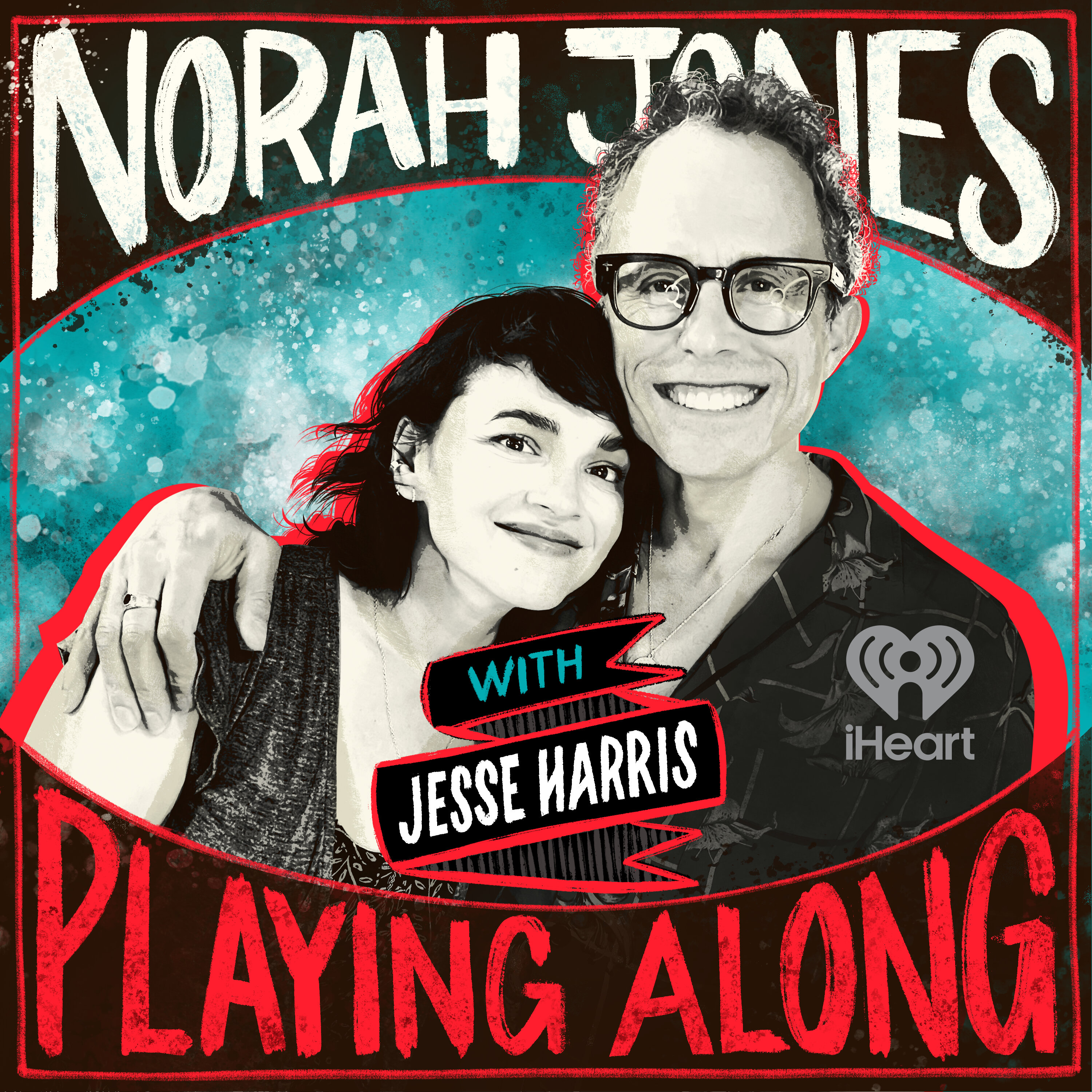
Jesse Harris
Episode Transcript
Hi, I'm Norah Jones and today I'm playing along with my old pal Jesse Harris.
I'm just playing lo Weuy, I'm just playing lone Weezy.
Hi, Welcome to the show.
I'm Norah Jones, and with me as always is Sarah Oda.
Speaker 2Hello.
Speaker 1Hello.
Speaker 3Our guest today is singer, songwriter, guitarist and producer extraordinaire and og friend.
Speaker 1Yes Jesse Harris.
Speaker 3He's released many albums as a solo artist and several with his instrumental group Cosmo.
And he also has worked with and played with several bands and artists, including Yours Truly me No, I'm pointing to you.
Speaker 1Nobody can see Yours Truly.
Jesse Harris is a friend of mine since I'm nineteen years old, and he worked on my first album with me.
He wrote Don't Know Why, which was my breakout hint and so for me, you know it goes pretty deep.
Speaker 3Yeah, He's written like an unbelievable number of songs.
Speaker 1He's a very prolific songwriter.
He wrote four songs, I think or five songs on my first album.
So yeah, if you know that album, you know his work.
Even if you don't know, you know, you know Jesse has.
Speaker 4A new album, If You Believed in Me, that just came out on November seventh on Artwork Records, and it's featuring an orchestra arranged and conducted by Brazilian composer Mike and Ananias.
Speaker 1And we're going to start this episode with a song I sang with him on that album called Having a Ball.
Speaker 3Stay tuned for a trip down memory lane.
Speaker 1This was fun.
Please enjoy this episode with one of my oldest friends, Jesse Harris.
Speaker 5Is it too late.
Speaker 6For me to call?
Speaker 7I feel so weak?
It hurts to fall.
It hurts to fall.
So can we talk about it?
Speaker 8All?
Speaker 7Wish that we were having wish that we were having a ball.
Speaker 9You had to be.
Speaker 7There.
I supposed it was mean.
It's just a joke.
It's just a joke.
Speaker 1But everything.
Speaker 7Went up and smoked.
Still you are having We say we are having a ball.
Speaker 5Just start we world yesterday.
Speaker 2Isn't it something.
Speaker 10I say?
Speaker 7I let you go, it's time to sleep, I lie, wake.
Speaker 6You count and.
Speaker 11Cheap, I'm kind cheap.
Don't go away the.
Speaker 12Things he keeps.
Speaker 7We say we are having wish that we were having a ball.
We said we will having We said we were having a ball.
We said we would have it.
Wish that we were having a ball, We said we would have it.
Speaker 12Was said we were having a ball.
Speaker 1Awesome.
Yeah island Es.
Hi, friend, Hi, we had to do this to hang out.
Well, you're busy, I know, but you're always gone.
I know that you're French.
Speaker 2Now, I've been around you know, I've been around some.
Speaker 1You spend a lot of time in Paris, though, I do.
That's true because you're French.
Speaker 2Now, yeah, I'm working on it.
I was at the beach yesterday in the day before.
Speaker 1Well, I didn't get a call.
Speaker 2Are you going out?
Speaker 5And Hi?
Speaker 1Welcome to our dynamic.
Speaker 2Have we started?
Speaker 1Oh?
Yeah?
Okay?
Hi, Hi, Now you're all self conscious?
Speaker 2No, I'm ready.
I'm good.
Speaker 1Let's start with a song for fun?
Okay, can we do one of the first songs I used to sing with you, sure, which is is a song that I did record on my first album that people who liked that album love that song.
And also this is the version I used to sing with you.
Speaker 2That's right.
Speaker 1You used to play with the Ferdnandos and you'd be playing at the living room and I'd be there and you just kind of like go like that with your head, you jerk your head, And what was that a signal for for me to come up and sing it with you?
Or am I thinking of not your fault?
Speaker 2No?
No, no, we would do this, We would do this.
Yeah.
But you sang on not your fault on the record.
Speaker 1But this was like one of the first ones, right, so this came out in two thousand and one.
Speaker 13Well, the album came out in two thousand and one, but we must have recorded it in two thousand ors.
Speaker 1Yeah, probably, yeah, but I'm not on the album.
Speaker 2Yes you are.
Speaker 1I am okay, I can't said yeah, okay, So I sing it with you on the album?
Speaker 2Yeah you did?
Speaker 1Okay?
Yeah, and that was like right after I moved to New York.
Yeah, okay, let's do it and then we'll talk about Okay, wait, do you do it in C minor?
Yeah?
Okay.
For some reason, I keep having not your Fault in my head.
I don't know why.
Speaker 13Well, you sang on that too, and you really were yelling.
Remember in the harmonies.
I remember, Okay, do you want to come in with me?
At the intro?
Speaker 14Okay, lines on your face, don't bother me, sit down in my.
Speaker 1Shill, when you dance.
Speaker 5So I can't help myself.
Speaker 12I got to see Gay.
Speaker 14Late in the night.
Speaker 5Well, I'm all alone and I look at the cloud.
Hallo, you're not home.
Speaker 12I can't help myself.
Speaker 1I got to.
Speaker 6See you again.
I had an almost go.
Speaker 5Just to watch you be seen.
Speaker 15I had a lomost gold there just to live in a dream.
Speaker 14But no, I won't go for any of those things.
Speaker 5To not touch your skin is not why I see.
Speaker 2I can't help my.
Speaker 6I've got to see you and game.
Speaker 5I can always go there just to watch you be seen.
Speaker 15I can always go there just to live a.
Speaker 16G But no, I won't go to share with But oh even though, no way.
Speaker 12I get Helmas.
Speaker 16I've got to see I can't helmas.
Speaker 2I've got to see Gay.
All right.
Speaker 1It really brings me back.
Speaker 2I remember I used to do a harmonica, so one Oh did you bring your harmonica?
I didn't.
I didn't remember until this moment.
Speaker 1Oh, that's that's right, because I was like, well, I didn't play piano on it.
Speaker 2And I haven't done that in a while.
Speaker 1But yeah, oh that would have been fun.
That's right, God those days.
Speaker 2Yeah, I was thinking about that on my way here because I used to live her on here, and so I was walking through the old hood and checking things out, and looked at my old place where I used to live, and I saw the old copy shop where I used to make my song books.
Speaker 1And oh, copy shops back before you had a printer in your house.
Speaker 2Yeah, wow, and they used to They would bind the books for me too.
Speaker 1Really, Oh, that's so cool.
Speaker 13So when we did the gigs, I never did any rehearsals, So I just bring the book to the gig, and whoever was on bass that night would just flip, you know, flipped to the song we were doing because they were in alphabetical order.
Speaker 1That's so easy.
That's so jazz of you.
I know, that's such a like jazz musician, jazz singer thing to do.
Have their own book.
That's so cool.
Speaker 2Had a cover too.
Speaker 1I remember You've always been excellent at making charts, so I remember.
Speaker 2That well early on.
Actually remember Ben Street.
Ben Street said you said you got to start making charts.
Speaker 1Really is he the one who made you do?
Speaker 2Yeah, in the very beginning.
Speaker 1Yeah, this is back in the ones.
Speaker 6Before that.
Speaker 1Even Okay, man, that's so cool.
Well, what I met you in Texas in nineteen ninety eight summer.
Speaker 2No, it was April April.
Speaker 1It was right before the summer.
Yeah, and I had the big Cadillac.
I'm sure some people know the story and some people don't, but you were driving cross country with Richard.
Actually, I think we told the story when I did the podcast with Richard.
Speaker 2Oh cool.
Speaker 1Yeah, But I met you and Richard Julian as well as Kenny Wallison and Kurt roseen.
Speaker 2Winkle and Johnson.
Speaker 1And I don't think I ever actually met Mark Johnson on that he was Yeah, he wasn't really around.
So I showed up in my seventy one Cadillac Cidandeville, and you had on like your Jesse hat and your Jesse shirt basically, and your guitar.
That night at the golf course, I showed you guys around town all day and then that night we jammed on the golf course and that was the first time.
Do you remember what song you sang that night?
Speaker 2Maybe?
Was it like Mommy, you've been on my mind?
Speaker 1Yeah, And I was like, that's a great song.
When did you write that or something?
And you're like, yeah, that's a Dylan song.
I was just so I was multiple and you and then I moved to New York and you kept giving me music to listen to, and you, like, you shaped so much of my early taste, you know, which is crazy.
Speaker 2But I mean you already knew a lot of.
Speaker 1Music I did, but I had a lot of gaps, right, yeah, I knew a lot of jazz, yeah, and some country.
Speaker 2You learned Dolly Parton, right, Oh.
Speaker 1Yeah, I mean I knew Dolly and Willie right, but I had a lot of gaps.
I had, like Big Bob Dylan gaps you filled in.
Speaker 2Yeah.
Speaker 1Yeah.
And then that summer I came to visit you, yep, and well visit New York, right for like a week, right, and I came to the living room to see you play with the Ferdinandos.
Oh my god, right yeah, and I was just like, this is fun.
Speaker 2Maybe I'll leave school.
Speaker 1Maybe I'll drive to school and move up to New York and play for tips.
And I got blamed, yeah, well by my mom until the Grammys, and then you were fine.
Speaker 2She came up and forget you know, it was actually town Hall.
Speaker 1Really yeah, what did she do?
Speaker 2She said, I'm not mad at you anymore.
Speaker 1That's so funny.
So I remember seeing you play with the Ferdinandos, and that was after One's Blue, right, Yes, so you had a band with Rebecca Martin called One's Blue where she did most.
Speaker 2Of the singing pretty much all the sings.
Okay, Yeah, I sang harmonies on just a couple of songs.
Speaker 1Okay.
You do well with with a female singer.
It's like a marriage of your songs.
Speaker 2Yeah, I've been doing it.
It's been kind of that way for a long time.
Speaker 1Yeah, well, you're good at it.
Speaker 2Well.
The cool thing is, you know, the Fernando's Back in the day, like when we did Crooked, we recorded over at Tony SHARE's apartment in Carroll Gardens and uh and it was Kenny Walls and Tony Share.
And now we've made a new record together.
Speaker 1Oh now cool.
Speaker 13Yeah, so it's the first time, you know, I did a record with those guys on it.
But it was like a different concept of an album, and Tony was playing upright, and it was a it was a certain thing.
But this new record is the first time since back in those days that I really feel like the three of us got together and made an album the way we used to except different.
Speaker 1Yeah, but it sounds very different to me.
Yeah, and the album is called paper Flower, Paper Flower, Yeah, but it's just the three of you.
Speaker 2No, it was because they're.
Speaker 1Synthesizers on it, which is totally different from the back in the day.
Speaker 13That's true, that's true.
Speaker 2Yeah, I used to be more of a purist than I am now, but but we kind of combined the old way of recording, like those are all live takes, but now just you know, adding new elements to it, believe it or not.
Some of the sense stuff is Kenny playing.
Speaker 1I believe that.
Speaker 2Yeah, Kenny's really into experimenting with sounds.
And then some friends of mind have over in Paris, like this guy named Julie's Cotton who's in this group called Papoos that who I work with, and he's great a since and doing parts and he really knows you know, old analog sense.
Speaker 1Really well, it's the whole world.
Speaker 13Yeah, and so he did a lot of that stuff that you hear there, and then you know, added other friends.
Speaker 2On there like CJ.
Camery aka Karm plays horns on one tune, and there's a great singer named Anton Jones sings harmonies throughout.
She plays some piano stuff too.
Speaker 1Nice you want to do a song from that.
Sure, Can we do you get a Broken Heart?
Speaker 2Yeah?
Speaker 13Yeah, sure, yeah, I knew you would like that one.
Speaker 1It's very it's very old, very old Ford.
And then we'll ease into the newer.
I mean this is still from the new record though.
Speaker 2Yeah.
Speaker 1I can tell that's Kenny.
It's so great.
Speaker 2Yeah.
Speaker 17Yeah.
Speaker 9If you get a broken hart, lose you way, fall apart.
Speaker 18There's no one that's going get back on your feet again.
Speaker 19When you're hurting deep inside, you do your best to try to hide, but.
Speaker 12It useless to disgusted.
They all see.
Speaker 20Bing you see, there's no need to let them know.
And it's spatter.
If they go, you can't learn to see to.
Speaker 5Mar why was the flowers as to go.
Speaker 18See?
Speaker 5If you get a broken horse, bow's your way to father part ask nobody.
Speaker 2To help you.
Speaker 12Get back on your feet again?
Speaker 2All right?
Speaker 1Nice, it feels familiar.
They all see beneath your skin.
Yeek, yikes.
It's like what we're always trying to avoid, isn't it until you get older and then you're cool?
Right?
Speaker 2Then revealed too much?
Speaker 1You're cool taking off your skin?
Speaker 12Right?
Speaker 1Wait a second, So you have so many albums, it's crazy.
Speaker 12I know.
Speaker 1Yeah, you've made so many albums.
Yeah, and you've made a lot of different albums, the stuff with Petra Hayden and right John Zorn.
I mean there's so many people.
You have a band, the Cosmos, Cosmo just Cosmo.
Speaker 2Yeah, yeah, it's all instrumental news.
It's with Will Brave, Jeremy Gustin great these days.
James Buckley's playing bass and Kenny plays marimba in the band.
Speaker 1Oh that's fine.
I saw him with his little shorty remember he like custom cut it.
Speaker 2Off right, and he installed the pickup in it.
Speaker 1That's so cool.
Speaker 2Yeah, he keeps it in my house actually, so it gets ends up being used on a lot of recordings.
Speaker 1That's cool.
And you've been recording at home a lot.
Speaker 2Yeah.
Speaker 1When did that start?
Speaker 2That started about oh, six and a half years ago.
Ready, that was a huge, huge development.
Speaker 13For the longest time, I always thought recording had to happen in a studio, that at home it would be a distraction or it wouldn't have the same magic or something.
And I resisted for a long time, and then he actually was through making one of the.
Speaker 2Cosmo records that we recorded at my place, and and my friend who was engineering, said you need to get your own stuff.
And finally I said, okay, fine, if you can help me, yeah, and so he placed an order for me, and then I just gave him my credit card and then yeah, and all this gear showed up, like sixteen boxes of stuff, and I thought, and I called him, I said, what do I do this?
He said, well, you have to get it wired up.
Speaker 1You're like, thanks, guy, Yeah, are you going to help me with it?
Speaker 2And then actually I called Matt.
Yeah.
But yeah, it's been a it's been a life changer.
It used to be.
Speaker 10You know.
Speaker 13If I got together was so one and we wanted to try something, we wrote a song.
Speaker 2Then we had to wait until we could get into a studio.
Speaker 13But yeah, now I you know, write a song, we'll walk across the room and record it, or for myself too, you know, make.
Speaker 2Records or do over dubs or whatever.
Used to be.
You know, if I wanted to change that one little thing in a song, I had to wait.
Yeah, No, I just turned on the studio and start working.
Speaker 1I mean that's kind of how everyone's doing it now, and all the studios are going out of business.
I know it's our fault, which is sad, but like you know, it's also cool that people can just sort of take things into their old own hands.
Speaker 2Yeah.
I still love the experience of going to a studio and working and making an album.
Speaker 9In the studio.
Speaker 2Of course, there is a certain energy that happens there.
Speaker 1Yeah, and there's a lot of money spent doing it.
That's true, that's prohibitive to most people.
Yeah, you know so, But yeah, I feel like all the studios I know that are surviving aren't making money on necessarily.
Speaker 2They find other means, or they have means they do like movies, or.
Speaker 1They do Oh yeah, there's a lot of voiceover work.
Yeah, totally.
All the studios are gone.
Speaker 2I mean in New York.
Yeah, yeah, La still got studios.
Speaker 1There's still studios here.
Speaker 2I don't know what I'm saying, they're not as many, No, tons of close.
Speaker 1How many songs do you think you've written?
Speaker 12Do you know?
Speaker 1Because you're very well documented human as I know you to be.
You're very you make charts, you you're an organized person, so you must know how many songs?
Speaker 2Actually, I've never I've never counted.
Speaker 1Okay, but i'd be curious.
Speaker 2I just on my own records.
Speaker 1I mean, oh, you don't have to do math right now?
Yes, okay, it's just the thought.
It's like it must be in the thousands.
Speaker 2I don't know that thousands sounds a lot.
Speaker 1It sounds like a lot, but I feel like it could be close to a thousand.
That's possible, which is insane.
Yeah, but because when I was just looking at the number of albums, Yeah, so Jesse Harrison, the Ferdinandoz, that's the first album you made with the Ferdinandos, right, because so I remember listening to that album like crazy, but I don't remember listening to Don't Know Why.
When I look at it and I think about all those songs, I don't remember listening to Don't Know Why, because I think it got somehow eclipsed.
Yeah, well in a weird way.
Speaker 2But because we started to play it, maybe and maybe though one a life of its own.
Speaker 1Really, But isn't that weird how the brain works.
It's like I actually was talking to someone who recorded the demos we made at Sony and will Will Garrett, Yeah, and he was saying that he had the original demo of me singing the songs that we recorded of yours for Sony because you had a publishing deal and he's like, I have that that demo and don't know why it's on it.
Speaker 2I was like, no, it's not.
Speaker 1We did it for the first time at Sorcerer.
I just in my mind I had completely rewritten it.
I just forgot.
Speaker 2Yeah, I kind of forgot we did it.
Speaker 1Then I forgot we did it, or maybe I didn't like it or the version wasn't as good.
I don't know.
He didn't play it for me.
But isn't that funny, Like in my mind, I never even knew that song until we did it at.
Speaker 13Sorcer, right, But that's not true at all.
Yeah, I mean we must have been performing it that whole summer.
Speaker 7I know.
Speaker 1I don't know if we performed it before we recorded it really with me singing it.
But again, I'm remembering everything completely backwards.
But I know that I'm you must have performed it, and I must have.
I know I listened to that record, but.
Speaker 2We had a version because Dan had his part.
Speaker 1You know, in my mind, it was just all spontaneous.
Speaker 2I don't know, well, it happened fast, it did happen.
Speaker 1I think it was the first take.
Speaker 2It was the first take, Yeah, and that was it.
Speaker 1But it's just funny to me, like thinking of all that.
Yeah, I must have listened to that record that you made with don't know why on it though a thousand times that summer.
Speaker 2Sure, but we had created our own thing with it.
Yeah, and we were doing you know, we were playing the living room and other venues that summer.
Remember we drove out to uh, Provincetown, No, not Provincetown.
I forget that town's name.
We have to look up the name of that town.
Speaker 1Yeah, we were playing at the living room a lot.
Yeah, Yeah, it happened really fast though, I remember, yes, but I remember, don't know why not being like our a tune from when we were playing live, Yes, until we did the recording, and then it was just such a killer recording.
Not that the tune wasn't great, but it wasn't like the one we were always playing.
I didn't think.
Speaker 3I don't know.
Speaker 1I don't either, and it doesn't matter, but I just like, like, I like to know if my memories are correct, because I feel like you keep good record.
Speaker 13I'm pretty sure that we were playing it because we came in knowing it and it was the first song you wanted to record, or.
Speaker 2One of the first ones.
Interesting, So you definitely had a comfort with it already, I must have.
Speaker 12Yeah.
Speaker 1Do you find that when you play a song too many times that recording it is difficult because you lose the spontaneity?
Speaker 2Well?
Speaker 13I do think that when you write a song, there is something great about recording it as soon as possible, right.
Speaker 1Yeah, yeah, Yeah, that's what I find more and more after that, after learning, you know about.
Speaker 2Because you start to change how you sing a song once.
Speaker 1You know, after a while you kind of stray from the melody.
Speaker 13Yeah, and if you could get it in that early moment, you're doing some things that you probably kind of filter out later on.
Speaker 1Yeah, like singing the melody accurately.
Speaker 2Maybe.
Yeah, that's why maybe when you try to re record the song, it had lost some kind of.
Speaker 1Oh yeah, well that version was just so good.
Speaker 21Yeah.
Speaker 1But I find that a lot with with all kinds of songs, I sort of put them away now and then when it's time to record them, I try not to rehearse it too much.
Speaker 2You know, stuff like that.
I think that's smart.
Yeah.
Speaker 1Have you been playing in Paris a lot?
Speaker 7I have?
Speaker 1Yeah, So where do you play locally in Paris?
Like, what's your your spot?
Speaker 2I tend to do a lot of There's this strip of jazz clubs there in Chatelat There's the Duke de Lombard, Bese Sallet, Sunset, Sunside, and they're all kind of in a row of Little Street, and I usually played there.
Speaker 13Unless I'm doing some other thing with, you know, sitting in with an artist I work with, who you know, playing at another venue.
But those tend to be where I do my gigs and they're fun, so fun.
Speaker 1Yeah, does it feel like you have that same thing in New York now?
Not really, not like it used to.
Okay, Yeah, I was curious about that.
Speaker 2Yeah, I don't know.
Yeah, New York's a little different.
Speaker 1But my question is like, do you really think it's different or are we just not in a new phase in the phase that's doing that.
Speaker 2You know, that's a valid question.
Speaker 13I just I think for sure that what's happened in New York is that it's really spread out.
You got venues in Ridgewood, in Bushwick, in you know, Crown Heights in Bedstye, uh, you know, like they're just all over the place, or Lower east Side, you know, New Blue and so there isn't this sense of there being a spot, like a little area where you can go and bounce around.
Speaker 1To different places, kind of like how the Lower east Side was.
Speaker 13Yeah, yeah, now it's you kind of have to make a choice about your evening now, yeah, and where you're going to spend it.
Speaker 2Yeah, things are just really spread out.
But there are a lot of cool places for sure.
Speaker 1This one song from your album, it has kind of a Parisian vibe.
Speaker 2Oh, paper Flower, I thought you were going to say that.
Yeah, that's true.
Speaker 1Yeah, you'll play it.
Speaker 2Yeah, okay, let's do it.
You're going to sing with me?
Speaker 1What do you want me to sing?
Harmony or murmur?
I can do whatever you want, okay.
Speaker 2Yes, yes, singing throughout.
Speaker 22I'll chime in, Okay as much as you want.
Speaker 2Okay.
Speaker 8If you give a paper flower, better say it's.
Speaker 6From the hard flowers all.
Speaker 8Fall the pond.
Speaker 6And rite over the time.
Speaker 5I would take a paper flower if you tell me that it's real.
Speaker 8All I need.
Speaker 17Is to feel.
Speaker 6A push from behind.
It's funy.
How will losion.
Speaker 5Soon becomes the truth?
You can't and that the fact inspite.
Speaker 11Of this soul confusion, I don't want to paper flower.
Speaker 6Touch it to a mass chaperns.
Speaker 12When will lie.
Speaker 6Ever how to read the signe?
Speaker 2It's funny how we lose.
Speaker 6So and becomes the truth.
Speaker 10You get and not the fact inspie this soul confusion out of wall of paper flower.
Speaker 6Touch it to latch, it burns.
Speaker 1When will lie.
Speaker 6Ever have to read the sign.
Speaker 12This paper flowers blind?
Speaker 2All right?
That was sweet?
Yeah, that was good.
You sound beautiful.
So fun to play these with you.
Speaker 12Yeah.
Speaker 1I feel like over the years, anytime I need a good acoustic guitar part, I call you.
Speaker 2Yeah, but yeah, you've been doing a lot of your own guitar stuff.
Yeah, that which is cool.
Speaker 1Well, I learned a lot from you and Richard, I feel like early on and you can.
I mean, I can't play acoustic like you.
You can do all the fingerpicky stuff, but I don't practice enough for that.
But I feel like the way I play guitar is basically equal parts you, Richard, Julian and Tony share, except way worse than all of you because I don't practice enough.
Speaker 2But it works.
Speaker 1Yeah, but it works.
Speaker 2You've cobbled together a very useful it's my own thing.
Speaker 1Yeah, Yeah, it's cool.
Speaker 2Yeah, you sounded you guys sounded great at Brooklyn Paramount.
Speaker 1Thanks, it was fun.
Yeah, you and Richard came.
It was nice.
I know it's the old crew.
So what are you gonna do this year?
Are you going to be on tour it all?
Or do you just sort of play?
Speaker 2What are you doing?
Speaker 1Are you sible?
Speaker 2And and yeah, it's a bunch of different things, right, you know.
Speaker 13I'm doing a few shows right now with Kenny and Tony and this keyboard play named Frank Lakrasto.
Speaker 1Oh yeah, he's great.
Speaker 2Yeah, And I just played over in Paris.
I've been going back and forth there and promoting the album and doing some radio shows and stuff like that.
But in terms of touring, not that much.
I do little sporadic shows.
I'm going to go to Japan and do a tour.
Speaker 1Ooh fun, are you playing in Tokyo.
Speaker 2We're gonna play this club called Duo Music Exchange.
Oh cool.
Speaker 13Yeah, when I do my own thing lately, I've been going there, but like I played the Blue Note with Gabby Hartman recently.
But but yeah, it's either like Blue Note or Duo in Tokyo and then but this time we're going to go around.
I think we're going to go to Fukuoka, do you not.
Usually I've done a bunch of tours like that, but sometimes, you know, you go over and you just play Tokyo and come home.
Speaker 22Yeah, so it's way more fun to that's so fun travel around.
Yeah, the bullet train is my favorite.
Speaker 7Yeah.
Speaker 1My favorite snacking in this earth is Japanese train stations.
Yeah, this is the most delicious.
I love it of snacking.
Speaker 13But I'm you know, I'm producing some different artists.
So we're going at you know, at my studio and also in Paris with Smartest over there.
I'm doing my first photography show.
Speaker 18What.
Speaker 2Yeah in Montalk this summer really oh cool?
Yeah?
Where at have you been to the ranch that?
Oh it's cool gallery.
Speaker 1That's cool.
Speaker 2Yeah, what do you guys?
How long you in town?
Speaker 1Another couple of weeks and then go back out.
Speaker 2Cool road through a lot more shows this summer.
Speaker 1About a month and a half, about a month fish know, you know you lose track.
Speaker 2Yeah, but just in the States, outdoor sheds some I.
Speaker 1Kind of had to ask them to stop booking me in certain places in the summer because my crew almost died.
It was just too hot.
Speaker 21Wow.
Speaker 1You know, we played a show in Nashville a couple of years ago outside in probably July.
Speaker 2And it you know, it's like a hundred degrees.
Speaker 1It's just too much for people to work outside all day.
The sequence on my my outfit that night melted, Oh my god, on my neck.
It was weird.
Who it was just very hot and for people to sit outside it was too much.
So I want to hit the hot places, like in the winter, indoors or something.
Yeah, so I've tried to plan it a little.
Speaker 2Oh okay, like cool both.
What about Brazil?
It's ever going to happen again?
Speaker 3God?
Speaker 1Yeah, it's my favorite place to go with you.
I know, you have to always come with me.
Speaker 2I know, we got to do another one.
It's been a long time, not really, has it not?
Speaker 1Well, if you think about the pandemic, it was right before it was in twenty nineteen.
Speaker 2That's true.
Speaker 1Okay, so ye's not so long well yeah, but it is if you erase those two years.
Speaker 18I know.
Speaker 2Yeah, right, you have to adjust.
Speaker 1Yeah, yeah, I'd love to God, that would be so fun.
Speaker 2I know I miss it.
Speaker 1I do kind of think that that is the best audience.
No offense to any other audiences, but they're just so into music.
But they're so vocal with their love, but not Heckley.
You know, it's not like they're just yelling random stuff at you, Like.
Speaker 2Music in Brazil is like food in Italy.
Yeah, it's just deeply ingrained in the culture.
Speaker 1It's so incredible and it feels like you're having a real exchange because they're really getting it or something.
I don't know.
Yep, I do feel like it's probably the best audience.
Speaker 2Yeah, I think so.
Speaker 1Yeah, let's go all right, all right, cool.
Speaker 2Already?
Speaker 1Growing up?
Did you Okay, one more question because this next this next song we're going to do, I feel like it has hints of stuff that I know you listened to growing up.
So I want to ask you, okay, growing up, Yes, where did you learn music from?
Was it your dad's record collection.
Speaker 2My dad's and my mom and your mom?
Speaker 13My father was a much more avid music listener, he was, right, I remember this, Yeah, okay, Yeah, So I continue to pill for his record collection to this day.
Speaker 1It's great that you have it.
Yeah, So what did he listen to?
Speaker 2Well, he went through phases.
You know, he really loved jazz and and he started listening to jazz in the sixties, so, and he had his favorite artists, Miles Davis and then all the offshoots and Miles Davis, you know, Bill Evans, Cannonball, Adder Lee.
Speaker 1All the good stuff.
Speaker 13Yeah, some Cold Trane.
But he loved the modern jazz quartet.
And then later he got into the seventies, he got super into everything that was popular then.
So he really followed, you know a lot of these artists into their fusion records and then new artists.
Speaker 2Do infusion and that was you growing up.
Speaker 13And then of course we listened to Steely Dan, earth Wind and Fire, Stevie Wonder.
Speaker 2And you know that was Yeah, that's a lot of what I heard growing up.
And my mom.
Speaker 1Also, what did your mom listen to?
Speaker 2She really loved the Police.
Speaker 1She loved the punk rock.
Speaker 2Yeah, yeah, she had more popular tastes.
Speaker 1I guess, okay, I guess the Police.
Yeah, I said punk rock.
But well it became more mainstream.
Speaker 13Yeah, well, I mean they were, you know, they weren't really they became mainstream later and actually, yeah, their last album was their most mainstream before that.
Speaker 2That was the stuff she liked.
Speaker 1Actually, okay, those earlier records.
Speaker 2But yeah, she listened to a lot of like quote unquote cooler kind of stuff, you know, and uh, and then I just started listening to music on my own.
And of course I went through many different phases.
Speaker 1When did you what was your first phase of playing?
Speaker 22I started the piano when I was ten, Okay, lessons, traditional.
Speaker 2Piano lessons, classical practicing, scales and arpeggios, and I hated it and I didn't practice same and I was I was, you know, music I guess came easily to me, and so I wouldn't practice, and then I'd show up for the lesson and I would do well at the lesson.
My teacher would say, Jesse, if you just practiced, you really could do a lot better.
And I'd say, yes, I know, I'm going to do it, and then I wouldn't do it.
And finally, after four years, you know, I stopped.
But I still had this desire to play music, and so I started playing harmonica, you know, just going around with a harmonica, playing with people before the guitar.
Before the guitar.
I did not know that, yeah, And so I would buy I would go you know, like sixteens, seventeen years old and New York City and so I started going around, you know, I buy all the diatonic harmonicas and all the keys and play with friends who played guitar.
Speaker 1Okay.
Speaker 13And there was a guitar in my closet which my mother had found because she moved to California for several years and when she came back, the people she sub letter places to left a guitar there and that was my first guitar.
Said I'm going to learn some Bob Dylan songs and so, you know, and Neil Young songs, and so I started.
I bought some songbooks and learned the chords out of the books at like seventeen yeah, okay, and that.
Speaker 2You know, and then started writing songs almost immediately immediately.
Speaker 1Did you feel did you think I want to be a songwriter?
Did you think that way?
Because I remember the first time I met you and Richard, it was the first time I'd ever met anyone who was a songwriter, And in fact, I said, what do you guys do?
What do you guys do?
And you said, we're songwriters, so definitively, and I never thought of that as like an offshoot option.
You didn't say we're musicians, right, You said we're songwriters.
Yeah, and that felt so intentional to me.
So is that how you did you like shift the way you think like, I'm going to be I'm a songwriter?
Speaker 2Well?
Speaker 1Did you think that early on?
Speaker 2Pretty much?
Speaker 13I mean when I first Yeah, from the moment I started writing songs, I didn't really want to do anything else.
Speaker 12Yeah.
Speaker 2But then it was when I was in Once Blue that I started to have to think about writing songs that I wouldn't sing.
Speaker 1Yeah, that's a whole other thing.
Speaker 13That had to be solid, you know, that had to be good enough for someone else to put themselves into, both melodically and lyrically.
Speaker 2And so that was a, you know, the beginning of a lot of work to start to understand what that would be.
Speaker 1Was there somebody that you saw that did that that you kind of thought about it in that way, like did you think of a specific songwriter who's a good question?
Or it just kind of sort of all came around it.
Speaker 13Kind of it was more of the latter, But you know, I mean, of course I was well aware that a lot of people sang Bob Dylan songs, but I didn't really model my songwriting after him.
Speaker 1But I don't did you feel like he ever wrote for other people.
He probably just wrote.
Speaker 2Yeah, I think he's just churning out tunes and people just.
Speaker 1Plucking them, and you know, not like a real building thing where they were specifically writing for other right, like Carol King or something.
Speaker 2Yeah, no, yeah, it's funny.
Speaker 1Though.
Speaker 2Later on I came to discover that, like in the Brazilian world, they were doing more of this people.
You know, a lot of singers like Gal Costa would cover Kaitanos songs about Jill Bert Jill's songs for example.
Speaker 13But I was kind of the same.
I wasn't really writing for other people.
I was still writing songs, but trying to write songs that other people could sing, yeah, or that would you know, work for another person.
Speaker 2And a lot of that came down to lyric writing too, and melody of course, as I said before, but making lyrics that that another person could put themselves into.
Speaker 1Yeah, do you ever feel like you're taking yourself out of songs?
Like just one word here, one specific word there, you know.
Speaker 2Like, no, I don't.
I've never filtered myself like that.
Speaker 1Yeah, it's not that it's more than that, like or yeah.
Speaker 13No, it's it's more that I try to let the song, whatever it is, be its own, have its own life, Yeah, to have its own logic and its own story.
Speaker 2And I feel like songs do have their own intention.
Speaker 1Yeah, and they kind of grab you and pull you along the path, right.
Speaker 2Yeah, I feel like you just have to kind of help them become what they're supposed to be.
Speaker 11Yeah.
Speaker 1I think that's the right way to think about it.
Speaker 2But I think I was.
Speaker 13There was also a period where I think I was a little bit lazy and I didn't work hard enough on certain things that later I decided.
Speaker 2Really yeah, like what like lyrics.
Speaker 13I listened to some of my records some of the other one older ones or middle ones or whatever.
Some songs work, and then others are like, come on, I tuld have done so much better.
Speaker 1Oh, I hate that it's like on record.
Speaker 2Yeah, that's out there in the world.
There's nothing you can do.
But that's cool.
I mean, it's cool for people to see things that you know that all sides of it, you know, whatt you grow a person or an artist?
Speaker 11Yeah?
Speaker 1Yeah, Well I think it's funny because I think the you know, I didn't really write songs when I met you.
I had written a couple of songs in high school that were stinky, so I stopped.
And then after I met you, you would send me.
You sent me one flight down right, Yes, I do, when I still lived in Texas.
Speaker 2Yeah, I send it to you in the mail.
Speaker 1You sent me a chord chart and lyrics.
Speaker 2And the melody was written on there.
Speaker 1Yeah, but not not a recording, no recording.
Speaker 3Yeah.
Speaker 2It was a leader.
Speaker 1She was just the lead sheep.
Speaker 2Yeah.
Yeah, and I had I was like, oh, okay, cool.
Speaker 1Yeah, and I think I played it, but I never played it on a gig until we started doing her.
Speaker 2Right.
You send me a letter back and you said, my mom really likes you.
Speaker 1My mom likes yourself.
Speaker 2Yeah, a lot of people don't.
Speaker 1Know about you, Okay, that you're really good at.
Speaker 2Sight reading melodies and singing them off the page.
Speaker 1Yeah, I am, because I learned how to do that very early.
I took a weird music theory class in elementary school along with my classical class, which I never practiced for.
But the site reading stuff, I had to do it all in high school at the performing arts high school, and then all in college, and I tested out of it because I had already done all that but I'm not great at reading reading full music, like classical music.
Speaker 2Just a line of melody.
Speaker 1A line of melody is so easy for me.
But to read like, you know, a bunch of like the whole thing, the whole thing with the bass cleft, is still a little tricky.
Sure, but I got really good at reading courtes.
Speaker 13You could do those gigs where you just open up the real book, Yeah, any song and sing it.
Speaker 1Yeah.
So that's why you sent me that, because you knew I did that.
Speaker 13I guess, yeah, I mean maybe I guess I knew because Kenny had gone to.
Speaker 2See you perform.
Speaker 1That's right.
You hadn't seen me.
Speaker 2I didn't.
I hadn't even gone yet.
Yeah.
Speaker 1Yeah, he came to the restaurant Popolo's in Dallas.
Speaker 13But I could tell that you knew you were talking about because when we were doing that at first little jam session, you were calling out the chords in your key.
Speaker 1What a precocious little yeah, totally.
Yeah.
Speaker 2I was eighteen, eighteen or nineteen yeah, I was nineteen yeah, just turned yeah.
Speaker 1That's crazy.
Speaker 2Yeah.
Speaker 1And so when we started playing together, I could I came at it from a jazz place, and you always have had a lot of jazz influence, but you came at it from a more structured place, right, Yeah, well that's.
Speaker 2What was so cool.
That was cool.
Speaker 13Here you play piano over these chords and bring them to life in a different way that I hadn't heard before.
Speaker 1No, it was cool.
Speaker 2I mean we did it.
Speaker 1It was awesome.
Yeah, that's crazy.
Those were the days.
Let's do you another song from your new album.
This one reminds me that seventies kind of stuff, the influence.
Speaker 2Yeah that's true.
Okay, you get to sing with me, right.
Speaker 1Yeah, Okay, I can do this one.
Okay, Yeah, all right yeah Angular Angular Baby.
Speaker 2All right?
Speaker 7Three?
Speaker 5We got nowhere we're going.
Speaker 6Oh else, we could lose alway.
Speaker 5If we fund, we'll have ourselves sublame.
We gotta know what we do.
Speaker 15It's easy to make chase.
Speaker 6With no one's looking.
Speaker 23That's when the world can change.
We got and know what we god because if we lose.
Speaker 14We lose a lot.
Speaker 1We got and know win to stop searching fall.
Speaker 3We got.
Speaker 5We gotta know what we're thinking.
Speaker 12It sees it.
Speaker 15Thanks you much, and keep bone pushing until we're allowed to tell.
Speaker 12We got and know what.
Speaker 2We got because if we lose we lose a lot we.
Speaker 5Got and know when to stop searching fall we got.
Speaker 16We got, and know what we got because if we lose.
Speaker 7We lose a lote we got and know when to stop searching for.
Speaker 1We go.
Speaker 2Yeah right, I like that.
That's fun Yeah.
Speaker 1Well it's funny because I came to music singing other people's songs, mostly through jazz, singing the old songs, being afraid of songwriting, singing your songs.
And then the more and more I wrote, I feel like the harder it's become to sing other people's songs, which is such a weird thing.
Well, I mean, I get it, but it's it's a funny thing.
It's like an evolution of sure things.
Speaker 13If you grow accustom also to expressing yourself that way, yeah, then you're gonna want that opportunity for yourself, you know.
Speaker 2Yeah.
Speaker 1I mean it's funny because I feel like early on, like on my second and third record, you know, I wrote more and more, but I was still writing, like, still very timid about it, still crafting the songs in a way that I was into, you know.
But then the more years of past, I feel like it's just the emotion.
It's more emotion in it now than I used to put in it, and I don't know how to capture that emotion singing other people's songs interesting, but I know that I used to be able to do that, and I feel like it's almost like a skill I've lost a little bit, really a little bit.
Speaker 13I feel that you get an opportunity to be an interpret or sometimes in outside projects though.
Speaker 1Yeah, but I don't completely feel the rawness as much as I I mean, because I used to not think about it.
Speaker 2Maybe because it was because you didn't write as many things.
Maybe you would pour everything into the songs that you sang.
Speaker 1Maybe or I would relate to it.
Yes, that's exactly what I'm thinking, damn it.
And now I can write what I'm thinking.
But isn't that weird?
Speaker 2It's funny, you know, we're all evolving and changing.
Speaker 1Yeah, ideally hopefully hopefully, but uh yeah, I do feel like I'm not good at it anymore, like, which is a weird thing.
Speaker 2I don't think that's true.
Speaker 1I disagree, but you know what it is.
It's honesty.
I feel like when I when I was young, I felt very honest singing all those songs, and I still feel honest singing them because I have to sing them like I wrote them, because like when I sing, don't know why, and people get so excited.
I feel like I wrote it.
I always give you credit, but I feel like, but I hear a song now, but I feel like I have to sing it like it's mine.
But I don't even think about it.
Speaker 2I just do it.
Speaker 1I own it in my heart.
And I feel that way with the songs I've done in the past that I still do now.
But I find it harder to adopt a new songs that I didn't write.
Speaker 2Yeah, a new friend or something.
Speaker 1Yeah, yeah, Well, isn't it funny?
You keep thinking, yeah, I don't need any more friends, and then you get into the next decade of your life and you realize you have a whole new said friends.
Speaker 2Yeah, but that's interesting.
Speaker 1I thought it was interesting.
Speaker 2Yeah.
Yeah, well, you know, it is something you've been working on and it wasn't there before.
Yeah, and it makes sense.
Speaker 1It's funny.
But I still own your songs in.
Speaker 2My heart, but you certainly own them when you sing them, that's for sure.
Speaker 1I love them.
People get so happy when they hear them.
It just like it brings people joy and it makes me so happy.
People always ask like, do you ever get sick of singing the same songs from your first record?
And I never do because the amount of like good energy it generates it makes me so happy.
Speaker 2You kind of rearrange them each time you do them.
Speaker 1I don't even mean to.
I think they just evolved.
Speaker 13I like that groove you guys do with brian On.
Don't know why kind of gospel groove that.
Speaker 2It has now.
Speaker 1Yeah, I like it too, but I hope people aren't bummed that it's a little different.
Speaker 2I don't seem bummed, but you.
Speaker 1Know what I mean.
Sometimes you don't want to change it too much, right.
I did sing it once.
I sing it once at a festival and I realized I was phrasing the bridge differently, and the audience started singing along and I wasn't singing with them correctly, and so I checked myself because I didn't even realize I was doing it.
So I went back to the old way.
It's just funny things.
Things drift off the off the map sometimes you don't know that they are.
Speaker 2Yeah, that's true.
You used to start doing it a different way of thinking about it.
But I think audience.
Speaker 13It depends on the performer, you know, like if James Taylor sings Fire and Rain, it has to be the same every single time pretty much.
Speaker 2But Dylan, Yeah, if the audience even figures.
Speaker 24Out what song he's singing, they're so exciting there as soon as they realize what, like, you know, oh, that's the groom still waiting at the altars, then they're really exciting that they know it, and then they'll start chanting along to the lyrics even though they're not even close to being in his phrasing.
Speaker 1I know, it's funny.
Yeah, it's something I don't think about much, but hopefully it's cool that it's a little different.
Speaker 2Well, yeah, it's totally cool.
Speaker 1Well, thanks for doing this.
Speaker 2I thought that we could.
Speaker 1I was wondering if you wanted to try a World of Trouble because this is the first song that is from like one of those demos we made Sony.
Yeah, but it's actually it got me.
It helped get me signed because I gave Bruce a blue note.
I gave him a recording of me doing a jazz tune, actually two jazz tunes, and World of Trouble.
So and then we recorded it for the Hottest State the movie.
Yeah, you you did the soundtrack to that film, and that was much later.
That was much later, but I still remember which album is it on?
Of yours?
It's on Cricolize, because I loved that album so much and I used to just sing along with it, and so it was one of my favorites of yours from the olden days.
Yeah, okay, we have a key discrepancy.
Speaker 2You sure do.
Yeah, you're very far away from I'm.
Speaker 1Really surprised because you have a high timber and I I feel like I don't get it.
I don't get the key to Oh you know, I know why, because it's it starts off slow.
Speaker 2Right, and then it goes high.
Speaker 12Yeah.
Speaker 1Yeah, so you said d flat, I mean I was singing flat.
What about seeing?
Speaker 17Yeah?
Speaker 2Yeah, you see your time, you see I see.
Speaker 1I don't need a k I don't get why we're so different.
Speaker 13That's a weird song to sing.
Basically, it's a hard song.
Yeah, I kind of I did a disservice to all of us.
Speaker 1No, it's a great song.
It's just a hard song.
Speaker 2The story of the recording from Crooked Lines is funny because we, as I said, made that record at Tony's house and we had recorded that song early on, and after we did it, we were like, cool, that's good, but we can do it better.
And for a solid year we.
Speaker 13Kept recording that song and every time we did her like, I don't know, we just don't.
She's not quite getting that one.
And one day Tony because it was all real to reel, Oh he on tape.
Yeah, we were on half inch.
It was eight track, half inch, And one day he put up a reel because he, you know, Tony like he doesn't he wasn't really marking the boxes very well, so we didn't even know what.
Speaker 2Was on this reel.
So he put the reel up to see what was there.
Speaker 13And all of a sudden, because all the tracks are open, there were the songs started to play and there were two vocals playing.
Speaker 1Oh that's right, it's got a double vocal.
Speaker 2But it was never meant to be.
Speaker 13That was just two different takes of the vocal where I sang it live, and then I was like, can I do it again?
And I did it again, and then we heard them together and then we said, oh, let's just leave it like that.
Speaker 1Yeah, so you had to take you just we had it for a year.
It needed a double vocal.
H.
Well, it's such a slow song.
Yes, And I find that songs this slow and vibe are really hard to just get because if you don't just get them, you can't labor over them.
Right, Yeah, they have to have that little bit of magicness.
Yeah, let's see if d works.
We're going to meet somewhere in the middle.
Speaker 2High PARTI high, but I think I can't do it.
Speaker 1Why don't you do the first verse and I'll sing harmony on the bridge, and then I'll do night Night when the phone rings?
Speaker 2Okay?
Speaker 1Is that cool?
Speaker 2Sure?
Okay?
And then what the last one?
We do together?
This is the last thing?
Yeah, okay, okay, cool?
Speaker 1Yeah, all right?
Yeah, and sing on World of Trouble with me even on the verse I do yep, yeah, yeah, totally.
Speaker 2Okay.
Speaker 5It starts off snow with the.
Speaker 1Kiss of folly.
Speaker 5And you don't see is more.
Speaker 12But after.
Speaker 5Wowing of the dogs, see sneaking in Little.
Speaker 6Bad you don't will lay tell you.
Speaker 5You don't really.
Speaker 6Down the world.
Speaker 12Shot, it's all.
Speaker 20You say.
Speaker 25I swear the phone rings, and it's so easy to get up and go back again.
Speaker 6You don't stop, you.
Speaker 1Don't think to leave without it.
Speaker 12No way, you are no wid.
Speaker 1It.
Speaker 15Don't blieve will they tell you.
Speaker 12You don't believe?
Speaker 23The world.
Speaker 12Shop it's old.
Speaker 9See this is the last.
Speaker 2Time, all the beginning, whenever.
Speaker 21You say enough, why each today, each month rolls out behind you.
Speaker 8The last time is coming your blood.
You don't really re They tell you you.
Speaker 2Don't really.
Speaker 14Then word.
Speaker 1Now, chop.
Speaker 5It's all.
Speaker 20You see.
Speaker 6A word.
Speaker 12Cho it's.
Speaker 21You.
Speaker 2I thought that word.
It was great.
Speaker 1Yeah, boy, she brings me back that song.
That was the special thing about that little time.
Yeah, and going to see everybody at the living room is they would actually just play their songs and you would get to know them before you'd even hear a recording.
Speaker 2Yeah.
In fact, I would often bring new songs to the gig, to my gigs and do them for the first time at the gig.
Same with you.
I remember the first time that we did the Long Day Is Over was live at Fez.
Speaker 1Oh, yeah, that one gig, same thing.
Speaker 2I brought you a lead sheet.
I was like, let's do this new song tonight, you know, and you and I had no way.
It wasn't Long Days Over.
Speaker 1It was what was I don't know what was it?
Speaker 2It was another song or.
Speaker 13Maybe it was long days over, but we had just written it.
We had just written it, but I brought the lead sheet and we did it for the first time on the gig.
Speaker 1Maybe oh, you brought the lead sheet for Lee maybe but on the bass.
Speaker 2But maybe the lyrics hadn't been written yet or something.
Speaker 1I don't know, but I just remember that time being so special because like I wasn't I was barely writing songs.
And it's why I started writing songs.
I came home from seeing like you guys and Tony at the living room and I wrote come Away with Me in my room alone with a guitar that I could barely play because I was inspired, you know.
Speaker 2Yeah, in that room that had a bed.
Speaker 1Oh yeah, my little rock bedrock.
We called it bedrock.
Speaker 19Hi.
Speaker 1Would you like to come hang out in my bed with me?
Because that's the only place I have to hang out, not romantically, just we'll rock out, play some songs.
Yeah, that's right, oh those days.
Well, I love you, thanks too, This is fun.
Speaker 2Yeah, thanks so much, all right.
Speaker 1Cool, all right, yeah, thanks Jesse, thank you.
That was so fun.
Speaker 3I love the story of how you guys met it's so special that you've stayed connected for so long.
Speaker 1Yeah, it's a good story.
Speaker 3Actually, you finish each other's sandwiches.
Speaker 6It's sweet.
Speaker 1It was sweet.
I'll never forget the day I met him and those guys.
It was a special day for me.
It was really great to play music.
We never really get to play together anymore, just like old times.
Yeah, Jesse's got a lot of new stuff coming out all the time, So check his pages and go see him live.
He plays a lot obviously in Paris as we went over, and a lot sometimes in New York City and he goes on tour, so check him out wherever he is.
If you want to know what songs we played on this episode.
The first song was called Having a Ball.
It's a song I sang with Jesse on his new album If You Believed in Me that just came out earlier this month.
Second song I've Got to See You Again, which I did record on my first album, Come Away with Me, but he also recorded it on his album Crooked Lines by Jesse Harrison the Ferdinandos in two thousand and one, and then again on another album, Songs Never Sung.
Third song was a newer song of Jesse's called if You Get a Broken Heart from the album Paper Flower twenty twenty four.
Fourth song was paper Flower from the same album.
The fifth song we did was We Got to Know from Paper Flower, and the sixth song is World of Trouble, which has been on a lot of different albums.
My demos from the Come Away with Me Deluxe album, The Crooked Lines, Jesse Harris and the Ferdinandos album from two thousand and one, and from the soundtrack to the movie The Hottest State two thousand and seven.
Special thanks Jesse Harris for joining us today.
Next week we'll be back with Sam Smith.
Norah Jones is playing along as a production of iHeart Podcasts.
I'm your Host Norah Jones.
This episode was recorded by Matt Marinelli, mixed by Jamie Landry, edited by Sarah Oda.
Additional engineering by Greg Tobler.
Additional recording by Jamie Landry.
Artwork by Eliza Frye, Photography by Shervin Lennaz.
Produced by Me and Sarah Oda.
Executive producers Aaron Wang Kaufman and Jordan Rundag, Marketing League Queen and a Key Toodles