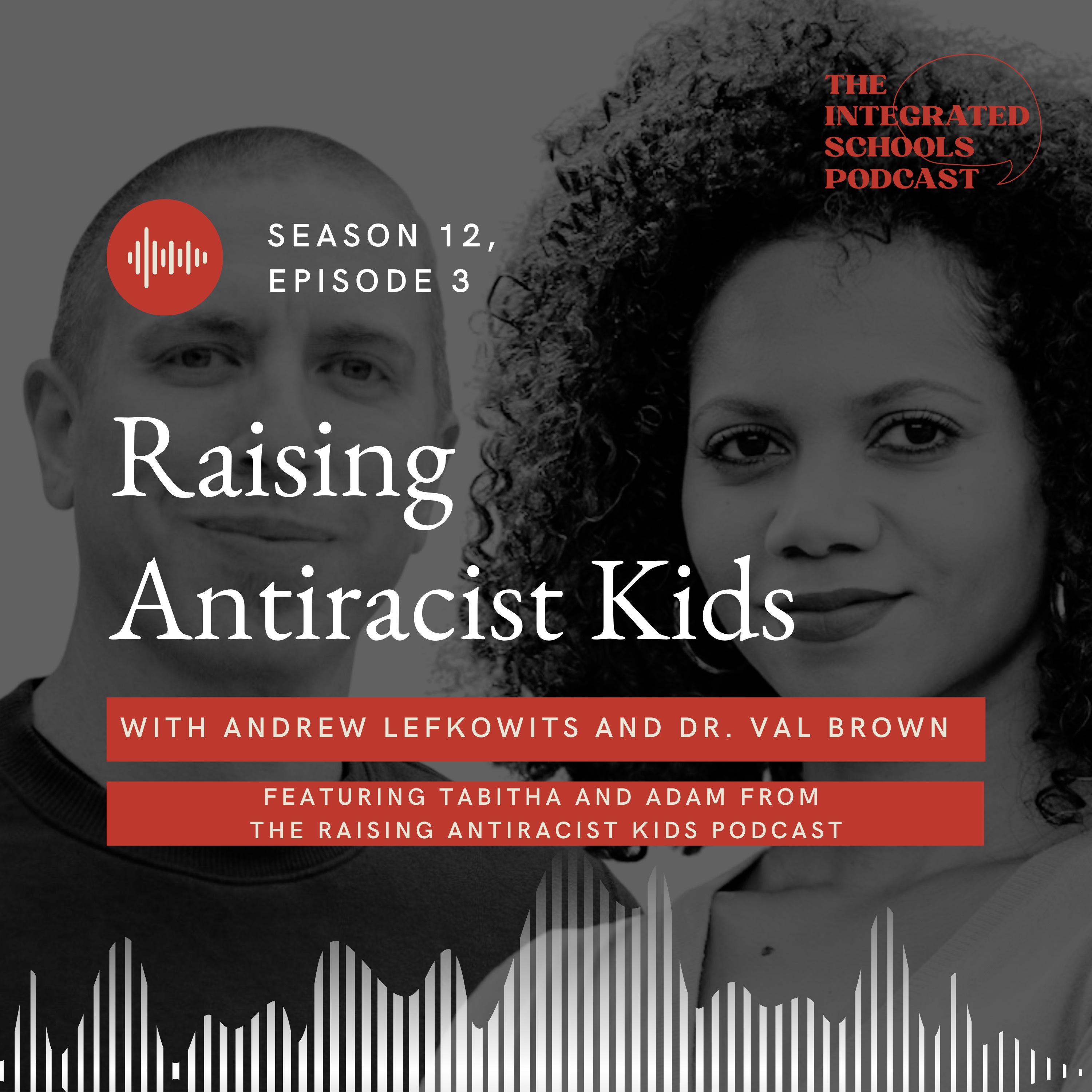
Raising Antiracist Kids
Episode Transcript
[SPEAKER_05]: Welcome to the Integrated Schools podcast.
[SPEAKER_05]: I'm Andrew White Dad from Denver, and this is Raising Antiracist Kids.
[SPEAKER_05]: I got a special treat for you today.
[SPEAKER_05]: A few weeks ago, Val and I were invited to be guests on another podcast that we are fans of called the Raising Antiracist Kids Podcast.
[SPEAKER_05]: It's hosted by an interracial couple, Tabitha and Adam, and I actually connected with Tabitha, all the way back in 2020.
[SPEAKER_05]: She reached out to integrated schools to talk about pandemic pods for an article she was writing for a column she had at romper at the time, [SPEAKER_05]: I followed her work ever since.
[SPEAKER_05]: I was thrilled when she and Adam launched their Substack raising Enterases kids and then their podcast of the same name.
[SPEAKER_05]: So when they invited Vau and I on to talk about building anti-racist school communities, we jumped at the opportunity to be on the other side of the mic, so to speak.
[SPEAKER_05]: So we're going to share that episode with you today.
[SPEAKER_05]: We encourage you to check out their Substack, their show, which is really full of just great resources for parents who want to prioritize anti-racism in their parents.
[SPEAKER_05]: They'll be links in the show notes.
[SPEAKER_05]: Vau and I had a great time being guests on their podcast.
[SPEAKER_05]: So, there are other podcasts you listen to, where you think we would be good guests.
[SPEAKER_05]: Let us know.
[SPEAKER_05]: Send us an email, podcast and integrateschools.org.
[SPEAKER_05]: About that, or anything else on your mind, let us know what you think of this conversation, and have a fun at them, and we'll be back in two weeks with another new episode.
[SPEAKER_05]: Okay, here is the raising anti-racist kids podcast.
[SPEAKER_01]: Hi, this is Tabitha St.
Bernard Jacobs.
[SPEAKER_06]: Really, are we doing full names now?
[SPEAKER_06]: Yeah, Tabitha St.
Bernard Jacobs.
[SPEAKER_01]: And this is the Raising Antaresis Kids Podcast.
[SPEAKER_01]: We are really excited you're here.
[SPEAKER_01]: That's good.
[SPEAKER_06]: Welcome to Raising Interest Kids podcast with Telefen Adam.
[SPEAKER_02]: The topic of today's podcast episode is parents as partners building anti-racist school communities.
[SPEAKER_02]: And today we're going to talk about what's happening.
[SPEAKER_02]: in this country, the context with which we're having this conversation, and then we're going to talk about how parents can be partners to teach us an admin and kids and so forth as we aim to really build and answer racist communities together.
[SPEAKER_06]: and we are very excited to have our very first guest.
[SPEAKER_06]: Andrew Lefkowitz and Dr.
Valbrown are the co-hosts of the Integrated Schools podcast, an award-winning podcast which is a part of their work to prepare families with racial or economic privilege to commit to integrating their children and driving new narratives about education and advocating for justice in our public schools.
[SPEAKER_06]: Integrated schools now has 43 local chapters around the country and their podcast one, a signal award, and was nominated for two ambees.
[SPEAKER_06]: Nice.
[SPEAKER_06]: So welcome, welcome, welcome.
[SPEAKER_03]: I'm just honored that you all think we are cool enough to share this space with you.
[SPEAKER_06]: I'm not sure you're super cool.
[SPEAKER_06]: As we have heard you do on your own podcast, we're going to start by asking you all to share a little bit about yourselves.
[SPEAKER_06]: Andrew, we're going to start with you.
[SPEAKER_06]: So what led you to launch [SPEAKER_05]: Yeah.
[SPEAKER_05]: I grew up in Denver.
[SPEAKER_05]: I moved away and then moved back when my oldest kid who's now 14 was was four about 10 years ago.
[SPEAKER_05]: Looking at schools was like, okay, there's a school.
[SPEAKER_05]: I can buy a house.
[SPEAKER_05]: It's a quote unquote, good school.
[SPEAKER_05]: It's a school that my sister actually went to.
[SPEAKER_05]: When I was growing up, it was a very integrated [SPEAKER_05]: balance neighborhood school, and I was like, great.
[SPEAKER_05]: I don't know anything about schools, but it seems like other people say this is a good school.
[SPEAKER_05]: This is what I'm supposed to do.
[SPEAKER_05]: I'm supposed to buy a house in the best school I can.
[SPEAKER_05]: That's what being good parent is about.
[SPEAKER_05]: Great, my work here is done.
[SPEAKER_05]: And then I got back and started looking a little more deeply at the school and started thinking back on my own elementary school experience.
[SPEAKER_05]: And my own elementary school is about a mile or so from where we moved.
[SPEAKER_05]: And I [SPEAKER_05]: when I was growing up and also when I moved back was almost entirely black and brown kids was largely low income students and that experience had a huge impact on me on kind of my view of the world on how I relate with other people and the things that I think are important.
[SPEAKER_05]: And I thought, like, this good school that I'm getting must be giving my kids that kind of experience.
[SPEAKER_05]: And then I started looking a little deeper as I go, actually, this school that we paid, you know, I don't know how much more money for our house to be able to have the privilege of going to is not going to give my kids any of that stuff.
[SPEAKER_05]: It was at this point, a 85% white school, you know, 80% economically advantage school and didn't seem like it was going to actually give my kids the [SPEAKER_05]: And so I just sort of struck by this like tension, like why are the messages that I'm getting about what it means to be a good parent in conflict with what I think is important and the messages that I'm getting about being a good citizen about caring about the world about, you know, being a progressive minded person who thinks that racial justice is important these things feel like they're in conflict.
[SPEAKER_05]: And I was curious if anybody else was feeling that same tension and sort of, you know, hopped on the internet to try to find other people who might be and came across integrated schools.
[SPEAKER_05]: The organization was started in 2015 by a woman named Courtney McKinney.
[SPEAKER_05]: And she was also sort of grappling with this question of like, how do I reconcile these two different messages?
[SPEAKER_05]: And I ended up connecting with her on a Zoom call and then met her in person.
[SPEAKER_05]: And the time she was just having lots and lots of one-on-one conversations.
[SPEAKER_05]: And she was like, I can't have one-on-one conversation with every white parent in the country.
[SPEAKER_05]: So, I was like, oh, what have we recorded some of those and put them out as a podcast?
[SPEAKER_05]: And so, in November of 2018, we launched the Integrated Schools Podcast.
[SPEAKER_05]: Really, it's a place to sort of grapple with those things.
[SPEAKER_05]: To have those conversations to see if anybody else was curious about those same things.
[SPEAKER_05]: And tragically, Courtney was struck by a car and killed the very end of 2019, which was a real tragic loss to the organization.
[SPEAKER_05]: who pulled together to keep the organization going in the wake of that and then a little more than a year and a half later we invited Val to join as the co-host.
[SPEAKER_06]: So that's a good transition to you, Val, what led you to it.
[SPEAKER_03]: Yeah, so during that same window of time in 2016, I founded an organization online call hashtag clear the air.
[SPEAKER_03]: And it was for educators and people who loved education to talk about the intersections of racism and education.
[SPEAKER_03]: And to just be real honest about what we were seeing in schools, how we should show up as educators.
[SPEAKER_03]: and built a pretty significant following in that work and one of my colleagues at the time said, hey, there's this organization integrated schools who's working with parents, maybe there's some intersection there.
[SPEAKER_03]: And so I actually do what all people do to make deals these days.
[SPEAKER_03]: I slid into the DMs and I said, I said, you know, let's figure out an opportunity to talk.
[SPEAKER_03]: And I think it was about a month before Courtney died.
[SPEAKER_03]: some time passed, and Anna reached out and said, hey, we would love to still figure out how to connect.
[SPEAKER_03]: And honestly, one of my questions and pushes for the integrated school's team was that I saw that the title of it was integrated schools, but it was talking only to white parents.
[SPEAKER_03]: And I wondered, like, [SPEAKER_03]: is there a space for me here like can we really talk about what this means and if everyone has a seat at the table um i was very very very busy but Andrew ran me down over and over it's a lot of emails just kidding i was a second choice i just want to put that on record oh [SPEAKER_03]: And that's, that's a, that's a, that's a, that's a, that's a, that's a, that's a, that's a, that's a, that's a, that's a, that's a, that's a, that's a, that's a, that's a, that's a, that's a, that's a, that's a, that's a, that's a, that's a, that's a, that's a, that's a, that's a, that's a, that's a, that's a, that's a, that's a, that's a, that's a, that's a, that's a, that's a, that's a, that's a, that's a, that's a, that's a, that's a, that's a, that's a, that's a, that's a, that's a, that's a, that's a, that's a, that's a, that's a, that's a, that's a [SPEAKER_03]: You know, we're both grappling with from our perspectives and our identities and our places in the country and and figure out how to do good in the process.
[SPEAKER_02]: Thank you for that.
[SPEAKER_02]: So, Val, one of the questions you asked yourself and asked Andrew and the team was really is there a place for you as they are placed for a black parent within this movement, within this community.
[SPEAKER_02]: How do you feel about it now?
[SPEAKER_02]: How is it landing for you?
[SPEAKER_03]: Oh, that's such a good question.
[SPEAKER_03]: So, yes, I certainly feel like there's a place for us in the movement.
[SPEAKER_03]: You know, sometimes Andrew and I will get into conversations where [SPEAKER_03]: We're like, oh, oh, oh, I'm saying why black people don't want to do that, all right, you know, I get it and recognizing if we are going to figure out how to win it has to be together like best just has to be what we all sign up for.
[SPEAKER_03]: And so, I do think it's very easy.
[SPEAKER_03]: Like, in a homogenous racial group, to feel like you're really doing the work, but you don't know how well you're doing the work until you try to do it interracially, right?
[SPEAKER_03]: You're like, okay, I'm down for the cause.
[SPEAKER_03]: I'm ready to do this.
[SPEAKER_03]: And then someone of difference that's sitting across me and you realize that, [SPEAKER_03]: what intellectually you think is working, you haven't figured out how to align that with your values, with your actions, with your words in the same way that you're able to intellectualize it.
[SPEAKER_03]: I'll speak for all black people, which I do occasionally.
[SPEAKER_03]: I think if we don't take the seat at the table.
[SPEAKER_03]: Then we won't have our perspectives heard.
[SPEAKER_03]: We won't have our needs addressed that it will continue to be a conversation about us around us and not include us.
[SPEAKER_03]: And I think it's really important.
[SPEAKER_03]: If we are all one in this integrated movement, we all have to be at the table to make it work.
[SPEAKER_02]: and created.
[SPEAKER_06]: Yeah, but that really, yeah, definitely made a lot of sense.
[SPEAKER_02]: It's also a conversation that we have because we do anti-racist parenting work and we notice that lots of the people who come to our workshops and trainings and so forth tend to be mostly white and multi-racial and people have asked questions about if they are space and the anti-racist parenting space for [SPEAKER_02]: Black folks and is their lessons for us to learn and the answer that I that I always say is yes because I think bias can exist wherever you land and I think we all have things to learn from being in multi-racial spaces and we all can teach our kids really significant things from them being in multi-racial spaces as well.
[SPEAKER_02]: Absolutely.
[SPEAKER_02]: Absolutely.
[SPEAKER_06]: What I heard is that you kind of started off is like we're like, I don't know if I'm going to do into great schools for very long And here we are however many seasons, you know, this man won't let me quit.
[SPEAKER_05]: I told him I ask you nicely to come back [SPEAKER_02]: But I think you both also do really incredible work together.
[SPEAKER_02]: It's something that's needed within the podcasting space within any conversation among about anti-racism.
[SPEAKER_02]: So I think it's something that's like deeply relevant, especially in these times when [SPEAKER_02]: parents are trying to figure out how can we as schools face attacks on D.I.
[SPEAKER_02]: as, you know, bookbands are happening.
[SPEAKER_02]: It puts more on parents to have to figure these things out.
[SPEAKER_02]: Absolutely.
[SPEAKER_02]: Absolutely.
[SPEAKER_05]: I think that the like the power of modeling.
[SPEAKER_05]: You know, like, like, Val said, you can do it in your head, all you want.
[SPEAKER_05]: You can read all the books that you want.
[SPEAKER_05]: You can study all you want.
[SPEAKER_05]: You can get an A plus in, you know, your anti-racism study course.
[SPEAKER_05]: But like, it doesn't mean as much until you actually try to put it in practice.
[SPEAKER_05]: Until you actually sit down and have a conversation.
[SPEAKER_05]: And so the place is where I go into a conversation with Val, not thinking twice about being in alignment somewhere.
[SPEAKER_05]: And then all of a sudden it's like, oh, wait.
[SPEAKER_05]: Like, now I need to sort of dig a little deeper.
[SPEAKER_05]: Now I need to explore a little more.
[SPEAKER_05]: That's the gift to me of getting to be in conversation with Val at every episode.
[SPEAKER_05]: But I think hopefully one of the things that people take from listening to the episodes is that we can do this and we don't have to necessarily agree every time.
[SPEAKER_05]: We can step in in wrong places.
[SPEAKER_05]: I mean, Val's second episode on the podcast.
[SPEAKER_04]: I was going to say that's what I was going to use.
[SPEAKER_05]: When hard, you know, like one of the conversations we were reflecting on and something that that one of the parents from the organization said that sort of struck a wrong, but we just went went right after it and sort of talked about it and that that the ability to do that to come out the other side, you know, with a closer relationship with having more understanding.
[SPEAKER_05]: There's so many places where I think people get scared and they don't want to talk or they don't want to say the wrong thing But they don't want to, you know, offend somebody and so we just write retreat to reading another book by Ebermix Kendi and like that's good You should read those books and that's not actually changing the world, you know, like it's going out and being in relationship with each other like Falses We only win if we win together or so [SPEAKER_03]: And that, in that example of that second episode, you know, I was nervous, I'm sure Andrew you were nervous too, because we were really just getting to know one another and I thought to myself, do I really tell him how I feel about this episode?
[SPEAKER_03]: You know, I could offend everybody in the whole organization.
[SPEAKER_03]: I just got here, you know, you're brand new.
[SPEAKER_03]: That's right, brand new.
[SPEAKER_03]: And I think there was a little like getting to know one another and how we felt about things in that moment.
[SPEAKER_03]: I'm actually glad it happened so early because it allowed us to see each other in a way that if we had held back, that we wouldn't have been able to for quite some time.
[SPEAKER_03]: And [SPEAKER_03]: I think it paved the way for us to know that we could experience that and get through the other side, you know, which felt really important.
[SPEAKER_03]: And I think gave me a lot of confidence about having the conversation with you so publicly.
[SPEAKER_06]: That's what's going to be very far.
[SPEAKER_06]: We heard a little bit about Andrew's background, can you tell us a little bit about what brought you to the work?
[SPEAKER_03]: Yeah, yeah.
[SPEAKER_03]: So I come from a family of educator activists, and I tried to run from that as long as I possibly could.
[SPEAKER_03]: Everyone around me was an educator growing up and so I always recognize the power and promise of education and then specifically around engaging civically, just in your community, right?
[SPEAKER_03]: So my grandfather always said, do you want to leave a place better than you found it?
[SPEAKER_03]: Whether that's the house, your community, anything.
[SPEAKER_03]: And so I started my career as a newspaper journalist and that was fun until I had to go the [SPEAKER_03]: on police raids and that's not my vibe.
[SPEAKER_03]: And so I went back to school.
[SPEAKER_03]: I've done a lot of physicians in education, including middle school teaching, high school teaching, higher ed, non-profits.
[SPEAKER_03]: I did my doctoral work in professional learning and specifically the professional learning that educator activists need in order to do their work well in communities.
[SPEAKER_03]: And so I commit this not only as a parent, but also as an educator.
[SPEAKER_03]: in this space.
[SPEAKER_03]: And so that allows us to have multiple layers of conversation because I tried to run from it for so long.
[SPEAKER_03]: It doesn't actually feel like a choice.
[SPEAKER_03]: It feels like a calling.
[SPEAKER_03]: And I'm okay with that.
[SPEAKER_03]: You know, I feel at peace with that.
[SPEAKER_03]: I feel like I am answering the call.
[SPEAKER_03]: It's interesting.
[SPEAKER_03]: Some of my black friends were like, Val, you have so much patience and grace to have these conversations.
[SPEAKER_03]: And so we want to do it so publicly.
[SPEAKER_03]: And it really, it doesn't feel like a burden.
[SPEAKER_03]: It feels like I am.
[SPEAKER_03]: doing what I am supposed to do.
[SPEAKER_03]: And my hope in my prayer, and my work is rooted in that, this is going to be valuable to someone at some point.
[SPEAKER_03]: I remember someone, it was around 2016, 2017.
[SPEAKER_03]: Someone that I worked with like four years ago finds me, sends me to text messages like, hey, I know I wasn't listening back then, but I totally understand what you were saying now.
[SPEAKER_03]: So my hope is that someone will hear these conversations at some point, and it will click.
[SPEAKER_03]: it'll be worth it.
[SPEAKER_02]: Val, I wanted to ask you, you said before, and activists educate, saw.
[SPEAKER_02]: Yeah.
[SPEAKER_02]: How do you define that?
[SPEAKER_03]: Yeah.
[SPEAKER_03]: So, um, so an educator activist, when I educate activists.
[SPEAKER_02]: Yeah.
[SPEAKER_03]: When I was thinking, just about my work in dinner, I was really missing my grandfather at the time.
[SPEAKER_03]: He's passed several years now, and my dad, like Simultaneously, sent me just some old letters that my grandfather had wrote.
[SPEAKER_03]: And I was reading them, and he was a social study teacher.
[SPEAKER_03]: He was also the first director of Head Start in 1965 in Sarah Soda, Florida, and this letter that I quote in my dissertation says, essentially that it's not just about what we're doing in the classroom, it's about what we're doing in the community, right?
[SPEAKER_03]: It's a both-and.
[SPEAKER_03]: And so, educator activists recognize that there's power not only in educating, but we have to think about all of the conditions around a student as well, right?
[SPEAKER_03]: And so, if we recognize that one of our students, any of our students, all of our students are struggling with poverty, what does that mean, what type of work do we decide to do not only in our school community, but maybe in our larger community, that will help address that root problem so that our kid can continue to thrive in an educational space.
[SPEAKER_03]: And so, educator activists, they care about the social issues that are affecting their children, and they don't ignore them, and they don't assume that kids can just overcome them when they come into their classroom, and they care enough to do something about it with the community in which they work and they serve.
[SPEAKER_02]: That's powerful.
[SPEAKER_03]: Hopefully, hopefully, everybody gets at least one in their life and in these educators aren't always public, but many of them are because they are so passionate about an issue, but it can show up in the ways in which you teach young children, like the ways in which you ask them to critically think about an issue that's happening in that community.
[SPEAKER_03]: You can show up as service.
[SPEAKER_03]: It can show up as using your voice as an advocate in some public way, but two often educators [SPEAKER_03]: in the name of like being neutral but you know that's impossible.
[SPEAKER_03]: And so it's it's owning that feeling empowered by that and wanting to do good as a result.
[SPEAKER_02]: That's powerful.
[SPEAKER_02]: And I also think this idea of neutrality is is not a thing especially in this time when educators have to be thinking about ice knocking on the door asking for students like there is no neutrality either you're there to [SPEAKER_02]: or what, you're not, which is a tough, yeah, which is a tough place to be.
[SPEAKER_06]: Yeah.
[SPEAKER_06]: You're there to educate all of your students, that's the other thing that I think is often overlooked.
[SPEAKER_06]: This is what I hear from your work and integrated schools is there's power dynamics at play.
[SPEAKER_06]: There are people at play and there's relationships that we have to build.
[SPEAKER_06]: But if we are not going to be having these hard conversations or if we're not going to be actively working to dismantle some of the systems that essentially made the school segregated in the first place, then it's not going to happen.
[SPEAKER_06]: So where are the raising antiracist kids?
[SPEAKER_02]: And where are the raising antiracist kids?
[SPEAKER_06]: We are the, we are the, we are the, we are actively trying to hold them.
[SPEAKER_06]: Yeah.
[SPEAKER_06]: But where do you see the connection between the integrated schools and antiracist parenting or interacist action?
[SPEAKER_05]: Yeah, you know, sort of big picture of what we would like to see in the world through the work of integrated schools is like a true multi racial democracy where we are actually sharing power equally where we are actually creating space where everybody belongs where the presence of everybody in the country makes the country a better place like the only way we get there is if we is if we overcome the hierarchy of human value if we overcome racism and to meet the way we do that is through relationships the way we do that is for getting to know each other and it is.
[SPEAKER_05]: not easy, but it is so much easier for our kids to do that.
[SPEAKER_05]: Our like natural state is to want to connect.
[SPEAKER_05]: Our natural state as people is to want to find commonalities and find shared humanity and get close to people.
[SPEAKER_05]: And so if we can create environments and we don't do a very good job of it.
[SPEAKER_05]: We don't do a very good job of it for all the reasons that we don't do a very good job of it for adults, because we don't have a lot of models for it, but I think if we do a good job of creating environments where kids can actually find their shared humanity, can see each other on equal terms and build those relationships that they want to build anyway.
[SPEAKER_05]: that that gives them a skill set that gives them a belief in the power of it that you can't really replicate intellectually.
[SPEAKER_05]: That gives them a heart connection that makes them feel like, okay, I know this kid.
[SPEAKER_05]: The story about Ruby Bridges is messed up to me, not because intellectually that seems unfair, but because I can imagine my good friend in that scenario and that doesn't feel right to me.
[SPEAKER_05]: And so I think like we need to do all the things like, you know, anti-racism is a large project.
[SPEAKER_05]: And we need to do all the things, but for me it's really hard to imagine doing it well while keeping our kids in segregated spaces.
[SPEAKER_03]: Hmm, an interesting thing happened to me.
[SPEAKER_03]: I was in South Carolina on a work related trip.
[SPEAKER_03]: And I was talking to a black man from a southern state.
[SPEAKER_03]: And he mentioned that it's like nine or ten years old.
[SPEAKER_03]: He had a white friend.
[SPEAKER_03]: They would always hang out in school and he was wondering, why can I become the over to your house?
[SPEAKER_03]: And so one day he goes over to the house to play basketball and when he gets to the house, the white boy's father is putting on a clan outfit, right?
[SPEAKER_03]: And the...
[SPEAKER_03]: Father's like, what are you doing here?
[SPEAKER_03]: You know, we don't like you people where I was as kid here.
[SPEAKER_03]: And the white boy, he set up for him.
[SPEAKER_03]: He's like, this is my friend.
[SPEAKER_03]: They both got in trouble for being together.
[SPEAKER_03]: and yet they couldn't stay away from each other.
[SPEAKER_03]: They are still friends to the state.
[SPEAKER_03]: And he showed us a picture of his friend and his son who also now has black friends, right?
[SPEAKER_03]: And so, Andrew, when you talk about like children being essential to us unlearning all of the hate and bias and anger and just the things that tear apart, they are essential to that.
[SPEAKER_03]: If nothing else, [SPEAKER_03]: we can learn how to love fully and holy from young people.
[SPEAKER_03]: And so for all anti-racist raising kids parents, it is essential, it is essential that you don't serve as the block to that, right, that you don't cut that off from them and what a miracle it is that that kid had a father with such hateful views.
[SPEAKER_03]: who was still able to see the humanity in his friend so much so that there's still friends today.
[SPEAKER_03]: Right?
[SPEAKER_03]: We have so much to learn from children.
[SPEAKER_02]: We do.
[SPEAKER_02]: And I also think about the fact that our children are sort of swimming in white supremacy in this country.
[SPEAKER_02]: And even when there's [SPEAKER_02]: intentionality around teaching them anti-racism, teaching them about equity and social justice and so forth.
[SPEAKER_02]: They are still things that they pick up on around them, a common theme that we sometimes hear in our work is that they're too young to learn bias and they only learn about bias from their parents or people around them.
[SPEAKER_02]: And the reality is that [SPEAKER_02]: Things like the media, it has a powerful impact on them to show as they watch the books they read.
[SPEAKER_02]: And we talk a lot about intentionality around all these things around the six building blocks of antiracist parenting, which I'm glad Andrew, you were talking about sort of moving at the speed of relationships and leaning into relationships, not just on a one-on-one basis, but also in community.
[SPEAKER_02]: with each other in larger communities because that's also something we talk about, the power of building and to racist communities, especially in person community.
[SPEAKER_05]: Yeah, I think that, like, you can't fake that, you know, like you, you can put all the other scaffolding around and set yourself up to capitalize on community as best as possible and doing that work is really important, but if you're trying to teach your kid that we are all equal that they should find shared humanity and then you're opting to put them in the quote unquote good school where they are surrounded by nothing but white wealthy kids, like what message are you actually sending to them?
[SPEAKER_05]: How are they actually going to internalize the idea that we are all equal if all of your actions tell them like oh, yeah Like we could we can go serve soup to those people you can maybe play sports with those people But when it comes to the things that are important to us like our education We're gonna keep you in this sort of claced or bubble where you're not gonna actually have exposure to anybody who's different from you I think like those messages are are nearly impossible to counter [SPEAKER_05]: No matter how many books you read, no matter how many, you know, webinars you watch, no matter how much kind of intellectual work you do.
[SPEAKER_03]: Exactly.
[SPEAKER_03]: I have a lot of white supremacy headaches, don't know, or podcast episodes.
[SPEAKER_05]: Yeah, yeah, we have a lot of stuff.
[SPEAKER_05]: Nearly everything.
[SPEAKER_03]: Oh, my things.
[SPEAKER_05]: We need to sit there.
[SPEAKER_03]: Yeah.
[SPEAKER_03]: However.
[SPEAKER_03]: However, I will say that the longer I'm in this work, the more grace I am able to find because the more I realize how thick that bubble is, how you can live your whole entire life and literally know nothing about anyone who's different from you.
[SPEAKER_03]: and if I may speak for black people again.
[SPEAKER_03]: This is for the record.
[SPEAKER_05]: I never ask her to speak for all people.
[SPEAKER_03]: I don't know.
[SPEAKER_03]: I don't know.
[SPEAKER_03]: I just do it.
[SPEAKER_03]: But I think that is something that we could learn and find more capacity in which to lean in, right?
[SPEAKER_03]: If you really think about, [SPEAKER_03]: someone's whole existence was designed to keep you out, keep your issues out, keep your thoughts out, keep your ideas out, to minimize you, to make you feel like you were nothing.
[SPEAKER_03]: And they are trying to break out of that bubble, if they are actively in this struggle and it's ugly and they're messing up, like you have to give some points for that.
[SPEAKER_03]: I didn't have that same battle, right?
[SPEAKER_03]: I cannot reflect on this time where it felt uncomfortable to talk about race with.
[SPEAKER_03]: my family.
[SPEAKER_03]: I cannot think of a time where we couldn't talk about blackness or what it meant to live in America in a racialized society or discrimination or, like, I can't think of a time where that was unsafe conversation in my family.
[SPEAKER_03]: And in fact, it was coming, you know?
[SPEAKER_03]: So yeah, I don't envy that bubble at all.
[SPEAKER_03]: And I applaud people who are trying to break out of it as ugly as it looks.
[SPEAKER_03]: And I hope they have, and they meet people who are willing to meet them, at least part of the way.
[SPEAKER_06]: Yeah.
[SPEAKER_03]: Yeah.
[SPEAKER_06]: It seems like you'll have to be, I mean, [SPEAKER_06]: We all have to be very intentional about breaking that bubble, but especially a white folks, because like you're saying, like if we don't, we can pretend that we don't see that bubble.
[SPEAKER_06]: I worked in New York City schools for a very long time, and New York City schools are incredibly segregated, especially racial segregated, but economically.
[SPEAKER_06]: And you could be 10 blocks away from the next school and it can look entirely different and the only way to break the bubble that you're talking about is to be super intentional about it.
[SPEAKER_03]: And that can be scary and painful and jarring and you start to question everything and the questioning everything could lead you to [SPEAKER_03]: retreat because it's scary out here.
[SPEAKER_03]: I don't recognize this place.
[SPEAKER_03]: This is not what I was taught the world was.
[SPEAKER_05]: Yeah, it comes back to the power of community.
[SPEAKER_05]: It's why I think like, you know, the resources that you all offer raising anti-racist kids, it's like people need somewhere to land.
[SPEAKER_05]: It's one thing to be willing to take the step to let go of all the messages that was white people we have received about how the world is supposed to work, about meritocracy.
[SPEAKER_05]: It's an intentional project of white supremacy for you to not be able to see the bubble.
[SPEAKER_05]: Right, like the invisibility of the bubble is intentional.
[SPEAKER_05]: So first you've got to see it, which is a big step.
[SPEAKER_05]: But then to break out of it, you have to know that there's somewhere to land on the other side.
[SPEAKER_05]: You have to know that in giving up all of these things, there's a soft place to be.
[SPEAKER_05]: And that's where I think creating communities.
[SPEAKER_05]: So what we try to do at integrated schools is create these pockets, 43 chapters now is like, here's a soft spot where you can land.
[SPEAKER_05]: If you're ready to take the step, we've got you.
[SPEAKER_05]: You're okay, you're in community.
[SPEAKER_05]: You may feel like you're going against [SPEAKER_05]: everything your parents ever taught you.
[SPEAKER_05]: You may feel like you're you know you're your dad who's putting on the clan outfit like to reject that is is a big step to reject all the opinions.
[SPEAKER_03]: It's a literal beating right as a child.
[SPEAKER_05]: Right.
[SPEAKER_05]: Yeah.
[SPEAKER_05]: To reject all the messages you're getting about what it means to be a good parent to reject the the things that your neighbors are the ways that they look at you when you say your kid is going to the school down the block all those things the the only way to get through it is is with community.
[SPEAKER_02]: We're sort of driven to think in very binary ways of people as I've a good or bad, and I'm thinking about what you said earlier, fall about extending grace to people who are committing to this work and who are maybe in a very messy way trying to work through it and struggle with it.
[SPEAKER_02]: And I really love that because I think that we always say that we work with people who are looking for the how and who have already committed to if they're going to do the work.
[SPEAKER_02]: And I think about the fact that so many people are struggling with it and it's messy and it's not a sort of binary or either good or bad or everything you do fits in so that it doesn't need little categories.
[SPEAKER_02]: That's a huge part of the work that we do is having grace for people that are willing and committed to the struggle.
[SPEAKER_03]: I mean, if they found us, that's already work that they've done, right?
[SPEAKER_03]: Also, I need so much grace around so many things when I think back on.
[SPEAKER_03]: my limited or ignorant thinking around any of the other isons that didn't directly affect me since 2016 I've thought more deeply about having citizenship and what that means and how that is a significant area of privilege for anyone who is not feeling that yet you should feel it right now you should you should see it in every community and every street and on the news right like [SPEAKER_03]: So I recognize, I need so much grace, and if I am asking for that from anyone who is willing to help me as I am assembling, it looks very, very second due as an extent that to someone who is also trying.
[SPEAKER_06]: Yes, I really appreciate that.
[SPEAKER_06]: And kind of giving as much openness of thinking about the episode you all did around, kind of like, is integrated integration working?
[SPEAKER_03]: Dr.
Rux.
[SPEAKER_06]: No, Leeway Rux, yeah.
[SPEAKER_06]: Yes.
[SPEAKER_05]: Yeah, that's quite a, quite a challenge.
[SPEAKER_05]: Back game, Andrew, I had a, for like, for weeks.
[SPEAKER_05]: And then I go back and start editing and get a headache.
[SPEAKER_04]: Back game, I have a real big headache.
[SPEAKER_06]: Because the assumption is that if we want to desegregate, we have to send black and brown students to the white schools.
[SPEAKER_06]: Dr.
Rooks said, essentially, she's like, I'm not against integration.
[SPEAKER_06]: I'm against integration in the way that it is currently done.
[SPEAKER_07]: Yeah.
[SPEAKER_06]: So have you seen examples of a working?
[SPEAKER_04]: I think we very well asked, y'all, y'all fit us right now.
[SPEAKER_05]: I would say we've never really tried true integration, real integration.
[SPEAKER_05]: The integrated NYC, the high school students came up with these five hours of real integration.
[SPEAKER_05]: What does it mean to first a school to be integrated in a way that actually works for all students?
[SPEAKER_05]: Because we've never tried that, right?
[SPEAKER_05]: Like in the wake of Brown B.
[SPEAKER_05]: Board, what we did nothing for a decade.
[SPEAKER_05]: And then in their wake of the civil rights act, we were like, okay, fine.
[SPEAKER_05]: We will be gradually allow black kids to come to white schools.
[SPEAKER_05]: And we certainly have no use for black teachers.
[SPEAKER_05]: So we fired 100,000 of them.
[SPEAKER_05]: We have no use for black principles.
[SPEAKER_05]: So we fired a whole bunch of them.
[SPEAKER_05]: We have no use for black schools.
[SPEAKER_05]: So we closed a whole bunch of them down.
[SPEAKER_05]: And like fine, you can come into our space, but we are not going to change our space in any way because you are here.
[SPEAKER_05]: Your presence is not going to make our space different in any way.
[SPEAKER_05]: And even through all of that, we know there were a lot of benefits.
[SPEAKER_05]: Rucker Johnson at a Berkeley has work showing the sort of like longitudinal benefits to kids who were exposed to what ended up being more resources.
[SPEAKER_05]: We know that green follows white.
[SPEAKER_05]: The money follows the white kids.
[SPEAKER_05]: You put black kids in white schools and they are going to get access to more resources and that is going to have positive impacts and there was a real cost to the way we went about that.
[SPEAKER_05]: There was a cost to, you know, communities.
[SPEAKER_05]: There was a cost to teachers.
[SPEAKER_05]: There was cost profession.
[SPEAKER_05]: And then there's like act of harm being done to kids every single day.
[SPEAKER_05]: But Tina Love calls, you know, like spirit murdering, happening every day in schools.
[SPEAKER_05]: Because we have not actually done the work to create inclusive welcoming environments.
[SPEAKER_05]: where everybody actually feels like they belong to do that.
[SPEAKER_05]: So I think, you know, Dr.
Brooks is at a place where her kind of faith in our ability to do that in the short term is pretty limited, which I understand.
[SPEAKER_05]: I still feel like it's our only hope to get through.
[SPEAKER_05]: But from the beginning of integrated schools, it's an organization.
[SPEAKER_05]: We have talked about the importance of what is the school actually look like when you get there.
[SPEAKER_05]: So first of all, our mission is largely calling in folks with privilege to do the work of desegregating.
[SPEAKER_05]: I drive my oldest across to the other side of the town to go to a school that is almost entirely buying brown kids as part of doing the work of desegregating because that one way model where we're just giving black and brown kids access to white schools has so much harm.
[SPEAKER_05]: But then how we show up in those spaces makes a huge difference.
[SPEAKER_05]: So like, when I get there, am I trying to take the school over, am I trying to remake the school in my image?
[SPEAKER_05]: where I'm trying to become a part of the actual community.
[SPEAKER_05]: So, I mean, to go back to your question, I think you can find some schools here and there that are doing a good job of creating really inclusive environments.
[SPEAKER_05]: I think they're pretty few and far between.
[SPEAKER_05]: And I think they're few and far between because there aren't a lot of incentives to do it.
[SPEAKER_05]: There aren't a lot of great models to do it.
[SPEAKER_05]: We're not really training teachers or administrators to have the skill set to hold a community like that.
[SPEAKER_05]: We have, [SPEAKER_05]: largely white teaching force, even wider school administration and spend very little time trying to give them the skillset that it takes to hold a multi-racial community together.
[SPEAKER_05]: And if a school leader's job is anything, it's to hold a school community together and there are so few models of what that actually looks like.
[SPEAKER_05]: And so [SPEAKER_05]: We see schools that are white and privileged and stay white and privileged and have white and privileged administrators who feel like they're doing a good job and their test scores look good and so the district is like you're doing great and then we have schools that are largely full of black and brown kids and and we have administrators who just cycle through there and the the rare handful of integrated spaces you know to to hold on to that to maintain those spaces is really hard and to have the skill set to hold those I think is something that we haven't done a good job of of building the kind of workforce to do.
[SPEAKER_02]: You said something that really resonated with me.
[SPEAKER_02]: You said the way the parents and white kids show up in schools that are predominantly black and brown also has an impact.
[SPEAKER_02]: We see this happening a lot online, especially post 2020, where white folks in particular come into black and brown spaces and they want to be like the most anti-racist and they want to be sort of like, [SPEAKER_02]: the voice of everything equity really it said.
[SPEAKER_02]: So can you talk a little bit more about how white parents and can also teach the kids to show up in spaces where maybe they're not centered, maybe they're not the focus, but they have to find a place within a community.
[SPEAKER_03]: I think it's my favorite episode of this season, Elias.
[SPEAKER_03]: He's in Elias.
[SPEAKER_03]: Yeah.
[SPEAKER_03]: Susan Elias.
[SPEAKER_03]: That's a mother and a son and the son spoke about being a white kid in a black school community.
[SPEAKER_05]: Yeah.
[SPEAKER_05]: So he's in high school now and his parents opted to move him out of a fancy private.
[SPEAKER_05]: kindergarten into the neighborhood school where he was like one of a small handful of white kids and he remembered the feeling of like not being centered that like it wasn't about him.
[SPEAKER_05]: And you know, I don't know how he dealt with that when he was five or six, but at 16, he was so grateful to have had that experience because he recognized that that was not the normal experience for a white man.
[SPEAKER_05]: And so to have that perspective, again, like the things you could tell him that a thousand times, but until he actually felt it as a six-year-old, it just didn't land in the same way.
[SPEAKER_03]: And it really stuck with me.
[SPEAKER_03]: His outlook around what's possible when parents not only commit to showing up in a way that doesn't harm the community, but also talks to their kids about what that looks like.
[SPEAKER_03]: And he also started to see how other schools [SPEAKER_03]: thought about his predominantly black school.
[SPEAKER_03]: So he would hear other schools at sporting events talk about his school, right?
[SPEAKER_03]: Assuming that he was not like one of them.
[SPEAKER_03]: And to have a sense of kinship with what the community was something that he also took away from that.
[SPEAKER_03]: But idea that [SPEAKER_03]: The schools that I went to, the schools that my children go to are not good enough for white family.
[SPEAKER_03]: That always feels so deeply personal.
[SPEAKER_03]: I don't understand it.
[SPEAKER_03]: It makes me sad because there are some my folks who will do anything, but put our kids together in the same school and it feels painful.
[SPEAKER_03]: So when I first started this work, I really wanted to do [SPEAKER_03]: on my son got the like second grade, right?
[SPEAKER_03]: He was like in kindergarten.
[SPEAKER_03]: I was like we could totally fix this by second grade.
[SPEAKER_03]: And so once I settled on understanding that this is a marathon relay race, I felt like my part of the race was more manageable.
[SPEAKER_03]: Yes, it's a marathon, but I'm not going to fix it all in my lifetime.
[SPEAKER_03]: And so, when we were dealing with 400 years of institutional racism on every level, the fact that I thought I was gonna take me two years.
[SPEAKER_05]: You're a boss, you're a boss, I mean, don't say yourself short, but you're the boss.
[SPEAKER_03]: I was only gonna be two years that is gonna take me to a fix this.
[SPEAKER_03]: And when I first started doing anti-racism work around the country, I told my grandma what I was doing, [SPEAKER_03]: I went to one of those trainings back in the 1960s.
[SPEAKER_03]: I'm like, oh, they are.
[SPEAKER_03]: That must be bad, but yeah, once you understand that, yes, this is a hard marathon that you're running and it will not be fixed in your lifetime to completion, you will absolutely do some good while you're here.
[SPEAKER_03]: You will do a lot of good while you're here, especially in our current context, so where it feels like, I don't know which way we're going.
[SPEAKER_03]: We are, we are swimming upstream currently, the fact that people spent generations upon generations upon generations enslaved.
[SPEAKER_03]: Literally, everyone that they knew and could remember being enslaved to know that just like these really good 70 years that I have, that feels like, okay, I've done my part for the people who could not see, could not see the four of us.
[SPEAKER_03]: on a call could not see you all married could not see me and Andrew rock and like that was unimaginable and so it feels in many ways like a privilege to be in this part of the race where we can be in the space where we do know like we have real allies and real people who are trying every day to get to the other side.
[SPEAKER_05]: M, look at you, conjure up some hope, Val.
[SPEAKER_04]: I don't think you had it in you.
[SPEAKER_04]: I can't, look, look, I can say I was hopeful when I got here.
[SPEAKER_04]: You know, I'm like, hey, I try not to read the headlines before we record.
[SPEAKER_06]: Yeah, I really love that visual of the marathon relay where we're here to pass it on.
[SPEAKER_07]: Yeah.
[SPEAKER_06]: So this is a back-to-school episode and we're thinking about how parents can go back to school and be in community with the educators and the other parents in their school around enteracism, around integration.
[SPEAKER_06]: What are some things that it can be thinking about and doing right now?
[SPEAKER_05]: like step one is getting into community and building trust and building relationships.
[SPEAKER_05]: So certainly if you're showing up new at a school, particularly, you know, if you're a white parent showing up at a school where maybe it's not entirely full of white parents, like taking the time to sit back and [SPEAKER_05]: to get to know the community, to look for all of the assets that exist in the community.
[SPEAKER_05]: So often we come in with this idea that this school is broken or I'm going to come fix this school or I'm going to get six of my friends and we're going to go over there and make that school great ignoring all of the wonderful things that exist in the school community.
[SPEAKER_05]: So try to become part of the community and and you don't necessarily get the benefit of the doubt just for showing up.
[SPEAKER_05]: I think, you know, modeling, what does it look like to find community?
[SPEAKER_05]: Our kids are watching us all the time.
[SPEAKER_05]: We can say go out and make friends with kids who look different from you, but when we get on the playground, who are we talking to, it's so easy to go and find the people who look like us and probably have similar life stories to us and jump straight into a fairly surface-level conversation.
[SPEAKER_05]: It's much harder to get through that kind of initial get-to-know-you-face of a [SPEAKER_05]: of a conversation with somebody if you have very little shared experience, but there's such like a richer conversation to be had if you can do it.
[SPEAKER_05]: And so, how are we showing up?
[SPEAKER_05]: Who are we talking to on the playground?
[SPEAKER_05]: Who are we trying to build relationships with at a school?
[SPEAKER_05]: I think our key, you know, kind of first steps, as you're thinking about the new school you're starting.
[SPEAKER_05]: Those are the places that I'm thinking about now, both of my kids are starting new schools this year.
[SPEAKER_05]: It's like, how do I show up and say, okay, who do I want to get to know?
[SPEAKER_05]: Who do I, how do I want to be in community in this school?
[SPEAKER_03]: I made Andrew get a Black Lives Matter sign for his yard once.
[SPEAKER_05]: That does not, that does not sound exactly the way I would like it to sound Val.
[SPEAKER_05]: It's you encouraged me.
[SPEAKER_03]: I did.
[SPEAKER_05]: I wasn't like resistant to the message of Black Lives Matter.
[SPEAKER_03]: No, no, you are.
[SPEAKER_05]: I just didn't have a sign in my yard.
[SPEAKER_03]: That's right.
[SPEAKER_03]: I think right now, show up, show up with some buttons.
[SPEAKER_03]: Show up with a shirt that says, I am someone who understands and knows and you can talk to me about certain things because I do think white folks in particular, if you have a stance that you are are willing to stand on, let someone know.
[SPEAKER_03]: I went on a film trip.
[SPEAKER_03]: So saying Augustine, Florida with my daughter once, and it was like super racist, the whole tour and everything else.
[SPEAKER_03]: And I'm just in shock.
[SPEAKER_03]: And this white one, she leans over.
[SPEAKER_03]: She's like, I cannot believe this, right?
[SPEAKER_03]: No, I don't like it.
[SPEAKER_03]: Maybe they're right, you know, and so both of us and our kids were together for the rest of the tour, like, processing and asking critical thinking questions around what the young people were hearing, right, but I thought it was just going to be me and my daughter, right, because we were only like folks on the trip.
[SPEAKER_03]: So I needed her to say, hey, so I am also looking at this, critically, I also see that there's an issue.
[SPEAKER_03]: So, white folks, in showing up, let people know what you stand for, and it can just be a button.
[SPEAKER_03]: I peep people's buttons all the time, and I compliment them.
[SPEAKER_03]: The other thing I will say is we know that educators are under attack.
[SPEAKER_03]: And so, if you see an educator, and they're sharing something or they're still a bit or they have a poster on their wall, so often they don't get the kudos that they need in those moments, like, hey, I really support this work.
[SPEAKER_03]: So if you are a caregiver or a parent and you see something in your kids classroom, go ahead and email that principal, you know, copy the teacher, let them know publicly and often how great they are doing because more often than not, the teachers are getting complaints about what's happening and not all the kudos.
[SPEAKER_03]: If your kid comes home and says how much they love their teacher, [SPEAKER_03]: let somebody know, right?
[SPEAKER_03]: Let your community know that the teaching at the school is phenomenal.
[SPEAKER_03]: And my kid is having a great time and here are the ways that they are developing.
[SPEAKER_03]: Using your your voice as a parent and the way that you are promote anything that you love, you should do that with your school community.
[SPEAKER_02]: Yes, I love that.
[SPEAKER_02]: And I also think about, if you're white and you are starting with a button, think about how you can always sort of graduate from there, who wants it the next thing.
[SPEAKER_02]: Right.
[SPEAKER_02]: As you start out, expand your work within the community and animals are thinking about finding your place and so forth, but start small and keep on going, keep growing, keep expanding and so forth.
[SPEAKER_03]: We need all families to continue to share that message with folks because there's too many counter messages to those ideas.
[SPEAKER_03]: And so we have to be loud and proud that our schools are fantastic, that our children are doing well, that you are safe and loved here, because it's true.
[SPEAKER_02]: Thank you so much for taking the time to join us.
[SPEAKER_06]: We really appreciate you all, bringing your wisdom and bringing your knowledge to the microphones.
[SPEAKER_06]: Not just in this tonight, but in other ones, and we're going back in the archives and listening to O.1s, and we're going to put some links, especially to the ones that we refer to tonight, but I think definitely encouraging people to go back.
[SPEAKER_06]: And listen, I'm really appreciate it and you all taking the time to keep going at it.
[SPEAKER_06]: And one of the things that I love about it is that there's a community out there.
[SPEAKER_06]: There's a community of people working on this.
[SPEAKER_06]: You are building community 43 of them so far.
[SPEAKER_06]: I would ask you how can people get involved in your work.
[SPEAKER_05]: And then really thank you all.
[SPEAKER_05]: Thank you.
[SPEAKER_05]: Yeah, thank you for having us.
[SPEAKER_05]: This has been a lovely conversation.
[SPEAKER_05]: And thank you for all the work you all are doing.
[SPEAKER_05]: The kids are the only hope.
[SPEAKER_05]: So we've got to start with them.
[SPEAKER_05]: You can go to integrativeschools.org.
[SPEAKER_05]: It's our website.
[SPEAKER_05]: You can find the podcast anywhere.
[SPEAKER_05]: You find your podcast.
[SPEAKER_05]: The integrated schools podcast.
[SPEAKER_05]: And on the website, you can find local chapter.
[SPEAKER_05]: You can join our book club.
[SPEAKER_05]: We've got a caregiver connection.
[SPEAKER_05]: So we connect people one-on-one if you're thinking like, oh, okay, I've got a kindergarten who's just starting and I'm not sure how I feel about this school.
[SPEAKER_05]: I need some, I need some community and I need somebody to lean on.
[SPEAKER_05]: We'll connect you with somebody in a similar situation or in a similar geographic area.
[SPEAKER_05]: somebody who's kind of been there, done that.
[SPEAKER_05]: We have something called the two tour pledge where we encourage people to go out and tour two schools that might not otherwise be on their list and find some good things about them and share those things with their community and you know, we're on social media.
[SPEAKER_05]: So you know, I find us there at integrated schools.
[SPEAKER_02]: I also just want to see on a personal level in the current climate where any work that has to do with anti-racism, equity, anything like that is under attack, not just from this administration, but from the people that support them, just regular people that support them, I am grateful for the work that you all continue to do, just your voice is very clear, and the work is really, really powerful, and I'm honored to be able to [SPEAKER_02]: Listen to what you've done so far and looking forward to what you have coming up in the future.
[SPEAKER_00]: Everyone listening to the racing and the races kids have a cast.
[SPEAKER_00]: Have a try and add them.
[SPEAKER_00]: Let me zip the stem by Stephen Jacobs and Adam Jacobs.
[SPEAKER_00]: Thanks for joining us.
[SPEAKER_00]: Thanks for joining us.