·S1 E103
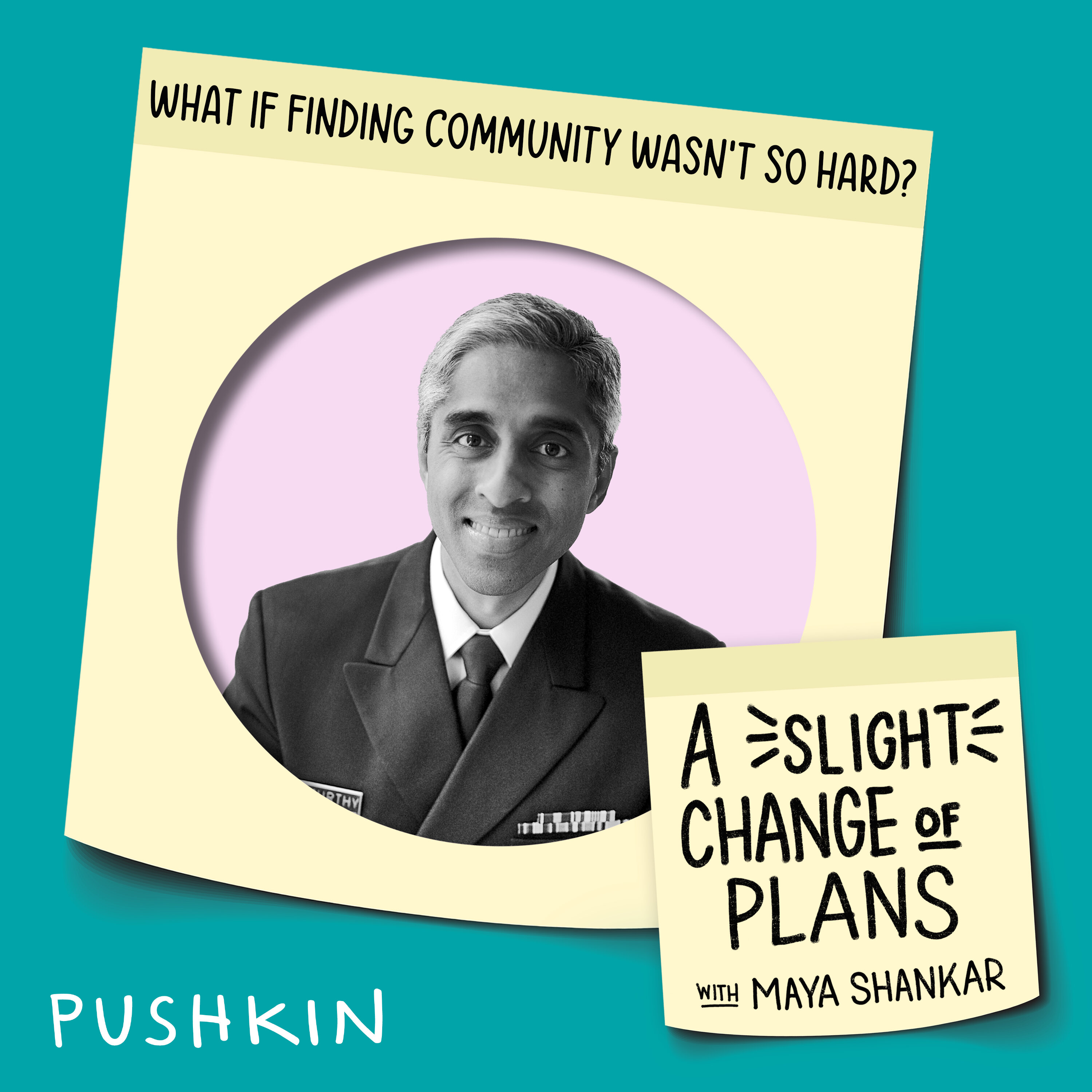
What If Finding Community Wasn't So Hard?
Episode Transcript
Pushkin.
Speaker 2Why are so many of the people that I meet all across America and increasing across the world, why are they so unhappy?
Why do they feel that sense of emptiness that so many people describe.
So many people would say, I guess this is just the way life is.
I guess it's like everyone's feeling this way.
It's that's just life.
And I refuse to believe that because I don't think that we are consigned to live a life of emptiness where we're just unhappy, because that life is hard and as a result unhappy.
Life can be hard, and life often is hard, but that doesn't mean that it has to be unfulfilling.
Speaker 3That's doctor Vivek Morphy, he served as the US Surgeon General under both President Obama and President Biden.
This is the vague second time on the show.
The first time he joined us, we explored the science of loneliness and how bad it can be for our long term health, but we didn't get to talk about how to actually build stronger, more meaningful connections in our lives.
I wanted to hear Vivgu's advice on this topic because when I hear that it's important to quote create community I feel intimidated, like where do I start?
Should I be signing up for a bunch of clubs or striking up small talk with strangers?
Maybe you can relate, but I'm feeling really tired right now, and the idea of adding more items to my to do list is exhausting.
But as you'll hear in this conversation, it turns out that building stronger connection isn't necessarily about doing more.
It's about being intentional about the way we interact with the people and communities we already have in our lives.
I left this conversation with a far more expansive understanding of what connection can look like in my life, and I hope you will too.
I'm Maya Shunker, a scientist who studies human behavior, and this is a slight change of plans, a show about who we are and who we become in the face of a big change.
Speaker 2In its deepest sense, community is a place where we know each other, where we help each other, and where we find purpose in contributing to each other's lives.
That's what makes a real community.
Okay, It's what my father had when he was in a small village in India growing up.
He was really poor.
He didn't and when I say poor, I mean there are levels of poor.
He was really really poor.
I mean they didn't have enough money to buy slippers or shoes.
So the first time he wore something on his feet was when he was fifteen, and he got because he wasn't used to it.
They didn't have enough food around the table most nights, so they just kept pouring more water, you know, to dilute the dolls so there would be enough to fill, you know, each child's bowl.
Times were tough.
But interestingly, he told me he never felt lonely until he left his village.
That even though they were poor materially, they were rich in community, and people knew each other there.
They actually looked out for each other.
They would invite someone in just to come talk if they were, you know, hanging out outside the house or if they were walking down the street.
They also helped each other.
When my father's mother died when he was ten from tuberculosis, the whole village stepped in and became surrogate parents to him and his five siblings.
That is what community really is now.
That is a It can feel like a lofty goal, and especially if you don't have any sense of community of life right now.
Yeah, it can feel like a big distance to go, but here's what I would say.
The path to building community is made up of small steps.
It's not like you need to completely quit your job, move to a different city, like transform everything.
You can start very small, right.
So, one of the things is a few things I often suggest that people do, just at a very baseline level, is to spend five minutes a day reaching out to someone you care about.
That could be a video call, it could be visiting them in person, it could be a phone call, whatever it is, five minutes.
The second thing is to make sure you're doing one thing each day to help someone.
Doesn't have to be someone you know.
It could be somebody in your neighborhood, in your community, in your workplace, and it can be something small.
And the third thing is to actually make sure that when you are people with people, that you are present right because a lot of times what happens, and I have been guilty of this on countless occasions, You're catching up with somebody and then all of a sudden, your hand dips into your pocket, your phone comes out, you're refreshing your inbox.
If you're me.
You're checking the scores on ESPN or like you know, you're checking in news, and you don't have to do these things, but we it's just like a compulsion.
We just do them, of course, right, and our attention frazzles.
But I suspect you and I have both been in conversation with people in one case where we knew they were.
Speaker 4Distracted, absolutely yeah, and in another case when they were fully focused on us, when they were looking into our eyes, really listening to what we were saying, responding to that, and that feels incredible.
Yes, there's one last thing I'll say, which is that something we realize.
I think a lot of us during the pandemic, especially in those first few months of the pandemic, when people weren't seeing each other very much, but we realized that it's not just the people we know whose presence gives us comfort, it's actually people we don't know.
People would tell me how they didn't realize how much how nice it was actually just to be in a coffee shop for other people, Yes, to be walking down the street and see other people, yes.
Speaker 3And see their facial expressions like not have mass on exactly, which includes so much.
Speaker 2Yeah, I would say at a very basic level, if you're finding yourself, you know, unable to reach out and call someone for whatever reason, that even just being around other people, like leaving your home and going to the grocery store, going to a local event or talk you know, at your local library or at your community center, seeing a load to your neighbor, any of these things, like just being around other people, can be very powerful.
Speaker 3I'm happy you brought that up because because of the moment we're in right now, where people are feeling just so utterly exhausted and depleted, and because socializing does take effort, it can feel very draining for a person who feels like they're lacking connection on a Friday night after a very challenging work week, and then they you know, every time they look at the news they see something horrific happening.
To say, Okay, yes, I'm going to make an effort to reach out to a friend and have a you know, one on one dinner, something that just feels more taxing, especially for people who might lean a little bit more introverted.
What I like about your advice is that in those moments, okay, yeah, maybe you don't do the dinner thing.
But maybe you walk to your downtown area and you just kind of people watch, or maybe you go to a cafe, or maybe you sit down for dinner even by yourself, but you're in the presence of other people.
And I do find that presence very uplifting.
I remember during the pandemic, when again we had to be socially isolated, I would walk by myself to our downtown farmer's market and I would just sit and just watch people come and go, and there is sometimes street musicians and whatnot, and I would feel some uplift, Like you said, even though I wasn't creating any sort of long lasting, meaningful connection with other humans.
Speaker 1It was just so comforting to be with others.
Speaker 2It is absolutely it nourishes us at a very deep level.
And it's It's also why when you're walking on the street, even if you just picked a couple of people and smiled at them as you're workingnize it.
You don't have to say a word.
Yeah, it is proven to make you and the other person feel better.
Speaker 3Yeah, but what all when they don't smile back, Bud, Why are we not a little bit kinder towards each other, Like well, I'll get into an elevator and I'm like, hey, how's it going, And there's just really no response at all, And sometimes I just want to give up.
And so what do I do when I don't get the high end response?
Speaker 1And then I feel a little bit of that rejection.
Speaker 2So that's a good question, and I know it's your topic because I felt the same thing, and I think that it for me.
What I've tried to do is to understand the moment why people usually don't respond.
It's not usually because they're rejecting you, per se.
Right, Like if ten people came into the same thing, their response may be the same.
But most people there their social muscle has become so weak over time that it's hard for them to activate it.
You know right away.
There are people are just donned that you said below.
Speaker 3Absolutely it seems like I lit up a firework or something in front of their face.
They really do.
There's almost an element of fear and like true surprise.
They almost jump a little bit.
That's right, because it's so not the norm.
Speaker 2That's exactly right.
So if you recognize that most people's lack of response is usually surprise or fear.
Yeah, or like some unfamiliarity for me that I was making me feel better because actually, then it makes me realize, am my saying hello to them is actually helpful because it's over time and I help you more because it more like Look, I have had this experience also as somebody said hello, and I was so surprised I couldn't get out a hello before they actually exited the setting right or they were walking past me and they already passed, but I was like, oh, hello, yeah, they're gone, right, But it made me feel good.
Number one that they said hello, and it made me more attentive about saying hello the next time, like somebody actually said hello to me.
All this just to say that I find recognizing that like helps me feel remember that the reject it's not sort of like personal rejection director to me.
And what I'm doing when I do that is not only helping myself feel good, but I'm putting just more social energy out into the world.
And this is how norms change is when people start behaving differently in larger and larger numbers, and when that behavior becomes acceptable.
And I think if we can make it more and more of a norm that we smile at people when we see them, and you could choose the elevator could be your work spot, you know, for this experiment, and you can just say, Okay, whenever I'm in an elevator, I'm going to smile at people.
And that's just it.
But that can make a really big difference again in how you feel.
Speaker 1It's just hard in the moment.
Speaker 3But then I also think maybe being a little bit more empathetic too, because what if I have actually just encountered someone on a really hard day that they're having and so yes, I didn't get anything in return, but maybe they got a good gift for me whishes to be smile of at.
Speaker 2Absolutely, so that is helpful.
Can we talk about energy for a second, Yeah, because you just talked about the fact that a lot of people are feeling really drained right now, and then when you're drained, it's hard to summon the energy to be social correct.
So I think this is a real phenomenon.
So let's just talk for a moment about this energy drain thing, because I think about our emotional wellbeing almost like a fuel tank, right, and there are things that feed that tank that increase fuel, if you will.
Social connection is one of them.
Gratitude is another.
But also sleep, you know, helps tremendously, and a lot of us don't get good quality or quantity of sleep because our devices are interrupting our sleep.
We get up and we'll drink some water, and then we're checking our email, et cetera.
But they are all of these things that can feed into, like our emotional wellbeing.
But there are also things that drain our emotional tank, right, and those include negative people, negative news, and for many people, their experience of social media, which is often negative, right, not for everyone dimensions to it, but when your experience of social media is that you're primarily seeing people ranting about things, treating each other poorly, and negative news posted.
These three things.
So social media, the news, and negative people will drain you, right.
And so I think if we want or.
Speaker 3Other people's highlight reels, which can also drain you absolutely, because then you're thinking, oh my god, am I the only one suffering here?
Why are they living the best life ever in Spain?
Speaker 1And here I am.
Speaker 2Exactly yeah, yeah, that's exactly right.
And that constant culture of comparison, which is dramatically accelerated online, Yes, I can drain us too.
So I think as we think about how to improve our emotional fuel tank and fill it up, we have to plug the holes while we're also trying to fill the tank.
And so like, for I was just telling in my own life what that's looked like.
That's like number one, I'm just a lot more intentional about my interactions engagement with people.
So if somebody is really negative, or if they're like constantly like complaining about the world and dragging me down, et cetera, just have increasingly chosen not to engage in those interactions, you know, and to try to step away.
Now easier said than done.
What if that person is a family member who you live with, exactly.
Speaker 3You're a coworker that you have to work on a project with, right, what can you do in that case?
Viig to tame their power over your mind and your well being?
Speaker 2Yeah.
So sometimes, look, if it's a case where you cannot reduce the amount of time and exposure that you have to the person, sometimes you need to actually have an honest conversation.
And it doesn't have to be like, hey, you're making me feel horrible, stop it, right, although sometimes that you have to be that blunt, but sometimes it can just be something as simple as like, let's just say that they're bringing up politics all the time and it makes you feel just worse about the world and think about stuff that you don't want to think about.
You just say them, hey, look, I love working with you, but I just really don't enjoy talking about politics.
Could we just your clear politics?
We just talk about other stuff.
I'd love to talk about your family, about work, about your recreation, anything else, but I just don't like that about politics.
And most people will respect that, you know, but it requires us to sometimes be a little bit direct.
The other thing that I have done when it comes to news is I've largely like reduced my consumption of news by something like ninety five and ninety nine percent, right, So I don't watch the news on TV anymore.
I cancel my TV subscription some years ago.
I generally don't read most news stories.
I'll sometimes see I'll see digests of headlines, so I have a sense of what's happening in the world and can dive deeper.
I certainly read articles that trusted friends may send me, or others or people I work with, because I know that they're filtering it for the kind of content that will be useful and important to me, and you can't escape all of it, by the way, like you're going to see something, to be walking down an airport, you're going to see like new news on the TV screen, Like you're going to see stuff.
And that's fine, but we can make choices to dramatically reduce our consumption of news.
And look, I hate to say it, but the news is trended negative over to the last few decades.
There are measurably more negative headlines.
We know that fear and anxiety are very reliable ways to get people to pay attention, and the media industry knows that too.
Speaker 1So they're praying on that.
Speaker 2Yeah, so if you stoke fear and anxiety, people are more likely to watch to click and that generates revenue.
And so the business model is largely, unfortunately steeped in stoking our fear and anxiety.
So again, it's not that all news is bad, but it's that there's it's almost like if I were to give you a container of yogurt and I told you, look, this yogurt has protein in it.
It's got some very vitamins and minerals in it.
But by the way, it's spoiled.
Actually, you'd be like, look, I know there's good stuff in there, but I don't know how to separate the good from the bad easily.
So I'm going to have to just put it aside.
And I find myself having to do that not only within news but also then finally with social media.
But for me, and this is true for me, may I'll be true for everyone.
It was like for every one good thing I was encountering, there were like twenty things that were dragging me down.
Yeah, And I was like, this is like not a good do the next benefit kids say?
So I was like, you know, I just this is not worth it.
So I pull back on it, and I will tell you.
I was like, wow, I normally feel better.
I actually have more time because I was at we spend more time on social media than we think we do.
Adolescents, by the way, I spend four point eight hours a day on social media alone, not screens, just social media.
So then I was like, wow, I actually can read a bit because I wasn't reading much.
I can be more present with family, all of these things.
So I mentioned all this just to say that in our own way, many of us are feeling drained, and we not only need to think about how to fill our tank more with things like social connection, activities that bring us joy, with moments of gratitude and moments of peace, but we also need to plug these holes because there's a lot that's draining our energy right now.
And I just worry that if everyone is drained all the time, how are we going to get together and do the things they need to be done in the world.
But also how are we going to enjoy our lives, build friendship, be a part of community.
Speaker 1Yeah.
Speaker 3I understand the reduction in social media use almost being uncontroversial when it comes to such a high reduction in news consumption.
How do you square that with this noble goal of being an educated, informed citizen of the world who stays on top of stuff.
Because I can see that being that filling some people with discomfort, like, Oh, if I back away from the news, does that mean that I've stopped caring about other people?
Does that mean that I'm burying my head in the sand doing an ostrich situation when the world's on fire?
Will that make me feel less inclined to be socially active, to engage in public service like help me and other people square that.
Speaker 2So this is and this is what we talk about in my family all the time because my wife, Alice is she's an extraordinary advocate and somebody who's just so her DNA is to help people and to respond when there's a need.
And so she's also she and I both have been thinking about how do we help be a positive force in the world where at a time where a lot of difficult and painful things are happening.
So I don't think that reducing news consumption has to be consistent with ignoring what's happening in the world or being uneducated.
Okay, I think instead what is happening right now is a pendulum swung so far in one end that we're not reading a news story about a situation.
We're reading it ten times, written by ten ten different ways, by ten different outlets.
And that has its own toll, because if you're reading ten negative articles instead of one concise article, that's your time, that's also your energy that you're expending.
Most of us are not at all in danger of being uninformed about what major events that are happening in the world.
We could reduce our news consumption by eighty ninety percent and still largely get the big events that are happening.
But finally, I'll just say, in terms of being a part of positive change, being an advocate fighting for people who might be hurting right now, we need to do that, There's no question, And I would actually say we are better poised to do that when we have more energy in our tank and more time on our hands, and a lot of our time and energy is being scrolled away and siphoned away by the negative news that we are consuming, the time we're spending doing that, and the time we're spending on social media.
I would love to see people dramatically reduce their consumption of news and social media and dramatically increase their engagement in their real world, whether it's meeting with their legislators about issues of matter, whether it's protesting, whether it's going to community meetings and talking about how is a community we can get together and help people who are struggling and suffering them That real world advocacy matters, But it's often at odds.
Speaker 3Yeah, you can't do that when your tank is empty.
It's interesting, Yeah, I think when we have a really visceral, emotional negative reaction to a news article, and we find ourselves spiraling in our bedrooms.
It does give us a false sense of accomplishment or effort of some kind, like we did something, but actually that's something hasn't translated into any meaningful external action.
And so if we were to channel our efforts that way, it just might be better for the world.
Speaker 2Yeah, and also just to this point about connection and how we build more of it, right, it's no secret that the world is really polarized right now.
It's not just the United States.
Many countries are experiencing this.
It's no secret that that's led to a lot of strife and anger and times even violence.
Right, many people used to encounter when I travel, As a certain general would say to me, why is it that we seem to treat each other so poorly these days?
Why are we does it seem like everyone everything is so much meaner now than.
Speaker 4It used to be.
Speaker 2And the thing is we it's easier to be mean and unkind to people and we don't know them.
So the question is how do we enable people to know each other as stories?
Better?
Experience is better?
That doesn't happen easily online, right, Like, how many people do you know whose views were profoundly changed because of a comment that they read on social media or post, right, right, More often that yeah, that happens actually when people come to know one another in person.
Speaker 3Right.
Speaker 2So it's like if I'm going to community meetings, you know, once a month, and I'm realizing, yeah, this person is sitting next to me, they they are completely different from me, Like they have kids, I don't.
They're young, I'm old, they're working, I'm retired.
Like what do I have in common with them?
But then we're part of the same community, we're each other.
If we start talking and realizing actually we're both concerned about the water quality in our community, we're both really worried about something else that's impacting our community, then hey, I got something in common with this person.
Maybe I'm listening to their comments, I'm learning a little bit about their family, and then all of a sudden, I've got a bridge that's been built.
I've a foundation on which I can then build further.
But that's what happens in person, and that's why I think making sure that we are doing the things we need to fill our tank, avoiding the things to drain our tank, and creating opportunities for people to come together and gather, whether it's for entertainment and joy, whether it's for understanding what we can do to support each other.
These are vital.
Allows you to tell an example, I just happened two days ago.
Yeah, I did this event a couple of days ago in Marine County in California, just north of San Francisco, and it was for a community called the Marine Villages, and the villages as part of a broader villages community as Boston Villages, San Francisco Villages, et cetera.
These are communities that came together to support seniors, realizing that a lot of them needed some help and were struggling with loneliness and isolation.
And what's very interesting is they just have these events where people can come together and often will learn about topics.
So I was a speaker at one of these events.
Every month they have somebody come and speak, and people just come together and they eat and they listen, they talk, and they learn.
But increasingly they also help, right, So they're thinking about how they can be of service, like in the community, who can they help within the community who might be struggling.
One woman I met there said to me, you know, I've been really concerned.
And she was not somebody who's running the organization.
She was just she was a member, regular member of the organization.
She said, you know, I've been really concerned that suicide rates are so high on holidays.
She said, I've my feeling is that a lot of people probably feel the acute pain of loneliness on holidays when everyone's out with their families and they're by themselves.
She said, you know what I did is a couple of years ago, I started hosting a party at my house on all the major holidays, and I just post signs so that everyone knows this is happening.
They feel like if they don't have a place they can go, they can just come.
She didn't say this to me with any bravado or hey look at what I did.
She just happened to mention this.
She was in a line, you know that people who were you know who wanted to talk for a minute.
She just mentioned this, And this is like, she's one person who's doing a wonderful thing and making a big difference.
But this is like the power of what can happen when we create opportunities for people to come together, and we never know when one of those small acts of outreach and kindness can read somebody at a critical moment of need, you know, when they are feeling really down on their life.
Like when I talk to the people who've considered taking their own life, who have considered suicide and then turned back, I all often ask them like, what made you turn back?
What made you choose life?
And so often it's a small, seemingly innocuous thing that somebody said to them.
It was usually a small moment of kindness, a small moment where they felt seen, I felt like they mattered, and that gave them what they needed to hold on and to stay with us.
And so we can never underestimate that power of reaching out to people, of showing up, and of being in person.
Speaker 3We'll be back in a moment with a slight change of plans.
You wrote the vague in your parting prescription to Americans a few weeks before you left the office of Surgeon General that love is at the center of community.
Speaker 1Can you tell me a little bit more about that.
Speaker 2I think we have somehow come to see love as less broad and powerful than it actually is.
Look, my belief for some time has been that there are two primary forces that shape the decisions we make in the actions we take in the world, and those are love and fear right, and they each manifest in their own way.
Fear can manifest as insecurity, as jealousy, as rage.
Love can manifest as compassion, as generosity, as courage, as hope, as forgiveness, as grace.
And the question that I have been asking myself increasing over the years when I'm making big and small decisions, is what is guiding me in this moment?
Is it love or is it fear?
And I think if we really want to help society heal, we need to have a conversation about love, about not only how to express it in our lives, but how to cultivate it in our children's lives, how to make it a norm in society that governs how we interact with each other, how we serve in government, how we serve in organizations that we may lead.
Right now, there's a lot of fear in the world, and we need more love.
When I put together that Parting Prescription to America, which was the last publication that I issued a search in general, what was on my mind was this question that had been bothering me for years, which was Why are so many of the people that I meet all across America and increasing across the world, why are they so unhappy?
Why do they feel that sense of emptiness that so many people describe.
And it bothered me because so many people would say, I guess this is just the way life.
I guess it's like everyone's feeling this way.
It's just that's just life.
Speaker 1Yeah, there's a surrender, yeah yeah.
Speaker 2And I refuse to believe that because I don't think that we are consigned to live a life of emptiness.
Yeah, where we're just unhappy because that life is hard and as a result unhappy.
Life can be hard, and life often is hard, but that doesn't mean that it has to be unfulfilling.
When I talk to young people, I got an interesting tidbit that helped me understand this more deeply, which is I would ask them the one consistent question high school college students, how do you define success?
And was really asking is how is society defining success for you?
And they would say some version of money, power, and fame.
Now they didn't always say they agreed.
Speaker 1With that, but that's what they'd been fed.
Speaker 2That's what they didn't fed, and that's what they had to follow, and even with those who disagreed with that are said, I'm not sure it's going to make me happy.
They didn't want to risk being left behind, so they didn't step off the treadmill.
And their parents were in the same boat.
No parent wants to put their kids at a disadvantage or makes them or you know, lead them away from success in any way.
And this is a form that was being given.
So parents are also on the band where I can trying to help their kids, you know, pursue.
Those are those elements of success.
But what really matters for our fulfillment, it turns out, based on science, our stories, our history, and our scripture scriptures across faiths, is relationships, purpose, and service.
Those are the three elements that drive fulfillment.
That is a trya of fulfillment.
But relationships, purpose, and service have to be anchored in a core virtue, and that virtue is love.
And that matters because if you pursue relationships out of fear, right, if you're doing service in your community because you're fearful, if you don't, you won't be able to put it on your resume and get into ca You get a drop like that is problematic, and it doesn't generate the kind of fulfillment that comes from knowing people, from helping people, and from finding purpose and lifting each other up.
We all want to be a part of something bigger than ourselves.
That's part of human nature.
It's why the eclipse was such an incredible moment for so many people across the world.
You know, in twenty twenty four, we felt like we were part of something bigger.
It's why astronauts who you may I've talked to over the years will describe looking at the Earth from their spaceship feeling so small, yet feeling so deeply connected in that moment because they're a part of something bigger.
Speaker 3You don't see the state lines and the country lines from.
Speaker 2It all feels like we're one.
And that's why a world and a culture that tells us that successful and fulfillment are to be found in focusing more and more on just ourselves, on the wealth we can aggregate, the thing we can accrue, and the power that we can amass.
That is a set of messages that increasingly take us away from the fulfillment we need.
And that's why what we have to do in this moment is to actually rebuild a culture that's rooted in this trya of fulfillment that's anchored in that core virtue of love.
And if we do that, then I feel confident that we and our children can live more fulfilling lives and we will help future generations to.
Speaker 4Do the same.
Speaker 3One thing that really resonated with me from this conversation is that when it comes to building community and connection, we can take out some of the intimidation factor by starting really small, right, doing small things to nurture this aspect of our lives, either in ourselves or in the children that we're raising, or the communities that we live in.
And so one story I heard about you that I absolutely loved that I think will liberate parents everywhere is you have stopped making it a requirement that your house is clean in order for you to invite people over to hang out with you.
Tell me more about that, because I think if the Search and General can commit former Search and General can commit to that, I think all of us in our lives can say, Okay, maybe we just get rid of that one barrier.
Speaker 2I think when it comes to our home, we realized that Alice and I that we were in this school community by default because our kids were in school with other kids and they all had parents, but we weren't really part of the community because weren't really seeing each other.
We weren't getting to know each other.
We also realized that in with our friends circle, but everyone was leading busy lives and it's just like everyone is so overscheduled and it was like hard to get together.
And so we finally just thought to ourselves, like, what are the barriers that are holding us back from actually having people because we love to have people over as opposed to going out, because it just feels like it was actually started very practical.
It was because our kids, like, we're not used to babysitters, and we always then had to be home by like eight or eight thirty to put them to bed.
And we're like, well, how can we go out to a restaurant and then run back.
But if we can meet at home, then our kids can just drift off to sleep, we can still hang out here with people, they can play in the living room, they won't get bored in the restaurant.
So that's how this started, and then we just realized it's just nice to be in a house, right but then the problem was our house was chaos.
It's like messy.
It was like, you know, it was small, and like we you know, my wife Alice can cook, and I'm not like a great cook, and so we're like, well if we can't make fancy food like for people.
Speaker 4Finally, at one.
Speaker 2Point, out of desperation, just shove that all aside and we just like message a friendly We said, look, our house is chaotic, but if you have time, and this is last minute, if you want to just come over this evening and just eat whatever we're feeding a kid, then that'd be great.
Speaker 1I love that.
Speaker 2And not only did they come over, but they said thank you for calling, because now we feel like we can have people over because our house is chaotic too, and we don't always know what to make.
And I also realized by the way an interesting things overscheduled as people are.
It turns out a lot of people can do last minute stuff.
Like if you call them like hey, you want to just come over tonight or tomorrow night or whatever, they can do it.
But it's like when we try to schedule an advance sometimes it's like I don't know, I've got this, we got that, You're right, so I don't know that we've been trying to be more spontaneous like that.
We've been trying to be clear that what really matters is having time with people we love.
And when we think about the dinners and lunches we've had with people we loved and how wonderful that was, you know, we don't remember how clean their house was, we don't remember exactly what they made.
We just remember that we had a wonderful time reconnecting with these friends.
So we're trying to get back to the heart of what really matters.
Speaker 1Oh, I love that.
Speaker 3What other kinds of barriers do witness in the people that you've talked to, either on the listening tour just in your personal life that prevent us from taking these small steps to connect with other people.
Speaker 2So there was a whole fun sort of publication that I issued in twenty twenty four called Recipes for Connection.
And we did this because a lot of people were telling us they want to have folks over for meals, but they're scared too.
Yeah, So we developed this little the Recipes for Connection book, not to give people like recipes for how to make souflet or how to make you know, like lasagna, but more to give them recipes for different ways to gather people, because one of the examples concerns people have is like I don't know how to cook.
Yeah, right, so how can I have people over?
Or my house is too small, right?
Or my friends at fancy houses mine is not.
They look down on me, like there's all kinds of concerns.
So one of the ideas we had is something called a childhood Favorites pot luck, which is that ever you just ask a group of friends to come over and you say, everybody, just bring a dish that you love when you're a kid.
And I actually ended up doing this myself with a group of chefs down in DC, and everyone brought a childhood favorite over.
I brought Rastamala, which is an Indian suite that you're familiar with that my mom made.
Speaker 1I would have brought Kraft mac and cheese.
Such an indulgence.
Speaker 2Yeah, but we got to not only taste these dishes, but here people's stories about their childhood and that was beautiful.
Speaker 3Yeah.
Speaker 2We also have the idea of a leftover's party, right where people could just you just invite everyone to just bring great whatever leftovers they have in their fridge.
Yes, and then everyone is set together, so it just takes their pressure off people who feel like I can't cook.
Speaker 1Yes, it's also okay.
Speaker 3I mean to your point about the barrier for us, it's I've lost all my cooking skills.
I used to know how to cook really good South Indian food, and I lost that skill when I think actually when I joined the White House, because there's just no time to cook, and so it's no longer something I can do well.
And so getting over that hump of it's actually okay to get takeout when you have friends over.
Yes, like, yes, you can show your warmth and your love through other vehicles.
But I think for a while I was a little bit self conscious, Oh are they going to think I didn't put in the effort and time to actually cook a proper meal for them.
But like you said, people just care so much less than you think.
They just want to have good conversation.
Laughs with you.
Speaker 2That's right, and we do this all the time.
We'll just get takeout and have friends over because sometimes if we're running, like we just don't have time to cook.
The other thing is like, if you look at the dishes that we use in the plates, they're all mismatched, the cracks in them.
There's like all kinds of stuff.
And initially I was like, oh, do we need like better stuff, you know, because like we're supposed to be grown ups here and like should we have better forks than I.
But again, nobody cares, like you care more than your guests care.
Yeah, and if your guests who really care about them, then you should think about whether you're inviting the right people over.
Yes, frankly yes.
But the people your friends, your family, they're just not going to care.
I mean, we used to have friends over, you know, who we worked with in the administration, and you know, some of these folks who are cabinet secretaries or they're high ups and whatever like organization or this or that.
But you come over and they're just like anybody else.
You're human, because at the end of the day, we all want the same thing, which is to spend time with people we care about, and to do so with ease, now with stress, you know, not feel like we have to live up to something that we're not or be somebody that we're not.
We just want to be ourselves with people we care about.
Speaker 3What is something that gives you a sense of hope and a feeling of connection.
Speaker 1Right now, that's maybe surprised you that.
Speaker 2I have found that interestingly, going to the gym has actually given me this funny sort of community that I didn't expect.
Right, So, I've been spending a few weeks in California.
You're visiting my in laws.
But I kept an East Coast schedule, so I was like getting up early doing meetings, et cetera.
But that meant that I'm up at like four thirty in the morning and everyone else is asleep.
So I was like, hmm, it's a good time to go to the gym.
So I started going to the gym with the five thirty crew.
And there is a crew that goes to the gym at five thirty, and it was usually the same people, and we were just there every day.
We see each other start smiling at each other, and I just felt like, uh, a sense of familiarity and community.
And it was a small, subtle thing, but it was unexpected.
The other thing that happened at this gym is a year prior when I had been there, I was just in the area basketball area, shooting baskets, and they started setting up for pickleball, and I had never played a pickleball, but I sat there and watched as people were playing, and I felt that same sense that I did in elementary school of knowing that I liked sports, but feeling hesitant to ask if I could join.
It was like I reverted like being a child all of a sudden.
And this one woman in the community saw me like kind of looking longingly at the at the folks playing and said, do you want to join?
I said, I never played pickleball before, and she said, well, I can teach you.
You know, everyone here is some sort of a beginner, and she gave me some pointers and some tip and I started playing with them, and I came home so happy that day.
It was half an hour that I played with them, but I felt like so cared for.
I felt like I had so much fun.
It was just like real sense of joy.
And to bring it full circle, this year, I happened to be again shooting baskets and they were setting up for pickleball unexpectedly, and I looked around and learning from us, and I was like, I should ask if I could play.
And it turns out the same woman who taught me to play a year ago was there and she said, ah, you came back, and I said, thank you for opening up this door from me right.
And so in these beautiful ways, sometimes we find connection and unexpected places.
Sometimes somebody is willing to extend a hand and teach us.
Sometimes it's just a presence of other people, even if we don't exchange words.
And those have just been just beautiful, unexpected sources of community and joy in my life.
Speaker 1Thank you so much for they This was such a pleasure.
Speaker 2And I'm so glad we did this.
And I'll just say, you know as we close that I just have so much admiration for you and so much warmth that I feel for you, and I so value our friendship.
And I think at a timeline, there's been so many people are feeling drained and are feeling bereft of hope, you know, as they look at all that's been happening in the world for years now, growing polarization, over time, more and more challenges, it's easy to turn to despair and to feel like to hunker down and just say, you know what, just got to look out for me, Like this is just too much everything that's happening in the world, and for people who are listening or a film that I get it, I understand it, and you're not a bad person if you feel that way.
But I do think that the opportunity we have in the middle of this despair is actually to recognize that the most powerful thing we need to rebuild a foundation of well being in our society our relationships with each other.
And that can start small.
It can start with the small acts of kindness and outreach that we do.
It can start by us showing up in other people's lives in small ways, and if we understand them, then we realize that we have more agency than we think.
And it turns out that the foundation for good policy, good programs, good investment, good culture comes from relationships.
It comes from a community where people truly feel like they do know each other, where they help each other, and where they find purpose and lifting each other up.
And so that's what gives me hope.
This is the broader revolution that I think we can build a revolution to build community, to build connection.
We can build a people centered life today.
And if more of us do that, we will build community and we will build a force that we need to really help us heal.
Speaker 3Hey, thanks, so much for listening.
If you enjoyed this episode, please follow a slight change of plans wherever you listen to podcasts, or share this episode with someone you know in your life who might be struggling with loneliness.
By the way, we're trying something new on the show.
We're now releasing full video versions of some of our episodes, including this one.
You can watch my conversation with Vivek at pushkin dot fm slash slight Change.
That's Pushkin dot fm slash slight Change.
I'd love to know what you think of the video, and if you'd like to see more of them.
You can reach me on Instagram at doctor Maya Schunker or send an email to slight Change at pushkin dot fm.
Join me next time when I have the total honor of talking with Nobel Peace Prize winner Malala Yusufsai.
At the age of fifteen, she was shot in the head by the Thaliban after speaking out publicly for girls' education.
Speaker 5I was in Coma when I was seeing the world define me.
I was somehow now the bravest girl and the most courageous gul and at fifteen, like, what do you know about being brave and being courageous and what do you know about being an activist?
Speaker 3That's next week on A Slight Change of Plans.
I'll see you then.
A Slight Change of Plans is created, written, and executive produced by me Maya Schunker.
The Slight Change family includes our showrunner Tyler Green, our senior editor Kate Parkinson Morgan, our producers Brittany Cronin and Megan Lubin, and our sound engineer Erica Huang.
Louis Scara wrote our delightful theme song, and Ginger Smith helped arrange the vocals.
A Slight Change of Plans is a production of Pushkin Industries, so big thanks to everyone there.
Of course a very special thanks to Jimmy Lee.
You can follow A Slight Change of Plans on Instagram at doctor Mayah Schunker.
Speaker 1See you next week.