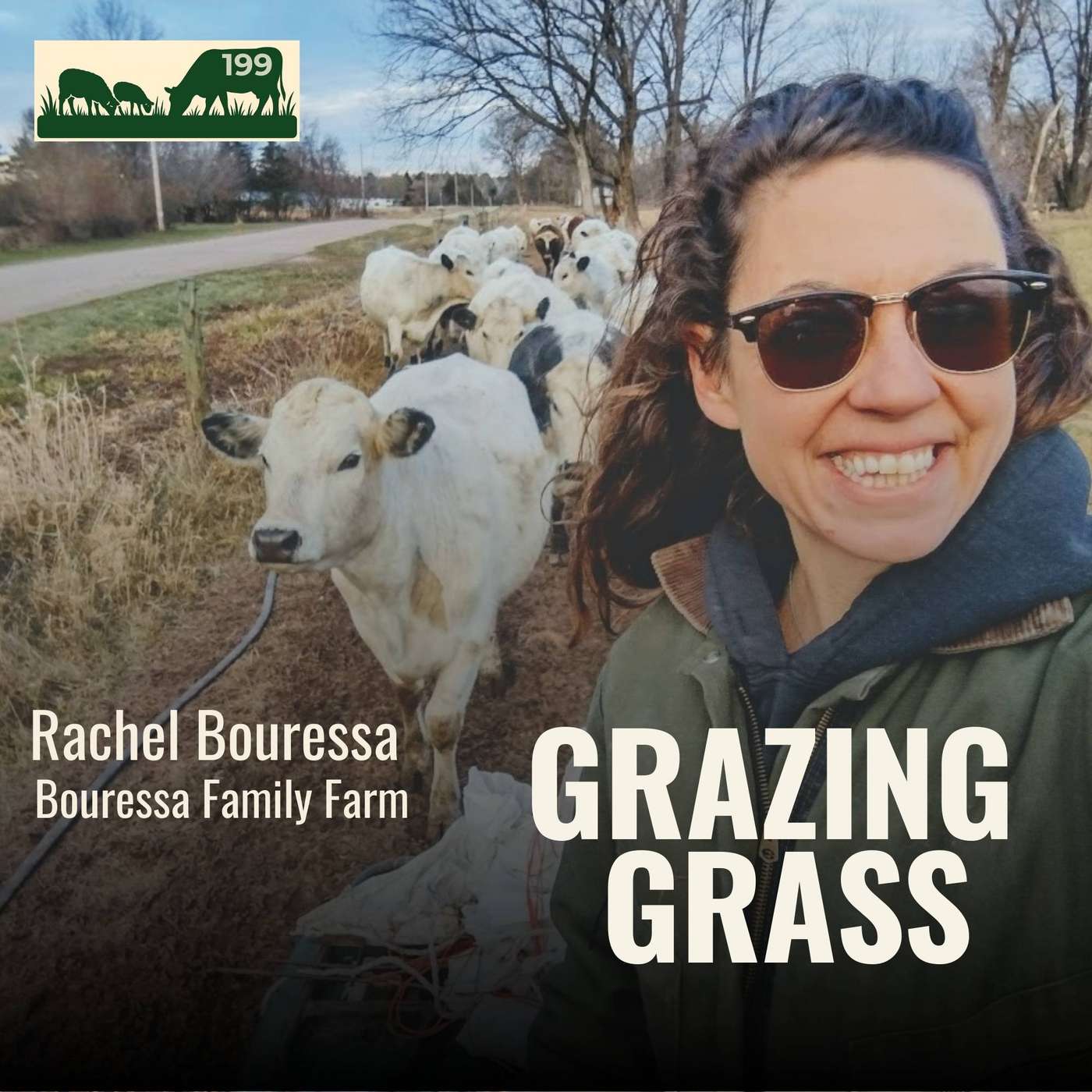
199. Soil-First Grazing and Earned Efficiency with Rachel Bouressa
Episode Transcript
Cal: Welcome to the Grazing Grass Podcast, episode 199.
Today we're joined by Rachel Bouressa of Bouressa Family Farm in Wisconsin.
Cal: She's a fifth-generation farmer and second-generation grazier managing 120 acres using soil-first principles.
Rachel, welcome to the show.
Rachel: Thank you.
I'm very excited to be here.
My name is Rachel Bouressa.
I farm in Royalton Township in Waupaca County, Wisconsin—kind of central Wisconsin.
I'm a fifth-generation farmer and second-generation grazier.
Rachel: Our whole farm is 360 acres, and I operate on 120 acres.
I moved back home in 2014 after being in grad school at the University of Wisconsin–Madison in the Agroecology Master’s program.
Rachel: When the barn burned down, I came back to figure out what needed to be done to sell the farm—and then got the idea that maybe I should stay and farm it myself.
Rachel: I was really into grassfed beef from a nutritional standpoint, so I thought I’d raise beef for myself and some friends and colleagues in Madison.
Rachel: When I moved back, I started with 15 acres and a goal of doubling every three years.
I'm more or less on track, and always thinking about future expansion.
Rachel: Off the farm, I’m a project coordinator for Grassworks, serve on the Farmers Union board, lead our local chapter, serve on the State Natural Resources Board, mentor women in conservation, co-coordinate our grazing network, write grazing plans, and recently became a participating farmer in the Upper Fox Wolf Demonstration Farm Network.
Cal: That’s a lot going on.
Tell us more about the demonstration farm network.
Rachel: It’s coordinated with NRCS, extension, private agronomists, and others.
Farmers work closely with NRCS to try different practices, be innovative, and host field days to share what works and what doesn’t.
Rachel: I enjoy experimenting—leaving controls, observing differences, and asking why.
Observation is one of our greatest tools as graziers.
Cal: You mentioned NRCS.
Many of us don’t use that resource enough.
Tell us more about your relationship with them.
Rachel: I'm lucky to have had a very engaged NRCS staff.
Grazing is only as strong as your local office.
For me, NRCS were my agronomists—I don’t buy much seed or fertilizer, so I don’t work with a co-op.
NRCS helped with planning, troubleshooting, and writing grazing plans.
Rachel: They focus on soil and water resource concerns, and grazing is a top practice.
They’re an amazing resource for all private landowners.
Cal: I encourage folks to use NRCS, even though I haven’t used them enough myself.
Rachel: I also speak to students about careers in the intersection of ag and natural resources.
NRCS and nonprofits hire grazing specialists and conservation staff.
It's a rewarding path.
Cal: Let’s go back to your history.
Fifth-generation farmer, second-generation grazier.
Tell us more.
Rachel: My parents were early adopters of managed grazing in the early 1990s.
Dairy crisis, overworked, and looking for options—they attended a Grassworks conference featuring New Zealand graziers.
Rachel: The focus was reducing inputs and improving quality of life.
They visited New Zealand farms and came home committed to grazing.
Rachel: As a kid, I went to Grassworks every year.
You leave with your mind spinning with ideas.
My dad became an advocate and hosted pasture walks.
Rachel: In 2005, after years of visiting Australia, my parents bought a farm south of Sydney and moved that spring.
Rachel: I later lived there for six months, which inspired me to switch from education to agronomy and soils.
I loved working outside.
Rachel: I planned to complete my agroecology master’s, but life changed course and I never walked at graduation.
Rachel: When the barn fire happened, renters were on the farm.
After transitions, the cropland was rented out, and I returned to figure out whether to sell.
Rachel: Ultimately, I decided I wanted to move back.
I call the email I sent my parents my “revenge email”—mirroring theirs years earlier.
Rachel: My dad recently visited for World Dairy Expo and got to see my field day, a Farmers Union event, and an award I received.
It was meaningful for both of us.
Cal: With your decision to move back, were you thinking beef cattle or other livestock?
Rachel: I knew dairy wasn't an option since it would mostly be me.
I considered goats, pigs, vegetables, even organic small grains.
But I loved grassfed beef and decided to start there.
Rachel: I bought 13 Angus steers with no perimeter fencing while 37 weeks pregnant with a toddler.
They got out often—would not recommend.
Rachel: Starting out, you don’t realize how hard everything is.
You just push through and learn as you go.
Cal: It's true—sometimes knowing too much slows us down.
When you're new, you're eager and willing to try things.
Rachel: I was talking with farmer friends about how naïve we were in the beginning—doing pigs, chickens, vegetables, cows.
We called it “earned efficiency.” Rachel: Over time you learn what works and what doesn’t.
You naturally simplify, but at the start, that ambition is a gift.
Cal: Did you ever think during those early days, “This isn’t it”?
Rachel: No—you’re too busy to think.
You just keep going.
Rachel: When I moved back, I flew to Australia to visit my parents.
On the flight, I wrote a huge list of basic farming questions for my dad.
Rachel: After answering everything, my dad said: “Farming never gets easy.
There’s always something challenging ahead.” Rachel: Weather, drought, policy changes, frozen water—there’s always something.
But he always said: “You can cuss, and you can cry, but you can’t quit.” Rachel: Learning grit was a big part of it.
My first year making hay was a disaster—I had an infant in the tractor cab and equipment that constantly jammed.
Rachel: It was a steep learning curve, but it makes you tough.
Cal: You’re a soil farmer as much as a grass farmer.
Tell us about transitioning row crop land into pasture.
Rachel: Much of my land was rented to a dairy, and they were great about letting me take fields back.
They’ve always been supportive.
Rachel: After reclaiming a field, I work with NRCS to lay out fencing, water, and plan the seeding.
The last 40 acres were split into three sections.
Rachel: One side was sandy, so I planted orchardgrass, alfalfa, and red clover.
The other side got the Grassworks mix—meadow fescue, perennial ryegrass, clovers.
Rachel: The middle section went into sorghum-sudan, and I’m now a huge believer.
The yields were incredible.
Rachel: It allows me to stop “saving” pastures for hay—just plant warm-season annuals and let perennial pastures be managed for grazing.
Rachel: Cutting was easy because sorghum is uniform.
Baling it took a long time because I was making a bale every 2 minutes.
Cal: With your seedings and establishment, are you continuing to overseed or mostly letting management take over once it’s established?
Rachel: I try to establish it and then let management do the work.
I rely on rest, rotation, and observation instead of constant reseeding.
Rachel: One field seemed low in clover last year, and I thought I’d have to frost-seed it.
But this year, with better management, the clover came back strong on its own.
Rachel: My management goals have shifted over time—from feeding the animals to farming for the soil.
When you manage for soil first, the forage and livestock fall in line.
Rachel: Thinking this way helps prevent overgrazing.
And the healthier forage ultimately produces healthier animals and a healthier product for customers.
Cal: So you’ve shifted from livestock-first to soil-first.
That’s a big mindset change.
Rachel: Exactly.
There’s a whole herd under the soil surface.
Managing for that herd benefits everything else.
Cal: Let’s talk livestock.
What are you running now?
Rachel: I started with 13 Angus steers.
I wouldn’t choose Angus again for my system.
In pasture school, I learned about grass-based breeds and decided on British White Parks.
Rachel: I bought my first cows from my mentor.
British Whites have great feed efficiency, good temperament, and are well-suited for grazing.
Rachel: I now run around 100 head total.
I’ve had goats, lambs, and pigs, but mainly for visitors.
I stay focused on cattle as my core enterprise.
Rachel: I’ve recently diversified genetics with a Devon bull (before he was injured) and now a Murray Grey bull for hybrid vigor.
Rachel: British Whites are extremely docile.
I tag calves while they’re nursing—moms just look at me like, “It’s her again.” Cal: That docility is a great trait.
And good genetics matter a lot.
Rachel: In Australia, British Whites are extremely popular as beef bulls.
They've even surpassed Angus in some areas.
Cal: With your direct-to-consumer sales, have you always sold beef that way?
Rachel: Yes.
Mostly by the cut or mixed packs early on.
Now more quarters and halves.
I’m streamlining inventory—mostly ground, fajita steak, and common items.
Rachel: If someone wants premium steaks, I encourage them to get a quarter.
It keeps inventory simple.
Rachel: I’m transitioning to Barn2Door now.
My website went down and the timing lined up.
They’ve been very persistent.
Cal: They are persistent!
But if it works for you, that’s great.
How’s the transition going?
Rachel: I have another meeting with them tomorrow.
It feels like a “leveling up” moment—time to streamline, track inventory, and help other farmers by selling their products too.
Rachel: Farming can be isolating.
It’s nice to work with a team and have support.
Ask me again in a year how it went.
Cal: What successes have kept you going along the way?
Rachel: Anytime I get to turn cows onto a new piece of land—especially land that used to be row crops—it’s incredibly rewarding.
Rachel: I also love hosting farm tours.
Watching people experience the land transformation is meaningful.
Rachel: I have a spot called “the gateway to the new land.” It used to be corn and manure; now it’s alive with birds, insects, and wetlands restored.
Rachel: This week, I got my Audubon Bird-Friendly beef certification.
I’m planting 14 acres of warm-season natives for habitat.
Rachel: Audubon started the ranching program out west and now it's in the Midwest.
It’s a great fit for my operation.
Cal: Before we move to the Famous Four, what goals do you have moving forward?
Rachel: Expanding the farm.
Extending the grazing season—I want to graze until Christmas this year.
Rachel: I’m also excited about the idea of grazing dairy heifers as a viable option for farmers transitioning out of dairy.
Cal: That’s excellent.
Let’s jump into the Famous Four.
Cal: It's time for our Famous Four questions.
First—your favorite grazing grass–related book or resource?
Rachel: After the soil, our greatest resource is each other.
Pasture walks, grazing networks, conferences—those are invaluable.
Grassworks Conference is a big one for me.
Rachel: As for books, Wendell Berry’s “Unsettling of America” and “The Gift of Good Land” are long-time favorites.
Fred Provenza’s “Nourishment” is another excellent resource.
Cal: Great resources.
Second question—your favorite tool on the farm?
Rachel: Honestly—polywire and extension-cord reels.
The cheap black reels are lightweight, easy to carry, and I can have a bunch of them without breaking the bank.
Rachel: And my UTV has changed my life.
I loved my four-wheeler, but having tools, posts, and wire with me—and being able to drink coffee while working—makes a big difference.
Cal: Third question—what would you tell someone just getting started?
Rachel: You’re going to have bad days.
You can cuss, and you can cry, but you can’t quit.
Better days are ahead.
Also—talk to people, look at your soil, and use your NRCS office.
Cal: Excellent advice.
Fourth and final question—where can others find out more about you?
Rachel: Hopefully my website will be back up soon at bouressafamilyfarm.com.
I’m also on Facebook, and honestly—you can just Google me.
Everything you need is there.
Cal: Do you have a question for me?
Rachel: What’s been your favorite episode or who would be your dream guest?
Cal: I enjoy them all, but one dream guest is Pete from “Just a Few Acres Farm.” He’s practical, thoughtful, and does things differently from common regenerative advice—but it works for his context.
Cal: He does a great job destocking early, penning cattle during drought, and sticking to what works.
I’d love to have him on the show.
Rachel: Set the intention, ask, and wait.
It’ll happen.
Cal: Rachel, thank you so much for coming on today.
Rachel: Thank you.
This was a ton of fun.
Keep up the great work.
Cal: Outro — Thank you for joining us for this conversation with Rachel.
Her story is a reminder that grazing isn’t just a management system—it’s a long-term commitment to the land, livestock, and people.
Cal: Whether she’s planting warm-season mixes, working with NRCS, hosting field days, or testing innovative practices, Rachel shows what soil-first farming looks like in practice.
Cal: If you’re a soil-first grass farmer and want to be a guest on the show, email me at cal@grazinggrass.com.
Thank you for listening to the Grazing Grass Podcast—more grass, better soil, happier livestock.
Cal: Keep on grazing, and we’ll see you next week.