Die Kruezen: Milwaukee's Hidden Punk Pioneers [Episode 314]
Episode Transcript
On this episode of Booked on Rock, the story of one of the most influential bands in punk, metal and alternative rock, The Story of De Creutzen, with author Sahan Jayas Soria.
Speaker 2We're totally bum rock and roll.
Speaker 3I mean, I'll leave you.
You're reading Little hens says, it's time to.
Speaker 1Rock and roll.
Roll up, we are totally booked.
Welcome back to book dot Rock, the podcast for those about to read and rock on Eric Sanitch.
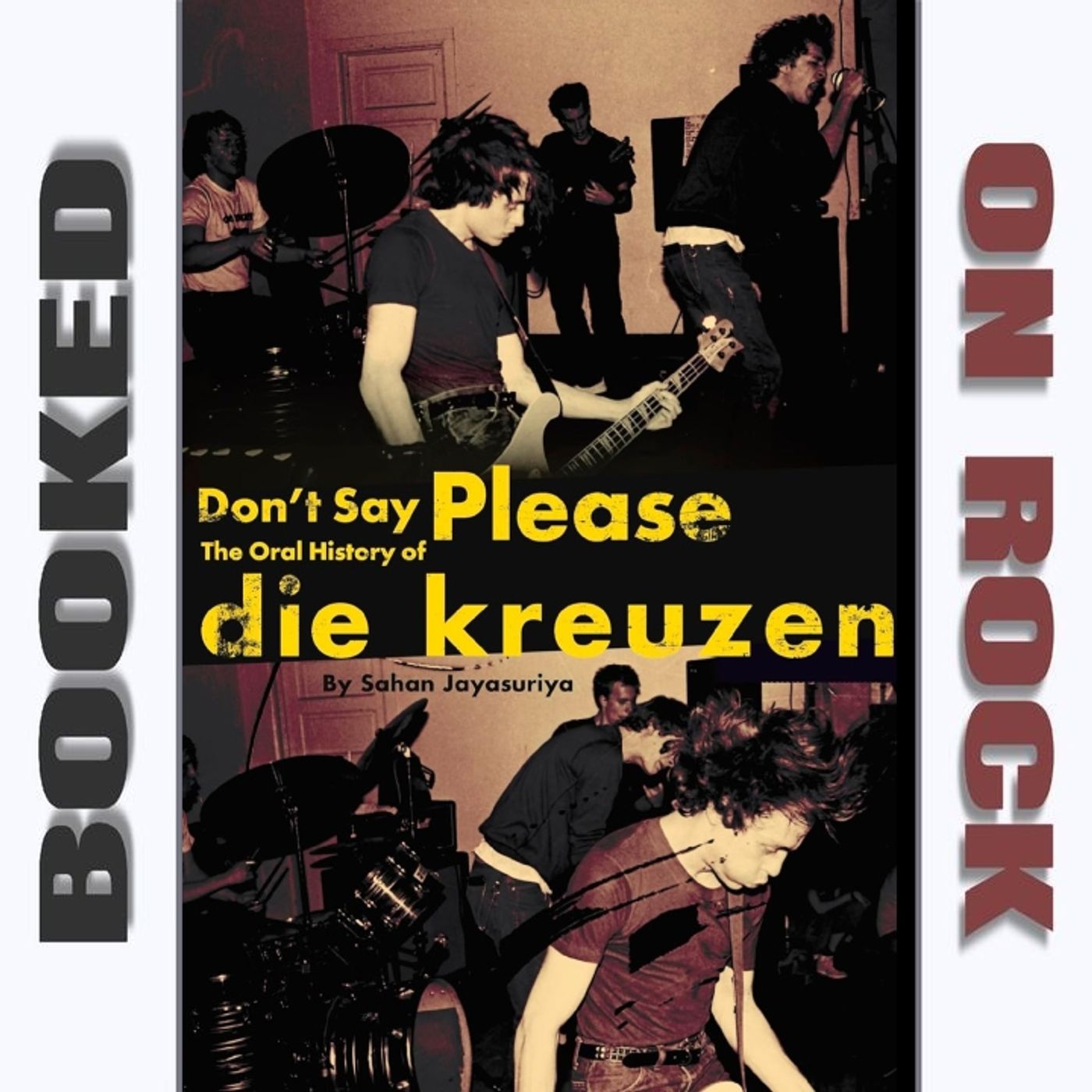
This episode's guest is Sahan Jai Soria, the author of Don't Say Please, The Oral History of De Creuzen.
Sahan, thanks for being here.
Speaker 2Thanks for having me right.
Speaker 1This is a book that was ten years in the making.
Tell us how it came together.
And you just spoke to so many people, including all the members of the band.
Speaker 3Yeah, I think I started probably officially.
I started the book ten years ago, and I didn't have any publisher involved, and it was just kind of this thing that I was doing because I felt like this is a really important band for my city.
It was clearly very influential, and I just wanted to tell their story and just kind of share it with anyone, not only the people who are fans of them.
But hopefully, you know, expose their music to you know.
Speaker 2A whole new aud some of the listeners.
Speaker 3And kind of the more research I did, the more I realized that they had pretty sizable following amongst you know, pretty prominent musicians.
So over time I just kind of kept reaching out to people and and just setting on my own interviews, and you know, next thing I knew it, it was like seven years in, and you know, I'm still like, am I done?
Speaker 2Am I not done?
Speaker 3And when Farrel House got involved, that's when they were like, Okay, I think you're a pretty good place now you should you know, finish instead of just keep going.
So they're kind of the ones who really got me to focus and and and kind of pare it down and edit it into the form that you see at the end of the day.
Speaker 1One of the many people you spoke with was which Vig, legendary producer who produced the band's albums, and he said, quote de Kreutz and or one of those bands that influenced a thousand other bands that went on to have huge success.
Why they didn't have the same level of success as something we'll get into a little bit more, but interesting, I'm interested in finding out how you discovered this band, it was that you were working at a record store, I believe right right.
Speaker 2I was working at a legendary record shop.
Speaker 3In Milwaukee that's no longer around, called Atomic Records, and my boss at the time, they gave me a copy of their first sevenence just to like check out, and he knew I was into hardcore, and I didn't really know him as someone as being into hardcore, so I didn't really expect much of it, honestly, and when I took it home, it just blew me away.
Speaker 2I was just like, I was not prepared for it.
And I think one of.
Speaker 3The reasons that really blew me away is it didn't really sound like anything else I had heard at that time, and I'd heard a lot of hardcore, but there was a lot of elements about it that just didn't make sense to me in terms of like the time that it was being made, so like the vocals were way more aggressive, the music was a lot tighter it.
Speaker 2It was just a different thing.
Speaker 3And then you know, the more that I kind of listen, the more questions I had, And I think me discovering their music more is also what kind of led me to eventually wanting to write a book because I had so many questions that I just wanted to have answered myself.
Speaker 2Right.
Speaker 3But you know, as they evolved, you know, they made this amazing debut album that's just like straight ahead, super fast, super tight hardcore, and it's pretty much like among that crowd, it's like universally lauded.
Like it's just it's one of those hardcore records that most people can just agree on.
Everyone loves it.
And the problem with doing something like that is, like, where do you go from there?
When you make this thing that people love so much?
Like if there's no way that you could follow it up with a you know, a better version of that, right, so you have to do something different.
And so they started to explore other styles of music, and it's just it wasn't a conscious decision on their part.
Speaker 2They just evolved.
Speaker 3Based on what they were into, both like the stuff that they grew up with because they were really into you know, prog stuff when they were younger, and also like the post punk stuff and things like you know, Brian Eno and Wire.
But there's newer influences as that were coming into the fold for them because they were really into like the forty D Records bands and just the kind of UK post punk thing, just stuff like Sisters of Mercy and uh like the Fordy stuff, you know what I mean.
Speaker 2And bands like The Birthday Party too, for sure.
Speaker 3And that was kind of coloring their sound.
But they're coming from hardcore.
So when you you know, come those two things, you're gonna get something that stay different.
But you know, over time, I think some people got those records and some people didn't.
And so when you know, I just kept like kind of digging into their catalog and it was just sort of like I've called them sort of like the proto everything banned for nineties alt rock, because their catalog really does show a very very broad range of what was happening in the under ground in both in I guess in the America and in UK at least in their influence.
It just covers such a broad range of like eighties eighties underground guitar music, and you know that was those records were super influential for a lot of other artists who went on to achieve greater or much greater success in the following decade.
Speaker 1Let's talk about the band's origins.
You write, quote it's debatable whether de Crouzon could have ever happened at any other time or in any other place besides the American Midwest during the nineteen eighties.
So give us the wind.
Where in the how the band comes together?
If you could the four guys, they all grew up in the right place, right time.
Speaker 2I'd say so.
Yeah.
Speaker 3Half of the band has origins in Rockford, Illinois.
Most people might know that as being the hometown of Cheap Trick.
And then the other half were from Brookfield, Wisconsin, which is a suburb of Milwaukee, Wisconsin, and vocalist Dan Kubinsky Brian Agnes where the two guys who were came from Rockford.
They were in previously called the Stella's, and the Stella's moved up to Milwaukee, and you know, they quickly realized they didn't have a drummer when they moved there, so they asked their friend Keith Bramer if he knew anyone.
He's like, well, I happened to know somebody's a really great drummer who was drummer Eric Tunison.
So he came into the fold, and not long after he joined the band.
They kind of realized that their basis at the time, they just weren't really they weren't really feeling it wasn't a good fit.
And then they asked Keith to join the band.
So then when they settle in that line up, not long after they changed their name from the Stella's to Decroitzen, and that was I believe at sometime in nineteen eighty one, this is when they changed the name to Decroitzen.
Speaker 1They were into a broad range of music, which you did talk about.
There are some they were fans of the classic rock bands like Kiss, cec Are, Zeppelin, ac Aerosmith.
There's a letter that bassist Keith wrote to Circus Magazine that's in the book.
He was a defender of Zeppelin, Kiss Angel, and Aerosmith.
Yeah.
Speaker 3Yeah, I mean, I think one of the things that I learned, you know, like I came up listening to punk and hardcore.
You know, I'm I'm almost forty, I'll be turning forty in October.
Speaker 2So the classic rock.
Speaker 3Thing was not really anything that I really paid much attention to as a young kid.
Speaker 2I loved Queen.
I was a huge Queen fan.
Speaker 3But you know, some of the other bands maybe just they didn't really connect with me, And it wasn't really until later in life that like, especially like the glam stuff that.
Speaker 2Really resonated with me.
Speaker 3And I think they came from really liking a lot of seventies punk, but a lot of the classic rock stuff didn't resonate with me.
And I think it's because I had other, you know, punk things to listen to.
But the thing that I learned in researching this book and just reading about this period in general, is a lot of people who listened to punkin hardcore bands.
Speaker 2Of course, they.
Speaker 3Weren't listening to punk and hardcore because they were helping invent it.
So they were listening to the heaviest music available, and the heaviest available was like hard rock and classic rock, you know.
And so many people you know who are like kind of gen X age group, they you know, Kiss was a big deal for them.
Speaker 2It was like.
Speaker 3A early early influence because it was just like it was made for teenage kids.
You know, they look like cartoon characters.
You know, it's just guitar solos and flamethrowers.
Speaker 2And pinball machines.
Speaker 3It makes so much sense for a certain a person of a certain age at a certain time to be a kiss fan, right, So all those things were just like, you know, the edgiest, you know, like gnarliest thing available.
And I think so many people who went on to play and punk and hardcore bands definitely did their time listening to you know, classic rock and them and that stuff.
Speaker 2I mean around sweet and slight.
But all that stuff is great, you know.
Speaker 1I think it's interesting.
And reading a lot about grunge bands and how much they were influenced by early Aerosmith and Black Sabbath, I hear that often early Smith and Black Sabbath.
Speaker 3Yeah, well, I mean the early Aerosmith records are pretty pretty cool.
I mean, especially you know, the vocalist for Decoys and Day Kebinsky.
He cites Stephen Tyler as a huge influence.
When he first told me that in person, years before I was writing the book, I was just like, I wasn't expecting it, because again I didn't realize that some of these like people who listen who made punk and hardcore were listening to classic rock.
Speaker 2But I was thinking about it.
I was like, well, you think about the end of dream On, where.
Speaker 3He's really pushing his voice into like screaming territory.
I'm like, oh, that makes sense, you know, but yeah, I mean the grunge bands.
I mean, Kirk Kobaane is a huge fan of like a record like Rocks by Aerosmith.
Speaker 2He loved that record.
Speaker 1You know, Yeah, it's dirty, it's it's it's grungy.
Speaker 3Yeah, totally, you know, I mean the drum sound of that record rules.
That's a great record.
I'm not like the world's biggest Aerosmith fan, but they have some records I definitely dig, for sure.
Speaker 1But at some point in the mid seventies, punk rock enters the scene and that has a huge impact on the guys, especially Keith.
He was the first guy in town to talk about punk.
According to drummer Eric Tunison, so Keith was the guy that knew punk.
Speaker 3Everyone has that friend I think who is just like so rabbit about music, and they're just like the one who's always like on the thing right as it's happening.
Speaker 2You know.
Speaker 3At a certain age, I was definitely that guy with my friends.
And you know, I still am theo that guy to some degree, but definitely in my teen years it's like I knew you know about you know, whatever new band or whoever's new record, like as you know it was just it was It was so important to me.
It still is important to me.
But there's that one person who's kind of like the town crier or something, right like they they're the one who informs all their friends.
They are the ones who's making the mixtapes and you know all that.
And I think Keith is definitely that guy for for that friend group for sure.
And he you know, he was the one who got all the early singles and buying you know, the Clash record on Import and you know all that stuff.
Speaker 1There was a point when the Stella sound evolved into something new, and this is around nineteen eighty one.
They would become known for their their speed early on.
What inspired that increased tempo and energy?
Speaker 2I think the speed thing definitely had.
Speaker 3There was a couple of records that was contributing to that, and I think like Group Sex by the Circle.
Speaker 2Jerks was a big one for a lot of people.
Speaker 3I think that that record came out pretty early on and it was pretty fast for the time.
Also, like the early Bad Brain stuff was pretty fast.
Some of the early Dead Kennedy stuff was getting fast.
So the temples were just being pushed and I think people were just kinda.
Speaker 2I don't want to say like.
Speaker 3Necessarily following the leader, but I just think it was just like it was just the.
Speaker 2Thing to do.
It was like.
Speaker 3That's how you that's how you made your music more intense, you know what I mean, Like the temp just made it like just gnarlier and heavier.
So I think that was like the whole It was just the thing that people were doing.
And I'm almost like I hesitate to use the word like in style, but it's just kind of it was just what was happening at the time, you know.
And it was if you if you could play faster, that was like, oh, like they're fast, like that was that was definitely kind of a uh something something to admire, you know.
And so you know, Ducrotzen were just kind of following like those bands and bands like da and it was just like a thing was like okay, like let's just try and speed it up a little bit, you know, because it's it's one thing to be.
Speaker 2Fast and slot.
Speaker 3You know, that's fine, that's its own thing.
I'm not going to name any names.
There's bands and I love that, but like when you're fast and tight, that's it's different.
Speaker 2That's a different thing and and and.
Speaker 3That shows that like these guys practice, right, So I think that was just things they were just like they push the tempos a little bit, push the temples a little bit.
Because I have like an old live performances Stella has been released, you know, not a lot of people have it, and there's some songs that ended up on the first Decroits and record that are played at like by comparison, they sound mid tempo, you know, and you can kind of make out the rips a little bit better because they're not played at like breakneck speed.
But it's like it's really cool to hear and it's just oh, like they were like there's you know, there's early footage of the Bad Brands playing like Attitude and they're like wearing suits and it's pretty mid tempo, you know.
And then you listen to like, you know, the like the Black Dots and it's a little bit faster, and they listen to the Roar Cassette and it's a little bit faster.
And then by the time you get to like Rock for Light, they've shaved on songs that's gotten so bad.
I don't necessarily think there were This is like following other bands that we want to be like them, you know, because like there's this thing that I've heard other people talk about.
There's an artist was a rapper, Fante Coleman.
He's a groupole little brother.
He talks about like this sort of phases of being influenced.
It says like imitation, inspiration, and innovation, right, And imitation is like I want to be like black Flag, right, And then inspiration is like I am like inspired by Black Flag.
I'm making music that's inspired by Black Flag.
And then innovation is like black Flag has pushed me to I mean, I guess like the creativity and my love of Black Flag has pushed me to innovate something something else completely right, And a lot of people don't get to the third stage, you know, a lot of that.
Speaker 2There's nothing wrong with that.
Speaker 3You can hear bands, and you can hear like, oh you're kind of doing this, and you're kind of doing that, you know, you listen to the Strokes, and you can hear television, right.
Speaker 2Yeah, but it doesn't really matter because they're good, right.
But it takes a special group of people to really get that.
Speaker 3Third state of well, I want to kind of do my own thing and de Crouzen got to that point for sure.
Speaker 1So han Jayasuria is the author of Don't Say Please, The Oral History of Decreutz, And let's talk about the name change to De Kreutzen October of nineteen eighty one.
That happened.
How did they come up with that name and what does it mean?
Speaker 2So it's from this kind of conflicting accounts.
Speaker 3Some people say it's a German German language Bible, some people say it was just a German book.
I just kind of bring them all up at the same song, because I've never really given a straight answer.
Speaker 2But Diane who came.
Speaker 3Up with that name, and then she's like, Yay, I'm gonna start this band called de Crozon And then or either she didn't or whatever, but they they just they ended up with the name.
Speaker 1It's a cool name, man, you gotta admit it's it's mysterious.
Speaker 3It's it's great.
It's definitely not always pronounced.
If I had a penny for every time someone said Mike Cruising, you know, d cruiser.
Yeah, but it's uh, technically it's the spelling doesn't translate perfectly to something, but it technically is either like the sign of the Cross, or like crossing, like the crossing, I guess, or even to some people, I guess it's like the crosses.
But it fucking looks.
Speaker 2Great, Yes, looks great at record cover.
Speaker 3I mean, I mean, if you get that, I mean, you don't need to think about it anymore.
Speaker 1Booked on Rock podcasts will be back after this.
During our brief intermasion, let's take a flying trip from lambda fantasy to everyday life.
Find the bookdown Rock website at bookdn rock dot com.
There you can find all the back episodes of the show, the latest episode in video and audio, links to all of the platforms where you can listen to the podcast, plus all the social media platforms were on Blue Sky, Facebook, Instagram, TikTok, and x.
Also check out the Booked on Rock blog.
Find your local independent bookstore, find out all the latest hot rock book releases, and before you go, check out the Booked on Rock online store.
Pick up some Booked on Rock merch.
It's all at booked on Rock dot com.
Lyrically, let's talk lyrics now.
So Dan Kovinski he avoided addressing politics, which wasn't the norm for punk and hardcore bands.
Talk about his lyrics and how he preferred also listener to assign whatever meaning they wished to his songs, and I believe in the future albums he didn't want the lyrics printed.
Speaker 3Yeah, after the first record in nineteen eighty four, they just consciously didn't print lyric sheets.
And I think Dan had said, you know, I'm paraphrasing him, but to the fact of he just kind of preferred the listener just you know, it hacked me songs, right, And as you know, the music changed.
You know, the music also kind of I think, just had a little bit more of like an emotional heft to it.
And so when you're making music that's kind of that emotionally heavy, it's pretty easy to you know, attach whatever meaning you want to it, right.
I mean, that's something Ram did too.
In the early days.
They didn't print their lyrics sheets.
And you know, people always talk about how like the vocals were mixed really low, and Michael Stipe's voice was kind of like mumbling a little bit.
So you know, a lot of people didn't know what the lyrics were.
And in the case of de Kreitzen, you didn't really know what he was saying, but you knew that it had some some you know, and had to do with how he was delivering it.
And in some ways that's better than having a lyric sheet, you know what I mean, because if if you have a lyrics sheet in front of you, it might not resonate with you the same way that it does, you know, with you having to kind of come up with your own meeting of this song.
Sure, but early on, yeah, I think there's a lot of bands.
Speaker 2You know, there's great hardcore bands who.
Speaker 3You know, like their their thing was just you know, addressing the political climate at the time, which you don't need to address.
And you know, like you know, all the Flyers have like, you know, Reagan on it.
And I'm not going to say, I'm not going to curse on your podcast, but you know, like there's there's very they would they would take images of Reagan and make him do some pretty interesting things, hilariously interesting things.
And you know a lot of bands play with that imagery and and and just had you know, a political agenda to their It's great.
Speaker 2I think it was fully really.
Speaker 3Common at the time for punk and hardware bandsy to be political, and you know, the band just kind of chose to not be political lyrically, like on thely material, you know, the early demos and the first seven inch, in the first full length, I think the lyrics were definitely just like kind of personal politics and just you know, kind of talking about things people experience at that time in life, and you know, conflict amongst friends, and I think there's a general just kind of feeling of like disillusionment and alienation that I think a lot of people felt at that time, and it was just writing from that perspective.
Speaker 1There was the EP in nineteen eighty two.
It's titled Cows and Beer, and it was followed by the debut self titled album in nineteen eighty four.
The debut came after the band return from California, and at this time they're fragmented.
The future of the band is uncertain or burned out, bummed out, but they reform after a short time.
What are your thoughts on this album and in particularly the vocals, because you say Dan style was the most notable shift.
Speaker 3That first record is.
Yeah, it's one of the best hardcore records ever made.
And I think one of the reasons why is it it does stand out, you know, the music at that point, they've been playing those songs for so long, so they're so well rehearsed, so the band is just super tight, super tight.
And I think in this time, you know, Dan had been singing a lot and you know, figuring out how he wanted to use his voice, and you know, by this point on this first record, I mean, no one was really shredding their vocal chords that way.
People would scream for dramatic effects, you know, but a lot of the hardcore guys were like shouting or barking.
No one was like really screaming.
It was like him and John Brannon from Negative Approach was doing it.
I mean, John was really doing it later on with laughing hyenas, And there's kind of more obscure bands like Siege who were doing it, and even to lesser degree, John the singer of Void, he was doing it a little bit too.
But No One was just like every song all the time, just screaming your guys out.
So it was a very different sound for the time, and the production was enhanced.
Speaker 2A little bit too.
Speaker 3By There's a little bit of reverb an atmosphere on that record that I kind of likened to the first Joy Division album on Unknown Pleasures.
It kind of has that maybe not that drastic amount of reverb, but it's definitely like a spacious sounding record.
And at the time, a lot of punk records are pretty dry, and when you add that amount of atmosphere to the vocals especially, it gives us this really like haunting, tortured quality.
It just kind of amplifies that to you know, to me that you know, later on you'd hear a lot of like like Scandinavian black metal bands really do that, but this is you know, quite a bit before that.
So it's just so ahead of its time and so good, you know, that first album is it's it's really an incredible record.
Speaker 1Yeah, and it got the respect of other musicians.
Some great quotes in the book from Sound Gardens, Kim Thyle Thurst and more of Sonic Youth, so many people.
Some great quotes from the late great Steve Albani.
Still I still can't believe he's gone, the renowned, Yeah, the renowned musician and audio engineer who produced Nirvana's in Uterol, which we have to talk about where you are now in relation to that album, But he admired the band's originality on that first album.
He said, quote, there's just nothing about that de Croyton record that sounds like it's received wisdom.
It sounds like they dreamed all that shit up on their own, Like no one would have ever been taught to play that way.
You can only come up with those things on your own.
That's that says it all.
I mean, that's the respect that they were getting from the fellow artists.
Speaker 2Yeah, I think I mean a lot of this too.
Speaker 3You know, as we kind of addressed earlier, like later on, people kind of you know, didn't always it didn't necessarily like understand those later records and they're like, oh, it's so different.
But you know, the thing that makes them so great and makes this first record so great is that they were different, right, Like they sounded pretty different from other hardcore bands, and they made this really cool hardcore record.
And I think people, you know, fans specifically some fans, I guess, the ones who maybe didn't like understand the later records.
They didn't stop and think like, well, the reason why I like them is because they're different.
Speaker 1Steve Albini is a guy who I could see would love that type of record because that's the way he was.
That's the whole reason Jirvana wanted him to produce in your euro because they didn't want to make something like never Mind.
They wanted something a little bit off the grid, something dangerous, something that's that's that the average producer wouldn't wouldn't do.
So talk about where you are, by the way, speaking of Steve Albini and in Utero, the reason you're you're you're checking in from your your vehicle right now is because you just came from a very cool place I was.
Speaker 3I was just for like a like a day and some change.
I was at packet In Recording Studio, which is in Cannon Falls, Minnesota, which is just like four thousand population, tiny town.
It's about forty five minutes out of the Twin Cities, and it's just uh, really small town.
And there's this wonderful studio there.
There's like and that's yeah, that's where Nirvana, madd Nuterro.
It's where like the Wedding Present recorded, and I think Live did Throwing Copper.
There, tons and tons and tons of great record PJ.
Harvey did Rid of Me there, Super Trunk recorded there.
A lot of indie rock bands like Unrest they recorded there.
I mean, there's the list goes on and on there's uh it's hums you prefer an astronaut is credited there.
They did one song there.
I think the rest of that record was done elsewhere.
But yeah, like tons of great records in the nineties and beyond, you know, like I think more recently, like ten years ago.
Speaker 2I think that band Normal Gene, I think they recorded there.
Speaker 3So it's it's a destination, but like there's the entire thing is meant for you to like live on the premises, so there's like a separate living quarters that's just like so not unlike it.
Speaker 2It's just so distinct.
It's just like spiral.
Speaker 3Staircases and crazy just seventies carpet and it's just like there's really wonderful space that's like surrounded by like a ravine all my and it's just like a really great place to to just be if you're trying to like focus and make music.
And my friend Graham Hunt, he's working on his next record right now, and he had me come up there and hang out for for a day and shoot photos and just you know, I mean everyone there.
There was like ten or eleven people who were playing on that record, and they're all really good friends of mine.
Big parts of like the Milwaukee and Madison music community.
So I was just hanging out with them and you know, on my way home.
But yeah, for me as a as a music fan, it's just it was a no burner.
I mean, I think I told Graham when he said he's recording a packer er, It's like, can I just like go.
Speaker 2Up there and touch the door?
Speaker 3Like yeah, right, you know, because you know, I mean I probably will never get the opportunity to record there because you know, it's a nice studio, so I don't necessarily have kind of funding to record, but you know, just to be in a space like that, it's just like so special, you know, to feel like it brings you closer to the music you love in a way that you may not always necessarily get to be.
So it's like, you know, some people maybe feel like going to like I don't know, like Sun Studios or something like that.
They're into that that stuff, which like, yeah, that stuff's great for sure, but like I just feel like when you can see the place where these records were made, it's just it's just I don't know, it just feels a certain way, like if you've ever toured Hitsville, the original Motown studio in Detroit.
It's I mean, like I walked in there and I got misty.
I just thinking about like music history was made here.
Speaker 2You know.
It's just it's fantastic.
So you get it.
Speaker 1You're oh yeah, man, you're one of us.
I envy you.
I envy you.
It's a fantastic Booked on Rock podcast.
We'll be back after this the Crekton.
We'll go up on back too after our short informationion.
Getting back to Decroyz and now let's talk about the album October File that came out a couple of years after the debut, and the band moves away from hardcore into slower, more conceptual work.
I don't know if I've ever heard a band transition so quickly and just progress and evolve so quickly.
It's interesting to read how the guys in the band had already started to move towards that sound by the time that first album was already out.
Keith Bramer talks about listening to Joy Division and Sushi in the Banchees and Rims, Sisters of Mercy, all these referred to these bands earlier.
Talk about that transition and how the guys saw that debut as an end to that part of what the band was doing.
I mean they were already moving on.
Speaker 3Yeah, I mean they were just listening to so much music, and yeah, even by the time they're making that first record, they're already discovering other things.
And you know, it's always kind of like I don't really want to speak for the band members, but you know, Keith said this other so I can just repeat it.
Speaker 2He's like, we just got bored, you know, like they just got bored.
Speaker 3And I think, you know, like you know, anything, if you do it for enough time, like yeah, you're gonna get bored with it.
And I think they just wanted to you know, I think any musician just wants to make the kind of music that they themselves will want to listen to, right at least, Like that's how I always approach music making, Like it's you know, I'm gonna be playing it.
Speaker 2It should should be fun, I should like it.
Speaker 3And you know, they just wanted to play the kind of music that they were into, and so they just kind of but again, they weren't just like were I want to be Sisters of Mercy.
It's just like, well, what does Sisters of Mercy make me want to do?
Speaker 2Right?
Speaker 3What is joy Division or Echo and the Bunnymen or the Birthday Party or whoever?
Speaker 2What is the cure?
Like?
What does that make me want to do?
Speaker 3And then that's how you get these later records that you know, like once you know the influence, it's like, oh, I kind of kind of hear that, but like on the surface, you're just like, I don'tn't really this sounds like different.
Speaker 2You know.
Speaker 1What was the response to the Star contrast to the first record and this one by critics and fans.
Speaker 2Well, with the first record, it was just like everyone loved that record.
Speaker 3I mean to me, it's like, yeah, there's some changes in production, but generally speaking it's it's still just.
Speaker 2Hardcore, right.
Speaker 3But the second record, you know, there were some people who really wanted another hardcore record.
Speaker 2They just didn't give them that.
Speaker 3And I think some of those people kind of felt, you know, I just they was upset about that.
But you know, for the people who maybe abandoned them because they were you know, changing, slowing down, maybe become a little bit more melodic, there's people who are now maybe they wouldn't have liked the first record, but they liked the second record.
There is a little bit more melody driven, right, So they're starting to gain a different audience than you know, people who are maybe maybe not people who are into hardcore, but maybe they're into something like Whoscurdu and Now and Who's Screw too.
They were you know, evolving and moving to you know, towards more melodic songwriting too, So you know, I think people were just turned on to the you know, the newer stuff they were doing.
Even though there was maybe other people who you know, like the older stuff, we didn't dig it as.
Speaker 1Much, You're right.
Quote Still, October File was only the beginning of the band's journey away from hardcore, mark the start of a pattern that we would see for the remainder of the band's career.
Next two albums produced by butch Vig nineteen eighty eight Century Days and the band's final album, which was nineteen ninety one Cement.
He also produced the nineteen eighty ninety EP Going Away.
Where does the band go?
Sonically on those last albums.
Speaker 3Man, it's interesting because, yeah, things definitely got more melodic, but I would argue that the music also became more difficult, you know, like hardcore is a brace of music, and it's fast, but in some ways it's kind of easy to listen to, Like you can sing along the minor threat songs, you know what I mean, Like they have hooks, they have choruses, you know, and you know, you can be fast and you can even if you're maybe not into like how abrasive the vocals or whatever, you can like, you know, po go around and have a good time.
It's fun, Like hardcore is fun music, you know.
It's like early eighties American hardcore is fun music.
And I'm not saying it's necessarily happy music, but it's fun.
And once you get darker and maybe dothier and a little bit more dissonant, you can still be singing.
But in some ways the music can become a little bit more difficult.
And I think what we talked about earlier, where it's just like, you know, they influenced a bunch of people, but they maybe never were able to get to that next level.
And I think one of the reasons why they never made that full break into the mainstream, I think a they couldn't find them major label that wanted to give them the kind of creative control that they wanted.
But b they didn't you know, labels didn't really know what to do with them because they were like straddling a lot of lines.
They sort of were kind of metally, but they're kind of post punky and kind of goth, and you know, especially at that time, like labels're like, well, who do we sell this to?
Speaker 1Yeah?
Speaker 2Right?
Speaker 1Would it be fair to compare them to Jane's addiction prior to james Addiction becoming big because metal.
Speaker 3Yeah, I mean I guess it's like, uh, similar ingredients making two different meals.
Speaker 2I could see that.
Speaker 1And they were a little they were a little ahead of their time to where.
Speaker 3Ahead of their time, But at least James Addiction got you know, I mean they had hits.
I mean like you know, eventually eventually the James says and didn't caught steal and stuff like that.
Speaker 1But you know, but at first, it was like what are we going to do with this?
Speaker 3Because it's not one thing right, It's like people don't know how to they don't know who to sell it to or how to sell it, right, And I think that was definitely part of it.
But you know, the you brought up earlier, like the gone Away, Yeah, like that to me is a song writing achievement.
Yes, that to me is the best song that they wrote.
Speaker 1That is a yep, say that's my favorite song.
Speaker 2Absolutely, me too, Me too.
Speaker 3It's a fantastic song, and I think it really covers all the ground that that band covered, minus the super fast.
Speaker 2Speed of hardcore.
But it's it's.
Speaker 3Really kind of beautiful and melancholy, and it's in three or four time, has this kind of rolling quality and has wonderful There's all these different like guitar hooks and then you know and Dan singing wonderfully.
But even then he has to take it to the screen.
He has to scream just for a little bit, right, So it's like it's a super melodic song and then it's just like it just you know, left turns of these kind of really like his kind of signature tortured pain to kind of scream.
But it's such a wonderful song.
It's three minutes long, you know, in a in an alternate universe.
To me, that's that's a modern rock radio head.
Speaker 1Absolutely.
When I first heard it, and I was telling you before we recorded that, I was I knew of the band, knew the name, but really didn't listen to a whole lot of the music, and as this has happened so many times to this podcast.
After reading a book, I listened to the music and I more often than not fall in love with the band.
And I've done it with this band.
And when I've heard Gone Away for the first time, I'm like, how, how the fuck this?
How does the song just skip past so many people?
Because it is Yeah, it's just the timing of it.
If it was a couple of years later.
Speaker 3Yeah, I mean I've said, like, well, you know, their last album, Cement, you know, was recorded and released in ninety one, and I think you know, they released Gone Away as a EP because it had been a little bit since they put out something new, and Touch and Go was like, maybe we should do et or something like that.
Speaker 1But what's cool is, by the way, we mentioned Aerosmith that Gone Away.
The next track is Seasons of Whather.
Speaker 3There are Seasons of Whether right, which is a great, great right.
It's a great cover.
But I think if they would have saved Gone Away for the Cement album and had that been like the single off that record, I think maybe it would have gotten a little bit more more people would have heard it.
You know, because I mean the timing of Cement is so interesting because right before they made Cement, Butch had finished you'd wrap up work on the first Smashing Pumpkins record, Gish and then either right before or maybe after or maybe like he started working on Cements and then finished it later, but he Butch had gone to La to Sound City to go make Nevermind.
Speaker 1Is that crazy?
Speaker 2And so the timing of it is so it's so wild right to think about.
Speaker 3You know, There's there's this article that was in Hit Parader in I think ninety two or early ninety two, and it was one of those like, you know, forty of the blah blah blahs to blah blah blah, right, and I think it was like forty alternative metal bands to watch in the year ninety two or something like that, and on the front page Smashing Pumpkins, Afghan Whigs to Kretzin, you know, and it's like, so, I.
Speaker 2Mean, they were right there, you know.
Yeah, Like, you know, I.
Speaker 3Think maybe one of the reasons why they didn't break through is you know, maybe labels didn't know what to do with them, but also like they were maybe a little bit too difficult to break into the mainstream, you know records.
Speaker 1You said in the book wanted to sign them right after they broke up.
Speaker 3After they had split.
Myke Getter, who went on to sign so many great bands.
Myke Getter is such a rad dude and has done so much awesome stuff.
I mean, he signed he ended up signing Jawbox to Atlantic and signing a lot of great bands from the underground and you know, giving them the resources to make you know, these kind of bigger records.
And I mean, I love that record Jawbox made for Atlantic as a savory to me again, should have been a top forty hit.
Speaker 2I don't know why I wasn't.
Speaker 3In my universe, that is a top forty hit, you know, but yeah's just a little bit too late.
And you know there, I of course, like there is a little bit of like the what if factor in that book, like well what if?
Speaker 2And you know, we'll never know.
Speaker 3But you know, I think if anything, they maybe would sign a major label, make a record that they wanted to make, and I mean maybe more people would have heard it, but not enough to please the major label.
Speaker 1Booked on rock Podcasts.
We'll be back after this.
Speaker 3I'm gonna need some flyers and uh set a thirty W eight ball bearings.
Speaker 2Black Fred gets here before I'm back, you.
Speaker 1Can tell him to start without me.
Speaker 2Hell you need ball bearings.
Fo Oh, come on, guys, it's so simple.
Maybe you need a refresher course.
Speaker 1Hey, it's all ball bearings nowadays.
Hey, guys, thanks so much for checking out the Booked on Rock podcast.
If you've just found the podcast, welcome.
If you've been listening, thank you so much for your support, and make sure you tell a friend, a family member, share on social media and let people know about Booked on Rock, And if you do like the podcast, make sure you subscribe give a five star review.
Wherever you listen to the Booked on Rock podcast, run Amazon, Apple, iHeart, Spotify, Speaker, tune in in on YouTube music.
You can check out the full episodes on video, along with video highlights from episodes on the Booked on Rock YouTube channel.
Find it at Booked on Rock.
Thanks again for listening.
Now back to the show.
Here's the quote from Vig in the book about when he first saw the band.
This says it all.
It was psychedelic rock, it was punk, it was almost metal at points, and yet they had this great pop sensibility to their songs as well.
So he saw something there.
He saw what he saw in Nirvana.
Speaker 2One hundred percent.
Speaker 3I mean, Butcher Vig is a pop guy through and through, and he calls himself with sub sub proclaimed pop geek is what he says, and so I mean he and he's the guy to bring hooks out at Peopball, you know, I mean the jump from Bleach to Nevermind is a very big jump.
Speaker 2Obviously the production played a big role in it.
Speaker 3And obviously there's not that many songs on Bleach that are as hooky as the stuff on never Mind, but you know, Butcher really brought out those melodic elements.
And then Andy Wallace, you know, who's known for mixing like Slayer, made it just sound and super heavy.
So then you have these really heavy pop songs and it appeals to the aggressive music crowd, but it also appeals to people who maybe have never heard Sonic Youth or Dinosaur Junior or whoever else.
Right, And you know, had they been able to make another record with Butch, who knows, but you know, we'll never know.
Speaker 1Yeah, they broke up in ninety two.
Speaker 2They broke up in ninety two, Vic but Vig.
Speaker 1Says he told you that, yeah, there were internal battles with some conflict going on there while they were recording Cement, but he didn't think they were going to break up.
Speaker 2What led to the breakup, it's nothing really interesting.
Speaker 3They just they got to the point where there's like, you know, we're we're playing, you know, we're touring all the time, and we're touring more than we're at home.
You know, the audiences aren't necessarily getting any bigger.
In some cases, maybe they're getting a little bit smaller, you know, and they just I think they just felt.
Speaker 2Like, you know, like we don't really know like where.
Speaker 3We fit in a sense, like they would played a nicer sized audience when you know, Bansic Sonic Youth could take them out of the road, but then when they would go out on their own again, it'd be like we all over playing to you know, one hundred people on hundred fifty people.
Speaker 1My feeling is listening to the music and seeing where music went and seeing how big Nirvana got.
If you put them out on the road, open for Nirvana for a little while, there build up that following next thing.
You know, I think they're headlining their own gigs mtvs picking up on them radios.
Modern rock radio is getting big.
You know, wait a year or two.
Speaker 3I think at that point, like being affiliated with Nirvana was definitely helpful.
You know, he helped the Melvins get signed, and you know, like you know, people were now turned onto bands like the Beans of the Wipers or whatever else.
Speaker 2But you know, and then even like you know, they.
Speaker 3Took Jawbreaker on on tour for what ten days, and that resulted in Jawbreaker becoming like a you know, the quorded by major labels, you know, the sort of unsignable band.
Eventually you know, they signed to a major label, right, but who's to say?
You know, I know, Kurt Cobain was a fan.
He he he wrote about He mentions them in his journals and it wasn't it wasn't like in one of those lists, but he was.
It was like a letter he wrote some buzz from the Melbyns and it was or maybe a letter he didn't send a buzz, I don't know, but there was definitely something in there where he said, have you heard the new dey Kreitzen album?
So it was at least the band he was aware of and I think.
I mean, he was a Kurt was a huge touching records guy, right.
He loved Big Black and Scratch Acid and all that stuff.
So I'm sure he at least knew those records.
I'm it's pretty safe to say he liked them.
But I can't, you know, make that assumption.
I know Dave Girl is a big fan for sure, but you know, I'd say, if you were into touch and go bands at that time, I think most people who were around for that era of touch and go they like Decroitson.
Speaker 1Well, this book will get some exposure for the band as well, don't say please the Oral History of De Creuzen and it's out now.
You can find it wherever books are sold and look forward at your nearest bookstore.
Go to bookdown rock dot com to find your nearest independent bookstore.
And where could people find you online?
To hunh uh?
Yeah?
Speaker 3So you can follow me me on Instagram.
I have an Instagram page for the book.
It's just at Decroitzen book and that's kind of just where I post just like just stuff about the band and then just like updates in terms of like events and stuff that I'm doing for the book and that's kind of the best way to figure out, you know, everything that's you know, going on with this book right now.
Speaker 1So Han, thanks man, thanks for just sneaking in this interview coming back from that very cool trip to a part of rock and roll history.
Speaker 3So I appreciate you taking the time to chat with me.
This is wonderful, So thank you so much for taking the time to talk to me.
Speaker 2And you're doing me a favor here.
Speaker 1Cool.
That's it.
It's in the books.