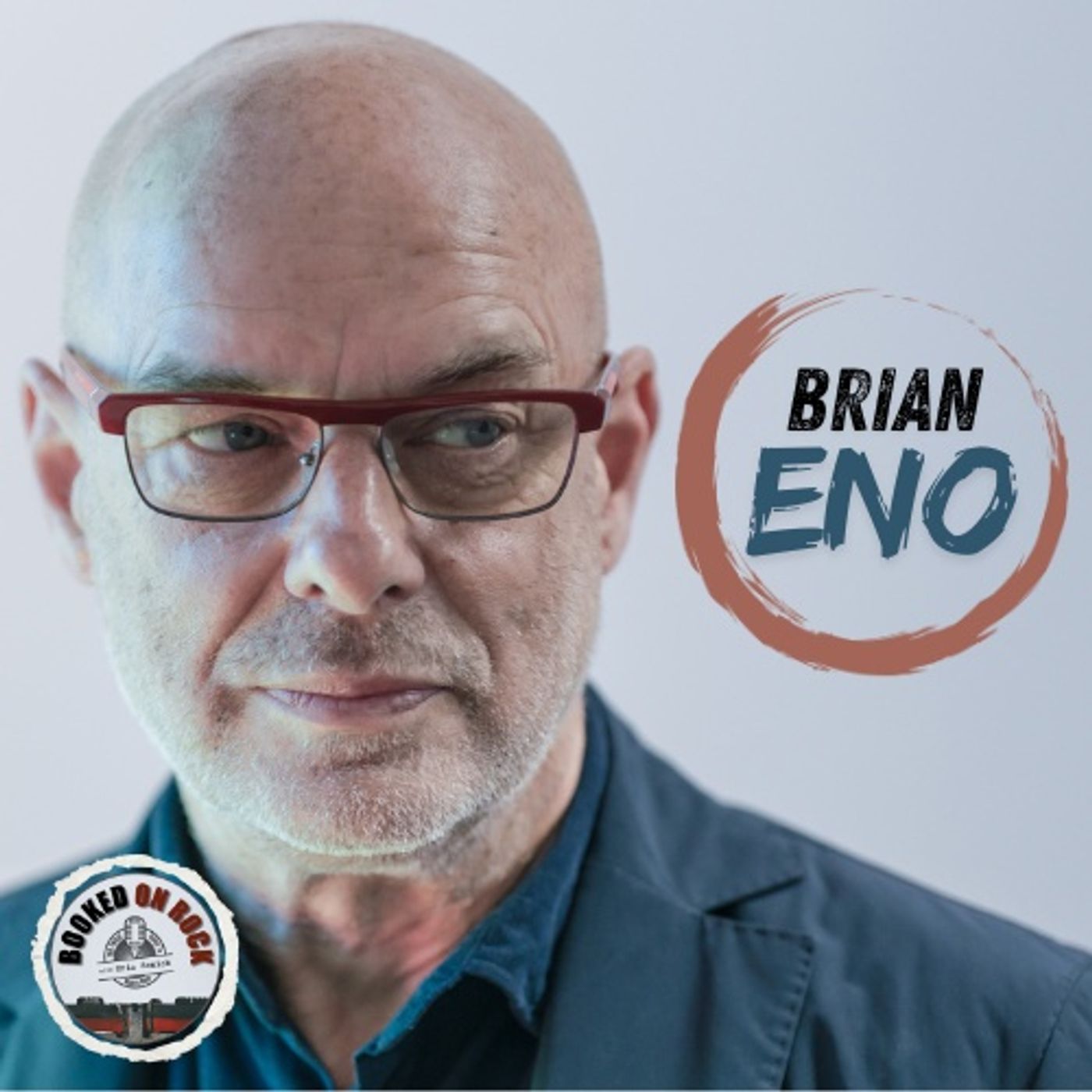
Brian Eno: The Art of Empty Spaces [Highlight From Episode 348]
Episode Transcript
Here's a highlight from a recent episode of book Don Rock.
Our guest is artist and writer Beta A.
She's the author of the upcoming book Slow Stories, a short story collection.
The stories take place in strange and imaginary towns and villages from pasts that never happened, in futures that will never occur.
These worlds exist without an elaborate background description, like islands in a misty c You also say that while making these stories that you discover the importance of leaving longer spaces.
Can you expand on that.
Speaker 2That was while making the record with Brian.
In the writing itself, I discovered that leaving things out can be very helpful for the reader to connect through their own imagination and their own visual imagery that they have in their mind.
So if I describe a town and I say there was a church in the center of the town, that might already be enough for you to mentally go to some town that you visited once or where you grew up.
So the more details, the more it becomes my story, and the less you can have your own imagery in that.
And Brian and I are very similar in that we like to leave a lot of room for audience in our art.
When I was reading the stories, he kept saying slower, slower, slower, until I felt like I was going really slow, you know it, keeping half a minute in between sentences.
And then when I listened to it again, I thought, oh, half a minute is actually not so bad because you can picture this this town with the church and the bells and some mountains in the distance.
So working with Brian in that sense taught me that actually more empty space is better.
Speaker 1Brian is on two of those tracks.
Brian, of course known for Roxy music and Prousing.
You too, David Bowie talking, how did you team up with him for this project?
Speaker 2Brian and I connected over our shared interest in what art does, why do we do art, what's the point of it?
And our frustration that nobody, in our opinion, had put this into words in a way that we agreed with.
And Brian had decades of thinking about this and lecturing about this, and we made a book together called What Art Does, in which we describe why do we believe people do art, what is the use of it, why is it important?
And we also collaborated on loads of things.
So I would go to the studio, you might be working on lyrics, and I would help a little bit, not always successfully, but I was around and he would help me sometimes with my stories, give some comments.
We painted together, so this came about very easily.
And my publisher and named Press, has released records for a while where they put one of the stories or poems that their writers do on the music on final So when I said to Ryan I might do that, he said, well, let's do it today.
Do you have a story ready?
And of course we didn't finish it in a day, but we just got started.
We started recording, looking through his archive, combining tracks, and it came together quite naturally.
Speaker 1And you did mention the quote that he had where he told you slow, slower, even slower, yes, more slow?
Is the actual quote that's promo material?
Why that approach from a stylistic approach?
Why was that important?
Speaker 2Brain thought about this longer, so he had he had a plan to do this one day, so he already thought about this, and he said that he always wondered why audio books are so fast and why they don't leave space, and he always had this idea of there should be a format with music very very slowly read stories and a lot of space for the music in between, and for the story and the music to be collaborative, and the music not too illustrative, and the story not too dominant.
When I sat down to read, I read in my normal I'm doing a reading voice, which means you read at a decent pace.
One of the stories starts with a girl was born in a village in a desert, so I would read it at this base and Brian would say slower, a girl was born, and then twenty seconds she was born in a village in the desert, with Brian's music next to it, which I didn't have as I was reading.
It feels completely pleasant and natural to listen to it really is like it brings you into this dream like state.
As I was doing it in a recording studio, it felt very unnatural to leave these giant.
Speaker 1Gaps because you're reading it.
You're reading it without the music.
You said, yes, he added it after interesting, Okay, Yeah.
Speaker 2We did put on some music at some point and had phones for me to make the reading less awkward, to get more of a sense of what he wanted to do, but that wasn't the piece that we used eventually, so once we had the recording, we started adding tracks.
He has this great archive of music he's made.
There's so much in his archive that's never used.
And he has this wonderful program that he made together with Peter Choffers, where he can automatically shuffle and it combines, for instance, three tracks.
And because his music leaves so much room for many of the tracks are pretty quiet and are not so dominant.
So if you can stack three tracks and they might still sound good.
So we did all this shuffling, We added some crickets, we took them out, and for both stories we ended up with what I think is really suitable music that adds a lot to the story.