·S2 E16
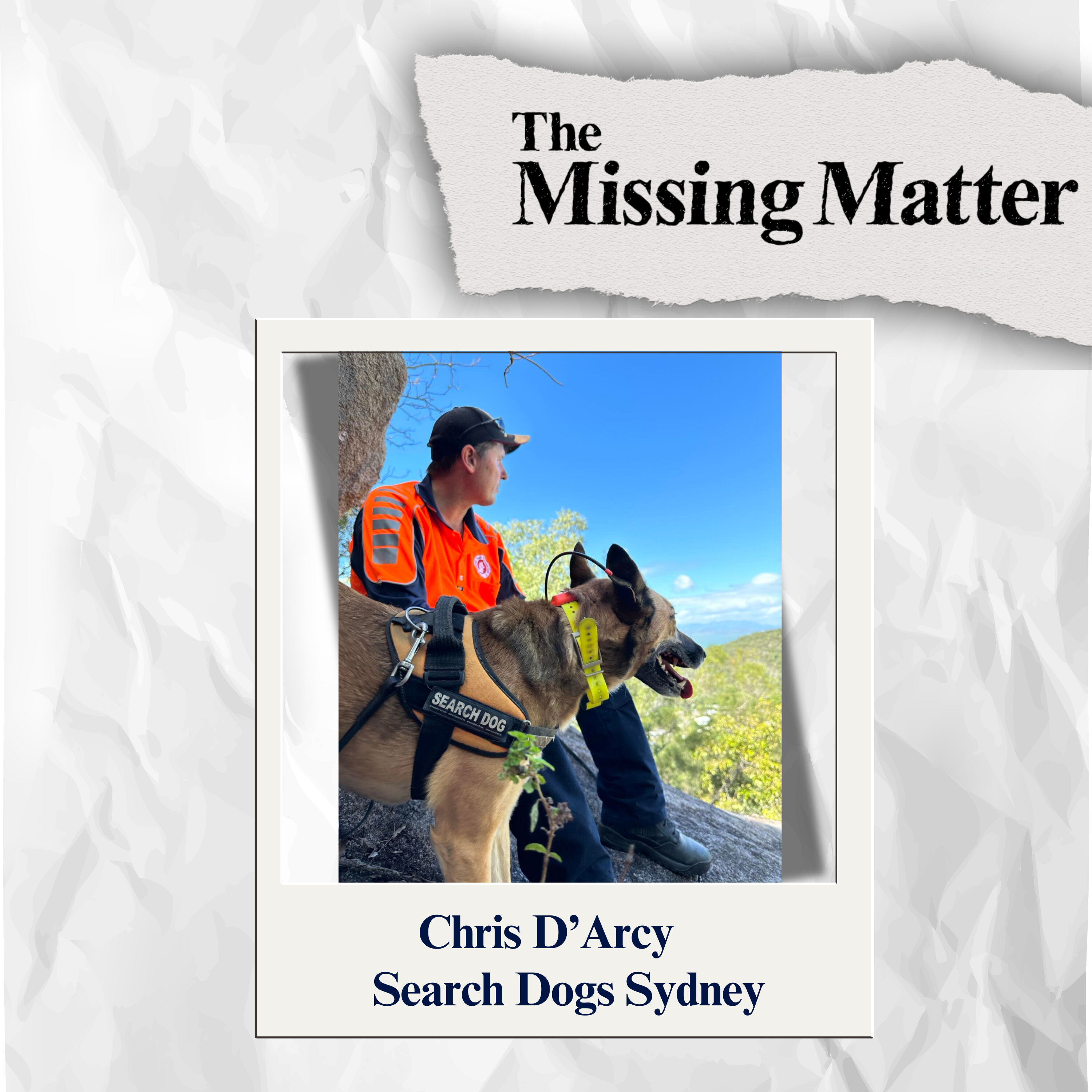
Search Dog Sydney - Chris D'Arcy
Episode Transcript
Apoche production.
Speaker 2In this episode of The Missing Matter, we meet Chris Darcy from Search Dog Sydney.
He's a highly trained handler who works on some of the most urgent and emotional missing person's cases.
Speaker 3We've been called into quite a few missing person searches, both live and de seas.
However, most of our work at the moment is for human remains detection of the long term missing.
Speaker 2Chris isn't just an expert in the field, He's someone Sally knows personally.
They've worked together in the search for Sally's mum, forging a connection built on trust, compassion and determination.
Speaker 1We finally made it.
Speaker 3Bounce the dogs over there, the dog rod that's coming around the bench.
Speaker 2Today, Sally explores the incredible works Search Dog Sydneys do and takes you inside the wall of the dogs and handlers who step forward when families need answers the most.
Speaker 4Welcome everybody back to the Missing Matter podcast.
Today, I am talking with a friend of mine.
His name is Chris Darcy.
You might remember his name.
He is the lead behind Search Dog Sydney along with his beautiful partner Adele.
Chris and I and Adele met for the first time last year in February when they came to support me at my mum's findings at Lincoln and I was so tough to see them both there.
They are in their full kits.
We knew exactly who they were, and they rocked up in their search dog Sydney outfits.
But I thought that was kind of a great way to bring a presence and an understanding of who you were and who was supporting my mum in this case.
Now since then we've met a few other times.
You came to the live shows in Sydney that we when Joonie and I were doing our fundraising and.
Speaker 1Talking about our trip.
Speaker 4He then helped us organize a dog search that we did in Armadale and in Inverarel back in August, and I did actually do a whole podcast episode for the Missing Matter Marion Matters.
Speaker 5Yeah.
Speaker 4I think it's episode four called Sniffing Out the Answers, where you'll hear us doing the full search of those locations and what we found.
And then of course we followed that up with having the National Missing Persons Symposium that we held in November twenty twenty four.
It was an interesting time for me actually because it was that weekend that my dad noticeably had something happening to him.
If you remember too, I was up the Friday, saw Dad knew something was wrong.
We had this imposing on the Saturday, and we sort of had to bail out of coming out to your property Chris, to see the dogs on the Sunday because we needed to do some work for Dad.
And you know, sadly, it's nearly a year.
He passed away couple of weeks ago, so it's been a crazy twelve months for me.
But I want to welcome you to the Missing Metal Podcast.
Thank you, Chris Darcy, Thank you very much.
Sally it can you tell us a little bit about how Search Dog Syney came about.
Speaker 3Originally, Search Dog Sydney was formed back in twenty sixteen.
We're coming up onto our tenp now, so it certainly developed from the original idea of being a search and rescue dog organization, too, being much more than that, a missing person's organization that actually can provide any and all resources available to the families of missing loved ones to assist in continuing that search.
Speaker 4And so tell us a little bit about your background and what you were doing prior to Search Dog Sydney.
Speaker 3Prior to Search Dog Sydney, I was part of the Urban Search and Rescue task Force here in New South Wales, a joint organization between multi agencies here in New South Wales, and it was our role to provide the canine search and rescue capability to the emergency services.
So we were a critical component of the Urban Search and Rescue Task Force because unfortunately, what the people don't realize is the rescuers can't do their job until we've actually searched and located where we can send the rescuers in.
So our dogs were actually trained to go into those disaster zones first and foremost before anybody had arrived or anybody had started to the rescue work, to locate those survivors and go from there.
So it was pretty critical what we were doing and certainly gave an interesting insight into the capabilities and what our taskings were.
Speaker 4One hundred percent and from your experience in New South Wales SEES and USAR where there's specific missing person's cases that opened your eyes to gaps in how missing person's investigations were being handled.
Speaker 3I suppose it's not down to one specific case per se as to the handling of missing person's investigations.
But originally it did art that we could see how good our dogs were doing in the disaster zones and how good that these dogs would be able to then transition into what we call in an urban search and rescue environment, a wide area search, which is basically a land search for a missing person, and by training the dogs to smell out in a human scent in an environment, we realized how good that they could be in a missing person search.
Speaker 4So I guess what I would like you to share with everybody is your mission as to what Search Dogs Sydney is about and how it's evolved over the years.
Speaker 3Search Dog Sydney was originally created and formed back in January twenty sixteen when the New South Wales SES decided that they would.
Speaker 5Not have a canine capability.
Speaker 3It was realized back then that it was too difficult for an emergency service organization here in New South Wales to manage a canine capability.
On top of that, Fire and Rescue at the time wouldn't permit us to go and train our dogs and they rubble paths because they deemed it too dangerous.
And yet here we were providing a specialist capability for them.
So eventually the SEES decided they'd closed down the canine capability and that's when we realized that a call came in for another land search in the Blue Mountains where a lady had gone missing up there and for ten days they continued to search for it.
They put a lot of resources into this particular search.
However they never called in any dogs.
Whilst I was a member of the SEES still at the time, I offered the services of the dog that we had to go up there and to assist, and that was promptly rejected that it wasn't required.
In actual fact, the very next day on social media it was posted that a explosive detection dog was sent to the scene for a community engagement to make it look like in the media a dog was attending the search this poor lady once again, he's still missing.
And that's when Search Dog Sydney it was determined that we need a canine capability here in New South Wales.
Speaker 4Can you highlight some of Search Jogs Sydney's key achievements today.
Speaker 5Every single search we do is to us our key achievement.
Speaker 3It's being able to assist those families because most of the time when we get the phone call, it's usually because police and emergency services have lucked out on the want of a better word, they've deployed what resources they have and they've been usually unsuccessful, hence why we get the phone call.
But there are a few memorable ones that we do have and the community searches up there called us in us is with our hires and the first thing we did as an organization was to go to Bairo Bay Police Station to make ourselves known, advise what resources we had with us, and to let them know what we were proposing on doing, and asking the officer in charge if there was anything that he would like us to do, because knowing the resources were short, we wanted to make sure that we had full communication and everything to let them know if they needed anything.
And the response we got from the police officer at that time, which has stood in our heads ever since, was knock yourself out.
Now, this is the officer in charge of a missing Belgium backpacker, and that's the response you're giving a search or organization that's come up here to assist you.
Knock yourself out.
That was the response.
But there's one more that I'd like to tap into, and that is the case of young Cheryl Grimmer, who had been recently heavily involved in Cheryl was three years old when she was abducted from Very Meadow Beach back in nineteen seventy and in nineteen seventy one a person admitted to abducting her and killing her and disposing of her body in a certain area and the police did a walk through of that area back in nineteen seventy one, but in fifty five years, they never undertook a formal search to look for her.
In fifty five years, even though there was a Supreme Court action occurring that two detective said arrested an extra nited a mand from another state, they had never actually gone through and searched for her body.
And that to me just highlights the problems that we are having for the families of missing persons.
Speaker 4And you recently have gone down and conducted a search.
Can we talk about that today or is that off topic?
Speaker 3No, we can most certainly talk about it.
It's currently lots of good things happening as we speak, which is excellent news for us.
Speaker 4I wanted to bring you on, Chris, because myself living in this space, and when we did two dog searchers over two days, one in Armadale and one in Inverrel, I found it quite fascinating and the process of you know, it's not just that you train a dog, you take the dog out, the dog finds bones, and bingo, you've found your missing person.
It's a lot more convoluted and there's a lot more process that goes into this.
So I wanted you to walk everyone through and understand the training processes for the dogs and how long does it take, what do they learn, and how do you prepare them for a wide variety of search environments.
Speaker 3We do two types of searching for missing persons, and that is persons that are alive or persons that are deceased.
So that's how we determine our two types of dogs.
Let's quickly knock a myth out of the way.
Kadava dogs and human remains detection dogs.
They're two completely different dogs.
Now, a kadava dog is initially trained to locate a kadaver, which is a body that is still in intact.
Speaker 5However, human remains.
Speaker 3Detection dogs or dogs that are trained to search for any part of the human body that may be remaining in an environment, so that could be the whole kadava, or that could just be purely and simply grave soil.
So I'm apologizing now if there's some topics that people don't want to hear, because it can be quite sensitive, and we do sort of talk matter frankly about it, because that's unfortunately what we have to do in regards to training our dogs.
It's a sense source.
It's what they're searching for and they're locating.
But when it comes to our live fline dogs, which we prefer to focus on, that's where we'd rather be.
We'd rather be getting in there as soon as the missing person is reported.
Our dogs are trained to locate any live human scent in any environment, and that stems from our urban search and rescue training.
So when we were deployed in twenty fourteen to the Roosevelt building collapse, that particular building collapse was a convenience store and upstairs was two unit blocks where a mother and told when I found sadly deceased.
But the man had tried to do an insurance job upon his convenience store and blew it up.
Sadly, he killed those three members now beco the training of our dogs, they were able to locate the mother and child throughout all of that distraction.
And when I say distraction, it's okay for us if we just put some perfume on or some deodor and all that sort of thing.
But if you were to walk into your kitchen and cook everything that's in your cupboard and everything that's in your fridge, and everything in your freezer all at the same time, then that's what the disaster zones generally smell like.
And then we're asking the dogs to say, go and find the pepper out of all of that smell.
We're asking them to find that one smell out of everything else that's there.
So that's when we say a contaminated environment.
And the difference with the dogs that are training in that they really know to pinpoint the human scent in that area.
And then that's great for working in the bush lands and for working alternative areas where the dogs are Now to get the dog to that stage, it's usually about eighteen months to two years, and that takes thousands and thousands of repetitions of those dogs to be first they've got a lerd to actually provide an alert when they do find a life human and associate that with a toy.
For lots of dogs, it's a tennis ball, or it's a food treat or something like that, but ultimately it's just having one.
Speaker 5Big game with the dogs.
Speaker 3And then we have the human remains detection dogs, which are changing very similar principle where they're trained on the six different stages of decomposition, including cremated remains.
So the dogs are trained to search for and locate all of those different stages because they don't know what they're going to find.
When we're searching for a long term missing person, depending on how long they've been missing for, depending on the environment, depending on the weather conditions, we need those dogs to be able to generalize all of those sense together and to be able to locate human scent, whether or not that be alive or deceased.
Speaker 5So it's very.
Speaker 3Much a long term training process with the dogs.
It's not something that we can do in eight to twelve weeks that okay, that would have let the dog to find something, but that would ultimately mean that you're getting a.
Speaker 5Lot of false reports.
Speaker 3So we want to make sure that before our dogs do leave the training facility that the dogs have been imprinted on almost every single smell available to them, as well as.
Speaker 5Every single type of response that could be given.
Speaker 4So you just said something there that I haven't heard before and something that I ponder in my own missing person world that potentially, let's say, one of my thought processes often is that my mum's body has been put in the bush, and then say there's a fire that goes through that bush area.
I didn't realize, like, I just literally scattered my dad's ashes last week, and this is a bit weird, I guess for most people.
But I said to Chris after I did it, I said, I probably should have kept some just to have some DNA there for whatever reason.
I'm just in this headspace now of trying to keep everything and protect everything and have things there for an emergency situation that you just don't know you're about to fall into.
And Chris was like, oh, yeah, I don't think they can get DNA from cremated ashes.
And then, but you've just said something that was interesting, that the dogs can actually pick up a scent on a cremated human.
Is that the case of you have you had to do anything like that.
Speaker 3That's a very interquestion question, and it's got quite fit from parts to it, so I'll try and break it down one at a time.
Chris is very correct, and you cannot get DNA from cremated remains if they've been cremated in a formal facility where they get the right temperatures, so DNA is completely destroyed when cremation occurs.
However, our dogs are trained on cremated remains, they still go off acent because of the fact that we could be tasked to search for cremated remains, and in actual fact not Last year, the year before, we were tasked by a new South Past Police State Crime Command to investigate and take the dogs down to the building that was on fire in Surrey Hills, and it was determined that there were potential of missing persons in that building based on the responses from the fire and rescue guys and based from the police.
It burnt for long enough and hot enough for cremated remains to actually occur, So we have to make sure that our dogs are set and trained in that event that something does occur, even though there's no DNA, so the dogs aren't smelling the DNA, they're smelling off the volatile organ it compounds, even off by human remains.
It's one of their seven different training aids that they do utilize.
But the dogs are also learn over time to bring all the sense sources together and to understand the differences between this and that.
Now, when it comes to scattering remains, yes, we currently have a case where we believe we've located and exactly what you've done.
Speaker 5A family member.
Speaker 3Had actually scattered some cremated remains in an area, and that's now caused us a little bit of brief because we don't know if it's the cremated remains or if it's the other person that we're actually looking for.
Now we have to go through a completely different set of forensic tests.
Speaker 5To understand that.
Speaker 3But when it comes to the Australia Bush, the great thing was we actually were able to do the research back in twenty nineteen.
Speaker 4I find it so interesting and such an important part of this space in locating people and lost behaviors and things like that.
You've said that the dogs are trained to search independently and problems solve.
Can you give us an example of a situation where the independent thinking was critical in a search.
Speaker 5Pretty much every search we do.
Speaker 3Their independent thinking is critical for us because we need them to be able to just work and tell us what they're seeing in the environment, to be able to listen to us, but at the same time wander off and explore because most of the time the dogs are off leash except for rufus and where I'm trying to work in a more methodical way.
Speaker 5But when it comes to our dogs.
Speaker 3Thinking for themselves, if they get a smell, we want them to be able to cross a creek or a river and to actually.
Speaker 5Go and do that.
Speaker 3And that's why we use GPS's on our dogs so that we can keep track of where they are, because the dogs can be four or five six hundred meters away from us at any one time, and yet we'll go two or three hundred meters down the area and the dogs will still be able to find us.
But when it comes to the dog's critical thinking, especially in disaster zones, we need the dogs to be able to figure out where that strongest sense source is, So we need them to actually work through the scent in the environment.
So think about it when you go home tonight and you're cooking a nice steak, say Chris has got it out in the back in the barbecue.
You'll come in the front door and you'll smell it in the laundroom, and you smell it in the front door area and you go, oh, that's a nice steak that's cooking.
But then you'll slowly work you away until you actually do find the barbecue that that meat is getting cooked that and that's what we call the independent thinking, where you've started to think about where the smell is and associated that we're looking for.
Then the dogs will go out and find that themselves.
So all of our dogs do that on a search.
They pretty much do that on training as well, and it's because we don't want them.
Speaker 5To be completely obedient to.
Speaker 1Us, Chris.
Speaker 4On a practical level in the field, when your dogs are deployed, who is there with them and what does a typical search look like.
Speaker 3So we've been able to make a typical search quite low profile.
And the reason we do that is because of the fact that it allows us to be very tactical with our volunteers.
Usually it's two people with a dog, and that allows us to remain focused because.
Speaker 5What we've learned over time is the bigger the team.
Speaker 3There is is start to disturb the ground a little bit too much, and it doesn't matter how big the team is.
Sometimes they get focused on other things.
They lose track when they're out on a search, and something that's cical to us very so much so is decision points.
So there's very little communication goes on between a search team because they've done that in the training already, But when they're out in the field, they're actually looking for the smallest of decision points when they're out there to see how that affects a search.
Because we can study as much as we like an area, we can study the lost person's behavior.
Ultimately, it comes down to when we're in that particular area, what would that missing person have done and what where are the critical decision points that have made them do what they do.
Speaker 4Or Search technicians obviously play a critical role as well.
Can you explain what they do and what qualifications or training they have to go through.
Speaker 3Our search technicians are an amazing asset to have on the team.
Most of our search technicians are actually trained aviation radio operators as well as lost person's behavior experts.
They're trained in map and navigation, they're trained in a whole range of first aid, whether or not that be first aid for the dog or first aid for the handler, or first aid for the person that we've potentially located.
They go through a whole range of training programs, not only through the Public Safety Training Program, which is the ascor approved ones that we know about that generally occur, but we've also got training through the Australian Search Dog Federation that gives us specific training as to how to work with search and rescue dogs and how to integrate drones and dogs together in order to maximize the outcome.
Speaker 4Yeah, and we did that in our search.
When I went out with you guys, you know, I thought it was amazing to witness and see all the GPS tracking and all over the laptop where both the dogs in different colors had been, and then obviously putting the drones up and mapping all of that as well.
The technologies is huge and obviously it's come a long way over the years.
Speaker 5Right, It certainly has.
Speaker 3So we've actually developed a drone program that not only is utilizing the drones to search for and map the areas, but it allows us to put it through artificial intelligence to look for anything in that area, so it really provides us with cutting edge technology for that, and we found out recently been approached by the Australian Federal Police to see if we would be willing to work with them and train them up on the artificial intelligence that we utilize in order to equip them with the ability to do that as well.
So between the dogs and the drones and all the other equipment that we do have access to, we're able to cover almost eating single environment, and we try and make sure that all of our search technicians, whilst they have their preferred niche whether or not they be a drone operator, or a dog operator or potentially even a boat operator with the sonar, they're allowed to not only training their own skill, but they're also able and fully aware of how the other skills operate.
Speaker 4You've said that part of your drive came from witnessing systemic failures.
Can you reflect on that turning point and where you decided enough is enough?
Speaker 3Yeah?
Look, the turning point for me was standing at a missing person's grave.
The family invited me to say goodbye to this young man and that's where I made a personal vow on that day that enough was enough.
Speaker 5This man shouldn't be deceased.
Speaker 3This man should be at home with his family today if it wasn't for the systemic failures of law enforcement and the emergency services in general.
Speaker 5This was a young man that had.
Speaker 3Simply gone out for a walk, and after three days of being missing, we believe that he received his own GEO targeted text message.
So he rang Triple OW and for three days he'd conserved his mobile phone so that he always had enough charge in his battery, and we know for a fact that he had fifty one percent battery charge when he rang Triple OW and he was on the phone to Triple O for over twenty minutes, and he said to Triple O, I need a rescue helicopter.
I can't go back the way I came, and there's cliffs surrounding me on three sides that are over ten to twelve meters tall.
I need a helicopter to come and rescue me.
That rescue helicopter should have been only nine minutes away, because that's how far the closest base was.
F light time rescue helicopter never came, and four months later I was standing at his grave saying goodbye to him Ken and we must do the better.
That same family had to quit their jobs to continue searching for their son.
Speaker 5This family went out there.
Speaker 3We was searching for their own loved one because we couldn't stay and continue that search for months on end because we have bills that Biquit pay as well.
The family utilized our GPS technology and by utilizing our GPS technology were able to do a comprehensive search three meters four meters away from each other each day, day in and they were searching six days a week looking for their sun.
And sadly, they located another deceased man, another man that had been missing less than five hundred meters from where his vehicle was now.
Police and emergency services had already allegedly searched that area five times.
But here's a family that now got to live with that for the rest of their lives as well as they're missing their sun that was eventually located.
But families shouldn't have to go through this.
That's the heartbreak that you know, at what point is enough enough?
Speaker 5And for me was that?
Speaker 4So I guess Chris, A good question to link into that is how do you sustain the organization financially?
And I know you don't get government funding.
So what does fundraising look like and how big is the financial strain?
Speaker 3Fundraising for US probably takes up sixty to seventy percent of our time because we don't charge for our services, where one hundred percent free volunteer organization that is there to assist the families where we can.
But fundraising for US takes many, many different forms.
It can be at the Blacktown Show or the Oberon Show, or a local show where we'll put up the tent and the marquee and we'll put some demonstrations on with the dogs and ask for a donation.
We do sell a supporter ribbon on our website for ten dollars to try and raise some much needed funds.
Speaker 5But one of the.
Speaker 3Primary fundraising sources is I actually go out and talk about missing persons across a lot of community groups, whether or not that be Probose, whether or not that be Rotary or Inner Wheel, and actually sit down and talk to them at their weekly meetings.
I think I'm almost about eighty or ninety in the last twelve months alone getting the awareness out there for missing persons and the issues that they face because many of them, unfortunately don't listen to podcasts or have a different media stream than us, and I really appreciate sitting down there and talking with them and listening to their questions at the end to find it out.
But they're also very good ways for us to fundraise.
Unfortunately, traveling around is quite expensive, and we've got to try and cover those fuel costs and the accommodation costs for when we do get out there.
Speaker 4So for someone who's worked over fifteen years in this space, now, how do you take care of your own well being and that of your team given the emotionally heavy nature of your work.
Speaker 3Dogs everybody loves the dogs, but the dogs keep us grounded.
They keep us happy and content, and they're able to keep us definitely level headed.
But we've got an amazing organization.
The team that are around me are so supportive and so understanding, and we're led by one of the best when it comes to our mental health, and that's our patron, Detective Chief Inspector Gary Rayman, who's a retired police officer is.
Speaker 5Also a retired airbo.
Speaker 3He's currently the chaplain for many organizations, including the retired and former police as well as a couple of others.
So he actually gives us a lot of assistance and a lot of support.
And for those that don't know Gary, Gary was actually the person that was in the railway carriage at the Granville Trained disaster.
Gary's been around this space for a long time.
He's also led and understands from a police perspective what goes on.
But he's able to keep us grounded.
And every now and then, just out of the blue, I'll go a phone call for a welfare check and it's good.
Our Gaza just given us a call to make sure that everything's going well.
And we have an amazing support network and we do appreciate having that because that's very valuable to continue what we're doing.
There has been times there lately where I'm pretty sure I'm starting to.
Speaker 5Go baled from what's going on altogether.
Speaker 4I want to ask a touchy subject, how do you maintain relationships with law enforcement agencies or in some cases pushback.
Have there been any successful partnerships where has friction come in.
Speaker 3It's quite easy to manage a relationship that's just not there.
It's definitely a one sided relationship.
We keep pushing for somebody to come and say gooday, somebody to come and meet with us.
However, the police don't seem to be wanting to be amenable to that.
So that's where we've we've sort of been forced to drag them to the table for this parliamentary inquiry so that we can have that conversation, so that we can highlight just how many times we've tried to reach out to an organization forget that to happen.
There could be some really good partnerships when we've certainly been boots on the ground and helping the families, the police boots on the ground, you know, at nine o'clock, ten o'clock on a Sunday night, let's see us out there looking for this particular person with Alzheimer's or dementia, and they know that we're here to.
Speaker 5Do the right thing.
Speaker 3We'll share information with us, just like we find information out, we'll share with those on the ground.
But it's up in the middle management and the upper management that we seem to find that there's problems and we're not sure what that conflict is.
Speaker 5Because we're always under the impression.
Speaker 3That if you've got a problem due diligence, go and find out, go and research, and so you can find out, so eventually we will resolve it.
Speaker 5But at the moment, no, Can.
Speaker 4You share a little bit more about the National Missing Person Symposium that we did last year in November and what were the major insights or outcomes that came of that.
Speaker 3The National Missing Person Symposium was a great time.
Unfortunately, it was a very stressful time for families to be really liiving some painful experiences.
But the National Missing Person Symposium gave people the opportunity to share their story, to share their experiences, and to share what they've been through over the last three months, six months, ten years, twenty years, thirty years, and to be able to actually tell you all of that together semi formal environment where all that information was tabulated and then it was put together into a report that was brought out by the Center of Missing Persons in March this year.
Now that highlighted that there was an issue within the missing person space, not only from the initial search where something happened to you know, going up to the coronial in quest and then pass that coroner's in quests to we do need to have a really good look at the whole space in together and to figure out how we can make.
Speaker 4It better, and I think you know, it was a really big eye opener for a lot of people.
It was quite an emotional day on the Saturday when we had people up there talking about our stories and what we've had to roll through, as you say, for over fifty years.
Speaker 1I just felt that it.
Speaker 4Was kind of like the start of bringing some awareness to that table and pushing We had the local mayor there that you'd been working really hard to get him to come along and make sure that he understood what we were trying to do, and it just seemed to me like it was the start of something that was rolling in.
Like we'd already had the petition you'd set up to try and get as many signatures as we could to try and get this parliamentary inquiry happening.
And I know that's been your main push is to get this happening because their needs change.
There needs to be something happening.
Speaker 3There definitely needs to be something happening.
I mean, we've been doing the same thing over and over again, expecting a different result, and we're not.
Sadly, our missing person numbers are going up every single year.
When I first started Search Dog Sydney, there was thirty seven thousand people a year reported missing and last year that number was up to fifty nine thousand people.
We do need to change the way in which we're dealing with our missing persons.
We do need to change the way in which we're supporting our families at missing persons.
And yes, it was definitely the culmination of a lot of work of starting the petition back in May, so, then having the symposium, so then having the report come out.
Speaker 5Because that momentum has continued.
Speaker 4We just thought if we can have a loouder voice and get some support in there in that space, it's going to make a difference.
And I'm really happy to say that thanks the likes of yourself and members of the Legislative Council in particularly Jeremy Buckingham MP, and the support of even the new South Wales Premier Chris Mins, along with all those people who signed the petition that we really pushed hard for online, we're moving forward, Chris, and I'm really excited about that.
There was a documentary on Channel nine that aired in July this year called Byron Bay Murders because mainly on sixty seven unsolved homicides and missing Women along the East coastline of New South Wales and surely after this the parliamentary inquiry was announced.
So on the fifteenth of October last month, finally an inquiry into the dozens of murdered and missing loved ones throughout New South Wales will now go ahead.
Now the inquiry is a huge step.
What changes do you hope to come of it?
Speaker 3We're hoping for full systemic reform.
We have been working very hard in the background for the last several years with many organizations across the state to arrange and to organize so that we can do things a lot better than what we have done in the past.
We've recognized that families deserve a better response to missing persons.
We understand that they need better resources when somebody does go missing, but also they also need better mental health support, better support in general for when you're going through that.
Family liaisons really need to come to the forefront and start being a lot more proactive in doing that.
But a lot of other things have come out that we'd also like to see because there's definitely a lack of oversight into these investigations and I've personally experienced what it's like going through a law enforcement Conduct Commission complaint because in the last two years, I've actually lodged two pretty serious law enforcement conduct Commission complaints in regards to missing persons and some of the miles forces attached to my missing persons, and the other one was responsed by emergency services to another missing person that is still to this day not on the missing person's registry.
Now, we need to have the oversight into these organizations, and without oversight, we're not going to get anywhere, because if I'm struggling to find and.
Speaker 5Get answers, then a family's got no chance.
Speaker 3Now, a family shouldn't have to be going through that, a family should be able to get the support that they need in any question they have answered.
We have full faith in that the system is going to be doing the best that they can.
But what we've realized is that there's a lot of roadblocks in the way.
Sally, I've seen you receive it firsthand from the Coronal inquest and the coroner said that police have got to investigate this further.
And the police tick that box.
They sent an email back to the coroner within their statutory six months to say, yes, we're going to investigate it.
Speaker 5But that's it.
That's as far as the oversight reaches.
Speaker 3The Premier's Department is responsible for that oversight, but we need to see that the investigations do continue, that the coronal recommendations are followed through.
But those recommendations aren't getting followed through and it's not an oversight body that is actually looking into what's happening, because just ending a letter back to the coroner saying here, we're going to do something.
Speaker 5Is not doing something.
Speaker 4And what I found particularly harrowing in my case was that, you know, I've got the coroner sitting there saying to me that it's back with the homicide team for further investigation.
Speaker 1Before we walked in, we were told.
Speaker 4That you know, they've got eight hundred cases and they need to prioritize.
I said, well, can you just talk to me about that in layman's terms?
And it was fed to me that your mum's case is open but inactive.
That's a very hard thing for a family to have to process.
And as you just clearly said, like I found out that that letter actually goes to the Attorney General as well, and so the Attorney General is reading this from New South Wales Police and they'd remove her full statement that was sent to then the Attorney General saying ongoing investigation.
Speaker 1I was quite concerned with that.
Speaker 4And you Johnie, Chris and I were sitting at dinner actually in Armadale when we found this, and we were chatting about it at dinner about the fact that there was multiple cases of the same language being fed back to the Attorney General, which is giving him a complete little purr.
Speaker 1Whoever is the attorney general at the.
Speaker 4Time in each state gives them a very different view on the current situation and therefore who's overseeing what the police are doing.
And to be perfectly honest, they shouldn't pick and choose what case is important to them as opposed to what's not important, because everybody matters.
And I think it's pretty disgraceful that they get to pick and choose what case because they use the excuse that there's lack of resources, and yes, tick, we all know that there is a lack of resource and we need more funding.
But there shouldn't be a pick and choose.
If the coroner is deeming after spending a million dollars to go through an inquest to determine what's happened, it shouldn't just be parked to the side.
Speaker 1There should be action being done.
Speaker 4And then, unfortunately, without these pushes, what's happening, what's going on?
Speaker 3Not a lot exactly.
And the sad thing is that police and government are hiding behind words, hiding behind words.
Speaker 5That say active investigation.
Speaker 3Now, an active investigation is an investigation in my understanding that as a detective allocated to it, that is looking into information.
It's not a case that of the folder is sitting over in there and there's ten boxes in storage.
That's not an active investigation.
That's a cold case.
So we need to start being honest and truthful with the what we're saying to these families is actually occurring.
There's cases out there, and I've heard this from police that were tasked in that particular department that they solved a case by accident because they're on sick leaf and somebody just grabbed a cold case folder and threw it out of him and said, hey, have a look at this for a while.
Well, luckily it was a good cop that was given that case and he investigated it thoroughly.
Speaker 5But we need to do have a deep.
Speaker 3Dive into the working, operational workings of this organization to find out what is a cold case, what isn't a cold case, what is an active investigation.
Let's get some honest terminology utilized, because it's not just the families getting told, but it's an active investigation.
Over the last eight eight months, I've lost track how many questions we've had asked on our behalf from the New South Wales Parliament.
Now within New South Wales Parliament, even the Police Minister is hiding behind the fact that it's behind a coronial investigation.
So I can't answer that when in actual fact there's a document called the n Manual that says, well, no, in actual fact this is separate to coronial investigation.
You should be having this information provided there's a real convoluted way in which our law enforcement and some of our politicians are actually hiding behind.
I hate to say word salad to try and confuse the issue, and that doesn't help anybody that doesn't solve the case, that doesn't provide them with any adequate resources.
And sadly I believe that I think it comes down to a little bit of our brand new Commissioner, mister Malanion here in New South Wales.
It does need to explain a little bit more to the the New South Walest community why our families are in the predicament that they're in.
Because he was the boss of State Crime Command when they disbanded pretty much the Missing Persons Unit and renamed it the Missing Person's Registry and sent all of these cold cases out to local area commands.
Speaker 4I agree with you, and you know, it is quite traumatizing.
I guess in a way that handballed by words a lot of the time, you know, and they sit there and go, oh, well, we can't discuss it because it's an open investigation.
Speaker 1But they're not actually doing anything.
Speaker 4It's quite hard for families to have to deal with that on top of the fact that they actually have a missing loved one.
Speaker 3And it's very similar to the Cheryl Grammer case where after Mercury had been let out of jail and the Supreme Court action had occurred, they did a full review of the case.
Apparently they did a full review of the case, and that review took four years.
Now, in the meantime, there was a podcast called Fairy Meadow came out.
That podcast found four additional witnesses.
At no point in time did the New South Wales Police reach out to those four additional witnesses to find out one of them was quite critical in regards to providing some information.
At no point did they actually speak with that witness and they said, no, we've reviewed the case and there's nothing to find.
So how borough are we being when we're doing our reviews?
How borough are we when we're doing our cult cases.
It's concerning because we've seen it in the Special Commission of Inquiry in the gay hate crimes of the seventies and eighties.
We get told that there's changes occurring, But I'm not having a lot of faith because in twenty nineteen that when a report was done by the new South Wales Police, they advised internally that they were more than nine hundred years behind in investigating and solving these cases.
Speaker 5And yet when we listen to.
Speaker 3David Laidlaw giving his evidence which I played to you guys at the National Missing Person Symposium, he was too scared to ask for more resources.
He was too scared to highlight that there's a problem.
If the bosses of these departments are too scared to ask for more resources and ask for assistance, then what is really going on That shows to me that we really do have a systemic problem that needs to be investigated and investigated thoroughly.
That's not picking on the police.
That's plicking on a system that needs to be changed.
Speaker 4So let's get back to the inquiry because I wanted to talk to you about the fact that media are suggesting and Jeremy Buckingham himself has said that the inquiry will mainly focus on Ivan Malatt.
Ivan Malatt was one of Australia's most notorious murderers.
Speaker 1He's now deceased.
Speaker 4He was convicted for seven counts of murder, but it is suggested that there are potentially a lot more victims that could possibly be related to him.
There's a reference that I want you to explain for everyone, Chris.
It's called terms of reference with regards to this inquiry.
Can you explain to everyone what that means.
Speaker 3The terms of reference are the rules set down by the New South Wales Parliament when it comes to what the inquiry can include and exclude when it comes to the inquiry.
Now, the terms of reference are quite implicit when it says the twenty odd names that have been mentioned within the inquiry.
However, there are quite a lot of open ended.
I think there's two particular terms of reference in there that have opened up the entire inquiry.
And whilst I appreciate that we don't want it to be a malatfest, Ivan Malatt actually is quite a good way in.
Speaker 5Which for us to look at the entire system.
Now.
Speaker 3Ivan Malatt has encompassed both cases here in New South Wales as well as Queensland and Victoria and other states.
So it'ich highlights that there is cross jurisdictional boundaries that we've got to follow.
It highlights a lot of local area commands that maybe not might not have had the resources to investigate that at the time.
But there's also a lot of cases in there that over my LA was not involved in.
But the terms of reference are quite broad, but at the same time it's been narrowed to just twenty because if we were to include more than eight hundred and forty long term missing persons, the four hundred and seventy human remains that have not been identified in conjunction with unsolved homicides, as well as the bodies that have not been located from unsolved homicides, because unfortunately, what we've been looking at is we change the law here in New South Wales and quite a few jurisdictions across the country.
Speaker 5The nobody no parole laws.
Speaker 3Now, a lot of criminologists, a lot of university academics have actually criticized them and gone on record stating that these laws don't work, and that is true, they don't work.
And this is where it's going to highlight that we do have a systemic issue when it comes to searching for our missing rum ones, because it's going to highlight within the terms of reference that the police we've got competing priorities.
Now that can be one of two things.
Do we prosecute the criminal that's involved that's undertaken this, or do we locate the body?
And nine times out of ten they're more interested in prosecuting the crime.
So being able to have the terms of reference the way that they are written still allows for everybody to have their say and everybody to have a voice.
Speaker 4And I understand too that there's protection offered, meaning that anyone who has information who comes forward now has a protection of the parliamentary privilege.
Do you feel this could bring people out of the woodwork who do no more?
Speaker 5Oh?
Speaker 3Most certainly, here's an opportunity for families or witnesses, for anybody that's involved in missing persons in the space for unsolved homicides to provide information to the inquiry and to be able to name names that maybe they provided previously to crime stoppers or the police that hadn't actually gone through all of the things that it may have been discounted at the time.
So this is going to allow a lot of people to come forward, and I think by able to not only they could put their name to it, they can also be anonymous and they do provide this information and allow it to be a public record forever for it to be seen that that hopefully we can we can solve a few of these cases that have been unsolved for such a long time, and providing an alternative space for these victims to come forward.
Speaker 4And I'd like to add too that if someone has given information to say crime stoppers, and they haven't heard back, which I hear all the time, I would suggest that you do it again through this process, because I know firsthand that information was given to crime Stoppers, and I know firsthand that it wasn't received by the OIC on my mum's case until I actually gave them the reference number and she went and found the information.
So that's an important thing to mention as well, because you might think that you've given that information and if that person's still missing.
I highly promote the idea of actually revisiting and reconnecting with that information and making sure that it is heard because it could solve a case.
Speaker 3That's correct, that's correct this parliamentary inquiry.
As soon as the website is open, I'll be sure to share the information.
But if you have previously provided anything to crime Stoppers and you're not sure whether or not it's been followed up, if you've reported it to the local police, or you've run police Link or done any of that previously and you're not sure that it's been followed up, please provide that to the inquiry so that they can then look into it and determine if it was followed through.
Speaker 5Because that's a key thing that we need.
Speaker 3To also look at as part of the inquiry is is crime Stoppers working adequately when it comes to reports for missing persons and unsolved homicides.
Whilst we've got the responses that yes, it works for a lot of other crimes, there's not any feedback in regards to missing persons or unsolved homicides that crime Stoppers is the ultimate goal and it's working the way it should.
Speaker 4One of the things I wanted to ask you is do you know if they will be encouraged to hand over the remaining human remains that are still in the possession of Miss soth well as police that mainly I think for independent testing, you know, rather than just the police testing their own work.
I think that that's something in my head that I would like to see happen, and it would give me a peace of mind to know that it is actually being done.
Speaker 3Look, I don't think that they're going to be handing over those remains.
I think they need to stay in their possession for the short time.
However, there are some pretty major changes and recommendations that hopefully will be coming out on the thirtieth of June that we have been working through over the last couple of years, and hopefully this will highlight the need for those changes that will include exactly what you're asking for, and that being independent testing and the setup of those facilities to be available because organizations like myself should not have to go all the way to Texas or all the way to England to get things tested properly to know that there is the independent oversight that the company is that so hopefully we can provide some definite good answers for what you're doing.
I notice you spoke to Jodie on one of your podcasts and I think she'll be very happy with some outcomes.
Speaker 4And that's the thing, right, We've got someone who is literally a genius in that space and setting up all the parameters to make that happen.
So I think everything is stepping forward in really good succession, Chris.
I think I can see the light at the end of the tunnel potentially and working towards that.
So I know that I will be helping promote on Mum's page as well and three or socials and on our website as well.
For anybody who has information or wants to know more about being included or putting in their submission to be looked at for being a participant in the parliamentary inquiry.
We will keep everyone abreast of that.
I just wanted to talk to you, like although the Byron Bay murders doco which I mentioned before, looked into sixty seven women stretching from Newcastle to Byron Bay.
There are also a lot of missing men and other women that weren't included.
And for me personally, my mum wasn't included because New South Wales Police have her missing from Southport in Queensland, so even though the coroner was a New South Wales coronial hearing, her last known digital footprints are in New South Wales.
Speaker 1For families of missing loved ones.
Speaker 4How can they engage with the inquiry and what advice do you have for them to prepare a submission or to be heard.
Speaker 3Everybody can affect change.
I hate to use the term, but it's a history making moment for families and missing loved ones that you have now a voice in Parliament.
Speaker 5Where it's going to be recorded.
Speaker 3Everybody with a missing loved one, anybody with an unsolved homicide, all of that information needs to come forward and you have the voice to affect that change now and to make these people listen to what's been going on.
Speaker 5Whilst we fought hard to get the inquiry.
Speaker 3Now it's the important part over the next six months and it's going to be a tough six months to share your story.
We want you to tell your story now.
We know that when somebody goes missing, there's more than one other person involved.
We want everybody to put down their story about how it's affected them, about what they have seen, how it's affected their families, because some of these stories now are of missing persons are generational.
We're seeing the parents, the brothers and the sisters, the kids of those and now the grandkids are all being affected because this missing person in their life, in their family has been unresolved for so long.
And we need you to be honest and tell your story so that we can get the politicians to learn from what's been occurring, not just what is getting reported to them by the police, by the Attorney General, by the Premier's department.
They need to understand just what is really occurring within the missing persons space.
Speaker 4And I guess, like looking for the future, what are your biggest fears or concerns for missing persons work in New South Wales and Astray and more broadly.
Speaker 3Miss My biggest fear is that we just keep going the way we're going, because if we keep going the way we're going, these numbers are going to be, you know, at five thousand in less than a decade of long term missing persons.
Speaker 5We need to change it, and we need to change it now.
Speaker 3Sadly, I can look at the Bureau of Crime Statistics and research monthly figures that come out to tell me what have been committed in my local area, but missing persons don't even rery to mention.
The new South Walest Boys has been it's very difficult to even keep a track of missing persons.
We need to provide our families with support.
We need to provide them with assistance because this affects so many people across so many different communities that we can't just continue to go the way that we're going and expect it to be okay, because it's not.
I'm sick of seeing families suffer when they don't need to suffer.
They need to get the support that they so rightly deserve.
These loved ones need to come home.
People die when they shouldn't have to die.
We need to be able to provide the support to these people sooner rather than later, because I'd much rather be bringing them home and looking after them.
Speaker 5Than burying them.
Speaker 3And that's what we've been doing lately, and it's just getting worse.
Speaker 4Chris, I always like to finish my episodes with asking my guess why they're missing?
Loved one matters in your case.
You look after everybody and care about everyone.
Can you share with everyone why you believe the missing matter?
Speaker 3You know they matter because they need to have a voice.
The missing have a voice, and whilst they can't speak for themselves, we can speak for them collectively.
And every single one of those missing persons needs to be loved and needs to be brought home and we need to do that.
So let's do that work together as one big community.
Let's come together.
There's lots of little groups doing a lot of little different things across there, and let's come together as one big group and actually show everybody that we can become one and we can help these and help bring them home, because that's the whole thing.
We need to bring them home and for that those families to you know, get the information that they so desperately need.
Speaker 2In the next episode of The Missing Matter, we turn to the disappearance of Aaron Clear, a son, a brother, a father, and now a grandfather who's been missing for more than five years.
It's a story filled with questions, contradictions, and moments that never received the attention they deserved, a timeline that doesn't quite add up, a system that seemed to look the other way.
Aaron's sister cass shares the truth and a family who's never stopped searching.
That's next time on the missing matter.