·S2 E9
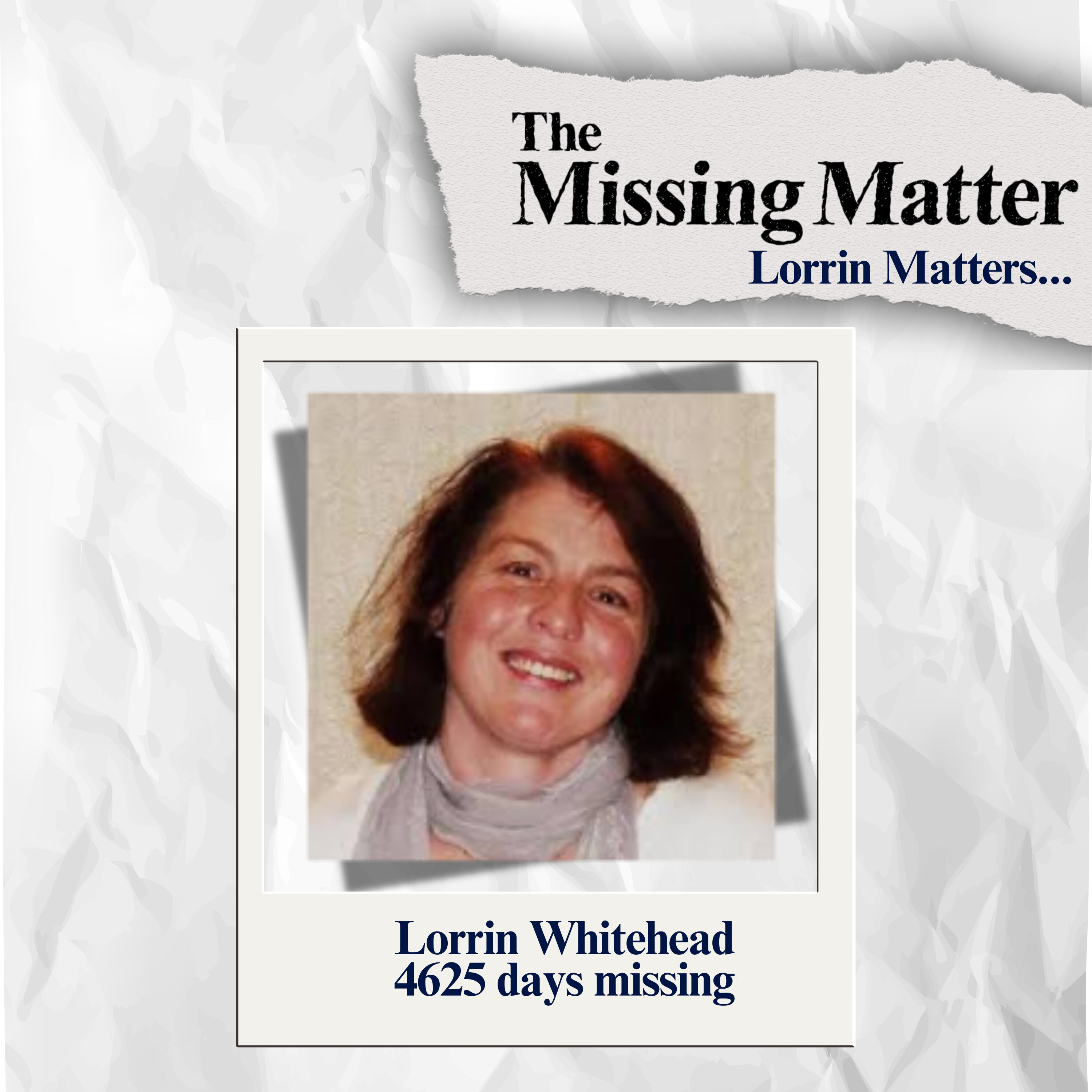
Lorrin Matters ...4625 days missing
Episode Transcript
Apodjay Production.
Speaker 2Hi everyone, it's sal I just wanted to jump on before the next episode and give a massive shout out to you all.
Thank you for listening to the Missing Matter podcast.
We have now reached five hundred k downloads and that means that more people are hearing these important stories of missing loved ones all around the world in the hope that we find that someone who knows something.
We're almost near the end of season one and I'd love to open the opportunity up to anyone who has a story they need to tell.
If you or someone you know could benefit by joining me in a gentle conversation on the Missing Matter podcast, please reach out to me at info at the Missingmatter dot com.
Speaker 1Stay safe.
Speaker 3It's been over twelve years since Lauren Whitehead vanished from a small Victorian town.
On February eighth, twenty thirteen, Lauren was caught on CCTV leaving the local safeway.
She bought a bottle of water, a pen, and a card.
Hours later, she was gone.
Her car was still in the garage, her wallet, insulin, and a handbag laid neatly on the bed.
The front door was open, the house half packed dropsheets, on the floor, photos stripped from the walls, as if life had suddenly stopped mid sentence.
Lauren was just forty one, a mother of five, a survivor of cancer, a woman finally rebuilding her life.
Twelve years on, her eldest daughter, Amelia, is still searching for answers.
She was just twenty when her mum disappeared and became responsible for four younger siblings, feeling questions from the police and the media, and her own grief.
In this episode of The Missing Matter, Amelia shares the story of her mum's last day, the heartbreak of being dismissed, and the toll of living in the unknown for more than a decade.
This is the story of Lauren Whitehead, mother, daughter, writer, missing.
This is the Missing Matter.
Lauren matters.
Speaker 2Well, hi everyone, and welcome back to the Missing Matter.
Today I am chatting with a lovely lady about her missing mum, Lauren Whitehead.
Lauren has sadly been missing now for six hundred and twenty five days.
She was forty one at the time of her disappearance.
Amelia is now thirty three and is the oldest of Lauren's five children.
Amelia was only twenty At the time of her mum's disappearance, Amelia took on a lot of responsibility looking after her four younger siblings, Meghan, Rachel, Arnold, and Quaid, who are aged between thirteen and nine at the time of Lauren's disappearance, Amelia, thank you for coming on and chatting with me today in a gentle conversation about your beautiful mum, Lauren, can you share with us a couple of your favorite memories that you hold close to your heart about your mum.
Speaker 4I guess when we talk about my mum, it's really hard just to sort of pick a specific memory, but I guess some of the memories that sort of stick in my mind was how mum would make the ordinary extraordinary and she did that with you know, things like Amelia Nights, where you know, she'd pick my favorite movie and my favorite dinner and we'd get in front of the TV and get to have special nights we're all focused on me.
And another memory that sort of sticks close is Christmas.
My mum was a mad Christmas fiend.
You know, she'd always make as I said, the ordinary extraordinary, doing you know, raspberry picking and making a homemade jam for everyone.
Singing along to Michael bouble Christmas album.
I think that's another one that sort of sticks close in my heart.
She was just this really extraordinary person that made life so much better.
Speaker 2She sounds like a wonderful person and too young to go missing, and you know, be still missing today.
It's been twelve years this year, which is a long time.
I know that's very hard living without your mum, and particularly you were like me in your twenties when she went missing, and so therefore we have a lot of things to live with without our mum's being there, and like getting married and having babies, and it's tough.
So you know, my heart goes out.
Speaker 1To you all.
Thank you so much.
Speaker 4Look, yeah, as you said, it's one of these things that the happiest times often the saddest times, you know, as you said, birth are children, marriages, graduations, those big happy moments really sort of impact to be the saddest moments as well, because you sort of go to Even now, I still have the instincts like, oh, I just got to tell mum, and I go, oh, yeah, cool, that's not possible.
Speaker 1You know, even now, I still have.
Speaker 4That knee jerk reaction, and it's really really hard to sort of get around that, that is for sure.
Speaker 2I understand that very well myself.
Let's talk about what happened around the time your mum went missing, so we can give our listeners an understanding of who your mum was and what was happening in her world around that time.
So it's February eighth in twenty thirteen and Bannockburn in Victoria at four forty five pm.
Speaker 4So sort of the sequence of events that I understand to be correct is that around three thirty I just knocked off work and my mum rang me and said, hey, I don't know what I'm going to do with the weekend.
You know, the kids are at your stepdad's.
I might go up and see your grandparents in Queensland.
I might go to a soccer game I've got I won some tickets.
I'm not really sure what I'll do, but we'll catch up Sunday for coffee.
Speaker 1And then she sort of paused and.
Speaker 4One, I'm really sorry, life's just been so busy.
I'm just sorry, And I went, oh, you don't need to be sorry, like I understand, things are just hard, and she goes, yeah, I'm just sorry, and I went okay, that's fine, you know, we'll catch up Sunday for coffee.
And she seemed to be in good spirits but just sort of really apologetic.
Speaker 1And then Sissy DV.
Speaker 4Actually captured Lauren leaving the Bannitburn plaza, so that was coming out of the safe way, which is what it was at the time.
She was recorded to buy a bottle of water, a pen, and a card and then exit out that building and go to a nab atm which she removed one hundred and fifty dollars.
There sent some sort of mixed reports of whether she actually got into a red full drive so she walked herself home, which was about a two kilometer walk from that plaza.
There's another report saying that she got into the driver's side of a red full drive, and then that full drive was subsequently seen at her primary place of residence over that weekend.
So as to sort of what happened after that point in time, it's not exactly one hundred percent concrete, but that was the last known sighting we have of my mum, and I guess from that point over the weekend there was multiple attempts at contact from both my siblings and myself in the normal capacity that the kids had swimming, and then she didn't shot up to lessons.
The kids would often contact my mum every single night while they're at their stepdad, so there was no answer over that weekend.
Speaker 1This wasn't like my mom.
Speaker 4My mom often stayed pretty close to her phone, stayed in contact with all of us, so we sort of knew what was happening.
Speaker 1Even it was just a brief text.
Speaker 4Message of hey as a gym, doing this, doing that, talk to soon whatever.
It was very unlike my mum.
So by the Sunday afternoon, I was exceptionally worried.
I said, all right, if I haven't heard fro, maybe she's lost her phone.
On Monday morning, I'll give her workplace a call and go from there.
Speaker 1So literally, at seven forty five.
Speaker 4In the morning, I rang my mom's workplace and my mom's boss said, actually, Amelia, I was just about to call you.
Speaker 1She hasn't shown up for work.
Again.
Speaker 4My mom had five kids, it wasn't unusual for her to be late to work, but in saying that, she always let her boss know, hey, I'm going to be late.
This was really unusual for my mom.
So he goes, look, let's just meet at your house.
Whatever you do, don't go inside.
I'm going to meet you at your house and we'll go from there.
I leave my workplace, He leaves his workplace.
We get to my house and I can see the front door is wide open.
I can see the garages wide open.
I'm desperate to go inside.
I'm very very nervous because this is not like my mum.
My mum is a single woman who lives by herself, very very strict on security, very very set.
You know, she had the security locks always in place.
I can see, you know, the car's still in the garage.
I can see.
Everything looks normal, except that she's not there.
So I just want to go inside anyway.
Twenty minutes later, the boss arrives and he goes in side first and does a look around and says, look, she's on side, let's go in.
We went in and the house was in disarray.
There was drop sheets all over the floor like the house was going to be painted.
All the photos were removed off the walls, the fridge, things were out of place.
There was dishes all over the sink, very very disarrayed from the normal messy of a house with five kids.
Speaker 1This is exceptional.
Speaker 4I can see all her belongings out in the bed.
So I can see that all her wallet, her handbag, her insulin or all laid out in the bed, just like she's gone out for a walk.
Speaker 1I don't know what to make this, So we called the police.
Speaker 4From there, you know, we contacted everyone sort of a mum's circle.
We contacted my mom's parents, we contacted close friends and family.
I went through her contact book, so we sort of went through that contact book individually seeing if anyone had heard from her.
Speaker 1No one had.
Speaker 4From there, the police sort of just took basic information, and there was sort of information come forward that Laurence done this before.
Was a comment made by my stepdad.
I said, actually we knew where she was in that previous circumstance.
Speaker 1This is not normal.
This is not something that is normal for my mum.
Speaker 4Police then go, oh, we just put this on hold until the aggreed custody exchange in the following Friday, so that's when the kids would go back to their mum.
Maybe she's just gone away from mental health break.
They sort of just put it down to left it own, you know.
Speaker 2Choice understanding that you have a different dad to your four siblings.
Speaker 1Were the kids on.
Speaker 2A week on week off with Lauren?
Speaker 1Correct?
Speaker 2Okay, So on that Sunday they weren't supposed to be going back to Lauren's house.
They were cared dad, okay until the following Friday afternoon, which at the school they would do like a drop off pickup situation.
Speaker 1On the Friday afternoon, Mum would pick them up from school.
Speaker 2Okay, Well, when was the last time you went to your mum's house prior to that time?
Speaker 4The Wednesday night, so I'd actually moved out and moved it with my partner's family.
I was working full time at a hospital new grad year Wednesday prior to her going missing.
I was looking after my four siblings whilst my mum attended an accounting course.
So I'd seen her on that Wednesday night in.
Speaker 1Really good spirits.
Speaker 4She was studying, We were planning a mother daughter trip for her birthday.
I was planning on moving up to Newcastle in the previous year, like in the next year, so things were on all.
Speaker 1Accounts, you know.
Speaker 4She was in really good spirits, making lots of plans, talking about lots and lots of different adventures.
She wanted to go on.
You know, to me, it was the best I'd seen her in years.
It's her mental health wise, it was the best I'd seen her in a long time.
Speaker 2Yeah, I've heard her friends say that too.
A lot of her friends were like, she was the best you know that they'd seen her in a while, after going through a pretty rough time.
Speaker 1She'd had cancer.
Speaker 2And she'd just come out the other end of that, so you know, she was in a pretty good space, one would.
Speaker 1Think, absolutely.
Yeah.
Speaker 4Between So just for a bit of context, my stepdad and my mum went through a pretty nasty divorce with multiple custody hearings sort of lack in year prior to that twenty eleven twenty twelve, very very nasty, lots and lots of water under the bridge.
Speaker 1But on all.
Speaker 4Accounts, mutually, things were okay.
In that sort of early twenty thirteen, things were okay.
Speaker 1You know, of course, it's always.
Speaker 4Distressing going through that kind of scenario and there will always be issues, but by all accounts things were settled.
It's just really really hard for me when you know, for instance, media paints this picture of someone who's mentally unwell or you know that's certainly not the case of my experience, and from what I understand and my mum, she was making plans, very, very the best I've ever seen her.
Speaker 2Well, you know, we always say that we know our people well, and I think police and media really need to listen to us as the next of kin or the closest to that person when something like this does happen.
I was curious, like, so you've left on Wednesday.
Had she mentioned to you that she was going to do any renovation or was she painting the house?
Speaker 1So could she talk to you about that?
Speaker 4Not really, So you know, she'd always talk because she bought this little family house and Bankburn.
I had always talked about doing it up, you know, like you know, to convert in the garage and potentially room for me that I could stay.
Different plans as you always do with houses, constant renovation, constant planning, but nothing imminent that I was aware of.
She's certainly not talked about painting or you know, anything like that with me.
Speaker 2And I think I heard you say that you had wished that you had taken photos of what you saw inside, because there was like a broken fruit bowl with fruit in it that had gone rotten.
The thinks was full of dishes and things that you felt were very out of character for your mum.
She was very neat and tidy typically, so that was very out of character.
Speaker 1So part of this podcast.
Speaker 2And talking with people who have lived experience, one of the other things I try to help is bring an understanding to what we go through and what we've lived through and how things could be done better or differently moving forward.
For the Sadly the next person as like one person goes missing every fifteen minutes in Australia now, So I remember hearing you say that you know you didn't think to take photos because your mum wasn't missing to you at that point.
There was just something not right and you were expecting her to come home.
Tell everyone what that feels like and how you cope with that, because I've done a similar thing in mum's case where it's a sliding door moment.
Speaker 4It's really hard to sort of articulate or put it into words about the what ifs.
I guess that's sort of what I call them is.
You know, it adds to this grief that you feel every single day, and you know, I look back on everything that I've been through and by some inside, I actually had the nouse to do a journal.
So I actually have a very detailed journal from the very beginning of everyone I spoke to things that happened on the day, including all the way up till now, So from the minute that my mum went missing, pretty much all the way up until now, I had some kind of foresight to actually journal about everything that I saw in great detail.
But in saying that, I didn't have the insight to take photos, and I wish it just adds to my grief every single day now I've reflected on this scenario.
I knew my gut from that exact moment I walked through the door that something was not right.
I knew this was not my mum, this is not But lots of other people's words get in your ears, Lots and lots of other people make you feel silly.
And I just see any other family going through this scenario.
I want to say, if you've got something in your gut, go with it.
You know your people the best, and even if you are wrong, there's no harm in overdoing it.
Speaker 1You can always delete the photos one hundred percent.
Speaker 2It does play with your head I've been doing it for a long time now.
In you know, I wish i'd just asked my mum where she was putting her shipping container so I could find her belongings, and just where she was staying in a hotel when she was traveling.
I just didn't think to ask those questions.
Speaker 4Yeah, it's amazing how much your mind actually goes over all the conversations you had before.
Speaker 1And did I miss something?
Speaker 3Is that?
Speaker 4You know even that in that phone call I got with her on the Friday afternoon that I'm sorry, I go to that sorry had double meaning, you know, like was she saying sorry that she leaving us?
So she's saying sorry that I didn't take it as that when that phone call is happening.
Speaker 1But you know, you do replay those words.
Speaker 4Over and over and over again, thinking am I missing something in this?
Speaker 1Have I missed some kind of sign?
Speaker 4If only I'd gone home that weekend, If only I had gone home on the Friday afternoon, Like, you know, there's all though I wish.
Speaker 2I did things, I know, and I'm sorry to drag you back through it again.
I know it's it's a horrible thing.
It cannot be very good for us too, write like making sure we look after ourselves and making sure that you know we're okay.
Speaker 4Yeah, I guess, as you say, talking about it, but you know, I think I've learned with dealing with services such as the Missing Person's Advocacy Networks Louren O'Keefe.
You know, talking with people like yourself who have that actual understanding of what you're going through.
It's really hard to talk to people who haven't been through it, and once you've been through it, it's really hard to explain it to somebody else unless they've been through it.
It's so important that we talk about it because, as you said, one person in Australi goes missing every fifteen minutes is the most under resource, underfunded.
No one is actually talking about these issues, and I feel like there's no set standard or procedure for families.
Speaker 1We're working on that.
Speaker 2I've had Sarah Whaling came on and talking about her new project and they're trying to put together a document that actually helps and guides police and media working together with what they can put out and give media a bit of a guide.
Speaker 1Poll.
Speaker 2I guess because I feel like there's such a mixed message and I'm sure you would agree with me with when it comes to media and what the police want us to do.
So when the police want media and they want to put something out there, they're all over it.
Yes, yes, yes, And when they don't, they pull us back.
And I've spoken to families before where they're like, don't talk to the media, don't say anything to the media.
We don't want it out in the media.
What's your experience with that.
Speaker 1The monster that is media.
Speaker 4Media is our best friend and our worst enemy is missing person's family.
Speaker 1It's really hard to in.
Speaker 4My experience, media has been this massive monster, family divider.
It's caused so much personal conflicts, so much personal grief and harm with misinformation that the media has printed.
Even for instance, something you know you said in the beginning about how I looked after my five siblings.
I actually didn't.
I didn't look after them.
I supported them emotionally.
I looked after them occasionally when my stepdad was not able to.
But you know, the media has painted me as this person looking after my five siblings and you know very much glorifying that scenario, or even that they in the beginning stigmatized my mum to have mental health history, when really she didn't.
She had a little bit of personatal depression of course, going through a nasty divorce.
She had, you know, periods of meant sadness, But what woman doesn't when they're going through a divorce, and that, unfortunately, in the very beginning, that really sort of drove the police in.
Speaker 1A different direction.
Speaker 4And I want people to know when they're typing their keyboard, Warrior behind a screen, we can see it, family can see it.
Where people behind a screen really really important what you type, and it's really really important what you say and the way the media portrays the situation and the story.
You know, take for instance, our current recent case of Gus.
The way the people are responding to that situation is horrific, terrible.
Speaker 1It's disgusting some of the comments.
Speaker 4And as a family of someone who's been through these scenarios, I am twenty at the time, I am so hurt by everything that's coming in.
Speaker 1You just block media.
Speaker 4But I'm very very lucky that I've sort of had time to evolve and understand how media works, and then now my relationship with media is a lot better by actually controlling the narrative.
And that's why I love these podcasts such as What You Do.
It allows family to control the narrative, and that's what I saw.
I encourage families of missing people to jump on these platforms to really control your narrative, control your story, and get out there the information you want to get out.
Speaker 2There was a time for me where someone in media said to me that I like to control the narrative, and I was really offended by that.
Initially, I sat back and thought about it and I went, damn straight, I want to control the narrative because if I don't control it, someone's saying the wrong thing.
They're calling her like I've got documents where they've called my mum Warren Brown.
So of course we want to control the narrative because we want the information to be correct.
We don't want it to damage the case.
And we also, on the same flip side of that, we are very careful about what we tell the media and what we put out there when the case is active, because more than the police and more than the coroners, we want to make sure that there's no damage done to our case to find our missing person by saying stuff in.
Speaker 1The media, and that can come back and.
Speaker 2Bite us on the backside too, if we're not telling people what they want to hear and people get upset with us.
But that's the crux of it, and that's just a whole nother rollercoaster side by side to having a missing person and dealing with all these other things.
Speaker 4Right, yeah, absolutely, they're the things that no one talks about in regards to a missing person.
Speaker 1Is all the financial all.
Speaker 4The media, the pressures, external pressures from No one tells you how to navigate a missing person emotionally, no one.
The world doesn't stop just because you have that missing person and you have to continue on with your air quote normal life.
Speaker 1But there is no five stages of grief.
Speaker 4There is no counsels that sort of understand I don't feel in my scenario, I've never met a counsel that understands my situation can help me through navigate through those cycles of grief because there's no closure, there's nothing, there's no outcome to sort of lay to rest.
You just have to sort of accept the fact that they're gone and you don't know why they're gone.
Speaker 2And we need to be kind, right, I mean, I'm in a situation with my brother who took his own life He was pretty heartbroken, as was I, but we were completely different humans.
You know, I'm a person who likes to talk about things.
I'm very open and communicative to talking about my mum's situation.
Speaker 1My brother was not.
Speaker 2He was introverted, very intelligent, didn't like to talk about it.
And then you know, when we got told that they'd located my mum and she didn't want anything to do with us, essentially is what they said.
Speaker 1He didn't cope very well with that.
Speaker 2And it was only a couple of years later he took his own life at the age of twenty seven, and to find out twenty years later that at an inquest that no one actually physically spoke to my mum, all sighted my mother.
This is where I sort of came into this new space that I find myself in.
Going words matter, We need to educate people.
We need to start at the top of the police tree.
And because their knowledge and their power trickles all the way through to their new recruits.
So how are we going to change the language or change the ideas and the methodology that they work with if we don't start at the top and help those people understand what it means like when you say that to somebody, you know, when someone rings you on the phone and says, oh, we've spoken to you mum, she doesn't want anything to do with you.
Speaker 1Who even does that?
Speaker 2Like, why would you not take the time to come and sit with the person and say, listen, this is what's happened.
Like they're a well position and ways that they could do that would make that so much about you.
Speaker 4We've had so many insensitive phone calls from police, unknowingly like they're just doing a job.
And I understand that they've got their limited resources and all this stuff, but our experience with police has not been a positive one, between the ignored phone calls, that ignored emails, the updates once every year for only you know, a handful of years.
Yes, in their active times they're always after you, but then they're very, very blunt, forceful, no tact.
We need this from you, drop your life, let's do this.
You can't say anything to the media, but you know we wanted in the media spotlight because we got new information to come forward.
Speaker 1So no guidance, No, are you okay?
Do you need support?
Speaker 4Like I don't think I've ever been asked, even with all the bad news that they've have been delivered.
Not one police officer as they ever said.
Do you think you might need some counseling or some psychological assistance?
Speaker 1Nothing.
Speaker 2Can we go back to when your mum was at home and the th that were missing from her house, tell everyone what was missing and talk about maybe her medication and why that was a key part to your theory as to why something else has maybe happened.
Speaker 4After my mum went missing, as you do, we sort of went through the house pretty systematically looking for any kind of clues, whereabouts, hotel cards, anything.
We were just desperate at that stage.
Police weren't really doing too much.
Things were on hold for a week, so my grandparents and I just sort of went through the house looking for information.
And the only thing we could really pinpoint that was missing was her personal phone and her personal laptop.
Speaker 1They were the only two items.
Speaker 4No clothing there was maybe I think there was actually a black and pink bag that was missing as well, but they are the only things and the items she's pictured wearing on the day she went missing.
Speaker 1There's nothing else.
Speaker 4All her clothing, her other items, and her life saving type one diabetes medication, all of it was still accounted for at the house and the reason why that is so important that as a Type one I bet it myself.
I know that that medication is I need that every single day.
I know that it takes two forms of ID and a script for me to get that medication, so there's no way you can falsify that, and I know it is extremely expensive.
So for the fact that she hasn't accessed that medication in you know, since twenty thirteen, that's massive.
That's what differentiates her in my mind between another missing person and my mum is that this is an ideable medicine.
You know, she was to access that medicine from anywhere, it would be registered with the National Diabetes Australia Registry, and that registry has been checked every six months since she's been missing, and none of it has been accessed for many months afters I don't know whether you have done something similar, but I actually sort of investigated how much would cost to get a fake ID.
But it's very, very expensive to get a fake ID, and you know, it's something that I don't think my mum was able to do.
Speaker 2So she purchased a Hallmark card and she also bought a pen which I find the pen thing bit weird because if you were going to go home, you would surely have a pen at your house, so why would you need to buy a pen?
So I was thinking about it yesterday a bit more going why did she buy the pen?
Did she know that she wasn't going home at that point or something was happening and she just desperately wanted to write something and get something to the kids, because she actually essentially sent that card to her ex's house for the four younger siblings.
Correct, And let's just talk about what was on the card.
Speaker 4So from my memory, it was a sort of seaside picture where there was a smiley face in the sand and it had print on the front don't cry because it's over a smile because it happened.
Speaker 1There was nothing written on the inside.
It was completely blank.
Speaker 4There was a postage stamp mark on it, so it had been sent through like a registered post setting.
There was no DNA evidence, as police told us, But the writing was also not a match for my mum.
I thought it did not look anything like my mum's writing in that light.
Also, Australia Post actually told us that she diverted her mail at the same time, so she actually diverted her mail not to come to her house and was to be held at the post office for six months in that same transaction.
Speaker 2Interesting and so the letter arrived at your stepfather's house on Friday, the thirteenth of February.
I wanted to mention this because this is something that we've done in Mum's case.
So on the postcards and the letters that we've received from Mump, there's these little purple line dots that sort of look like they've been through a scanner, and the scanner has put these dots on there.
We were able to work out that when you scan those dots, it actually identifies where exactly that letter was posted and whether it was posted in the morning or the afternoon.
I was just curious, has that been done with police?
Have they done that for you?
Speaker 1I believe so.
Speaker 4So I believe that for my understanding, it was sent from the Bannkburn post office in the afternoon of the previous friday, so in that same captured time frame of when she was last seen.
I believe it was posted in that same window of time.
I've only ever seen the card through police officers.
I've never actually it was only shown to me in an interview setting.
I've never actually been able to my stepdad's girlfriend at the time.
It was actually the one to open the card.
You know, it was very distressing.
All I had on the front was to the Kaser Kids.
That's litually what it said on the front was the Kaser Kids and the address that was it.
My mum was a horrific writer.
She actually wrote as a hobby.
She wrote books, she wrote poems, she wrote, you know, she was a writer.
And for me, that's such a key thing that there was nothing written in the card.
Speaker 1It was blank.
Speaker 4And for me, if she was going to go away, go leave of her own volition, that's not something my mum would do.
Speaker 2So talking about the police, it currently sitting with Mirrorble Crime Investigation.
Speaker 1You noticed that right in Victoria, correct, Yeah.
Speaker 2Just for the purposes of people understanding the way this conversations happening with Amelia and I today is that due to a new media push that was done by the family at the beginning of this year, new information has come about.
Therefore, we're not going to talk a lot about what's happening right now in this space.
We're going to make sure the integrity of the case is one hundred percent foremost the most important part of this, but we still wanted to give everyone an opportunity to hear about Lauren's story and Amelia and her family's journey to find her.
I did want to mention about listening to another podcast that you've done two years ago, and the police officer who spoke to that journalist mentioned that to date, so we're talking ten years, there's nothing to indicate that there's anything suspicious about your mum's disappearance.
And I nearly fell off my chair.
I was that's two years ago.
That is not that long ago.
Are we not learning anything?
Because you might have heard me say a few times, you start it suspicious and you work backwards.
How do you juggle that in your head?
Amelia?
Like, as you say, you've got no one offering you any support, But two years ago they're telling you there's nothing suspicious, and now you're saying, hey, don't speak to anybody because there's something happening over here.
How does that affect your daily life.
Speaker 4It's really hard to sort of explain in words, but just to put it into context for listeners.
When mum initially went missing, the police officer at the very beginning said, right, with missing people, that's three avenues.
You know, self inflicted suicide, own volition, she left of her own choice, or she's met foul play.
I think we can rule out the foul play.
I just I think she's gone of her own choosing, or she's taken her own life.
There's definitely no mental health history.
We'll just sort of got to go down those two avenues, not so much the foul play.
And that's literally from the very beginnings sort of what police drilled into us to spite families concerns, despite family's alarm bells of this is not normal, this is not all the complexities that was my mum.
There was a lot of financial and social circumstances that just didn't add up in our minds, and nothing was being answered.
I felt like nothing was being taken on board for at least the first maybe seven years, maybe even longer, maybe even until I really did this recent media back, you know two years ago where I did the missing podcast with many curists.
I really felt like no one was taking me seriously and it was just ticking a box, going through the motions, listening to our concerns.
Speaker 1Taking statements.
Speaker 4I recently had a conversation with a police officer that's now actually in charge of.
Speaker 1My mum's case.
Speaker 4They said that they inherited three boxes of information, of which when they opened it, every single day time they talked to a key witness, four more witnesses would come up that they'd have to speak to because they hadn't been interviewed.
Key people had never been interviewed.
Despite family saying you should really talk to this person, you should really talk to that person.
This person will have good insight.
My uncle in London has really never been interviewed.
It's really really hard for me as family to sort of hear that distress in his that he's got a lot to say here.
My mum were really close and he might have insight that one piece of the puzzle that might click everything else into place, that might give some other piece of information a new light.
And that's why I always say to people, no matter what information you have, big, small, old, new, whatever that information is, I urge you.
Speaker 1To come forward.
Speaker 4I urge you to tell the police, whether it be through a crime Stoppers or actually calling them morrible c are you directly or messaging our Facebook page that we have missing personal Lauren Jane Whitehead.
I urge people to message us and tell us that information because it's really important.
And I think after I did that podcast with many curis, we had so much information come forward that we'd never had before.
There was actually information come forward about mum being seen getting into either one report says the driver's side, one report says the passenger side of a red fall drive, and then that full driver was supposedly then seen multiple times over that weekend between the eighth and the eleventh, going in and out of her residence or on the nature strip of her actual resist sidence, which that's all new information for family.
Speaker 1We're not aware of that until it was actually.
Speaker 4Released to the media.
We were not told of that before that media release so fast.
It was quite just stressing that the police didn't tell us before the media.
You know, it's a massive deal.
Speaker 1I know myself.
Speaker 2I had a complete meltdown sitting in my mum's inquest because a gentleman who was a person that the coroner referred to as a significant person of interest in my mum's case, he admitted to having an affair with my mum.
He's on her timeline at the time she disappeared.
He was asked bluntly in court in front of me, did you murder Marian Barter?
And he said no, and he got up and he walked out on his WHEELI walker and most of the court had left because we were breaking for lunch, and my whole body I remember leaning forward and I asked for a tissue and I literally just had a complete meltdown.
My body, My whole body was convulsing.
I was shaking, and they're like, what can we do, and he's like, do something like yeah.
Speaker 1This is amazing things that hit you.
Speaker 4So an example I have exactly like this is that I was working night shift in the hospital that I work out here, and I was sitting in the staff room and on the board in the staffroom there was like a patient board where you can see people who come in.
Speaker 1And then I'm looking at.
Speaker 4The board and there's a forty one year old female who had the name Lauren Whitehead, spelled exactly as my mum.
My mum has quite particular spelling of her name of Lubrin, so very particular spelling of Lauren, same age, same demographic.
I'm sitting there, I jump up from my lunch, I run out to the bay that she was in.
I throw away from the curtain and you don't even think, you don't even think it wasn't my mum.
But and then I broke down.
You just it's amazing things that trigger you.
With this life and this grease cycle that we go through, it's really hard when you don't think about it.
Speaker 1I know this might kind of hit a bit close to home for.
Speaker 4A lot of family members, but when I stop and think about this as my loved one, there's my mum and not just a case and not just a project that we're.
Speaker 1Forced into and doing it hurts.
It hurts so much.
Speaker 4It's too hard to think about it personally all the time because you just wouldn't cope.
I know I wouldn't hope if I didn't actually put a hat on of something completely different.
I have to completely disassociate from being a daughter.
And I think that's the thing that no one talks about with missing families, is you actually take away.
So for instance, even in my personal life, I'm not really a sister anymore.
They're my business partners because we still look after all my mum's finances and assets.
Speaker 1Don't get me wrong.
Speaker 4We still have elements of being siblings, but I feel like that whole relationship has been robbed from us because we are business partners and we have to talk about mum's finances all the time, and we have to talk about mum's situation all the time.
So we're not really siblings anymore.
We're just associates.
And it's really sad.
It's awful.
And you know, I'm not a daughter anymore.
I'm just someone who's managing her affairs and doing all these things.
And she's robbed all these years from my life.
And I feel like all this stress.
And you know, I don't know about you, but I've had a lot of people go, what would you do if you come back home tomorrow?
What would you say?
What would you do?
When I I have no idea.
First I'd be probably really mad, I'd probably faint, and then I don't know what I'd do.
But you know, it's so hard to think about this in a personal context rather than just slack all business hats on kind of process.
Speaker 2It's such a weird space.
I'm very closed off.
I think to my reality that my mummy is missing, and I know I talk about it and I'm open about it.
But to be able to do that, I have to put myself in that position, because like you, we get upset, we cry, it's upsetting, and we can't sit here and talk about it as openly as we are if we don't put on that hat.
Speaker 4Absolutely, but I also know that if I don't do it, no one else will.
And this is the thing that I've come to the realization that police are so under resourced.
They have no idea what we go through.
They have never been through anything like most of the police officers speech.
You have no clue what we go through on the daily, what their phone calls do when they ring you and they tell you information blase a.
They have no idea that for two weeks, three weeks, four weeks after towards I'm still manifesting on that phone call.
I'm still fixated on every little word that they've told me that I go on and I add it to my journal about what who I've had a conversation with and what's happened.
Speaker 1And they don't.
Speaker 4Understand the gravity of emotionally how it affects you know.
For instance, even my grandparents are my mum's parents.
I have my grief.
But there the nine times are by ten when I think of them, she's losing a child.
Now I've had a child myself.
I can't even imagine what they go through on the daily.
And they are these strong people that every single time the police officers talk to them, as you can imagine, they're hanging off every single word these police officers are saying, because all they want is they little go home and to know what's happened to their little girl.
And that is what Lauren is.
Lauren is their child, Lauren is my mum.
Lauren is a best friend Lauren has And through this process, I've learned that she is so much more than what I ever thought.
You know, she was an elite swimmer, she wanted to be a nurse.
I found out all these things about my mum that I never found out before she went missing.
And all these people have come out of the woodwork being her friend and the amazing things.
Speaker 1That she has done.
Speaker 4It's really really amazing to me that I wish I could sort of articulate and put into better words about.
You know, she was this amazing person that is so much more than a missing person poster.
Speaker 2Am I correct in thinking that there is an inquest coming for your mum.
Speaker 4Correct, So after the many Caress podcasts will given a coronial inquest number.
But from my understanding, there's too much information at the moment to the police side of things to submit an inquest.
So they're still finalizing things on their end to be able to submit all the information.
So that's what I understand the hold up to be.
But I may be wrong in that understanding.
The police still haven't submitted their inquest documents.
Speaker 2Okay, And this is another problem, right because Victoria is different in yourself Wales.
Yeah, in New South Wales they have to write a report for the coroner that oh I see, so the officer in charge and then that report goes to the coroner and then the coroner makes a decision based on that report whether they are going to take it to an inquest or not.
Is what happened for me in my case.
And it was only after we went public and I did a podcast that all this sort of started to roll out, Which is interesting, isn't it.
Speaker 4That's exactly what ours did to the minute we started getting high media profile.
We've been pushing for a coronal inquest for many sort of that year seven just to settle her financial affairs.
So in Victoria, for instance, we can't settle any of the financial debt.
Speaker 1Tax.
Speaker 4We're still doing her tax return yearly.
We're still paying her mortgage, We're still doing things like that.
Speaker 1So her house is still there.
Speaker 2Correct, her house is currently being leased.
And her car was still in the garage right correct.
Speaker 4So I had to personally buy her car.
I bought her car, put the money into her accounts, so we agreed on a value as a family.
I bought her car and we held onto the car for thinks five to seven years after she went missing.
My husband and I actually drove that car, which is so much grief in itself.
That layer trauma is the stuff that no one navigates you through like.
We couldn't get legal even legal advice was super hard to obtain because it was such a unique circumstances.
We had to try and cancel a gym membership.
And oh my lord, can you just get her to give you a call in person?
Was the comment we got over the phone.
I went, she is missing.
If she calls you, please let me know.
I said that to the worker over the phone.
Speaker 1So she's missing.
Speaker 4I just want to cancel her gym membership or she actually needs to call in person if we want to cancel that membership.
Speaker 1And I was like, it took me nearly two and a half years to cancel that.
Speaker 4We were paying a gym membership for nearly two and a half years because we couldn't individually cancel it as until I got a legal representation of being her.
Speaker 1Advocate, which you have to pay for.
Speaker 4It was like three hundred and six dollars an hour of a legal representative to pay for these fees.
These are all the things that just I wish I could help others through that.
And I guess that's why I jump on these podcasts talk about it in such openness, and it's because I never want someone feeling alone in this because we felt so alone.
I don't know about you, but I was the most.
It was trauma and trauma, and I sometimes feel like it's the trauma my mum is one thing, but it's the having to everything else, see everything else that kills you as a person essentially.
Speaker 2And we're taking it all on ourselves because, as you say, we're the only ones here doing it.
There's no team behind us.
We're just there.
To muddel our way through because there's no guidebook and potentially there should be a helping hand.
I know Lauren, like I was part of helping with ambiguous loss cards that we did through MPEN And but we need more out there, and we need funding.
Lauren's doing all this work and Susie does all this work, and it's out of their own back pocket and out of fundraising and out of donations from people.
So hopefully we will be heard, and doing these podcasts is obviously good.
The more each we have, the better opportunity we have to make sure that people actually are listening of what we're actually dealing with.
It's not just the fact that our mums are missing.
There's ABCDEFG going all the way down in all the other things that we have to cope with and deal with.
And the fact that you haven't had an inquest yet so therefore you haven't been able to finalize your mum.
You don't have a death certificate for her, I would assume either, and therefore you can't sell our house, you can't close her things and just have an element of peace that that is done.
It's a horrible thing to do.
I only just went through it last year myself.
Twenty seven years took me to get a deertificate for my mum.
They were still charging my mum a monthly transaction fee on her bank accounts, even though she's missing.
All those tiny, tiny, tiny little things which don't probably seem like much in the scheme of it, but when you add them all together, it's monumental.
Speaker 4Absolutely, Look, it is absolutely monumental.
And it's those tiny things that add to the grief backpack, that's what I call it.
It's like, every single day since she's missing, I've been wearing this backpack and some days it's so heavy that I just can't carry it by myself and I have to lean on others and I feel like I just want to rip it apart and throw it at the bin.
But then other days I barely feel it, and you know, I know it's still there, but you know, you just have to carry on with life as air quote normal.
Speaker 2Well, you are doing an amazing job.
I really take my hat off to you, and I know it's been a really huge journey for you.
I mean to have this happen to you at twenty you're now thirty three.
You know your mum yourself and it's hard to manage and keep moving and putting your foot forward, but you're doing an amazing.
Speaker 1Job, and thank you.
Speaker 2I'm proud of you for what you're doing as well, because it is it is hard, and know that as part of this too, we become family in this space, and we become friends as well and look after each other and just have someone to chat to who actually understands it a little bit better than maybe someone who hasn't been through it one hundred percent.
Like I know, a lot of people try very hard to grapple with what we're going through, and there are some really beautiful humans out there.
If that's probably the good thing that comes out of this space is.
Speaker 1Yeah, absolutely.
Speaker 4I have met so many beautiful people like Laurena keep, like Susie Radcliffe, like Denise and Bruce Morcombe, like.
Speaker 1You know other list goes on and on, like yourself.
Speaker 4I've met so many amazing people that just give so much life, and you never know this space exists until you're in it.
I encourage all people out there who are going through this scenario, don't do it alone.
Don't reach out to these us, reach out to all of us.
We will always have a listening ear, you know, like we'll always guide you through things the best we can because we've been through it, and like I are just anyone going through anything hard.
Speaker 1It's such you don't have to be alone in this.
Speaker 2I did notice that you're colecting all of the articles and the newspaper clippings and everything, and they're in this beautifully presented album that you've got.
That must be such a big treasure for you, I guess, and part of your journey, but would probably hold a lot of stress and emotion and heartache in there as well.
Speaker 1Yeah.
Speaker 4So I have something called my memory book.
And when my mom went missing, probably about four months in I graduated from UNI, so I actually completed my nursing degree, which we always talked about, like, you know, I can't wait to see you get up there and graduate, was always my mum's words, and I started making it at that point where I started keeping a book of everything significant myself and my siblings did, and the media articles and everything.
So when she came back, I could give her the book and I could say this is everything you've missed and said of me trying to catch her up.
Speaker 1That was my thought process initially was to catch her up.
Speaker 4On life, but then over time, over the last you know, thirteen years.
It's the day I gave birth to my daughter.
I wrote a letter to my mum about, you know, the feelings that I wished I could share with her, and that's gone into the book.
When my daughter said, who's that in the photo and I said, that's your nana, and you know, she's actually talking and she's three now she knows who Nana Lauren is and she doesn't really understand the context of you know, Nana Lauren, but that Nana Lauren's not here anymore.
Like I want her to know my mom in capacity, but it's so hard to sort of explain that to just Nana Lauren's not here anymore.
And you know, I wrote my mam a letter in that stage, so that all goes in this book.
And for me, I think it's very casartic in that it gives me peace and closure that she was to walk through back that door.
I'm living my life to the fullest because that's what she'd want.
I know that she wanted what was best for us kids.
She'd always put us first, beyond everything, and that's the kind of person my mum was.
She was a mum before everything, before her personal life, before her health and well being.
Speaker 1In some ways, she was always a mum.
Speaker 4She'd always show up to be a mum in one hundred percent capacity, no matter what dentriman it was to her.
And that as now I'm a mom myself, I know how hard that is.
When I see the things she actually did, having four kids under four under four, I look at my mom, I'm like, you're a superhero.
Speaker 1Woman, Like how did you and do that?
Speaker 4Like you know, for me now that I've kind of come into this space of my own space of being a mum, I look at the things she achieved, going back to work, when having five kids, you know, showing up every single day for all the multiple things that we'd be doing.
Speaker 1She was just this amazing human.
Speaker 4And I think that, as you said, I'm kind of growing into this space now of sort of taking charge of the narrative per se.
It's because I've finally grown and realized how amazing she was and how much I wish I could do more for her.
And I know that my voice has so much power and my words have so much power that when I'm saying something I'm hoping someone out there that knows something will come forward because they're hearing what I'm saying and knowing that she's so missed and so loved and we just want to know what happened to her, and we want to no matter how small, that piece of information that might be that last little piece of the puzzle that puts everything else into context.
So you know, police are always sort of say, big or small, please come forward.
Speaker 1It's not just words, they are actual truths.
They are so important, so important.
Speaker 2I can't stress it enough either.
I always finish our podcast by asking families why they're missing person matters.
Can you share with us why Lauren matters?
Speaker 1Why Lauren matters?
Speaker 4As I've sort of said before in this podcast, Lauren is a daughter, Lauren is a mum, Lauren is a best friend.
Lauren matters because she mattered to so many people, and she's just this amazing human being that deserves an answer what happened to her and deserves justice for finding out what actually happened to her.
And despite everything that's sort of been said by police, and despite all the assumptions and the stigma and everything else that's kind of gone on before this point, we need to know someone out there must know something.
This has gone on for so long, for thirteen years, that's too long to wait for answers.
Lauren's parents are getting older, things are happening.
You know, my grandparents, they're desperate for answers.
And I just a plea to everyone.
Lauren matters, Lauren, everything.
Speaker 1Almost impressive matters.
Speaker 4But for me, you know, I just want to give my grandparents closure and give myself some closure, and to really find out what happened to her and bring her home and lay to rest, if that's what that means.
But you know, I just thank you so much for this opportunity and giving me this sort of space to control the narrative and to say my piece, because it means so much to family that we can have that opportunity and using this platform and using everything you've been through, like I can't imagine what you must go through.
I just, you know, I take my hat off to to use your space so positively because I know every day I could curl up into a ball and I end up in a psych unit.
I know that, you know, I feel like I could crumble over and be a mess.
But we have to use our strengths, and we have to use what's like, you know, the strength that my mum gave me.
I have to use that to try and bring answers because without that, I don't know whether we will get them.
Speaker 1Next week.
Speaker 3On the missing matter, grown.
Speaker 5Up my whole life with three amazing, amazing arts who have always maintained they could never understand why dad has done what he's done because I was the apple of his.
Speaker 1Eye and he loved me immensely.
I understand that desperation.
I definitely understand that desperation.
Speaker 5Especially when you feel like you've got no one to turn to or no one understands you.
It's not like your parent has passed from an illness, it's not like you've lost a child through an accident.
You know, there's no there's no necessary network for for us to go and feel like we as their family matter