·S2 E13
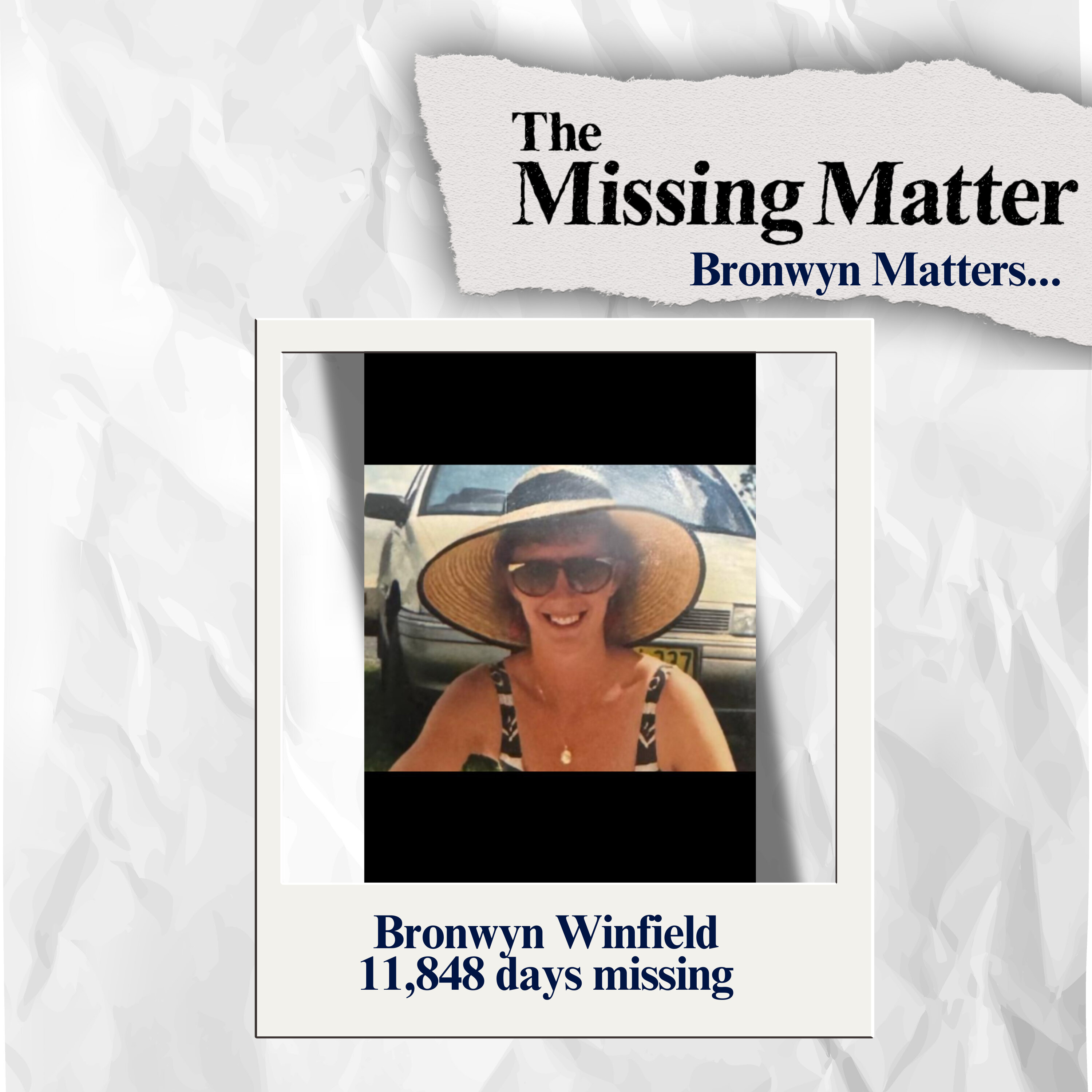
Bronwyn Matters... 11,848 days missing
Episode Transcript
Approche production.
Speaker 2When someone disappears, the people left behind are forced to become detectives.
They follow half trails to code fragments, search for the meaning in the silence.
Kim Marshall has been doing that for more than thirty years.
Her sister, Bronwan Winfield, vanished from Lennox Head in nineteen ninety three.
She was a mother of two who seemed to simply disappear.
But Kim doesn't believe people just vanish, not without a trace, not without reason.
So she's been quietly doing what investigators should have been doing long ago, tracking down unanswered calls, revisiting old phone books, and piecing together the threads that were never tied.
Recently, she found one a mysterious phone number and a three minute call made to Tasmania that wasn't from her mum, her nan or from her.
For Kim, that single unanswered call might hold the key to what happened to Bronwin.
This is her story, a story of persistence, family, and the hope that somewhere in the archives of the past lies the truth of what happened to her sister.
Because Bronwin matters.
Speaker 3Well, Hello everybody, and welcome back to the Missing Meta Podcast.
This morning, I'm speaking to someone who I refer to as a good friend.
We've been connected through our missing loved ones, and I'm very pleased to have Kim Marshall joining me this morning.
We're going to be talking about her sister, Bronwin Winfield.
Now, a lot of you probably know about Bromwyin and have heard about Bromwin, but we're going to do a deep dive into kim story today about her sister and what Bromwin means to her and her fight to find her.
Reported missing by her estranged husband John Winfield eleven days after she was last seen on the sixteenth of May nineteen ninety three, Bromwin has been devastatingly missing for eleven eight hundred and forty eight days.
This year will mark thirty two years.
So that's a big number, Kim.
Speaker 1You I've never heard it like that.
That's tracking in a very big number.
Speaker 3Those numbers do trigger me as well when I'm saying them, but I want people to understand it.
Speaker 4It's a long time.
Speaker 3Like you lose your keys for one hour, you're in a panic trying to work out where your keys are.
So just to put it into some perspective.
When you've got a missing loved one who's missing eleven eight hundred and forty eight days, that's that's a lot.
So thank you for coming on the Missing out Of podcast.
I've been asking you for a little while and you've finally said to me, I'm coming, Zala, I'm going to come and talk to you about my sister Bronnie.
Speaker 5Well, yes, it's good to be here with you, soo thank you for having me.
I'm going to say I am glad I actually know you.
And today's truth Tell is a synchronizing moment because a person special to Bromwin was recommended to contact you way back Sircer twenty nineteen, and here we are today.
Speaker 3And we have spent many many hours on the phone chatting and becoming friends and connecting in this space and beyond that space as well.
But I know we're both here fighting for my mum and for your sister.
So let's jump in and let's have a chat about who Bromin was and who she was to you.
You've described Bromwin as your big brave sister.
We refer to her as Bronnie and Braun.
Can you tell us a story or a moment that really captures her character and what she meant to you.
Speaker 5To me, Bronwin has always been my big and brave sister, affectionately referred to as Bronnie or Braun.
I have a distinct recollection that I still carry forward to today.
I always remember witnessing Bronnie starting again and recognize this as her inner strength.
Two huge qualities always stand out, one being self respect and the other was always hopefulness.
She had this unwavering dream of creating a stable, loving home, something she held on through every up and down that came at her.
There were times, yes, she was let down, could have been the workplace and definitely in relationships, but she never showed to me that those experience hardened her.
Instead, she carried herself with dignity, She picked herself up, and she kept moving forward with that beautiful mix of hope and resilience.
Speaker 1That defined her.
I have to say that.
Speaker 5Over the years, I caught myself questioning whether I ever did actually have a big, brave sister, and this questioning became a reoccurring theme during the podcast produced about the disappearance.
Regardless of everything associated with Brody vanishing, my connection to her and my memories.
Speaker 1Are stronger now than ever.
Speaker 5I see her as a woman prepared to take the hard steps to be proactive, and she did capacity build her way forward.
Speaker 1She was a trailblazer in nineteen ninety three.
Speaker 5If you think about it, I see her as a woman engaged with the system and reaching out for the supports that were available when know too well today how vital it is for a woman to reach out and ask for help.
So from her story, I've adopted three core values from her character that I use during my life journey.
They are courage, brave, and joy.
I recognize how I have to turn out for others is very important.
Learning from my sister's plight, I have identified lessons to guide me much better.
They involve something like we've discussed language boundaries, trust, curiosity, Patience is something that I can learn from Bromwin's light, and I still hold out that everyone can become more authentic.
I've worked hard to own my own truth, and what I do recognize is not everybody can actually do that.
Speaker 1I can't rely.
Speaker 5I can't expect other people to do the same as I perceive that she'd be done.
This whole story, I think is about trust, and kindness from others.
It's not going to ever be unconditional, unfortunately, and this was the core failure of why Bronwin's not here alongside us today right now.
Speaker 3And you said a word there, Joy, And I know that the name Joy is actually very special and precious to you.
Speaker 4It's Ronnie's middle name.
Speaker 3Actually, I wanted to ask you why it was important that she passed her name on to her daughter Crystal.
Yeah, traditions, they seem to pop up everywhere in our family.
Speaker 1It does anyway, our family with women.
Speaker 5I also want to make mention that there's another special woman out there, and another very special daughter out there who also has a middle name of Joy.
And that also was a thread that gave me courage to actually step forward.
Not that I really always feel comfortable talking about me and putting myself first and being honorable for my mum, But here we go.
And Mum Barbara was given the middle name of Joyce as a dedication to a young relative who passed away.
My Nan, I'm aware, gave it to her and she was very fond of it.
Mum and Nan often shared family stories as I grew up, and this is just one of them.
So Mom thought her middle name being Joyce had become a bit dated, so she decided to soften the name, and that's where joy came from.
Barbie passed her middle name to Bronnie, and then more tradition happened.
Ronnie then chose to give her middle name to Crystal.
Speaker 3Let's talk about the kind of things that Bromwin loved doing.
You mentioned her style and her letters.
What other side of her do you remember?
Well?
Speaker 5I have the memories that Bromin liked to cook and was fond of using recipes from Nan read Nan Hay and Mum.
Speaker 1I'd have double and triple check this.
Speaker 5Luckily, now I have a connection to be able to hear things from the red side of the family, and I think it's very warm to hear those connections.
She enjoyed cooking, which then led to her enjoying to entertain.
She definitely liked to host a party or two.
She didn't have any hobbies as such where she would actually do craft intensively or anything like that.
Hers was always about social connection and family.
Speaker 1She did like to have nice hair if she could afford to.
Speaker 5She liked to keep her clothing tailored and elegant, and I can definitely say that Megan agrees that Bronnie loved to entertain or be out in a social setting.
Speaker 3Now, you've told me a story about when you were young and how it's sort of labeled from when as your protec, can you tell us about the night from which she coined the phrase the four Musketeers and how Bromin made you feel safe growing up?
Speaker 5Yes, the tas Mane you visit When she was a teenager, our home had a very long, wide hallway.
It was very dark at night.
One night I woke hearing a noise down the side driveway.
I woke Mum, awoke Bronnie and her girlfriend, and we all went off to investigate.
I have these distinct visions.
We tiptoed all the way to the back door down this long, dark hallway, single file, holding onto each other.
But at the helm was Bromwin and she was holding the stick of the vacuum cleaner like a baseball bat.
We tiptoed all the way down.
Mum then removed herself from position too, went forward, opened the back door and shouted out that whoever was there to go away.
Ronnie positioned herself with the baseball bat in hand.
Speaker 1And leaped forward out onto the back path.
We could hear voices.
Speaker 5I actually have suspicions and pretty well know there were people in our driveway.
So we locked the door, came back inside.
And it might sound bizarre, but I've never ever wanted to own a red vacuum cleaner.
Speaker 1So the Four Musketeers.
Speaker 3The Four Musketeers was created, and memories are a firmly still there for you, which is kind of nice.
I think it's nice to hold onto those memories, and especially when you feel you would have been probably afraid and worried, and you know she brought her calmness to you by being the brave one who stood out the front and made sure she was going to keeping you all safe, which is a nice, nice trait.
You did mention before that that time was when Bronni came to Tazzi for a trip and your teenage years you described a distance between you and Bromwyn.
Can you share what that felt like as a child and how do you reflect on that now?
Speaker 5Yeah, so it's a bit like a seesaw talking about the Four Musketeers.
That's where I reflect.
I knew that I felt safe as a young child.
I knew that I meted to Bromwyn, I knew that I felt special because she always remembered my birthdays and she always wanted me to visit her in Sydney.
And I just loved being a little sister because there were times where I had to actually live as an only child, but there were the incredible times where I actually did get to be fully recognized as a sibling in person.
This distance was quite significant because I actually wished never had happened, and it is a horrible thing to happen to any child that's developing.
So when you become a teenager, you know you're still trying to work out how the world is and where you fit in the world, so things can be pretty black and white.
I wasn't equipped to relate to the responsibilities of being an adult and everything that comes at you.
And I believe this is where Bromwyn was starting to be weighted down with the repeated cycle of being let down, having things where her trust was broken, having to ask for help, and then being made to feel that she was fragile or she was weak.
Speaker 1I believe those things aren't fair.
Speaker 3And how old were you and Bromwyn at that time.
Speaker 5Well, I remember The last time that I actually saw Bromwyn was when she had got married for the first time and she had a lovely honeymoon that she was blessed to be able to go on.
And that's where Mom and I after Crystal whilst she was on the honeymoon, so I had my braces on, so I was actually in grade seven.
And that's where after that last visit to Sydney, things went down quite rapidly in that marriage downhill.
I know why, I know what happened, but they're things that I don't want to be pacific about today.
But it was once again a chapter that Bromwin had to close and she had to rebuild her foundations again and she had to start again on her own, and this time she was actually doing it with Crystal that was no longer a baby wrapped.
She was actually now a toddler, so you know, feet on the ground, busy mum, and the impacts from the breakdown would have started to put a lot of weight on her and this is where Bromwin started to actually maybe struggle for the first time with v able to manage everything that was on her plate.
And then shortly after this is when this critical chapter started for her, which as has actually led to her plight.
Speaker 3So at that point, tell me about the time you plan to go to Lennox Head in northern New South Wales to visit Bromwin and her babies.
Speaker 4What do you remember about that time?
Speaker 5Well, there's been a lot of distance that had obviously happened.
I had actually switched off and suppressed that I even had siblings.
And then long story short, the opportunities a rose for various reasons, and with the encouragement of my mum and also Bromwin had actually started to indirectly disclose what was actually happening.
Also, my grandmother had interjected and laid down the law and that also got Bromin things to think about, and she had started to reconnect with Mum.
I was watching from the side, and then gradually I decided that it was time for me to be humble and reconnect with my sister.
So we started these amazing conversations and phone calls in the ninety two year and I advocated that my mother really should be up there helping her and supporting her and doing her wonderful duties that I knew she could do so well.
Speaker 1To support my sister.
Speaker 3From your point of view, what were the main pressures and challenges Roman was navigating in those months leading up to May sixteen, nineteen ninety three.
Speaker 4In the day she disappeared, she.
Speaker 5Was struggling on all sorts of different levels.
A lot of people will know that she had had to go through some tough decisions and I believe the connection and the strengthening of the bonds and eyes with the women in Tasmania gave her the courage to start advocating for herself, and so things started to actually move quite quickly.
Speaker 1You've probably heard of the stages of change.
Speaker 5She had moved from pre contemplating to contemplating change and actually then preparing planning that down to getting a job, down to looking at where she could live, starting to get multiple versions of legal advice, and in the end she made a decision to vacate the family home with the children.
Speaker 4And so that was in the March.
Speaker 3And by all accounts and memories and documents I guess too from you know, police records and all sorts of information.
We know from your evidence that you actually spoke with Bromwn on the evening of May.
Now, looking back at that call, what stands out to you.
Obviously, I know you were young and it's hard to sort of pull yourself back thirty two years, But what do you remember about that time?
Speaker 4Kim?
Speaker 5I remember keeping in mind that there was no mobile phones.
You had these breaks in communication being sent and received.
Speaker 1You had your letters as well.
Speaker 5But I'd come home from work thinking that we were going to have amazing Friday night phone call and we were going to actually finalize my travel arrangements because I still hadn't booked an airline ticket.
I had everything else booked, and.
Speaker 4What date were you supposed to fly up?
Do you remember, well, this.
Speaker 5Is very very interesting because I did not have a plane booking and you do not, especially back in the nineties, delay getting a ticket out of Tasmania.
Speaker 1There were limited seats.
Speaker 5All my colleagues and all my friends that were going on the work trip, they had all their tickets booked.
I had all my accommodation booked.
I had all my tickets and expenses and everything booked.
But I did not have a plane ticket.
Speaker 4And so why do you think you hadn't booked your ticket?
Speaker 5Because Bromwin and I were continually trying to work out what her action of plan was in regards to departing Lennox Head with me at the end or somewhere within the month of May into early June.
Speaker 3So people who might not have heard about Bromwin's case before, I think this is important.
Speaker 4So you mentioned the flat.
Speaker 3What we know is that Braun actually moved out of the family home at Sandstone Crescent into a flat at Lenox Head in the March.
So we're not sure of one hundred percent of a date, are we, Kim.
Speaker 5We're pretty confident because you know, when good old Telstra connects your phone we should say Telecom back in those days, we actually have.
Speaker 1Phone records showing connection.
Speaker 5But we also have phone calls to women in the family announcing that she has actually arrived and her phone is working and here's my number.
Speaker 3So March to May, this is all when this is all happening, and we have the phone call to you, and Bron's confirmed that she's felt safe, She's got a locksmith to come and let her into the Sandstone Crescent house because the locks had been changed.
Speaker 4She moved back in on May fifteen.
Speaker 3Do you recall any changes in Bromwin's behavior, mood, relationships with friends, partner, obviously friends that gave you calls for concern or that you reflect on now differently.
Speaker 5It's a little bit challenging for me because I'm actually educated formally in the community service sector.
I'd like to first answer that question is if I actually had a support worker for domestic violence hat on if I may?
Speaker 1Is that?
Speaker 3Okay, you can, but remember this is about you and your feelings, not you don't have to wear a hat.
On the Missing Matter podcast, this is about you, my friend.
Speaker 5So I get home from work stuck at Brolin's house because the lights.
She tells me that the lights are on in Marriy and Deb's house next door in the kitchen, and she's safe.
And I was not prepared to hear her living situation had changed.
I was not aware that during the last couple of days she had taken action moving.
Speaker 1Back into the property.
Speaker 5That Friday, she was very, very busy and the couple of days proceeding, so she had actioned moving back into the home based on the fact that she felt safe that she had initiated legal proceedings in regards to divorce.
She even felt safe that she had initiated an appointment for Monday to do her back in those days called an apprehended violence order.
She felt safe that that was pending and that was going to happen.
Speaker 1What I found overwhelming.
Speaker 5Was that phone call included so much information about so many different things that it was just this huge sudden download of anything and everything that she was doing.
So it was like she was juggling all these balls in the air.
She was trying to wash the dishes, she had put the girls to bed, she was doing everything in that phone call with me.
So I believe she was heightened, and that's all that Bromwin was.
Bromwin's behavior had only changed in the fact that she was actioning.
Speaker 3Now, if you're comfortable to share with us, what, in your opinion was her relationship like with her a strange husband, with the home environment that she was trying to build for her children.
Did she share with you any concerns that worried you at this time?
Speaker 5Taking aside what Brodwin had said, I have my own first hand experience of actually hearing what was happening to her when I was on the.
Speaker 1Phone, so I can speak directly to that.
Speaker 5I know that Bronwyn was being abused by not and that's even before I connect information from other people that have actually experienced the same phone calls.
Then obviously all the records, information, letters, diaries, everything that we actually can access.
Speaker 1So I have a first.
Speaker 5Hand experience of Bromwyn being abused at the flat and that is ever ever been entered into evidence, along with a multitude of other.
Speaker 1Pieces of information.
Speaker 5And obviously since those phone calls back in nineteen ninety three with my sister and analyzing her behavior during some of those phone calls in the flat, the phone calls she would try and cut off and hide at the beginning, and that's when a woman is still in pre contemplation or contemplation stage.
They're still trying to recognize what is really happening to them.
To the point where she hung out all her dirty laundry with Mum and I and did not hang up the phone.
Speaker 3I think that's an important stage of when this is happening to somebody.
So this is why I feel everyone's very brave to share experiences and stories with others.
But I think that's important to note because her actions at that time, and this is why I wanted to talk about it, because it happens to so so many people in our world.
And if people are listening to this and they can recognize and see similar actions and similar traits as to what they might be experiencing with someone that they know or that they're very close to, maybe there's just room for a conversation there beyond what they're seeing and what they're hearing.
Speaker 4Would you agree with that?
Speaker 5Totally agree because when a woman is recognizing that something's not right.
Bromwin did this for me, and she showed me that she no longer had embarrassment and she no longer carried shame.
She was brave enough to step beyond those two little elements that society makes us feel too frightened to push away from us.
Speaker 1And she did it with people that counted.
Speaker 5Whether it was us, women that she was close to and she engaged with services.
Speaker 3Were there any observation of how the investigation began or how quickly things happened or they didn't.
Speaker 5As a twenty one year old, none of the adults were doing anything.
Everyone was just waiting.
I was questioning why at the police ringing?
Where are the police?
It was like we had all these telephones hooked up, but you had to wait for hours and days for the phone to ring.
I actually saw no action, just the occasional conversation, and then I'm horrified that there was no formalities followed other than one phone call to my mother from the police.
And I understand and have had clarified that my mother has been overridden as next of king, and I do not understand that was.
Speaker 4That before she passed away.
Speaker 1Most definitely, yeah, most definitely.
Speaker 5She was never given the opportunity to pass her right as next of.
Speaker 4King, so who was regarded as next of kin.
Speaker 5Bromwin's brother Andrew, which I totally think was a very good thing to happen, But it still does not excuse a consultation and a formality being followed.
Speaker 3You have said that Bromwin is a missing part of me.
Could you describe what that means in your daily life and your sense of self?
Speaker 5Things have changed today, but if you look over just about all the years that Bromwin has been missing, Brown has been a suppressed memory for me.
It can also be described through psychological trauma as symptoms of phantom memories.
Speaker 1Did Bromwin actually really ever exist?
Speaker 5You carry a whole pile of questions that come from your memory bank or your deep consciousness, and they will up at any moment and rear themselves at you.
Speaker 1Bromwin in reality is.
Speaker 5Not physically present, but she is definitely psychologically present.
That is what I can describe for you as Bromwin is a missing piece.
It's like Bromwyn is a part of me that I for many years actually had no choice to leave her behind or leave her hidden, because there's been no help which can allow you to keep these physically absent people from your family in the now.
None of us, we all don't know what to do with a missing loved ones.
Speaker 1All we've got is.
Speaker 5Lost trust and we know that kindness hasn't been afforded to us.
So once again it comes back to all these relationships that down everywhere, and I no longer have.
Speaker 1Bronwyn missing from my life in the present.
Speaker 5Which I am so relieved that she has been able to be brought forward with me.
So broman being a missing piece means that I can go missing for hours, I can go missing for days, I become absent from my beautiful children, my family.
So that's what Bronwyn actually means in the past as a missing piece.
But today, yes she's missing, but she is my engine, She's my fire It's messy and it's not going to go away, but I'm going to do a damn fine job at living day to day.
Speaker 3What has life been like for Bromwin's daughters and how do you see the absence of bronwhen shaping their life and their identities?
Speaker 1Well, I have to note caution.
Speaker 5I also want every single human being on the planet to understand that I can only talk from my perspective.
I try to be careful with the footprints that I make because I don't have both of these girls one hundred percent unconditionally in my life.
So all I can do is honor my mum, honor my sister, and forget about how much harm or how much damage I can cause.
I've spent years worrying about causing damage hurting other people, but I'm not sorry anymore.
I am going to shine whatever I can about how Bromwin would have wanted to guide and provide shaping for her girls, and hopefully they will bump into this information.
They will use the information how best they see fit.
But I will always be here if the pieces are falling apart, and I will unconditionally make myself available to listen and be around.
Speaker 2And you know what.
Speaker 4We don't need to talk too much about it.
Speaker 3I know after many conversations with you, your heart is in the right place and you care so much for all those people in your space, right they're all there, But I think it's hard.
Like I'm obviously a daughter with a missing mum.
I was young too when my mum went missing, not as young as the girls were, but there is that impact that it does have on you as you grow older.
And I think, Kim, you're just them knowing and hearing if they do hear this, that you are there for them and you care for them and the door is always open.
Speaker 4I think that's all you can offer.
Speaker 3You've described moving from hurt, rejection, and emotional suppress to a place of resolve and present living.
I think this is a really important topic for anybody living in this space, and it's always good to get a perspective from somebody else who has walked that walk.
How does that ambiguity of having a missing person show up for you?
Guys, like, how do your kids see it and how do they look after their mom?
How do your process things In the past.
Speaker 5They really had no idea what was going on, moving through the years of therapy and counseling and bringing light to Broni's story.
They have actually seen me have emotions and at times.
Speaker 1Say it's too much for them to see.
Speaker 5They will also see that their mum has disappeared.
They see that their mum is on the phone for way too long and their mum becomes unavailable, and if you really want to be hardcore with it, they see their mom disassociated.
And so there are times where if you do not take responsibility for your role as mother in the family, then you are going to re expose the next generation and it becomes no longer ambiguous loss.
It becomes intergenerational trauma.
So whatever I do, I have to do it carefully.
And I have had to remove myself from the family home during periods of time because if I'm so overwhelmed or needing to focus on Bromwin's story, then I have to be mindful that I do not bring that into the family home.
Speaker 4It has been thirty two years.
Speaker 3How have you found ways to keep Bromwin present in your life and what helps you in keeping her connection alive even though she's still missing.
Speaker 5I spend hours upon ours talking with Crystal about all the childhood memories that she has, all the memories I have, all the memories that Megan have, every single memory I can get from Bromwin's girlfriend's, Bromwin's acquaintances, and I will.
Speaker 1Continually keep on being a repeat.
Speaker 5Offender and share every piece of information about Bromwin that I can that will keep her memory alive even when my own children or close members in the family go.
Speaker 1I've heard that before.
Speaker 5Because probably going back to Eban, your previous question is the immediate family can give me empathy, but they'll never ever be able to actually understand because they haven't been sitting in the movie theater with me for all these decades, reliving all these events.
Speaker 3What do you wish people would understand more about ambiguous loss when it comes to a missing loved one versus a loved one who has died with a body found.
Speaker 1Wow.
Speaker 5Well, first thing is that ambiguous loss is a condition.
It is an invisible thing that is going on for people that are walking.
Speaker 1Around in their bodies.
Speaker 5But there is so much more going on beneath the iceberg than what people can actually see.
And what is different is that there's this closure that they say can happen, I actually can't confirm what it's like to have a person go missing, but then the body is found.
All I could probably connect to would be perhaps there's some more threads that are connected.
It must be absolutely devastating.
I can't even give it war words.
But when a person is missing and there is no reconciling of what happened to them, people like us, Sally, we're on repeat dialogue that you can't actually see.
So we need help to be kept grounded.
We need support in having safe places and opportunities within the system that we can really be heard authentically without the language getting complicated.
We must have investigations that have had all bias removed, the highest of ethics practiced, because so many pieces of information are missing from Bromwin's case that it is just hard to believe that it happens when the most significant crime could have possibly happened.
Speaker 1Just is mind blowing.
Speaker 5Someone can be put in jail for a very very long time when they commit a crime, and it's talked about everywhere, it's published, But when a person is missing, you can't get to the end of the train line.
Speaker 3And you know, if I can share, if you don't mind me sharing, You know, my dad passed away last Thursday, and I've spent the last twelve months looking after him and caring for him, and seeing him go through palliative care, and watching him fade away and then pass away, and then walking into his room literally forty minutes after he's passed away, the person that I saw only hours before looked so different to how he looked once he had gone, and I was completely shocked to see him, and I just said, odd, Dad, like I just couldn't actually fathom that he had color in his face hours before, and then nothing when.
Speaker 4I came back in.
Speaker 3And as hard as that was and as sad as that was for me, the other thing that I had to deal with at that moment was that I actually never got to do that for my mum.
I never got to see her.
I never got to hold her hand when she was dying.
And even worse, I don't know how she died, or where she died, or where she is now.
And I came to the realization, Kim, I actually have not grieved her.
I have not processed that she has passed away.
I was thinking about that earlier yesterday, as I'm going through all the processes with Dad now and getting ready for him to be cremated and you know, scatter his ashes and you know everything that must go through that process.
It really alarmed me in myself how much I have not processed those things.
And I think that's where the ambiguous chat comes from.
Speaker 4It's an underlying current.
Speaker 3Where you have have this side of the fence and then you have this side of the fence, and they are so different to manage.
So I hope sharing that helps other people understand a little bit too, about having a person there when they pass away and being told by a coroner on a piece of paper that your loved one is to cease, but you don't have that.
That's actually very difficult to process and manage.
And I feel for every single person who has to do that.
Speaker 5I concur and I'm learning hearing your words and your experiences that I'm very grateful that you are sharing with me today is that you have skipped the stages of grief where.
Speaker 3Starck Browin's case saw an in quest take place in two thousand and two, this is nine years after she vanished without a trace.
A reward is then offered in twenty ten for one hundred thousand dollars seventeen years later.
Speaker 4These are very long.
Speaker 3Delays, but there have been searches and case reviews and a podcast.
What's your opinion with regards to what has been the most helpful engagement with authorities and media and what has been the most frustrating.
Speaker 5Until recently, there hasn't really been anything that's been helpful, and that's actually not been sarcastic when I deep dive into my recollections, there really hasn't been anything that's been helpful from my perspective or from my understanding.
Speaker 1So there just hasn't been anything.
Speaker 3You've described feeling not confident in asking to speak with authorities and that small details recorded in error build to wrong lines of investigation.
I think that's a perfect statement.
Could you share an example of a detail that you found was recorded incorrect and what were the consequences of this.
Speaker 5One example is my surname recorded was not my surname.
That then compounded the understanding and the recording that my relationship to Bromwin was not blood related, so I was not recognized as any blood related sister.
Speaker 1I was referred to as a stepsister.
I then feel that that has.
Speaker 5Created confusions in running sheets that were initially recorded, because I see that phone calls have been confused.
I feel that different relationships have been confused, and overall information has not been kept in the first hand.
It has been intertwined and cross referenced, so information has become very confused.
Speaker 1But I wasn't.
Speaker 5Actually entitled to any support as a family victim because I just simply wasn't eligible as a family victim.
And so I've gone all these decades not receiving the right information and having to make my own way to deal with my sister disappearing.
Speaker 1And compounded on that.
Speaker 5Is that I feel evidence from me may have been taken more seriously and may have been entered into the evidence of brief.
So I find that small things can have critical impacts down the line.
Speaker 3And once things go into brief are noted as a finding from a coroner, for example, you can't go and change them.
You have to go through the whole process again to add and tract things.
And I know in my case there's things that didn't get put into evidence.
For mum's case, that's.
Speaker 5Right, And who would know if that brief of evidence, with all its missing information, They're not even making a decision based on what I would call reliable fact.
Speaker 3I agree, it's not all there right.
If they're leaving things out, they're not getting the full picture.
And no, that's a big problem.
I have a lot of beef with this actually with mum's case, because the head guy at one time who was for the New South Wales Missing Person's Unit, who has written to the AFP saying that I believe Sally is seeking a scapegoat for this situation.
Her mother was cited as recently as last month, so this is about ten years after she's gone missing, and we're in the inquest, Kim.
They didn't want that person's name available in evidence, and you know why because it shouldn't have ever been said, because that's just assumptions and it's actually accusation and it's not even true.
I have spoken to you many times about this that your words matter, your language matters, and what you say to people can have consequences.
So you need to be very very careful in how you speak to somebody, how you address somebody, especially someone with a missing person.
And the example was I recently just was interviewing a beautiful girl, Amelia and her mum, Lauren Whitehead, is missing and She was talking about how it took two years to cancel Lauren's gym membership because she wasn't a missing person, she wasn't deceased.
In the legal side of things, like, there's no box to tick, so you're either alive or you're missing.
There's no in between for that missing person.
And so we're just trying to help people who are listening and working in an environment where if you find yourself talking to somebody who rings you up and says, hey, I have a missing person, trying to educate and teach people how language and how your words matter, and even if it is tricky and you do have hoops to jump through, you actually just pause for a moment, think about what that person's going through, and actually try and make a solution or bring a solution to the table, rather than saying, oh, well, you need your missing person to ring us and tell us that they don't want their membership anymore, because that just has absolutely zero compassion and zero empathy for that case at that time, and they're triggering moments in life when you have a missing person.
Speaker 4In my opinion, it's.
Speaker 5Okay to recognize that there's been a mistake.
Don't let your embarrassment about making a mistake or missing something out, or your work performance being judged be more important than the importance of a missing person.
And my example is that I only became aware of the importance of a proof of life situation for Bromwyin when I actually attended the coroner's inquest.
Speaker 1Those nine years leading up.
Speaker 5At no time was I ever questioned thoroughly or accurately to retrieve information or witness experience that I had actually had, And that to me is a clear failing.
It's not my job as a family victim to forth a whole pile of information, or change the questions or control the questions.
Speaker 1At twenty one and even today.
Speaker 5I should be able to trust that whoever is going to ask questions about my missing sister is going to cover all bases and all possibilities.
It's not my job.
It's not me on the watch.
It's for the investigators to do.
And when I came across that I they had firsthand information that needed to be disclosed to the coroner, I was shut down and I was dismissed.
And on that last day of the inquest, when the coroner announced at the end, is there anyone in this court room that feels that they need to add any information relevant relevant to the disappearance of Bromwin Winfield.
I clearly remember hanging my head in shame because I had been told to keep quiet and not say anything because it was way too late for the brief of evidence to be changed.
Speaker 3What steps do you feel at this point need urgent reform.
Speaker 1We have a system that is definitely not working.
Speaker 5We can see clear gaps of where there is critical errors.
We see clear gaps where family victims that are living with a missing person or are awaiting on a resolution to an unsolved homicide.
It's becoming very hectic, sally, it's becoming extremely messy.
And when you google what does it mean when there's a national issue?
Speaker 1Do you know what comes up?
The word crisis comes up.
There's actually a.
Speaker 5Very serious set of issues that must be addressed.
And why should we wait for something severe to happen any more than what's already happening.
There has to be a parliamentary inquiry.
That may mean that it can't be done across the nation, but if we could actually start with one state or one territory and create an evolving modernized model of what needs to happen.
Speaker 1There's got to be a review.
Speaker 5Of how things are done, and easy way of putting it is there has to be system reform.
There needs to be a framework where all stakeholders involved in the missing person space.
There has to be a community consultation amongst stakeholders, and we have to work together to co design a way forward because the system is broken and something really bad is going to happen before too long, and some of us.
Speaker 1Have to step up and we have to.
Speaker 5Address the trauma that is ongoing because this victim mindset has to shift.
Speaker 1We can't continue to.
Speaker 5Live in a world where we are publishing our sadness.
We have every right to stand tall and get our language right and be a reference for how money is allocated and how services are allocated, the review of the justice system, how it relates to space, and most importantly, it seems that the state commands and the police forces in each state and territory would really benefit from as shared knowledge, wisdom and experience.
Speaker 3There's power of the people and we're stronger together, right, we all have to work together.
I'm hoping that just even what I'm doing is bringing more awareness to the missing space and sharing stories.
And I even was on the phone to the company who's looking after my dad right now in his time of death, and the woman said to me, your voice is very familiar to me, and I'd said, my name is Sally and I said, oh, do you happen to listen to podcasts?
And she said, I knew it was you.
It just means that the word and the voice is getting louder and further and people are hearing, which help bring awareness and power.
Speaker 1It's incredible.
Speaker 5I'm even hoping that I can get every hairdresser in Australia to know Sally Laden.
Speaker 1And that's only one small piece.
Speaker 5The further and wider we go across communities, across industries, through sectors.
We're going to build a bridge, Sally, and let's build a bridge that's bigger than Sydney Harbor Bridge.
Speaker 1But do you know what that's going to take.
Speaker 5Because when you were framing up the beginning of your question, you said, how can community It starts with the stakeholders.
So everything that each stakeholder is doing within as Space needs to find a way to remove their ego, open up their ears, have their eyes wide open, and be ready to build the hugest toolbag of resources and assets that we possibly can muster and if an independent body, and what I mean by that is a board on a nonprofit organized that does not have any lived experience.
Speaker 1We need experts.
Speaker 5We need skilled people that can do the red tape grind.
Whilst us dynamic experts can be on foot in the field being frontline workers.
Speaker 3How can listeners help make a difference in practical ways?
I wanted you to talk about the fact that there's a phone number in Tazi Oh that you need some helpful At.
Speaker 5One point, I've decided I was going to do a bit of Sally and Joni because.
Speaker 1There's a phone number that has not.
Speaker 5Been identified to my understanding of a call made tasmy now it is a phone number that I'm not familiar with, and so the only way for me to track it down as an everyday person is I thought I'd take myself off to the archives and I have to book the access to the phone book of nineteen ninety three by appointment.
So I've actually managed to go back a couple of times, but I've only got to page sixty three, and there's obviously still a large number of pages to go, and that also then includes the yellow Pages, which I've started on as well.
And I was wondering whether there were any people out there with skill sets that actually would be able to help me find an answer to who my sister was talking to, because the call goes for over three minutes, so it wasn't like she rang a phone number in era.
Speaker 1She was actually talking to somebody.
Speaker 5I have gone to local Facebook community groups and I have trapped down the phone number back to twenty ten.
Speaker 1Some people have actually reached out, but that as far as they can get.
Speaker 5So I actually know what exchange the phone number is linked to, and I know the address and the residents have where the phone number in twenty ten was belonging to.
But that's as far as I've got, and I need to get back to nineteen ninety three.
So I thought the best way was to go through the phone book and physically find it, but it could be a silent number when I actually get through the phone book as well.
Well.
Speaker 3That's how we found the phone number.
We had our eleanor superhuman who went and hand scanned thousands of phone numbers to identify who belonged to the phone number in the ad in the newspaper that we found, which was a very key moment in our investigation.
And I will tell you that the police said that they only could go back as far as X Y Z and they'd found the guy who had that phone number, and they were like, oh, definitely he has nothing to do with your mum kind of thing, without really looking too far into it turns out he didn't, but it does prove that the records do exist and they do sit there.
So we'll put a call out and see if there's any super sluice, particularly in Tazzi, who.
Speaker 4Might be able to help Kim.
Speaker 3You can email tell me at info at the Missingmatter dot com.
Speaker 4You've told me a.
Speaker 3Lot over the years about your mama, Barbie.
I know she would be so proud of you, Kim, and the daughter and the sister that you are today.
Speaker 4And by all accounts, your Nan.
Speaker 3And Barbara were both very strong, passionate women, so it's no real surprise to me that you were equally as strong and determined.
Barbie sadly did pass away in two thousand and six, but I'd love you to share a memory that you have about Barbie's baby book for Bronnie.
Speaker 5Barbie was a very attentive mother, and she had completed a baby book for Bromlin from back to front with the most amazing photographs and the most beautiful entries and dialogue, had all Brohmer's milestones, and that baby book somehow was not in her matrimonial home when she was locked out, and I find that incredible.
My understanding from stories I've been told is that Mum was not able to retrieve any of her belongings, so when she had actually left with Bromwyn to go and help.
Speaker 1And then with the death of her.
Speaker 5Husband, our grandfather, Mum must have taken the baby book with her because she had all intentions of actually starting a baby book for Andrew.
There is no baby book for Andrew.
So I am just so thrilled that that baby book has survived all the generational history and trauma and it is very safely in the hands of Bromwyn's eldest daughter.
We actually got that to Crystal before Mum passed away.
Speaker 1Mum decided it was time to part with it.
Speaker 5I believe Mum had formed her final opinion that Bromwin was no longer here.
She actually writes it in her diaries and she released it to Crystal, and Crystal has that as a beautiful treasure.
The biggest point of all of talking about this baby book is that our mother was an attentive mother, because how many people do you know that would have had access to a camera back in those days, would have had the time or made the time to actually complete a baby book from front to back.
Because I know that as each child I've had, I don't have complete baby books for all four of my children, and I'm going to be very authentic and own up to it.
Speaker 3I would like to give a shout out to Bromwin's cousin, Meghan.
Meghan gave evidence at Bromwin's inquest in two thousand and two, and together you have both been able to connect so many threads of Bronnie's life, ensuring that she's not forgotten.
What would you like to say about Meghan?
Speaker 5I am just so thrilled that Megan and I are connected, because I have never had a relationship with Megan.
Even though she was at the inquest, the inquest that I attended, even though I was asked not to attend it, I still went, But I never actually got to even talk to Megan there.
I had no idea who she was.
Meghan has been able to help Bromwan not be as missing in my life because between us those threads and of all Bromin's history, it's just amazing.
And I just hope that they become the caretakers of Broman's legacy.
Speaker 1I really do.
And if it wasn't.
Speaker 5For my mum who had kept all her correspondence and had told me still over the years that there was this lovely person called Megan that wrote to her, that sent her photos and Megan wrote back, I am so glad my mother shared that with me, because I made sure that I seek to Megan out to know her myself, and I understand her in many ways.
And it doesn't matter who you are, doesn't matter what you are.
Everybody associated to Bromwin counts.
And that's what I really want the investigators to always be aware of, is that all perspectives count, doesn't matter how it's delivered, what language is used.
It's their job to actually tease that out and get the truth right.
If anyone out there that is on their job and they're responsible in their jobs for actually investigating disappearances or soul unsolved homicide, it's actually their responsibility, and part of that is also then being accountable forgetting the truth.
And I want all the leaders across the nation to really understand clearly that this has to all stop because too many people are coming up with clear gaps in what's not actually channeling through.
And we all know, we've always known communication is one of the biggest challenges ever.
So can you all please get it right.
It's just got to stop.
It's got to stop.
Speaker 3If you could speak directly to Bronwyn today, knowing what you know, what would you say to her?
Speaker 1Bronnie?
Speaker 5In many ways, I actually know that you're safe, and I also know you deserve to have your girls back.
Whatever happens, whatever comes to light, let it come.
But at the end of the day, all I can do, and I won't stop doing it for you, is I will make sure that your girls know who you are because you're still with us, not gone.
Speaker 3On that note, can you share with us why Bromwa matters.
Speaker 5Bromn matters because she is just one story, one version of things that have kept happening time over again and again and again.
It's the really big question of why she matters.
But if we make it about the bigger picture, it's about trust and it's about kindness.
Speaker 1And if trust and kindness can't be there.
Speaker 5In relationships, well then do the right thing and step aside and let other people have a happy life, because when you try to control people, when you try to take away from people, it's those elements that build the foundation of a good human society.
And I just really believe that Bromwin matters because she deserved to be able to fulfill her role as a nurturing mother and that was taken away from her and her girls lost their mother when and that should never have happened, the simple as that it didn't need to happen, didn't need to happen.
Speaker 2Next week, on the missing matter, I.
Speaker 6Took it upon myself to try and research as much as I could about how large scale DNA identification programs work in other parts of the world, because you know, we weren't talking about tens of remains.
We're talking about hundreds and hundreds of sets of remains.
Someone tried to tell her that that wasn't a good idea for her to go and view those remains, because you know, that shouldn't be the last thing that she needs to see or remember that that individual from.
But you know, I think we owe it to every family of a missing person to get onto those bones, so you know, sal so other people in your situation know, is my loved one sitting there on a box and why the hell are they?
You know, I truly believe that no one's story should end in anonymity simply because of the forensic.
Speaker 4Resources that were or weren't available.
You know at the time or place that someone had died,