·S5 E102
102. Rumors: The Murder of Joan Feeman
Episode Transcript
This episode contains graphic details of violence.
Speaker 2Please listen with care.
Speaker 1Lieutenant Carl Koehler stood back in the shadows, camera in hand as mourners filed into Saint Valentine's Roman Catholic Church in Bloomfield, New Jersey, dressed in plain clothes.
His presence that day wasn't to grieve, It was to watch and record video of those in attendance.
Joan Freeman was just twenty two when her life was suddenly and brutally stolen in an act of violence, and while her family said their goodbyes, Lieutenant Cohler relied on them for something more than memories.
They were his eyes.
If they spotted anyone they didn't recognize, anyone out of place, he would approach the person and question them.
He and another officer kept vigil not just at the funeral, but at the graveside too, because it's no secret.
Sometimes the killer shows up.
When the victim is someone they know, a friend, a co worker, even a romantic partner, it can be a calculated move to blend in, to look normal, to weep alongside everyone else.
But when the victim is a stranger, that's when it turns darker.
It becomes about ego and power, sitting quietly in a pew and watching their work on display the grief, devastation, and chaos that they caused.
It isn't just theory.
There are documented cases of killers inserting themselves into the very funerals of the people they murdered.
And on that Tuesday in September of nineteen sixty eight, it was imperative that investigators quietly study the crowd, noting any out of place mourners faces the family didn't recognize, people whose presence couldn't easily be explained.
And then there were the known friends and colleagues who showed up for Joan Freeman, taking note if grief seemed genuine or performative.
By the conclusion of Jones's funeral, Lieutenant Kohler had video footage and pages of notes.
But would any of it lead to an answer?
The question, of course, was who murdered the quiet, kind, twenty two year old.
Welcome to method and madness.
This is rumors the murder of Joan Freeman.
I'm your host.
Dawn and Today were covering a New Jersey cold case in which a twenty two year old woman was inexplicably and brutally.
Speaker 2Murdered while at work.
Speaker 1This crime was so violent that it led the medical examiner who performed the autopsy to state that he'd never in his career seen such brutality.
I've become familiar with Jones's case over the past few months and brought to mind other cases of women murdered under similar circumstances.
Will explore the details and the possibilities of motive throughout the up.
Whether these events happened last year or sixty years ago, there's no statute of limitations on murder, and no limit to how much each victim's lives meant, not only to themselves but to their loved ones.
Just a note, if you like listening to Method and Madness, be sure to leave a review or a rating on Apple, podcast, Spotify, or on your favorite podcast platform.
It helps spread the word and make sure you subscribe to the podcast and follow along on social media.
And Now, without further ado, this is Jones's story.
On the radio that summer, the Rascals asked, why can't.
Speaker 2You and me learn to love one another.
Speaker 1It was the late days of nineteen sixty eight, and though the country was still reeling just months after the assassinations of Martin Luther King Junior and Robert Kennedy.
Speaker 2Life carried on.
Speaker 1People went to work.
They tried to find normalcy in the uncertainty.
One of them was twenty two year old Joan Freeman.
On Saturday, August thirty first, she clocked in for overtime at her job as a clerk typist at Hoffman Laroche, the pharmaceutical giant straddling the Clifton Nutley border.
The sprawling campus employed over three thousand people and was considered one of the best places to work in North Jersey.
Good benefits a strong safety program, even its own security force.
It was designed to protect against accidents, but not against what would happen that day.
Joan had studied at the Catherine Gibbs School in Montclair, a one year secretarial program that opened doors for many young women after high school.
For three years she worked at Hoffman Laroche, and it was there, behind the high fences and factory walls, that her life would end by homicide.
Born in nineteen forty six, Joan Carol Freeman was the daughter of Bertram, a World War Two veteran, and Carolyn.
She was the younger sister of Raymond The family lived in Bloomfield before settling in West Patterson, today called Woodland Park on Grand View Drive, a quiet street that still carries whispers.
Speaker 2Of what happened.
Speaker 1Neighbors point to the Freeman home and say softly, that's where she lived.
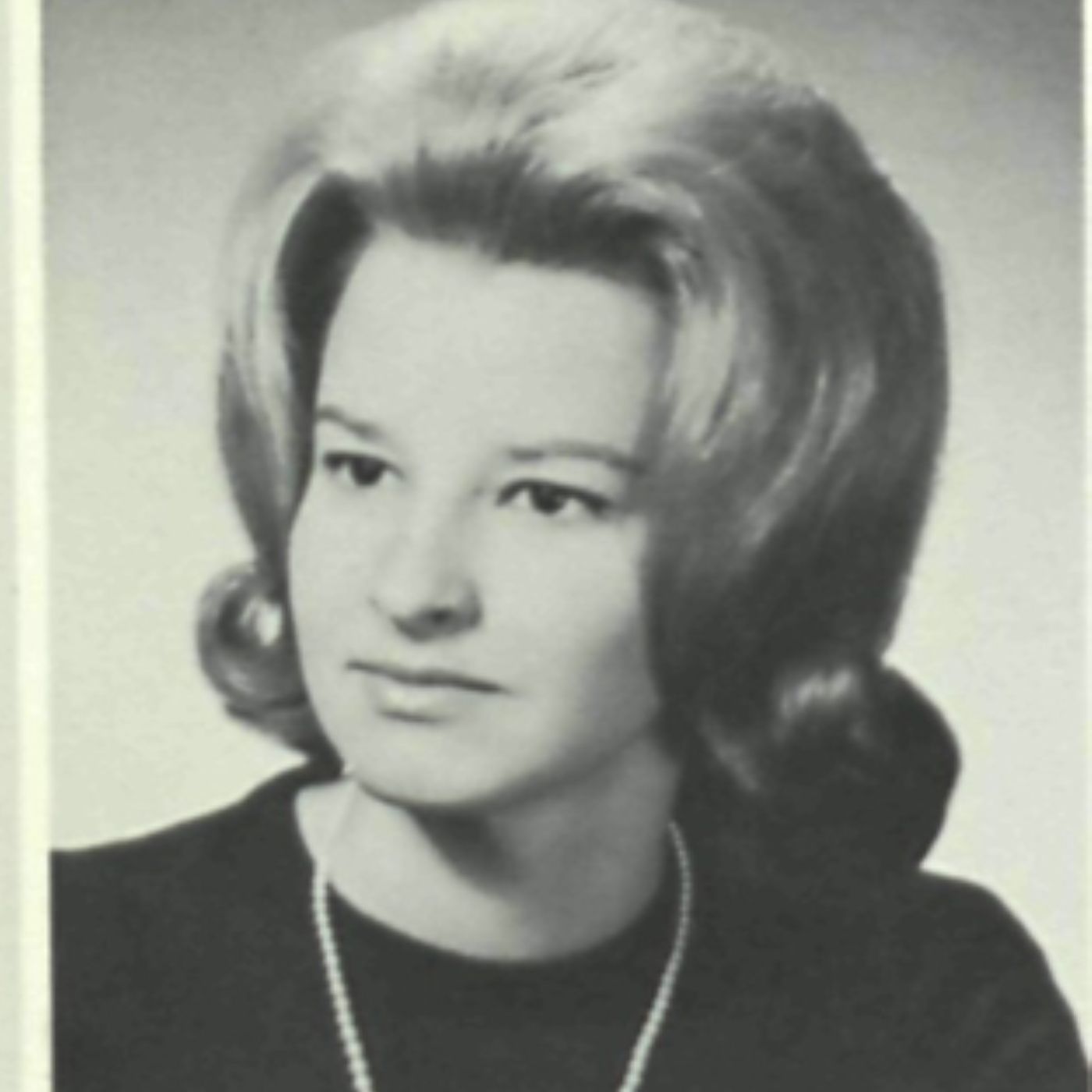
In photos, Joan is striking her hair pulled back in a Bardow ponytail in one, and in her senior portrait she dons a bob reminiscent of Jackie Kennedy.
The caption underneath her senior photo in the West Passaic yearbook says quote, Joni would like to be a secretary.
She remembers September seventh, nineteen sixty two, her first traffic ticket and Saint Benedict's senior prom Her main interests include a certain someone, stuffed animals, miniature golf, and dancing.
Her secret ambition is to spend.
Speaker 2Her honeymoon in Hawaii.
Speaker 1In quotations are the words the light that lies in Women's eyes, a line from Thomas Moore's poem The Time I've Lost in Wooing and listed as her school activities were arts, crafts, science show, pre nursing club, Spanish club, leaderts exercises, and tumbling friends described Joan as kind, quiet and stylish.
If asked where she was when John F.
Kennedy was assassinated, she could have answered simply she was a senior standing on the edge of adulthood.
By nineteen sixty eight, she was an independent young woman building a future, and on that late summer Saturday, on Labor Day weekend, she walked into the factory for a shift she would never leave.
Joan's regular workday kept her in Building one in the Marketing and Research department, But on Saturday, August thirty first, she carried a stack of punch cards across the grounds to Building thirty four on Kingsland Avenue, just one hundred feet from her desk.
She needed to feed them into a data processing machine on the second floor of the Medical Literature department.
By five point thirty that afternoon, those cars lay scattered across the floor, a reporter later describing them as strewn about like confetti.
Nearby was a site far more horrifying.
A security guard making his rounds had stumbled onto a pool of blood surrounding a body.
The clothing suggested a young woman, a niche shirt and pants, but the face was unrecognizable.
Speaker 2It was Joan.
Speaker 1Her attacker had struck her repeatedly in the back of the head with a blunt instrument, then slashed her throat and stabbed her multiple times.
One source described her face as looking like it had been pecked by a chicken.
The brutality was staggering.
This was no accident of workplace machinery.
Speaker 2This was murder.
Speaker 1The data machine beside her was still humming, switched to the on position.
Joan never had.
Speaker 2The chance to cry out, let alone escape.
The sheer size of the.
Speaker 1Hoffman Laroche complex complicated the response.
Straddling two towns and two counties, it drew in both Clifton and Nutley.
Police officers sealed off the grounds, combing through all eighty six buildings with flashlights and spotlights long after dark.
They even searched the sewers looking for any evidence.
Investigators said little about what they found, careful not to reveal too much before they had a suspect, but eventually one critical clue surfaced.
A wooden mallet identified as the weapon that crushed Joan's skull.
Dozens of such mallets were kept at the plant to break hardened chemicals from barrels.
This one had been turned into a weapon of slaughter.
Jurisdiction briefly stalled the case Clifton or Nutley, but soon it was established that jones murder had occurred on the Clifton side, putting the investigation into the hands of the Clifton Police and Passaic County authorities.
Police Chief Joseph A.
Nie released statements to the press, though his updates were vague.
That summer Clifton had already seen one workplace killing.
Just weeks earlier, forty year old Reuben Alfonsa Williams, a nursing home cook, was shot five times at his desk by his co worker and girlfriend, fifty five year old Naomi Jones.
The two had gotten into a heated argument about Reuben's supposed infidelity.
Now a second murder had shaken the community.
Doctor William van Vooren, Assistant County Medical Examiner, conducted jones autopsy.
In his many years of practice, he said he had never seen such brutality.
Joan's skull was crushed in multiple places.
Her throat was slashed so deeply the blade stopped only at her spine.
Van Vooren could not determine whether the blows or the cuts had come first, but estimated Joan had been dead for about four hours when her body was discovered, placing her murder around one thirty pm, not long after she'd clocked in.
She had not been sexually assaulted and was found fully clothed.
One detective put it bluntly, Joan had been triply killed.
Any one of her wounds.
Speaker 2Would have been fatal.
Speaker 1The headlines were jarring Clifton police hunt murderer of clerk typist.
The communities of Nutley, Clifton, and West Patterson were stunned.
A brutal murder had taken place, not in a dark alley or an isolated road, but inside the walls of one of the region's largest employers.
Joan's devastated family cooperated fully with investigators.
Her brother, Raymond, voiced what many quietly believed, that the killer.
Speaker 2Was someone Joan knew.
Speaker 1Investigators agreed the violence felt personal.
Joan did have a boyfriend, but it's uncertain if he was ever cleared as a suspect.
That general uncertainty altered the way locals went about their daily lives, locking their doors, going places in pairs, and being more vigilant.
And while law enforcement remained tight lipped during the investigation headlines like roche murder news scarce led to imaginations going wild.
For the Clifton Police and the Passaic County Prosecutor's office, the task was overwhelming.
Time cards proved that five hundred and nineteen employees punched the clock that day, including Joan.
But then there were the window cleaners, the construction workers, and contractors.
Sixteen investigators were assigned to the case, but progress was slow.
The wooden mallet that crushed Joan's skull bore no fingerprints.
Had the killer worn gloves.
The sharp weapon that slashed her throat was never recovered.
Had the killer brought it in and carried it away.
Detective Edward Snack later explained that the team looked closely at Joanes's personal and professional life.
Speaker 2We couldn't find anything bad about her, He said.
Speaker 1She was a regular working girl, just a good decent kid.
Still, investigators interviewed more than three hundred people, everyone from security guards to clerks to maintenance staff.
They ran background checks, administered polygraphs, and set up shop inside the Hoffin Laroche complex to question employees as they came and went.
Yet the more the case dragged, the louder the rumors became.
There was talk of stolen drugs, a case or even a palette of valium gone missing, had Jones stumbled upon the theft.
One former employee's family later recalled that the story of a theft circulated heavily among workers.
Many convinced that that was the motive.
Others speculated about industrial espionage.
An early official statement didn't help.
When pressed about Joan's work duties, investigators said releasing details might interfere with the investigation.
One newspaper quoted an unnamed source saying she may have quote seen something she shouldn't have, something so important it was necessary to shut her up permanently.
And then came the more salacious theories, a love triangle, an affair with her boss, even claims that she'd been coerced into working that Saturday so she could be set up.
But employees quickly dismissed that Saturday work, they explained was common at Hoffman Laroche.
Clifton police Chief Josephne tried to shut down the speculation.
He said, we have discussed theft with the authorities.
Speaker 2There have been no thefts.
We do not know the motive.
Speaker 1Assistant County Prosecutor Vincent Hall echoed him, insisting no information about espionage or stolen secrets had ever been released.
Still, whispers spread faster than facts.
Just a week after Jones's murder, word flew through town that an arrest had been made, that a suspect had been led away in handcuffs.
Prosecutors had to step in to confirm it was false.
The headline stated, simply, prosecutor denies Freeman case break.
That same week, a county psychotherapist offered his own disturbing theory, leading to the headline doctor sketch first portrait of Girl's killer.
Based on the ferocity of Jones's wounds and the app sense of sexual assault, he suggested the killer may have been sexually attracted to Joan, but impotent, acting outrage born of frustration or rejection.
It was also probable that he was a psychotic individual.
What was clear to both police and public alike was that Jones's murder was driven by anger, resentment, something deeply personal.
Speaker 2Many assumed it.
Speaker 1Had to be a coworker, after all, who else would nowhere to find her on a Saturday afternoon inside a secure facility.
But by spring of nineteen sixty nine, investigators publicly walked that back, noting that the grounds were large enough for anyone to walk in, which meant Jones' killer might just as easily have come from outside the plant, possibly someone she knew from her personal life.
Either way, the effect was chilling.
A young woman had been slaughtered in broad daylight, and for the people of Clifton, Nutley and beyond, a single question remained, was her killer walking among them?
Three months after jones murder, in December of nineteen sixty eight, Assistant Prosecutor Vincent Paul announced detectives were packing up their command post at Hoffman Laroche.
The campus had been scoured, searched, and studied.
Now the work would continue from the prosecutor's office in Patterson, and soon a grand jury would hear the case.
In January of nineteen sixty nine, Prosecutor John Favos went a step further.
From then on, He said every sudden death in Passaic County would be presented to a grand jury after the local investigation.
That meant Jones' case was officially moving into the courtroom, even without a suspect.
So what did that mean?
Here's where prosecutors in New Jersey had a tool that kept a case and hope alive.
It's called a John Doe indictment, and instead of charging a named person, they could indict an unknown suspect described by the details investigators had at the time.
The goal wasn't to solve the case on the spot, but to preserve the evidence and lock it into the legal system.
That way, if the killer was ever identified five years later or even fifty, the indictment could be updated and the case could move forward.
Today, most people associate John Doe indictments with the DNA era, when prosecutors indicted John Doe defined only by his genetic profile, waiting for the database to produce a match.
But in nineteen sixty nine, Passaic County used the same strategy in Joan Freeman's case, even without a name.
They were trying to leave the door open for justice.
Over the winter and spring of that year, more than two hundred people testified before the grand jury.
Detectives, Hoffman, Laroche, employees, Joan's friends, including her best friend Lauren Garrett.
Vincent Hull presented the evidence, mapping out Jones' movements in the weeks before her murder.
Piece by piece, he laid out her story before the jurors.
On May twenty seventh, nineteen sixty nine, the grand jury returned an indictment of John Doe.
The document was handed to a superior court judge in Patterson, and the jury was dismissed.
Hull reminded reporters that there was still no suspects strong enough to charge, but the indictment meant the case was alive, held open in the eyes of the law.
Was this a breakthrough or simply a way to keep a terrible crime from fading into silence.
In April nineteen sixty nine, newspapers reported that three new Jersey murders might be connected.
The first went back to September twenty fourth five, when eighteen year old Alice Jean Eberhardt returned to her home in Fair Lawn.
She just left the nursing school she was enrolled at to attend her aunt's funeral.
Someone was waiting inside her house.
Speculation was that they'd been waiting behind a bedroom door.
Alice was attacked in her bedroom, stabbed sixty one times, her skull fractured.
The front door had been left unlocked, as it usually was.
Her father, Ross arrived home about two hours later and discovered Alice on the living room floor.
The knife was still lodged in her throat.
Fast forward to February fourth, nineteen sixty nine, twenty year old Linda Messier pulled her car into the garage of her Pequinock home just before three am.
As she stepped out, a man rushed her, slashing her arm.
Linda screamed for help, waking her father, forty six year old Alexander Messi.
He ran to protect his daughter, fighting off the attacker, but was stabbed to death in the struggle.
Linda survived and the assailant fled.
Never identified, witnesses described him as a white man in his forties, about six feet tall, two hundred pounds, with receding brown hair, wearing a waist length jacket with a V shaped neckline.
And then there was Joan Freeman.
Investigators noted that Joan, Alice, and Linda all frequented the same four lounges in Patterson, New Jersey.
The connections didn't end there.
The Eberhart and Messier families had once lived just a block and a half apart in fair Lawn.
When the Messiers moved to Totoa in nineteen fifty seven, Linda wound up at the same high school as Joan one great apart sharing mutual friends.
One of those friends was a boyfriend of Linda's, whom Joan tutored later.
Joan's family lived only a half mile from the beauty salon where Linda worked.
Just a week after Alexander Messier's murder, Linda's boyfriend was approached by a stranger who matched the suspect's description.
The man stepped out of his car, started to speak, then changed his mind and got back in and drove away.
Who was he and why did he back off?
To this day, the murders of Alice Eberhardt, Alexander Messier, and Joan Freeman remain unsolved.
The amount of secrecy surrounding Joan's case was said to be unusual back in nineteen sixty eight, and so many questions still remain.
If Joan really was scheduled to work that Saturday, why didn't anyone notice her absence between one point thirty in the afternoon and the discovery of her body four hours later.
Was she even on the schedule that day?
And what was the urge in working on a holiday weekend.
Who gave her the assignment to feed the cards into the machine, and what exactly was she working on, why the secrecy did she check in with anyone upon her arrival, and how close was the nearest employee who might have heard something if it was possible to just walk into any of the buildings in the complex, what exactly was the job of security that day?
And does her killer appear in the video footage recorded by Lieutenant Kohler on the day of Jones's funeral.
The answers, if they exist, are buried in the files from the three month long grand jury proceedings of nineteen sixty nine.
Statistically, when women are killed at work, the perpetrator is often an intimate partner, but Jones's case has never fit neatly into that pattern, which leaves room for another possibility, one that casts a wider, darker shadow over New Jersey in the late nineteen sixties, because at the very same time Joan was killed, another predator was prowling the region.
Richard Cottingham, the so called Torso Killer, would later confess to more than a dozen murders in New Jersey alone.
Could Joan Freeman have been among his early victims.
Some experts think it's possible Cottingham himself, who's living out his final days in a New Jersey state prison, denies it, saying he'd never walk into a random, unfamiliar building to find his next victim, and in a future episode we'll explore that angle more closely.
Speaker 2Stay tuned for now.
Speaker 1What we do know is this, when detectives revisited Joan's case in two thousand and five, they leaned in a different direction.
Given the high security at Hoffman Laroche, investigators were convinced her killer was most likely a co worker.
Yet even with that renewed focus, no one has ever been charged.
There been a number of similar cases where a woman was killed by a coworker while at the workplace.
Twenty six year old Caroline Bington went home on her lunch break in twenty nineteen to her apartment in Plainsborough, New Jersey.
She interrupted a coworker, Kenneth Sall, who had broken in to install a camera in which she could watch Carolyn without her knowledge, he had already installed cameras outside her apartment, and his obsession escalated.
He murdered Carolyn in her own home that day, and a wellness check was initiated when she didn't return to work.
In twenty twenty four, Tamara Colazzo walked out of her office at Allegiance Trucks outside Dallas, Texas to have lunch in her car.
When she returned to her desk, coworker Travis Merrill shot her five times with the revolver he'd retrieved from his car.
Merril had reportedly become obsessed with watching Tamara on her lunch breaks was frustrated that she didn't pay him the attention he craved.
Tamara had reported him to each other.
Just this year, thirty nine year old Jennifer Harris, manager of McDonald's in East Point, Michigan, was stabbed to death by an employee that she had sent home early.
Twenty seven year old Alfini Muhammad returned to the McDonald's.
Speaker 2Later that day armed with a knife.
Speaker 1We see examples of obsession in the workplace leading to violence cases of violence being the answer to conflict.
Common triggers are revenge for perceived injustice, unwanted romantic interest, or sexual harassment disputes.
Studies show that women are almost three times more likely than men to be murdered on the job, and for women, they're more likely to be killed by someone they know while men are more likely to be killed by strangers.
What will it take to close out jones case today?
I suppose it depends on what if any of the crime scene evidence was preserved.
It's possible that her killer cut himself while stabbing the twenty two year old to death, opens up the possibility of two types of blood being collected.
Another possibility is under Jones's fingernails.
But most of all, what it takes is the willingness for detectives or a cold case squad to take another look.
With thousands of unsolved cases in New Jersey, it seems an impossible task, but I don't intend to stop advocating for their closure.
Joan Freeman never had the chance to honeymoon in Hawaii, A life unfinished and gone too soon.
Joan Freeman's parents are both deceased.
Her father, Bertram passed away in nineteen ninety and his wife Carolyn in twenty ten.
All three are buried in Glendale Cemetery in Bloomfield, New Jersey.
Speaker 2If you have any.
Speaker 1Information about the murder of Joan Freeman, please contact the Clifton Police Department at nine seven three four seven zero five nine zero eight to submit information about the murder of Alexander Messi, contact the Morris County Prosecutor's Office at nine seven three two eight five six two zero zero.
To submit tips about the murder of Alice Eberhart, contact the Fair Lawn Police Department at two oh one seven nine four five four one zero.
Speaker 2Thank you so much for listening.
Speaker 1Method and Madness is a completely independent podcast, written, produced and hosted by me.
Speaker 2To find out more about the show, including access to all episodes.
Speaker 1Visit Method and Madness podcast dot com.
To support the show, consider leaving a rating or a review, and.
Speaker 2To connect them on Instagram at Method and Madness Pod.
Speaker 1You can find me on TikTok and Facebook as well.
To chat, suggest a case, or to discuss the episode.
Reach out to me at Method and Madness Pod at gmail dot com.
Speaker 2That's it for this week.
Until next time, take care of yourself.
Speaker 1You matter for christis support Text Hello to seven four one seven four one