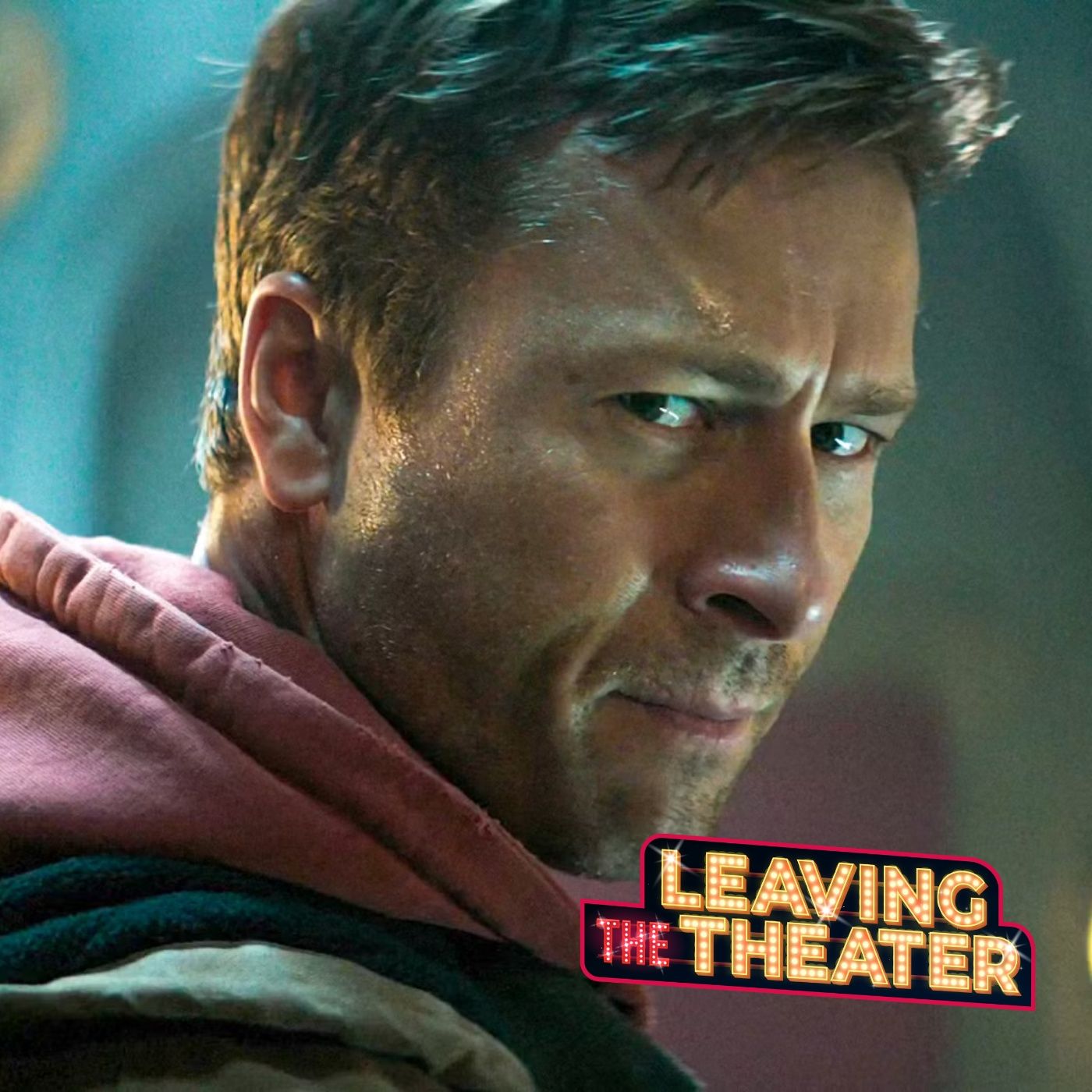
The Running Man
Episode Transcript
In the dystopian future.
Inflation has skyrocketed, and there are both jobs and housing crises.
Rich folks are consuming every bit of wealth they can lay their eyes on, and the only hope the common man has is in their ability to create engaging content.
Am I talking about right here and right now in real life?
Yes, but I'm also talking about The Running Man.
I'm Ronald Young Junior, and I'm leaving the theater.
Speaker 2All right.
Speaker 1This is Ronald and I am leaving the theater after seeing The Running Man.
The Running Man written by Michael Bacali and Edgar Wright, directed by Edgar Wright, starring Glenn Powell, William h Macy, Lee Pace, Michael Sarah, Amelia Jones, Daniel Ezra, Jamie Lawson, Sean Hayes, Coleman Domingo, and Josh Brolynn.
And for complete cast listing, you can go to the link in our show notes.
It is just me today.
Those of you who are Patreon members, you will have already listened to the On the Couch episode where I reviewed The Running Man, which came out I believe in nineteen eighty one, eighty two, eighty three, eighty four, eighty seven.
Speaker 2I think it was nineteen eighty seven.
Speaker 1As a matter of fact, if you look in your feeds right now, you could probably see if you're not a Patreon member, you could probably see a locked episode of On the Couch entitled The Running Man nineteen eighty something on there with the picture of Arnold Schwarzenegger.
It is a adaptation of the Stephen King novel from nineteen eighty one.
So this is a remake of the original film, and I'm sure it's also drawing from the source material as well.
Speaker 2So this is the.
Speaker 1Second adaptation of the novel, and I'm sure it's drawing some inspiration from the nineteen eighty seven or eighty six movie as well.
So in this one, Glenn Powell is not His name is Ben Richards, and he is not a police officer or former military member at all.
They are still in a dystopian future where people are very broke, very poor, wages are very low, and the only way to get real money is to do these humiliating games in front of everyone that are really meant to motivate people and make people think they have a chance.
And Ben Richards has a wife and daughter who is ill.
The daughter is ill, so he is forced to become a part of this capitalistic intention, and of course he becomes the titular running man.
Watching this film, it is at times a very scathing rebuke of capitalism.
But I also think that it's it's a little bit messy and a little bit shaggy, and because it's a big budget film, there's stuff that it simply.
Speaker 2Will not do.
Speaker 1It will allude to a revolution.
It will have people who would be considered to be revolutionaries, but they're kind of painted with broad strokes in some ways, they're not necessarily as nuanced as you would expect them to be.
There's more than one voice that is talking about the resistance against the Network, which is what they're called NCG, which is now kind of the governing body of the United States.
There is a president, and I believe that president is intended to be Arnold Schwarzenegger, which is a wink and smile to the original film.
He is listed on the money infliction is out of control.
People just don't have what they need.
So these revolutionaries are pushing up against the idea of the Network, and for me, those were the more interesting parts of the film.
There is a you know, Ben Richards is married to a black woman.
He has a black child, which I have some thoughts about, especially in this dystopian future, especially with the role of black people in this film.
Colman Domingo is a showman who's kind of in the host of The Running Man, the television show, and Josh Brolin is the network executive.
Coleman Domingo again is the host.
Then you know, you have Ben Richards who has a black wife and he is then at some point assisted on the streets by a family of black folks.
And there's this role of black people in the film, which is I'm I'm curious as to what it is and what it means in terms of the future.
And again you're always going to hear me point this out.
When you make these casting choices, you have to consider what role race plays in the universe that is established by the film, but also what that says to a viewer who is not living in the universe established by the film, meaning that me, a black man watching this is going to have opinions about what Coleman Domingo thinks and what is survival to him in this world?
What is race in this world?
What does it look like?
Who actually has the power?
If that never comes up as a part of the plot.
Then you end up with a film in which I see black folks doing things, but I'm curious as to what they think of themselves and kind of the people around them.
If you turn this into kind of just well, this is rich versus poor, which I actually believe that to be true, I still want to know if there's any commentary where it's gotten so bad that we actually have gone post racial in this society.
But that's not something that's examined.
It's more been Richards that is examined.
And he has this motivation where he's just like, I got to get back to my family.
I got to get back to my family, which is it's fine, but it makes his intentions and his character development a little more shallow than I would expect for it to be.
And the reason why I think that's important is because I think if this person is going to be a spark that lights a revolutionary fuse, as the movie tends to be pushing him to do, then I really want more realizations from him about the world that he's living in in a way that is, I mean, at times felt messy, ham fisted, other times maybe more overt especially because Okay, so one of the family, the Black family that assists him, one of those characters is basically what we would now know as a YouTube conspiracy theorist, but he's definitely right about how the show The Running Man is ran, what that means for Ben Richards, and how the network is going to operate with him.
Speaker 2So a ways into the movie, we.
Speaker 1Start to realize that this interaction between the network and between Ben is one that is mostly beneficial to the network.
And the reason why that's important to note is because at some point when we start examining that, I thought there was an opportunity for the movie to do something very very interesting with regards to where we are in the real world in twenty twenty five, and it walks right up to the line of basically talking about control and programming and what it looks like for the government to be involved, and what it looks like for folks to use what we consider to be entertainment to actually control us, and what it looks like to whip a bloodthirsty mob who is desperate into a frenzy.
And I think there was a couple of moments in here where people who are also being oppressed by the network might have joined together and turned against the network as a unit.
And there's one or two people in particular who kind of work for the network that I feel like at some point would say, oh, yeah, well, we should definitely stop doing this and work together against the network.
But that's not what happens.
And there's a sense of realism to that.
And the only way I can attach it is to say, I'm looking at ICE officers and not totally understanding their motivation Right now, I don't understand why you would continue to do this job.
It's dangerous for you, it is not something that can last forever.
And you're the bad guy.
You are the bad guy, no matter what you tell yourself.
As history continues to grind forward, you will be exposed as the bad guy.
But this movie is making a more overt claim about these bad guys in the film, and for me, unless all of their lives are under threat, unless all of their families are under the gun, they just can't convince me that this is something that they would continue to do.
But I guess when I think about the fact that ICE is continuing to do what it does, maybe the movie has some sort of a point.
I think that the Ben Richards character is Glenn Powell does the best job that he can.
I really appreciate what the movie is doing, and probably the first third of the film.
Over the course of the rest of the film, my enthusiasm for it wane.
I think that this has the same issue I had with Good Fortune in the ending, which is I expected to hear about more collaboration and more community towards the end, and there's a hint towards that, But again, because the focus is about Ben Richards getting back to his wife and child, you end up with this kind of very individualistic mission for this white man to do.
And it's important for me to mention that he's a white man because this self actualization and this individualism is something that is endorsed by white men.
The idea of the meritocracy, all of that is endorsed by white men.
That one man could come and change everything is endorsed by white men, but there's never this idea of everyone coming together.
Again, he meets with these black folks who are assisting him, and there's more than one of them, and their work together to help him.
Speaker 2However, at some.
Speaker 1Point he meets with a white dude who is also assisting him, and that white dude is not only working on his own.
He insists that Ben is the spark that can light the flame of the revolution.
And I just don't think that messaging is one that we need to continue hearing in twenty twenty five.
I still think that filmmakers need to think about community.
And the folks who were talking about community in here were the black people.
Or at some point there is a black character that is working for the network who turns to the network heads and says, Hey, my job's over here because you've lost the crowd, so I'll see you later.
I guess my only point is this movie is attempting to engage with some pretty big ideas, but because it is a Hollywood film with the budget, it ends up kind of nerfing those ideas and not necessarily have courage.
I think films like this should have courage.
I think filmmakers need to have courage.
I was walking out of the theater and Linda Holmes told me the original ending to this film, and the original ending to this film is based on a novel by Stephen King.
I'm sorry, it's not the original ending to the film.
It's how the book actually ended, and when I heard how the book ended, it's very bleak.
But a blaque ending is not a disqualifying one for me personally.
So I guess my point here is I wanted this movie to do more.
The movie itself was fine.
I think it's shaggy.
I think it has pacing issues.
I don't know if i'd want to watch this again.
I wouldn't say that I had a good time.
I think there were several times in which I would have loved for them the show Ben Richards being more crafty or having more agency, but he's kind of just shuffled along.
I don't think he does anything clever enough to stop himself from being killed.
Speaker 2I think.
Speaker 1There are instances in the movie where I think maybe he could have he could have been pointing to something clever, or he could have done something clever, but really he was just assisted by someone else doing something.
He really is just a cog in the wheel.
And if that's the intention of Edgar Wright to just say, hey, if you watch this movie closely, there are really few decisions that Ben Richards makes on his own accord that actually get him to his destination.
And when I think about that, then It makes me say, Okay, if this is done with intention, then yeah, this is a way better movie, because now this band has been fooled into thinking that he can do something on his own, but it turns out he's been assisted the whole time.
If that's the conceit of the movie, then yes, I get it.
However, if that's not the conceit of the movie, then why would I want to watch this again.
He's not like making homemade bombs and planning him somewhere and blowing up people.
And he's not rigging a house.
Someone else's rigging house.
He's not rigging a house and killing people.
He's kind of just moving along.
He doesn't have any real Everything that he does that's good in this movie is set up by somebody else, or offered to him, or given to him by somebody else.
With all of that being said, I think this is a three star movie.
I would not watch it again, but I'm sure somebody will.
It's not too long.
I think it's just over two hours.
It probably could have been a little shorter.
I didn't really enjoy it, but I liked it better than The Long Walk and a couple of other things I've seen recently, I can't remember what I Bogonia definitely better than Bogonia, not better than Predator bad Lands, sorry, Perdator bad Lands.
Not better than that, but it was all right.
I'll give it three stars and with that leaving the theater is a production of Oh It's Big Ron Studios.
I mixed this episode and by the time listening to this, this one should come out on time.
This one should come out on Monday if I'm smart, because I'm recording this on Monday, and I should be cutting this on Wednesday to give myself a break, because I keep putting myself in a very tough Sunday situation the last couple of weeks because I've been traveling, which means last week's Bogonia didn't come out till Wednesday, and no two weeks ago is Wednesday didn't come out till Wednesday, and then last week's Predator Badlins didn't come out until Tuesday.
So I should be you can see I'm slowly working my way back.
But it's just me, y'all, and I'm doing a very, very I think, good job consistently delivering these episodes from week to week.
It is an easy job.
I'm watching a movie and then recording it, but I also have to edit it.
I also have to think about the Patreon offerings.
I also have to think about ads.
Now I'm putting ads in, and for those of you that are listening to this on anything else rather than Patreon, then you're probably hearing ads.
But I still have to work out where those go and make sure they're optimized and spreaker as I post them.
It's a lot of work.
It's a labor of love, but it's still labor.
There are offerings in the Patreon.
There is the ad free feed, there's I don't like that, there's on the Couch, which is a video podcast.
Now I'm working it out and I'm trying to move forward.
So if that's important to you, and you're like, you know what, let me give Ronald five to seven of my hard earned dollars.
Actually I think the lowest is seven.
Let me give Ronald seven of my hard earned dollars a month.
If that's important to you, please give me seven of your harder dollars a month, is what I'm saying.
You can go to patreon dot com, slash even the Theater, or go to the link in our show notes, show art from Heather Wilder.
Theme music by the mysterious Breakmaster Cylinder.
For more information about The Running Man, check out our show notes.
You can follow me on Instagram Blue Sky, TikTok, Threads or letterboxed at Owens Big Ron.
Speaker 2That's at O H I T S b I g R O N.
Speaker 1You can find out more about this show and other od's Big Ron Studio shows by following us on Instagram at o its Big Bron Studios.
Leaving the theater will be back soon.
Speaker 2Thanks for listening.