·E847
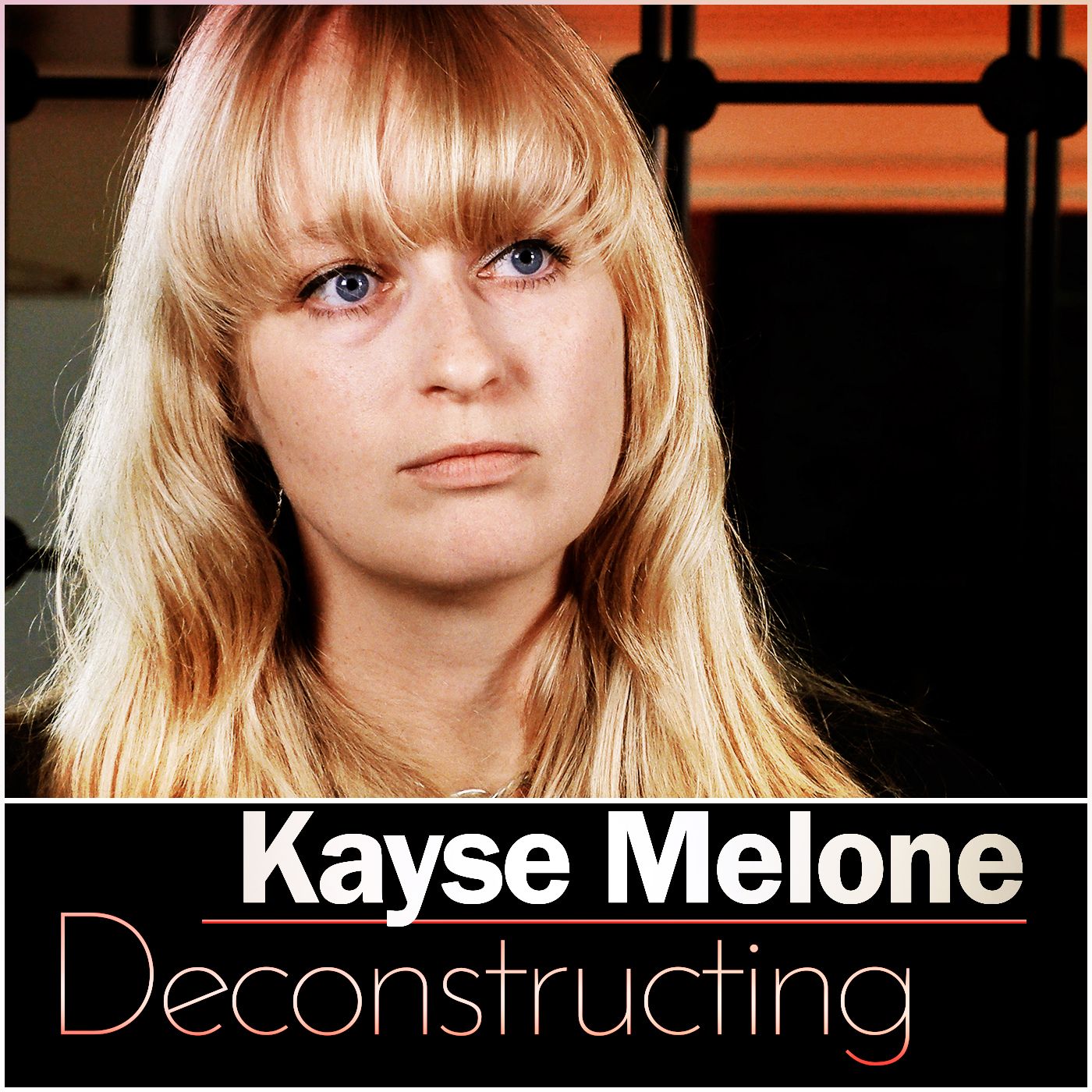
Kayse Melone: Deconstructing
Episode Transcript
The Thinking Atheist.
It's not a person, it's a symbol, an idea.
Speaker 2The population of atheists this country is going through the.
Speaker 1Rule, rejecting faith, pursuing knowledge, challenging the sacred.
If I tell the truth, it's because I tell the truth, not because I put my hand on a book and made a wish and working together for a more rational world.
Speaker 2Take the risk of thinking.
Feel so much more happiness.
Truth, Fusian wisdom will come to you that way.
Speaker 1Assume nothing, question everything, and start thinking.
This is the Thinking Atheist podcast hosted by Seth Andrews.
Speaker 2Okay, is there something suddenly in the drinking water in my hometown of Tulsa, Oklahoma?
I mean, I was born here, I've lived here.
It's just what it is.
It is whitebread, corn fed, red state conservative, maga Jesus town, Oklahoma.
Right.
And then I find out a few years ago Forrest Valcai lives about twenty minutes from me, and we become friends and brothers in a way.
We're going to actually be at a live event coming up in March of next year.
And then somebody brings to my attention another ex vangelical activist.
Her name is Casey Malone, Kays Malone, Elne Well.
I had never heard of Casey Malone, and the listener was like, Oh, you got to have this conversation.
She's terrific.
So I browsed the YouTube channel, and there is a ton of information, videos, content, etc.
That's been hidden in plain sight, right in front of my face, and I missed it.
So I spent a bunch of time browsing her content.
She's got videos debunking Christian morality and quote unquote Western civilization.
She does commentary about the Christian nationalism pipeline to fascism, how evangelical Christianity is helping to ruin the United States, Christianity and the climate, how faith is actually a tool of control, an atheist take on the Catholic Church, an atheist take on islamaphobia growing up in a megachurch.
Lots of stuff on Christian Zionism, which we spoke about in a conversation a few weeks ago.
Right here on the podcast, well I asked, Casey, would you like to sit down on camera and let me do I call it a profile or a video essay, and it's kind of a produced piece.
The final edit I think came out to about sixteen seventeen minutes where she sat down.
I actually put a video set together in my living room and she came by and we had a chat.
We actually talked for forty five minutes.
But the video version is kind of edited down in streamline that is linked in the description box.
It is available to watch on YouTube, but for you, I wanted to provide kind of the raw interview, the whole freaking thing, which is twice the length, and it's interesting stuff.
My conversation with ex vangelical and humanist activist Casey Malone and I began with a question about the origins of her faith, kind of the Genesis chapter one of growing up in a Christian home.
Speaker 3I was raised in an evangelical, fundamentalist Christian household, school and church, so that was here in Tulsa, Oklahoma.
I went to a very Bible based private high school affiliated with a megachurch.
And it was not just an act for me.
I believed very deeply, all the way down, all of the layers of belief.
I believed everything I was told, you know, especially when it's reinforced in the household, it's kind of hard to escape the reality that is presented to you until essentially when I went off to university in another state.
That opened up a little bit more opportunities for my perception to expand.
But up until then, I had no questions, I had no doubts.
It all made sense, all of the scriptures that were taught to me, not just weekly on Sunday sermons, but in the daily Bible classes that were required for my education.
It was easy to piece it all together.
It was easy to never question.
Everyone around you is believing the same thing.
And I remember walking away and it felt like I was completely reidentifying.
I mean, that's what the process is, right.
Speaker 2How literal were you?
How fundy were you in your words?
Speaker 3So I use the term fundamentalist with the definition of the literal interpretation of the Bible as the infallible and unquestioned word of God.
So that does lead to a creationist worldview.
Six thousand year old Earth.
The iteration of my upbringings denomination.
Technically we were non denominational, but of course that's a denomination.
Our megachurch and therefore school also promoted the Armageddon interpretation of the Book of Revelation, which definitely came into play.
There was always an anxiety about the end of the world.
Every year, we would you know, pull out the lawn chairs and sit in the front yard waiting for the rapture.
I mean it was all very fundamentally yeah, really literal.
Yeah.
Speaker 2What prompted that?
Was there a date, like a save the date it may happen today, or was it just a random Hey, let's go out and wait for God and the trumpet.
Speaker 3So according to the theology that we were taught, the offshoot of Christianity from the original religion of Judaism, right, well, they have seven yearly feasts and the specific feasts line up with biblical events.
This was reverse engineered, of course.
So for example, Passover is a Jewish feast kind of celebrating the liberation of the Israelites from Egyptian slavery.
This was all taught to me.
Again, I'm not a Jewish scholar.
But then when Jesus died on the cross, this was supposed to be the biblical fulfillment of that Jewish feast.
So that's one example of the seven.
While the first three Jewish feasts throughout the year, according to Christian theology, have been fulfilled, and then the next one, the first autumn feast that Christian theology says is going to be fulfilled is the feast of trumpets, which is reverse engineered and considered to be the rapture.
So every year when the Jewish Feast of Trumpets was coming around, that's when these evangelical Christians in Tulsa, Oklahoma and throughout the United States would sit, you know again on their front porch, waiting for the rapture.
And this is why recently when the Jewish Feast of Trumpets was coming around, there was that rapture panic pretty much every autumn.
So that's why we see that there is actual theological backing behind it.
Speaker 2Were your parents weird, nervous, afraid of public school?
Speaker 3I think there was an anxiety about public school on behalf of my parents.
But I also this is something I talk a lot about on my platform.
I think there is a very weird tension when you start to deconstruct or you do deconvert.
There's this anger, totally valid anger of feeling like we've been lied to our whole lives and manipulated our whole lives.
But then when we get into it, for example, me looking at my parents, I know they weren't actively lying to me.
I know, they weren't actively trying to raise me in a harmful environment.
They were actually just doing their best.
And so that's a weird tension because I still feel like I've been lied to, but I don't blame that, if that makes sense.
So they did have an anxiety about public school and the secular world and modernization, a lot of those themes that we see as fears presented in evangelical culture.
For sure, I.
Speaker 2Feel the same way.
The religion was a lie.
My parents were not liars, correct, And that's weird for some people to try to process, right.
My anger was more about boundaries totally.
Once I left, was yours a culture of shame being a female in this space.
Can you talk about growing up as a woman in a fundy faith?
Speaker 3Sure, so it's easy to use the terms patriarchal Abrahamic faiths when we're talking about Christianity.
That is accurate when we get down to the lived experiences of women raised in an evangelical fundamentalist church.
There are a lot more layers that I think are important to point out.
For example, the simple fact of gendering the creator of the known universe that does set up a psychological aspect of little girls in Sunday school manhood or masculinity with divinity, and there will just constantly be a hierarchy associated with that moving forward throughout the rest of our lives.
The resulting culture from those kinds of mentalities, the he hymn of Divinity itself, the Hehmn of Jesus, all of that results in a differential treatment once we get into say, adolescence and what it looked like in the environment I was raised in, definitely boys and girls were treated differently and purity culture.
I am not the expert on purity culture, but having lived through it, I can tell you it affected the both boys and girls, but it affected girls in such a way that I think the damage is a little bit more longer lasting.
Now there is, of course the argument like purity culture results for the boys who are taught, don't worry about you know, there's no culture of consent, there's no culture of Maybe that's not true obviously, I'm not, you know, jaded at all, but I just think, for EXAs example, whenever we had the talk in chapel during high school, they would split up the boys and the girls and they would give us different messages about how to navigate hormones and adolescents and dating and all of these different things.
Obviously, abstinence was just the only possible avenue for any of us to take.
But the way they presented abstinence to boys was to resist temptation.
The way they presented abstinence to girls was it's your job to make sure that the boys resist temptation.
And so in that way, the girls were kind of pulling double responsibility in managing their own attire for the sake of the boy's attention, in being responsible for any sin.
I mean, this even gets into Adam and Eve, who is the sinner?
Speaker 2There?
Speaker 3Eve ate the apples, she is considered the first sinner.
Now there's all different kinds of theological arguments.
Well, Eve didn't know any better.
Adam was actually the first sent and you can interpret it a million different ways.
But really what we see when we do these theological interpretations of scripture like that, are you still using your reverse engineering your arguments and these scriptures so that they hold up to whatever moral or ethical or logical point you're trying to make.
And in that sense, the question is, did we really need the scripture in the first place if that was the stance you were going to take.
So yeah, I mean, the culture of shame really did go deep.
The culture of responsibility for sexuality was just solely on the girls in the environment I was raised in, and I think really so, I graduated top of my class of the private high school I went to, and I'll never forget that on graduation night when I gave a wonderful valedictorian speech, got a standing ovation.
It's not a big deal.
Obviously I didn't peak in high school.
But I'll never forget how many people came up to my dad, who's kind of walking around in the after you know, the afterwards ceremony, and told him he's going to make a great two options pastor's wife or English teacher.
That's what I was told on graduation night.
So that's another example of the differentiation between boys and girls, because that just would not have been the case for a boy who was the valedictorian.
So examples like that are certainly a lot.
They hit a little bit closer to home when we're talking about the lived experiences of women being raised in the church, and it's a little bit heartbreaking to see a lot of the girlfriends that I grew up with and loved so much.
They are adults now kind of doing all of these mental gymnastics to explain why it's important for them to submit to their husbands and why it's important to let him lead.
And I'm just kind of watching and sitting here and supporting them as women.
But it's tricky to navigate, I'll admit it.
Speaker 2Tell me about the seeds of doubt.
When did you start hearing a tiny ping?
Speaker 3I was always a reader.
I read C.
S.
Lewis and AW Tosar and a lot of other kind of more in depth theologians starting in high school.
I was very curious and very studious that I brought with me when I went off to public university in a different state, outside of that bubble in which I was raised.
So originally I started taking religious studies courses at university for the sake of proving the validity of the Bible.
Right that was my original intention.
And as a result, of course, I kind of got knocked around a little bit with a lot of the ideas that were presented to me, and was a lot more difficult to prove the validity of the Bible than I expected.
So as a lot of people in the deconstruction space talk about, I really considered deconstruction a journey, not a destination.
I'm still deconstructing aspects of evangelical upbringing and that mindset that I was raised with.
But I did have a capital M moment, and that happened when I was reading Lewis and ein Rand simultaneously.
Now, neither one of their actual ideologies do I really align with, But what really happened was I was seeing how these two very different authors were infusing their fiction works with their own ideologies.
And that's what did it for me, was realizing that authors always have an agenda, and so that kind of kicked my brain into gear.
I had already been kind of confused about the Bible, and obviously I didn't have my home church anymore, so the community aspect of traditional evangelical culture I was lacking as well.
I had tried to go to a church in the New State where I was going, but it just didn't feel right and nothing would ever replace the friends I made growing up.
So there were a lot of different factors that played into it.
But once I realized that writers and authors always have there at the very least their own personal biases when they're writing something.
The validity of the Bible broke down.
So again, it's not that I was super persuaded by Rander Lewis.
It was that I saw that they were infusing their ideology, and to me, that was the thread that was like the through line of my entire belief system, was the validity of the Bible.
Again going back to being a fundamentalist.
So once I realized that this book had been translated thousands of times for thousands of different reasons and used for thousands of different ways, it just kind of broke down the rest.
I mean, that was the pillar on which the rest of my faith was resting.
And so that started the process.
I remember walking through campus and looking around and realizing is really what it was a realization that I was not a Christian anymore?
And I knew nothing.
I didn't know what to wear the next day.
I didn't know why I was brushing my teeth, I didn't know why anything, what, anything, who anything?
Speaker 2Did you confide in anybody about all this or was it always just buried.
Speaker 3The deconversion part.
Yeah, I think my friends at university weren't as evangelical as I was, they were probably what we would call cultural Christians, and so I didn't really talk to them other than maybe a single conversation of I don't think I feel like I need to go to church anymore.
And they had already not really been going to church, so they were fairly supportive.
And because they weren't raised in such a high control environment, I don't think they ever really understood I guess why I was the way I was, so they were just kind of like, okay.
And there were certainly other points along the deconstruction journey when you know, maybe I would go home for the holidays and have to come face to face with my parents and tell them I'm not a Christian anymore.
Or my old high school friends who slowly but surely started to kind of wean me out of their circles, you know, blocking me on social media, only to unblock me a decade later when they left the faith.
So that's been interesting.
But I was certainly the first one in my friend group who not only believed the evangelical faith so fully but walked away from it.
So that was lonely.
Speaker 2That's a tough conversation with mom and dad they freak out.
Speaker 3My dad struggled.
My dad struggled.
My mom has been more supportive and understanding, but my dad really closely identifies with his faith, and I don't think he has been able to come to terms with my own realization of my own journey without it being kind of an affront to his own.
Speaker 2Or that, Hey, he trained up a child.
What went wrong that I failed?
Did she fail?
Speaker 3Yeah?
I think he considers it his personal responsibility.
Speaker 2You know.
Speaker 3I don't want to speak for him, but I think he takes it personally that I walked away and again he did his best.
You know, I don't blame my parents.
Speaker 2In the last half of my conversation with Casey Malone, I want to talk talk about identity.
I want to talk about her inbox.
She's got Christians, she's got some creeps, and she's got some other folks who have sincere questions, and she talks a lot about that and more.
In just a second hang on before I get into the final twenty minutes twenty five minutes of my conversation with Casey Malone, I want to mention again that I've been given the honor of joining a wonderful nonprofit called the Creator Accountability Network.
Now I'm not on the staff, I actually signed up as a content creator.
I want to kind of lead by example.
Here can does this.
They are dedicated to trying to reduce harassment and abuse, whether it's in the online space or maybe in person.
Somebody feels like they have been slighted or harmed or abused in some way, and maybe in the past they got frustrated because they didn't feel like or was anybody they could tell, there was no path forward to try to inform the content creator and educate them on what the hell was wrong and how do we find restoration perhaps even build off of that encounter.
Not always possible, not always possible, but I'm convinced that a lot of times when somebody feels slighted or insulted, or you know, they get creeped out or whatever, a lot of times there is simply a misunderstanding, a lack of education.
Maybe the person is clueless as to what they did or said, and they simply need to be educated.
And I am all about de escalation whenever possible.
So you can go to Creator Accountabilitynetwork dot org and they can help to make it right.
De Escalation take a breath, Let's find out what happened, Let's educate each other, and let's see if there might be an opportunity to move forward and heal.
That is my kind of party.
CAN is also on the hunt for volunteers from communities who can help.
So if you've got a skill or you've got time desire, you can go to Creator Accountabilitynetwork dot org to find out about volunteer opportunities.
And then, if you are a content creator, are you no one who would like to also lead by example?
They can go to that same website to help us build safer communities together.
Okay, let's continue the long form audio version of my recent interview with ex evangelical Casey Malone.
Tell me about identity.
Now, you've emerged from the faith which informed your view of everything, So now.
Speaker 3What you know.
Part of the reason I really started showing up online this year to talk about this is for the version of myself twelve years ago who had nothing and no one to really understand what I was going through.
And I think because of the intensity of my upbringing and the lack of support, when I walked away, I was very directionless.
I was very much in the void.
Britt Hartley with No Nonsense Spirituality talks about navigating the void after a deconversion quite a bit, and that phrase really resonates with me navigating the void very much alone, and so I think part of there's a lot of conversation about once you deconstruct, you have to reconstruct your identity as well, and to me that has become the more beautiful and motivational and meaningful part of my life.
I love discovering who I am every single day.
However, at first it was absolutely terrifying.
At first, it was so confusing, no grounding, and again that's kind of why I show up and do what I do now, because I would hope that it would become an easier process for others.
That's really important to me because it can get pretty dark going from having everything figured out to nothing.
And so the rebuilding of identity interesting because one of the things that I think a lot of people that I've talked to end up discovering is how you can deconstruct all the way down to nothing.
And when we I think for a lot of people who grew up in such an environment and then walked away from it, we can be a little bit more in tune with the idea that all of our identity is constructed by all of these systems of thought.
So I talk about these four main hierarchies, white supremacy, patriarchy, organized religion, and capitalism.
All of these hierarchies are absolutely bombarding us everywhere we go with these thought patterns that would uphold those hierarchies.
And deconstructing those is why I say it's an ongoing journey, not a destination.
We're not just done ever.
And so when we're kind of in tune with that, we realize that our identities can be deconstructed all the way down.
And that is very jarring initially when you are clinging to an identity for so long for safety security, even in a lot of cases material resources.
Right.
And so then we get to this point where all of that identification is stripped away and we have nothing.
We have no values, we have no well, I mean, I think part of it is just realizing that all of those values and identifications were constructed by ourselves and our social environment.
So in recognizing that, it can become a beautiful and empowering transformation of authenticity of this is who I am, This is what I believe this is what I stand up for, this is what I want to do with my life, and that takes a level of courage that in those first moments after the de identification process can be really challenging.
And so that's again kind of why I love having these conversations is just at the very least, letting people know that they're not alone, because I felt so alone and I don't want that for anyone, And so, yeah, I guess that's why we're here.
Rebuilding that identity though, can be really fun and exciting if we kind of don't feel alone.
I would imagine you don't.
Speaker 2Have to go here, but I'll set you up what changed, like, give me the then and now, and you can go point by.
I don't care how you tackle.
Speaker 3Okay, sure, So I think that religious indoctrination and political indoctrination go hand in hand.
So from my own experience, when I walked away from religious indoctrination, I did not really have the mental awareness that I was also walking away from political indoctrination.
Now, there's a lot of privilege that's tied into that.
As a white woman in the middle of America, I didn't really have to face a lot of the political consequences of essentially being raised on the religious right.
You know, they go hand in hand, because what I've come to realize is that the way we see reality working, the way we envision reality, whether or not there's a creator being, how morality works, and whether or not it's handed down from a creator being, all of these different philosophical beliefs will manifest as our political affiliation in a sense, not to parties, but just in general.
And so because I was able to kind of set aside the political indoctrination, I wasn't really aware of it.
I did a lot of that internal I guess you could say more philosophical questioning, more existential questioning at the beginning of my deconstruction journey, and pretty quickly I came around to, you know, being more of an ally to the LGBTQ community and being a you know, identifying as a feminist and supporting the Black Lives Matter movement.
You know, those are all I would say, I don't want to say superficial, but there weren't really the crux of the belief system that deep down I was kind of raised in though, and it's only recently that i've really been trying to analyze the beliefs that were both political and religious in nature, and so to me, the switch happened a little bit naturally, because once we start to answer these bigger questions and maybe have a more human focused sense of morality and justice instead of divinely inspired, I think a lot of these other I guess you could say opposing but very different political alignment kind of comes forth emerges in a sense.
So I think it's incredibly important to have this conversation and for people who are still in the Christian Church to realize that the culture of a patriarchal religion, the culture of a divinely inspired morality, those beliefs will manifest along the line as the distribution of resources.
And I try to get to that point a lot, because as much as I enjoy engaging in the more intellectual arguments about deconstruction and atheism and talking about these existential questions like whether or not there's a creator being, I think what I really try to get back to at the end, result of whatever internal beliefs we have, those beliefs will trickle down and end up manifesting.
For example, when we believe that there is a creator being who wants society to be a certain way.
If that's what you believe, that's going to result and a distribution of power and therefore resources.
And to me, that's the crux of why it's important to have these conversations is I often say, you know, it's not that I care what you believe.
I care about what those beliefs result in.
Right.
So, if your belief is that there's this creator being in the sky who is gendered, he him who only wants this book to be worshiped and therefore you know his son that he said, that's great.
Conceptually, that's not my business.
Go ahead and believe what you want.
If that results in only Christians being allowed citizenship, we have a problem.
That's why I'm concerned with the rise of Christian nationalism, because when a certain belief system has this level of hierarchy over others, it's not so much about the belief it's about how those resources are going to get distributed.
That's why we have social issues and social inequality and wealth inequality.
It's because a lot of these belief systems end up propping up these hierarchies of power, and so unfortunately, yeah, we do have to talk about the belief itself, the core ideological root of why certain people think it's okay to just ignore people on the street, or to ignore people of a certain skin tone, or to ignore people of a different nationality.
Speaker 2I see a tattoo on your arm.
Is that like you've desecrated the temple?
Is that like a liberation exercise once you busted out of the faith or was this pre deconstruction?
Speaker 3No, the first tattoo after I broke free from the faith was a moon.
So very cliche, I guess, But I have many tattoos.
This one might be my favorite.
We're still working on it.
It's a full sleeve and it's the symbology of aphrodite and or venus.
So I have a wonderful tattoo artist.
She's incredibly talented, and so yeah, it's kind of been an exercise in reclaiming some feminine divinity.
Speaker 2I suppose tell me about the people who are reaching out to you now that you are in an activist space.
Tell me about your inbox?
Maybe?
Is the question?
Speaker 3You mean just in general, not specifically from the evangelicals.
Speaker 2No, I mean the people who found you because they're having a no shit moment.
In their own faith.
Speaker 3That's been probably the most meaningful part of my work.
My inbox is certainly flooded with a variety.
I would say the majority, well over sixty to seventy percent, are people proselytizing their faith and trying to get me to reconvert or convert to a different religion.
But I do get emails every once in a while from someone with just a genuine thank you, or with a sincere question of advice, such as, I am realizing I'm an atheist, but I'm I was married as an evangelical.
How do I tell my wife?
Speaker 2Right?
Speaker 3These very real human stories that I find the most impactful and why I do what I do.
I mean again going back to if I can just help one person, one version of Casey twelve years ago, ease the process a little bit better than it's totally worthwhile, and it's worth all of the ridiculous emails I get.
Of course, there's certainly been incredible opportunities to connect with other creators in this space, like yourself for sure, But that's also been really important to me as well, because we talk about how important it is to build community and then having it really kind of play out has just been really kind of heartwarming.
Speaker 2Tell me about the ridiculous emails.
I'm all curious now and how much of that is just straight up sexism?
Speaker 3A lot of it is sexism, A lot of it is even There have been I can think of more than one email of someone, and oftentimes a scholar, a very well informed man, telling me this or that and the other, and telling me that because I said that I think I'm gorgeous one time on a live stream, that they just can't listen to me anymore, can't believe how vain a am, and all of you know, absolutely apparently offensive statement to make, right, but I would say in large part most of them are still trying to proselytize.
And unfortunately I just don't read those emails, so I don't get into the nuts and bolts of an email this long that's telling me all about how I'm wrong.
I'm just you know, I'm busy.
I'm here for the people who might send me an email this long talking about their life and their struggles and you know what advice they might need or just a genuine thank you, things like that.
But yeah, otherwise I don't you can't read all the comments.
You can't do it, It'll drive you crazy.
Speaker 2I'll ask the question.
I know my listeners are probably wanting me to ask.
You say I'm gorgeous?
Are you an egomaniac?
Or have you just retaken your power?
Speaker 3It's a little bit of both, right, But I have to recognize that under the system in which we live, the female body is commodified, and I do recognize that it is a certain kind of currency.
And at the same time, if I don't kind of step into that power and embrace what it means to live with this kind of body and this system, it will be used against me in ways to harm others.
Because I know that in kind of the public eye there is kind of a responsibility to kind of be aware of these things.
But at the end of the day, I've done enough apologizing for how I look.
I've done enough apologizing for existing as a female, as a woman whatever they want to call it.
And so again this kind of goes back to I've kind of been saying this because the girl twelve years ago, the girl twenty years ago, she did not think she was pretty, and unfortunately that matters how you doing.
Speaker 2Come on, you miss it.
Speaker 3There are nostalgic aspects to having a community so closely knit.
And there's also a component of whenever my family life got difficult, I had this community of evangelical Christians there with me who kind of became my new family.
And I miss the people.
They do not think they can be unequally yoked with unbelievers, and therefore I'm not really an option for them to be a friend.
However, I miss them very dearly, and I respect that that's where they're at.
I think a lot of especially the things I say online, I think it can be pretty almost scary to kind of come face to face with the internal cognitive dissonance.
And I'm just kind of like a walking embodiment of that.
So people have reached out to me from my past.
There have been people who have reached out and said, hey, you were right all along.
There have been people who have apologized for blocking me and kind of ostracizing me and realizing that they don't believe the environment we were raised in as accurate as either.
There have been those people, and that's always impactful.
Speaker 2You may have expanded their horizons as to what a non believer is.
Speaker 3I think it almost becomes a more humanized concept of walking away from the faith when it's someone you love dearly, because as children were told of these non believers and they're just out there, they're not part of the church, they're not in the class as we grew up in.
We don't know them.
But when it is someone we know, it creates a more human element to This is someone I love and know dearly, and they don't believe in the same things as me anymore.
So of course, initially that always looks like, well, I have to bring them back into the fold.
I was very often proselytized by my closest friends and that was difficult for me, and I imagine it was difficult for them because we're both kind of trying to navigate, well, can we still have a friendship now, because your belief and identity doesn't really leave room for people who think differently than you.
I think that we can still maintain friendships.
A lot of people are dealing with this though.
We are all coming to terms with people who have different religious and or political identification, and it is challenging for a lot of families right now in this political landscape.
Really, but yeah, I think seeing someone you know walk away from the faith brings a more human element to it, and it does.
It did kind of I think inspire a few of them, at least a few of them told me that.
Speaker 2Tell me about your head and your heart space.
As a non believer, you're supposed to be miserable and sad and riderless and whatever.
Speaker 3I've never felt so simultaneously myself and compassionate for others.
I never had this level of empathy as a Christian.
They were just wrong.
They were non believers.
They didn't understand.
I have a depth of understanding and compassion that I'm not perfect at, but that I genuinely feel is a lot more authentic, and it brings actual meaning and value to my life.
I feel very aligned with my self defined purpose of helping others as much as possible.
And I just did not have that as a Christian.
I just didn't.
Speaker 2What would you say to somebody who's going through that uh oh moment or where things aren't lining up and they stumble upon you, you're over coffee, they watch your channel, What would just say to somebody who's in a journey, even if they can't define it.
Speaker 3For someone who is beginning to question their environment and their belief system, and ultimately their identity.
I would say that the parts of you you love are you, and not what you've been told to believe.
The parts of you that is good and kind, I think are you and not because you were told by a book.
And I think that everything you've ever accomplished was because you are worth accomplishing it, not because a creator being allowed you to accomplish it.
I think that is something I would have liked to hear.
Speaker 2Okay, I will link to Case's YouTube page in the description box of the broadcast.
I hope you enjoyed.
I'll see you back here next week.
Be safe, Take care.
Speaker 1The Thinking Atheist on Facebook and Twitter.
For a complete archive of podcasts and videos, products like mugs and t shirts featuring the Thinking Atheist logo, links to atheist pages and resources, and details on upcoming free thought events and conventions.
Log onto our website, The Thinkingatheist dot com.