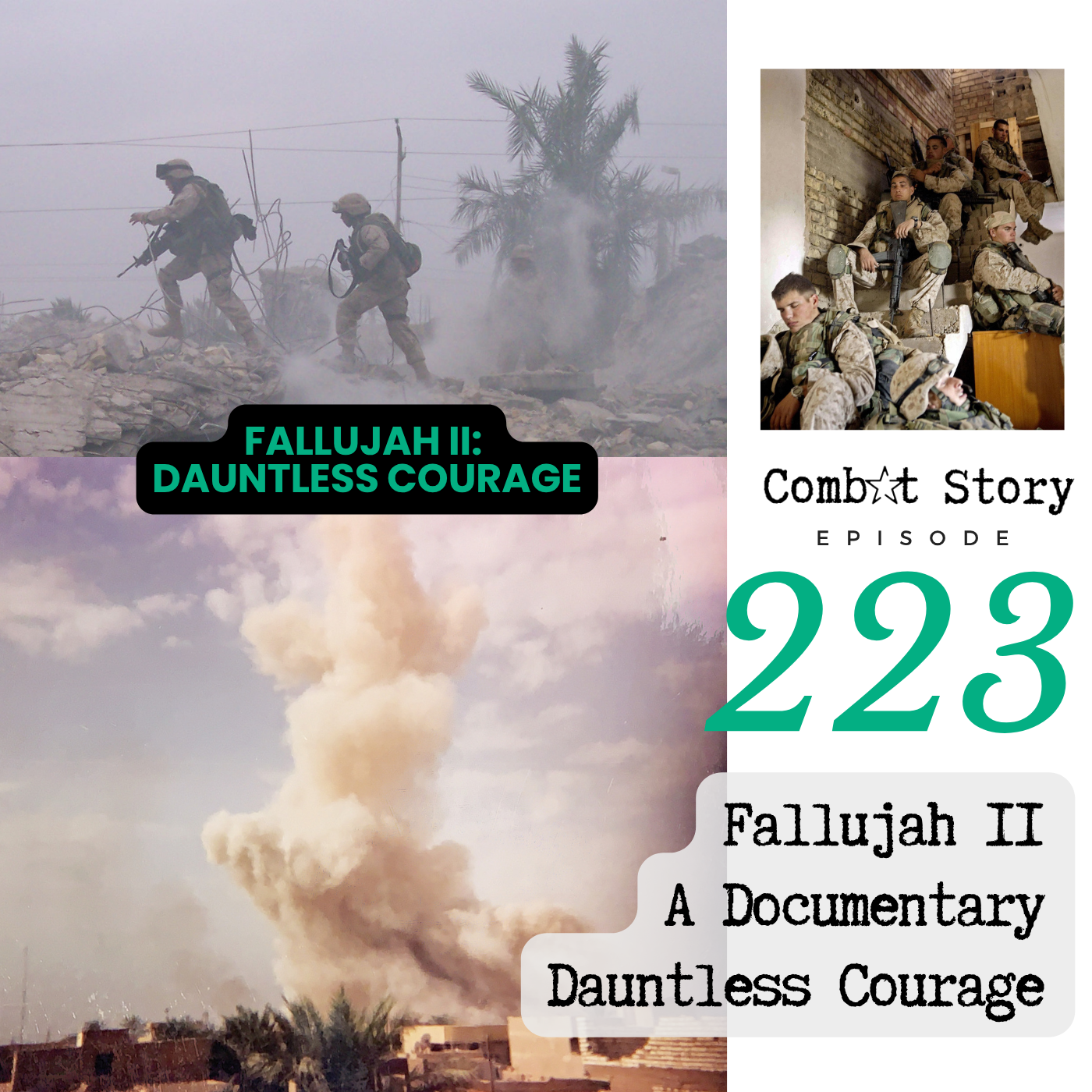
Dauntless Courage: Inside Fallujah II and the Hardest Fought Battle of the War
Episode Transcript
The second battle of Fallujah in November, 2004.
It was one of the greatest battles in in military history since Vietnam.
I mean, just to frame it, Fallujah was an enemy stronghold.
It was a fortress, a stranglehold of bad guys.
It was the hornet's nest.
We all thought we were gonna die in Fallujah.
We all thought we were gonna die in way of one.
Right.
And it was just house to house.
It was a city urban environment and there was nobody in that city other than people that wanted to fight us.
It was like the Super Bowl for the insurgency.
Yeah.
We dropped the pamphlets, said get out of the city.
They knew we were coming, so it was, it was there to be a gunfight.
That's what it was.
They were basically cordoning off the area and sending out a freaking come as you are, message to any insurgent, wanting to kill an infidel.
I just saw Dauntless courage.
I remember our company, gunny was getting body bags one day, and I just happened to look over and he was putting 'em in the back of the truck.
That's when it really hit.
It sank in.
I saw him and I'm like, like, fuck, those are body bags.
This is like, this is real.
This is no joke.
We're going in Dauntless courage.
Just doing what they had to do to survive the combat and Fallujah was the, the most intense, I mean, it, it's, it was a day in, day out grind.
I mean, you're not, you are kicking in every door of every house on every street, and then when it happens, it's just total chaos.
I mean, the intensity is out of this world.
It was a hornet's nest, and we were tasked with going in there and eliminating the threat.
My granddad taught me about the, the World War II Normandy fight, and I got my generation's Normandy Beach with Fallujah.
Yeah.
Did where everyone is on a shoulder to shoulder fighting the same side.
It was a, a really, uh, incredible experience to have what I witnessed, you know, it was just courageous down to the individual, what I saw, man to man sustained over a period of time, all young men too, very young, you know, you're, you're talking young souls, putting their lives at risk.
So I was kind of clueless, honestly.
I was 19 years old.
Travis Greenwood, Sergeant three five India Company.
I ran the medevacs and I ran all the resupplies for the company.
I was doing a lot of recon for the operation of the invasion.
When we showed up in there, had been the battle in the spring.
And what had happened was the deal that ended sort of nominally ended that battle was all US forces left the city and they stood up this thing called the Falluja Brigade, which was just Iraqis, and they would be in control of the city.
Well, it basically didn't, it only existed on paper.
And Al-Qaeda ran, Fallujah was a no-go place for all, all American troops.
So if you were in lumbar, everyone knew all the bad stuff was happening in Falluja, all the IUDs, everything was their sanctuary.
When the Iranian revolutionary coups guys came in with the pros, when Al-Qaeda was bringing in the foreigners and you started getting Chesney into Filipinos, and, you know, these were, it became the global Allstar team of terrorists and Fallujah became their epicenters.
They had gone there on a jihad mm-hmm.
Um, knowing that they were going to die there.
Yeah.
And so their whole mission was to take as many of them, uh, many of us as they could with them.
Yeah.
Well, I had a, a video that I had, I had got from Intel.
It was.
There's a video of a, a daisy chain of IEDs that were on these gates of these houses.
Um, a bomb had been dropped on a, on a vehicle.
And then next thing you know, just the entire block was all the gates were exploding.
Um, just I was doing everything I had or everything in my power that I could to give as much intel to the guys as possible.
And so I never really focused on myself.
I was more focused on prepping my guys as much as I could.
So it was very obvious to us early on there was gonna be a second battle Fallujah.
And even like, you know, the most junior PFC in the platoon, I mean, will come up to me and say like, Hey sir.
So there's gonna have to be another battle in Fallujah.
Uh, our battalion rotates back to the states in February.
Presidential election is in November.
So you think we'll probably go like at the beginning of November after the election and you know, like, yeah, that sounds about right.
And that's exactly when we went.
And we are working to advance liberty in the broader Middle East because freedom will bring a future of hope and the peace we all want and we will prevail.
Our strategy is succeeding.
Apprentice.
Now it's time for reality, and next summer he will gamble on the casino following.
Also, back in 2004, those newlyweds, I know it's tuna, but it, it says chicken caramel.
Electra and Dave Navarro go through this.
You know, Fallujah was sort of this outlier, this big set piece, conventional urban battle that was about to go down.
My name is Elliot Ackerman.
So I served as an infantry officer in First Battalion eighth Marine Regiment.
We were deployed in lumbar province of Iraq.
We fought in the Fallujah battle in November, 2004, and thereafter served at CIA as a paramilitary operations officer.
So they lined up six battalions, four marine battalions, two army battalions.
We basically got online at the north of the city.
They assigned us, you know, six lanes.
We were basically running and we wound up by and large pushing north to south through the city.
So one eighths lane was right in the middle of the city.
And so the city's bisected by a road called Highway 10, which basically runs like east west through the city.
Also Cal phase line.
Fran's what?
It wasn't on military maps.
And our battalion was pushing in our company.
Was tasked with seizing the government complex, which is like right in the center of the cities.
I am Tony Scardino.
I was a Lance corporal pig attached to the scout Sniper Platoon was a Banshee too, and we were supporting India company during the battle of illusion.
When we were getting ready to, we were just coordinating the city off, like that was like our primary job.
So we, we as snipers, we were like set up on the train track or the trestles looking, overlooking the train tracks coming into the city.
We were also set up at different tcps, uh, technical checkpoints that entered the city and sniper towers that were nothing but RPG magnets.
Uh, my name's, uh, Scott Prill.
I was a hospital corpsman first class, uh, and I was the, uh, company corpsman for India, company three, five.
You know, I rolled into the city with the company, you know, with the, uh, with the India company.
I was, uh, moving mostly with the headquarters element of the company, is that, that was as my role as the senior corpsman I was to be there, you know, kind of oversee the medical for all of the, the junior corpsman that we, we had, uh, um, 9, 9, 10 other guys.
Uh, I did sit down and I spent a lot of time with, 'cause like I said, I, I think I was the only one of our group that had been.
In combat before, and I spent a lot of time, you know, just trying to teach them what they needed to the basic, this is what's gonna save lives.
You know, to really reiterate that these guys depend on you.
Um, and you gotta keep your cool, you gotta keep your your head because when you're calm, when you're cool, it inspires confidence to their Marines because they know that if something happens to them, doc's gonna be there to take care of.
Each company of the three line companies gets one sniper team, a four man team that goes with that individual line company.
And then team four is, uh, h and s or general support.
So I am still in a sniper platoon.
I'm in a sniper team.
And so Fallujah kicks off November 8th, right?
And I'm in general support indie company goes in, I still clo, I'm still close with my boys.
Everything's happening.
General support rolls up, and now our job is to go to the southern.
And of the Jolan district to the apartment buildings.
Right.
So we were there for about a week waiting, faking attacks from different sides and doing all the things that army Intel does.
I mean, pallets show up.
Grenades and Claymores and.
C four.
What do you want?
You know, we're everything, every toy, every gadget.
Everything you asked for is there.
It was like you're called up, you're riding a bus from Scranton, Wilkes Bury to Rochester, New York, and now you're flying first class and you know you've got seals.
I've never seen a seal in my life.
You know, Delta Force Green Berets.
And the media shows up.
It was like inter, it was like Super Bowl week.
I don't know it actually, the Marines to me always seem relaxed when they're going in.
They don't seem stressed out.
They don't seem scared.
But I know it's there.
It's in the background, you know, it's, there name is, uh, Justin Oliver.
I was a hospital corpsman second class, which is an E five, and I was attached to India Company.
Second Platoon is what I was wine, what's called a wine form p medic.
We talked earlier, I was responsible about roughly 25 Marines as a 19-year-old kid.
I remember it was PSYOPs and then just blaring like guns and roses and everybody's just hanging out there and like one guy had cha and I was like, how's that?
And I wanted to tried it and I was like, this was just fucking disgusting.
I can't do this.
I'm like, guess it's terrible.
But everybody hides it with their humor.
And, um, just the, the jokes and the things that you do and then you're kind of just trying to hang loose, try to be as calm as possible in a war zone.
I mean there, I don't really remember like a lot going up into the point of for so and so.
We would go through a traditional squad.
Where you got two teams of five basically, uh, you've got a Grenadier, which is a rifleman with a little 2 0 3 40 millimeter launcher.
You got a, a squad automatic weapon, an automatic rifleman.
You've got your, uh, your, your team leader with an M four.
I've got the M four shotgun, whatever it is, Fallujah taught us.
I need machine guns and I need 'em everywhere.
I'm not SEAL Team six.
I'm not doing anything surgical.
I'm not breaking into your house.
Shoot a guy in their face and taking the cookbook and bringing it back to a CIA guy I'm killing.
This is Old Testament women.
Children are gone, civilians are gone.
If you're in that city, you are dead.
I found a letter that I had written to my family the day before Fallujah, and so it's November 7th, 2004.
And my God, that I think I was gonna die clearly based off of that.
Right?
And so we call them like death letters.
Uh, and some people do 'em, some people don't.
This wasn't a really a death letter.
I wrote something like that as a 20-year-old in Fallujah, uh, the day before.
I would challenge anybody to, to kind of put into perspective their entire life is to to write a letter to your family as if you were to die tomorrow.
What would you say in that letter?
What would you want to impart on the world?
Um, um, and have them remember you, uh, by.
All right.
Well, I, I just want you to know our hearts are with you.
We're thinking about you guys all the time.
Tell us one more time.
The, the morale of the Marines who are with you right now, girding for what could be the toughest fight that you guys have faced since Vietnam?
Inside the Regimental Combat team, I got some of the greatest marine soldiers, sailors and airmen that you could possibly imagine.
Every marine that I told the soldiers sailor that, you know, the army coming in to take on some of our tasks while we get to our business.
Everyone broke out with a biggest smile and said, sir, we're ready.
I think that that brings a good summary of the type of morale that we have.
Our Marines and our combat team is ready for action, and then we go over the berm, we blow it up.
Our engineers are incredible.
82nd engineers with us, they're awesome, and our tankers, 1, 6, 3 armor, just animals, just animals, just ripping everything up and then we punch into the city and everyone else is having a hard time getting through the burn.
So we punch through, we hit our phase lines, and all of a sudden we get just a wave of attacks and just everywhere you're looking.
And so we realized that everyone has to use our breach over this berm and we're the only American forces in the city outside of the Delta guys that are sneaking around.
And so we became the only entree on the menu.
And so we have to basically fight back to the start point.
Start again.
They're not up to you yet.
Start back, go again.
First day Ofia, we're in the back of the, the AAVs like just jam packed in there.
You it room capacity is like 10.
They would say, you know, they put like how many guys are supposed to be in there?
But it was way up more than we were supposed to have in the back of the aav, but I remember when the door came down, the back of the AV and everybody just rushed out.
And I was with, uh, Sergeant McNerney, who was our, my squad leader.
And I remember like seeing mortars or something hit door, opens pitch black, you hear gunfire, guys are running out, and I'm like, fuck, am I supposed to fucking deer in the headlights?
Had no idea what the hell was going on.
So that was, that was probably the scariest move of my life.
Our command star major is the first guy to die in Fallujah.
First American to go down.
Yeah.
He died at the breach.
And, and we loved him and he was like, he was our father figure, you know?
Yeah.
And so he goes down to a sniper and then, you know, we lost our Exo Edward Iwan and our commander Sean Sims, and a scout JC Madison, a unit had not experienced that since Vietnam, where you lost your immediate chain of command, you lose your senior NCO and it's all a day apart and it's all close quarter battles.
So we knew that we were gonna be getting some, we knew that the fricking bad guys were coming in and we were just trying to get, be ready for it.
And I, I think we were ready for a close quarter battle of 35, 50 meters.
That's what we had.
We had a couple of.
It's really up close fights in mu but we overwhelmed them.
And you know, a lot of guys would run when they saw us coming.
And I just remember I was actually 30 minutes into my rest cycle and it was so hot in the tower.
You can either sleep at the base of it, but it was in the dirt, so it was uncomfortable.
And it was too small to like have a co, so like 30 yards away.
There was an empty bunker that we had a co in and that's where we stored our stuff.
And I just remember like having my pants around my ankles, laying there with my eyes shut.
Trying to sleep is like, I'm sweating profusely and just like pop, pop, pop, pop, pop, pop, pop, pop, pop, pop, pop.
And like initially I was kinda like, ah, that's just like, nothing's gonna happen.
Like it's gonna die down.
And then I was like, holy shit.
Like within 15 seconds I was like, this is like amping up exponentially.
Like, and it's.
It's still ramping up.
Um, so I, like, I ran across the thing with like my pants around my, like trying to pull my pants up like with my gear on like all haphazardly and my gun like trailing behind me and I look up in the tower and trailer or Taylor, Justin Taylor's up there.
He is like, you're fucking everywhere, man.
I'm like, fucking get up here baby.
My flag jacket.
Holy shit.
I'm like trying to climb up there.
And I just remember boom, like feeling like I like a shockwave, like go through the freaking tower and I was just like, we fucking just got hit by an RRP g first day of the battle in Fallujah.
The company I was with was held in reserve, so our battalion was.
Assigned to seize the government center, which was right in the middle of the city.
And so two companies, Bravo and Charlie Companies were tasked with sort of fighting up 800 meters into the city and they were gonna open a channel for us to come through and we were gonna go 800 meters into the city and then about like another 800 meters deeper.
Our company would then sort of in the classic mechanized rates, seize the government center.
And then over the course of the next day, those other two companies would fight up to get even with us.
So my first day of the battle was basically a mechanized raid, uh, right into the center of the city.
So, uh, we had spent the whole day before on the outskirts of the city listening to all the radio traffic.
And frankly, you know, listening to all the medevacs rolling in throughout the day, uh, as you know, Bravo and Charlie Company, uh, were fighting and if you just toggle through the frequencies on your radio, you could listen into, you know, third battalion, first Marines fighting, or third battalion, fifth Marines fighting.
Um, so we were all just sort of gathered around radios waiting.
So we brief, we got the plan.
My, my battalion took the northeast sector of the city.
And the plan is at this point we're pushing through.
We have our sector, all of our phase lines, and we're going house to house and we're getting it on.
So we we're, we're mechanized moving up there.
We're in, uh.
Seven ton trucks, all the, which by the way, no armor, this is still at the point where none of that had all soft skin, no armor on, on our vehicles.
We push into establish our presence on the northeast side there, and man, they were engaging us from, from the road.
We're up on the highway at this point still, so they're in the city and I'm seeing, at least at the time, I didn't quite understand what it was 'cause I, I couldn't really hear the explosions but their impacts, and you're seeing the effect of the impact.
It's not like movies with like mortars, there's no big fireball, or if it is, it, it lasts a half a second, it's gone.
You don't see that.
You see really the energy and then you see like dust from it landing on the ground or whatnot.
And man, we were just having these impacts all around our convoy.
Again, just one of those times where it was like those would easily take out a seven ton truck.
I mean, the entire, it would've been catastrophic.
So we're getting, getting engaged from personnel on the road, getting engaged via I indirect fire.
As we're moving in.
And it was that sense of like, wow, they're, they're bringing the fight and we're not even off the vehicle yet.
We haven't even dismounted.
So we dismount, we basically clear the first block and stop, and we essentially stay there for a month.
And we get in little engagements back and forth, static engagements of them, kind of probing our lines and uh, and, and firing pop shots at us and maneuvering and moving.
And then very early on the morning of November 10th, um, 2004, our company crossed the line of departure into the city.
And obviously that was the Marine Corps birthday.
So as we loaded into the ramps, I'll never forget to sort of, you know, fer that sort of dim, glowing light in the back of the Amtraks Marines.
Breaking off pieces of pound cake, uh, because we, you know, we eat the birthday cake, uh, that day.
So, you know, oldest and youngest Marines and taking and eating that cake almost, it looked like it was like, kind of like, uh, communion, wafers, sort of how I always remember it.
Uh, we climbed the back of the amtraks and then our company A XO read the Commandants birthday message, um, over our company net as we rolled into the city.
Uh, it was pretty quiet at first, and I think we got into the government center about four or five in the morning, and we had rehearsed this mechanized raid over and over and over again.
And so we started moving, building to building.
Uh, our platoon was tasked as sort of the, of the three platoons in the company.
Uh, we were the, the main effort of salt platoons.
So we were moving very quickly through all these buildings.
The fire at the time, the sun was coming up, uh, we had soon a platoon battle position on the southern end of the government center, uh, which at this point made us the southern most element for our entire battalion.
And then when the sun came up, all hell broke loose.
So there's a train track, there's a train station to our west, and there's an apartment complex six, seven stories tall.
So Guillermo Sandoval memo, my, my partner, uh, who's team four general support in this thing, we.
Are going to get in the, uh, apartment building, and then we're going to cover as the grunts make their cross to this threshold into the city, they're gonna gain their foothold on the way into the apartment building.
It gets like zippered up with like fire.
We're getting shot, like on the way in.
Okay.
So.
So memo was carrying the M 40, which is the 7 62 sniper rifle, and I'm the pig in the sniper platoon.
And so in this relationship, um, you know, memo was acting as the hog, right?
And I was, uh, the pig.
What's a pig in the scout sniper community?
You're one of two things.
You're either a pig or you're a hog.
Pigs are the professionally instructed gunmen who are trained by the hogs, who are the hunters of gunmen.
Pigs haven't been through school yet, but they're trained by the hogs who have, so they're professionally instructed.
It's a colloquial term, like it's a, a term of endearment.
So we climb up these stairs, we get to the fifth floor of this apartment building.
It's completely vacant, right?
I set up and we're covering into the city.
Now we can see into the city, and then all of a sudden.
We we're getting like moving tables and whatever and you know, and getting set up as everything's kind of kicking off.
And then artillery is hitting, cobras are hitting, everything's kind of going on chaos.
And then we hear footsteps coming up the, the stairwell.
So now Memo and I come around the corner and we're like pieing and holding on these stairs.
And who comes up?
Two Navy Seal snipers.
One by the name of Chris Kyle.
So Chris, Kyle and his partner cruise up.
Him and his partner are literally across the hall and I'm telling it's a very small apartment.
So across the hall is five, 10 feet away, out of the room into the very next room.
And so now.
On the left hand side of this, this apartment are the marine snipers.
And on the right hand side are the navy snipers.
And okay, they have 300 win mags, right?
They got like way better at guns than we do.
And then we start this competition, right?
And so like, like as we're going, like, you know, we'll hear the, the 50 cal go off when I'm shooting or memo shooting.
And we're like, Marines one, right?
And then like, again, people are gonna hate this, but like the, the, you know, Chris Cower, like navy wood, right?
And so we have this like, I mean, again, like I get it, like I understand, I understand the humanity and everything now, and in retrospect I completely understand that, but.
It's hard for me to quantify when people are like, well, do you enjoy your job?
No, I don't enjoy the act of killing people, but I enjoy the idea of being able to train your entire life for a specific purpose and the getting to do that purpose.
But I was very happy to be taking out an enemy combatant that would have the opportunity to harm one of my comrade.
We were the angels on their shoulders for sure.
That's my job, is to take care of them.
And so, yeah, I'm proud of the fact I did my job.
Um, and so that led to some of the problems, some of the animosities.
I'm a pig who's rocking the sasser and I'm getting, I'm getting a lot of work done is what, what Aaron said, right.
Um.
And yeah, there was a lot that happened that day.
Um, and then as the sun set that evening, Chris, Kyle and his partner ended up taking off and then meeting up with the Marines and carrying in.
Well, we stayed there for two more days and continued operations there as guys were going through the southern part of the city, uh, and working through the southern part of the Joe Lawn District, and then working their way towards the center of the city, I mean, gunfight, once we established a foothold in the city.
Mm-hmm.
We had a corridor basically out northwest.
Yeah.
Around the apartments.
And then back to Camp Fallujah, which was the main hub.
And then Camp Fallujah was what's called Bravo Surgical.
And so they would run these ambulances, we'd get wounded casually, we'd get 'em off the front, and then we'd load 'em into these vehicles, and then he would take them back and forth.
Corman and Corman in hand.
Yeah.
And that was, that was pretty interesting because, I mean, and my only response was, I'm the only medevac.
It was like, I'm not slowing down.
Like, I mean, that also leaves you up for ambush and stuff like that.
So it.
I rolled around the city, just one vehicle all over the place, but I'd get the guys out as fast as I could and, and get back to the company for the next next injured guy when the dudes were kicking in doors.
Um, but at night, I don't think I slept for like the first five days because at night, like I was running medevacs and, and doing stuff during the day to help other guys.
And then all night long I was running resupply to the platoons.
That was, that was pretty wild.
Like here I am driving around with MVGs, like all over the city, like trying to figure out where the platoons are set up at.
And yeah, I lost a couple times, got shot at a few times and it was just, it was interesting.
On one of my resupplies, I come up on this house and on this one I am by myself in the vehicle, middle of the night running resupply, making sure dudes have ammo, grenades, a t fours, everything they needed.
And I'm driving down this street and there's this house with lights on and.
I'm like, what is going on?
And I look, and two Iraqi males and two females walk out of the house and start walking toward me, and I'm on the radio.
I'm like, Hey, I've got these two MAMs over here.
There's females, it's family.
I was like, what am I supposed to do?
And I was told to detain them and bring them back.
I was like, I cannot do that.
I was like, I, I've got munitions.
The whole Humvee was just loaded with grenades and stuff.
How is one person supposed to, supposed to do that?
So I ended up getting a little bit of trouble maybe, but um, yeah, I just marked the location and, and I headed back.
But yeah, it was, it was kind of interesting how I was rolling down, rolling around by myself for a lot.
The Ari District of Fallujah, the eastern side.
It was called the Soldier's District.
And this is where Saddam.
Retired as general.
So there's an upper middle class neighborhood and the Iraqi culture is very insecure.
These are giant thick homes.
Every home is built for defense.
You basically, you had tunnel network systems that were connecting homes that had, you know, one, one house would've nothing but medical gear in it.
The other one would've bullets.
The other one would have, you know, explosives.
And they all knew the marketing system.
Foreign fighters were on the perimeter, the hardened guys were on the inside.
And so we were clearing buildings that we had cleared the days before.
So you get a little bit of familiarity with where we're going.
We were staging across from of the train tracks, I think a little bit too long.
It let guys start moving up.
So that initial, initial push at that first night, there was some contact, but not a lot.
And then once we got rid of those guys, I think it took a while for people, for insurgents to move back up to where the contact kicked off.
We were adjacent supporting the company, and all of a sudden it came over the radio that, um, Antoine Smith was killed.
But yeah, I got the, I got the call that we had, uh, a marine down, two wounded and a location for him.
And so, I mean, I was in the Humvee.
I grabbed, um, an, a driver, somebody throw in the back and just got up to the house where all the guys were at.
They loaded every, everybody in the back and I flying through the city up to the apartment complex, um, outside the city where a battalion was set up at.
Yeah, Antoine d Smith.
He wasn't my platoon, but I had, I had known him out at CACs right before we kicked off this deployment.
And he was, he had a stutter and like, it was, it was fun talking with him, but he was honestly one of the nicest dudes.
I ever met.
I mean, I know it sounds kind of funny to say, but he was as sweet as can be.
He was just a really, really nice dude.
That was, uh, my, the first major, major one, he was KIA is one guy I couldn't get to, which, which hurt, hurt me the most was, um, mayor, corporal, mayor.
I mean, he made it outta there.
But, um, I watched, actually, I watched ma get hit.
I watched him get go down.
He came back up and I could see his leg was already just covered in blood.
So I saw him, it was like, boom, I'm hit.
He comes up and I see him run around to this building.
So I see him, I go to go get him, and then as I'm running to go out the door, there's a wall here, and then Mary's in this house here, there's a wall here.
Well, I go to go out the door to go over that wall.
All of a sudden, bullets start hitting the door next to me.
And somebody grabbed me, I don't know who it was, grabbed my flag track and pulled me back in and said, doc, you can't go.
I was like, what the fuck you mean?
I can't go?
This is my job.
Right?
Um, luckily another sergeant, another corpsman, uh, Nevilles, where I was able to get around and get into him.
So obviously he got buddy head first, but that, that, that stuck with me for years.
I think it stuck me the rest of my life, the fact that I couldn't do my job.
So I did my best not to let it emotionally affect me.
Um, I was more focused on, I have a mission.
I need to focus on that.
And so getting those guys out, that was my priority.
That's what I, I focused on.
Um, like I said, he was, he was the first dude I knew that got, that got killed in combat.
So.
It took a little while for it to actually kick in.
I mean, when South got shot, he took an AK round right, right to the jaw.
And uh, I got on scene, you know, shortly after, you know, they had pulled him out of the building.
Doc Lowry was there and he, he was initially treating him.
I took over care of him.
And, um, a couple other guys that were hit.
It's kind of funny, um, when he was, we were in the truck and I'm trying to make sure he's still breathing and all this, and he keeps pointing to his leg, keeps pointing to his leg, and I'm like, I don't understand what's going on.
'cause you know, I'm worried about you being able to breathe.
And they, I had finally look and he had a bullet hole in his ankle or, uh, about his heel.
And that that's what was, he was worried, more worried about than.
Them being shot in the face.
'cause I guess that's what hurt.
And um, at that same time had another marine that had been shot in the upper chest and was developing attention pneumothorax.
So as we're.
Flying down the road in the back of a Humvee, I'm having to decompress his chest as I'm trying to make sure that he's still breathing.
And, and then other marines were wounded and then we needed to move to support this.
So like, I, I remember coordinating with the powers on the mic, like, Hey, like, where are you guys?
And like, Hey, we're here.
And like, we linked up and then we were clearing the house and freaking.
Nothing, nothing, um, was going on.
It seemed like it died down a lot.
And we got up onto the rooftop and the, the fight had, like, died down considerably.
Seemed like it, the situation stabilized like, yeah, we probably don't need to Overwatch, we're good to go.
So we started like coming back downstairs and then all of a sudden all hell just broke loose, sprinted back outside.
I was the last man out.
I just remember JP was the first man out.
He like took three steps onto the door and like identified a threat like 50 yards away, like jumping over a roof.
As I came out, I like looked in and just saw what he saw and saw him drop the dude.
So they were like trying, they were reinforcing the position via the rooftops.
And so we started engaging them, um, with like grenades and, and everything else.
I was on the left most part of the, the roof and JP was directly next to me.
And I remember like shooting, like seeing a target and like engaging 'em and then like all of a sudden.
Like JP was just like on top of me and he was engaging this way.
And so he saw, or like to my left, there was a flat rooftop, um, and we could see like the windows of the next door house over, and there was tar, there was an insurgent in there with like a, a machine gun.
And he started like, shooting at us and freaking, so JP took him out.
Um, and we realized we're in a fucking L-shaped ambush, like a, a multi-story, l-shaped battle.
Um, and it's just five of us engaging in both directions.
And so, um, Blake had the idea we were gonna, we were gonna split our forces.
Um, his team was going to climb up onto the rooftop, uh, of the adjacent house.
And while they were doing that, Justin and I would jump over the wall and like close the distance across that rooftop to engage through that window and engage those threats.
So that was the plan.
Sure.
With just one.
Yeah.
The reality went a little bit different.
So bi Bisecting Fallujah was, uh, highway 10.
And so we were fighting basically with the insurgents who were on the southern end of the highway.
We were on the north end of that highway all day long, and that kind of became their main line of resistance throughout the day.
You know, one of the first principles of urban combat is before you launch an attack, you gain a foothold.
That night, our company commander basically let, let us know that the entire battalion, which had now sort of fought up even with us, the entire battalion was going to cross Highway 10 the next morning.
During the course of that day, one of our other platoons, there was a, uh, friendly fire incident where, um, GBU 38 was dropped on that platoon and a bunch of Marines were hurt.
Um, we started taking some casualties throughout the.
Uh, our weapons platoon commander was killed that afternoon, um, and sort of by the end of the day we were exhausted.
And so he told our platoon that we would gain a foothold for the battalion and we were gonna infiltrate across Highway 10.
In the middle of the night, we identified this one building, uh, where we would gain that foothold from battalion on the southern side of the highway where all the insurgents were.
So we identified that building, and it was sort of at this, this split in the road, which later became called the pizza slice.
So sort of like a triangular fork in Highway 10, sort of to the west of our position.
And we identified that that would be a good building, you know, pretty close to where the rest of the battalion was, um, perfect foothold.
And so we said, all right, well, we're gonna call in an AC one 30 just to do some prep fires on this building.
We get the whole platoon together, and then we start infiltrating across Highway 10, probably around three in the morning.
We are in a fucking L-shaped ambush.
We're gonna jump up here, we're gonna pop smoke once it's obscured the window.
You guys are gonna pop the wall, you're gonna run over and we're gonna kill these guys in this fucking house.
And then you're gonna cover down on the windows and the doors while we get over onto the third deck.
We're gonna come down and then you're gonna link up with us and we're gonna breach in.
And it was like, okay, that's what we're gonna do.
So we pop smoke and Pell and, um, Blake were able to climb up and scale this rooftop, but as like I, the, it was happening, like they started getting shot at, from that window, from insurgents tucked back into the house.
So JP joined us and we jumped the, the wall.
And I remember it, it was like, it was terrible.
And so there's like a freaking three foot gap between these buildings.
And I remember being like, oh my, like Justin and, and JP like maneuvered it.
Seamlessly.
And I, I was like, like trying to freaking like, put one leg here, put another leg here while there's insurgents behind me.
My, like guns dangling in between me.
I freaking throw myself over.
And the, the, the ground on the roof next door is like two feet lower.
Then the, the ground of the roof that we were on.
And I'm short as it is and my gun gets stuck between the buildings and like, like I'm stuck like with my gun in between the buildings, unable to use it.
And I just remember looking to my left and seeing a dude like draw down on me and the freaking Tinder block just exploded.
And forget.
I fell on my back and like looked at my thing and realized I don't have a primary weapon system.
Like, so I drew my side arm, like ran across the rooftop, um, with JP and Justin.
And Justin and JP are like covering down on this doorway and some other windows I'm covering down on the window that JP engaged the, uh, machine gun through and like I'm shooting through there, throwing grenades between bars.
As we ran into that building, it was just a smoke and debris.
You couldn't see a thing and the AC one 30 had done too good of a job.
So at that point, the whole platoon work, consolidating in this building we're pretty exposed.
And this sort of, you know, the questions are, well, what are we gonna do?
So, uh, I looked out kind of to this, through this blown out back wall and I could see another building.
Um, but this one was about 200, 250 meters deeper into the city, but it looked like it was defensible when we could fight from the rooftop, I said, all right, let's go for that building.
And it turned out it was basically, we call it a candy store.
It was like a convenience store.
So we get into this building and at that point, you know, we, you know, we'd been out, I dunno, over the better part of three, six hours.
All we had was a salt packs.
Most of the Marines are pretty low on water and getting very low on chow.
And so we were sort of delighted to find like, cases of soda that we could drink and, you know, Pringles, chips and snacks.
And we started setting up, basically a defensive position in the middle of the night, um, consolidated it.
And when the sun came up that morning, the entire battalion was scheduled to
begin its attack at like 9begin its attack at like 9:00 AM The sun came up around, you know, six 30 or seven, and we just started seeing, you know, little groups of like five and six, uh, Al-Qaeda and Iraqi just sort of, you know, and surgeons bebopping up towards, uh, highway 10, which had been the frontline the day before.
Just totally oblivious the fact that they, we were there.
And so the entire, our entire platoon just started opening up on these guys.
I mean, we were just mowing these folks down.
They had no idea where we were.
But after about an hour or so, they quickly figured out that we were consolidated in this house, and they started surrounding us.
After a few minutes, uh, I just heard like, you boys need some help.
Like, look back and it's Clint Alanis and Shane Kellian, and like they jump over the wall.
They freaking close the distance and like duck under the, the windows with us.
Shane, he was, uh, our radio operator.
I was about as close to him as anybody else.
So we were both in headquarters together.
He was the, the radio operator for our xo, but like the, the HQ guys there, there weren't very many of us.
It was just a couple of us.
So like, and when we were in Barrio, we lived in the same little hooch.
We worked out together every day and we were just with each other all the time.
Because that was, that was our, our billets at that time.
Shane was uh, like a PT stud.
Mm-hmm.
Was like our discipline guy was like the quintessential marine.
Mm-hmm.
And I was doing the medevacs and stuff.
That's when Killian got hit super, super close with Killian.
And um, it actually like tried to get him to switch me rolls and I was gonna take over the radio just 'cause that the platoon that got hit, those were his guys.
Um, that was the platoon he came from with and he was really distraught over it.
And, um, we were sitting on a rooftop and there was kind of, you know, there was firefights going on.
Um, I think the company was pushing into an apartment building something and I was sitting up with the headquarters element of the company and someone came over the radio and was asking, Hey, what's all that shooting going on over there?
And our radio operator, uh, Shane Killian at the time, he, uh, goes over the radio and goes, be advised there's a war on.
And I just like, I mean, he was just leaned back against his radio and just commas, KBI said that.
And I was just like, yeah, that's time.
Yeah.
And so, because I knew the plan, I was gonna go with them, but I was under the window.
So Shane was like, where do you need me?
I was like, could you hold security?
You take my position.
And so I remember going.
To link up with Justin.
And at around that time too, it was so chaotic.
But around that time too, JP had went back to, uh, help out Blake and me.
Justin and Clint were, I guess getting ready to jump the rooftop to go over.
And, um, I just remember Justin being like grabbing me and pulling me back and being like, no, like, we're down a man.
We can't, we lost powers.
And I looked and like there was a marine laying on the ground where, where I just was.
And I ran over to him thinking that was Powers like, and I ruled him over and it was, it was shame.
Um, and he was still, um, he was still in the fight, but he just couldn't.
Do a lot.
So I tried to treat him, um, best as I could when I removed his helmet.
So I was like supporting his head and my fingers sank into the back of his skull.
Uh, like, so, like I kind of, I was like, uh, like, but he was still kind of in the fight.
Um, 'cause he was a war dog.
We loaded him up on the stretcher after I tried to treat him.
Um, carried, like, ran back the way we came across the rooftop, loaded him over, slid him over.
And um, uh, I stayed in the fight and I, I, I took his rifle.
Then shortly after that, we were told, Hey, we're pulling back, like we're gonna drop ordinance on these fuckers.
Like, and that's what happened when I was doing the medevacs and stuff.
That's when Killian got hit.
I got Killian out and.
Like, part of my job on top of the medevacs and everything else was when I did medevac these guys, I had to get out their serialized gear, bring it back to the company.
They weren't allowed to go off with their serialized gear.
We had to keep track of it.
And so, so when Shane got hit, I had his flack jacket and I was going off and there was a lot of stuff on it.
Um, 'cause he had been shot in the head and I knew he, he carried a picture of him and his wife and his, and his flack.
And I remember I opening it up, pulled out the picture and just lost it.
Absolutely lost it.
That's when Muncy came up and just bear hugged me.
I was able, luckily I, I kept the picture the entire time I put it in my flag.
And held onto it the entire time.
And I gave it to his wife, um, when we got back here, but it destroyed me.
Like his, his first son was born the day he got killed a little bit, a little bit after he got, got killed.
So that was, that was the, the hardest right at the, the beginning for me.
That's still, that's still a tough one.
Uh, that one's in there all the time.
Um, and I remember, uh, that night, uh, captain Cosh said he had to go back to the battalion CP for a meeting and he grabbed me and he took me and he's like, doc, I want you to come with me.
I was like, that's weird.
He never take, takes me to these things, but okay.
And he took me and he dropped me off at the BAS and to one of my, one of my best friends was working, uh, HM one, Chris Pearson.
He was there and.
I guess he, I don't know if Tasha had talked to him ahead of time or what, but, uh, I was pretty broken that day and he brought me, dropped me off at the BAS and Chris brought me a cup of coffee, a freaking hot cup of coffee, you know, something I hadn't had in, I don't know how long.
And he brought it to me and we sat and talked for, I don't know how long, but he left me there at the aid station for a long time just to help me get my head right.
And, uh, yeah, that was, um, yeah, that when, uh, that day, 'cause we lost Smith that day and, and Shane and several other guys were wounded.
And it is just, it was a rough one.
And that's every year.
It's still a rough one for me.
And when we knew that he was, you know, and April was going to give birth, that was like all of us.
Mm-hmm.
We were all in that, right.
Mm-hmm.
And.
Later on in, in, on our further deployments, you know, uh, Ross Smith.
Mm-hmm.
You know, he was the soul of the company.
And when those people, we lose those people, a part of us dies with them.
Yeah, for sure.
Man, that's a beautiful description.
That's a great way to strive it because it's totally true.
Just a quick word from our sponsor, veterans help group, and we'll get right back to this combat story.
Some of you may be struggling with things today that weren't there before you deployed, or maybe you're noticing this in a loved one, like a spouse, son, daughter who went down range, came back a little different.
Like many of us trouble sleeping, dealing with pain, stress, mental health issues, maybe a whole lot more.
And the question is, what can you do about it?
Well, let me tell you, you signed that contract.
You served your country.
You earned your benefits.
That's why I want you to do yourself a favor and call your friends at Veterans Help Group today.
They're here to help you get your benefits.
I've navigated the VA system to get my own results and benefits.
It can be hard at the best of times, and Veterans Help Group makes it that much easier.
You see, veterans Help Group knows the VA because VA disability is literally all that they do.
Whether you've been denied or appealing or filing for the first time, it doesn't matter.
These guys know how to get you approved for 100% of the benefits you deserve.
They've done it for thousands of vets just like you and your loved ones who serve.
Go to Veterans Help group.com or call Veterans Help Group at (855) 233-6144 and tell them your buddies, Ryan and AJ from Combat Story sent you.
That's Veterans Help group.com.
Veterans Help Group does not guarantee outcomes and past performance does not guarantee future Results.
Company is neither a law firm nor affiliated with any part of the US government, including the va.
This video is also sponsored by Delete Me.
Delete Me.
Makes it easy, quick, and safe to remove your personal data online.
At a time when surveillance and data breaches are common enough to make everyone vulnerable, delete me, knows your privacy is worth protecting, sign up and provide.
Delete me with exactly what information you want deleted and their experts take it from there.
Delete Me, sends you regular personalized privacy reports showing what info they found, where they found it, and what they removed.
Believe me, isn't just a one-time service.
As someone with an active online presence, privacy is really important to me and my family, especially given my background in the military and in the agency.
I wanna make sure people don't have too much information about me online, and I have been doxed by some fairly unfriendly people in the past.
I love getting my monthly Delete me reports, telling me exactly how much of my online presence has been cleared.
I actually look forward to this.
Take control of your data and keep your private life private by signing up for Delete Me Now at a special discount for our listeners.
Get 20% off your Delete Me Plan when you go to join delete me.com/combat and use promo code Combat at checkout.
The only way to get 20% off is to go to join delete me.com/combat and enter code combat at checkout.
That's join delete me.com/combat code combat.
And now back to this episode.
And um, at this point too, the My Battalion that was back in the government center, you know, they were also heavily engaged.
So the time of our battalion attack kind of kept getting pushed back for the first four days of Fallujah, I wasn't with any single line company.
We were general support.
We were helping Kapha, we were shooting if we needed to do other missions that we ran adjacent to.
'cause I was general support.
Well, team two Banshee was our call sign.
Banshee two got in a really bad firefight in the Jolan district with the India company, and a lot of Marines got hurt that day, uh, to include, uh, a Navy corpsman, uh, doc Pell.
Uh, doc Pell got wounded really, really bad.
He was going in between two buildings and then they kind of hit him a lot.
Uh, he was, his life was saved, but he was hurt really, really bad.
And so what happened was, uh, team two was down a man.
And so then what happens is now I'm combat replacements.
And so I go into team two and I continue the rest of the push.
In Fallujah, we're clearing houses with the grunts, right?
Like I said, there are, I, I came from India company and I'm supporting India company.
So we're with him, house to house, fight to fight, whatever it was.
And then what the snipers started to do was we used the snipers as kind of like a squeegee.
So at night it was really weird.
Uh, everybody fought during the day and then understood that like when the sun set, there was no more fighting.
Like everyone went and like smoked cigarettes and like ate dinner and then the sun would rise.
And so.
What the snipers would do, we would go out and we would move ahead of the forward line of troops and we would set up a position that would cover a long axis.
So what the mujahideen would do.
Is at during the day, they would have fighting positions and they would fight with us, and then they would fall back, and then they would fight and fall back and fight and fall back.
So we hit an artery where we would stay and they would cross that artery when they were falling back.
And so we were like living, we didn't know what houses we were taking.
We would have to make what we called, like a surreptitious entry, we would've to cut locks, get inside, right?
Movement very quietly.
Conduct, you know, everything in the most sleuthy thing ever.
And then set a position and like, not even breathe, and then set a position for the next day's fight.
The good guys knew what building room in, and then they would push the mujahideen into us.
Um, was kind of how we worked all like every single night through Fallujah.
And so then they would cross our line.
We would keep, we'd call 'em, we'd call an airstrikes.
You, we didn't move, we, we, we had to put like broken glass on the stairs and cut locks and C four and whatever to be able to protect ourselves.
We were in, you know, in, in wild zone.
We were like in Badlands.
So we'd fight during the day and then at night we'd go out and do recon and, uh, we'd, so we'd do satellite patrols, two man patrols at sometimes like doing man shit, you know, in the middle of the city, like with nods, nothing but hand in arm signals like running and afraid hundreds of meters ahead of the fricking like company.
So the time of our battalion attack kind of kept getting pushed back.
And by the early afternoon, um, we had taken, uh, some casualties.
My platoon sergeant had been shot in the head.
Uh, one of the machine gunners in the platoon had been shot through the femoral artery.
It was bleeding really badly.
And so I called in a medevac.
They sent out two Amtraks, um, you know, these amphibious armored vehicles, Weran Jews, and as soon as they left the government center, one of them was taken out a catastrophic kill with an RPG.
So it was just sort of lying there in the middle of Highway 10, you know, on fire burning.
And so we had no medevac at that point.
Yeah, the, the very, um, the very north east corner of the city was like, we essentially had pushed everybody over there.
And so we bottlenecked them to the corner of the city and we took a lot of, a lot of casualties over there.
I actually came up on my, comes up on my, basically my platoon TT is, uh, a first lieutenant's gonna be Sonny Rollins, who was a, uh.
Uh, mobile assault platoon commander.
So he was out there just with like some light skinned Humvees with, uh, you know, 50 cows and Mark nineteens on 'em, and he on his own cognition, just rolled his platoon down there.
And we link up, we get our, get our casualties out, uh, which was really tough to do.
Um, we got them out and later, later, brown survived.
Um, but was given last rights, uh, when he made it to the battalion aid station.
So sort of a miracle he survived, but we're still sort of surrounded at this point.
We can't get out.
It's only getting more intense and it's now, it's sort of early afternoon.
I was on the radio with my company commander at one point.
Kind of talking about what we're gonna do.
And he said, listen, the battalion attack's gonna go, it's gonna go at, you know, three o'clock, we're coming, be ready, you know, we're gonna link up with you in stride.
And I started arguing.
I said, Hey, listen, like it's gonna be dark in like three or four hours, like, let's do this at night.
And he and I sort of were having this debate.
He was a great company commander.
He's like under, basically saying to me, understood.
But we're coming at three o'clock, we're moving around in an upscale neighborhood.
Uh, and my XO right before he is killed, isolated, about five guys from a cell, he engages and destroys one of 'em.
The other guy goes into a house, we're separated by maybe 400 meters.
And that was a, we never, we didn't know where the bad guys were.
So this is a huge advantage to know.
Somewhere in these 10 houses, bad guys are there.
They're not leaving this block of 10 houses, 10 to 12 bad guys not leaving this neighborhood.
So we got 'em cornered.
In my career, I'd say there maybe a dozen times where I really felt like I was earning my peg.
And one of them was that moment on the radio with my company commander.
'cause I remember probably anyone who wasn't manning a fighting position was sitting there listening to that conversation.
'cause they could overhear him on the radio and they could see me talking and they knew that however that conversation went meant whether or not we were going to.
Sort had to run out into the jaws, whatever was awaiting, rush further south in the city or whether or not we'd be able to hold tight for three or four hours.
I obviously, I didn't have my way and we got told that we needed to push.
So I remember I ran downstairs to the candy store.
There's only one door in and out of that building and said, well, let me see if I can even get us outta here.
I tucked my head out the door and there was like a PKM that had a line of fire right down this alleyway and it just stitched up the alleyway.
I kind of kinda like barreling back in through the door, and I'll never forget this.
I remember just sort of watching the alleyway after that and this sort of calm moment and there were like these two pigeons and there was a wall on the far side of the alleyway and they were trying to land on this wall and every time they would land they were just, you know, and they couldn't land on the wall.
And I turned around and the first squa in our platoon guy named Adam Bonai kind of saw me.
We bumped into each other and I looked at him and I said.
We go out that door, it's suicide.
And he later told me, he's like, you know, I was never really worried the whole time until I saw you and you said it was suicide.
When we go out that door, that was the one time I really was worried that this wasn't gonna work out okay.
In Fallujah, air support became like a deli.
You got a number, there's, you know, everyone needs a bomb.
So it was like, you know, you waited like the DMV, like when's a bomb gonna come?
Like the, if you got a bomb, nobody else got artillery.
Nobody else got Apache support.
If you got a bomb, everything was cleared.
And you just had fixed wing in rotation, so you, you're basically occupying the battle space if you get a bomb.
So you waited and you waited.
Marines are using 'em, scouts are using 'em.
Everyone's using bombs.
So naturally I wanted a bomb, uh, but we couldn't get one.
And, uh, we walked in house after house after house and we didn't get anything.
And then we walked into a house and it was like the Battle of Gettysburg.
At that point, I was trying to figure out, well, how are we gonna get the platoon out of this building?
So we go out this door, it's gonna be really, really bad.
And I had this great combat engineer who was attached with our platoon, uh, a guy named Davies, who was Corporal.
And, um, he was a, from like West Virginia, super colorful.
He had this condition called periodontitis.
Which basically meant like all of his teeth had fallen out when he was like 15 years old.
So Davies wore dentures.
Anyone who was Iraq there remembers the great tent fire of all Assad and Davey's teeth had gone up in the tent fire, so he had no teeth.
So we told him he could go to Ramsey to get new teeth.
They would take like six weeks, but he like refused to leave.
He's like, no, man, I'm staying.
So Davies did that entire deployment with no teeth.
So Davies kind of sits there and Davies is like, like, Hey sir, like, you know, I bet like this building's like built pretty strong.
I built if I, if I pack a bunch of C four on the far wall, we all go to the other side of the building.
I could blow out the back wall, make us a new door.
And so like no one else had any better ideas.
So I was like, all right, well that's what we're gonna do.
So we all.
You know, at that point, the whole company of the whole battalion is sort of assaulting south.
We gotta get out of this house.
I'm being pushed, uh, a section of tanks to help us.
Um, and we've been told we were going to basically a phase line, 400 meter south of it's company called Phase Line Blue, which is sort of an arbitrary line.
It was a road.
So the mission was now get to phase line Blue Davies stacks, a bunch of C four against one side of the house.
We all get to the other side, you know, he pulls the fuse, huge explosion.
You know, we're all, got our fingers crossed, the house isn't gonna collapse on us.
It doesn't, and then we all just go barreling out the, uh, the door that Davies had made.
And at that point we were into, into the assault.
And, um, and the platoon, we basically just for the next.
Five hours.
It took about five hours to go 400 meters.
Um, or just kind of fighting up to phase line blue.
And you know, to this day so much of those, that assault is blurred to me.
Like kind of time just sort of takes on these weird proportions.
Um, uh, Chris Ole is our saw gunner in an another squad.
He opens a door and he just, I mean, this kid was one of the best saw gunners, I think at the battalion.
This kid just to go from opening 10 houses, I mean, you're talking about adrenaline high, adrenaline low.
The door opened and just reflexively put down a long burst, which kept their heads down enough.
And then that fusel, lot of fire comes back.
Uh, Warren Misa, a team leader from another squad, pulls him out, really saved his life.
We would switch roles a lot, and so it was sometimes we'd be clearing with them.
I mean, house to house fighting, I mean, every single day kicking.
I lost a very good friend, uh, in Fallujah.
It was heartbreaking losing these men because the, I guess the finality of it is what is the hardest is like, I guess imagine having this conversation and then 10 minutes later you're, there is no opportunity for this conversation.
Like ever, ever.
So the finality is the thing that, the gravity of the finality, I lost a very good friend, uh, Greg Run, and he was from Littleton, Colorado.
Funniest guy was run.
I mean, that, that dude, he was, he was always just a clown.
And, um, the funny thing about him, he had like a very overactive saliva gland.
And, um, there was like, I remember when he had to get his wisdom teeth pulled, we were over here and he came back and he was just like drooling blood for forever.
But that guy, he was, he was always a, always a clown.
Um, but he was always like happy and excited.
I remember the, the night before he got killed.
Um, he actually, we were, we were sitting at a house and I was working on the radio, and Greg just comes up and he, he's got a big smile.
He's like, grandma, what are we doing tomorrow?
And just, I was like, well, we're gonna keep pushing like we do every day.
He was like, all right.
He was in Columbine, uh, when Columbine shooting happened.
He was in the school, uh, and saw like Dylan Cleal and whatever, and saw that and, and there, and then joined the Marine Corps.
And so when I was going through my first divorce, uh, because I was a Lance Corporal, Greg let me sleep on his couch and we spoke Parliament cigarettes.
I'm 19 years old, you know, after being married at 18 years old, smoking Parliament, cigarettes and Greg run drove me around way too fast in Southern California in his little Cadillac.
Right.
You know, like this, like beat up old Cadillac Greg Run took care of me, you know?
And then, and then he gave his life for his country.
So we were held up in a house.
Um, it was this block we were on.
There was like four houses in each corner.
And I remember.
Like the day before, something like that, before they dropped a bomb or something like that, we went in and then all of a sudden just like shit hit the fanm.
Somebody went into a house and just all hell rose.
And I remember being across the street, Sergeant McNerney, my, my, uh, squad leader and some guys were like taking fire from the house.
Some guy popped out, they killed him.
So then we ran right across the street to pull back into another house and there's just so much chaos going on and somebody's like, oh, somebody got hit.
Another corpsman was over there.
And like, it was a lot of confusion.
They, somebody that was surfing was like, oh, he is got blonde hair and it's like blonde hair, like.
This was Turpen.
They're like, no, no.
Then somebody finally figured out it was run.
Greg entered into a house that they knew there were bad guys.
And so you have to think about this.
I hate the term hero.
I hate it.
I hate it when people thank me for our service.
I don't like, I understand that it comes from a place of love, but it kills me because anything, they're like, you're so brave.
Sure, but you know what?
Bravery is?
Bravery is Greg run when he knows that there are bad people on the other side of the door.
And what does he do?
He kicks the door open anyway, and he goes in and he fights and then continues to fight and then they couldn't get him out of the room.
Right.
And then they fought and sent more people and, and, and, and, and just witnessing that, right?
Witnessing that love for one another.
That's the weird thing is people are like the sniper force, recon sniper.
He talks about love.
None of that was hate.
Everything about that was.
Greg didn't yell for the corpsman.
It was his friends that yelled for the corpsman.
The bravest thing I saw were grunts doing stuff like that in Fallujah, just going house to house with no idea what was on the other side of the door.
Or you know, patrolling around Afghanistan when you're gonna go into a village and nobody really knows what's in the village, but you know, hey, let's just go check it out and see what's there.
So it was just sort of that kind of mod, the modest and enduring courage of the young infantry men, I would think is the most impressive thing that I saw in all my time.
It's impossible to stay focused when you know, oops, something's here.
It isn't there.
You see blood, you see a body and these houses are booby trapped and they know our tactics and it, it was, it's psychological as much as it is physical and, and, and mental.
They're, they're getting into your head.
And it, it was tough that I wa I didn't get to take him like, like, 'cause he was from my platoon.
We were super close and you know, he was another one that.
I worked, I worked on him until we got him all the way out of the city into um, camp Fallujah, all the way to the surgical company.
But it's just, and it, any one of 'em, you lose in any one of 'em.
It's, it's personal and it's like you get through the rest of the day, you get through the battle, you move on, but then like that night it just hits you all at once.
Whole platoon was just, 'cause we actually, 'cause mayor got hit, but didn't, we didn't lose him.
Yeah.
Medevac run.
Actually we lost it.
So that was, that was huge.
That haunts me.
And the worst part about that was Greg died on December 11th, 2004.
December 11th is, um, Jane run's birthday.
Jane Run is, Greg run's mother.
And so Jane was having a birthday party at her home when the Marines showed up to have notify her that her son had been killed in Fallujah.
And so Travis Greenwood and a number of us, um, make a, made a commitment, um, to call Jane every year to be with Jane as much as we can every year so that we change the memory of what her birthday is.
Not the day that her son died, but the day that she gets to see her son's friends.
It's fucking miserable, man.
But like, I wish that he didn't die.
I wi I mean, of course, no.
Like I, I, I think about those things and, and so you, what I often have to tell myself is just the way that you want the world to be, and then there's the way that the world is.
And so the way that the world is, is that Greg died that day.
And so what we have to do is be able to, uh, try to honor his legacy and be as good as we can to be able to, to carry that thing forward and, and try to make sure that we live a purpose driven life for him.
I'm on the left side of the house.
They're all on the right side of the house, and we're just separated by just two.
Enormous cones of fire that are just the only light is tracers and there's a chandelier or nice chandelier that's just getting ripped apart and guys are cut up and bleeding and it was just really chaotic.
And Joe Swanson and Jameson McDaniel are two young machine gunner and they just start firing from outside the house into the house.
Their fires coming through the wall, the bad guys fires coming through the door in the wall.
The wall is crumbling apart.
Rounds are like, throw a log on a fire.
The embers, that's what the, the bullets are doing.
There's nothing you could do.
Yeah, man, I, what are you gonna do?
I, I asked for a two 40, uh, but they couldn't bring it from the outside.
Inside.
I asked for a saw, I looked at my rifle and I couldn't, the trigger wouldn't go.
The bolt was open and I thought it was a double feed and.
I had a little bit of numbness in my thumb and I looked down and my whole magazine was a part.
There was a round that had hit the magazine well and just lodged into the, into the bolt.
Uh, so that weapon was dead.
Um, and I just, I needed a saw.
So I, someone slid me a saw with 200 rounds and, and I thought, you know, let's just suppress these toys, get in that door, fire off as many as I can, control bursts and get everyone out.
And then once we're out, we'll consolidate, come from the plan, uh, or get a bomb.
But we found two of the bad guys are in this house and they're under a stairwell and a bunker.
Let's let me occupy them enough to get everyone out.
So I figured I'm just gonna put rounds in and get everyone out.
Um, but man, that was, it took a lot of intestinal forward to do that because.
I knew with the amount of fire coming through that door, if I didn't immediately kill them, was pretty much thinking I'm dead.
Like, that was the only part of that whole day that I thought I'm gonna die was the suppression part.
That's the part that took the most amount of, of, um, you know, intestinal fortitude.
You know, I figured suppress him, get outta the house, um, let's kill him immediately and get a bomb.
That was the plan, and it went sideways really quick.
The, the saw went cyclic, which means that the, the trigger was back.
It just got firing.
And at that point, I, I went second knuckle to just basically like, I'm gonna get popped, and when I get popped, I just wanna keep shooting bullets.
And it just, it wasn't, it wasn't working.
So I, uh, I got out of there and as soon as I left, I, I'm on the stairwell above them, outta ammo with a saw.
And I'm like, I gotta get the hell outta here.
So I just kind of threw something to distract them and I ran and I just felt the bullets coming.
And I was like, I didn't get any of these guys.
Like, not like they're not even wound.
They were alive and I was running for my life and I'm running again.
And I've never broken contact in my life.
None of us had, we never, ever broke contact of a fight.
And I was so proud of that until that day.
That was the first time we got out of something that we couldn't get out of ourselves.
We're all, got our fingers crossed, the house isn't gonna collapse on us, it doesn't, and then we all just go barreling out the, uh, the door that Davies had made.
And at that point we were into, into the assault.
And um, and the platoon, we basically just for the next five hours, about five hours to 400 meters, um, are just kind of fighting up to phase line blue.
And you know, to this day so much of those.
That assault is blurred to me.
Like the crime just sort of takes on these weird proportions.
And I took that really seriously and I, it really pissed me off and I was like, I don't give a shit.
And so I just went back in.
I figured there's two guys, I'm good for two.
I mean, you know, they, hopefully they got dinged up on my saw or they're shook or they're, you know, wounded, hit with shrapnel, something.
I can take two, but I'm thinking there's only two.
There could only be two.
And then I thought, well, maybe there's three.
And then there was fire coming from other sides and I could hear voices and I was like, oh shit.
Like, I think there's, I think we might have walked in on the hornet's nest here, but, uh, yeah, there was, there was a little bit more, I think six or seven, you know, we just kept fighting and got through it.
It just felt so quick.
We're in audible time, so I just kind of was like, whatever plan I had, you know, let's just take the fight to 'em.
By the time that was all over, you know, we had, we were in a platoon column, first pla first squad, second squad, third squad.
Uh, within about an hour, the first squad had been so chewed up.
Adam Bonai, who I mentioned was wounded.
Um, the second squad then took over as the point squad.
They got chewed up.
That squad leader was wounded to, um, we finally make it to phase line blue.
Uh, it's getting dark at this point.
We all barrel into this house.
And I get up to the roof of that house with a platoon.
And I, and I know you know, that we're not in good shape at this point, but I don't really understand the scope of it.
And, uh, I lost my platoon sergeant that morning.
So my pla the platoon guy who was a young sergeant at this point was the, you know, the senior NCO of the platoon.
And I said to him, I said, Menard, like, I gotta know how many combat effectives do we have?
So he sort of ran downstairs and started counting people.
But Menard did a headcount at that point.
And we started the day, uh, with 46 Marines, and when he found me, he's like, we got 21 Combat effectives.
And you know, that was a real, I remember that was sort of a real chilling moment for me because, I mean, listen, one of the things they teach you, um, whether you're a Marine NCO staff, NCO marine officers, you know, you are in charge of everything your marines do or fail to do.
And, um, you know, you're in charge of everything and responsible for everything.
So you know, this, you know, you know, you just, you feel that sense of responsibility.
Like this was not a, a good day for our platoon, but what was really remarkable was in all the young Marines, like stepped into their position.
So I went from having a, you know, first squad leader who was a sergeant to having a first squad leader who was a Lance corporal.
And, uh, you know, and that marine, you know, he did a great job.
So that was sort of the first, you know.
36 hours of the battle for us, you know, and then it went on for a month.
The Medal of Honor is about what, what was witnessed.
That's what the Medal of Honor is.
Yes.
The Medal of Honor is what was witnessed.
And I got a reporter there from Time Magazine.
He, uh, recorded the entire thing.
Michael Ware is, I think the only reason why I got the Medal of Honor, to be honest with you.
Michael Ware is from Tom Magazine Australian.
He was with us and filmed it.
He's a huge part of my life.
He's a huge part of our, our, uh, battalion's identity.
But yeah, but he's got it on tape, so it's like a 29 minute fight from start to finish and that, that really, that really rattles me.
And then you hear the voices of the insurgents in English and in Farsi talking, you know, and it, it's just the whole thing.
It, it's creepier to hear it than it was to, to go through it.
Of the three squad leaders and six fire team leaders in the platoon.
At the end of that day, we only had one of the original squad leaders left, and two of the original fire team leaders left.
It's a weird experience to get set apart.
As a squad leader, you're writing the awards for your guys, you're seeing all your guys, and then you get it.
And it's a weird thing.
And they, we shared it together and it made a, it, a lot of healing was needed for war and all the different things we went through in life.
And we learned that we're still a team and a brotherhood again.
And, uh, it was, they were, they're amazing men.
The ram rods are, are really good guys and I love them.
I don't think we're able to say that when we're 20.
Yes.
I think it takes you, you gotta wait until you're middle age, but.
Um, I don't know.
I I, I could probably give seven medal of honors that day, but, uh, 15 years later they, they gave it to me.
So this is a whole deal.
Yeah.
I'm grateful that they allowed it to be about us instead of about one guy.
Yeah.
Because I try to make it about us and I'm really proud that my, my teammates and my platoon and my company and my battalion allowed it to be about us.
So I'm, I'm blessed, you know, when we fought in Fallujah that the battle was about a month, but the initial assault through the city took us about a week and we got ground up, you know, pretty good in that week as a platoon.
And the sort of question, uh, was, well, what do we do when we hit the south end of the city?
'cause we went from north to south.
Like, what do we do when we get to the end of the city?
'cause we all knew, you know, that we were bypassing centers of resistance, that there were certain still behind us, and we got to the south end of the city.
Our headquarters basically took a satellite image of the entire city.
The S two shop labeled every single building in the city, handed us those maps and said, now you need to go through every single house and clear up every house of this city.
And that turned into this massive game of Russian roulette.
And the bravest thing I saw were, you know, the PFCs and the Lance corporals that I served with like day after day as their friends were getting ground up, be the first guy to kick in the door of a house, walk in, and have no idea what was on the other side of that door.
I remember reaching the final like house and like seeing the river beneath us.
And then kind of turning around and looking across the city and realizing, holy fucking shit.
It, it looks like Armageddon mission fucking accomplished.
There tends to be a mindset with our deployment and how politically divisive Iraq became that somehow coalition forces didn't care about the civilians.
That we didn't have a connection.
That town was ours, and we became a part of that community.
When you see children and innocent people gunned down, blown up, it's, it's yours.
Uh, you know, it's, it's your loss.
You're, you're seeing grieving people that have been through hell.
And, you know, Iraqis want what Americans want.
They want their kids to be safe.
They want their kids to grow up, they want opportunity, they want jobs in Iraq.
Millions of voters took Park Sunday, an election to form the country's new national assembly, the first contested election in Iraq in half a century.
And there's a lot of, uh, a lot of joy as far as I'm concerned in, uh, seeing the Iraqi people accomplish this, uh, major milestone.
In the March to Democracy, there's millions of people voted.
You know, my war was Iraq.
We don't pick, we don't select that.
That's just, that's the fight we have.
But, you know, when people come to me and they're like, what did your friends die for?
What really was the purpose?
My friends died for me.
They died for us.
Literally.
So message to anybody that wasn't there that, you know, might not understand what it was like.
Um, that's tough.
That's tough.
'cause I mean, you can't, it's really hard to articulate that, put that into words for, for people that, that, that wasn't there.
Just to know that every one of those men that walked on those streets, they were there and willing every day to put their life on the line for each other.
That's what we were sent there to do.
And I think that I, I, I knew that was a historical, like battle 'cause none had been fought to that scale.
But I think that this was also kind of like a, a almost like a, a message to the insurgents of the world.
Like, we don't care, bro.
We'll find you.
I mean, I had a long conversation with, with a young corporal yesterday and like I've heard some of the guys say, oh, if, if I could be with the same guys and go back and do it again, I'd do it in a herpes.
I like, I actually thought about it and I was like, with all the guys we lost.
All the guys that have killed themselves since, and all the, the anguish that everybody's been through because of the repercussions of that battle.
I was like, no, I wouldn't do it again.
I mean, obviously I would go there and be with, be with the guys if I had to, but if I could go back in time like, oh, we're not free.
Five isn't doing this battle.
No, I wouldn't go do it.
Did I think about what it would mean if I died when I was in the service?
Yeah, I thought about it.
What were the stakes?
They were pretty manageable for me as a very young man with no significant attachments.
What I really think about now, what really hits on with me now, what the stakes were for the guys I circle alongside who are older, who had families.
I mean, you join the Marine Corps to, to fight.
I mean, I joined right after nine 11.
I knew what I was getting into.
You join a fight, but the, the burden of war, I wouldn't put that on anybody.
These men.
You know, they're everyday guys now, you know, and you don't know it, you don't know that these guys were there.
When you see 'em on the street, you meet 'em at a bar or wherever, but they're all something special.
They're all, they all carry something special inside 'em.
And, you know, sharing this and being able to, to, to be there together is, uh, really important.
And, uh, I'm thankful for it.
Or what should we do during peace time?
I was like, train hard.
Don't get complacent and be prepared.
The next conflict could kick off tomorrow, but if you go, if you just do four years, if you make it a career and you can do 20, 30 years without ever going to war, I'm fucking happy for you.